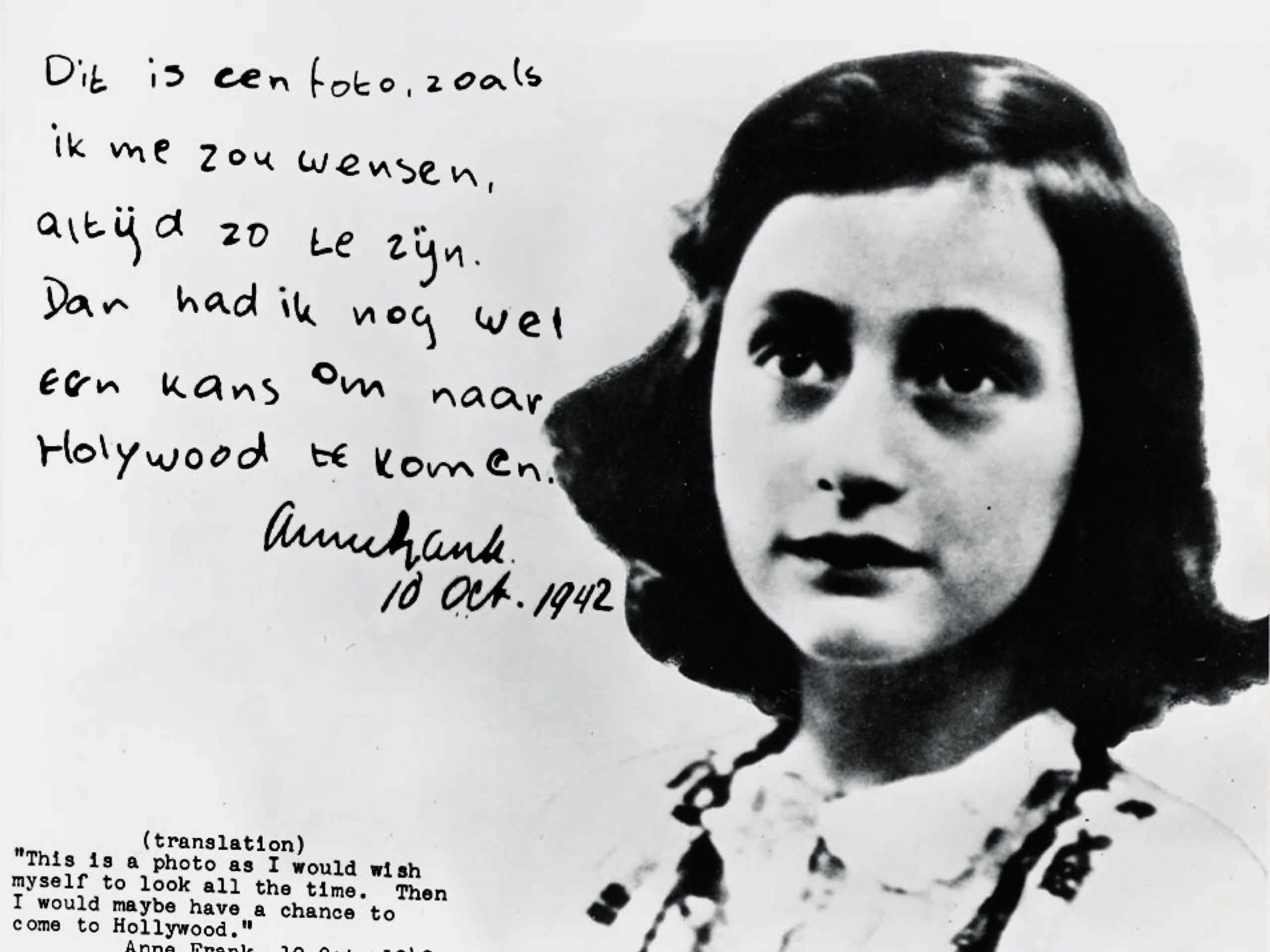
Anne Frank is perhaps the best-known victim of the rise of the Nazi regime in the years leading up and during World War II. The experiences Anne conveys in her diary gives the reader as well as society at large an important insight into the daily life under an oppressive regime and extreme discrimination. A window into anti-Semitism in the mid-twentieth century, Anne’s father Otto
Frank took it upon himself to preserve both Anne’s diary as well as the ‘Secret Annex’ that the Franks, family friends the Van Pels, and a man by the name of Fritz Pfeffer hid from the Nazis for two years. Named after his youngest daughter, Otto founded the Anne Frank House in the years following the end of the war.
The museum was built into the existing building that Anne and her family hid in, and houses a collection of contemporary objects that accompanied Jews in hiding. The museum was founded in 1957 by Otto and was later inherited by the state of Netherlands after his death in 1980. The house still serves as a museum to this day and sees over a million visitors a year.
While the museum was originally created as a way of preserving the memories of the Frank family and those hiding for their survival, the museum and collection’s message has become warped over time due to the potential of profit. The original purpose of the museum has subsided to make the museum more profitable, and no other decision conveys this better than the refurbishment of the house itself in renovation during the coming of the new millennium.
When Otto started the Anne Frank house, he chose not to refurbish the building, saying: “They took everything out during the war, and I want to keep it that way”.[1] Otto’s goal was ultimately to display to visitors of the museum the bareness and lack of the materiality as well as lives under the genocidal Nazi regime. However, in the 2000s, Amsterdam chose to refurbish the house despite Otto’s intentions. While the explicit reasoning for the refurbishment is unknown, it is highly likely that it is a decision by the museum to be more “immersive” and allows for the visitor to depict themselves in Anne’s situation. The decision to have the museum more like that depicted in Anne’s diary depicts the shifting purpose of the museum from one that shows the palpable fear of Jews in hiding from almost certain death to one that glamorizes the building into a replication that one can be profited off.
There are other examples of this shift in intent, such as the sale of cardboard models of the Secret Annex as well as replicas of the diary Anne used herself. The Anne Frank House also allowed its duplication in “The Fault in Our Stars” to be used as a background for a kiss scene. These examples depict a key theme: the Anne Frank house and the collection it houses have been transformed from a story into an experience. The house no longer serves as a reminder of the grim story of the Frank family and destructive anti-Semitism. Rather, the house and collection have been reduced to a fantasy setting that aims to make the original story more fantastical and immersive, as if the diary were a fictional tale aimed at the relatability of its readers.
Every museum or collection creates a narrative, whether it be intentional or not. As a replication of history, the Anne Frank Museum and collection has partaken in the setting of a narrative. Rather than portray Anne as a multi-faceted teenage girl who grappled with her adolescence while living in hiding, the museum strips Anne of her agency and depicts her a character. The museum is more focused on making the collection “more immersive” for guest experience instead of relaying the story of the dangers of hatred and fascism. For as long as this persists, the house stands as nothing more than a tourist trap, and the story of Anne and other Jews cease to remember by the collective. Anne Frank has been monetized and commodified in the last couple of decades – no longer a human being who existed less than a century ago but instead a copyrighted character for profit.
[1]Frank, Otto. “How It All Began.” Anne Frank Website. Anne Frank Museum , October 16, 2019. https://www.annefrank.org/en/about-us/how-it-all-began/.
Works Cited
“Anne Frank Collection.” Anne Frank Website. Anne Frank Museum , March 31, 2021. https://www.annefrank.org/en/museum/anne-frank-collection/.
“Auschwitz Exhibition Blog – New Objects from Anne Frank House Added.” Auschwitz. Auschwitz , November 6, 2018. https://auschwitz.net/new-objects-from-anne-frank-house-on-display/.
Chakravarti, Sonali. “More than Cheap Sentimentality: Victim Testimony at Nuremberg, the Eichmann Trial, and Truth Commissions1.” Constellations 15, no. 2 (2008): 223–35. https://doi.org/10.1111/j.1467-8675.2008.00486.x.
Diaries, Radio. “Before Rosa Parks, a Teenager Defied Segregation on an Alabama Bus.” NPR. NPR, March 2, 2015. https://www.npr.org/sections/codeswitch/2015/02/27/389563788/before-rosa-parks-a-teenager-defied-segregation-on-an-alabama-bus.
Frank, Otto. “How It All Began.” Anne Frank Website. Anne Frank Museum , October 16, 2019. https://www.annefrank.org/en/about-us/how-it-all-began/.
Ozick, Cynthia. “Who Owns Anne Frank?” The New Yorker. The New Yorker , September 29, 1997. https://www.newyorker.com/magazine/1997/10/06/who-owns-anne-frank.
Pitock, Todd. “Amsterdam’s Anne Frank Industry.” Haaretz.com. Haaretz, November 17, 2014. https://www.haaretz.com/opinion/.premium-amsterdams-anne-frank-industry-1.5330170.
“Shop.” Anne Frank Gift Shop. Anne Frank Museum . Accessed October 4, 2021. https://webshop.annefrank.org/en/all-products/.
Williams , Zoe. “Totalitarianism in the Age of Trump: Lessons from Hannah Arendt.” The Guardian. Guardian News and Media, February 1, 2017. https://www.theguardian.com/us-news/2017/feb/01/totalitarianism-in-age-donald-trump-lessons-from-hannah-arendt-protests.
Media
Tour of the Secret Annex: https://youtu.be/0SJgudCq540
Bookcase as a Secret Door: https://youtu.be/1JSEVBX3cfY
 The Materials of History, Thought, and Art
You must be logged in to post a comment.