
My mom has often accused me of owning too many books. Despite having a very large bookcase (laid on its side is four feet tall and six and a half feet long), a good chunk of my books end up on piles on the floor or shoved haphazardly beneath my bed. It was only a few months ago that I had thrown and donated at least sixty books. Since then, my collection has only grown as I buy new textbooks or find a bunch of Penguin classics at Salvation Army. My bookshelf (as well as the surrounding surfaces) is the amalgamation of my personal identity. While I don’t seem to find joy in my books, the books convey a certain narrative and demonstrate things about myself I would rather not acknowledge. While sorting through some of my older books, I felt an indescribable tightening in my chest. I certainly was not feeling joy, but perhaps a gut-wrenching grasp on the past or my state of being. As a result, I took a different approach than Marie Kondo’s simple “joy test”. I separated the books on my shelf into two distinct piles: books that exist in my periphery and books that have impacted or made me feel an emotion I can’t quite grasp.
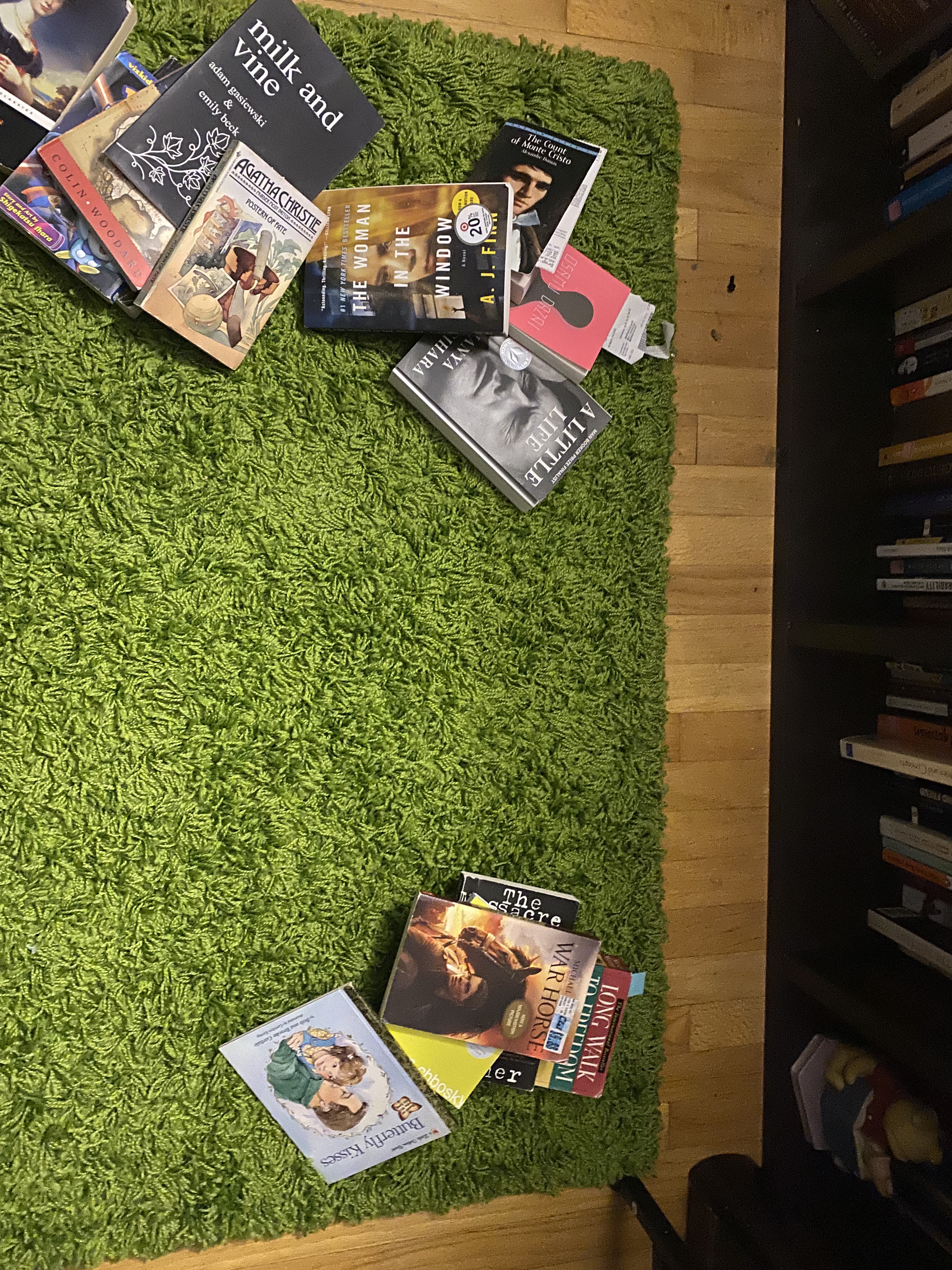
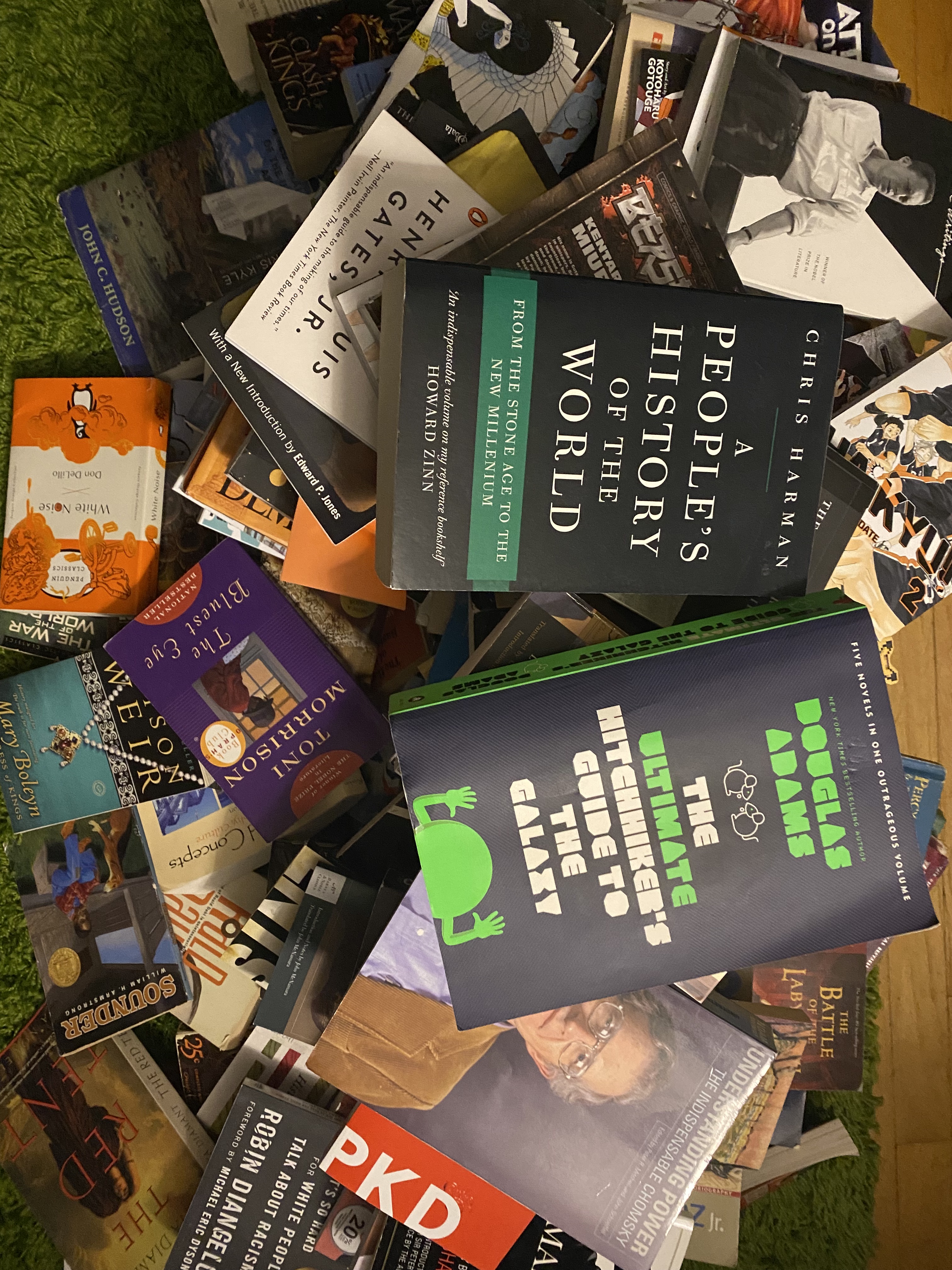
My books share a space with well over a hundred CDs from K-Pop artists (which I find to be particularly humiliating to reveal), but I will be focusing solely on books I own. I underestimated the vast number of books I owned, and I worked up a sheen of sweat as I took the books off the shelf. The books on my shelves numbered past a hundred and vary extensively in subject topic. I began my Kondo-adjacent experiment with well over a hundred books. By the time I had taken all the books off my dusty shelves, I had counted a total of 140 books.
I was astonished to see how many books I had. It was only a few months ago that I had thrown out and donated over fifty books. Due to the sheer number of books, I was unable to move further than a foot away from my bookshelf.
I started with my two favorite book series from my childhood: Harry Potter and Percy Jackson. Each of them took up their own cubby in my bookshelf. Despite the centrality of the series’ location on the bookshelf, I only chose two books from each series to put into my “feel something” pile. While I was separating the two series, I realized that the books I had chosen to “keep” had an underlying recurrent theme: a caring collective that ranged from mentors to friends to teachers. As someone who has lived in almost isolating solitude, these books did not evoke a joy but a desire to belong.

As I continued to separate books, those that ended up in my “feel something” pile did not all evoke this desire I felt with the Harry Potter and Percy Jackson series contained. Those that also evoked an emotion or changed something about me were books like The Massacre at El Mozote and The Book of Job. The former conveyed to me the extent of pure human anguish. While I have never experienced the gruesome crimes against humanity that are described in the book, the book portrays to me the extent of human cruelty but also tenacity. Definitely not a joyous book nor one for the weak-stomached, just looking at The Massacre at El Mozote reminds me of those rare times I heard pure screams of human anguish. The book reminds me that while life is painful, time will keep moving and thus I will as well.
The Book of Job as well as Albert Camus’ Committed Writings, on the other hand, made me think differently on life and problems within society, religion, and a multitude of other things. I don’t feel a spark of joy when I read these books, but instead a different outlook on life and other things such as religion. I found that the pile of books I had acquired in this experiment conveyed to that I desired certain things like a sense of belonging. But at the same time, the experiment conveyed that I value the human experience despite not knowing how to make sense of it.
By the end of the experiment, I found myself almost sick to my stomach with emotion and realizations that I am unhappy and alone. The books I had chosen to keep in this experience subconsciously pieced together the parts of myself I thought I was lacking. While I didn’t experience joy with these objects, I find that the books I had kept demonstrated that I find objects to be adjacent to my being. I find it hard to separate myself from objects – as they make up a part of me in a sense. In my life, I am unable to tell where I end and the objects and people around me begin.
 The Materials of History, Thought, and Art
It is really interesting that while you sorted based on your own variation of the method. You did not feel joy from your objects, but did feel something. I like that you latched onto that and tried to work backwards to find the connection between the objects that evoked this feeling. I relate to your process, because I found that I could not part with some of my own books because they had ties to important memories. I also had a Percy Jackson book, and I chose to keep it because it was very nostalgic to me. I am sorry that the experiment caused such strong negative emotions for you. I hope that if not objects, you can find something else that will bring you joy and solace.