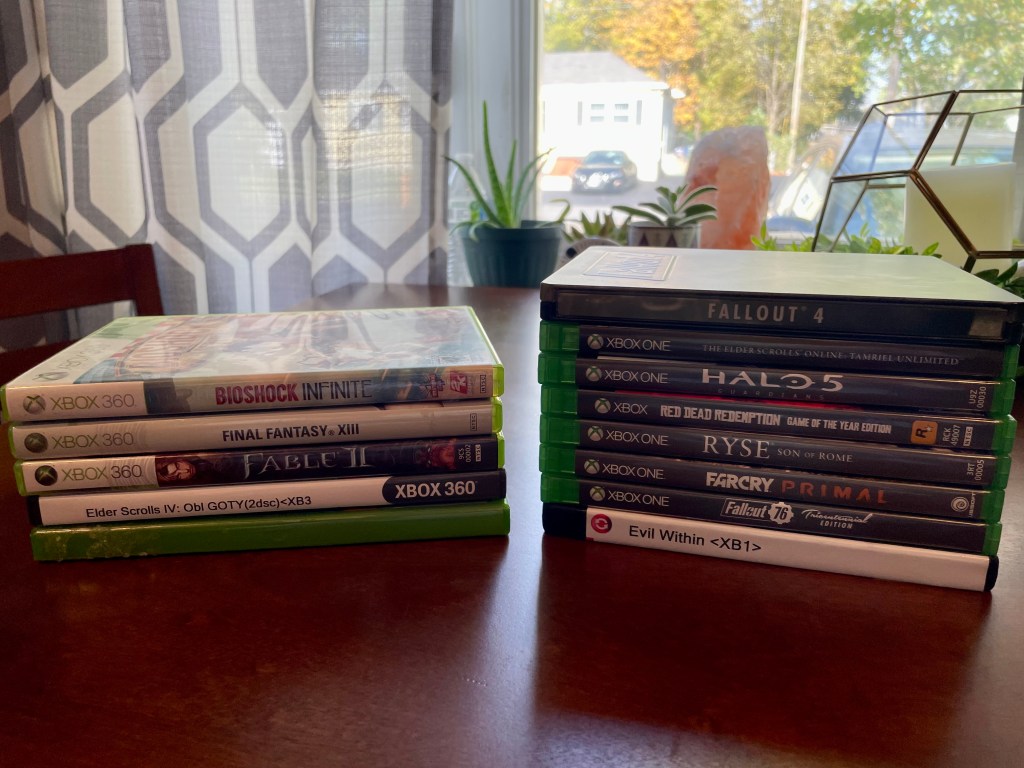
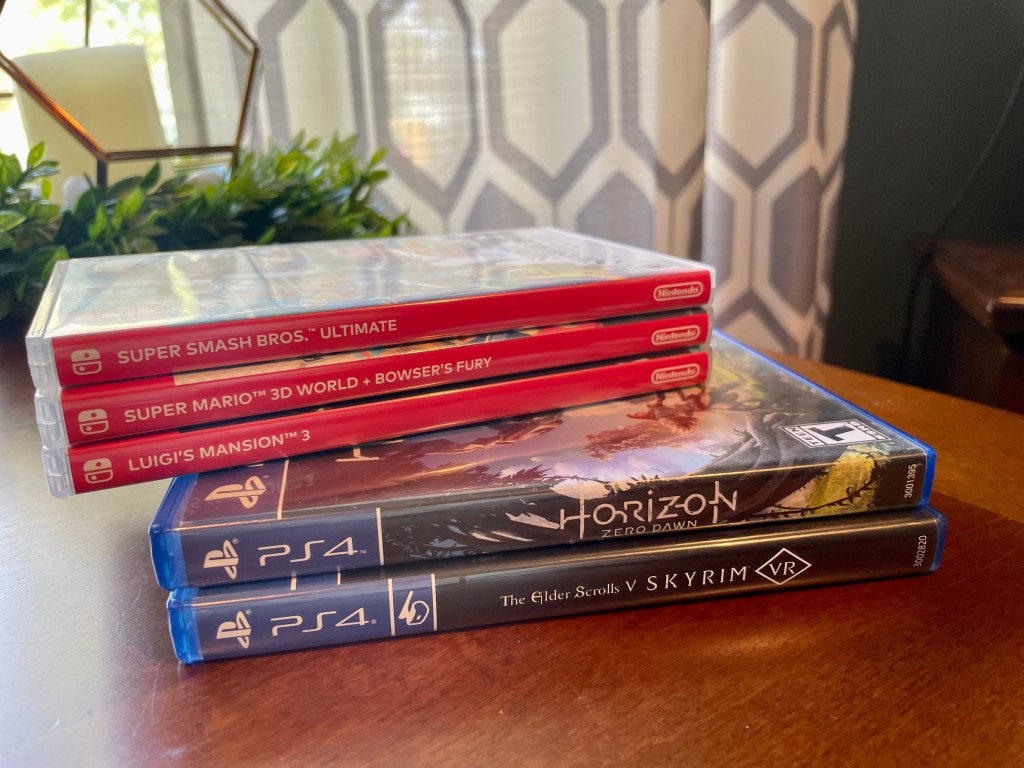
Marie Kondo’s “joy test” is one that seems extremely simple in theory. In practice, it is a bit more complicated. While the categories of clothing or books could have been sorted through, I felt this “joy test” should be done towards objects I feel more connected to, and so I chose my video games. I have several consoles and have purchased and been gifted many games over the years. I have played several of these games multiple times over and have spent countless late nights playing others with friends. I started with ten Xbox 360 games, thirteen Xbox One games, one Xbox Series X game, eight PlayStation 4 games, one PlayStation 5 game, and five Nintendo Switch games, for a grand total of thirty-eight video games across six consoles (not counting those that are still at my childhood home). If you can’t tell, I am more of an Xbox fan than a PlayStation fan!


Sorting through my video games was not as difficult as I expected but I was surprised by some of the choices I made. I expected that every game I own in the “Fallout” franchise would “spark joy” – even those I would rank lower on my list – but that was not the case. Both Fallout 4 and Fallout 76 were put into the “discard” pile. I was surprised by this because I love the “Fallout” franchise in its entirety – I have replayed Fallout 3 and Fallout: New Vegas numerous times and have played Fallout 4 twice. Fallout 76 had its drawbacks, but I enjoyed the time I spent playing with my friends discovering a new post-apocalyptic wasteland. Fallout 3 and Fallout: New Vegas, on the other hand, both caused immense joy. Not only was I flooded with memories of all the different times I have played the game, but I was also reminded of the passion I have for these games – how much knowledge I have of the characters, the setting, and the quests. Certain video games “sparked” conflicting emotions within me. If you know anything about The Last of Us and The Last of Us Part II, they are not feel-good games, especially the most recent installment. Yet, when I held the games in my hand, I found myself yearning to go back into the cordyceps-infected world that Joel, Ellie, and Abby lived in. I wanted to relive the experience that playing those games was – even if it meant going through the five stages of grief all over again – solely because of the deep emotional connection I formed with the characters. I felt the same way about Death Stranding – a game I consider to be a work of art. The Last of Us Part II and Death Stranding both had me sobbing uncontrollably at certain points, and yet I love the games so dearly for the journeys they took me on and the lessons they taught me. So, while these games did not “spark joy” per se, they did illicit a strong emotional reaction. There were, of course, games that received a dull reaction from me. One I was surprised by was Skyrim: VR. Skyrim is tied for my favorite video game of all-time and I was in awe at how well-done the virtual reality version of the game was. However, all I could think about was the awful headache I got every time I played the VR version, and into the “discard” pile that version of the game went.
At the end of this “joy test,” I had “kept” six Xbox 360 games, five Xbox One games, one Xbox Series X game, six PlayStation 4 games, one PlayStation 5 game, and two Nintendo Switch games, for a grand total of nineteen games – exactly half of what I started with.


This exercise was very revealing and taught me a lot about my relationship to objects. For example, the two games from the “Fallout” franchise I chose to “keep” were the Xbox 360 games. Fallout 3 and Fallout: New Vegas were released in 2008 and 2010, respectively – they are both over a decade old and the graphics of Fallout 4 and Fallout 76 (made for Xbox One) far-surpass both games. Why did I choose to “keep” two games that are so old they can barely be played on my console without it crashing? Memory and emotion. Even games such as The Last of Us Part II and Death Stranding – whose poignant stories led to heartbreak and tears – I find great value in due to the way playing them made me feel. This exercise taught me that I place the most importance on objects that I either have fond memories with/of, or that cause me to have a strong emotional reaction. Almost every game I chose to “keep” I could subcategorize into “games that I have fond memories of” and “games that made me deeply feel things, good or bad.” When I think of other objects I own, I see that same pattern repeating – even with my clothes! Overall, I found Marie Kondo’s “joy test” to be an enlightening and “joyful” experience and I believe many people can learn about themselves, and their relationship to their things, if they try the “joy test” themselves.
 The Materials of History, Thought, and Art
I don’t have many physical games left, I chucked my x-box like 6 years ago when it red ringed. I have my original copy of Skyrim but not much else. I can relate however to this feeling when I have to clean up the games in my library when my drive starts getting a little full, I really had to make a tough decision because the witcher 3 was taking up about 90 gigabytes. Funny enough I have my Skyrim disk in a safe place just for the fond memories.
I relate to this comment so much! Some of my favorite games take up so much space that it was nearly impossible to purchase new games because I knew I would have to delete one off of my console. I solved this dilemma by getting an external hard drive LOL!
Hi Tabatha! I really related to your experience, there’s something about having a physical copy of a game that feels better than downloading it digitally. I think it’s really important to consider how a game made you feel while playing it, that often affects my decisions when choosing a favorite game from a series! I could tell how much these games affected you just by reading about your process of taking the “joy test”. I also love the amount of voice you put into your writing!