As I type this, I see that my Google Drive is 75% full: all of my work, whether it be creative or academic, is done on the computer. I love typing. I journal my days on my laptop, begin creative work, take notes for class, do homework, write assignments, create outlines, or simply practice free-association. Today, I decided to hand-write a creative piece, then edit, and re-write it. I expected myself to write without referencing the online dictionary or un-typing a word I didn’t like. When I use a computer, I always have a few tabs open, and also find myself distracted when writing. I never am fully 100% in the moment of just writing. I used a pen and a notebook I use on a daily basis (although, I typically use the notebook for scheduling and planning), put away my laptop and my phone, and sat down in the quiet corner of JFT. Here is the first page:
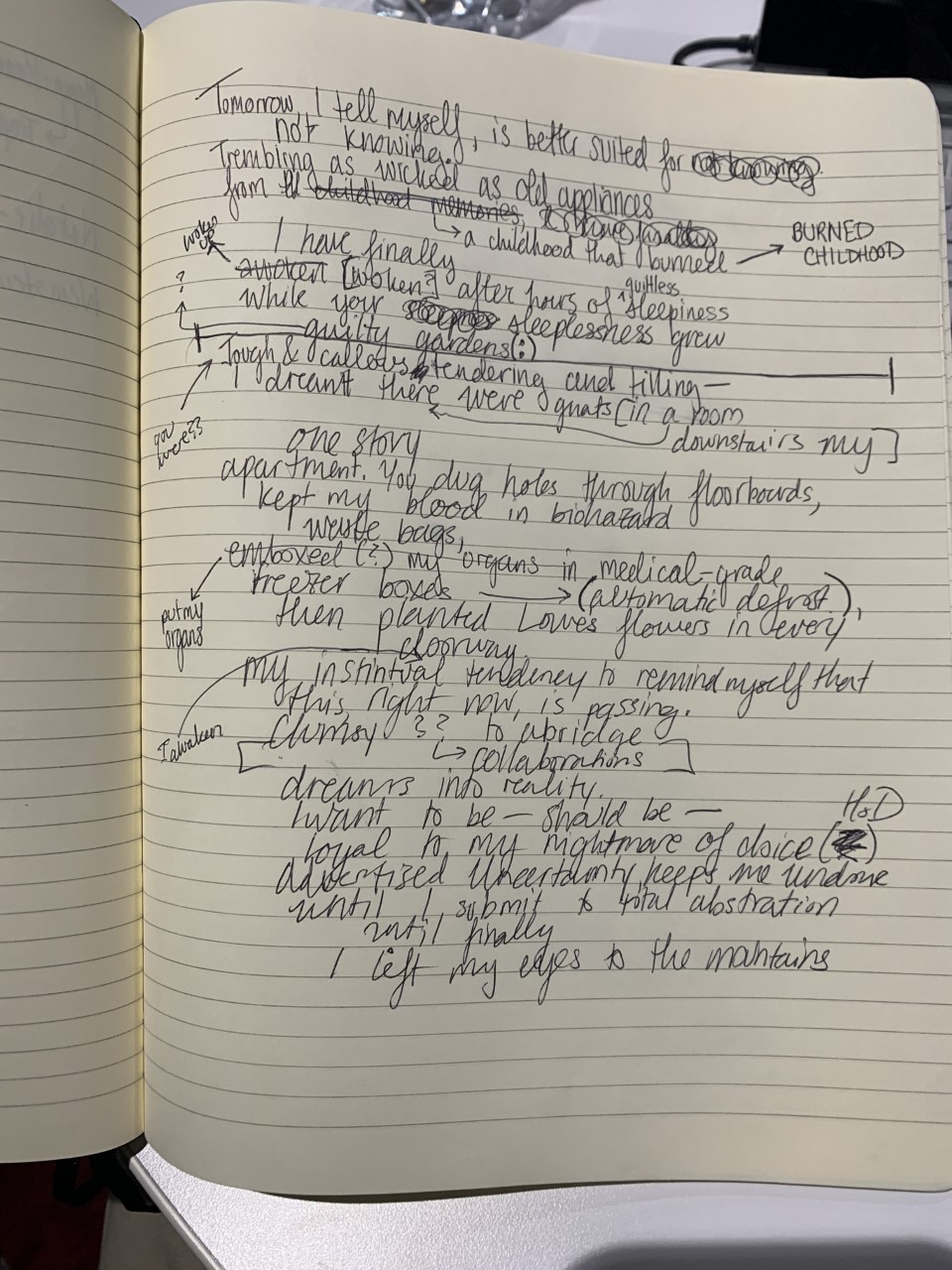
I had some working ideas coming into writing, so I started off with some words that were bouncing around my head. “Tomorrow, I tell myself, is better suited for not knowing.” I had begun with that phrase but realized I didn’t like how long the sentence looked (aesthetically), so I moved it down a line. This act influenced the form of the poem. As I wrote, I read the words out loud (something I typically do not do). The break between “better suited for” and “not knowing” started to shape the tone I was going for. Recently, I had a dream that my body parts were being moved around by my girlfriend while she was gardening inside my childhood home. When I recall the dream, I remember bits and pieces at a time, and I have to pause when I recall the dream; allowing myself time to think. I wanted the poem to reflect that uncertainty.
The words then began to flow naturally. I went to the next line as I recalled more details. The middle section of the poem beginning with “Tough and callous” and ending with “doorway,” is the actual dream I had. Afterward, I paused again. The dream was over; summarized in a few short lines. I spent some time recalling my feelings after the dream, and also at the moment that I was writing. “My instintual [sp.] tendency to remind myself that this right now, is passing.” As I am analyzing my page of writing, I cannot recall the inspiration for this line. Part of me imagines it was my desire to stop writing by hand, and the other part of me knows I was referencing the nightmare the dream became. I know this because I became a little more literary and careful with the next few lines.
The ending of the poem has more emphasis on form, as I struggled to find words. Many of my words are references. “Dreams into reality” is a phrase I know I have heard; perhaps read on an inspirational classroom poster. “Loyal to my nightmare of choice” is a direct reference to Joseph Conrad’s Heart of Darkness. For some reason, the quote was bouncing around in my head when recalling this dream. The quote from the actual book, according to Goodreads is “It was written I should be loyal to my nightmare of choice” (Conrad). I was pretty close. The temptation, however, to look up the quote and make sure I had remembered it correctly (as in, remembered it was from Heart of Darkness and that it was the correct word choice) was insatiable. The literary reference, on the other hand, inspired me to become more poetic, hence the phrase “advertised uncertainty.”
Once I had gotten all of the words down, I began to do some editing. Whenever I was writing and couldn’t think of a word I would write “[??]” or “(?)” in place. I went in, removed some commas, changed some wording (“childhood memories” to “a childhood that burned” to “burned childhood”). Unlike when using a computer, I had to look at my big ugly mess. There were markings everywhere. I was also made hyperaware of my cursive-print hybrid handwriting. My “a” switched from the double-storey to the single-storey “a” as I switched from print to cursive. Then, after reading the poem aloud, I asked myself: When did I wake up? “I awaken.” This line was added in afterward. I also noticed, in my cursive-print hybrid, that the last line looked like “I left my eyes to the mountains,” which I had not intended to. Yet for some reason, I almost sort of liked it. I ended up adding the dot above the “i” as I had intended.
Instead of typing the final product, I rewrote it as neatly as I could:

The disappointment I felt when I made an error and had to scribble it out on line 11! As I review the final product, I also realize I have completely forgotten finger spacing as a rule of thumb (pun unintended). The phrase “dug holes” looks like “dugholes.” This is also true for “wastebags.” As I rewrote the poem, I also gave myself the liberation of adding more lines and phrases, changing the order of some words, and editing the punctuation. I found it incredibly frustrating to flip back and forth from the original to the rewrite. I also found it difficult to figure out how I wanted the form of the poem to look: rewriting the poem caused me to forget how I had intended the poem to look. When I type, I can easily change the order of the words. For example, I am typing this after I wrote the final line of this paragraph since I find it laughable. I am reminded that hand-writing is difficult.
With some reflection, I learned that there is some peace in hand-writing without the use of technology. I let myself just think. It was me, a paper, a pen, and the environment I put myself in. I just had to think. I found that in comparison to some of my typed writing, this poem was pretty honest. I didn’t exactly care about having the right words, or if they were aesthetic enough. It was for me. On the other hand, I know that my goal in life is to write for other people to read. Some things are quite nice when kept personal, but I know that one day these words could become alien to me too. I am ever-changing, and so is the world. I still find myself embracing the technological world.
Even now, as I type this response, I am actively hitting the backspace key, changing my phrasing, and undoing my initial, authentic thought. The act of my fingers hitting the keyboard is so raw and natural to me at this point that I find it easier to be authentic in my writing followed by seamlessly editing my words without hesitation. Even Grammarly assists me in the act of clarification. My concluding thoughts honestly relate back to my embracement of the cyborg. While I am terrified of technology in many ways, I find that technology is not an “other” to me. It is integral in my experience as a human being, and I enjoy it. I must admit that I am heavily influenced by Donna Haraway’s essay “A Cyborg Manifesto.” She argues that embracing the cyborg lifestyle allows women (especially oppressed women of color) to seize the circulation of male-dominated writing. She writes, “Cyborg writing is about the power to survive, not on the basis of original innocence, but on the basis of seizing the tools to mark the world that marked them as other” (Haraway 55). While I do not have the intellectual capability nor space to break down her entire argument, I find that digital writing offers many powers that are silenced by the hidden notebook. Even now, anything is possible: I have the ability to take this entry and post it on a blog page. I think I just might.
References:
Haraway, Donna J. “A Cyborg Manifesto.” Manifestly Haraway, University of Minnesota Press, 2016. ProQuest Ebook Central.
 The Materials of History, Thought, and Art
You must be logged in to post a comment.