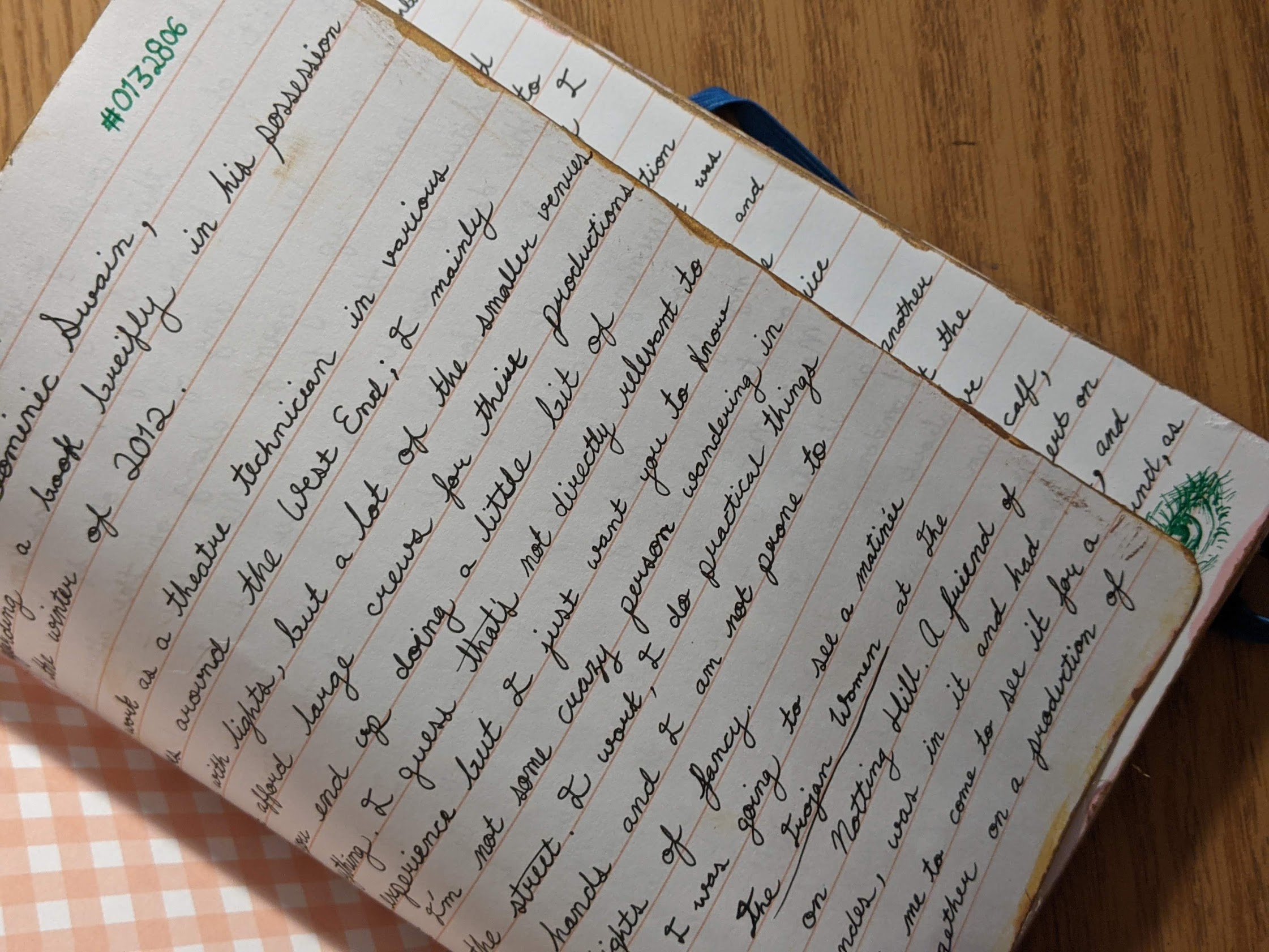
Last year I performed an experiment. Due to the pandemic, all of my classes were online, and I found that I was doing very little of my usual writing by hand. I decided that it might be fun to write only in script. Usually this would be too much of an inconvenience, I am not used to cursive writing and it is harder for me to do quick note taking with it. However, with all my notes done digitally, making all of my other handwriting cursive was a lot more manageable. I wrote everything in cursive for the next few weeks, and my sketchbooks still have some scribbled in the corners. Since then I have mainly gone back to print, but I definitely have grown more comfortable writing in script, and I have a greater appreciation for the aesthetic of it.
My recent “Analog Experience” was actually a gift that I made for my brother’s birthday. I wanted to give him a notebook that was based on a narrative podcast we both enjoy. While I am not experienced in bookbinding, I did some redecorating to an empty second hand notebook. I wanted an old fashioned feeling to the book, so the worn and yellowed pages worked nicely. Using materials from the art store in town, I pasted patterned paper onto the front and back covers. I even gilded the edges of the pages, and dyed the previously beige elastic band to a bright blue.
Since it was based on a particular episode of the podcast, I decided to include a transcription of it in the first few pages. Keeping with the antique-vibe, I decided to write it in cursive. I expected it to only take up a few pages, but in the end I wrote twenty-seven.
During that process, I found several new details, both about the object, and the episode. The notebook is lined with faint red ink. This caught my attention, as I am used to the blue of looseleaf, or black lines from other notebooks. I also found the white thread where the pages are bound together. I would have expected to find it halfway through, but it was actually much closer to the beginning. Maybe the book was not unused after all, and the previous owner had ripped the old pages out before donating it to the local bookshop where I bought it.
I also noticed many new details about the episode. I had only ever listened to it before, but copying it down by hand was very different. Having to write each and every word made me pay attention to them. I realized how many points are repeated throughout the episode to help indicate the most important details. I realized that there was a lot of foreshadowing, and the first mention of a character who is not officially introduced for another two seasons. There was even an entire subplot that happened in the first five or six pages that I had completely forgotten listening to.
After finishing it I was most surprised by the sheer amount of time it took. I thought I would finish it within a few days of starting. I did not expect twenty-seven pages written over the course of two weeks. It is truly amazing how many words fit into a twenty minute episode, and how much shorter spoken words feel than written ones. Afterwards I often found myself still in the habit of writing in script, even when I did not mean to. I also developed a fondness for certain cursive letters. I like writing the letters “j”, “s”, “z”, and “f”.
There was an exciting aspect to writing in an analog fashion. Staying up late to write in an old notebook by lamplight has a very good ambiance. With my usual analog writing I mainly use a pencil and cheap looseleaf, but I loved the feeling of the pen scratching against the paper, even if it made the smudges and mistakes hard to fix. There was a nice amount of personalization that came from it being a physical object. It was my handwriting instead of a font, and I was able to change the cover to my own liking rather than finding clip-art online. In addition to actually making it, I had to put aside time to walk to the bookshop and art store. I remember trying to carry the huge stack of books around in the cold, all while trying to not crinkle my newly purchased paper. Even though it was more time consuming than a digital project, it was nice to slow down and spend time on something.
Before:


After:


 The Materials of History, Thought, and Art
You must be logged in to post a comment.