19th Century timekeeping in New Paltz (Revised)

Modern objects meant for keeping time are often small. Phones, watches, and clocks might vary in size, but they are all typically small enough to fit into a pocket, or at least to hold in your hand. These objects are personal, and they belong to someone in particular. Even though it is common to ask another for the time, most people tend to have their own timepieces. Here in New Paltz, there is another layer to our timekeeping. Many towns have clocktowers, and we are lucky enough to have one on campus. The van den Berg Clocktower, sits atop van den Berg hall, and it chimes every half hour. Even though no one relies solely on clocktower, it still is a helpful reminder to our community. It feels grand and important, and we all follow its time, even if our own timepieces are out of sync. The clock is an object for a community. It can be heard from anywhere on campus, and the idea of one clocktower reaching everyone at the school, reinforces our sense of solidarity. Unlike other timekeeping objects, a clocktower is much too big to fit it in your hand or your pocket. It is an object to be shared. It is viewed, admired, and used by everyone here, and it belongs to us all.

Among the extensive list of items in the Estate inventory of Cornelius Dubois, there is an object listed as “1 Sundial”. This object seemed out of place, as sundials are usually seen as an archaic method of telling time. Ironically, clocks are seen as timeless, as though they have been around forever. This is not true, and even after the invention of the clock in 1283, alternative methods of timekeeping, such as sundials, did not immediately lose their value. 

Sundials are timepieces that predate clocks. “Sundial, the earliest type of timekeeping device, which indicates the time of day by the position of the shadow of some object exposed to the sun’s rays. As the day progresses, the sun moves across the sky, causing the shadow of the object to move and indicating the passage of time.”(Sundial) They consist of a gnomon, which is a thin piece or pillar that projects out and casts a shadow onto the dial. The dial is the flat surface that the gnomon sits on. It is often marked with a circle of numbers that indicate the time of day based on the position of the shadow. While they can be made to be very complex and expensive, sundials are often inexpensive and reliable ways to tell the time. As long as the sun is shining they can be used to tell the time. 

Before 1816, clocks were expensive and hard to come by. Once the shelf clock was invented, they were able to be mass produced and more commonplace. “Eli Terry designed a shelf clock with interchangeable parts, giving birth to the Connecticut clockmaking industry”(Andrewes). Eli Terry invented shelf clocks in 1816, the same year as the estate inventory. While previously created clocks may have been used, the shelf clock was self-contained and easily installable. It could simply be placed on a shelf with no added assembly. It also was far less expensive to produce and allowed clocks to be widely available. 

Since this specific sundial was purchased before the invention of the shelf clock, it was likely less expensive and difficult to use than a mechanical clock from this time. However sundials were still useful after 1816. “Until the 19th century sundials were still used to reset mechanical clocks.”(Sundial) Even though clocks became more commonplace, they were not always accurate until more precise clocks were invented at the end of the 19th Century. Until then clocks often had to be rewound to display the correct time, and sundials were a reliable source to set them against. 

Currently watches, clocks, and computers are common ways of telling the time, but residents of New Paltz also rely on the chimes of the clocktower. There are two clock towers in town, one on top of van den Berg hall, and the other at the Reform Church of New Paltz on Huguenot Street. Van den Berg hall is one of the oldest building on campus, but its clock is one of the newer ones in town. While the original was built in 1932, it burnt down in 1990. The current clock tower was rebuilt in 2005. The Reform Church dates back hundreds of years, and its clocktower is almost as old as the Estate Inventory. “Our present church, a fine example of Greek Revival architecture with its four-column timekeeping in portico and two-stage clock and bell tower, was erected in 1839”. (Our Church History).  This clock tower was built just twenty-three years after the Estate Inventory was written. It likely affected the same people who once used the sundial to tell time. Two decades later the shift from sundial to clock created a prominent part of the town’s landscape. And it is still used today, hundreds of years later.

Reformed Church of New Paltz Clocktower, built in 1836 (Our Church History)

Rebuilding of the van den Berg Clocktower, 2005 (Van Den Berg Learning Center Clock Tower)

A Sundial from New York made in the late 18th Century, which might be the same type as listed in the inventory. (Horizontal Sundial)

Section of Estate Inventory pg. 12  

Sources:

Andrewes, William J. “A Chronicle of Timekeeping.” Scientific American: A Matter of Time, vol. 23, no. 4s, 2014, pp. 50–57., https://doi.org/10.1038/scientificamericantime1114-50. https://web.s.ebscohost.com/ehost/detail/detail?vid=9&sid=02426177-34e2-434c-87ca-5455c9f7d26b%40redis&bdata=JnNpdGU9ZWhvc3QtbGl2ZQ%3d%3d#AN=98843277&db=a9h

“Estate Inventory of Cornelius Dubois.” 1816.pg. 12

https://omeka.hrvh.org/scripto/transcribe/2907/3454#transcription

“Horizontal Sundial.” National Museum of American History, https://americanhistory.si.edu/collections/search/object/nmah_856464

“Our Church History.” REFORMED CHURCH OF NEW PALTZ 92 HUGUENOT ST. – NEW PALTZ, NY (845) 255-6340, https://www.reformedchurchofnewpaltz.org/our-church-history.html

“Sundial.” Encyclopædia Britannica, Encyclopædia Britannica, Inc., https://www.britannica.com/technology/sundial“Van Den Berg Learning Center Clock Tower.” SUNY New Paltz | Van Den Berg Learning Center Clock Tower | Van Den Berg Learning Center Clock Tower, https://www.newpaltz.edu/clocktower
Letters, Journals, and a Good Friend

To preface my analog experience, a short history of my friendship with Molly Mueller (a friend from Cornell) is necessary. We met the summer before our freshman year but, we lived a few hours apart and had no means of communication. Over the years we ran into each other a few times, but we were never given the chance to connect and get to know one another. We somehow started writing letters as our main form of communication roughly two years ago. These letters were sporadic as we both lead busy lives, yet, through these letters, we connected and got to know each other. As our lives are busier than ever, we have not written in several months. We talk on the phone occasionally, but our previous means of communication have become something of the past.

           When deciding my analog experience, I immediately wanted to write a letter, but letter writing is something I do often which contradicted the prompt of the exercise. However, after thinking a little more I realized I hadn’t written a letter since the summer, and even longer since I had written Molly. I decided to write Molly a letter, not the typical kind where we have a topic that we critically argue about, but one that would replace the phone calls we have now about our lives. As of late, our phone conversations consist of relationship or life advice when our emotional peace is disrupted. I devoted an hour at my desk, with my AirPods in, my diffuser diffusing lavender, and a cup of tea in hand to write this letter. I wanted it to replicate the therapeutic phone calls we’d been having.

           While therapeutic writing is something I do often in a personal journal, writing in the vulnerable state I wanted to replicate from our phone calls to someone was a challenge. At times I felt I should hold thoughts and feelings back. This was confusing as I am beyond comfortable sharing on the phone or in-person with her. The act of putting it on paper and sending it was slightly nerve-racking. As I talked myself out of being uncomfortable with the form in which I was sharing the emotions I had been feeling the words began to flow. I became excited that she would be able to read and reread to fully understand my view on what was going on. The realization that she could absorb the information and write back excited me in that she could develop her ideas in a way that is not possible on a 45-minute phone call.

           After I wrote the letter, which came out to be roughly four pages, I reread it to check for grammatical errors and to make sure it made some sense. I usually am all over the place when it comes to emotions that are not completely clear to me. The rereading of my letter was the most profound part of this analog experience. Since I journal regularly, I am used to writing about my feelings and emotions, but I never read over what I write. When I finish a notebook with entries it goes straight to a bin, I keep random sentimental objects in. As I read through what I had written I saw my emotions in a different light. This led me to grab a journal I had filled a few weeks ago and go through some entries. This was something I had never done before, and I was amazed by how closely the letter I had written, and my journal entries resembled each other. I had originally struggled with the idea of writing my emotions for someone else to read. I was surprised by how similar the flow and rhetoric were. The unconscious writing style that I had developed in my journal came through in this letter.

           Writing the letter rather than having a phone conversation became much more than fulfilling my analog experience. I found my style of writing reflected my journal writing style. Until this experience hadn’t recognized my particular journal writing style.

An Analog Experience

Last year I performed an experiment. Due to the pandemic, all of my classes were online, and I found that I was doing very little of my usual writing by hand. I decided that it might be fun to write only in script. Usually this would be too much of an inconvenience, I am not used to cursive writing and it is harder for me to do quick note taking with it. However, with all my notes done digitally, making all of my other handwriting cursive was a lot more manageable. I wrote everything in cursive for the next few weeks, and my sketchbooks still have some scribbled in the corners. Since then I have mainly gone back to print, but I definitely have grown more comfortable writing in script, and I have a greater appreciation for the aesthetic of it. 

My recent “Analog Experience” was actually a gift that I made for my brother’s birthday. I wanted to give him a notebook that was based on a narrative podcast we both enjoy. While I am not experienced in bookbinding, I did some redecorating to an empty second hand notebook. I wanted an old fashioned feeling to the book, so the worn and yellowed pages worked nicely. Using materials from the art store in town, I pasted patterned paper onto the front and back covers. I even gilded the edges of the pages, and dyed the previously beige elastic band to a bright blue.

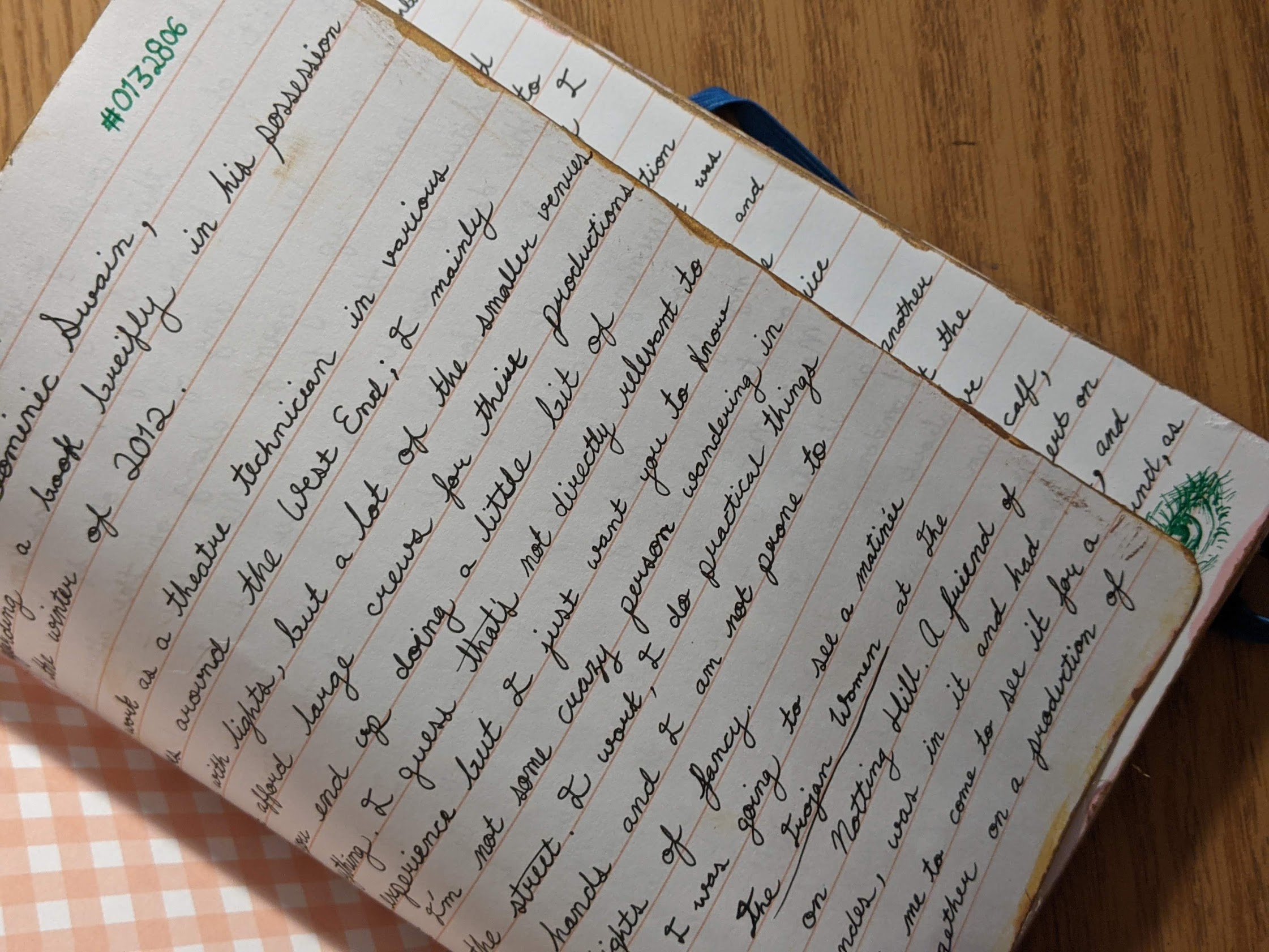
Since it was based on a particular episode of the podcast, I decided to include a transcription of it in the first few pages. Keeping with the antique-vibe, I decided to write it in cursive. I expected it to only take up a few pages, but in the end I wrote twenty-seven. 

During that process, I found several new details, both about the object, and the episode. The notebook is lined with faint red ink. This caught my attention, as I am used to the blue of looseleaf, or black lines from other notebooks. I also found the white thread where the pages are bound together. I would have expected to find it halfway through, but it was actually much closer to the beginning. Maybe the book was not unused after all, and the previous owner had ripped the old pages out before donating it to the local bookshop where I bought it.

I also noticed many new details about the episode. I had only ever listened to it before, but copying it down by hand was very different. Having to write each and every word made me pay attention to them. I realized how many points are repeated throughout the episode to help indicate the most important details. I realized that there was a lot of foreshadowing, and the first mention of a character who is not officially introduced for another two seasons. There was even an entire subplot that happened in the first five or six pages that I had completely forgotten listening to.

After finishing it I was most surprised by the sheer amount of time it took. I thought I would finish it within a few days of starting. I did not expect twenty-seven pages written over the course of two weeks. It is truly amazing how many words fit into a twenty minute episode, and how much shorter spoken words feel than written ones. Afterwards I often found myself still in the habit of writing in script, even when I did not mean to. I also developed a fondness for certain cursive letters. I like writing the letters “j”, “s”, “z”, and “f”.

There was an exciting aspect to writing in an analog fashion. Staying up late to write in an old notebook by lamplight has a very good ambiance. With my usual analog writing I mainly use a pencil and cheap looseleaf, but I loved the feeling of the pen scratching against the paper, even if it made the smudges and mistakes hard to fix. There was a nice amount of personalization that came from it being a physical object. It was my handwriting instead of a font, and I was able to change the cover to my own liking rather than finding clip-art online. In addition to actually making it, I had to put aside time to walk to the bookshop and art store. I remember trying to carry the huge stack of books around in the cold, all while trying to not crinkle my newly purchased paper. Even though it was more time consuming than a digital project, it was nice to slow down and spend time on something.

Before:

After:

KAI’s Self-Titled EP and the Whirring Machine

I have a very large CD collection that tops a hundred, yet I rarely play them. It seems highly ironic to own such a large number of CDs yet never play them. In order to assuage my guilt for wasting away my checking account, I ordered a CD player off Amazon last year. But instead of playing my CDs more regularly, my CD player has sat unused on my desk. Paired with a different CD every time I want to alter the feng shui of my room, my CD player has mostly melted in the background. 

When I replaced the CD of the month to replace it with Korean artist Kai’s self-titled EP, both the resident CD and the CD player were covered in a fine film of dust. It has been well over six months since I last used the CD player which was evident by the dust covering the contraption. After spending a few minutes cleaning the dust from the CD player, I removed Kai’s EP from the back of the album packaging. To do so without damaging the paper flaps that snugly covered the disc took a few seconds longer than expected. The CD, bought off an online retailer, was embellished with an image of the Korean artist underwater in a white shirt and black pants. Although I don’t speak the same language as the artist, the singer’s artistic presence and warm voice made me a fan.

Once I had removed the disc from the paper confines of the back of the accompanying photobook, I gingerly touched the sides of the CD, careful not to place my finger on either side of the CD and damage it in the few seconds I had it.

I popped the EP into place on the player with a satisfying click. Once I settled into my desk chair, I pulled the cord to start the CD player. It didn’t play at first, and I stood up and peered over the side of the contraption. The audio system has more settings than needed and I had to click the ‘mode’ button a few times to switch it to ‘disc’. The CD began spinning rapidly and producing a low whirring noise. 

Unlike the automatic press of a button music playing I had gotten used to with my computer and phone’s Apple Music, there was a handful of seconds where everything was silent minus the whirring of the device. Once the disc began to play and Kai’s warm voice drifted out of the speaker, the moment was cut short by the device pausing momentarily before continuing on. The title track, 음 (Mmmh), resumed and I was once again surrounded by the Korean artist’s 2020 title. 

I tried to enjoy the song as I usually do so on my headphones, it found it incredibly hard and awkward to do so. Instead of the clear audio, the mini album was accompanied with by the CD player’s unwanted whirring. The whirring undercurrent to the song became like a pickaxe to my ears. As I tried to ignore the sensory issues beginning to give me a headache, I felt myself becoming more irritated than content. The album was one of my most played albums on Apple Music for 2020 (despite only coming out in November of that year), but I couldn’t stand listening to it at that moment. It was like I was listening to a completely different artist. 

As I got up to get away from the whirring of the device, listening to the music felt laborious. Sitting on my bed several feet away from the audio player, the music felt like it wasn’t loud enough but also too loud. Tweaking with the audio settings of the device, it was difficult to find a comfortable setting that was perfect. It only lasted until the next song, Nothing on Me, to get a response from one of my family members to turn it down. 

By the time I had finished listening to CD in its entirety (17 minutes and 55 seconds), I had a growing headache and was unprepared for the continued playing of the CD. I had become so used to the Apple Music default of stopping automatically that I forgot to turn it off. After pulling the cord once again, the whirring noise ended once again and it felt like the room had become less stuffy. Rather than endure the laborious attempt of removing the CD and putting it back on the bookshelf, I have left the CD embossed with Kai’s figure underwater to remain on the CD player.

Throughout this analog experience, I felt very tired and irritated. My life has become very fast paced, and with it I have become impatient with the objects that surround me. I use my phone to listen to music constantly: Apple Music has recorded that I have listened to 1,068 hours of music this year alone – or 44.5 days. While I enjoy the collecting of CDs and the various ways I can arrange the CD albums on my shelf, the whirring and labor of the CD playing experience left me wanting to plug in my headphones. 

The experience of listening to music, I realized, was very intimate to me. I did not want to share the music I listened to aloud with my family. I wanted to contain the music to my ears only, and change it at my will. Rather than walking across the room to reach the CD player to skip a song, I could do so with a pinch of my AirPods.  The exposing of my music for other people to experience made me feel self-conscious despite being in my own house. 

A Family Analog Experience

Even though video games have a strong presence in both my childhood and current life, I have always had an appreciation for board and card games. At my house, we have almost three closets full of board games, when we probably only play a few of them regularly. By “we”, I don’t mean my family. In recent years, I found myself only playing board games with my friends. The youngest member of my immediate family is eighteen years old, so I suppose we all got too busy to play board games together, and outgrew them. It’s a shame, to put it bluntly, because I have so many good memories of playing board games with my immediate and extended family. When I was a child, it was practically a tradition in my house to play our Spongebob version of the Game of Life when our power went out, before it got dark. At almost every holiday gathering, someone always ends up recalling how we all used to play Uno Attack together, and how the machine lasted a surprisingly long time before it stopped working. It is extremely difficult to get a game started with my family lately, everybody is always too tired or has work the next day. However, this past Thanksgiving, I finally got to have the experience again.

My family got to host Thanksgiving this year, and it was nice to see everybody again, since we didn’t get to last year. When we host holidays, my mom likes to either set a theme, or plan something for us to do together, besides eating dinner, of course. For example, when we hosted Christmas Eve last year, we asked everyone to wear black and white. It’s never anything too complex, just something fun to do and help us enjoy the holidays together. So, this year, because my mom plays it every month with her friends, and it’s basically common knowledge among my family members, we played a 16 person game of Bunco.

For anyone who may not know, Bunco is a dice game meant for a bigger group of people, where you play in groups of four and move around different tables. There are 6 rounds, one for each number on a standard die (we played 12 rounds, 2 for each number). When seated at a table, you play on a team with the person seated diagonally from you, and you have to try and score more points than the other team at your table. There is a “head table” that dictates when a round begins and ends, once a team at the head table reaches 21 points, a round ends. Every other table keeps scoring points until the head table rings a bell to signify the end of a round. During a round, members of each time take turns rolling three dice. If you roll the number of the round (first round you roll for ones, second round for twos, etc.) , your team gets a point and you keep rolling until you don’t roll the number you’re looking for. Then the dice are passed to the next person. If you roll three of the number you’re rolling for, that’s called a bunco, and your team earns 21 points (an automatic win at the head table). If you roll three of any other number, that’s called a baby bunco, and you earn five points. At the end of a round, both teams count their scores, and determine a winner. The two members of the winning team then move to another table. Throughout the whole game, you cannot be on a team with the same person twice. During the game, everyone keeps track of how many rounds they won, and how many buncos and baby buncos they rolled. At the end of it all, prizes are distributed for the most buncos, last bunco, most wins, and most losses.

Like any group of adults would, we played this game for money. Everybody contributed $5 to the pot, creating a grand total of $80. But when the game started, nobody seemed that focused on the money. Except for one of my cousins, who was on such an impressive losing streak that she figured she was better off trying for the most losses prize (she did earn that title, she lost 10 out of the 12 rounds). It was so nice to see everyone having fun together, and to learn just how competitive my family can be sometimes. I never really look forward to family events, because everyone just talks about work and other adult topics that I can’t quite relate to yet. As the youngest members of the family, my sister and I just kind of sit there and talk to each other the whole time. Bringing everybody together allowed for family members that don’t interact often to catch up and enjoy each other’s company.

With a simple game like this, everybody had an equal chance of winning, and we were able to focus more on spending time together than the logistics of the game itself. If I were to try to teach any of my family members a video game like Mario Kart, it probably would not have been as simple. My cousins that aren’t much older than me know how to play, but teaching it to my 83-year-old grandmother probably would have taken some time and effort. Video games also come with player limitations, and you can only play with the amount of controllers you have on hand, and most games max out at four players. With board games, all you have to do is deal another person in and teach them the rules. And board games tend to be much less complex and mentally straining as video games, and don’t require skill or practice to have an enjoyable experience. I can’t say I prefer one over the other, I love the single-player experience of watching a story unfold in a video game, or just having the liberty to do what I please. However, whether it’s a game of Card Against Humanity with good friends where we’re trying our hardest not to laugh, or dominoes on Christmas day with my family, the board game is an experience that simply would not be the same if these games were digital. Being able to fan out the cards in your hand, or rearrange your pieces and tap them against the surface of the table makes the experience more physical, and therefore, memorable. It’s like how some people will only play as a specific piece in Monopoly, they create an attachment to the object. Whether the person likes the item the piece represents, or they just think it’s a charming little trinket, it becomes a part of their experience playing the game. The tactile experience of a board game makes it more appealing to people, especially those who are older, or don’t find enjoyment in video games. I truly cherished this analog experience, and I hope I can do something like it again in the future.

(Also in case anyone was wondering, I ended up winning $40 that night!)

Using Simple Technologies for Complex Sequences

Our world is dominated by technology. That isn’t to say that we’ve become enslaved to it (although arguments have been made to say otherwise), but we do rely on technology now more than ever. This shift in cultures isn’t abnormal, it’s natural for humans to innovate to make difficult tasks easier. But we’ve gotten to a point where we are innovating to make easy tasks even easier. Technology was once humanity’s ability to match the capabilities of other species, now it is used to become godlike. We’ve gone from making tools to take lives, to creating medicine to save them, to creating new lives via cloning and now we’re trying to create artificial consciousness via computer programming. 

The point of this introduction isn’t to create existential dread, but rather to make apparent our issue with technology: our constant need to improve. Every new innovation and advancement is immediately followed by theories of how it can be improved. This culture of innovation can be suffocating at times, and it’s important to step back and understand other technologies we have that can perform the same tasks as our newer, more modern products.

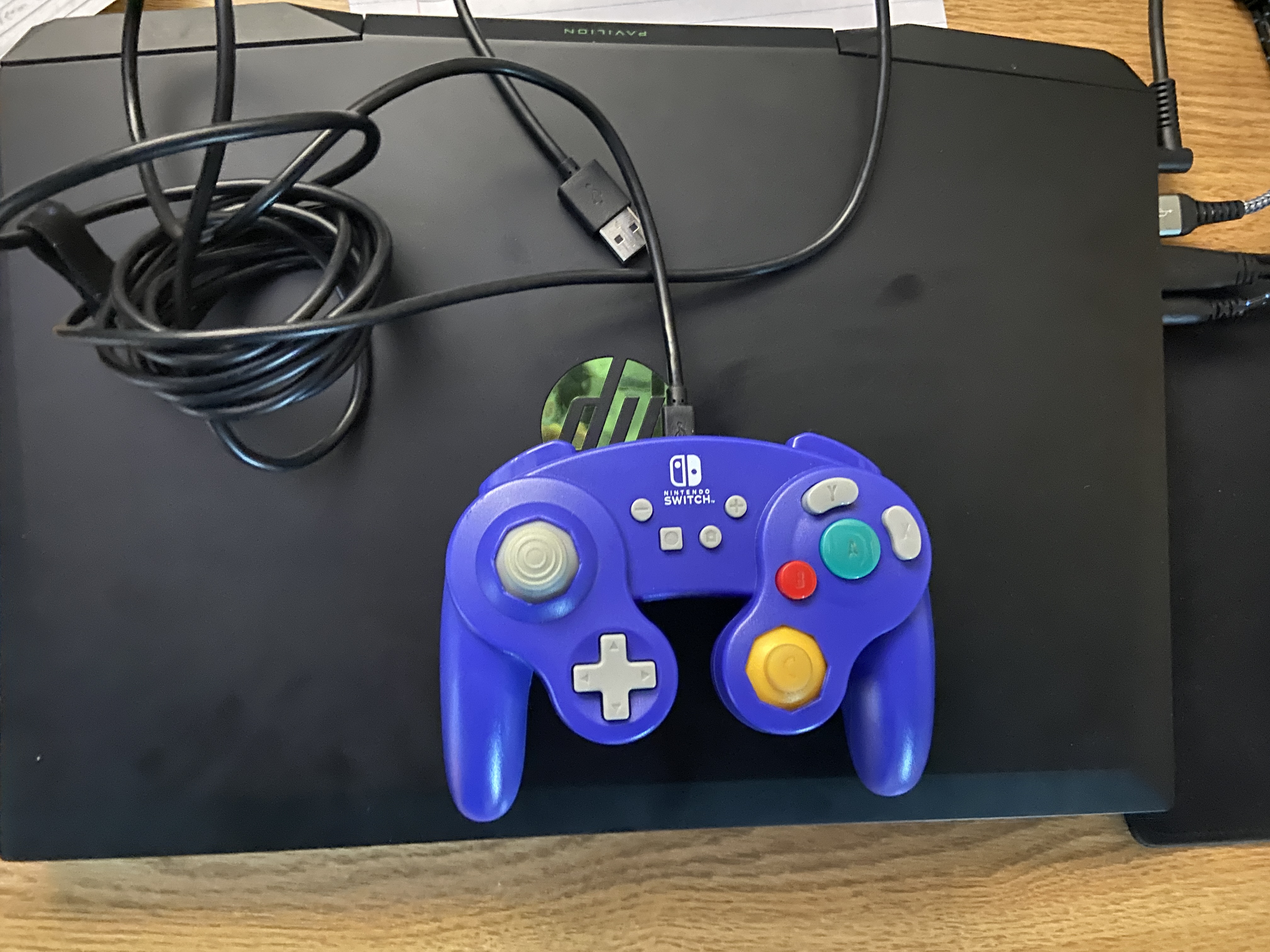
For my project, I decided to choose an object that is slightly different from those listed as examples. These items included typewriters, film-based photographs and even newspapers, and they all have been replaced by new technologies that are more convenient. For my project I chose a video game controller, specifically a Nintendo GameCube controller. This controller was made back in 2001 by Nintendo alongside the GameCube. In terms of controllers for games today, that 20 year gap between then and now is a huge difference. Designs, button layout, quality of components and general versatility have been improved and innovated over this period of time. So using a GameCube controller seems like a waste of time, as there are many options that are more accessible and provide more advantages. 

This was my thought process as I started playing some games with my friends using this controller. It should be noted that I’m used to playing most videogames on a keyboard and mouse, as that is always accessible as long as I’m playing games on my laptop and there are far more buttons to use and thus more options available to me. But while using the controller, playing against my friends in games like Smash Bros and Mario Kart, I began to grow fond of certain aspects of the controller. The first noticeable one was the distinct sound it made, both when moving either joystick and when pressing most buttons. The controller made a sound that could best be described as “clacking” when almost any action was performed with it, and this sound was specific to this controller. You would think that this sound would be annoying for the controller’s user, but oddly enough it was actually quite satisfying. It acted as an extra layer of feedback towards my action, as if the controller itself was assuring me of what action I had performed.

After playing a few rounds with the controller, I began to feel more comfortable with the layout of the buttons and joysticks. It took a while, as I had to translate the large arm movements of using a mouse into the fine motor skills of using a joystick with my thumb. But eventually I had mostly mastered using the controller. This shift was very pleasant, as I’m used to having a dedicated space where I could play games but at that moment I could play in whatever position was comfortable for me. This sense of freedom over my position allowed me to be more relaxed while playing, and created an environment that was less competitive and more casual between me and my friends. It was interesting how the dynamic shifted so easily due to a change in analog input.

After using the GameCube controller with my friends that night, I decided to keep using it from time to time. It has a USB connector, so I can use it as long as the device has a USB port on it. This newfound mobility became a great convenience to me, as all of a sudden I found myself playing games with people in close proximity with them, which was a nice change of pace from our usual conversations taking place over the internet. This sense of social freedom, along with the mobility granted by the controller, add together to create an experience that is focused less on the game itself and more on the social interaction between players. 

All in all, this experience was much less drastic than I was expecting. I thought using a GameCube controller would be a hindrance, and that it would be uncomfortable to use for quite a while. The truth is quite the opposite, after learning the muscle memory required to use the controller I found it to be a satisfying experience. On top of that, I find myself being more social with my friends while using this controller. I still use my computer to play games from time to time, but I’m glad I found an alternative method of gaming which is more social and, in some cases, enjoyable. In most cases the use of old technologies gets overshadowed by the convenience of the new, but sometimes there are qualities of the old that can’t quite be replicated.

Hand-Writing Creative Pieces

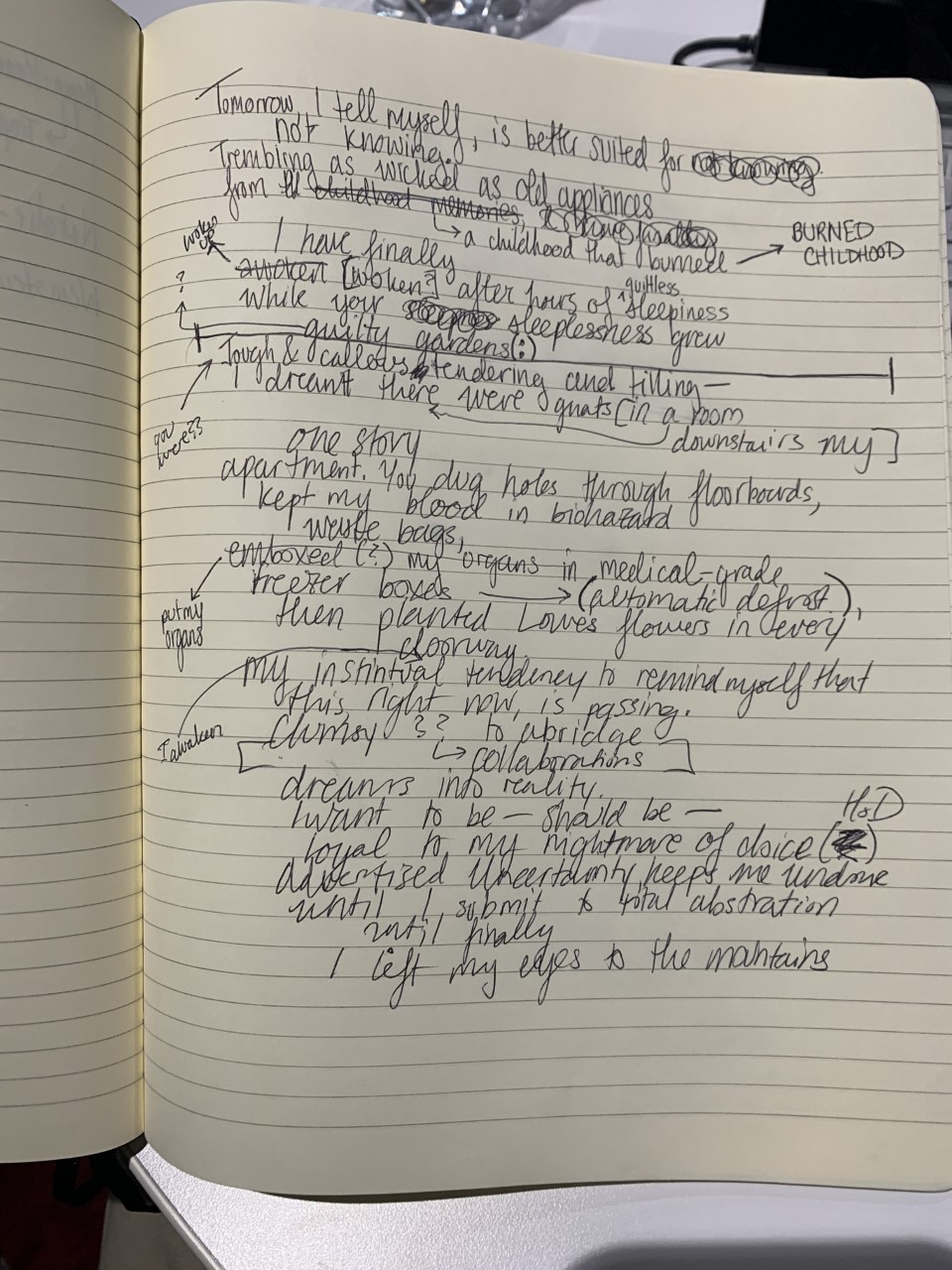
As I type this, I see that my Google Drive is 75% full: all of my work, whether it be creative or academic, is done on the computer. I love typing. I journal my days on my laptop, begin creative work, take notes for class, do homework, write assignments, create outlines, or simply practice free-association. Today, I decided to hand-write a creative piece, then edit, and re-write it. I expected myself to write without referencing the online dictionary or un-typing a word I didn’t like. When I use a computer, I always have a few tabs open, and also find myself distracted when writing. I never am fully 100% in the moment of just writing. I used a pen and a notebook I use on a daily basis (although, I typically use the notebook for scheduling and planning), put away my laptop and my phone, and sat down in the quiet corner of JFT. Here is the first page:

I had some working ideas coming into writing, so I started off with some words that were bouncing around my head. “Tomorrow, I tell myself, is better suited for not knowing.” I had begun with that phrase but realized I didn’t like how long the sentence looked (aesthetically), so I moved it down a line. This act influenced the form of the poem. As I wrote, I read the words out loud (something I typically do not do). The break between “better suited for” and “not knowing” started to shape the tone I was going for. Recently, I had a dream that my body parts were being moved around by my girlfriend while she was gardening inside my childhood home. When I recall the dream, I remember bits and pieces at a time, and I have to pause when I recall the dream; allowing myself time to think. I wanted the poem to reflect that uncertainty.

The words then began to flow naturally. I went to the next line as I recalled more details. The middle section of the poem beginning with “Tough and callous” and ending with “doorway,” is the actual dream I had. Afterward, I paused again. The dream was over; summarized in a few short lines. I spent some time recalling my feelings after the dream, and also at the moment that I was writing. “My instintual [sp.] tendency to remind myself that this right now, is passing.” As I am analyzing my page of writing, I cannot recall the inspiration for this line. Part of me imagines it was my desire to stop writing by hand, and the other part of me knows I was referencing the nightmare the dream became. I know this because I became a little more literary and careful with the next few lines.

The ending of the poem has more emphasis on form, as I struggled to find words. Many of my words are references. “Dreams into reality” is a phrase I know I have heard; perhaps read on an inspirational classroom poster. “Loyal to my nightmare of choice” is a direct reference to Joseph Conrad’s Heart of Darkness. For some reason, the quote was bouncing around in my head when recalling this dream. The quote from the actual book, according to Goodreads is “It was written I should be loyal to my nightmare of choice” (Conrad). I was pretty close. The temptation, however, to look up the quote and make sure I had remembered it correctly (as in, remembered it was from Heart of Darkness and that it was the correct word choice) was insatiable. The literary reference, on the other hand, inspired me to become more poetic, hence the phrase “advertised uncertainty.” 

Once I had gotten all of the words down, I began to do some editing. Whenever I was writing and couldn’t think of a word I would write “[??]” or “(?)” in place. I went in, removed some commas, changed some wording (“childhood memories” to “a childhood that burned” to “burned childhood”). Unlike when using a computer, I had to look at my big ugly mess. There were markings everywhere. I was also made hyperaware of my cursive-print hybrid handwriting. My “a” switched from the double-storey to the single-storey “a” as I switched from print to cursive. Then, after reading the poem aloud, I asked myself: When did I wake up? “I awaken.” This line was added in afterward. I also noticed, in my cursive-print hybrid, that the last line looked like “I left my eyes to the mountains,” which I had not intended to. Yet for some reason, I almost sort of liked it. I ended up adding the dot above the “i” as I had intended.

Instead of typing the final product, I rewrote it as neatly as I could:

The disappointment I felt when I made an error and had to scribble it out on line 11! As I review the final product, I also realize I have completely forgotten finger spacing as a rule of thumb (pun unintended). The phrase “dug holes” looks like “dugholes.” This is also true for “wastebags.” As I rewrote the poem, I also gave myself the liberation of adding more lines and phrases, changing the order of some words, and editing the punctuation. I found it incredibly frustrating to flip back and forth from the original to the rewrite. I also found it difficult to figure out how I wanted the form of the poem to look: rewriting the poem caused me to forget how I had intended the poem to look. When I type, I can easily change the order of the words. For example, I am typing this after I wrote the final line of this paragraph since I find it laughable. I am reminded that hand-writing is difficult.

With some reflection, I learned that there is some peace in hand-writing without the use of technology. I let myself just think. It was me, a paper, a pen, and the environment I put myself in. I just had to think. I found that in comparison to some of my typed writing, this poem was pretty honest. I didn’t exactly care about having the right words, or if they were aesthetic enough. It was for me. On the other hand, I know that my goal in life is to write for other people to read. Some things are quite nice when kept personal, but I know that one day these words could become alien to me too. I am ever-changing, and so is the world. I still find myself embracing the technological world.

Even now, as I type this response, I am actively hitting the backspace key, changing my phrasing, and undoing my initial, authentic thought. The act of my fingers hitting the keyboard is so raw and natural to me at this point that I find it easier to be authentic in my writing followed by seamlessly editing my words without hesitation. Even Grammarly assists me in the act of clarification. My concluding thoughts honestly relate back to my embracement of the cyborg. While I am terrified of technology in many ways, I find that technology is not an “other” to me. It is integral in my experience as a human being, and I enjoy it. I must admit that I am heavily influenced by Donna Haraway’s essay “A Cyborg Manifesto.” She argues that embracing the cyborg lifestyle allows women (especially oppressed women of color) to seize the circulation of male-dominated writing. She writes, “Cyborg writing is about the power to survive, not on the basis of original innocence, but on the basis of seizing the tools to mark the world that marked them as other” (Haraway 55). While I do not have the intellectual capability nor space to break down her entire argument, I find that digital writing offers many powers that are silenced by the hidden notebook. Even now, anything is possible: I have the ability to take this entry and post it on a blog page. I think I just might.

References:

Haraway, Donna J. “A Cyborg Manifesto.” Manifestly Haraway, University of Minnesota Press, 2016. ProQuest Ebook Central.

The Happy Planner®’s (To-Date) Worst Planner

We had spoken in class about how our phone devices have become an extension of ourself, used to store information that would traditionally be stored in our heads or on paper, such as phone numbers, calculating, reminders, the list goes on. During this conversation in class, my mind was drawn to my personal experience with keeping myself organized, or lack thereof, between school and work. I remember every year from elementary school to my senior year of high school, we were given an agenda to write down our homework assignments. Embarrassingly, I could go the entire school year without touching this spiral bound notebook. In replacement, I would use my phone notes to make a checklist of each assignment or task I had for a night. I started using my phone notes as my checklist sometime in high school, and carried this out for the rest of my academic career. Even when this exact “Analog Experience” assignment was due to appear on my radar, I found myself typing it into my notes app. For this analog assignment, I decided to use a physical planner for a week. Starting the process, I was curious to see how my analog version would affect my productivity or readiness to complete the tasks at hand. In addition, would the physical action of hand writing each task, rather than typing, impact my ability to remember the assignments I had? Would I feel more organized? Or lost in the inconveniences of flipping to a page in a book rather than the one-touch accessibility on my phone?

To start my process of this experiment, I dug out a completely bare and blank planner gifted to me by my mother earlier this year, and jotted down “analog experience assignment, due dec. 3rd”. This was the first line of writing to start my process. I began to write down some other assignments for classes. I was unsure if I wanted to organize my assignments in a particular way the way another student might practice, or messily type out nonsense with no order or organization the way I am comfortable with. I decided to exercise this approach the way the planner would want me to. The planners are designed to promote organization, and despite my natural instincts to think differently, I decided to embrace the structure set for me. I neatly wrote down all my assignments I had on my radar for the week. Later that day, I completed one assignment for a design class. I had my first exciting moment in this process: the ability to cross out an assignment with a pen. The touch of a pen tip to paper, scratching out a task I considered completed and off my mind, was the first rewarding experience. I noticed there was an innate difference between the physical material of crossing out a task, over the simple deletion of a task, or checking it off with a tap. Because I would have to physically use the materials of pen and paper, I felt more satisfied with my accomplishment. I continued the exercise for the rest of the week.

I noticed several patterns during the exercise of using a physical planner versus my phone notes app. I felt more inclined to do my work, because I saw the assignments in front of me, rather than hidden away in my phone. The exciting crossing-out-part was also a motivating factor. Despite these benefits, there were also several instances where I was inconvenienced by the physical space of the planner. It’s a bit twisted, but I am admittedly lazy and reliant on everything being right in my hand, as an extension of myself. And so, when I was in my bed late at night and wanting to remind myself of my tasks for the next day, I wasn’t too thrilled to know my physical planner was sitting at the bottom of my bookbag, which I was not of interest to get. Also, because the habits of my mind are accustomed to my “to-do’s” existing within my phone, I often forgot I was using the planner and barely brought it out in class.

There was one last significant obstacle I found throughout this process. I was experiencing impostor syndrome. Even though the objectives of staying organized are consistent in both the physical and digital approaches, I felt like I was taking on a completely different personality during this experiment. I find it interesting how the use of an analog object can completely transform your experience, and in this instance, transformed how I viewed myself. I found myself uncomfortable with the experience, because this type of organization just does not work for my needs. However, I know that I can only speak for myself, and someone else may view their physical planner as a lifeline. To each their own.

For amusement, here’s a few embarrassing screenshots of what my nonsense “digital planner” looks like in my notes app, misspellings and all.

An Exploration with the 4×5 Camera

For my own analog experience, I choose to work with a film camera, more specifically, a Large Format 4 x 5 film camera. Being a photographer, I typically work with a digital format DSLR, but I have had prior experience with 35mm film cameras. For this experience, I wanted to explore and dive deeper into the world of film cameras with the Large Format camera, one that I had never before had the opportunity to explore. 

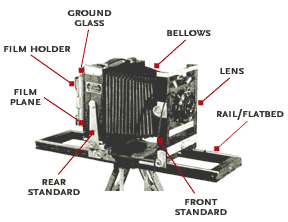
Image of a Large Format camera and its different parts

I knew it would be wildly different from my preferred digital camera experience upon beginning this exploration. Still, I had some inclination it would be similar to a 35mm film camera. Using this new 4×5 film, I wondered if the images produced would be equal to or better quality compared to my DSLR? Aside from technical aspects, I wondered if it would feel different while shooting and taking the images than with my digital camera. This camera is around fifteen pounds, requires a nearly five-foot tripod, and only comes with eight film slides. With all that being said, setting up to take the picture and taking the image will take a lot more time than it would with any digital camera. Would this impact my experience with it? And would that impact be positive or negative?

For the actual experiment, I choose to photograph simple objects around my house and backyard, even getting some pictures of my grandfather working outside in the barns. The investigation itself was a bit complicated and very time-consuming. To take an image, the tripod has to be level and at the correct height for the camera’s glass to be at eye view. To focus on the subject matter in the mirror, the dark cloth is needed, precisely what it sounds like, the black fabric called the “dark clothe” is draped over the user to see the image reflected upside down in the glass. Once the image was focused, I had to meter for the correct lighting and exposure time. To little time the image would be too dark, too much time, and the image would be too light, making the exposure the most crucial aspect of the photograph. The experiment was concluded after doing this whole setup and process eight times and changing locations midway through. 

Image of an individual focusing on a subject matter under the Dark Cloth.

Reflecting on my exploration, I realized there are a lot of steps to set up the image and make sure the exposure is correct before even clicking the shutter to take a photograph. By the time I focused, I had found the light had changed and needed to re-meter the whole picture. Besides these technical difficulties, this time between taking the images and setting them up allowed me to slow down and the information I was photographing. 

After developing my film from this experiment and having all of the negatives come out, I was relieved. My experiment was successful, I learned how to use the large format 4 x 5 camera, and I even got some excellent photographs. I found that these images were highly detailed and crisp, much sharper than any image my DSLR could produce. It is a long-standing truth in photography that film is the best to shoot on for higher quality and sharp appearance. I never truly believed that until I saw these images, I was honestly a little surprised. Besides technically being a successful experiment, I can’t say I loved the experience as a whole. Unlike my DSLR that I can strap around my neck and take with me anywhere, like a spontaneous trip or event, this camera was the exact opposite. The weight and its cumbersome nature overshadowed any quality of images that it produced. I did enjoy slowing down and spending more time with my subject matter while setting up my pictures. However, I found myself missing that digital aspect of taking five or more images with one click of a finger. I found this type of camera was limiting and often didn’t let me take complete creative control of the image in more ways than one. Overall this experiment was enjoyable, and I can proudly say that I now have the knowledge and experience working with another film camera under my belt. This was a great exploration, but I think I will be sticking with my DSLR camera for any future shoots.

Some of the images i took during my experiment, developed and printed.

Image Sources:

http://www.shoppbs.pbs.org/wgbh/amex/ansel/sfeature/sf_camera_text_1.html

https://www.richardphotolab.com/blog/post/how-shoot-large-format-film

A Simple Phone Call

With the advent of cell phones and social media, the use of phones for actual calls rather than texts has decreased. While this might not be true for everyone with a cellphone, it has definitely definitely true for me, in fact any time I do get a phone call from someone that isn’t a family member, I usually let it go to voicemail. For the most part I reserve phone calls for family members without cellphones and for holidays and birthdays, which I believe warrant a phone call rather than a simple text because of the sentimentality that it holds. Any time I talk to my friends the conversation takes place via iMessage or on a social media platforms like Instagram or Snapchat. This simple fact has led me to call one of my friends for my analogue experience. For my phone call I decided to call one of my friends who lives in Virginia, and subsequently is one that I haven’t seen in a while due to the difference in our schedules which has led to most of our communication being in the form of texting via iMessage and Snapchat. 

Because phone calls require more attention, one of the first things that needed to be done was to actually schedule the call. This first step was proven to be a bit difficult. As previously mentioned one of the main reasons why my friend and I haven’t seen each other in a while has to do with the differences in our schedules, which is a difficulty that doesn’t necessarily need to be considered when texting, because texting is something that can be done at any time of the day. Texting can be considered much more convenient in this instance, because the message doesn’t expire and therefore can be responded to whenever the person receiving the message has the time to type a response. Phone calls don’t have this luxury and need to be planned at exactly the right moment so there aren’t any time restrictions and so both parties can give the phone call their full attention. This first and essentially only step was one that was proven very difficult. The first phone call that we scheduled was while I was driving home from school. I had wrongly assumed that I would be able to give the phone call my full attention and that my car’s Bluetooth system would allow for both of us to hear each other. This was not the case and the phone call was ended shortly once we both realized that we could not hear each other due to multiple reasons, including the road just being too loud which prevented both of us from hearing each other and the fact that my Bluetooth allowed me to hear my friend but wouldn’t let my friend hear me. In all honesty, planning the phone call while I was driving might not have been the smartest idea in the first place because of the attention that driving requires, the failure of this first phone call attempt was fully my fault. On this very short phone call that involved both of us unable to hear each other, we decided that we would call each other when I had gotten home. This plan was foiled by my friend being on another phone call that lasted too long preventing us from having the time to call. Over text, we decided that we would call sometime over the next few days because both of us were off from school due to our Thanksgiving breaks. When we were finally able to schedule a phone call it was later in afternoon the following day when both of us knew that there wouldn’t be any external factors that would prevent us from talking.

While on the phone call one of the main things I noticed is that there were many instances where I was unable to hear what he was saying and where he couldn’t hear what I was saying, leading to the next problem that occurred during phone calls that didn’t occur while texting: difficulties in hearing what the other person was saying. In these instances, we were left to saying, “What did you say?” and “I can’t hear you,”which are perfectly fine to say, but caused lags in the conversation that wouldn’t normally be there because texting avoids this issue completely. Despite this issue, the conversation still went on and lasted around 2 hours, which was an amount of time that both of us admitted as feeling much shorter than it actually was. I found that during these 2 hours we talked about many different things, similarly to when we text each other. The phone call didn’t create any actual limitations to what could be discussed, we talked many different things, including the movies that we had watched recently and our dream vacation locations. The only real limitation that the phone call had was that any little thing, like a movie title, that we talked about that could be easily forgotten, mostly due to my bad memory, wouldn’t be saved. However, this problem was easily addressed and anything that we needed to remember, like a TV show one of us had recommended to each other, was just sent as a text message so it couldn’t be forgotten.

Before this experiment, I assumed that there would be more than just one or two lags in conversation that would create awkwardness, but I was pleasantly surprised when this wasn’t the case. While there were instances of quiet, I found that these periods would be present in a normal face to face conversation and therefore were not an issue exclusive to phone calls themselves. I also came to realize that these periods were beneficial, since they had allowed both of us to think about what we would say next and had allowed us to formulate our thoughts. There can also be a comparison made between the silence during a phone call and an extended period of time without a text response, both allow the people having the conversation to think about what they are going to say next, however breaks of silence while texting have the ability to last longer periods of time, because there isn’t the feeling of there being a time limit. Lags in phone call conversations usually need to be resolved quickly or else the phone call ends, however breaks in texting still allow the conversation to pick up where it left off because both parties are able to look back and see what they were talking about. I also found that this made us talk about things that held more weight and value or the things that we would discuss in person. I have found that text conversations tend to be about things that don’t necessarily hold a lot of weight or personal value, but phone calls always seem to be more personal. I attribute this idea to the other idea that phone calls can act as a face-to-face conversation and almost replicate the closeness that occurs in those situations.

From this phone call “analogue” experience, I have come to the conclusion that while phone calls require more planning and more time, I may prefer them to texting. For me personally I have discovered that my best conversations occur when I talk to someone face to face, and while phone calls aren’t exactly face to face, they give off the illusion that the conversation is occurring this way. Before this analogue experiment, most, if not all, conversations with my friends had taken place via text message, phone calls were kept to parents and family members whenever there was a holiday or other special occasions. While I won’t make every conversation I have with friends occur via phone call because of the convenience and simplicity text messaging has, I will definite integrate them more into my day to day life because of the “closeness” and illusion of being a “face-to-face” conversation that they have.