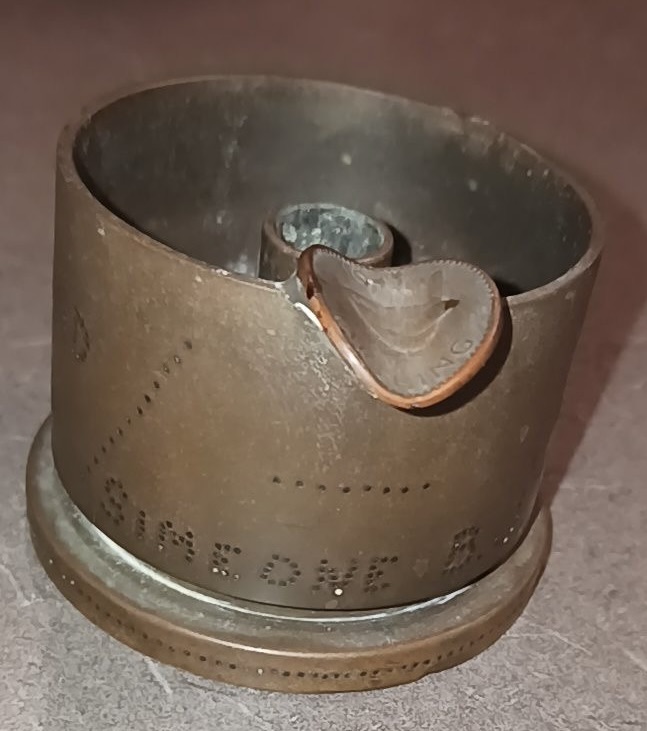
The object that I have chosen for this blog post is a piece of world war 2 trench art that was handmade by my great grandfather’s brother. I was unable to bring these pieces of trench art to college with me, so I asked my family members to take the best photos they could to represent this object. My object is about 3-4 inches in diameter and about the same height as well. It takes the form of a short, hollow, cylindrical shape representing an ash tray of sorts. The general cylinder lies atop a thinner, but wider circular base that has many small holes punched into it. On the general cylinder shape, there are many holes punched into it, creating straight lines, arrow-like slanted lines, and even letters. These letters spell out the name of my great grandfathers brother, “B.J. SIMEONE”.
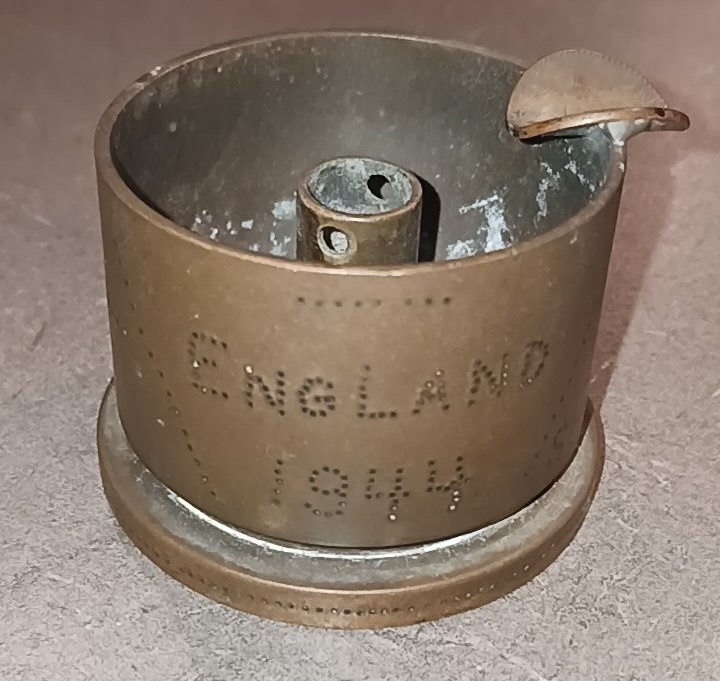
They also spell out the word, “ENGLAND,” as well as the number, “1944”. Finally, the last letters punched into the cylinder spell out the words, “U.S. NAVY”.
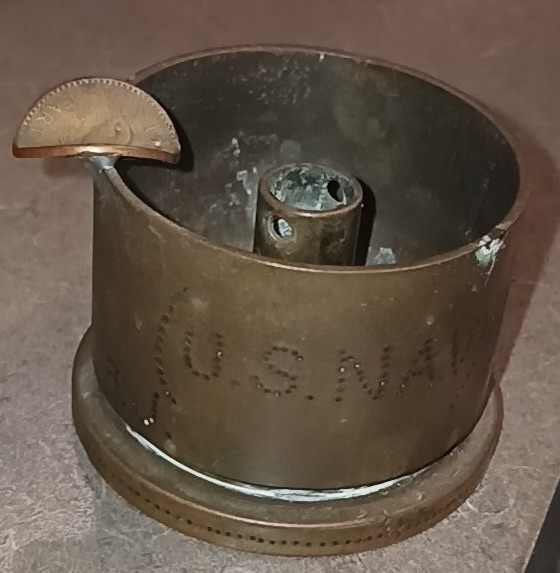
Towards the center of the object lies another hollow cylindrical shape that is about 1 inch in diameter and 2-3 inches in height. Towards the top of this cylinder lies two small holes directly across from each other. On the rim of the large cylinder lies a bent, coin-like shape that seems to be welded onto the cylinder rim. On the coin, there is a bird-like image and some letters that are hard to make out. This coin seems to be made of a copper-like material with a small layer of dust covering the surface of it. The cylindrical shape seems to be made of a metal-like material and is brown in color. There are several signs of both white and green patinas throughout my object as well. The object smells somewhat like metal as well.

On the bottom of my object, there are multiple engraved circles surrounding the outer edge and the very middle. There are also multiple engraved numbers and letters, none forming coherent words.
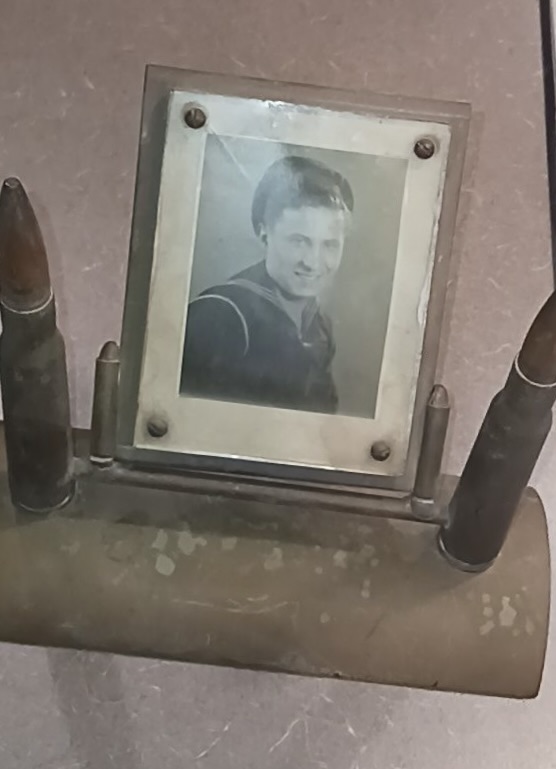
This is a picture of my great grandfathers brother. I am still unsure of his full name and only know minuscule details about him. However, I was able to obtain some information about my great grandfather that helped me figure out some information about B.J. Simeone. My family found these art pieces in our basement while cleaning out some older holiday decorations. The house that we live in used to belong to my great grandmother, Mary Simeone. Fun fact: we still get our water bills addressed to her in the mail! Anyways, Mary and her husband, Urbano Simeone, lived in this house before my family. The house used to be a one story ranch house, with horse stables and wells all throughout the property. My great grandfather, aka Urbano, planted a long row of berry trees along the driveway, and used to make wine in the cellar located in our basement. We even have these soaked wine barrels to this day! We think that Urbano and his family back in Italy used to own their own wine vineyard and he continued on the business here in the United States. He was originally born in Filetto, Italy on July 10th, 1914. He became a registered U.S. citizen after escaping from the rule of Benito Mussolini. From this information I can assume that his brother, B.J. was also born in Filetto, Italy and moved to the U.S. around the same time. In October of 1940, Urbano was drafted into the United States Navy to fight in the second world war, as well as his brother. B.J. was stationed in England in 1944 and had a hobby of creating trench art. This ashtray was one of the pieces he made, along with the picture frame holding his image and even a little wheelbarrow, which I will attach at the end of this post. All of his artwork was created using scraps found on the battlefield, like empty bullet shells. That would explain the serial numbers on the bottom of the ashtray, although I do not know enough about bullets to figure out the exact model. Therefore, the ashtray is made up of many different sized bullets that were welded together in the trenches. Also, the coin on the rim of the ashtray, upon further research, is called a UK Farthing coin and the small bird is a wren to represent one of the smallest birds in Britain. They are worth about $3.00 today, depending on the year located on the coin. Also, during 1944, England was a very active site for the war. Food and clothing were very sparse and rationed among the people. Bombings were very frequent and caused mass death and destruction throughout England. Therefore, I think my great grandfather and his brother must have had a very hard life while stationed in England and I find it extremely impressive that B.J. was able to create these amazing pieces of art.
After the war, these trench art pieces were passed onto Urbano when B.J. died, then passed onto Mary after Urbano died, and when she died, we inherited the house as well as these works. I also love these objects because the love for art is really strong on my fathers side of the family, and seeing these trench art pieces only verified that, and made me feel even closer to my ancestors.

Citations:
EmmaP. “The Wren on the Farthing.” Wash Your Language, 13 Oct. 2019, https://washyourlanguage.com/the-wren-on-the-farthing/#:~:text=The%20smallest%20of%20pre%2Ddecimal,a%20much%20more%20symbolic%20bird.
Morano, Johanna. Interview. 2023.
“We’re Giving You Access to Your History.” Join Ancestry, http://www.ancestry.com/discoveryui-content/view/193959668:2238?tid=&pid=&queryId=256bccedfc2ea1f52ba06b30c83ca82a&_phsrc=hgy48&_phstart=successSource.
 The Materials of History, Thought, and Art
Hi Alyssa! It was so interesting reading about all the intricate details within some of your ancestor’s creations. I feel that I am reading such a rich segment of history the comes from your storytelling. Artistic expression is present in many trench arts when people resourcefully create a new object out of recycled materials, or as you mentioned “scraps from a battlefield.” There seems to be many more untold stories behind the object, such as the mysterious engraved numbers and text. I wonder if they serve a function like a serial number as a type of identification. Your description also prompted me to do further digging into what trench art was! Great work!
Alyssa! Your family’s value in art that stems from your great grandfathers brother is amazing! The fact that a piece like this has been valued and kept in the family for so long is really touching! I think it is beautiful that B. J. Simeone was able to create art from a timeperiod of war and carnage. Really well written and a great object!