When I begin this assignment, I’m not sure if have any objects that have survived throughout my family history. My grandparents on both sides had come to India from various places, England (my mother’s mother) and Pakistan (my father’s father), only carrying a limited number of personal belongings. My parents, too, came to America with only a few possessions. What did they deem important enough to pack with them?

I think for a while, searching my house, until I remember that when I was young and loved to read, my maternal grandmother gifted me a book that she had received as a child. The book was passed directly from her childhood to mine, and I was never forbidden from touching this piece of history. I was allowed to hold the book as I read it, to marvel over the black and white printed image pages, to notice the stains and creasing of the paper.
To begin my research, I first ask my mother what she knows about this book. She only remembers what her mother told her, that my grandmother received it as a prize in her hometown as a child, that it was very special to her. Together we open the book to see the award affixed to the inside of the front cover: “For Good Conduct, Diligence, and Regular Attendance. Obtained 106 Marks out of a possible 106.”
After I manage to decipher the handwriting on the bookplate, I’m excited to find quite a bit of information that can help me uncover the story of this book. Tadley Corps refers to the branch of the Salvation Army that my grandmother attended as she grew up. I know my grandmother’s maiden name, Jennifer Hicks, and the date she received this book, January 1951. I know the names of the Salvation Army officers who presented this prize book to her. And of course, I know the title and author of the book: The Form That Liked To Be First by Nancy Breary.

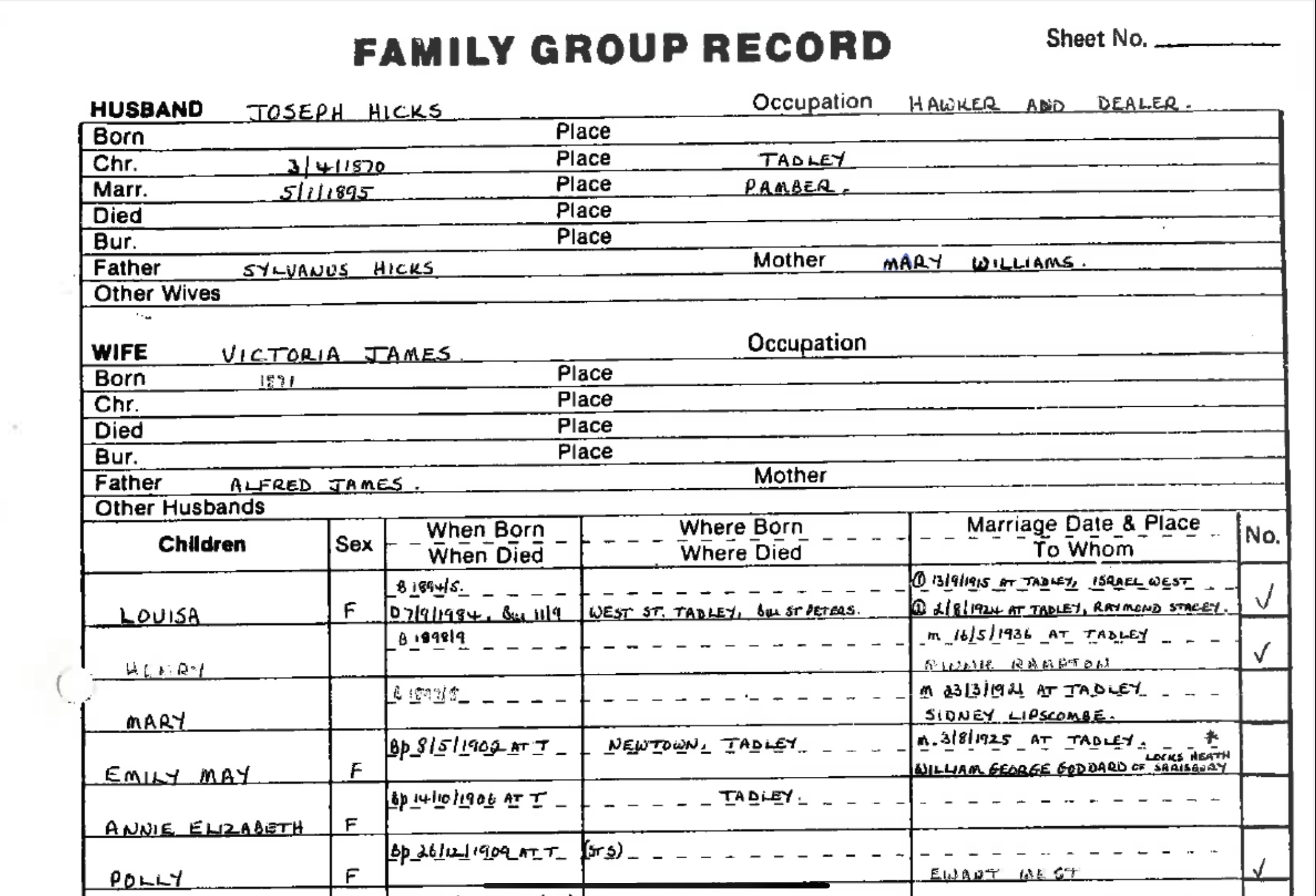
I begin with the small town of Tadley, England. I’m lucky to find an entire website dedicated to the cataloguing of this place and its people, the Tadley and District History Society. Through records of births, baptisms, marriages, and deaths, I confirm that my grandmother was born there in 1938, and her family had been in the area for generations prior. My grandmother referred to her father, Henry Hicks, as a “gypsy” and mentioned that her mother, Minnie Rampton, had urged him to settle down and work a factory job. I trace the lineage of Henry Hicks and find that his grandfather Sylvanus Hicks is recorded as “traveling hawker” and his family was “not living in houses” in 1861, and was living in a “housed van” by 1871 in Tadley. Even his son, Joseph Hicks (my grandmother’s grandfather), was noted as a “hawker and dealer” in terms of his occupation. My family has been moving around for generations, taking with them only the objects they valued. Like this book that I now hold in my hand, which has traveled from England to India and now to America.


I decide to research the book itself. It was first published in 1948 by Blackie & Son, a company located primarily in London, England. The author Nancy Breary wrote almost 30 books in a genre called “Girls’ School Story,” which “offer amusing stories – sometimes almost parodies – complete with many over-the-top elements” (Goodreads). My mother tells me that that my grandmother was the first girl to receive a book prize award (my grandmother isn’t sure if this is completely true). I wonder if this is why the church officers chose this book for her, a teenage girl. I think of the entertainment targeted towards teenage girls today, similar exaggerations of the adolescent experience. I wonder what my grandmother thought when she received the book. I want to join her in the moment of congratulations, standing in the Salvation Army Hall, being presented with such a prize.
A little history: The Salvation Army is a church based on evangelical Christianity, founded in England in the mid-to-late 1800s. A report from the Tadley and District History Society (2009) notes that at the time, it was considered a non-conformist church because many of the meetings were held in the open air and music was an important part of worship. Evangelists known as “officers” preached the word to gain support from the people, and set up “war posts” in areas that had many members. By 1898, the Tadley Corps was meeting in a small building that could not fit the amount of members.
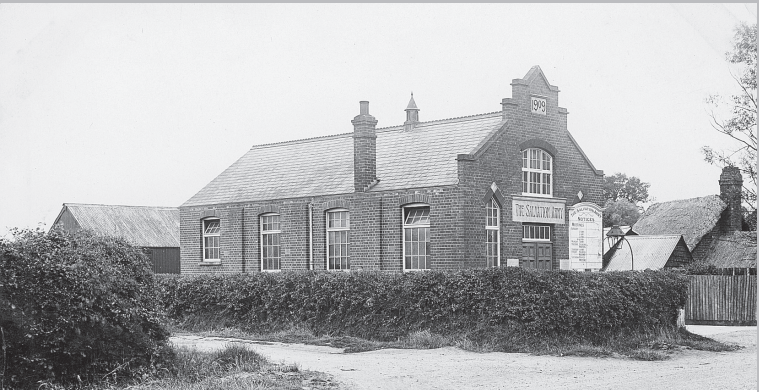
In 1909, the Salvation Army Hall on Mulfords Hill, the road on which my grandmother lived, was formally opened. This building is still standing today, along with more modern additions to the property.
I call my grandmother (she lives in India) to ask her what she remembers about her childhood, why her family attended the Salvation Army, why this book has traveled across the world through time. She tells me that her mother’s family, the Ramptons, have always been “chapel people, not Church people” and that her mother joined because she enjoyed watching the Salvation Army band march through the village of Tadley every week. Her mother, Minnie Rampton was highly devoted to the Salvation Army and began studying to become an officer, but her eyesight was too poor. She ended up becoming a Sunday School teacher after marrying Henry Hicks, who also became a Salvationist. My grandmother tells me that when she was growing up she attended Sunday School twice, once before lunch and once after lunch, which explains why she received perfect marks for regular attendance.
She recounts the months she spent living in hostels in London as a young adult, bringing only a few possessions, including the book. She isn’t sure why exactly she carried it with her. “It’s a children’s story, isn’t it? Must have been just a bit of ‘for old time’s sake’. It’s amazing that the book has reached America. I forgot I brought it to India… maybe I thought I would read it to my children. I didn’t expect it to go to my grandchildren.”
And yet it has. I wonder where it will end up next.
References
“Nancy Breary.” Goodreads, https://www.goodreads.com/author/show/717985.Nancy_Breary
“The Tadley Corps 1898-2009.” Project News, Tadley and District History Society, 2009, https://tadshistory.com/TADS/TADSOLD/Projectnews/projectnews_14pr.pdf
 The Materials of History, Thought, and Art
Hi Saj
I loved reading your post! I’m impressed with all the information you found about this object and your family by extension. I really liked that you added family records and a picture of Salvation Army Hall to your post. I really liked when you said, “The book was passed directly from her childhood to mine, and I was never forbidden from touching this piece of history”. I thought it connected with our conversation about A Hare with Amber Eyes and the idea of everyday vs. displayed objects. Well Done!
Hey Saj! I loved this story. To know that it was something that was not intended to be passed down was really interesting–especially when it was something she brought with her even when she had few possessions. I wonder if that in and of itself made it worth keeping. I loved the insight into the decision making and history. Great job!