Scrolling and Browsing

For this assignment, I decided to shop for something I’ve needed for awhile: a new dish rack. The prospect of getting a new dish rack for my roommates and I is actually deeply exciting, which is how I know I’ve officially transitioned out of teenhood. I decided to start by just googling “dish rack” and seeing what the internet’s first ideas for me were. Of course, the top hit was an Amazon link, which would surely lead me to the most extensive plethora of options. So I bit. Shapes, sizes, colors, and prices varied. The price range sat at a pretty consistent $20-35, but for name brands like KitchenAid, we were looking at about $50. What did I want out of this dish rack? I had to decide after being presented with the existing options. Ooh, shelves? A drainer? A place for knives to drip dry? Amazon was presenting me with options I didn’t know existed until I’d begun scrolling through the page. This complicated things. I thought I knew what I wanted, but Amazon opened so many doors for me in terms of what a dish rack could truly be. There was, of course, the $13 “Amazon’s Choice,” but now that I’d seen what beautiful dish racks existed, I didn’t know if I could settle for the silicone option. Sure, if I’d seen that one first, maybe, but Amazon strategically stuck it at the bottom of the page. My roommates and I deserve something a little flashier, right? And isn’t it an investment? We’ve been laying our dishes out on the limited counter space. This is a purchase that’s granting us space and efficiency. When did this get so complicated?

I settled on a $25 silver dish rack with two shelves and, yes, a special place for our (dull, breaking) knives. And I felt winded from the search, but then I took two seconds to really reflect on it. It was a seven minute ordeal. I looked at probably fifteen dish racks in that time. Dish racks that completely presented themselves to me as I sat in the same place I’d done the rest of my homework and eaten my lunch. I just conjured them with their name like a wizard. 

As for my browsing, it was a completely different experience. It was different mainly because I didn’t go in looking for anything at all. I woke up early on Saturday morning with some extra time and realized it would be a perfect time to walk over to Twice Blessed, the church thrift shop on Huguenot St, and just poke around. So I did. I left my phone at home and walked over at 10 am. It was hopping. The old folks in town come from far and wide to browse on these Saturday mornings. It was also the iconic basket sale, meaning patrons can fill an entire basket for a flat price of $15. But I wasn’t even planning on doing that. I picked up a basket and it remained empty. Something I realized, actually, was that nobody really goes to Twice Blessed because they need something. The promise of nothing being new kind of eliminates that. It’s a treasure trove. You really have to dig, which makes the prospect of finding something all the more rewarding. 

It’s hard to compare ease because one experience felt like leisure and the other felt like a task. I had to find a new dish rack. It was on my to-do list. But the trip to Twice Blessed was honestly just to kill some time and maybe see some of my peers who I know also love to make the Saturday morning trek to chat with the church ladies. It was nice. When I journaled about my day later, I found myself writing about the twenty minute experience more than I thought I would. But it felt like hanging out with myself, which I forget to do. And interacting with little objects is fun. Imagining where the items came from, thinking about how disastrous it would be if I dropped the ceramic hummingbird, trying on little golden rings, these are things I can’t actually do on the Amazon storefront. I think Guriel is onto something. When I found myself on Netflix later that day, I noticed the tab at the top of my laptop said “browsing.” It made me laugh. I wasn’t browsing. I was looking for something to satisfy my exact mood, though I didn’t know what it was. But I was looking for something. That’s the difference. I wasn’t looking for anything at Twice Blessed, I was just looking. I was having an experience, as Guriel urges us to do in his writing. 
Browsing and Scrolling

True to my oppositional nature, I did the experiments in reverse order. I spent last Saturday afternoon browsing vintage shops and craft markets for about 2 hours, and then scrolled on Wednesday for about an hour. I enjoyed browsing more as I am more interested in objects when I can touch them, smell them, and view them from multiple perspectives, as well as observe the context they are in.

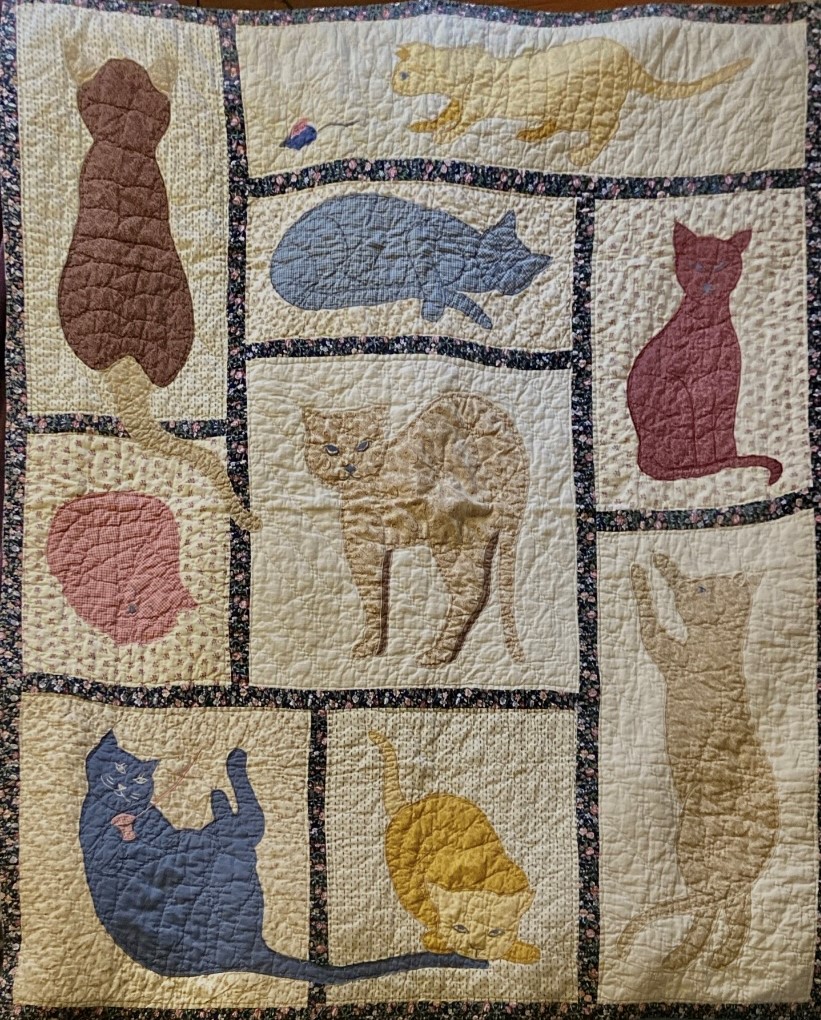
Photograph of cat quilt
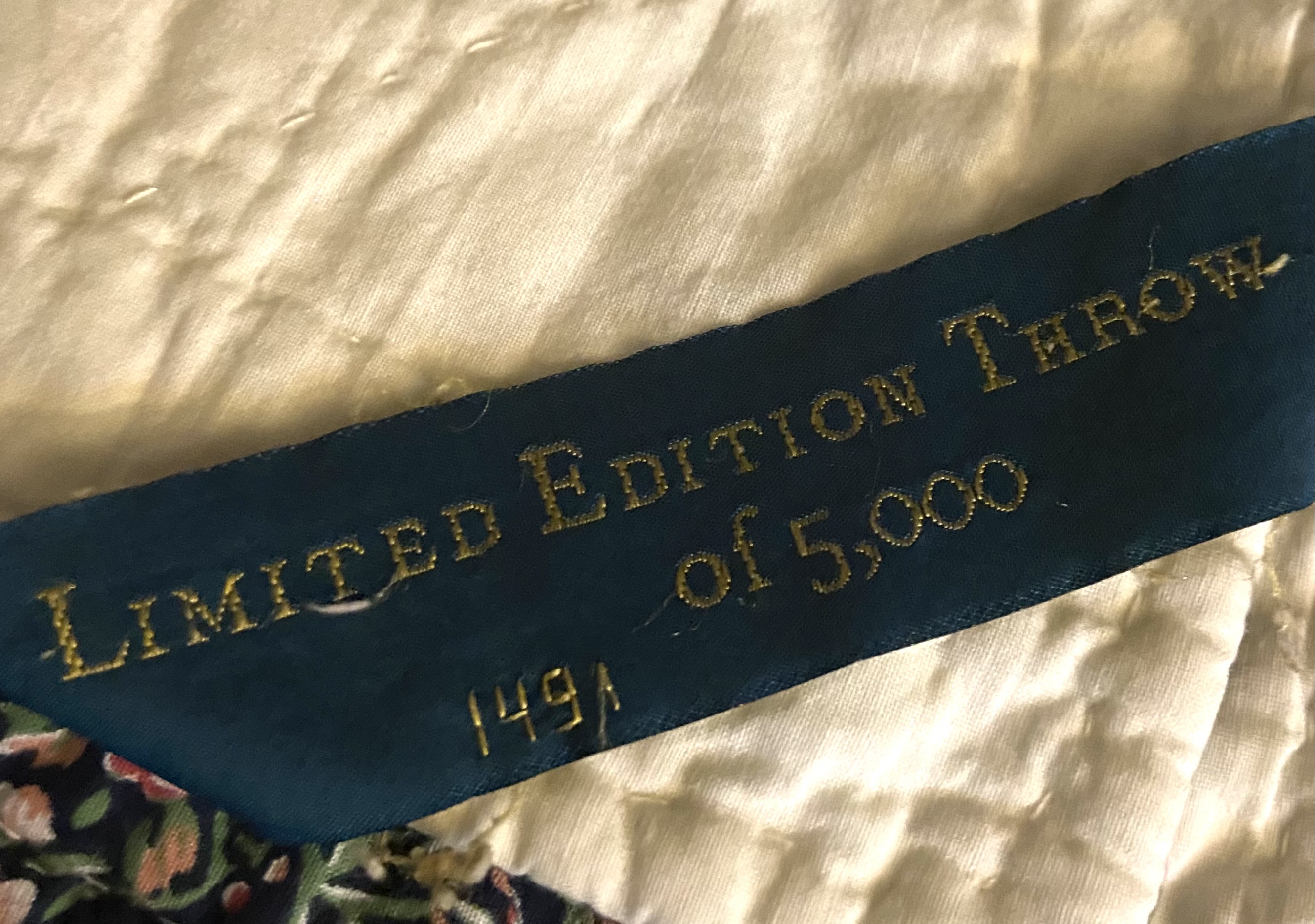
Photograph of quilt label

I ended up purchasing a beautiful quilt decorated with designs of cats from the Marketplace on James in Syracuse, NY, and didn’t realize until I returned to New Paltz that it was labeled as a limited edition throw. I wondered if I could find its counterparts online, so I began to scroll.

This proved to be almost impossible, countering my expectation that browsing is more frustrating as it takes more time and effort to find objects. I personally found scrolling the internet to be harder, even though I used the search engine to my best efforts. I first tried to use key words (“limited edition cat throw”) to find information about my new quilt, but no results matched mine. I then used a reverse image search of a photo of the blanket, but still found no exact matches. I finally tried a reverse image search of the label on the back of the quilt, and found a different quilt on eBay that had a similar label, possibly produced by the same maker or guild. Unfortunately, there was no information there that could help me. 

Based on my experiments browsing and scrolling, I found browsing to be more fulfilling. Since there is no specific thing I’m looking for when I go browsing, the experience itself is rewarding even if I don’t end up purchasing anything. When scrolling, there is usually an end goal, and I get frustrated if I cannot reach it. However, I think that browsing is a luxury; most people cannot afford to spent time on something that may not provide results. Scrolling is generally faster to provide results, even if the results aren’t exactly what you’re looking for. But I think this makes it easier to miss information, since the top results of a Google search are usually the only ones that people click on. We don’t realize that there are thousands of results, one of which could be more relevant to the query. This is what browsing allows: aimless wandering through objects until something truly interesting catches your eye. I think both have their benefits, but if you have time, browsing will provide a more personally rewarding experience.  

A Family Feud

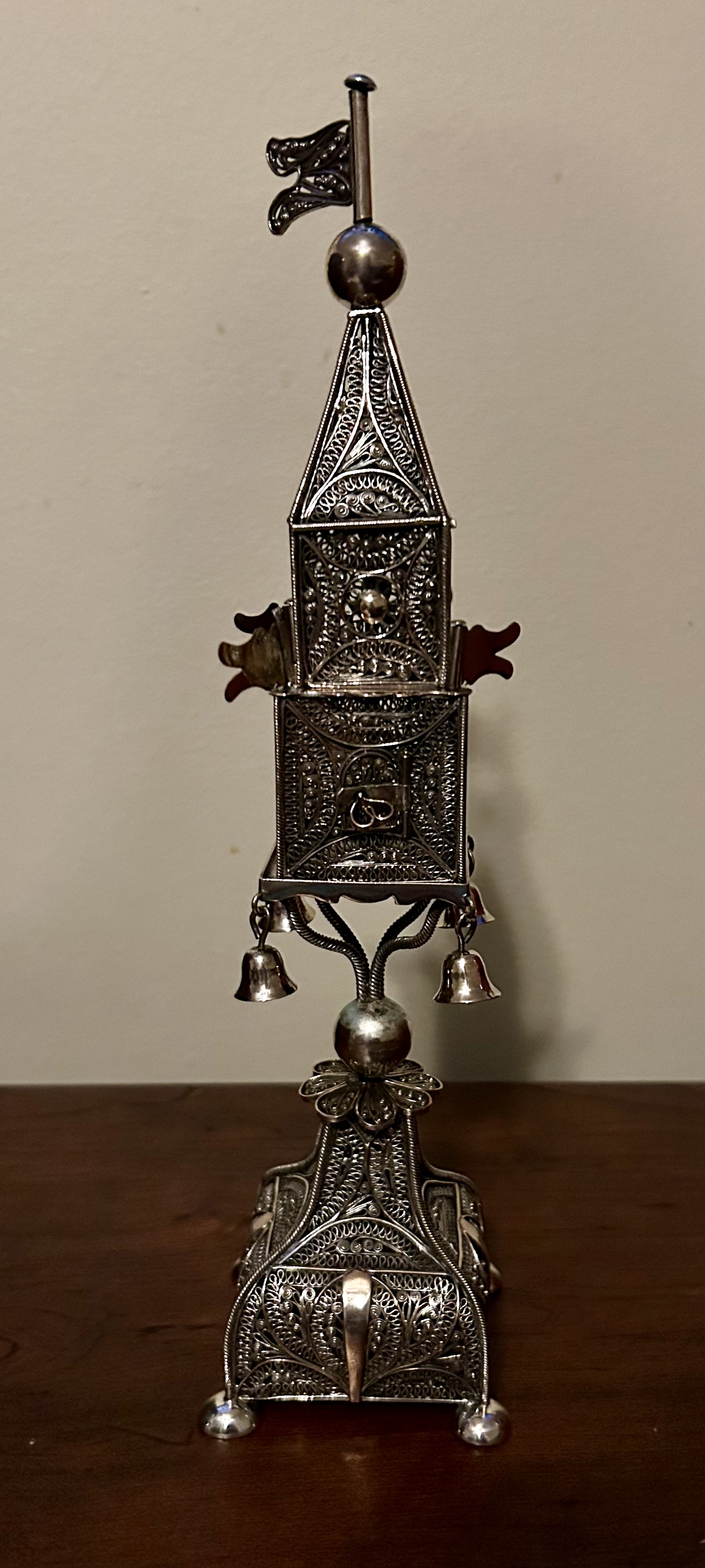
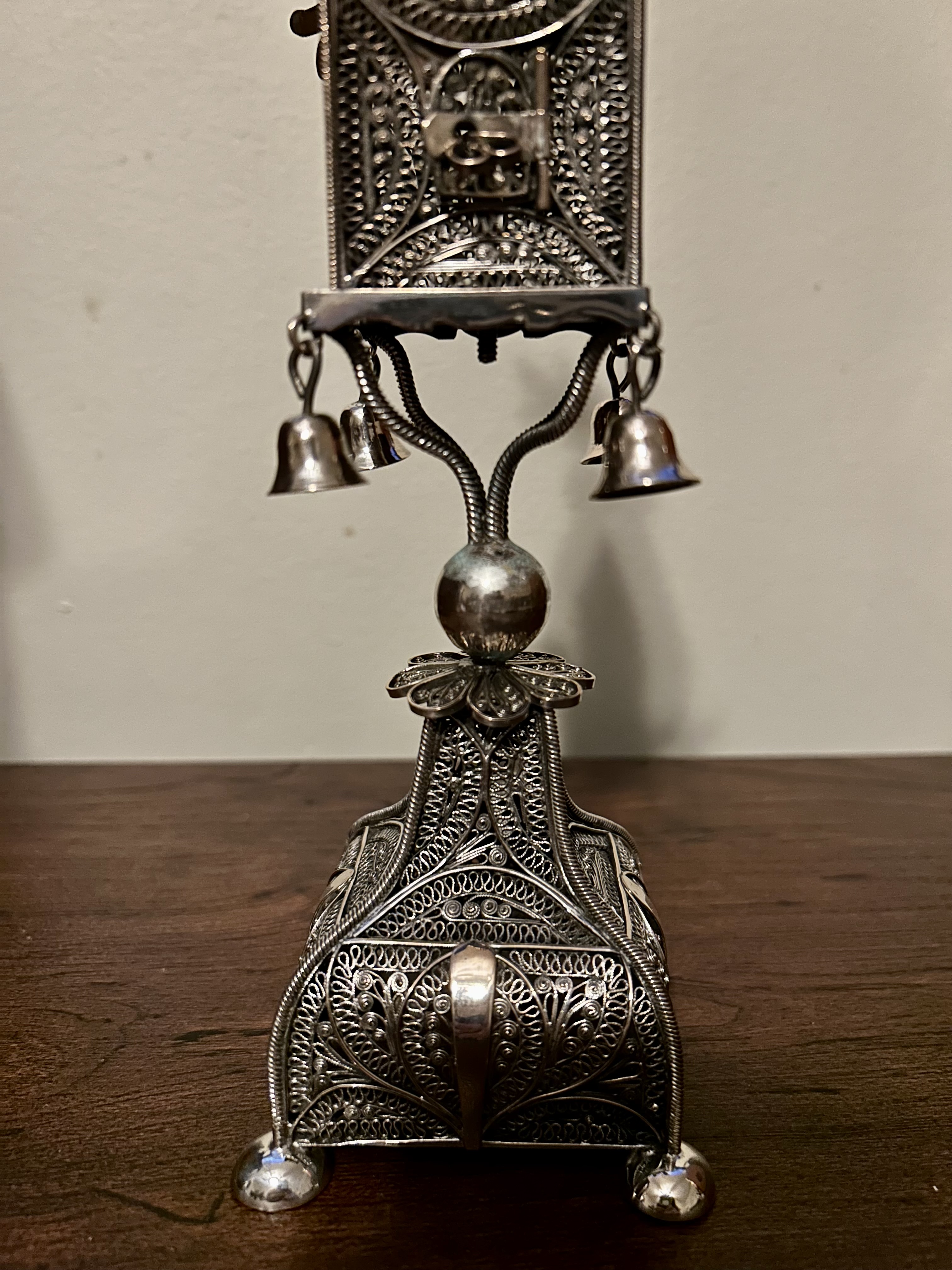
This Havdalah Spice Box has been in my family for generations. Passed down through my mom’s side of the family, no one knows when or how we acquired it. The original ownership papers were lost during the Holocaust, so there is no documentation regarding its purchase. My great grandmother, Ruhla, is the first person we are aware of who owned it. We know that she inherited it, but unfortunately, both her and my grandmother Rebecca passed away years ago. As such, we never learned who she inherited it from. My mom speculates that we acquired it in Huși, a North-East province of Romania. There’s a strong Jewish community there, and it’s where my grandmother was raised.

Composed of silver filigree, the spice box is exactly 12” tall. The base is 4” by 4”, and the top half is 2” by 2”. A Havdalah Spice Box is used during Friday night Sabbath. A mixture of cloves, cinnamon, and cardamom is placed inside. Afterward, the box is passed around, its fragrant scents inhaled.

My mother, Ingrid, immigrated to America from Romania at 13 years old in 1974. At the same time, Ruhla moved to Israel to live with my mother’s aunt, Nutsi. In 1981, Ruhla immigrated to America, living with Ingrid and Rebecca until she passed away in 1996. Unfortunately, she had a massive stroke in 1985, leaving her unable to take care of herself. As such, Rebecca became her caretaker. My mom says that Rebecca worked very hard to make Ruhla comfortable. When creating her will, Ruhla decided that the spice box would be passed down to Rebecca.

However, the will was never written down. Ruhla verbally told Rebecca it was hers, which caused a massive family feud about 20 years ago.

In 2002, my grandmother loaned the spice box to her nephew, Gabi. His son, Ross, wanted to show it off at his Hebrew school. He was supposed to return it after a couple of weeks, but they didn’t. When confronted about it, Gabi’s wife, Brenda, claimed that the spice box belonged to them. After a lot of arguing, they finally returned it in 2007.

When asked about the spice box, Brenda told me that Nutsi’s father, David, wanted Nutsi to inherit it. There is no written evidence of this, as David didn’t create a will. He passed away in 1967 from stomach cancer. As such, my side of the family argued that it was Ruhla’s to give away, since she was the sole owner at the time of her passing.

To this day, Brenda claims that the spice box is rightfully theirs. When Rebecca passed away in 2018, Brenda mentioned the spice box at the shiva. We refused to give it back, and now the spice box sits in our living room. When I interviewed her for this paper, she even started to get angry about it.

She claimed that since her side of the family is more religious, they would use the box for its intended purpose. However, my mom countered that by saying her heritage is just as important to our side of the family as the practice of Judaism is to Brenda’s family. Since 1981, the spice box has been on our side of the family. Throughout my mother’s childhood, Rebecca would prominently display the spice box in the living room, placed in a fine wood cabinet. There’s a lot of emotion attached to this box, which nearly tore a family apart.

Works Cited

Iosefson, Brenda. Interview. 11 Feb. 2023.

“Spice Box.” The Jewish Museum London, 2021, https://jewishmuseum.org.uk/schools/asset/spice-box/#:~:text=The%20spices%20used%20in%20the,separation%20of%20work%20and%20rest. Accessed 16 Feb. 2023.

Veiss, Ingrid. Interview. 12 Feb. 2023.

Sandor Floral Enamel Brooch

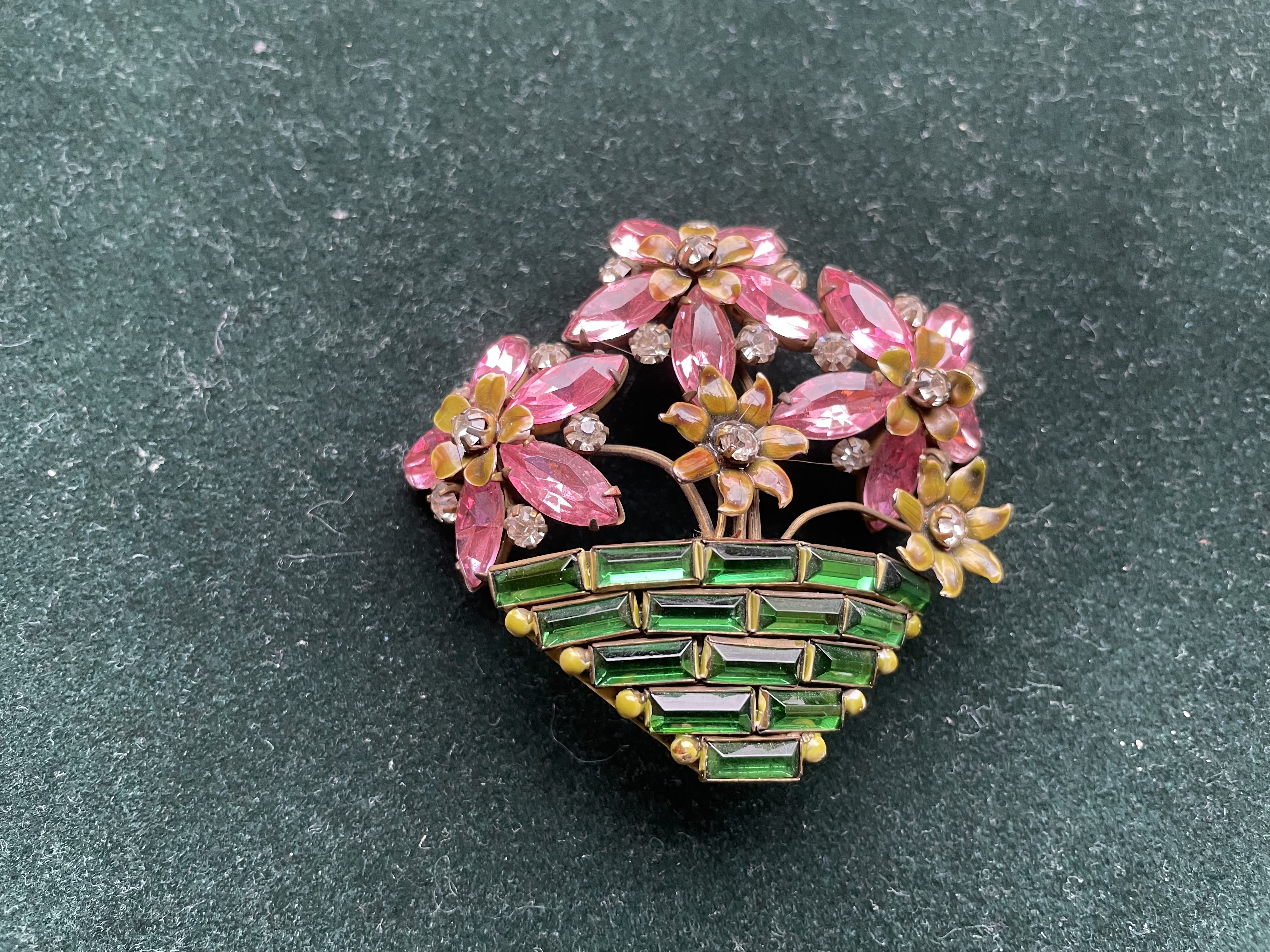
The object that I have chosen to discuss is a floral enamel brooch passed down from my great great grandfather. 

Jane and Sandor

His first shop was known as GS&H, which opened in 1920 in New York City. He worked alongside a man named Mr. Lowenstein. Their creative focus was on buttons, jewelry, and handbag frames, until Sandor married Jane, and Lowenstein retired shortly thereafter. Jane joined the business at a booming time in the industry: the Great Depression. This was great for business as wealthy women could no longer afford real stones, and turned to Sandor’s costume jewelry instead. Due to this, they mainly produced jewelry to keep up with the times, changing the name to Sandor Goldberger, Inc.

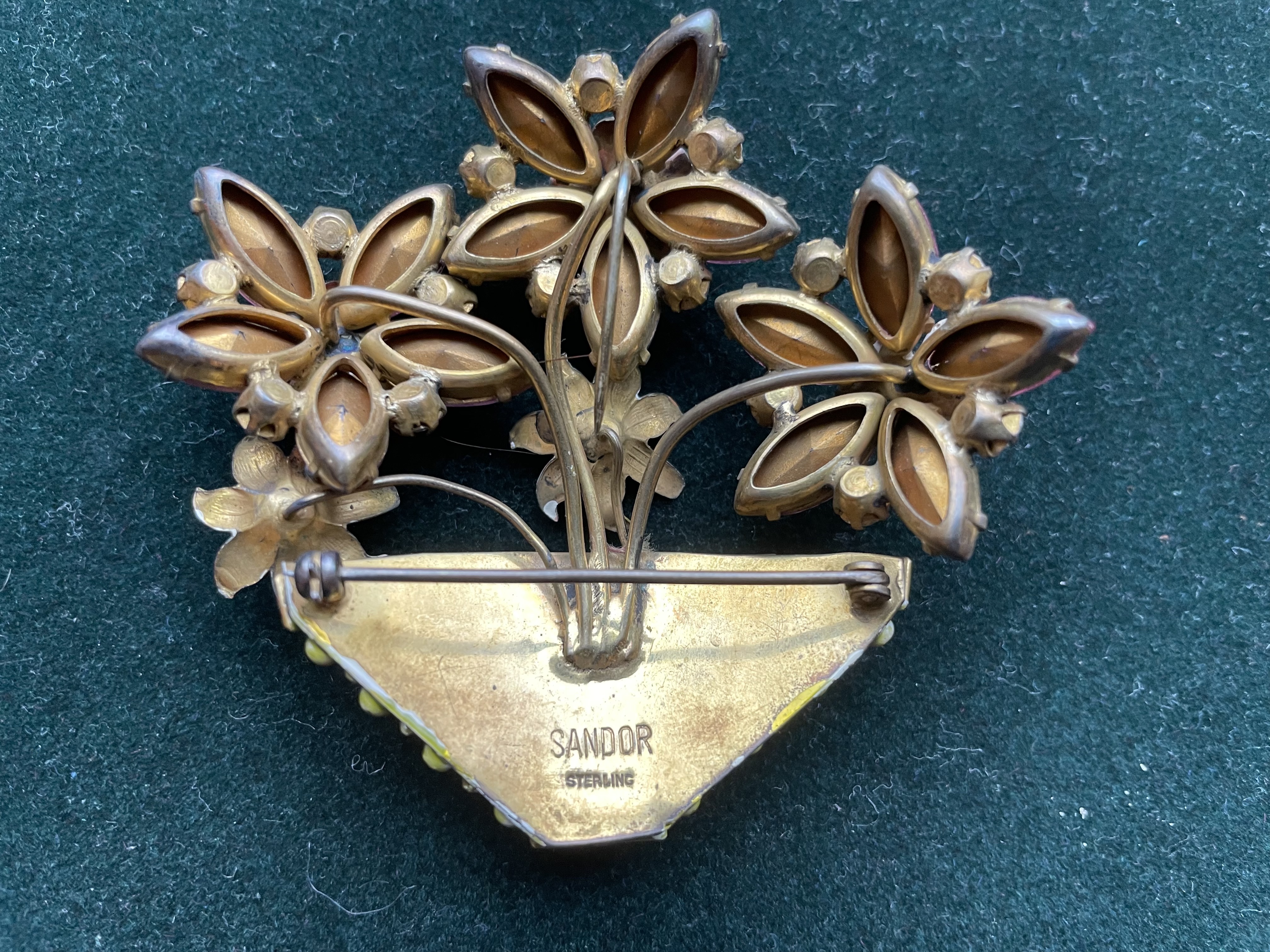
He was well-known for his enamel flowers, such as the one depicted below:

My great Grandma Janet spent an awful lot of time in his shop, helping with the jobs of the day. One day she asked Sandor for this object, and he gave it to her despite it being the best-selling one on the market at the time. This is a brooch (a pin) meant to be worn on dresses, coats, hats, and suits. Big brooches were in-style and Janet wore it everyday.

Sandor and Jane’s families both came from Hungary. When they were young they moved to the United States in search of a better life. My Grandma Carol tells me the family used to call the pieces with diamonds and colored stones Hungarian Jewelry, yet she doesn’t recall why they called them this name, especially since none of the pieces were from there.

This brooch was made of sterling silver in 1943. Normally, they would be made out of brass. This is because of WWII, where brass was needed for bullets and weapons. Although it appears to be brass, it is actually silver that looks brown from it tarnishing overtime. The “stones” are made of glass from Europe, and have been set in place through careful, handmade sterling silver soldering. For a stone to be set, it means there was no gluing involved; similar to the setting of a diamond in an engagement ring. The back is engraved with Sandor Sterling,

The shop was a big open space that glistened in the light from all the stones hanging from the walls. Behind the shop was the workroom. This is where people functioned as an assembly line. The men who formed and set the designs had learned the trade in other countries. Women did the enameling and beading. Though the shop wasn’t the only place these exclusive costume pieces were sold. They could be found in department stores, and even featured in Vogue.

This piece was left for my Grandma Carol when her mother Janet died; though Carol uses this solely for special occasions. She often attaches it to a coat or a purse, specifically when seeing the Baltimore Symphony Orchestra. Carol feels connected to her mother Janet when she wears the brooch, as they used to see orchestras together ever since she was a little girl. Carol now has it pinned onto a heart-shaped Godiva chocolate box alongside other Sandor pieces she was gifted.

Sandor and Jane were focused on making good use of their resources. They would buy pieces from the United States and set them with the European “stones”, all by hand. Sandor never drew out his ideas, he just went straight into physically designing them. Each year, they would produce 3 different lines of jewelry. Each one was through Jane’s eye for future fashion trends, which she based mostly off of Europe. 

My Grandma Carol says she can look at a Sandor enamel flower, and recognize it as his in a jumble of costume-jewelry flowers. The Sandor costume jewelry company lasted until the 70s, and mainly because it was all done by hand.

Nowadays, many of his pieces are being sold on Ebay for much more than they used to sell for. 

My Grandma will be leaving this for me when she passes. As of now, it sits on her heart box in the center of her living room–each grandchild will receive one of the pieces. I look forward to wearing this fine piece of art and hold the family histories close to my heart.

Sources:

Carroll, Julia C. Collecting Costume Jewelry 303: The Flip Side: Exploring Costume Jewelry from the Back: Identification and Value Guide. Collector Books, 2010. 

Bz, Viola. “Sandor Vintage Costume Jewelry.” Kaleidoscope Effect, 15 Mar. 2022, https://nasvete.com/jewellery-company-sandor/. 

“Antiques Roadshow.” PBS, Public Broadcasting Service, https://www.pbs.org/wgbh/roadshow/season/18/anaheim-ca/appraisals/sandor-sterling-brooch-ca-1940–201303T05/. 

Sue. “Sandor Jewelry – History and Collecting.” Paloma and Bianca, 5 Jan. 2023, https://palomaandbianca.com/sandor/. 

“SANDOR.” Sandor Jewelry, https://oldcostumejewelry.com/sandor/. 

“Sandor Jewelry Products for Sale.” EBay, https://www.ebay.com/b/sandor-jewelry/bn_7024757112. 

“Sandor Goldberger.” Etsy, https://www.etsy.com/market/sandor_goldberger. 

Benjamin, Carol L. “Sandor Jewelry Interview.” 16 Feb. 2023. 

Benjamin, Melvin C. “Sandor Jewelry Interview.” 16 Feb. 2023. 

My Great Grandmothers Engagement Shawl

The object I have chosen for this assignment was a shawl inherited by my grandmother after my great grandmother passed away. 

This shawl was an engagement present gifted to my great grandmother, Maria Socorro from my great grandfather, Jose Angel Riera after getting married March 1st, 1947. He purchased this shawl on their honeymoon trip to “Santiago de Cuba” where Maria met his family. 

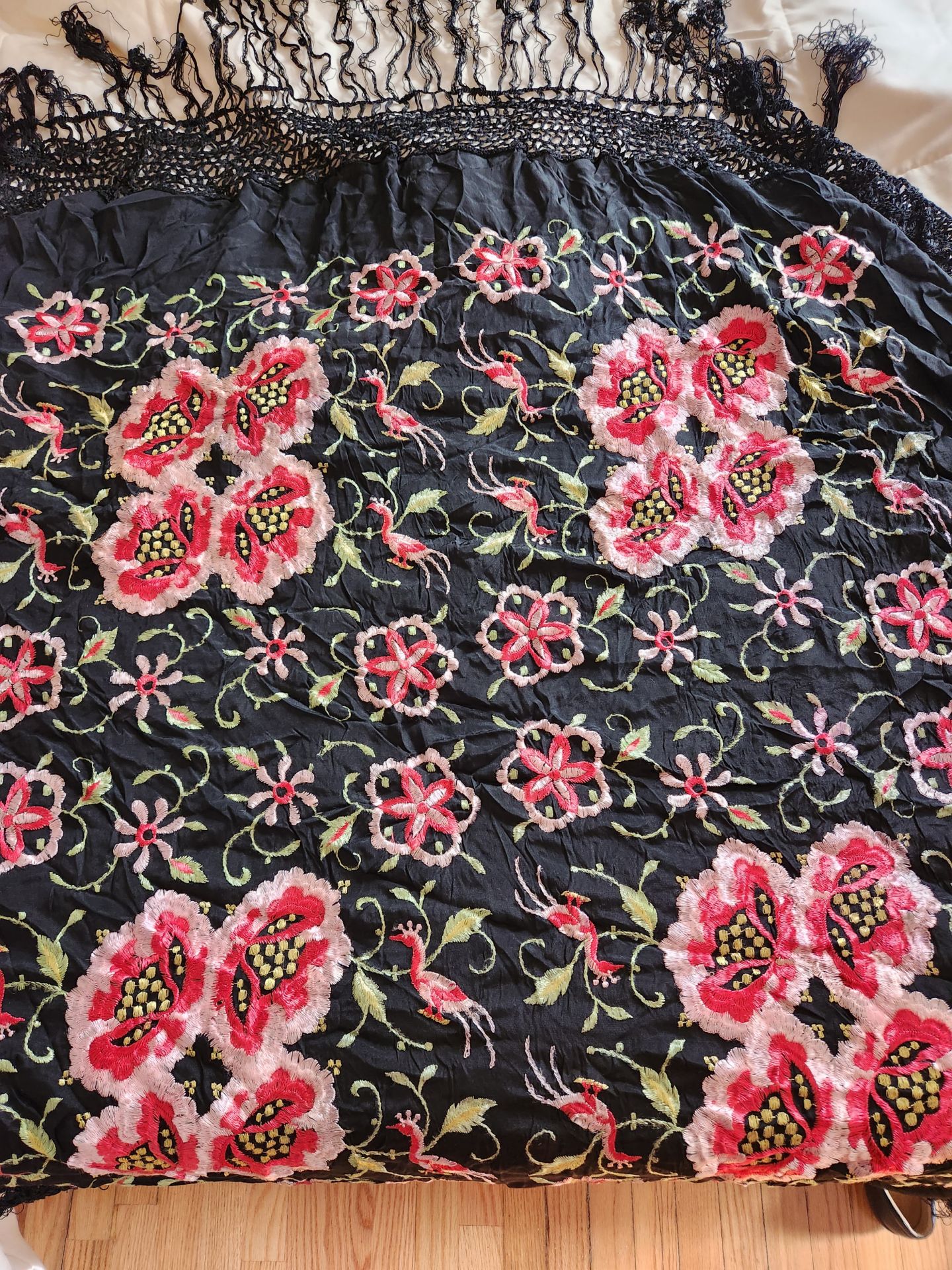
The shawl itself measures 64” by 64” and is very lightweight. While the fabric itself looks to be soft, it is the opposite. It is rough to the touch, similar to the feeling of wool. The embroidery throughout the shawl is very finely done, indicating that it was made by a machine (according to my grandmother). The colorful pattern on the fabric seems to consist of flowers-some of which are bigger in size and grouped in 4 groups of four spread out evenly in a square like shape- and birds, both difficult to distinguish what type. However, the three tails on the bird design, may indicate that it could possibly have been made to depict a phoenix.

After briefly gaining insight on how this shawl came into my grandmothers possesion, I wanted to delve deeper into the events that led up to and occurred during the ownership of this object. I decided to tackle this research by first asking my grandmother the story, as best she knew, of how my great grandparents met:

Maria and Jose’s wedding day. Taken on roof of 964 Fox Street, Bronx, NY March 1, 1947

In 1945, Maria used to work in the Bronx location of Woolworth, which was a five-and-dime retail company that closed in July 1997. She worked behind the coffee counter which sold coffee and sandwiches so customers could eat while shopping. My great grandfather Jose, would always come in and order food, hoping she would be his server. However, with her being only 25 years old at the time and him being 20 years older, she thought of him as an old man and paid him no mind.

My great grandmother lived alone as a boarder, which meant that she paid a woman for room and food accomodations in their household. One day, Maria realized that she was out of sheets, so the lady she was boarding with mentioned she knew a man that was able to sell them to her. So, she agreed to meet with this man to purchase some sheets. Low and behold, this man was my great grandfather and the second he saw her he says, “Look at what destiny has put before me”. From this point, Jose started courting her until they got married in 1947.

Maria has always had an affinity for shawls, scarves or anything that she could wrap around her arms or neck. It was her favorite way to accessorize. My grandma told me she wouldn’t leave the house without one or the other; and she would always make sure to match the color or pattern of it with her outfit. She said that whenever my great grandfather would go out with her he would always say how much he loves how her outfits match her colorful personality.

On their honeymoon trip to Santiago, Cuba, my grandma told me how Jose had planned on getting her something really special. So one day on their trip, my great grandfather snuck away for a bit, in search of a gift for his wife. He came across a busy marketplace with stands of fruit, jewelry, shoes, pots, and then found a stand with shawls and scarves with such elaborate and vibrant patterns. That’s when he knew he needed to get something for my great grandmother here. He picked the one you see in the pictures above because of the black background representing Marias “reserved and tough exterior” and the colorful flowers and birds representing her “inner joy and beauty”. After being gifted this gorgeous piece she rarely took it off, she said it went with everything she wore, so why should she?

Despite my grandmothers collection of family heirlooms and abundance of old pictures, she sadly did not have any photos of my great grandmother wearing this beautiful shawl. But my grandma continues the life of this object as she wears it whenever we have a special occasion to attend. She doesn’t want to wear it too much becuase she wants to keep it in very good condition. However I am very appreciative to have been able to learn more about my great grandparents story and the significant objects in their relationship. I find it so heartwarming how much my grandmother cares for all of her things and tries to collect and keep as much as she can from her past. It further gives me access to unlock things I didnt know about my family’s history and keep these memories alive.

Riera, Pilar. Telephone Interview. 2023

Great Grandma Ray’s Initial Pins 

They are fragile and dainty in appearance, unlike the feisty woman who wore them. 

I have now in my possession two letter pins: An “R” and an “S”, but also an “S” and an “R”. Each letter is curling and elegant; not quite cursive, but fancy enough to evoke visions of a wedding invitation or wax seal. The pins are crafted from a material silver in color and adorned with 36 and 23 clear gemstones, respectively. Each pin is just under 1 ½ inches in height and around ¾ of an inch across at it’s widest point, with a clasp and a sharp pin closure residing on the back. 

Ray Goldstein was born in the Bronx, NY in 1921. At age 18, she married Connecticut-born Irving Shapiro and became Mrs. Ray Shapiro—the strong, stubborn woman I knew growing up Her parents, Anna Rosegar and Samuel Goldstein, a tailor, were both from Vladavostak, Russia. Out of their 12 children, only 6 survived past infancy. My great grandmother was the youngest of all of them—their “little ray of sunshine”. She always hated the name. She thought it made her sound weak, although she still used it for her entire life. When she was growing up, children didn’t ask for things. They didn’t say, “I want this, I want that.” I was always impressed with how fiercely she advocated for herself and the people she loved once she was grown up.

Ray grew up in Manhattan, going to school and Hebrew school. Up until the end of her life, she always loved learning new things. As a teenager, she enjoyed learning about all different subjects, and especially liked reading books. In a phone interview with my sister back in 2015, she said, “I liked to be around smart people. They have a saying, I’ll tell it to you now. If you go around smart people, you become smart. If you go around people who don’t care, you become stupid! So if someone wasn’t smart, like a new girl or someone, I’d say hi and be nice to them, but I wouldn’t be their friend. You know why it’s not good to be around people who don’t care?” My sister filled in the blank here with a, “Because then you won’t care?” to which our great grandma replied, “That’s right. And then you won’t do well in school.” She was brilliant, and carefully curated her social circle. Even well into her 90’s, she stayed sharp and did not miss a thing. When she was still a teenager, she graduated high school, got married, and started working. I can only imagine how many degrees she would have earned if she were alive today. 

I do not know much else about her childhood. She was always very present in the moment, rather than reflecting on her history. She either didn’t know, or would not talk about any unpleasant things. From the few puzzle pieces I have been able to scrape together, I know she had a tough time growing up as the youngest child in a poor family. She did not have many material possessions to call her own growing up, so she began hoarding everything from her extensive teddy bear collection to extra tissue boxes stored away under her mattress. My family always talked about how Morris Shapiro—Irving’s brother—was like a brother to Ray, too. Morris was a Staff Seargent with the 381st Bomber Group of the US Army Air Force, and it hit the couple hard when he was killed in action on January 21st, 1945. Irving fought as a member of the US Navy who participated in the D-Day landings at Normandy. He was wounded while making a landing at Omaha Beach, and again while he was fighting in the Pacific Theatre. He later received two Purple Hearts to commemorate his bravery. 

As a woman, much of her life seemed to be defined by the men in her life. Most of the documentation we do have is mostly about the men who fought in the war rather than the wives who stayed behind. In the 1950s, she was a Clerical Worker in the Jewelry Manufacturing Industry. By the 1960s, she worked at the Empire State building in some sort of secretary or administrative position, possibly book keeping for an insurance company. We think she got the pins around this time. Throughout her life, she was always very fashionable and put together. It was too expensive to keep up with fleeting trends, but she created a wardrobe of timeless classics that would never go out of style. I have memories of her adorned in matching jewelry sets and colorful, fitted blazers. And, of course, her signature coral-undertone pink lipstick. Ray would never leave the house not looking her best, because you never know who you are going to run into. Much like her own physical presentation, she liked to keep her things nice and neat. Her storage bags were very put together and presentable, showing how observant and detail-oriented she was. These pins act as a synecdoche for her extensive collection of pins and brooches.

After 97 brash and stubborn years, Ray passed away. 

We cleaned out her apartment in the stale New Jersey resident’s facility. Her tchotchkes had been attempting to fit in with the extremely Jewish community there, and I somehow know that they appreciated the change of scenery when they were passed down to her daughter, Eileen. While she was still alive, Ray worked hard to make sure her only daughter was successful. She signed her up for dance classes and elocution lessons so that she could express herself and be successful. My great grandmother was far from nurturing, but she still wanted to provide for her family. 

Eileen Shapiro Rolnick had the collection for a few years. I don’t know for certain if she did anything with the pins, dangling necklaces, or showy clip-on earrings, but I would be surprised if she did. My grandma never really got along with her mom and doesn’t like to talk about her very much. Eileen does enjoy jewelry making and other artistic pursuits, but it is clear from her creations how drastically her and Ray’s styles differ. Her late husband, my dad’s dad, was named Stan Rolnick. This “S” is part of the reason my name starts with an “S”, and is important on both side’s of my father’s family tree. 

After a few years of collecting dust, my grandma passed on the collection to my Aunt Elissa Sherry Rolnick, so that she and her two daughters—my cousins, Sophia and Julia Cannilla—could go through all of the accessories. They agreed that everything was beautiful, but unpractical in our modern day. With that, they passed on the collection to my parents. 

When we dug through the large plastic bin, these pins immediately caught my eye. “S R”. Sky Rolnick. The, flip the order and they are suddenly “R S” for my great grandma Ray Shapiro. My parents believe that she bought these pins herself, although we have no evidence, no paperwork to confirm this. They very well could have been gifts. What I do know, however, is how important these initials have become in the tradition of our family names. Perhaps this is part of the reason why these specific pins have stayed in the family for so long, where others have been given away, gifted, sold, and donated. 

Sources:

Alan, Rolnick. Interview. 2023

Eileen, Rolnick. Interview. 2023

Laura, Rolnick. Interview. 2023

Normandy Trip Photo Album. 2008 

Rebecca, Rolnick. AP Literature “Sam I Am” Family History Project. 2015 

United States of America, Bureau of the Census; Washington, D.C.; Seventeenth Census of the United States, 1950; Record Group: Records of the Bureau of the Census, 1790-2007; Record Group Number: 29; Residence Date: 1950; Home in 1950: New York, Bronx, New

Nazi War Medal

The object I chose for this assignment was a Nazi war medal that my dad has had since 1997, and in our garage since 2004. This medal is about four inches long, not including the ring at the top, and about a fourth of an inch thick. I would say it has a diameter of about 3 inches and an oval shape. This medal is made out of bronzed brass and has the german words “FÜR ARBEIT ZUM SCHUTZE DEUTSCH LANDS” inscribed on the back of it. On the front side of it towards its bottom, is a depiction of a World War ll bunker along with a cross sword and shovel making an ‘x’ shape above it. Above that, is a depiction of a German eagle looking to its right with its wings stretched out, standing on top of a small circle with a leaf border and a swastika in the middle. The leaf design that is featured on the border of the small circle I mentioned, mirrors the border of the entire front and back of the medal. At the very top of the medal is a small hole with a bigger ring attached to it. The ring is circular and about one inch in diameter. This ring is also asymmetrical and slightly bent. This ring also has a spot where the bronzing on the brass chipped off revealing a dark gray color underneath the finish.

According to valleyviewcoinsandcollectables.com, these medals are known as West Wall Medals and were considered a military decoration of Nazi Germany. These medals were awarded to specific Nazis in World War ll hence the German inscription on the back translating to “FOR WORK ON THE DEFENSES OF GERMANY”. When interviewing my dad, I learned that he was left this medal when his grandmother, Augustus DelRiccio (AKA Nanny), passed away. He was always fascinated with this medal ever since he was a young boy. He felt as if seeing this medal really made the tragic history of World War ll real to him. When he would visit Nanny and ask her about it, she would tell him about how both of her brothers died in World War ll fighting the Nazis. But before Herman DelRiccio, one of the two brothers, died he killed a Nazi soldier, ripped this medal off of his corpse, and sent it back home to her and the rest of the family. According to Nanny, this is why the ring at the top of the medal is worn down and bent. She told him that the reason he sent this back was to show that he was alive and doing what he set out to do in war. She told him that she kept the medal inside her jewelry box because she believed that leaving it out would release some type of Nazi curse into the air. This was passed on to my dad instead of Nanny’s children, my grandma Diana and my great uncle John, because they were mostly just disturbed by the story whereas my father really appreciated the history behind this object and was able to put himself in the shoes of Herman to really understand its significance without being scared away. I think Nanny saw that ability to appreciate the story behind objects and decided that it’d be best to stay with him. To this day my dad keeps that medal in our garage with a cross on top of it just in case the object is really cursed. 

Works Cited-

“WWII German West Wall Medal.” Www.valley view coins and collectibles.com, http://www.valleyviewcoinsandcollectibles.com/wwii-german-west-wall-medal-p/715.htm. 

Carta, Raymond. Interview. 2023

Grandfather’s Pliers

During the early months of 1942, while men over the age 18 were either drafted or enlisting in the military, my grandfather Romeo had to stay at home as he was only 14 years old. While his siblings and cousins went overseas to fight he was upset that at his age he couldn’t fight. During this summer, my grandfather decided that it would be a productive idea to get a job. As a first generation immigrant it was difficult to find work due to discrimination or language barriers. He went to a local summer camp and asked if they were in need of workers. Upon hearing that the pay was only a couple cents for a few hours of work, he exclaimed, “That’s basically slave labor!!!” and immediately looked elsewhere for work. 

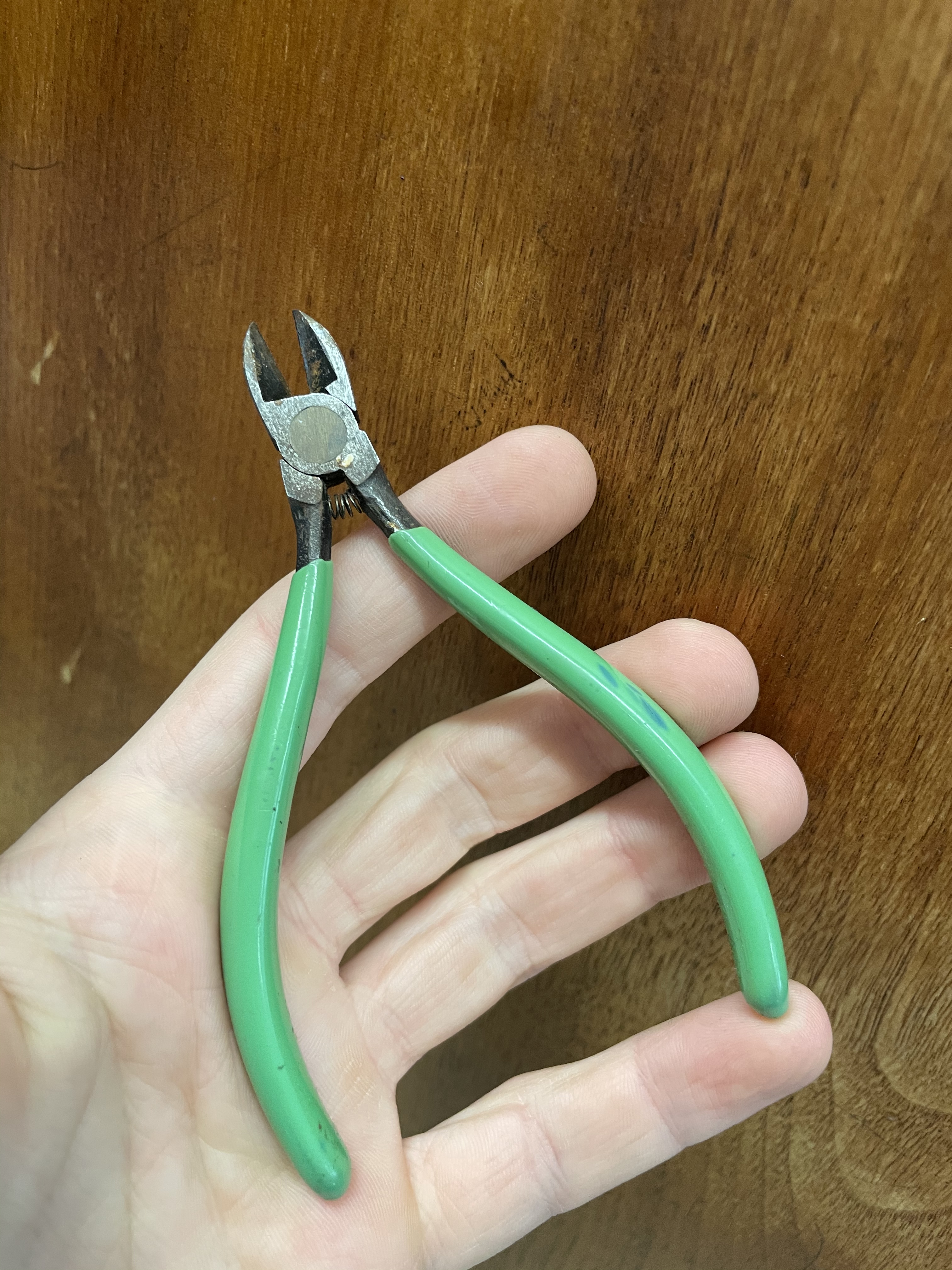
My grandfather is remarkably intelligent, and realized that because all resources, metals, and technology were in demand for the war, being a repair mechanic would be a very lucrative career. He studied up on how to fix up different radios and taught himself how to solder. After a couple weeks he began to market himself as a repair mechanic, with each fix only costing a few dollars. There was such a demand for radio repairs that he was making upwards of 15 dollars a week! While that may not seem like a lot of money nowadays, calculating inflation would be the equivalent of making around 300 dollars a week at 14 years old! His business was so successful that he decided to purchase high end tools to enhance his repairs. That is when he purchased these small green pliers.

Over the course of the next few years he would use these pliers for radio repairs or projects around the house. After marrying and starting a family, these pliers played a very important role in the family. Romeo would teach his sons how to solder and repair radios and other technology. This led to his sons gaining a fascination in science and engineering. With one son going into chemical engineering and the other son (who is also known as my dad) going into computer science, these pliers served as the catapult that launched his kids into STEM related education! After these kids moved out the pliers remained dormant in a tool shed. Never forgotten but laid to rest for a while as the pliers waited for the next opportunity to be used. Only after my dad brought up my passion for jewelry making to Romeo did the pliers find another use. Once my grandfather discovered that I was cutting wire for jewelry making, he rushed towards the garage to give me these pliers. 

These pliers now serve once again for a small business! I constantly find myself using these pliers for cutting wire for creating chainmail jewelry. Despite the age of the pliers and the wear on them, they cut beautifully and better then most modern pliers! As I type this assignment I even have a cut from where I accidentally clipped my skin while working with these pliers! These pliers really tell a beautiful story about my grandfather’s values in life. They were used to construct the best life for him and his family, and are still used to this day to support the family he created.

My Grandmother’s Book

When I begin this assignment, I’m not sure if have any objects that have survived throughout my family history. My grandparents on both sides had come to India from various places, England (my mother’s mother) and Pakistan (my father’s father), only carrying a limited number of personal belongings. My parents, too, came to America with only a few possessions. What did they deem important enough to pack with them? 

Photograph of the book.

I think for a while, searching my house, until I remember that when I was young and loved to read, my maternal grandmother gifted me a book that she had received as a child. The book was passed directly from her childhood to mine, and I was never forbidden from touching this piece of history. I was allowed to hold the book as I read it, to marvel over the black and white printed image pages, to notice the stains and creasing of the paper.  

To begin my research, I first ask my mother what she knows about this book. She only remembers what her mother told her, that my grandmother received it as a prize in her hometown as a child, that it was very special to her. Together we open the book to see the award affixed to the inside of the front cover: “For Good Conduct, Diligence, and Regular Attendance. Obtained 106 Marks out of a possible 106.”  

After I manage to decipher the handwriting on the bookplate, I’m excited to find quite a bit of information that can help me uncover the story of this book. Tadley Corps refers to the branch of the Salvation Army that my grandmother attended as she grew up. I know my grandmother’s maiden name, Jennifer Hicks, and the date she received this book, January 1951. I know the names of the Salvation Army officers who presented this prize book to her. And of course, I know the title and author of the book: The Form That Liked To Be First by Nancy Breary.  

Photograph of the bookplate.

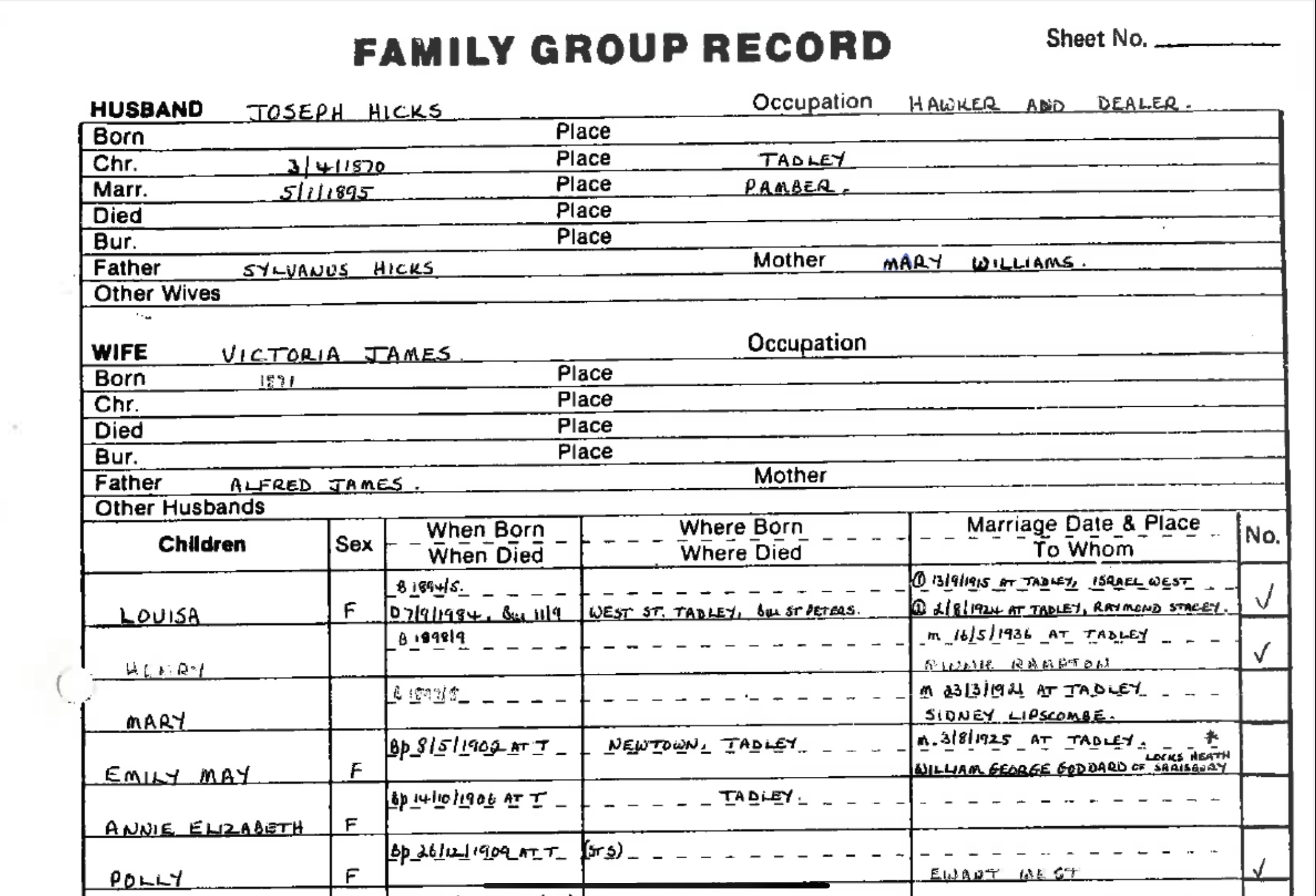
I begin with the small town of Tadley, England. I’m lucky to find an entire website dedicated to the cataloguing of this place and its people, the Tadley and District History Society. Through records of births, baptisms, marriages, and deaths, I confirm that my grandmother was born there in 1938, and her family had been in the area for generations prior. My grandmother referred to her father, Henry Hicks, as a “gypsy” and mentioned that her mother, Minnie Rampton, had urged him to settle down and work a factory job. I trace the lineage of Henry Hicks and find that his grandfather Sylvanus Hicks is recorded as “traveling hawker” and his family was “not living in houses” in 1861, and was living in a “housed van” by 1871 in Tadley. Even his son, Joseph Hicks (my grandmother’s grandfather), was noted as a “hawker and dealer” in terms of his occupation. My family has been moving around for generations, taking with them only the objects they valued. Like this book that I now hold in my hand, which has traveled from England to India and now to America. 

I decide to research the book itself. It was first published in 1948 by Blackie & Son, a company located primarily in London, England. The author Nancy Breary wrote almost 30 books in a genre called “Girls’ School Story,” which “offer amusing stories  – sometimes almost parodies – complete with many over-the-top elements” (Goodreads). My mother tells me that that my grandmother was the first girl to receive a book prize award (my grandmother isn’t sure if this is completely true). I wonder if this is why the church officers chose this book for her, a teenage girl. I think of the entertainment targeted towards teenage girls today, similar exaggerations of the adolescent experience. I wonder what my grandmother thought when she received the book. I want to join her in the moment of congratulations, standing in the Salvation Army Hall, being presented with such a prize.  

A little history: The Salvation Army is a church based on evangelical Christianity, founded in England in the mid-to-late 1800s. A report from the Tadley and District History Society (2009) notes that at the time, it was considered a non-conformist church because many of the meetings were held in the open air and music was an important part of worship. Evangelists known as “officers” preached the word to gain support from the people, and set up “war posts” in areas that had many members. By 1898, the Tadley Corps was meeting in a small building that could not fit the amount of members.

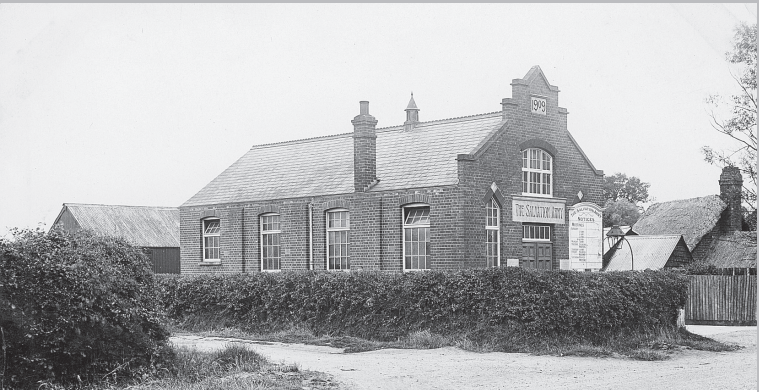
Photograph of the Salvation Army Hall, prior to additions in 1955 and 1978. Source: Terry Hunt, TADS

In 1909, the Salvation Army Hall on Mulfords Hill, the road on which my grandmother lived, was formally opened. This building is still standing today, along with more modern additions to the property.  

I call my grandmother (she lives in India) to ask her what she remembers about her childhood, why her family attended the Salvation Army, why this book has traveled across the world through time. She tells me that her mother’s family, the Ramptons, have always been “chapel people, not Church people” and that her mother joined because she enjoyed watching the Salvation Army band march through the village of Tadley every week. Her mother, Minnie Rampton was highly devoted to the Salvation Army and began studying to become an officer, but her eyesight was too poor. She ended up becoming a Sunday School teacher after marrying Henry Hicks, who also became a Salvationist. My grandmother tells me that when she was growing up she attended Sunday School twice, once before lunch and once after lunch, which explains why she received perfect marks for regular attendance.  

She recounts the months she spent living in hostels in London as a young adult, bringing only a few possessions, including the book. She isn’t sure why exactly she carried it with her. “It’s a children’s story, isn’t it? Must have been just a bit of ‘for old time’s sake’. It’s amazing that the book has reached America. I forgot I brought it to India… maybe I thought I would read it to my children. I didn’t expect it to go to my grandchildren.”  

And yet it has. I wonder where it will end up next. 

References

“Nancy Breary.” Goodreads, https://www.goodreads.com/author/show/717985.Nancy_Breary  

“The Tadley Corps 1898-2009.” Project News, Tadley and District History Society, 2009, https://tadshistory.com/TADS/TADSOLD/Projectnews/projectnews_14pr.pdf 

Red Garden Geraniums

The garden geranium perches undisturbed on my family’s home windowsill. Each day, a member of my family draws open four wooden blinds to flood our living room with the warmth of direct sunlight. Full sun exposure allowed the geraniums to flourish for almost two decades.  

After interviewing my mother (Lisa) over the phone about our geraniums, I recalled many of her oral stories about her childhood that were told over our dining room table. The blossoms of the vibrant red geraniums were my late grandmother’s favorite flower to admire. My brother and I called her “Popo,” which translates to maternal grandmother in Cantonese. She was a caring, hardworking, and sensible woman. Popo instilled values of education—including the importance of learning English—within her three children, Karen, Victor, and Lisa. By completing schoolwork or watching television, the children experienced the cultural values of America. 

I pieced together dates and timelines. In the winter of 1983, my mother was eight years old when she immigrated to the United States from the Guangdong Province of China. My mother shared one of her childhood American sitcoms with me on our phone call. Small Wonder, a series that comically features a human-like robot disguised as a family’s adopted daughter, aired from September 1985 to May 1989. 

Many of the details in my mother’s personal accounts about Popo’s long working hours at clothing and garment factories in New York City’s Chinatown parallel the muckraking in the New York Times Archives. Popo’s sweatshop experience of cutting, sewing, and stitching clothing is similar to the sweatshop conditions detailed in William Serrin’s “After Years of Decline, Sweatshops are Back.” I could imagine her hunched over large and dangerous sewing machines that threatened to pierce her nimble fingers. Garment workers were not given a sustainable hourly or yearly salary; instead, “wages in a Chinatown shop are 50 cents for a [completed] skirt and 50 cents for a [completed] jacket” (Serrin). Popo faced pressure to meet a high garment quota to earn a sufficient paycheck that covered the family’s necessities—rent, groceries, and clothing. The merger and hard-earned wages from the Chinatown sweatshops were not enough to support a family of five. Popo, Gunggung (my grandfather), Dai Ye (my aunt), Cow Fu (my uncle), and my mother resided in a small apartment. Purchasing a potted houseplant for indoor atmosphere and aesthetics was an unaffordable expense.  

Whenever I saw my grandmother as a child, before she passed away from cancer in 2011, she was long retired from working grueling hours at the clothing shops. During Popo’s retirement, she had the luxury of time to pursue a new passion. Under the open sky and comforting rays of sunshine, the whole motion of gardening for Popo was rejuvenating. My cousins and aunt savored the fruits of her labor at their dining room table. For five years, Popo resided in Dai Ye’s home to take care of my four cousins. As a grandmother, she tended a thriving vegetable garden of bell peppers, amaranth greens (“Yin Choy”), and bitter melon. Although the geraniums sitting indoors did not bear fruit, the flowers were special. Popo enjoyed tending to the plant because the geraniums were durable and required minimal maintenance. The presence of red flowers in Chinese culture symbolizes “longevity of life,” but Popo treasures the geraniums because the flowers represent her family’s persistence through hardship (Yelang). I could picture Popo’s proud and serene smile that lifted the corners of her eyes while watering the red geraniums. The red flowers outlived my grandmother’s lifetime and can be found throughout my family’s home. 

In 2004, my family moved into our house in Flushing, Queens. Without any houseplants or meaningful objects, our abode full of scattered cardboard boxes felt impersonal. Popo wished to help my parents begin the next chapter of their story, and she still lived at Dai Ye’s home—which was a quick five-minute drive away. From a geranium planted in my aunt’s outdoor garden, Popo snipped off a sturdy green branch that sprouted healthy and full leaves. She gave the branch as a housewarming gift to my parents. 

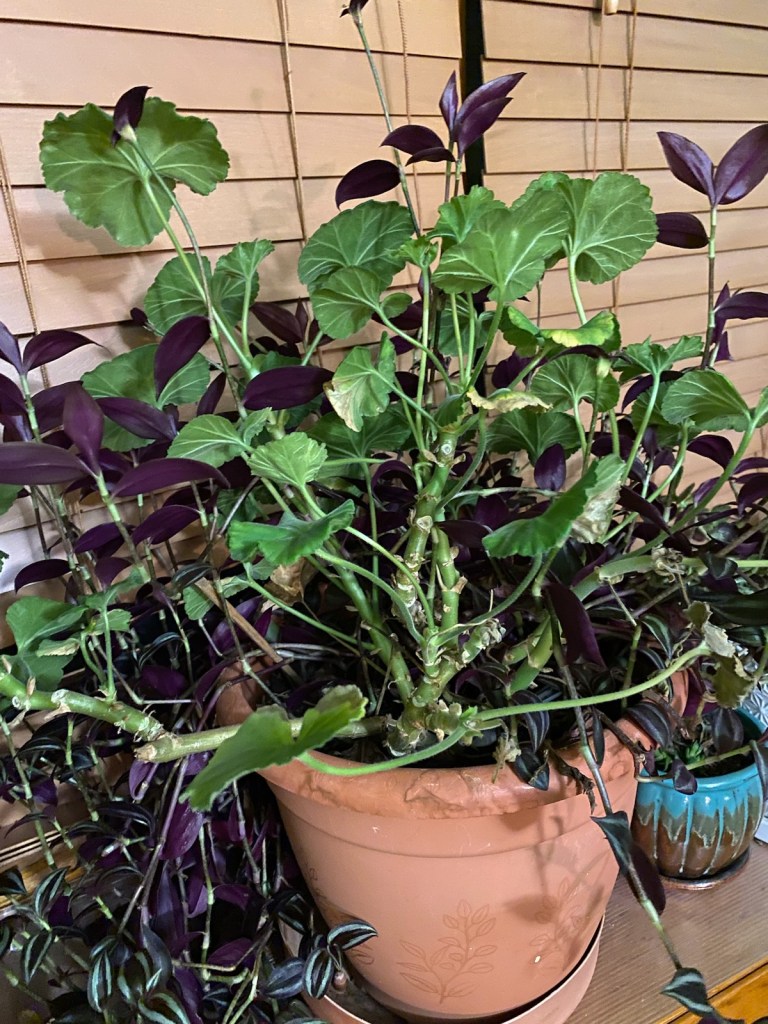
Fig. 1.3 – One branch of a geranium that can be cut from the plant to propagate. The cut should be located at thick brown-green branch, near the black marker. Healthy green leaves, that are circled by yellow markers, should be attached to the branch.

Geraniums can propagate after being cut from their stem. The single geranium branch has blossomed into several bundles of flowers. Today, they continue to thrive despite having an average lifespan of two years. Popo’s love for nature and her green thumb were passed down to my mother. There are many pots full of red geraniums scattered along the windowsill that now welcome house guests. Outside of our home, our front yard is a living and growing collection of peppers, strawberries, roses, sunflowers, and succulents.  

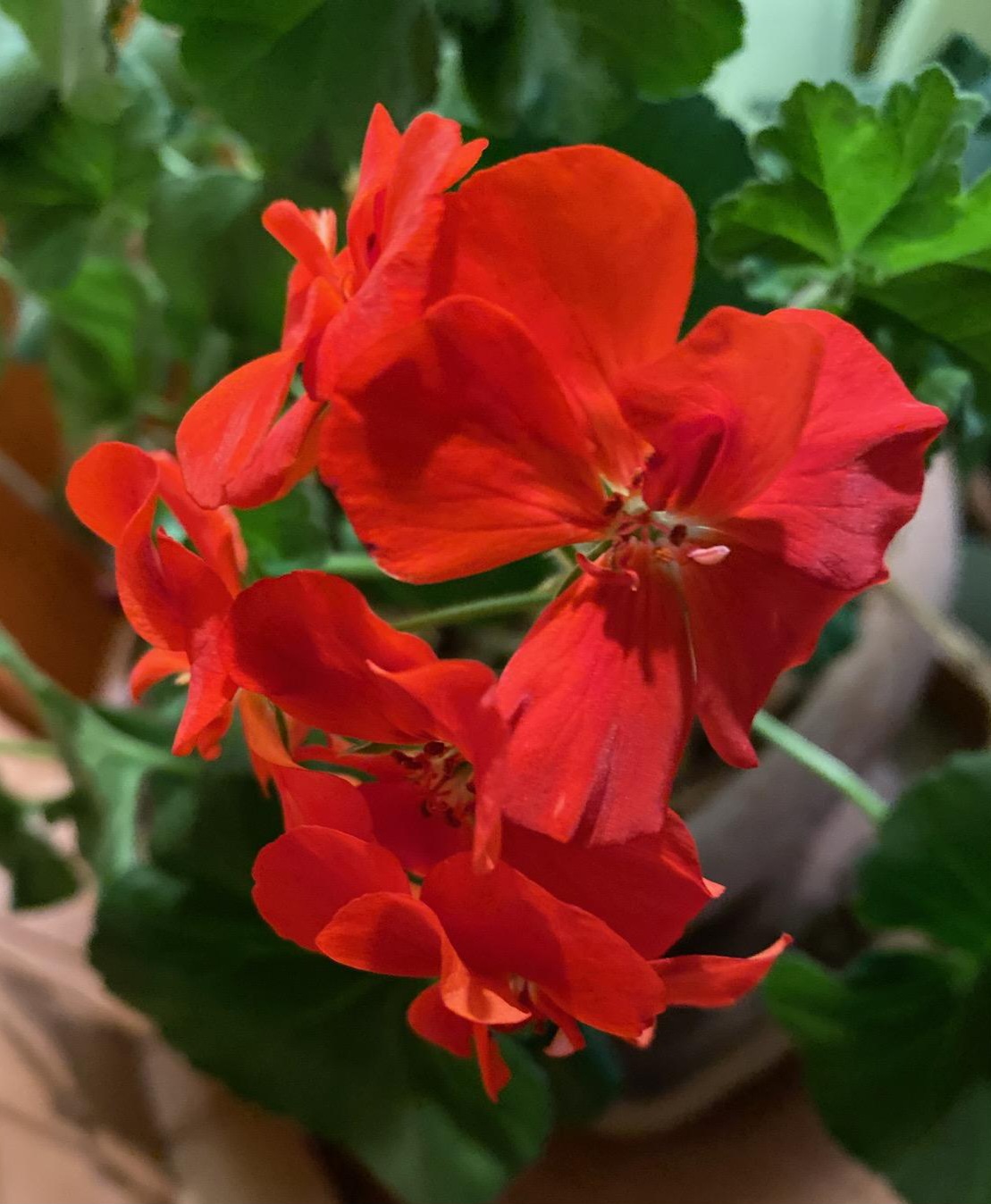
The medium-green leaves, knobby-thick trunk, and vermillion-red flowers all grew from Popo’s original geranium branch. Our red garden geranium is a cherished possession that holds a remnant of Popo and a continuing family narrative of tenacity and resilience.

Fig. 1.4 – Zoomed-in image of my family’s red garden geranium in full bloom.

Works Cited 

Liu, Lisa. Interview. 2023. 

Serrin, William. “After Years of Decline, Sweatshops Are Back.” The New York Times, The New York Times, 12 Oct. 1983, https://www.nytimes.com/1983/10/12/nyregion/after-years-of-decline-sweatshops-are-back.html

Yelang. “Meaning of Flowers in Chinese Culture(12 Types).” Son Of China, 12 Oct. 2022, https://sonofchina.com/meaning-of-flowers-in-chinese-culture/