My Mother’s Lladro

For this assignment, I decided to describe my great-grandmother’s Lladro which was left for my mother when she passed away.

This Lladro is made of porcelain and the cream-colored, stone-like base is about half an inch in height and six inches in width. From a straight-on view starting from your far left, you would first see a human-like figure sitting on what seems to be stacked stone slabs holding a small white lamb with dark brown eyes and pink hooves. She seems to be female and has her right hand paused mid-caress of the lambs head. Her other arm is holding the lamb on her lap. This lamb is laying down with their face pointing toward the inner bend in her elbow. The woman holding the lamb is wearing a white headdress with warm-toned brown hair sticking out and a light gray polka dot pattern. This headdress is tied in a knot under her chin. The top half of her dress is a wide strap tank top-like shape and is a cool-toned brown color. She is wearing a high-neck, long-sleeve top under her dress which matches the color of the polka dots on her headdress. The skirt portion of her dress is loose, touches the ground, and is light brown in color. Half of each of her feet peek out from the bottom of the dress and she is wearing what seem to be simple gray flat shoes, with no visible openings. Her skin tone is almost the same color as her dress skirt but with more of a yellow tint to it and her facial expression seems content. She has brown eyes and black pupils, similar to the lamb, and her eyebrows are not intensely arched but resemble a slightly widened rainbow. She is gazing to her left at a wheelbarrow whose wheel is pointing in that same direction while the handle is pointing in the other. Inside of the wheelbarrow is what looks like a spherical cabbage surrounded by many big leaves with pale yellow coloring towards their middle and light green coloring towards their edges. The cabbage has some texture to it and is a yellow-green color. 

This Lladro was made in Spain years ago and was bought by my great uncle Bobby about 40 years ago. It was a gift from him to my great-grandmother, and when she died her other son, my grandpa Fred, found my mother’s name taped to the bottom of it. He then gave it to my mother Laura which was touching for my mom considering how much this Lladro meant to her grandmother. 

This object acted as a piece of house decor in my great-grandmother’s house and then also in our family home. We had it placed on a wooden shelf in our living room next to any other similar decor pieces we had. I would say this object is pretty unique in the US since it is from Spain but I’m not exactly sure how unique because my mom doesn’t know where in Spain my uncle bought it and for how much. This piece I always thought of this as very beautiful and serene and after hearing the story behind it, I appreciate it even more.

Steamed Stuffed Tofu

The object I chose to describe is perishable within hours. The short shelf-life of my object, after it has been prepared and steamed, transcends my ancestor’s lifespan in which they created the recipe for 蒸釀豆腐. 蒸釀豆腐, pronounced zhēng niàng dòufu in pinyin, translates to steamed stuffed tofu. In my Chinese American household, the homemade Cantonese dish is a staple that combines the delicacies of tofu, shrimp, and fish.  

 
The small rectangular pieces of tofu each estimate to ¾ of an inch wide, ¾ of an inch high, and 1 ½ inches long. None of the pearly white pieces are identical in size, but each is cut from the same slab of soft tofu that originally totaled to a weight of 14 ounces. Each tofu is crowned with sprinkles of cornstarch with balled-up chunks of a pink, gray, and white mixture. These chunks are a dense mixture of shrimp and tilapia (fish) smashed over a painstaking twenty minutes. The fish and shrimp have been rinsed, peeled, dried, and finely chopped. A filling marinade of ¼ tsp of salt, ¼ tsp of sugar, 1 ½ tbsp of cornstarch, and 1 ½ tbsp water is the final component of softening the blend of seafood. The pre-steamed platter of tofu lies on a cold stainless steel metal plate, ideal for conducting heat. There is a slight excess liquid from the tofu packaging on the plate that pools underneath each nutrient-rich nugget. Excess cornstarch lightly powders the surface of the gray plate. While the stuffed tofu rests on the flat smooth surface of the plate, the raised rim is an integral property of a bowl that will contain and protect the dish from excess heat or potential spillage while steaming. 

Fig. 1.1 Pre-steamed stuffed tofu placed in a stainless steel plate.

After steaming the dish, the dipping sauce—containing ¼ tbsp of fish sauce, ¼ tbsp of oyster sauce, ¼ tsp of brown sugar, 4 tbsp of water, and ½ tsp of cornstarch—thickens over a low flame in a saucepan. The sweet fragrant smell of the savory sauce lingers throughout the kitchen air.  

Slightly tinted golden-yellow squares of tofu struggle to balance the weight of the homemade shrimp and fish paste. I needed several attempts to top each tofu, one by one, with the seafood paste. Still, despite the individualized attention while transferring the steamed stuffed tofu from the steaming plate to the serving platter, there are some minuscule triangular-sized fragments of tofu that broke off during the transition.  

 
After 8 minutes of steaming, perfectly well-done stuffed tofu now lies on a blue 10” flower-printed plate. Rich forest-green spring onions cut into ⅛ inch long pieces serve as a garnish. The tofu is drained of any excess liquid. Rough edges are smoothed into a succulent, rosy-pink latter of shrimp and tilapia.  

 
Chopsticks and a soup spoon carefully cradle the healthy delicacy, cupping the delicate slice of tofu topped with fish. Prior to eating, I lather the bottom of the stuffed tofu in a thick viscosity of the golden-brown dipping sauce. Raw sliced vivid-green scallions in the dipping sauce pack a tinge of spice with a rich earthy flavor. The luscious and tangy flavors of the oyster sauce melt harmoniously with the tofu in my mouth. The shrimp and tilapia bind together in a tender softness that has a uniquely elastic and chewy texture. My tastebuds welcome the fresh, clean, and mild hints of fish. Delectable ingredients that lack preservatives compose an easy-to-digest and scrumptious Cantonese cuisine. 

Fig. 1.2 Steamed stuffed tofu set on a decorative plate. The savory dish is ready for consumption.

 
Cooking a savory comfort meal with my mother ignited a new passion project of learning about Chinese cooking techniques like “wok hay.” I want to continue capturing my family’s traditional Cantonese delicacies through handwriting many more sweet and savory recipes. 

Grandfather’s Pliers

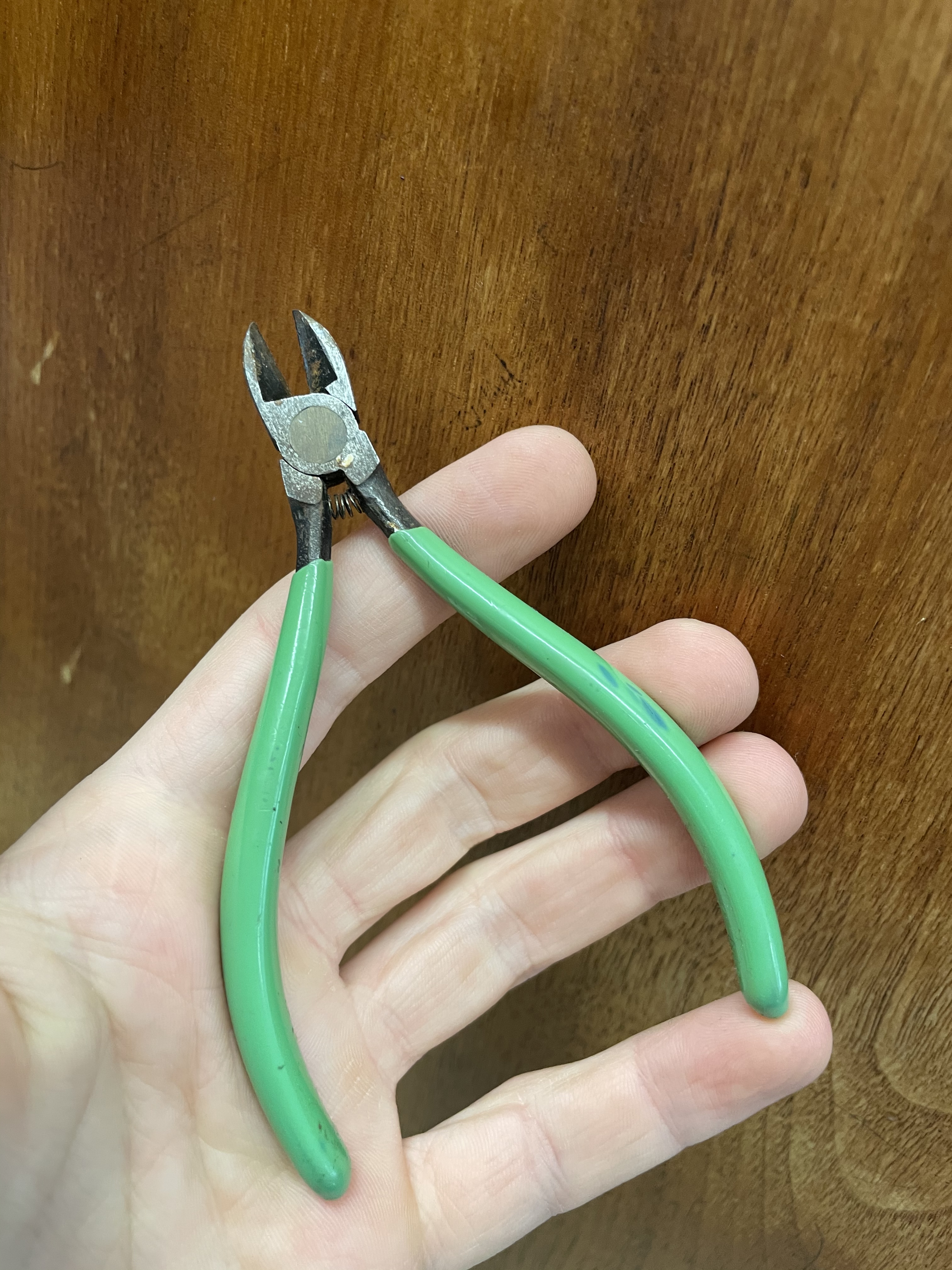
For the past few years I have been utilizing pliers in my metalworking that I received from my grandfather. He used to use these pliers for radio repairs when he was around my age, as he was too young to fight in the second world war, he worked fixing radios. When I told him that I began to work with wire, he excitedly gifted me these pliers. 

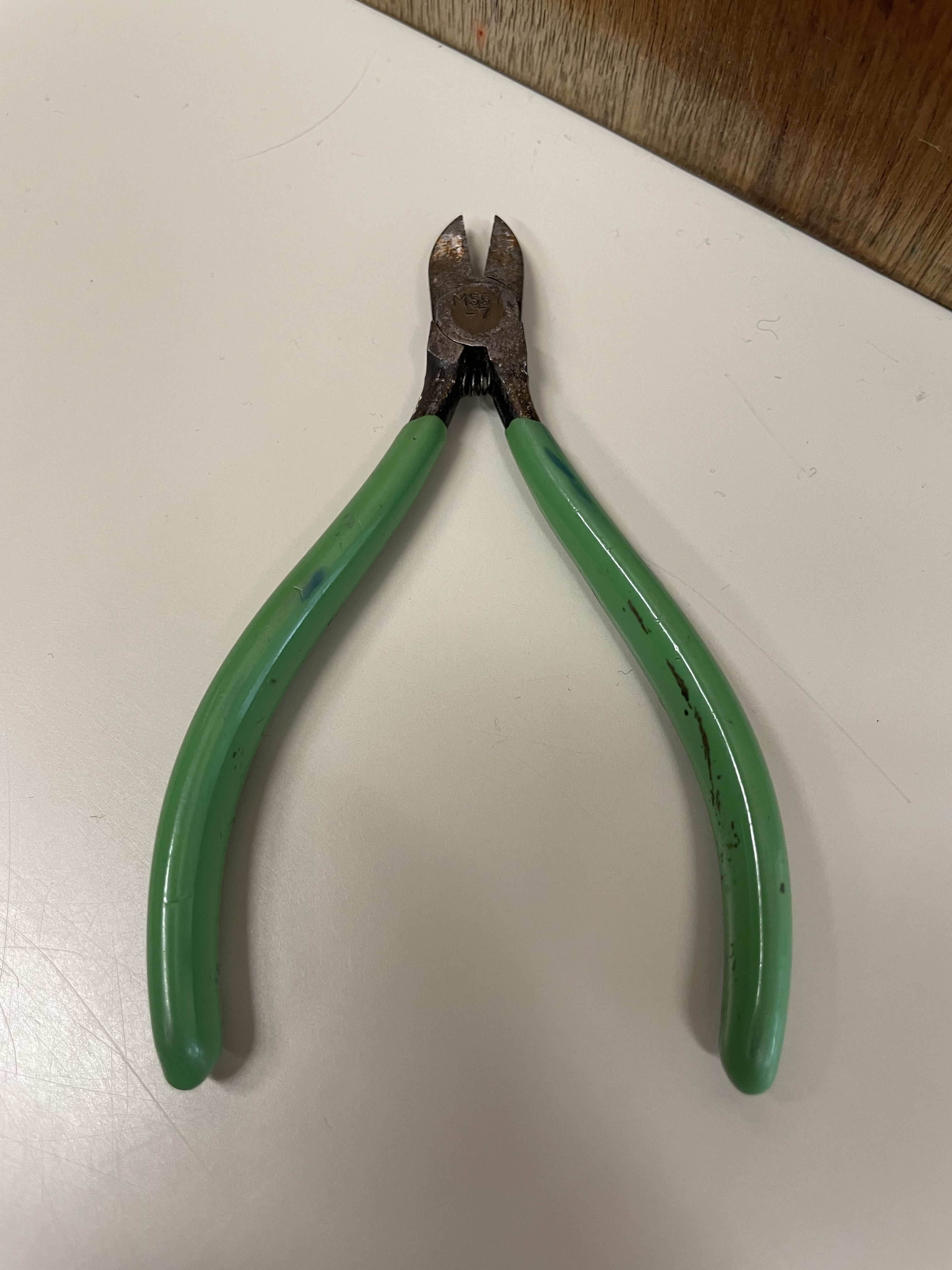
These pliers are three inches in length and an inch and a half in width at the widest point. The pliers are remarkably thin and modest, and almost remind me of an ant. While small in size ants are capable of great feats of strength, these pliers are capable of such fortitude despite the miniscule proportions. The pliers are surrounded by a layer of rubber, this rubber is worn and slightly discolored as layers of metallic dust, sweat and residue have inlaid its way into the plier.

The metal that is not encapsulated by a thin green rubber sheath is covered in a patchy layer of rust and oxidation. The backside of the pliers display the numbers MS54-7. These numbers are not cast onto the plier through heat, but instead are stamped onto the bolt used to help the pliers swivel. When squeezed the pliers demonstrate the simplicity behind the mechanism, two sharpened metal rods rotate towards each other until finally connecting. Despite years of usage the mechanism runs perfectly, and there is no squeaking to establish its age or rust to slow the mechanism and expose its inadequacy. 

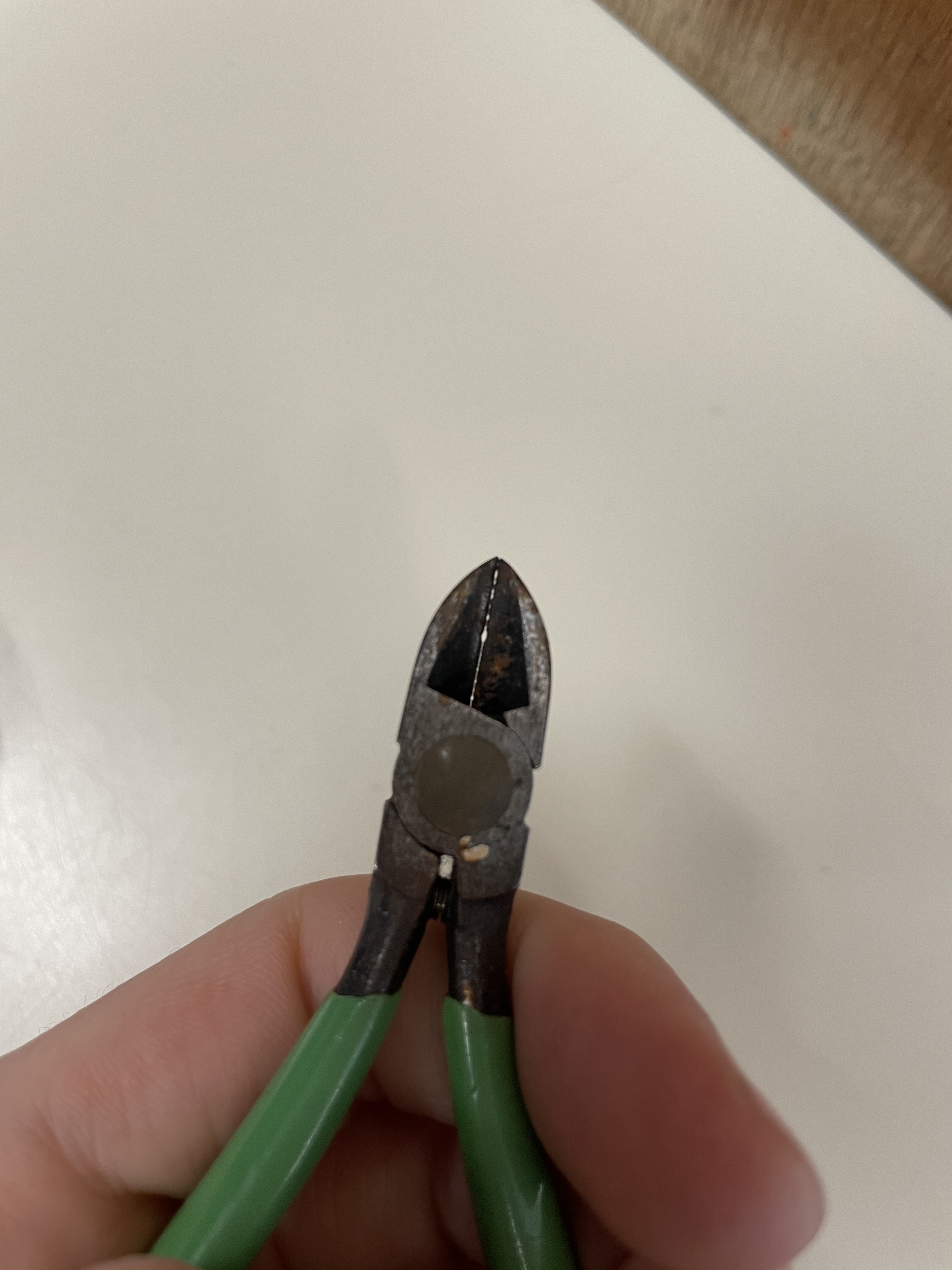
The sharpened blades tell a story of their own as they have been worn down over time, upon close inspection light passes through different areas of the blades. One large gap displays a story of a foolish grandson who tried to cut a large piece of steel with the pliers, leaving a dull area in the midsection of the plier blades. Despite the dulled areas of the pliers, they are still razor sharp and threatening. The rust and residue remaining on the sharp blades indicate that this is not a welcoming area for fingers but instead strictly for non-ferrous metals. 

In the center of the metal lies a spring. Despite the pliers age and heavy use, the spring still recoils with a sense of vigor. When squeezed you can feel the tension build as the plier fights to reopen against your grip. When wire is caught between the plier the spring begins to strain as the stress begins to grow between the wire and the mechanism. In due time the wire always surrenders to the pliers strength and launches into two divided parts. 

These pliers allow me to have a direct connection with my family history and always serve as a reminder of how important my lineage is. Combined with the value of pliers spanning from generation to generation as well as its almost pristine cutting ability, these pliers are a demonstration of my family’s values as craftsmen and artists as well as the value we hold in family. 

My Name Inscribed on a Dog Tag

I chose to describe my dog tag which was made by my grandfather and mother for me when I was a toddler.

The metal is shaped in a rounded cornered rectangular form. It is two inches long from the farthest sections of the outward bulges on the short sides, and one and one-eighth inches wide across the flattened sides. On the externally protruding side, there is a ridge that lines the outer edge of the shape about one-sixteenth of an inch across. The inner portion of the shape dips slightly downward toward this region before the lip abruptly curves upwards and flattens out to line the figure. 

On the left side, flush against the ledge, is a hole that penetrates through the object and measures one-eighth of an inch in diameter. As though a hole puncher had pierced through the object to create the hole, there is a small ring around the hole that extends just above the flattened surface that surrounds it. This is supported by the slight dip in the cavern seen from the back surface. This back surface does not possess a ridge around the edges, though there is the faint silhouette that appears from the tarnished and scratched surface supported by a small line giving the impression of an edge as it matches the width and shape of the other side, but is flat to the surface. 

The surface is heavily scratched, though still entirely smooth to the touch, with most of the markings running horizontally on the same plane as the text. The marks reveal a slightly illuminated shade to the metallic surface. The scratches are of varying length, from merely a speck decorating the surface to a mark nearly an inch across on the back that fills in the space not occupied by the text. There are additional marks that appear as dark streaks running vertically in small clusters on the back, with a few horizontal ones on the front lower right region. These dark streaks create contrast with the much brighter illuminated scratches as well as with the generic color the metal possesses. The primary color of the object is gray with some silver and shine. However, because the most prominent feature of the metal is the general dull tone as opposed to shine, the metal is certainly an aluminum derivation. This is compounded by the lack of rust and scratch proneness that is characteristic of aluminum. 

Somewhat tilted so as to run ever so slightly higher on the left side than the right side as handmade things have a tendency toward, there are the letters inscribing “ALLYSON C SHENEMAN” that appear as though stamped into the surface to protrude upwards, similar in feeling to running your fingers over braille imprinted into metal signs. From the back surface, the letters can be seen mirrored along the horizontal axis, reflected from the front of the object. 

This dog tag was made for me when I was three years old to honor my family’s long military history. As such a prominent influence in my life, I went to flight school in preparation to join the Air Force, and used this as my good luck charm, despite my generally not superstitious tendencies. My life plans and aspirations changed due to medical complications, but I continued to keep this dog tag with me on every journey on which I embarked. Following the passing of my grandparents it has doubled as a memento to bring them with me everywhere I go.

Picture 1 (above). My dog tag pictured from the front

Picture 2 (above). My dog tag pictured from the back

Picture 3 (above). A penny for scale comparison above the dog tag

Woodblock Stamp

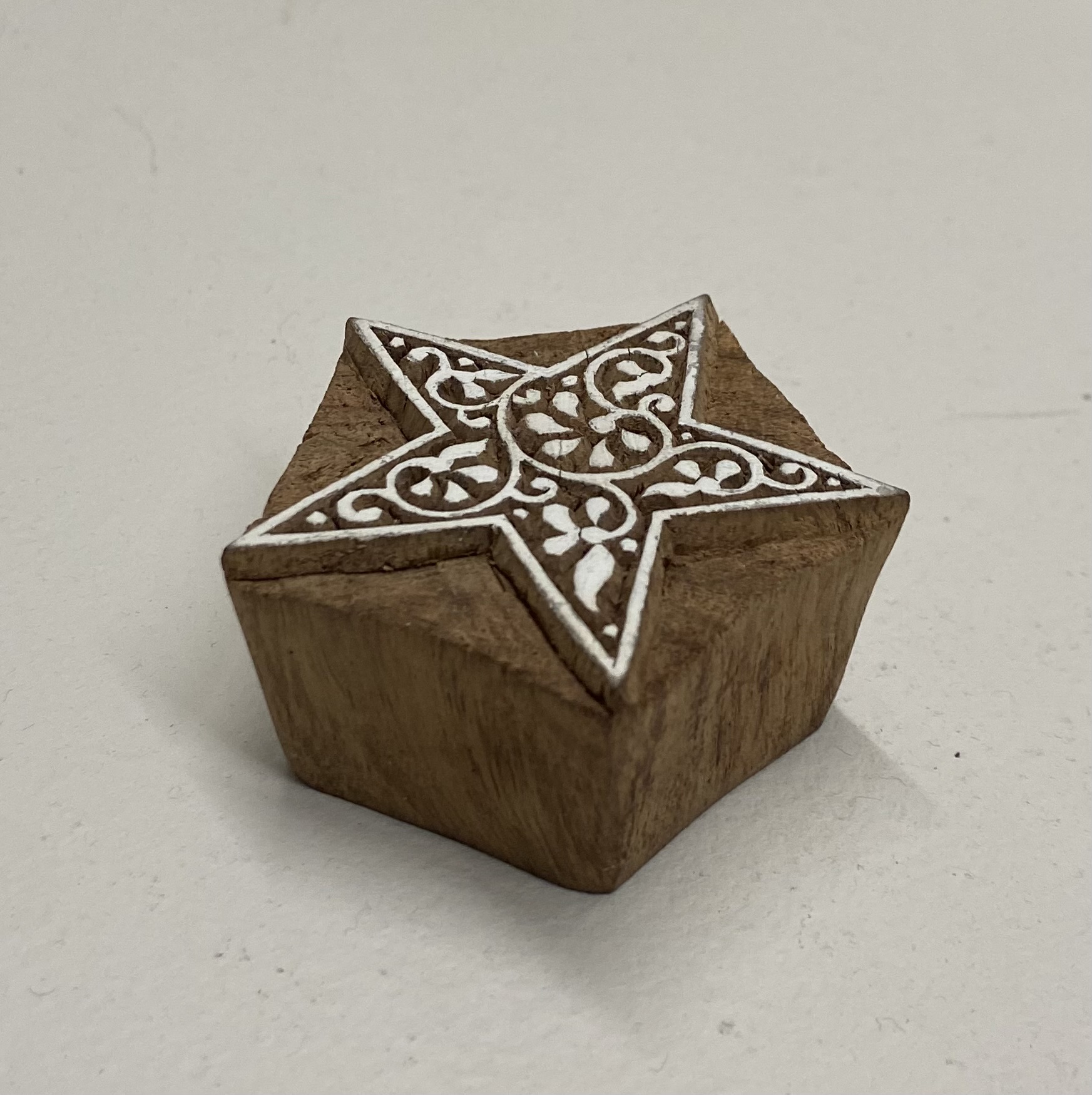
Top view of stamp
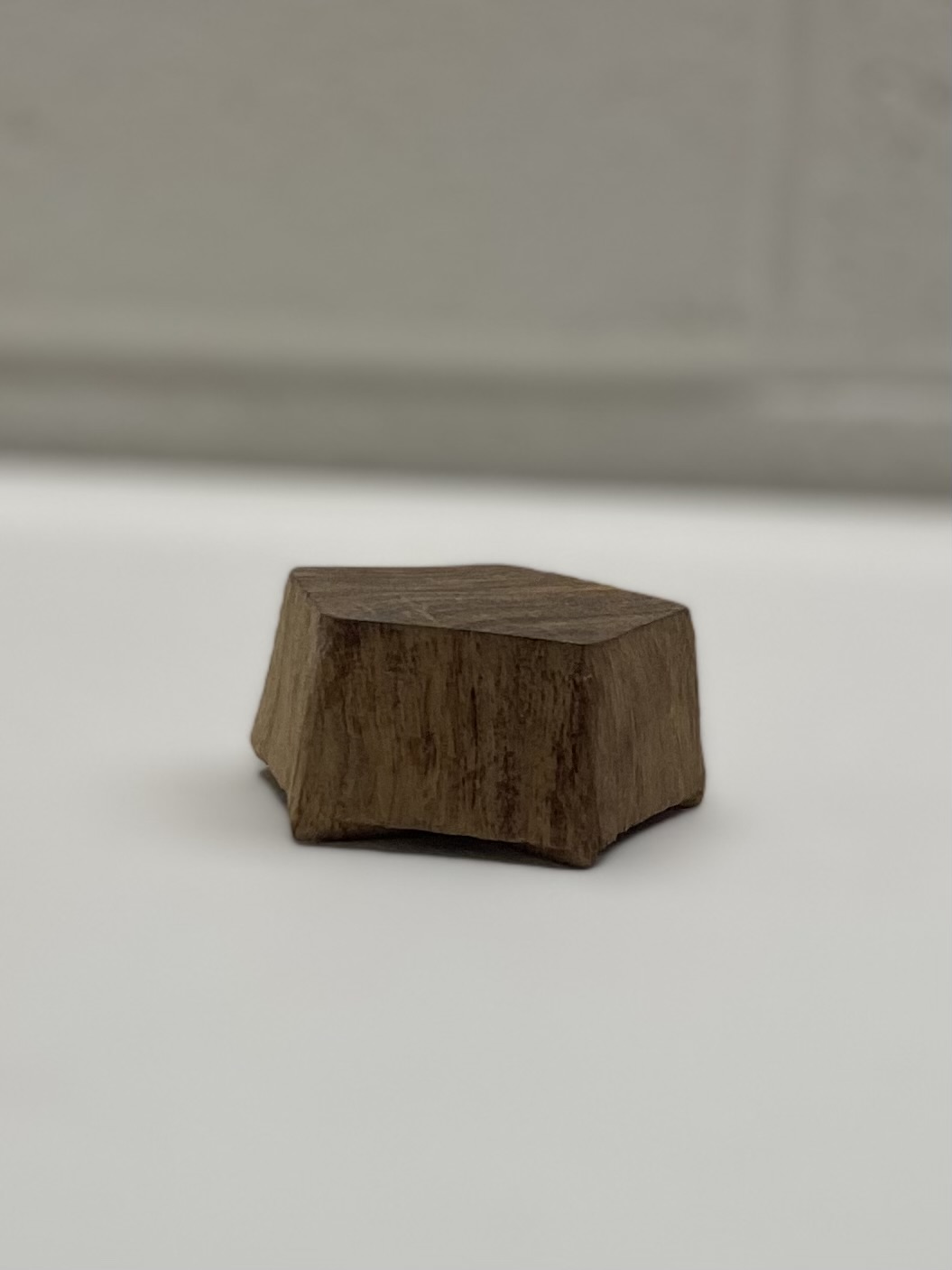
Side view of stamp

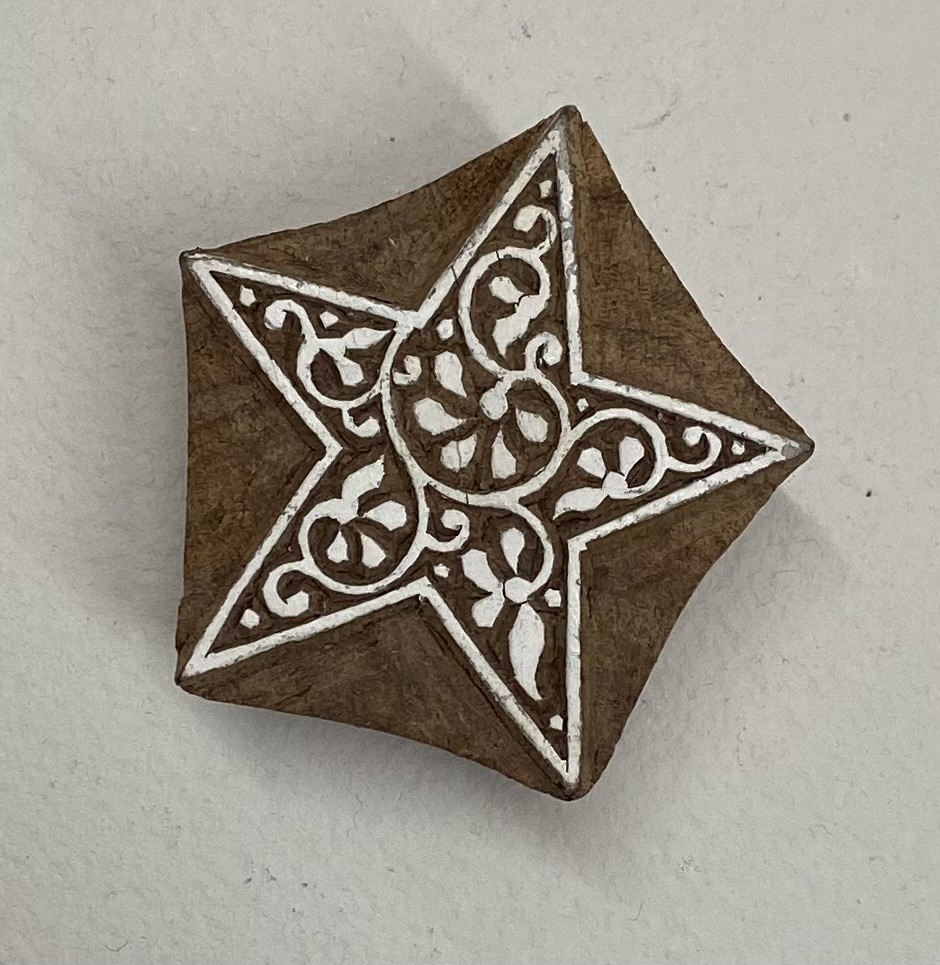
This is a woodblock stamp, one of the few that remain of a collection that my mother bought from a woman who was carving them on the side of the road in Mumbai, India when we visited my family there around 15 years ago. 

The stamp is carved from a warm-toned wooden pentagonal prism with a height of around 1” not including the protruding design. The faces are parallel, with the non-incised base being slightly smaller than the incised face so that the walls are not quite perpendicular to the faces. Each wall of the bottom pentagonal base is about 1.25” while each wall of the top pentagonal face is 1.5”. The walls of the prism are slightly concave, some more so than the others. Each wall feels smooth when I drag my thumb across it vertically, but horizontally I can feel the tiny ridges of the wood grain.  

Stamp upside down

The bottom of the stamp is the smoothest, flattest face. I can run my finger along it without catching any rough patches. A pattern of wavy wood grain is visible across the base but has been disrupted a bit by a few scuffs and scratches, although these are so small that they do not affect the level feeling of the surface.  

The top side has a pattern that protrudes about 1/8off the surface of the stamp, emphasized by a thin coating of white paint. A 5-pointed star creates an outline for the pattern, each point at a vertex of the pentagonal surface. Each side of the star is around 1” long. Outside of the star’s outline, the top surface of the stamp is roughly carved so that it resembles the texture of a hard piece of cork. Cracks are visible and my finger can feel the irregularities in the wood. If I try hard enough, I can scratch little splinters off the surface.  

While the star itself is symmetrical, the design inside of it is not. It is made up of a curving spiral, small dots, and organic shapes reminiscent of florals. From one inner vertex of the star comes a curve that coils through the center of the star and branches off into each arm of the star. On the arm of the star directly opposite to where this curve begins, a large organic leaf-like shape reaches up into the point from the curve. The other arms of the star each contain a piece of the same curve that spirals into a rounded end. There is a small dot in the thinnest part of all 5 arms. There are more organic leaf-like shapes and dots throughout the inside of the star, as well as some teardrop-like shapes and smaller spirals extending off the continuous curve.  

Around and in between the white-painted elements of the design, the wood has been etched into so that only the design itself reaches a level height. The etching has not been done strictly perpendicular to the surface, but instead creates little irregular sections within the deeper wood, almost outlining each element of the design. This leaves unfinished areas of wood that are too small to reach but would probably be rough and splintery to the touch.  

But this stamp does not exist simply to be observed; it is meant to be used. When printed onto fabric or paper, the design has a chance to exhibit itself, while the stamp remains a tool. After examining its form and craftsmanship, this stamp seems to be just as worthy of attention, if not more so, compared to the design it produces.  

Short Assignment 1: Ring Description

I’m describing a ring I wear every day (and never take off). 

The metal band has a diameter that is about as wide as a single key on a laptop keyboard. The metal is silver. It remains untarnished. The band is extremely thin. One could slide it under the top of their fingernail. The circle isn’t smooth or perfectly round. It looks as though the parallel sides of the shape have been pushed away from one another, creating almost more of a triangle shape than a perfect circle. The band is slightly flat on the bottom, allowing it to stand up on its own flat surface. The band itself has a rectangular shape to it, meaning the band is not exactly cylindrical. This allows for space on the inside of the band for an engraving. 

On the inside of the band, “925” is stamped into the metal. The stamp is about the size of a gnat. The numbers are stamped in a dark black color, contrasting them against the silver metal. 

Three metal cone shapes protrude from one quarter-inch section of the silver band. They are small, smaller than the letters on the keys of the mentioned keyboard. They are only distinguished as three separate cones by the engraved lines on them. Without these lines, the cones are connected as one, three-pointed shape protruding from the band. One can discover this upon turning the band around to view the back of the shape, which is smooth and without engraved lines. 

The three cones are embellished with the same color engraving as the “925” on the inside of the band. They don’t all peak at the same height. From right to left. The cones are short, tall, and short again. The rightmost and leftmost cones peak at the same height and are slightly smaller than the middle cone. The engraved lines accentuate the wide bottoms of the cones, which sit closest to the band itself, and then taper up the sides of the cones. The lines also carve out small stem-like bases on the cones, which connect them to the band itself. The three cones are uniform; they look the exact same despite the varying sizes. There are six lines on each cone, all situated at a slanted angle on both sides of the cone as they taper upwards. This leaves a triangle shape at the top of each cone. 

Due to the engraved lines, the cones are left in arrow-like shapes, pointing up towards the sky when it sits on the table. The band is not displaced by the weight of the cones, and sits upright on the table due to the mentioned flat surface of the rectangular-like shape of the band itself. The design is fairly simple, and vaguely resembles a crown of sorts when it sits upright. When it is slid on a finger, it gives the illusion of there being no metal band at all, leaving just the cone shapes in the front. 

Dragon Pentacle Pendant (& “Lo mein” cord)

For this first assignment, I am describing my dragon pentacle necklace. My mother purchased it for me from the small selection of items on the clearance table at Dragon Realm on Main Street here in New Paltz. I have since replaced the fabric cord with one of nearly identical properties, but the pendent remains the same as the day it first came into my possession, weathered only by time, travel, and wear. 

The pendant is constructed of a thin flexible metal with properties similar to those of pewter. It is a light silvery grey, and reflects the light in patterns that dance on the slightly raised edges of the structures. When held in one’s palm, it is surprisingly light, as if it could take up in flight at any moment, yet it emanates a sense of grounded protection and strength. For the uniformed, a pentacle is a symbol consisting of a pentagram, shaped like an upright star, inside of a circle. This circle is 1 ⅛ in diameter. Each straight line of star section is just under 1 inch, and the dragon, when measured wingtip to wingtip, is 1/16th shy of being exactly 2 inches long. 

The points of the star are connected to the outer circle on four points, but the top point has a thin slice where it is no longer connected to the outer circle. The metal is darker at the points of overlapping intersection in the star design, while the outer circle is lighter in color and the most thin on the top third of the circle, making it extremely fragile and easy to bend back and forth with light pressure from the fingers in opposing directions. One can bend the star outside of the circle into a more three-dimensional shape, although the two thin scratches where the outer circle could easily break off completely become more prominent with each experimental push. I am thinking of gluing or somehow securing it soon, as I am afraid of the pendant breaking. 

The piece is cool to the touch, and carries an aroma of the musty “Witch City Wicks” scent “Holy Ground” of Salem, Massachusetts mixed with the smoky, pine-gilded ember air of “Dragonfire & Brimstone” perfume oil. Underneath this first layer, there is s slightly dingy, iron-y metallic scent. 

The wings are bat-like, and evoke a leathery, or perhaps scaly, texture despite their metal material. The wings curl upwards at the end in a proud display of flight as they complete the bottom third of the outer circle. The left wing (or the right, if we are positioned in a way similar to the creature), has a larger ridged spike than that of the other wing. The same spot on the other wing feels jarringly rough and sharp—though not enough to elicit any sort of cut or injury from feeling it—as though it once was adorned with a similar spike, only to have lost it from wear and tear. 

The head tapers down into a reptilian snout with two miniscule indentations that seem to mimic nostrils. Past the bridge of the nose, there are two darker depressions in the material where one would expect eye sockets, which lead to two gently curving horns and a raised back spine. The placement of the horn-like structures is evocative of where one might draw eyebrows on a more humanoid figure. The figure is positioned so that, when worn, the creature is facing downwards towards the floor (assuming the wearer is upright). The creature wears a somewhat placid expression—although I realize it can be difficult to read an expression without a lower jaw and therefore no mouth, a fact we have all become familiar with through wearing masks on the lower halves of our faces these past few years. The face is scuffed up with worry lines under the eye sockets, as well as other shallow indentations, adding to the overall structure and dimension of the intricate head.

When observed from a new angle, the entire piece is remarkably flat, and appears as though soaring horizontally, the head and wings dissipating into a remarkable side-profile of the rotund pentacle body. Only the head is raised, with the eye and forehead area tapering down into the snout. The bottom side of the head, where the lower jaw would rest if this creature had one, has a considerably large indentation. It is smooth, and allows the top half of the face to be raised on the other side. The cord of the necklace is laced through a small hole at the top of the pendant. When laid out end to end, it is 2ft 7 and ¾ inches. It is just about 1/16th of an inch in width, and is made of a black, slightly stretchy fabric material.

The cord is round, flexible, and soft to the touch, not unlike a worn rope or piece of twine might be. Due to its round and thin nature, I frequently refer to this type of necklace as a “lo mein noodle”. Each end feels slightly harder than the rest of the cord, and uneven in such a way that they may have been burned or singed to prevent extreme fraying. Despite this effort, there remain (or perhaps have come into being) some small fibers sticking out in random directions on the edge. Upon closer inspection, one can see that the cord is composed of many smaller threads that have been weaved or otherwise intertwined together to create a single larger whole. 

Fig. 1.1 Front view of pendant

Fig. 1.2 Back view of pendant

Fig. 1.3A Side view of pendant

Fig. 1.3B Slanted side view of pendant

Fig. 1.4 Pendant with full attached necklace cord