Because my mother is the artist who finds beauty in a pulled thread or a burned match
My house was filled with crap
And no one understands that we are the creators of worlds
The gilded pieces on our walls float from the rubble which coat the concrete basement
And creep up the ceiling until they themselves are found
as gifts under lover’s trees
“Aesthetic Waste” is not a singular project. It is the theory and inspiration behind this art installation, the title of this poem, and the ongoing mindfulness within my life. The original goal was to bring awareness to material usage and waste in the artistic community. However, as the project progressed from an idea to a reality, I found the idea of self-worth coming up in terms of what is being thrown away.
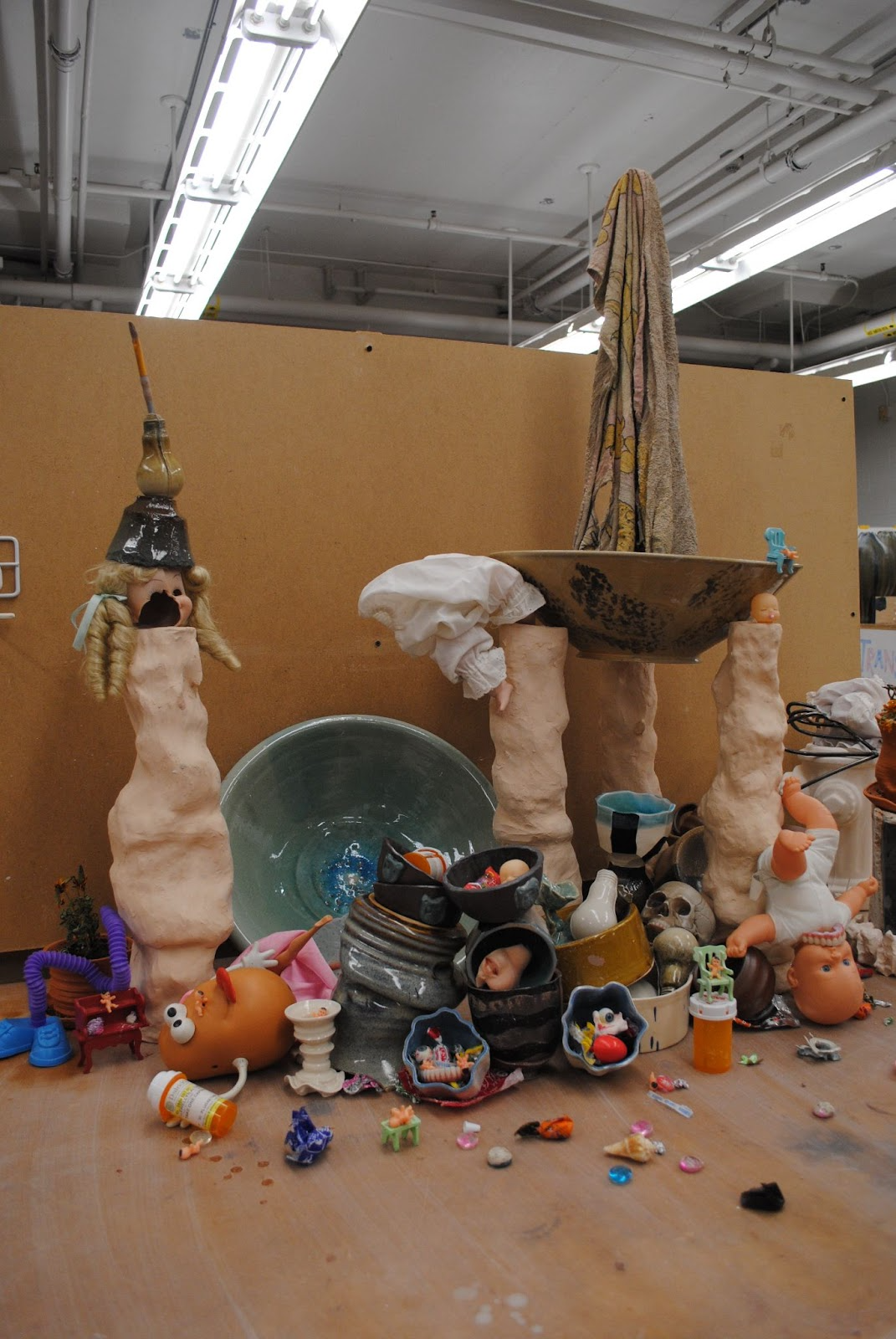
This installation involves ceramic work that was intended to be thrown away by myself and seven other artists, plus a plethora of found items that were going to be used for art projects and abandoned. I realized in the quest for perfection in craft, we sacrifice the reality of the art-making process. Pieces that aren’t “good enough” are thrown away, even those that are still usable. Pieces that break do not get repurposed as they could be most of the time. Miscellaneous art materials purchased with intention are often tossed into a corner to collect dust. In this piece I chose to celebrate these lost ideas through objects intended for the landfill.
Last semester in the ceramic studio I realized that in college, professors don’t refer to what we make as “artwork.” They call it “work.” It is work. It is patience. It is practice. It is mindfulness. As a collector of things, I accumulate objects that other people consider to be waste. I have been meaning to make a “shit sculpture” (for lack of a better word)for quite a while. Preparation for this installation involved finding objects that fit my criteria, unwanted items like broken pottery and old art projects. I intended to create a pseudo-landfill filled with life and hope-even in the face of death. Tiny baby dolls are juxtaposed with skulls and dead flowers, while broken and unsatisfactory pots rest atop unfired and abandoned work. At the top, a crusty towel stands on its own, begging the viewer to see a waterfall, thereby creating a visual hint to what our mind views as landscape. Aspects of the scene are disturbing and grotesque, while other parts are playful.
As finals approached, I saw how excessive my material usage is. The catalog of pieces due the week of May 15th was 20 large-scale drawings, a sculpture made of steel and plaster, 140 realistic Ancient Roman cups and bowls, and my own personal ceramic work to apply for senior studio. My craft is being honed and my eye attuned to details as never before. The work I have accomplished is very important to me. I now notice the difference in thickness of a pot by the sound it makes when I tap it. To get to this place has yielded one piece I am proud of for every 50 that are not successful. It pains me how much material was wasted with all the pieces I was unimpressed by. I realize that disappointment within myself is not enough to warrant added excess trash on Earth.
My life experiences, thoughts, and feelings are processed the most deeply through creation. However, this is not always the most conducive lifestyle for how the world operates.
I will never forget the day that one of my toughest and most influential professors used the term “the artist’s curse.” He explained the phenomenon as “never satisfied with anything you create.” It is really about being your own hardest critic. The process of dealing with how you view yourself and how others view you is painful. Even though my art is not me, it is an extension of me which has no other way to be seen. I have heard people talk about “the artist’s curse” in terms of success and money and how society does not value the work of artists to allow for consistent income, except for a chosen few. For this reason, the act of being an artist becomes a political statement within itself. As artists we constantly defend the work we do. We do not choose to make art because it is lucrative, it is because we must do it for ourselves and society.
These images depict the front and back of Abraham Hasbrouck’s (1707-1791) ciphering book, where he solved mathematical problems that related to real-life financial exchanges of the early Huguenot settlers in New Paltz, NY.
Physical Description of the Object
The outside cover of the book is a mixture of many shades of brown, likely from dirt residue. Darker brown spots appear near the top and bottom left of the book as well. The right outer edges of the front cover are curved, while the left, binded side of the covers are intended to be right angles, though with the passage of time they are looser. The material composing the cover appears to be a kind of animal skin material. The inside cover of the book contains a dark spot, similar to a coffee stain, on the top left corner. Written on the cover is a message that is not fully decipherable as it has faded, but appears to be a dedication to Abraham Hasbrouck, though it is spelled “Hasbroucq.” A few inches underneath, Abraham’s name is repeated, and written in Abraham’s own handwriting. Inside the book, each page is a light-brown color, and a coffee-like stain in the top corner bleeds through almost all of the pages, that same stain from the inside of the cover. The outside cover at the other end of the book folds to the front in a triangular shape, featuring a hole where a thin string of the animal skin-like material is tied to, and wraps loosely around the book.
Provenance
Abraham Hasbrouck’s Ciphering Book was most likely originally donated by Annette Innis Young in 1963. (huguenotstreet.org) Before then, this book likely cycled through Abraham’s descendants, such as Kenneth E. Hasbrouck and Isaac Hasbrouck. Accounts are kept detailing the purchase and sale of books, shirts, tobacco, pipes, and other domestic goods that can be traced back to Isaac. (huguenotstreet.org) On page 225 of the ciphering book, it is stated that Daniel Hasbrouck and Solomon Hasbrouck loaned the book as well, both brothers of Abraham, though the writing is faint and not easily decipherable.
Date(s) of Creation
Abraham Hasbrouck’s ciphering book is dated between 1730 and 1739, as he lived from 1707 to 1791.
Narrative
Abraham Hasbrouck Jr’s ciphering book is a great example of what was valued in Huguenot culture, and how they valued it. Firstly, the book is written in a mixture of French and Dutch, showing the roots of the Hasbrouck family. The Hasbroucks, along with 6 other prominent families called “The Patentees,” “purchased 40,000 acres of land from the Esopus Indians on the west side of the Hudson River” (hvmag.com). The sale included the exchange of domestic supplies, as well as farming tools, blankets, clothing, horses, wine, gunpowder, and tobacco. The math problems in Abraham Hasbrouck’s ciphering book are in units of florins, sols, and deniers, to name a few. Florins are golden coins that originated in the Republic of Florence, sols describe a number of different coins, and deniers were coins of small value. Together, they could be used for transactions in between the Huguenot settlers, especially the 7 most prominent families who influenced New Paltz’s founding. Abraham Hasbrouck’s ciphering book features a fair amount of the mathematics that went into the affairs of the Huguenot settlement; even if the problems were hypothetical, they reflected real situations and exchanges of money. The book also shows the Huguenots’ Dutch influence, containing “proeve” problems, which is the Dutch word for aptitude. Abraham Hasbrouck, father of Abraham Hasbrouck Jr, headed all negotiations with the native Esopus people and English government with Louis Dubois, member of another prominent New Paltz founding family, and one who had many connections to the Dutch (hudsonrivervalley.org). Abraham Hasbrouck was well into his adulthood at the time he worked in the book, in between 23 and 32 years of age, so this isn’t a typical child’s schoolbook. Abraham Hasbrouck’s interest in, and application of, education in his 20s and early 30s demonstrates that the Huguenots put a big emphasis on education, especially education that could help translate into business transactions. Understanding the exchange of coins for goods was a very important skill to master and defined the early Huguenot economy. The ciphering book also demonstrates an attention to detail and order, as its pages have calligraphic headings. Though this is a tradition when using ciphering books, the vast number of early Huguenot Street settlers shows that the attention to detail and order carried throughout the early settlement. Abraham Hasbrouck’s ciphering book is a glimpse into what the typical economic affairs were for an early Huguenot settler in New Paltz, NY.
Levine, David. “Dive into the History of Historic Huguenot Street in New Paltz.” Hudson Valley Magazine, 2 Nov. 2021, hvmag.com/life-style/history/huguenot-street-new-paltz/.
Levy, Josh. “The Artistry of Learning Math: The Ellerton-Clements Cyphering Book Collection: Unfolding History.” The Library of Congress, 7 Apr. 2022, blogs.loc.gov/manuscripts/2022/04/the-artistry-of-learning-math-the-ellerton-clements-cyphering-book-collection/.
Kastens or large free-standing cupboards/wardrobes with two door panels and an exaggerated cornice were considered a staple piece of furniture in Dutch-American homes in the 18th to 19th century. Before being donated to Historic Huguenot Street by Richard R. Hasbrouck, this specific Kast displayed below, stayed in his direct descendent, Jacob J. Hasbrouck’s house from 1767-1850. This Kast was made in Kingston, Ny by a furniture maker in the Beekman-Elting Workshop whose name is unknown. Of the artifacts accepted by Historic Huguenot Street from the Richard Relyea Hasbrouck estate, the Kast was known as a major central piece in colonial New York. It signified the influence of Dutch culture throughout the Hudson Valley. Since Kastens were normally part of a woman’s dowry, it is possible that this Kast was in the dowry for Hasbrouck’s marriage either to Margaret Hardenbergh (which took place from 1776-1796) in 1793 or Ann DuBois from (1777-1854) in 1799.
Object Description
One of the many Dutch-kastens in the Jean Hasbrouck house. Made out of red gum, sycamore and pine. Standing at 73.25 in. tall and a width of 16.25 in.
Made out of red gum, sycamore and pine, this dark brown Kast stands at 73.25 inches tall and has a width of 16.5 inches.This Kast is standing on two ball feet in the front and two pegs the same height in the back. The first part closest to the legs include two rectangular drawers side by side with circular knobs attached to both in the middle. In between and on both ends of these two drawers is a vertical rectangular design the same length as the sides of the drawers. As we continue to move upwards we reach the middle of the Kast that holds two large doors in the shape of vertical rectangles with two smaller rectangles on the inside of each door panel where there is a continued theme of rectangular designs. On this section there are two longer vertical rectangles placed in between the two doors and on both outer sides of the doors. There are no knobs on these panels so you have to open them by pulling on them. On the inside of each panel there are three shelves large enough to fit a standard sized banker box. The top section of the Kast (cornice) is angled more outwards compared to the rest of the object with a length of 67.5 inches and a width of 22.5 inches. The wear and tear of this Kast is evident in the dents and chipped wood throughout the object and the large chipped piece of wood on the top front left corner of the kast.
Side view of the Kast. Has a width of 16.5 in. Front left corner of cornice. Shows a large chip and some other small dents.
Narrative
When we think of storage furniture like cabinets, cupboards or wardrobes we think of a place that stores dishware, spare bedding, clothing or just clutter. We don’t tend to think about the impact of its physical attributes like its structure, the shape of the doors, the texture of the wood, etc. We typically have this type of furniture for its convenience, we don’t tend to perceive it as an indication of status or think about the cultural influence that led to the creation of these pieces. However, back in colonial New York with its strong Dutch influence, Kasten were that staple piece in these Dutch-American homes but because of these looked past reasons.
In the early 1600’s the Dutch colonized the Hudson Valley as well as parts of New Jersey, Pennsylvania, Maryland, Connecticut and Delaware. They named their colony New Netherland. But after surrendering to England in 1664, the capital city of the colony, New Amsterdam became what is now New York. This meant that the Dutch influence eventually faded away within 100 years. Because of their fewer outside influences, Hudson Valley, on the other hand, remained carrying out Dutch traditions, customs and continued speaking the language for the next 200 years.
These Kasten held a lot of significance during this time period for Dutch settlers and are now major indicators of that continued influence of Dutch culture and values because of the specific design and style. “It safeguarded not only such tangible treasures as gold, silver, and linen but Dutch notions of domestic life as well” (Berman, 1991) Because of its practicality due to storage it became an essential piece of furniture for Dutch settlers to own. And because of Dutch values, the standard Kast also symbolized one’s wealth and status in society. A typical Dutch family’s most prized possessions were their silver and gold items as well as textiles, so displaying their Kast in their living room for guests to see was a symbol of their achievements. Since these objects were considered to be too precious to leave out in the open, the Kast itself became a decorative piece.
Learning about the Kastens’ significance to a family’s status and wealth gives further insight into the Hasbrouck family’s economic and social standing throughout the Hudson Valley. Seeing this object displayed in the Jean Hasbrouck house shows that the family had valuables and money to show off as well as frequent visitors as this object was considered a conversation piece and meant for people to see.
Based on the images above it is evident that the inclusion of the rectangular panels and the exaggerated cornice were made to give the Kast a higher status look, and just make it more pleasing to the eye. However, what is interesting is that the materials used to give the Kast a more costly appearance like mahogany and red gum are both inexpensive. This contrast also ties in with how both the interior and exterior aspects of the Kast further gives insight into the Dutch’s values of functionality but also aesthetics. So, while the outside of the Kast is adorned with these rich-looking designs, the inside is actually very spacious with its deep shelves.
When seeing this massive cupboard on the Huguenot Street tour, isolated in the hallway of the Jean Hasbrouck House, I was intrigued to know what significance this piece of furniture held. Despite its size and grandiose structure I feel that people tend to look past an object like this because it is really just a basic functional cupboard. And yet, after doing research on it, there was so much to uncover. Just by looking at it, you can see the Dutch history, values and the role it played in their homes. With it still standing in the house today, these Kasten keep the Dutch-influence alive.
This clock is 11.5 inches long, 21 inches wide, and 91 inches tall. It is made of cherry and white pine wood, has a molded edge, metal, swan neck, glass, paint, and the clock is the tempanent of the case. In the center, there is a brass ball and Arabic numerals. The dial clock face has a star-shaped wheel and a gold leaf triangular-like flower shape. The clock has a locally-made alarm feature. Inside, two weights hang on pulleys and a pendulum that is not attached. The feet on the base section have been shaved and the wood has small scratches and areas of discoloration. There are blocks under the clock that lift it off the ground.
On the face of the clock we can see a second hand dial above two diamond style brass hands, and its calendar dial is missing a hand. The face of the clock originally had the numbers: 15, 30, 45, and 60. Then the numbers 1-12 were added later on.
Covering the clock’s face is an arched, glazed dial door. The finish of the clock is very dull, and there is no false plate on this clock, making it very Scottish (a false plate is used by the clockmaker as an aid for them to not pierce the paint on the clock). The hood has two rotated columns and curved rectangular glass panes on the side panels.
Provenance
This DuBois clock located in the Visitor Center at Huguenot Street was made by the artist Kenneth Maclennan, however he did not sign it. It was made in New York between the years of 1810 and 1820, as the style of the case and dial are very traditional. Because the piece is cherry, it hints at the idea that the piece originated in a rural area. The absence of a false plate means the dial must be American or Scottish. It was passed down through the DuBois family, ultimately from Jonas to Perry to Charles A. DuBois. Before Charles A. passed away in 2009, he gifted the clock to Huguenot Street.
Narrative (The History of the Tall Case Clock):
In the 18th-19th century, clockmakers had many restrictions, especially when they were apprentices. Apprenticeships for clockmaking were rigorous and lasted about seven years. The men who did this were forbidden to have girlfriends or wives. In the same light, women were not allowed to work on the clocks or become clockmakers. The masterful clockmakers wanted their apprentices to focus on their craft and not be distracted by a girlfriend or wife.
Clockmakers of the tall case clock were first located in cities, mainly Philadelphia and New York. It was much easier for clockmakers to sell their clocks in cities, as there were more rich people to buy them. In the country/rural areas, there were very few clocks that were made. More and more clockmakers moved to New York City in an effort to find their niche in clockwork. This upped production in New York at this time, specifically in the city. Seeing a clock in someone’s house meant they were quite rich. Clocks were often the most expensive item in the home. They took up a significant amount of space and owners often used them to flaunt their wealth. The biggest appeal for rich folk to buy tall case clocks was the aesthetic and look of them. The bigger the inlay of the clock, the more wealthy the person who had it was. They are a unique addition to home decor, as it is more out of the ordinary in comparison to an expensive table or chair. Sometimes clocks were sold overseas so the artists could make more money and so people who were not in the United States could acquire such high class clocks.
Tall case clocks were more common than grandfather clocks, but then it was found that smaller clocks needed to be made. Then grandfather clocks went out of business for the most part, and people bought the smaller ones. Clocks began to be mass produced and became less expensive. The average man could now afford a clock. Clockmakers also made the clocks more practical by making the faces white so the black numbers could be more visible at night. From the late 19th century to the early 20th century, the United States became the biggest supplier of clocks.
Narrative (Distinguishing a Tall Case Clock and New York Styles):
The most prominent New York clockmakers in the 18th century were Thomas Pearsall, Anthony Ward, the Embry Family, and Samuel Marti. Clocks can be distinguished based on the mechanical features on them. This often shows the time period as well as who the maker was. NY clocks in particular have a very unique style to them. Swan neck tops, differently painted tiles, cherry and white pine indigenous woods, and molded edges are very New York styles. One way to determine the artist of the clock is to look at the dial; this is where the artist often signs their name. Sometimes artists do not sign their name, and you must infer who made the clock based on its features.
On some clocks, there was a strike feature which could silence the ticking of the clock. If someone had this feature on their clock, it meant they had quite a lot of money, as one would only silence a clock if they had another clock they wanted to hear instead. To make a tall case clock, there must be a clockmaker/artist as well as a cabinetmaker. The artist was the person who received credit for the making of it, even though the cabinet maker was heavily involved in the wood making part of the clock. In some instances, artists were not very good mathematicians. For instance, the hand would beat once every seventy seconds instead of sixty (and this happened more than once).
Narrative (Importance to Huguenot Street and New Paltz History):
This specific Huguenot Street tall case clock is seen as an unusual and unique clock. The center has a star wheel, which is the alarm disk that runs and strikes a bell. The buyer of the clock had to request the alarm function be built into it. The alarm disk function is seen on three clocks on Huguenot Street. This is interesting since this is an incredibly rare feature, yet it is quite common on Huguenot Street. The Deyo house and Fevre house hold the most of these clocks. This shows that this feature had regional influence. There were very few clocks in New York in comparison to Pennsylvania, and there were very few clocks outside of the city. In Ulster County, there were a handful of these rare clocks, especially those with the alarm function. This is important to New Paltz history, as it signifies that there were some very wealthy people here. These wealthy people not only had many clocks, they had many clocks with a unique and more expensive feature. These clocks are very unique to New Paltz history.
References
DuBois, Mary, and Stephen DuBois. “2021.05.” Mcgoldrick, Louise, 20 July
2021.
Musso, Anthony P. Hidden Treasures of the Hudson Valley / Anthony P. Musso. NetPublications, 2011.
Received by Louise McGoldrick, Research on Standing Alarm Clock Object,
1 May 2023.
“What Makes a Clock New York, a Virtual Presentation.” Performance by
Throughout this whole semester, I have been thinking about objects one keeps after a significantly intimate relationship or friendship ends. Personally, I have kept a lot of objects from these similar kinds of relationships. As I was thinking of the significant value these objects hold to my identity as well as my past, I thought about others who might do the same. So, I began to ask my friends and family what objects they have kept from their past relationships.
I decided to do a video interview because I believe it is most effective at capturing true responses. I interviewed Marie Bruno (my grandma), Greg Benlien (my dad), Regina Benlien (my mom), Robert Shaw (my boyfriend), and Sky Rolnick (my friend/classmate). All of these people come from different backgrounds, genders, and ages so, I got a variety of responses for my project. Three people chose to recall objects from past friendships and two people spoke about an object given to them by an ex.
After taking feedback from my classmates, I walked around campus and asked random people about objects they have kept from their past friendships or relationships. I got a variety of answers and was pleasantly surprised by the number of people eager to be interviewed for my project. I believe these short interviews, which I interspersed in my video, strengthened my project because I got to interact with even more people about this topic.
Before I interviewed my longer segment interviewees I asked them if they wanted to participate in my video. Then we found time to meet and I recorded them on my phone. I asked them questions like, “Who gave you this object?”, “What is your relationship with that person?”, and “ Why did you hold onto this object?”. After the interview was over I asked to take a picture of their object and used a white piece of paper for the background. Once I got all my video clips and pictures, I used iMovie to edit the video. I also record a voice-over to explain what my project was about and a conclusion.
I learned a lot from interviewing my family, friends, and strangers about their objects. Each of them had a unique story associated with their object that tells me more about the person they are. I found it shocking that they all were happy to talk about the objects they selected, even though it could potentially be a touchy subject. I found it interesting that all of these stories happened a significant amount of time ago but they were able to recall the story of how they got the object as if it happened yesterday. For many of my interviewees they at first didn’t think they had any objects they held on to after an end of a friendship or relationship. Each one of them as they thought about it realized that they did in fact have something.
Overall this project taught me that the objects we hold on to after a relationship or friendship ends are how we identify with our past. These objects are not always apparent to us but they bring us comfort or in some cases pain. I infer that many people (myself included) keep these objects as a remembrance of the person they lost. This object serves not only as a reminder but as a placeholder for the person that is no longer in their everyday lives. When I was first coming into this project I thought many people threw out objects after a relationship or friendship ended. I was comforted to hear that many people keep these kinds of objects, similar to myself.
In the future, I would love to continue this work either through a longer interview documentary or maybe into a piece of artwork. I began to wonder how the person who gave the other person the object feels about them still having said object. It is so fascinating what objects we choose to hold on to and how we choose to remember the past.
Figure 1: This image depicts the Jean Hasbrouck House, located on Historic Huguenot Street in New Paltz, New York. The focus of this image is aimed specifically towards the rich stone structure that this house is comprised of. This stone runs deep into the history of New Paltz and its surrounding towns through the ideas of wealth, culture, and representation.
Physical Description
The stone foundation of the Jean Hasbrouck House is comprised of many heavy stones of different sizes and shapes. Some stones are longer and skinner, while others are larger and wider. These thicker, larger stones are mainly placed in the corners of the foundation to give the house a strong and reliable structure. The skinner, longer stones are spread throughout the sides of the foundation. From looking at this house, the stones are not placed in a perfect line. This is due to their variance in shape, which differs from drawn diagrams found in architectural records. These stones, from a glance, appear to be sealed together using some sort of clay, or paste. This clay has hardened into a gray-white color. In some areas of the foundation, these stones exhibit different shades of gray and brown and make up walls that are two feet thick. The stone itself is rough and rigid to the touch, especially on the corners of the foundation.
Provenance
The stone foundation of the Jean Hasbrouck house dates back to the early 18th century, estimated between 1712 and 1720. The original stonemason and laborers who created this foundation are unknown, however, it is known that to create and build other aspects of the house, many laborers were needed. This included slaves Garret and James, inherited by Jacob from his father. Therefore, they may have possibly contributed to the construction of the advancements of the house in the future. The chain of ownership of this house is known information as well. The original owner of the Jean Hasbrouck house was in fact Jean Hasbrouck. While he had died in 1714, before the whole house had been built, there was some evidence of his original dwelling, which included a fireplace, as well as its south and west walls. From here, this house was passed down to his son Jacob Hasbrouck, who concluded the general construction of the house. Jacob then passed the house down to his son, Jacob Hasbrouck Jr. around 1761. Josiah Hasbrouck was next in line, modernizing the house around 1786. After Josiah died in 1821, the Tenant Era began between 1822-1886. During this time, Levi Hasbrouck rented out the home to tenants, but it was still owned by a Hasbrouck. The last Hasbrouck to own this house was Josiah Hasbrouck, Levi’s son. After the second Josiah, Jesse Elting bought the house in 1886, rented it to a tenant family, and eventually ended up selling it to Historic Huguenot Street in 1899.
Narrative
Limestone and Community Relations:
Upon further research into the specifics on the stone foundation of the Jean Hasbrouck house, a multitude of information regarding the history of New Paltz was uncovered. First of all, the specific kind of stone used in the foundation was limestone. This was often the preferred material used in building stone houses throughout New Paltz, as it was relatively easy to quarry and dress. This meant that it was easier to harvest, surface and shape than many other stone materials during this time. Not to mention, there were numerous outcroppings of limestone in Kingston, Hurley and Marbletown, which allowed for easier collection from field and homestead sites rather than importing stone from further areas. Limestone mines in New York were actually a leading contributor to the country’s move westward as well as industrialization efforts. The mining here in Ulster County even helped lead to the creation of some of the most widely known landmarks in America today, like the Brooklyn Bridge, the Washington Monument, and the Statue of Liberty. From this point on in New Paltz history, Kingston became a relied upon source for economic and social reference.
On a similar note, the stones were bound together using clay dug from pits along the Wallkill river and the exterior joints were sealed together using hard lime mortar. This reinforces the idea that many of the stone structures built in New Paltz and the surrounding areas relied heavily upon local sources of stone, clay and mortar, maintaining important relationships with neighboring towns to obtain these materials.
Wealth Disparity in New Paltz:
Stone houses became a staple structure in Ulster County, and some have been preserved and remain today in New Paltz. However, these stone houses represent much more than just a type of foundation and relationships between neighboring towns. Stone houses were actually staples of wealth and upper class here in New Paltz. Building stone houses was very costly and pretentious, and they were exclusively owned by the Huguenot patentee families. The only reason that New Paltz could afford to house many stone structures was due to the economic and social composition of its landowners, aka the Huguenots. Therefore, the Huguenots were extremely wealthy upon their settlement in Ulster County.
In the later half of the 18th century, New Paltz began to grow and diversify in terms of its economy as well as its culture. This also meant that the town’s structures followed suit. The buildings in New paltz around 1798 ranged in value from $1900 to 25 cents, where the stone houses costed much more than the wood and log houses. These log and wood houses belonged to the other ethnic groups and individuals of lower economic status compared to the Huguenots. However, something interesting about New Paltz is the idea that stone houses belonged to the wealthy folk, while in other areas throughout the United States, brick structures belonged to the wealthy folk. This says a lot about the difference in industrialized advancements in New Paltz compared to other areas around the United States. This might also suggest that while the Huguenots were considered extremely wealthy settlers, in other areas around the country, the Huguenots may have been perceived as a middle class candidate. This can also be compared to the United States as a whole today, regarding wealth disparity and the range of minimum wage per state. Therefore, even 3 centuries ago, wealth disparity was a leading issue among Americans just as it is today.
Dutch Culture in New Paltz:
Lastly, an important thing to think about when researching the history of a community is its culture. Before the Bevier, Crispell, Deyo, DuBois, Freer, Hasbrouck, and LeFevre families settled in New Paltz, the area was inhabited by Dutch folk, who were more conservative than progressive at the time. However, when these French families immigrated to the United States, they began implementing advancements through architecture. They did so in a way that would not dominate over Dutch culture, but emphasize its cultural separation and economic dominance. Therefore, stone was the material used to express power and permanence of the Dutch culture within New Paltz. Also, these settlers named their settlement “die Pfalz” which translates to New Paltz, therefore, giving this town its name today. Upon their arrival, the settlers began to embrace and learn about Dutch culture as well, originally speaking french, then Dutch, then english, and they even attended the Dutch Reformed Church. This emphasizes the richness of Dutch culture here in Ulster County, even in New Paltz in general.
Concluding Remarks
Overall, the stone foundation of the Jean Hasbrouck house is representative of many significant plot points throughout New paltz history. Not only does it represent a type of foundation found during the 18th century, but it represents strong connections between neighboring communities, self-sufficiency, wealth disparity, and representation of Dutch culture. These stone houses serve as a reminder of not only the past of New Paltz creation, but a token towards what is achievable in the future.
Citations
Crawford & Stearns Architects and Preservation Planners, and Neil Larson & Associates. Historic Structure Report: The Jean Hasbrouck House. 2002.
Larson, Neil. “Stone Houses of New Paltz.” Neil Larson, 2014.
Levine, David. “Dive into the History of Historic Huguenot Street in New Paltz.” Hudson Valley Magazine, 2 Nov. 2021, hvmag.com/life-style/history/huguenot-street-new-paltz/.
Before being donated to Historic Huguenot Street by Richard R. Hasbrouck, this Kast stayed in his direct descendent, Jacob J. Hasbrouck’s house, built by his father Major Jacob Hasbrouck in 1786. Of the artifacts accepted by Historic Huguenot Street from the Richard Relyea Hasbrouck estate, the Kast was known as a major central piece in colonial New York. It signified the influence of Dutch culture throughout the Hudson Valley. Since Kastens were normally part of a woman’s dowry, it is possible that this Kast was in the dowry for Hasbrouck’s marriage either to Margaret Hardenbergh (which took place from 1776-1796) in 1793 or Ann DuBois from (1777-1854) in 1799.
Object Description
One of the many Dutch-kastens in the Jean Hasbrouck house. Made out of red gum, sycamore and pine. Standing at 73.25 in. tall and a width of 16.25 in.
Made out of red gum, sycamore and pine, this dark brown Kast stands at 73.25 inches tall and has a width of 16.5 inches.This Kast is standing on two ball feet in the front and two pegs the same height in the back. The first part closest to the legs include two rectangular drawers side by side with circular knobs attached to both in the middle. In between and on both ends of these two drawers is a vertical rectangular design the same length as the sides of the drawers. As we continue to move upwards we reach the middle of the Kast that holds two large doors in the shape of vertical rectangles with two smaller rectangles on the inside of each door panel where there is a continued theme of rectangular designs. On this section there are two longer vertical rectangles placed in between the two doors and on both outer sides of the doors. There are no knobs on these panels so you have to open them by pulling on them. On the inside of each panel there are three shelves large enough to fit a standard sized banker box. The top section of the Kast (cornice) is angled more outwards compared to the rest of the object with a length of 67.5 inches and a width of 22.5 inches. The wear and tear of this Kast is evident in the dents and chipped paint throughout the object and the large chipped piece of wood on the top front left corner of the kast.
Side view of the Kast. Has a width of 16.5 in. Front left corner of cornice. Shows a large chip and some other small dents.
Narrative
When we think of Kastens or cupboards we just think of a place to store spare bedding, clothing or just clutter. We don’t tend to think about the impact of its physical attributes like its structure, the shape of the doors, the texture of the wood, etc. We typically have this type of furniture for its convenience, we don’t tend to perceive it as an indication of status or think about the cultural influence that led to the creation of these pieces. However, back in colonial New York with its strong Dutch influence, this Kast was a staple piece in these Dutch-American homes.
In the early 1600’s the Dutch colonized the Hudson Valley as well as parts of New Jersey, Pennsylvania, Maryland, Connecticut and Delaware. They named their colony New Netherland. But after surrendering to England in 1664, the capital city of the colony, New Amsterdam became what is now New York. This meant that the Dutch influence eventually faded away within 100 years. Because of their fewer outside influences, Hudson Valley, on the other hand, remained carrying out Dutch traditions, customs and continued speaking the language for the next 200 years.
These Kasten held a lot of significance during this time period for Dutch settlers and are now major indicators of that continued influence of Dutch culture and values because of the specific design and style. “It safeguarded not only such tangible treasures as gold, silver, and linen but Dutch notions of domestic life as well” (Berman, 1991) Because of its practicality due to storage it became an essential piece of furniture for Dutch settlers to own. But because of Dutch values, the standard Kast also symbolized one’s wealth and status in society. A typical Dutch family’s most prized possessions were their silver and gold items as well as textiles, so displaying their Kast in their living room for guests to see was a symbol of their achievements. Since these objects were considered to be too precious to leave out in the open, the Kast itself became a decorative piece.
Based on the images above it is evident that the inclusion of the rectangular panels and the exaggerated cornice were made to give the Kast a higher staus look, and just make it more pleasing to the eye. However, what is interesting is that the materials used to give the Kast a more costly appearance like mahogany and red gum are both inexpensive. This contrast also ties in with how both the interior and exterior aspects of the Kast further gives insight into the Dutch’s values of functionality but also aethetics. So, while the outside of the Kast is adorned with these rich-looking designs, the inside is actually very spacious with it’s deep shelves.
When seeing this massive cupboard on the Huguenot Street tour, isolated in the hallway of the Jean Hasbrouck House, I was intrigued to know what significance this piece of furniture held. Despite it’s size and grandiose structure I feel that people tend to look past an object like this because it is really just a basic functional cupboard. And yet, after doing research on it, there was so much to uncover. Just by looking at it, you can see the Dutch history, values and the role it played in their homes. With it still standing in the house today, these Kasten keep the Dutch-influence alive.
The fabric is framed atop wood shingle with space to see the fraying and ripped edges beneath the glass in a 1-inch wooden frame. The piece was likely torn from the bottom stripe of the flag, based on the extent of the tearing on the other sides. There is an inconsistency to the red dye in splotches throughout the remnant and seems to be from a stain, which was reported to be from the blood of soldiers. The embroidery reading “1863.” is very neatly embroidered, which alludes to the use of a machine. It was pinned to blue lined paper that was removed in September of 2012 to reveal an inscription reading “Remnant of Flag carried by 156th Regt” (156th Regiment).
Provenance
This flag piece can be dated to the year 1863 from numerous angles; the type of embroidery is typical of that of 1863, the written accompanying narrative from the New Paltz Independent and New Paltz Monumental Society additionally supports this, and it is, of course, embroidered on the flag itself. It was reported to have been carried by members of the 156th Regiment–more specifically color-sergeant James Brink, Corporal Alexander Cameron, and Corporal John Scott–and is said to have the splatterings of the blood of each of these men. Its origin in the 156th Regiment further alludes to an origin in New Paltz specifically, as a majority of the 156th Regiment was recruited in and from New Paltz. At the Monumental Society, this piece was displayed and in the possession of Elvy D. Snyder, later given to the granddaughter of Cyrus Freer who married into the Snyder family. Speculation has led many to assume it was given to her as Cyrus Freer was killed during the civil war as a gift in memory of her father.
Narrative
1863 was a formative and bloody year in American history, and the year embroidered on this scrap of blood-stained red fabric. This tattered fragment of fabric was written about in the “New Paltz Independent” paper on January 6th, 1870, and described as “a relic.”
Carried in the Second Winchester Battle in Winchester, Virginia, this remnant describes a country in turmoil. The First Winchester Battle in 1862 was a decisive, threatening, and frightening Confederate victory. With Winchester, Virginia located so close to the Mason-Dixon line, this was an important location for the Union to stand their ground and push the Confederacy to retreat. The Second Winchester Battle in 1863, where this flag was proudly marched by the Union, was yet another Union defeat. It wasn’t until the Third, and final, Winchester Battle that the Union persevered.
The greater flag this piece was a part of was carried by color-sergeant James Brink, who was wounded in the arm while carrying it. It is said to have splatterings of his blood and the blood of two other men: Corporal Alexander Cameron who was killed during battle after taking this flag from James Brink, and Corporal John Scott who was fatally wounded with it shortly after seizing it. In the writing sample, they write, “The stains of blood may yet be seen upon the flag!” It wasn’t until twenty days after that writing sample was written that Virginia rejoins the Union on January 26th, 1870 during Reconstruction.
The 156th Regiment, inscribed on the paper it was pinned to on the back, was composed of hundreds of men from New York, including the “New Paltz Volunteers.” The Regiment was constructed in 1862 and continued until 1865 when they were disbanded in Georgia. If the flag remnant continued with the group, this would explain the delay in its arrival in New Paltz until 1870 when it was revealed and discussed at the New Paltz Monumental Society by Elvy D. Snyder.
It is unclear as to how this piece was separated from the rest of the flag. It could be something that was torn during the throes of battle and later discovered as the piece that we currently have, though it seems more intentional to me as it contains specifically the embroidery of the year. There is a small “~” mark that appears just before the year and a “.” at the end, which seem to collectively imply that there was more embroidery around this year. This adds to the supposition that it was intentionally selected to be separated as it contained the year, which would have been important given the context of the battle it was carried into in 1863 and the men who died with it that year.
The greater flag that this scrap likely originated from can be predicted from those on coins of this era. It likely appeared very similar to those of the current flag of the United States of America, though adjusted for the number of stars based on the states that were established at the time. It is unclear if the 156th Regiment had a distinct flag, but there is no indication that they were carrying a flag different from the greater United States flag. This piece therefore likely belongs to one of the stripes, and would probably have been placed on the top or bottom stripe. As evident by the excessive tearing at the top and the relatively intact sewn line at the bottom, it seems to have been embroidered along the bottom stripe.
The use of embroidery on this piece is also of note. It was not until 1828 that machines were being invented to assist with embroidery, and by the year 1863, it had become relatively commonplace to use these machines in place of hand embroidery. The neat nature of the embroidery heavily implies the use of a machine in its creation, further indicating the time frame and context of its use and making.
This flag remnant is a time capsule of the military contexts of the time and intersects with a part of New Paltz’s history as a snippet of the greater United States experience in the bloody year of 1863.
Works Cited
“1863.” National Museum of American History, 26 Aug. 2013,
LeFevre, Ralph. History of New Paltz, New York and Its Old Families: (from 1678-1820)
Including the Huguenot Pioneers and Others Who Settled in New Paltz Previous to the Revolution. with an Appendix Bringing down the History of Certain Families and Some Other Matter to 1850. Genealogical Pub. Co., 1973.
“New York State Military Museum and Veterans Research Center.” 156th Infantry Regiment ::
This eight by seven-foot double cloth coverlet is a stunning work of art, showcasing the intricate design and skillful weaving techniques of the Libertyville Woolen Mill with its stunning crests and floral patterns, natural dyes, and elegant craftsmanship. Donated by Ruth O’Hara, this coverlet is not only a stunning work of art but also a symbol of the rich history of textile production and the families who ran the factories in Ulster County.
Physical Description of the Object
Double cloth refers to the interlacing of two separate sets of wool, and allows for the creation of such remarkable crests and floral patterns. The fascinating range of dulled yellow and black demonstrates the complex nature of the dying of fabrics during this time period. “Many of the dyes used came from plant sources such as indigo, madder, and weld. These dyes were often used in combination to produce different shades and tones” (Lemire 356). With these dyes creating the 3 primary colors, it’s remarkable that the natural dyes could have such a wide range of color as demonstrated by this coverlet. Upon closer inspection, one can see that in the center of the coverlet four bald eagles proudly spread their wings over a crest, symbolizing the American flag and virtue. The corner of the coverlet proudly reads the description Libertyville Ulster County NY demonstrating that this is a locally sourced coverlet. Along with that the name Dinah Roosa is displayed on the corner as well presenting who this coverlet was given to and who owned this coverlet. This cloth’s beauty stands as a testament to both the skill of the weavers and the designers of the Libertyville Woolen Mill.
Provenance
This coverlet is one of only eleven coverlets owned by Historic Huguenot Street. This coverlet was woven by the owner of the factory during the 1850’s Jacob Lowe, during this time it was gifted to Dinah Roosa. Eventually this coverlet was gifted to Ruth O’Hara, who kindly gifted it to Huguenot Street. While the details of how Ruth O’Hara came to possess the coverlet are also not known, the fact that the coverlet has remained in the possession of a small number of individuals over the years is significant, as it suggests that the object has been valued and cared for.
Narrative
This woven coverlet tells a significant story about the values and products exported and sold in Ulster County. The wealthy LeFerve family purchased the Libertyville Woolen Mill during the 1800s. Descended from French Hueguenot settlers, they became very wealthy through the buying and selling of land and crops. Involved in local government and politics the LeFevre family was integral to the growth of Ulster County. While the exact year is unknown and reason as to why Jacob Lowe sold the mill, during the late 19th century the LeFevre family gained possession of the mill. The LeFevre family as intelligent business owners expanded the factory, making the Liberty Woolen Mill one of the largest places of employment and production in Ulster County. This factory played a major role in the local economy as it encouraged local farmers to produce wool and other goods that could be utilized in factory production.
New technological innovations allowed for coverlets like Dinah’s to be created. Joseph Jacquard was a revolutionary inventor who created the Jacquard loom. This loom allowed for complicated patterns to be quickly woven automatically into textiles. In Jacquard’s letter to the Prefect of Lyon he states that, “by means of this new machine the most beautiful fabrics may be woven, with designs varying from the simplest to the most complex, and all with the utmost precision.” This invention allowed for complicated crests and patterns to be made at a quicker speed, allowing for mass production of such gorgeous coverlets. Despite new advancements in technology, a significant amount of physical labor was still needed. Often factories relied on immigrants for this labor in factories. After the LeFevre family expanded upon the Liberty Woolen Mill, there was a significant increase in the amount of immigrants from Germany, France, England, Ireland, and other European countries in Ulster County.
As demonstrated from the 1880’s United States census, there are a significant number of people on this census in Ulster County whose birthplace was in Germany. This influx in immigrants has had a significant impact on New Paltz today as so much of the population and culture around Ulster county has been based around people coming to America for a better life.
While addressing the possibility of utilization of immigrant workers it is important to consider the idea of maltreatment of these workers as well as the incorporation of slavery in the workforce. While these conversations can be uncomfortable and difficult, it is important to address the entirety of history to get a holistic and accurate perspective. While slavery was abolished in New York in 1827, looking back at the family history of the LeFevre’s reveals the family’s ethics and values that affect the local politics, economy, and factory. In the United States census for 1800, one of the first members of the LeFevre family to immigrate to America from France was on the list.
The LeFevre family owned four slaves during this time period, much of the wealth that the family earned through farming and textiles during the 1800s was from the slaves in the family. It is essential to address that the industrialization of the Libertyville Woolen Mill and expansion and success of the Ulster County economy had foundations in slavery. Acknowledging the contributions made by enslaved individuals to the economy is of utmost importance, as it highlights the profound impact that their labor had on successful businesses such as the Libertyville Woolen Mill. Understanding this history and its lasting effects can help pave the way for a future marked by equity and justice.
Work Cited
Jacquard, Joseph Marie. Letter from Joseph Marie Jacquard to the Prefect of Lyon, March 16, 1804. Textile History, vol. 16, no. 2, 1985, pp. 135–142. JSTOR, www.jstor.org/stable/27768154.
Lemire, Beverly. “Textile Dyeing Technology in the Late Nineteenth Century.” In The Industrial Revolution in America: Iron and Steel, Railroads, Steam Shipping, edited by Kevin Hillstrom and Laurie Collier Hillstrom, vol. 4, 349-366. Santa Barbara, CA: ABC-CLIO, 2002.
“United States Census, 1800,” database with images, FamilySearch (https://familysearch.org/ark:/61903/1:1:XH5T-XC4 : accessed 25 April 2023), Phillip Le Feve, New Paltz, Ulster, New York, United States; citing p. 242, NARA microfilm publication M32, (Washington D.C.: National Archives and Records Administration, n.d.), roll 21; FHL microfilm 193,709.
“United States Census, 1880.” National Archives and Records Administration, 1880. Accessed April 24th, 2023.
At just over a foot tall, this tin candle mold is evocative of a time before one could simply press a button or flip a switch to turn on a light. Donated by Dewitt Chauncey LeFevre (1903-1987) of Beaver Falls, New York, this tool sheds light on an aspect of daily life in the 19th century.
Physical Description of the Object
This tin-plate tapered candle mold stands tall and proud at a height of 12.5 inches. A total of twelve hollow cylindrical vessels for wax are lined up on a rectangular base measuring 8.5 inches in length by 3.75 inches in width, with significant negative space between each cylinder. The top of each mold hole is about three quarters of an inch in diameter with the intention of producing candles of nearly the identical size. The two rows of six are captured between the base and a congruent top, both of which have a half of an inch deep recessed lip. On either side, rounded handles are attached to short side edges of the top rectangle and the two outer cylinders of the candle mold. The length including the handles is 10.5 inches long, making each handle about an inch across at its widest point. The mold is silvery-gray in appearance, although it is discolored by rust in many places. This tawny orange buildup is most noticeable on the outer edges of the handles and the recessed rims of the top and base, although it can be seen speckling each of the individual cylinders, with a particular buildup near the seams and towards the lower half of each candle mold.
Side-view of the candle mold
Top view of the candle mold
Bottom view of the candle mold
Provenance
Dating from the 19th century, the candle mold currently resides as an object in the Historic Huguenot Street collection in New Paltz. It was donated by Dewitt Chauncey LeFevre in the mid-to-late 20th century, although it is unclear where exactly he procured the item. LeFevre lived in Beaver Falls, New York, where he wrote a book in 1979 titled, “Grand-Pere’s Legacy” detailing LeFevre family history in America. There is no indication if the mold was passed down to him as a part of his direct family history, although LeFevre had a clear interest in history, suggesting that he may have been a collector of antiques.
Narrative
Before the invention of electrical lights, people relied on a combination of natural sunlight and candlelight to illuminate their homes and daily lives. With the help of candle molds, people could reliably shape nearly identical hand-poured candles, a method of candle making that was, in some ways, easier and more efficient than the previously used hand-dipping method. Homes in the 18th and 19th Centuries were lit using candles or lamps that burned oil or grease. Thus, candle molds with one to 72 narrow tin tubes grew in fashion and were used regularly in the household, marking candle making as both a practical necessity and, perhaps less so, as an artform.
To use a candle mold, a person—usually the mother or a housemaid of the family—would thread a wax-dipped string through each tube, tie it off at the end, seal up the bottom with a small ball of wax to stop leaking, and then pour the melted wax of their choice into the mold to harden. Once poured into place and tied off with a stick to help keep everything lined up and in place, the wax could take up to a full day or more to harden completely. Once the wax settled, the candlemaker would sometimes need to pour in another layer so that the candles did not have hollow centers, which would both weaken their structural integrity, as well as shorten the lifespan of how long the wick would burn. To remove the candles from the mold, it was helpful to soak the entire mold in hot water to make the cast removal easier, as it was possible for candles to get stuck in the mold or for wicks to snap off during the removal process. Although there were some meddlesome aspects of candlemaking, many families still chose to utilize candle molds to create straight and uniform candles for their aesthetic appeal and consistent dimensions. This was particularly important so that a family could display their candles in votives, sconces, and candelabras, all made to fit standard-sized candles. These candle holders were practical, but could also act as a status symbol if a family or organization, such as a church, had many that were adorned with ornate decorations.
Early candles were made from animal fat, beeswax, or bayberries; however, with the growth of the whaling industry in the late 18th century, spermaceti wax made by the crystallization of sperm whale oil became readily available. Spermaceti did not smell unpleasant, and produced a brighter light than past options. It was also harder than tallow and beeswax, meaning it wouldn’t soften or bend in the heat of summer. It was also less likely to blacken or disform in extreme temperatures, and therefore maintained uniformity better than tallow. Stearin wax, developed in the 1820s, produced study candles that burned cleanly for a long period of time. In 1834, Joseph Morgan, a pewterer from Manchester, England, invented a mechanized candle mold machine that allowed for the continuous production of molded candles, meaning that candles were a more readily available product overseas.
Candle mold stakes, made of iron or steel, were tinsmithing tools used in the production of individually-crafted candle molds.
With no clear date of creation or maker’s mark, it is difficult to connect this specific candle mold to its production. However, with fairly standard dimensions and uniformity in its creation, it was likely produced at a small-scale manufacturer in the Northeastern United States in the early-mid 1800s based on others of similar design and structure.
Unlike their European counterparts, individualistic Americans were more likely to own and use smaller-scale tin candle molds. This allowed for residents to make their own candles rather than rely on someone else to create and supply them. Families would often have a stock of candles, although they were not burned unnecessarily, as everyone in the family knew that making more candles was a time-consuming process because they had the let the wax fully harden before they could be used.
These figures of a “Ryder and Leonard’s” style candle mold were featured in Volume VI. No. 9 of the “Scientific American. A Weekly Journal of Practical Information in Art, Science, Mechanics, Chemistry, and Manufactures” in New York on March 1st, 1862. This particular design includes a manufactured feature that held wicks in place while the wax cooled.
Paraffin wax hit popularity in the 1850s, as it burned cleanly, consistently, and was more economical to produce than any other form of candle fuel. However, paraffin wax has a low melting point. This led to stearin wax, which had a higher melting point, to overtake paraffin in everyday use when it became more widely available in the 1860s. The invention of the light bulb in 1879 led to a decline in candlemaking, as people now had electricity to light their homes and daily activities. Candles once again rose in popularity during the early and mid-20th century due to an increase in the production of paraffin and stearic acid as byproducts of the U.S. oil and meatpacking industries. Although people had electric lighting as an option, candles were seen as a traditional novelty item and used for special occasions, such as decorating birthday cakes or adorning Christmas trees during the holiday season.