
Provenance
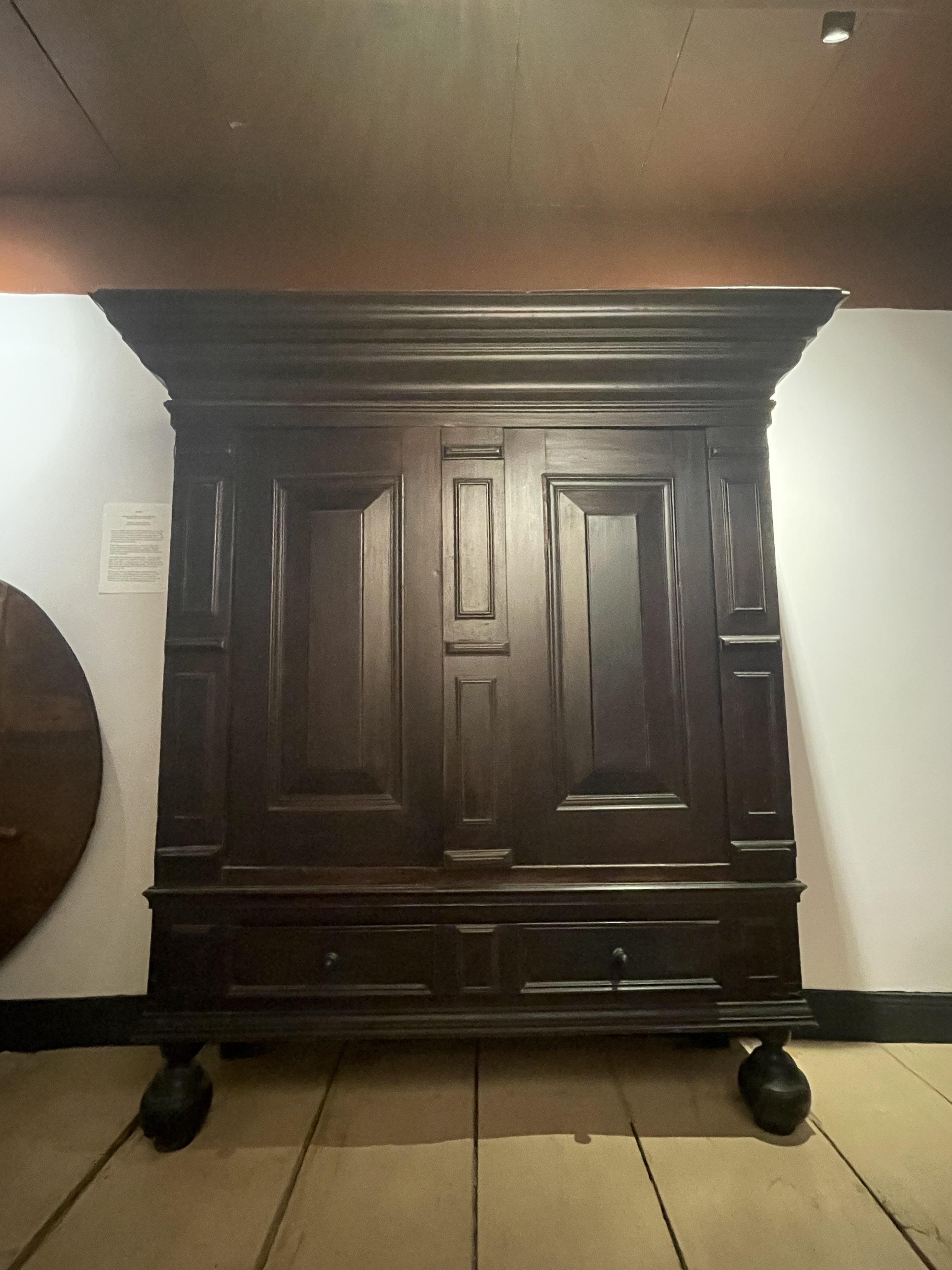
Before being donated to Historic Huguenot Street by Richard R. Hasbrouck, this kast stayed in his direct descendent, Jacob J. Hasbroucks house which was built by his father Major Jacob Hasbrouck in 1786. Of the artifacts accepted by Historic Huguenot Street from the Richard Relyea Hasbrouck estate, the Kast was known as a major central piece in colonial New York. It signified the influence of Dutch culture throughout the Hudson Valley. Since kastens were normally part of a woman’s dowry, it is possible that this kast was in the dowry for Hasbroucks marriage either to Margaret Hardenbergh (which took place from 1776-1796) in 1793 or Ann DuBois from (1777-1854) in 1799.
Object Description
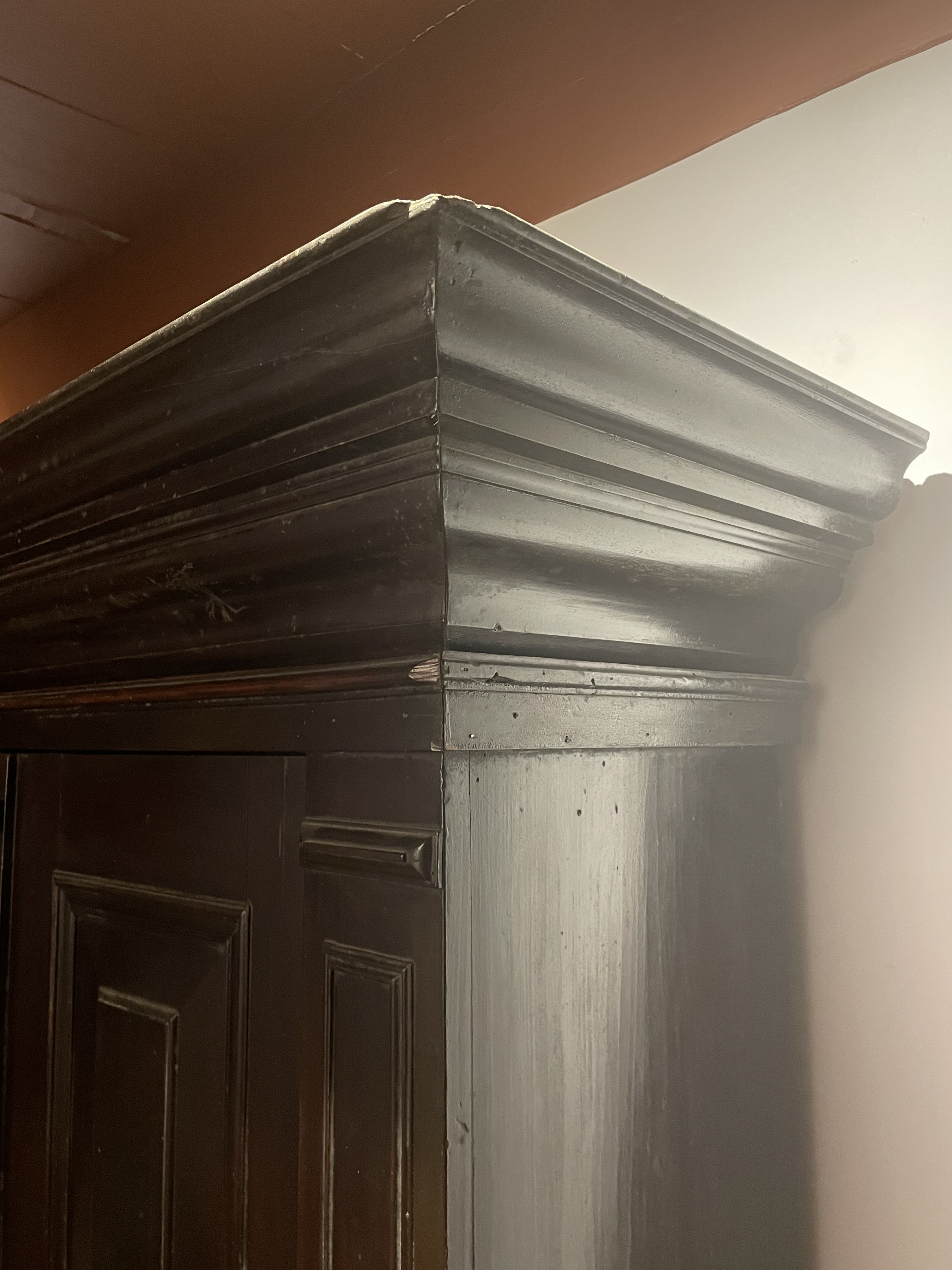
Made out of red gum, sycamore and pine, this dark brown kast stands at 73.25 in. tall and has a width of 16.5 in. measured from the middle. Starting from the bottom, this kast is standing on two ball feet in the front and two pegs the same height in the back (measurements currently unknown). As we move upwards to the body of the kast, the first part closest to the legs include two rectangular drawers side by side with circular knobs attached to both in the middle. Inbetween and on both ends of these two drawers is a vertical rectangular design the same length as the sides of the drawers. As we continue to move upwards we reach the middle of the kast that holds two large doors in the shape of vertical rectangles with two smaller rectangles on the inside of each door panel where there is a continued theme of rectangular designs. On this section there are two longer vertical rectangles placed inbetween the two doors and on both outer sides of the doors. There are no knobs on these panels so you have to open them by pulling on them. On the inside of each panel there are threee shelves large enough to fit a standard sized banker box. The top section of the kast or the cornice is angled more outwards compared to the rest of the object with a length of 67.5 in and a width of 22.5in. The wear and tear of this kast is evident in the dents and chipped paint throughout the object and also in the large chipped piece of wood on the top front left corner of the kast.
Narrative
When we think of Kastens or cupboards we just think of a place to store spare bedding, clothing or just clutter. We don’t tend to think about the impact of its physical attributes like its structure, the shape of the doors, the texture of the wood, etc. We typically have this type of furniture for its convenience, we don’t tend to perceive it as an indication of status or think about the cultural influence that led to the creation of these pieces. However, back in colonial New York with its strong Dutch influence, this kast was a staple piece in these Dutch-American homes.
In the early 1600’s the Dutch colonized the Hudson Valley as well as parts of New Jersey, Pennsylvania, Maryland, Connecticut and Delaware. They named their colony New Netherland. But after surrendering to England in 1664, the capital city of the colony, New Amsterdam became what is now New York. This meant that the Dutch influence eventually faded away within 100 years. Because of their fewer outside influences, Hudson Valley, on the other hand, remained carrying out Dutch traditions, customs and continued speaking the language for the next 100 years.
These Kasten held a lot of significance during this time period for Dutch settlers and are now major indicators of that continued influence of Dutch culture and values because of the specific design and style. “It safeguarded not ony such tangible treasures as gold, silver, and linen but Dutch notions of domestic life as well” (Berman, 1991) Becuase of it’s practicality due to storage it became an essential piece of furniture for Dutch settlers to own. But because of Dutch values, the standard kast also symbolized ones wealth and status in society. A typical Dutch family’s most prized possessions were their silver and gold items as well as textiles, so displaying their kast in thier living room for guests to see was a symbol of their achievements. Sicne these objects were considered to be too precious to leave out in the open, the kast itself became a decorative piece.
Citations
Berman, Avis. “The ‘Kast’.” AMERICAN HERITAGE, 1 May 2023, http://Berman, Avis. “The ‘Kast’.” AMERICAN HERITAGE, 1 May 2023, https://www.americanheritage.com/kast.
 The Materials of History, Thought, and Art
You must be logged in to post a comment.