
Physical Description
Three lidded balusters, or full bellied vases sit next to each other inside the Jean Hasbrouck house on historic Huguenot street. They stand around 13 inches tall, towering over a room of everyday useful items, as beautiful tokens to be admired, rather than used.
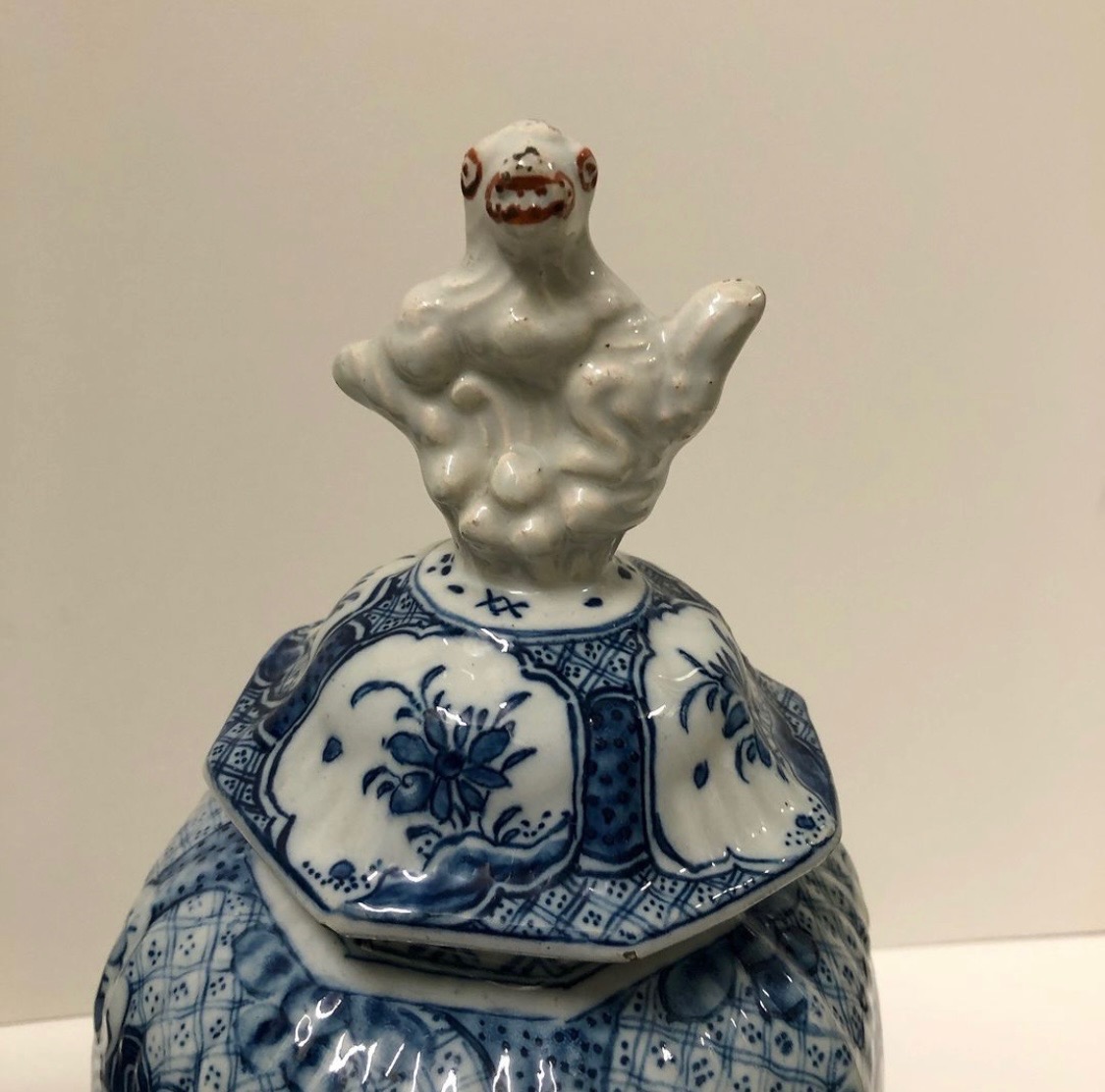
The lids are bell-shaped. Classified as inset lids, with the flange built to rest perfectly inside the mouth of the vase. Decorative handles known as finials sit on top of the lids. Here, we see a different white foo dog on each of the pieces. Their mouths are painted with a brilliant red.
The bodies of the vases are hand painted with cobalt, and display a variety of patterns, mark-making, and storytelling. A transfer decoration adorns the main panels on all four sides of each vase. They display a scene with two joyful deer in a field, and are framed with exquisite, painterly swirls.
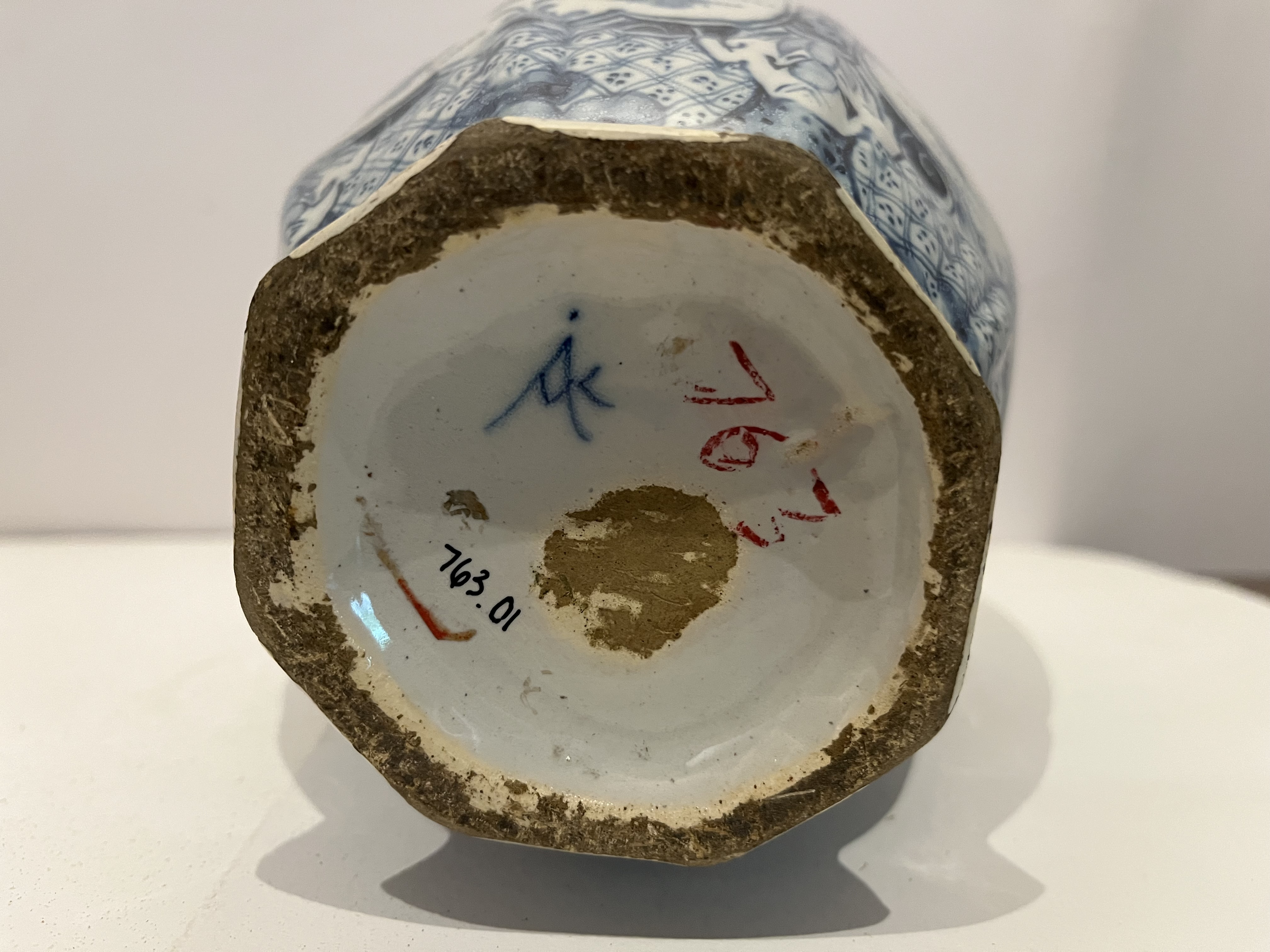
The bottom of the jar and the lid have a distinct ring of brown raw claw where they sat on the kiln shelf. It is a stark difference from the rest of the white piece. An ornate blue signature is also seen on the bottom of the vase and the lid, accompanied by a serial number written in marker.

Provenance
Set of 18th-century Delftware Vases.
These are made of earthenware, a common clay body found in rivers and deposits around the world. Earthenware is a dark, easily manipulated clay. It is generally dark red/brown from encountering other sediment, and lots of red iron in the ground throughout its lifetime. Due to weathering, it has a relatively small particle size compared to other clay bodies, and for this reason it is also very easy to sculpt and throw with. This is the only type of clay that was native to Europe. The natural orange look of earthenware was celebrated for centuries, most notably in Greek and Roman pottery.

In the 14th century, Marco Polo brought porcelain to Europe. This type of clay was white and delicate, yet durable. China is rich with porcelain, a clay which has not been tainted by other colorful oxides the way earthenware is. Polo called this white clay porcellana, a term for cowery shell, which is also shiny and white. Porcellino in Italian is also the name for a little pig, whose white bellies also look like soft white clay (Force). A fascination began to brew in Europe. In the 16th century, trade routes between the Netherlands and Asia brought fine china to wealthy homes. “[Blue-and-white porcelain] went on to triumph far and wide, reshaping [and sometimes destroying] pottery traditions in virtually every society it touched, from the Philippines to Portugal” (Finlay). Since not everyone could afford this luxury, Dutch potters developed their own methods to make similar pieces. Delftware is the art of emulating traditional Chinese blue and white porcelain vessels.
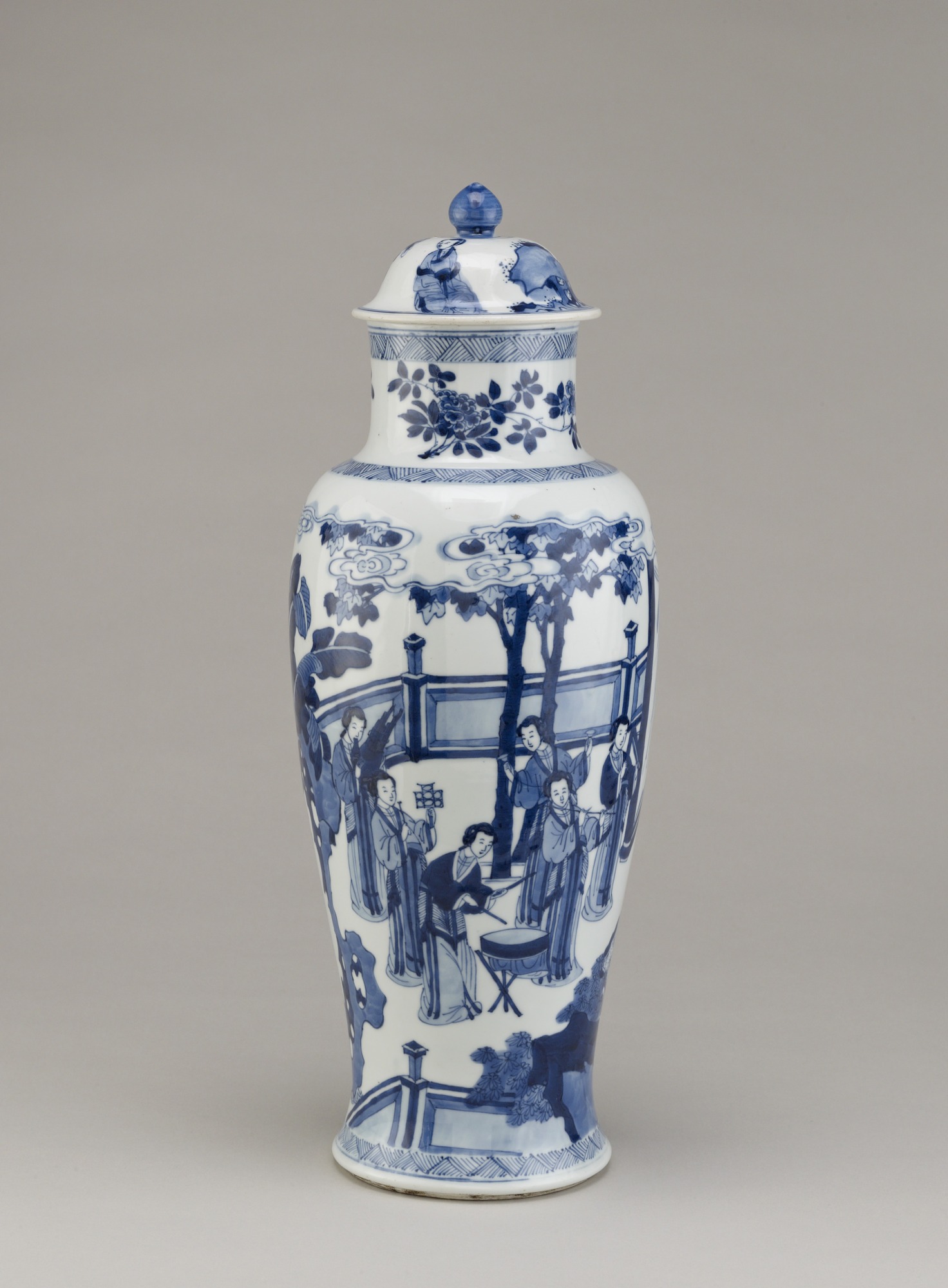
The process of creating Delftware begins with using earthenware local to the Netherlands to create a pot. To conceal the natural color of the clay, tin is used to create an opaque white glaze. True Chinese porcelain was painted with cobalt imported from the middle east (Pierson). This was already available to Dutch artisans, and they were familiar with the material in ceramics. The tin glaze was a beautiful base for painting with cobalt atop of, and though the method produces a sophisticated result, it is actually a simple concept. It was Chinese ceramic design and painting style which really took Europe by storm, and Dutch potters used delftware to adopt Far East aesthetics in their entirety.

Narrative
Three of these vases rest on top of a kasten in the Grote Kamer, or hallway, of the Jean Hasbrook House. Other delftware bowls and cups sit below, but these three have a grand place overlooking the room. In total, they were made as a set of five, but the Hasbrouck house only displays three. These pieces did not belong to the Hasbrouck family themselves, but rather represent the type of decorative artwork that a family of this stature would own at the time. The Hasbroucks’ were Dutch-American immigrants who colonized Huguenot street in the 1600’s and brought the culture of the Netherlands along with them. They were a relatively wealthy family, and we can discern their appreciation for the finer things even from the architecture of their house. As explained on a tour of the Jean Hasbrouck house, even having a hallway was a signifier of class. A handmade Hudson Valley kasten is the only furniture adorning this space, and these delftware vases accentuate the eliteness of the people who once lived here. They hold a place of honor in this home for people to understand the breadth of Hasbrouck’s riches (Hasbrouck Family Association).
This set was produced by the DeWitte Ster Factory in the city of Delft, the Netherlands. High-quality ceramics were created at this factory from 1660 to the late 1700s. Though this factory was very good at making delftware, their mission as a company was to create all different styles of attractive high-end ceramics for aristocrats.
DeWitte Ster’s signature on the bottom of all pieces made at the factory was a star. We can date this piece to a more specific date because accompanying the star is the initials AK. Albertus Kiell was the owner of DeWitte Ster from November 1761-December 1772. This is is an interesting mark for a production piece, giving it more depth and recognition than we may otherwise have understood. A post by Historic Huguenot street provides context to the importance these pieces may have had in a Dutch-American home:
“The finials of these vases represent a Dutch interpretation of a Chinese architectural ornamentation. Foo dogs, or fu dogs, are lions typically made of stone and thought to protect against evil…To the Dutch, these beasts resembled the dogs they kept as pets, and foo dogs were painted to appear more familiar and dog-like. Dogs and other animals are a common motif on delftware”(HuguenotStreet).
Though these specific vessels are not a Hasbrouck family heirloom, they were placed purposefully. It appears that these pieces were somewhere between a point of pride, a beautiful object to absent-mindedly stare at, and a good luck charm for the house.
Work Cited
“Baluster Vase, One of Three in a Five-Piece Garniture (F1980.190–194).” National Museum of Asian Art, asia.si.edu/explore-art-culture/collections/search/edanmdm:fsg_F1980.192a-c/. Accessed 8 May 2023.
Finlay, Robert. “The Pilgrim Art: The Culture of Porcelain in World History.” Journal of World History, vol. 9, no. 2, 1998, pp. 141–87. JSTOR, http://www.jstor.org/stable/20078727. Accessed 5 May 2023.
Force, Thessaly La. “The European Obsession with Porcelain.” The New Yorker, 11 Nov. 2015, https://www.newyorker.com/books/page-turner/the-european-obsession-with-porcelain#:~:text=Porcelain%20was%20white%20gold%2C%20valued,and%20vials%20of%20musky%20scents.
“Hasbrouck Family Association.” Historic Huguenot Street, http://www.huguenotstreet.org/hasbrouck. Accessed 8 May 2023.
Huguenotstreet. “This week’s curatorial post features a set of 18th century delftware vases.” Instagram, 15 Nov. 2022, https://www.instagram.com/p/Ck-6OWStr_o/?utm_source=ig_web_copy_link
PIERSON, STACEY. “The Movement of Chinese Ceramics: Appropriation in Global History.” Journal of World History, vol. 23, no. 1, 2012, pp. 9–39. JSTOR, http://www.jstor.org/stable/41508050. Accessed 5 May 2023.
“Roman Pottery Beaker.” Museum Wales, museum.wales/collections/online/object/54638d3b-71e7-30f5-97f4-8fd4b479be6b/Roman-pottery-beaker/. Accessed 8 May 2023.
 The Materials of History, Thought, and Art
You must be logged in to post a comment.