
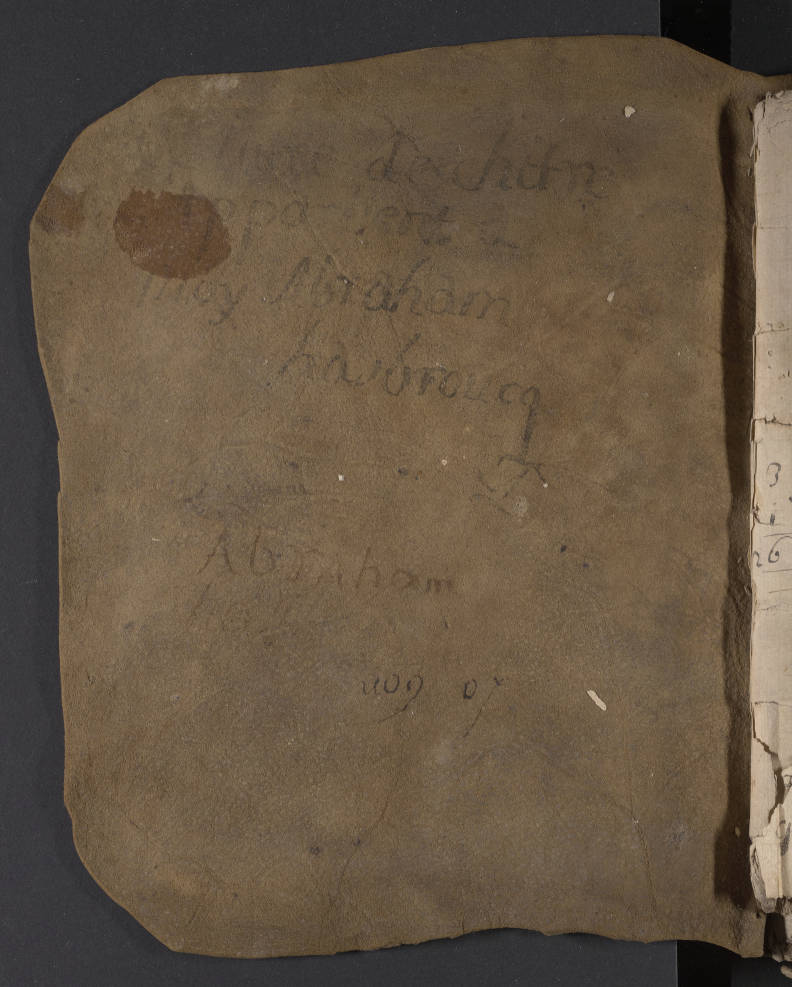
These images depict the front and back of Abraham Hasbrouck’s (1707-1791) ciphering book, where he solved mathematical problems that related to real-life financial exchanges of the early Huguenot settlers in New Paltz, NY.

Physical Description of the Object
The outside cover of the book is a mixture of many shades of brown, likely from dirt residue. Darker brown spots appear near the top and bottom left of the book as well. The right outer edges of the front cover are curved, while the left, binded side of the covers are intended to be right angles, though with the passage of time they are looser. The material composing the cover appears to be a kind of animal skin material. The inside cover of the book contains a dark spot, similar to a coffee stain, on the top left corner. Written on the cover is a message that is not fully decipherable as it has faded, but appears to be a dedication to Abraham Hasbrouck, though it is spelled “Hasbroucq.” A few inches underneath, Abraham’s name is repeated, and written in Abraham’s own handwriting. Inside the book, each page is a light-brown color, and a coffee-like stain in the top corner bleeds through almost all of the pages, that same stain from the inside of the cover. The outside cover at the other end of the book folds to the front in a triangular shape, featuring a hole where a thin string of the animal skin-like material is tied to, and wraps loosely around the book.
Provenance
Abraham Hasbrouck’s Ciphering Book was most likely originally donated by Annette Innis Young in 1963. (huguenotstreet.org) Before then, this book likely cycled through Abraham’s descendants, such as Kenneth E. Hasbrouck and Isaac Hasbrouck. Accounts are kept detailing the purchase and sale of books, shirts, tobacco, pipes, and other domestic goods that can be traced back to Isaac. (huguenotstreet.org) On page 225 of the ciphering book, it is stated that Daniel Hasbrouck and Solomon Hasbrouck loaned the book as well, both brothers of Abraham, though the writing is faint and not easily decipherable.
Date(s) of Creation
Abraham Hasbrouck’s ciphering book is dated between 1730 and 1739, as he lived from 1707 to 1791.
Narrative
Abraham Hasbrouck Jr’s ciphering book is a great example of what was valued in Huguenot culture, and how they valued it. Firstly, the book is written in a mixture of French and Dutch, showing the roots of the Hasbrouck family. The Hasbroucks, along with 6 other prominent families called “The Patentees,” “purchased 40,000 acres of land from the Esopus Indians on the west side of the Hudson River” (hvmag.com). The sale included the exchange of domestic supplies, as well as farming tools, blankets, clothing, horses, wine, gunpowder, and tobacco. The math problems in Abraham Hasbrouck’s ciphering book are in units of florins, sols, and deniers, to name a few. Florins are golden coins that originated in the Republic of Florence, sols describe a number of different coins, and deniers were coins of small value. Together, they could be used for transactions in between the Huguenot settlers, especially the 7 most prominent families who influenced New Paltz’s founding. Abraham Hasbrouck’s ciphering book features a fair amount of the mathematics that went into the affairs of the Huguenot settlement; even if the problems were hypothetical, they reflected real situations and exchanges of money. The book also shows the Huguenots’ Dutch influence, containing “proeve” problems, which is the Dutch word for aptitude. Abraham Hasbrouck, father of Abraham Hasbrouck Jr, headed all negotiations with the native Esopus people and English government with Louis Dubois, member of another prominent New Paltz founding family, and one who had many connections to the Dutch (hudsonrivervalley.org). Abraham Hasbrouck was well into his adulthood at the time he worked in the book, in between 23 and 32 years of age, so this isn’t a typical child’s schoolbook. Abraham Hasbrouck’s interest in, and application of, education in his 20s and early 30s demonstrates that the Huguenots put a big emphasis on education, especially education that could help translate into business transactions. Understanding the exchange of coins for goods was a very important skill to master and defined the early Huguenot economy. The ciphering book also demonstrates an attention to detail and order, as its pages have calligraphic headings. Though this is a tradition when using ciphering books, the vast number of early Huguenot Street settlers shows that the attention to detail and order carried throughout the early settlement. Abraham Hasbrouck’s ciphering book is a glimpse into what the typical economic affairs were for an early Huguenot settler in New Paltz, NY.
References
“Abraham Hasbrouck House.” Www.Hasbrouckfamily.Org – Hasbrouck Family Association, http://www.hasbrouckfamily.org/historic-houses/abraham-daniel-hasbrouck-house/. Accessed 18 May 2023.
“Abraham Hasbrouck.” Geni_family_tree, 27 Sept. 2022, http://www.geni.com/people/Abraham-Hasbrouck/6000000001689679018.
“Ciphering Book Collection (ca. 1730-1849).” Historic Huguenot Street, http://www.huguenotstreet.org/ciphering-book-collection. Accessed 18 May 2023.
“Ciphering Book, Abraham Hasbrouck.” Home, nyheritage.contentdm.oclc.org/digital/collection/p16694coll153/id/2684/rec/3. Accessed 18 May 2023.
“The Founding of New Paltz, NY.” Www.Hasbrouckfamily.Org – Hasbrouck Family Association, http://www.hasbrouckfamily.org/the-founding-of-new-paltz-ny/. Accessed 18 May 2023.
The Huguenots of New Paltz Were Not Only the Founders of a Historical …, http://www.hudsonrivervalley.org/documents/401021/1054326/huguenotsnewpaltz.pdf/46939c97-606e-4a35-a671-e7eaccbc8a24. Accessed 18 May 2023.
Levine, David. “Dive into the History of Historic Huguenot Street in New Paltz.” Hudson Valley Magazine, 2 Nov. 2021, hvmag.com/life-style/history/huguenot-street-new-paltz/.
Levy, Josh. “The Artistry of Learning Math: The Ellerton-Clements Cyphering Book Collection: Unfolding History.” The Library of Congress, 7 Apr. 2022, blogs.loc.gov/manuscripts/2022/04/the-artistry-of-learning-math-the-ellerton-clements-cyphering-book-collection/.
Schenkman, A. J., et al. “The Trials and Tribulations of Abraham Hasbrouck.” New York Almanack, 23 Aug. 2021, http://www.newyorkalmanack.com/2013/12/kingston-the-trials-and-tribulations-abraham-hasbrouck/.
 The Materials of History, Thought, and Art
You must be logged in to post a comment.