19th Century Canton Ware: Serving Vegetables on Porcelain

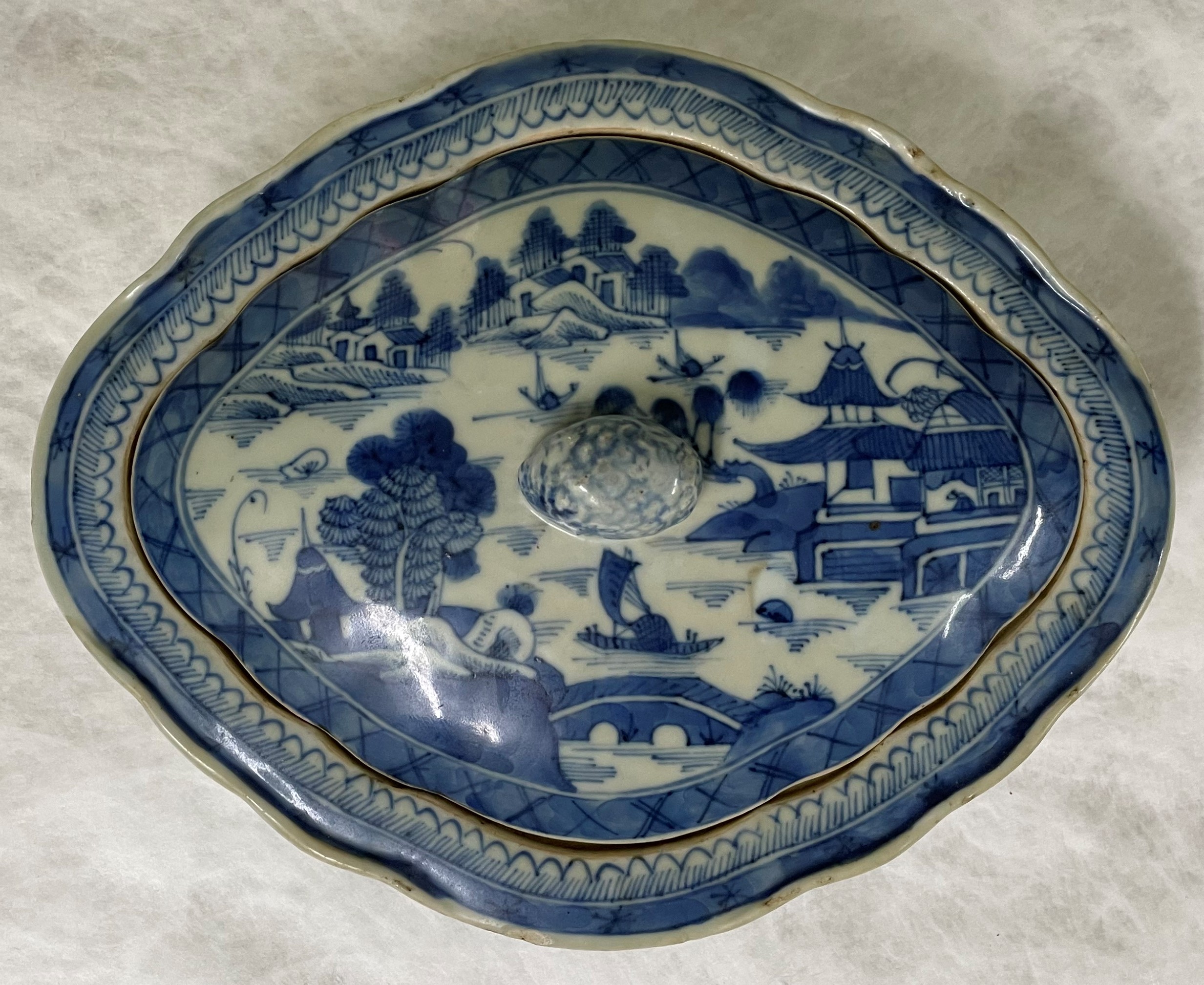
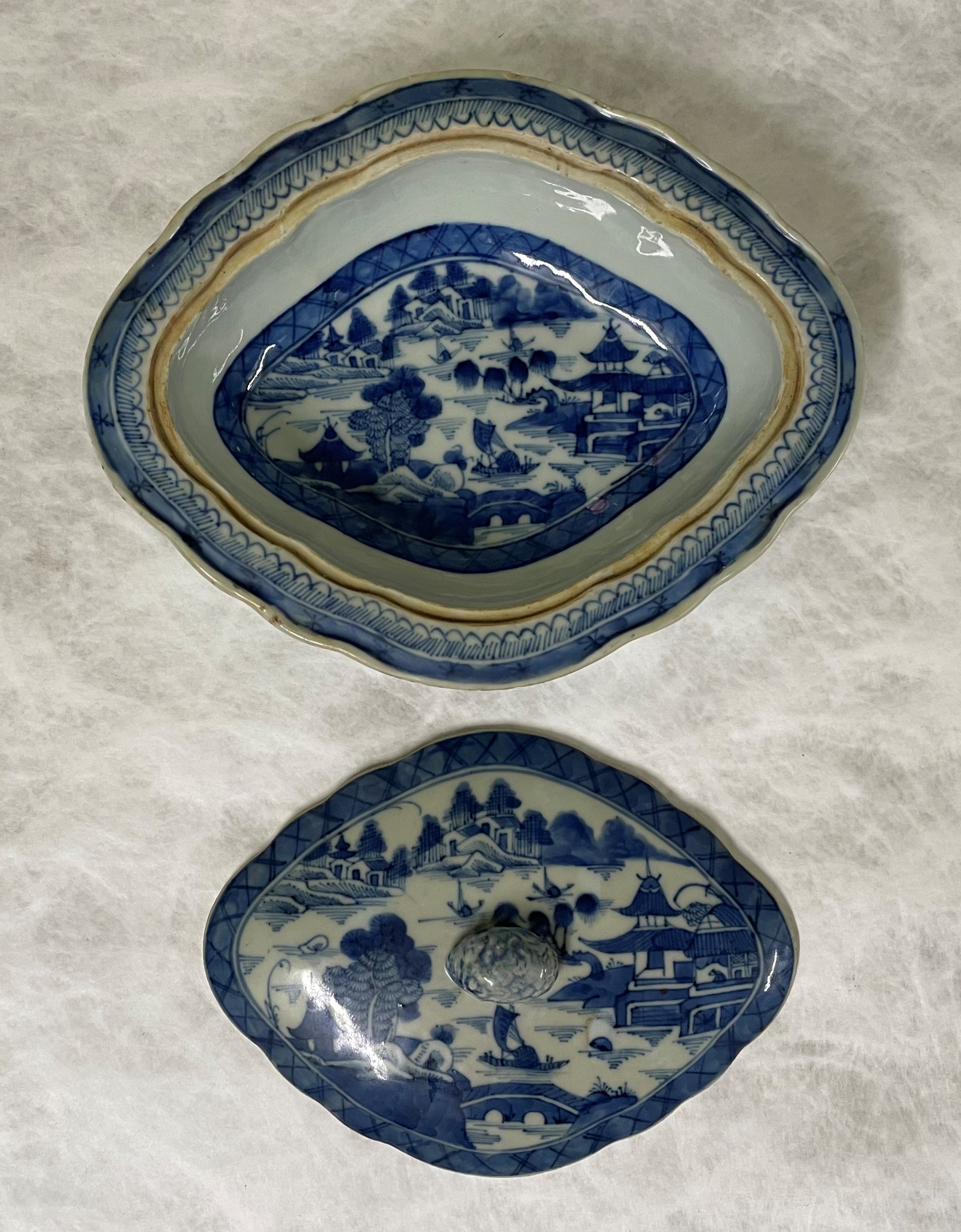
What is your first thought upon laying eyes on a canton ware that dates back to the 19th century? Before lifting the pristinely decorated porcelain lid to unveil the awaiting scrumptious contents of the vegetable serving dish, would you attempt to piece together an understanding of the depicted environment in the painting? The cobalt blue illustrations spanning across the canton ware are cool to the touch and memorizing to admire. (Image: Louise McGoldrick, 2023)

Physical Description

This diamond-shaped canton ware set includes a plate and a lid that come together as a vegetable serving dish. Both underglaze pieces are first adorned with painted scenes of a Chinese coastal village in a monochromatic cobalt blue before being covered in transparent ceramic glaze. The 3” deep dish is painted with the “blue willow” pattern. A serene atmosphere features trees growing in harmony alongside the riverbank. In the foreground, a junk ship with raised sails is floating between a small pedestrian bridge and a Siheyuan-style courtyard with pavilion roofs. Towering mountains uniformly line the background behind French country-style houses. An oval knob-like handle protrudes half an inch from the center of the lid, which obscures part of the painting. The 8” long by 6” wide cover is outlined with large decorative “X” markings on top of a thick blue band. Meanwhile, the lip of the deep dish is traced with a royal blue ribbon that fades into thin lines and scalloped edges. The dish is larger than the cover, measuring to be 9.5” by 7.5”.  

Provenance

This porcelain vegetable serving dish and lid is part of Barbara Lumb Jeffers’s 38-piece donation to Historic Huguenot Street (HHS)’s permanent collection. Porcelain that was manufactured and exported from the Canton (Guangzhou) province of southern China is coined the term “canton ware.” This selection of canton ware is estimated to have been painted during the early nineteenth century (1800-1835), which is distinctly recognizable with the “blue willow” pattern. Her fourth great-grandfather, Jonathan Deyo, started collecting canton ware while living at New Paltz during the early 1800s. It would take another six generations—passing through the hands of Peter, Ira, Jacob, Florence, and Josephine—until Barbara inherited the 47-piece canton ware collection. 

Narrative

China is multifaceted. One object cannot represent the culture—arts, religion, language, and traditions—of its 56 ethnic groups. Yes, the country was prosperous, with prominent advancements in agriculture, medicine, and consumer goods. Even so, many Chinese citizens simultaneously faced a growing social class divide, political corruption, and civil wars. However, what if this vegetable serving dish was my only exposure to China? During the 19th century, idealized fantasies about a foreign country could have easily become mistaken for irrefutable truths.  

This particular canton ware holds a historical narrative of values from the porcelain’s first collectors. The creation of the dish dates to the early 19th century. Remarkably, the last seven generations of the Deyo family have excellently preserved this piece of canton ware without a single crack or chip. They treasured their canton ware collection.  

The Deyo family is one of the French Huguenots who settled in the town of New Paltz. The family lineage includes influential figures, such as politicians. The first collector of canton ware in the family was Jonathan Deyo, a 5th-generation Deyo.  

Marriage record between Jonathan Deyo and Mary (Maria) LeFevre. (Image: Family Search)

On February 16th, 1780, Jonathan married Mary (Maria) LeFevre at the Reformed Protestant Dutch Church. They had seven children, including four daughters and three sons. Throughout fatherhood, Jonathan instilled religious and educational values in his family. 

Receipt billed to Jonathan Deyo for the education of Abraham, Daniel, and Peter Deyo. 
(Image: Haviland-Heidgerd Historical Collection, Elting Memorial Library)

All three sons had private schooling. The Haviland-Heidgerd Historical Collection of the Elting Memorial Library published a digitalized tuition receipt billed to Jonathan on April 29th, 1804. The total expense for the schooling of Abraham, Daniel Lefever, and Peter was $23.30 ($596.01 today). Peter was the youngest Deyo. He was given the opportunity to learn at seven years old, unlike his sisters: Catherine, Elizabeth, Catrina, and Cornelia.  

I could imagine Mary and Jonathan taking out their precious collection of canton ware for the first time. The children are setting the table for a hearty homecooked lunch after the Sunday church service. Sunlight is streaming through the drawn curtains, casting its warmth throughout the dining room. The family of eight is seated around the dining room table. Soon, appetizing aromas and curls of steam waft upward from freshly baked potatoes that are inlaid on the uncovered vegetable serving dish. After the first serving, the second helping is kept warm under the covered dish lid. 

(Images: Louise McGoldrick, 2023)

The hand-painted porcelain distinguishes itself from other wooden or pewter plates, common dinnerware found in American households during the early 1800s. Jonathan begins his first educational lecture on the Deyo’s success. The canton ware displays their family’s great material wealth and social status. After all, they can afford exquisite dinnerware to entertain guests. Jonathan made his porcelain purchase from a local vendor who was actively bolstering the surrounding economy of New Paltz by participating in direct trade with Chinese merchants (University of Illinois).  

With a mouth full of potatoes, Peter asks, “Why are these plates, dishes, and teacups so special?” 

“Peter, the first President, George Washington, was fond of porcelain sets like these!” Jonathan proudly exclaims. He contrasts the affluence of the Deyo family with that of an American revolutionary leader. Meanwhile, many other American families still used pewterware, an affordable and versatile metal alloy composed of tin, antimony, and lead (Pewter Society). Jonathan takes note of Peter’s genuine intrigue.  

Next, Jonathan talks about kaolin, the specific clay used to create porcelain. The Deyos are amazed to hear that the serving dish needed to be fired at such high temperatures of 1200-1400 degrees Fahrenheit to create a smooth and durable finish suitable for serving dinner (Warwick 2012). 

The lunch conversation soon takes a nosedive into Orientalist concepts, with Jonathan leading the enlightening narrative used to define Chinese folk within the confines of the canton ware. To only receive education about a place, people, and culture through a singular story is dangerous. When only one understanding of China was academically praised and circulated through early American newspapers, US citizens were only exposed to an echo chamber of prejudices held against Chinese folk. The iconic “blue willow” pattern, a common motif of canton ware, perpetuates China as a “non-Western societ[y]” left “untainted by industry and capitalism” (MET). As Jonathan’s fingers trace the blue willow pattern on the dish’s scalloped lips, he invites his family to view, feel, and experience the Western world’s construction of Chinese culture. 

A brief glance alongside a thin narrative of the dish perpetuates the romanticized stereotype that China is an exotic and backward empire. They use old technology like junks (sailboats) instead of steam-powered vessels. Or worse, Chinese folk need “saving.” After all, there is a lack of visual representation of China’s citizens or technological innovations under the translucent glaze of the canton ware. Edward Said wrote about how “Orientalist ideologies actively shape the world they describe [because they] perpetuate people as inferior and subservient. [Orientalism] create[s] a worldview that justifies Western colonialism and imperialism” (Hibri). Later in 1839, when canton ware fell out of popularity, Britain invaded China to control merchant trade during the Opium War.  

Throughout Peter’s childhood, Jonathan sent him and his brothers to receive the best schooling. Yet was teaching an Orientalist perception of China sufficient to be called an education of substantial quality? 

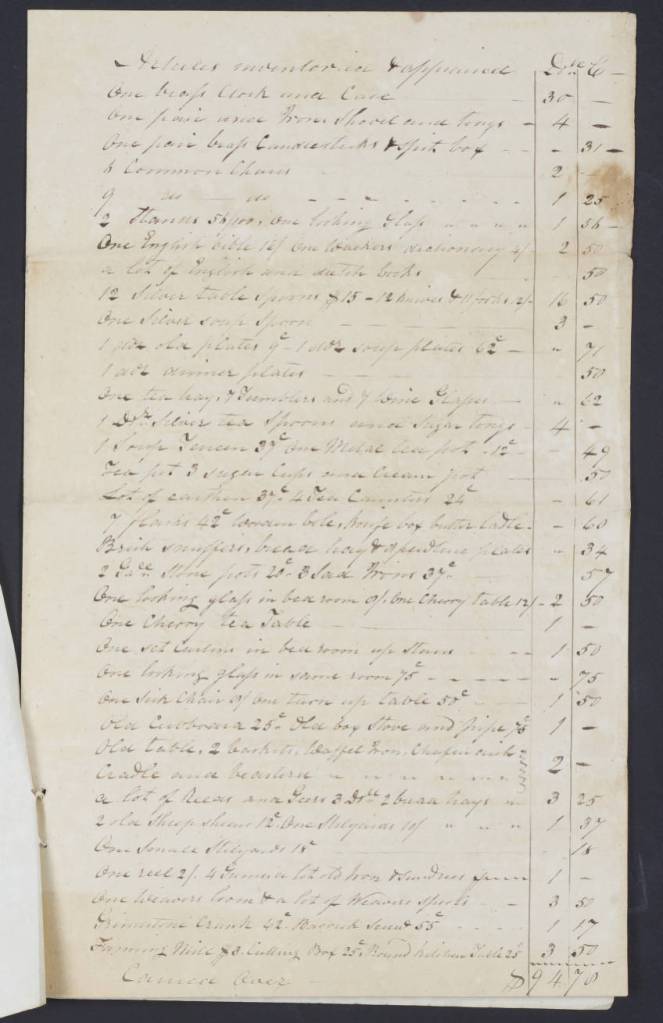
Two months after Jonathan died on March 26th, 1833, Josiah Dubois and Daniel Dubois appraised the 90-acre estate. The total value of numerous kitchenware items—plates, silver utensils, tongs, and tables—was $94.70 ($3,593.29 today). The canton ware collection was passed down to Peter and his heirs. Today, the vegetable serving canton ware rests unused, waiting to reveal its truth. We know better than to place make-believe fantasies on a pedestal, which emits ignorance and omits cultural sensitivity. In a world already riddled with conflict, exposure to varying narratives helps us grow with greater empathy, reducing bias and judgment. 
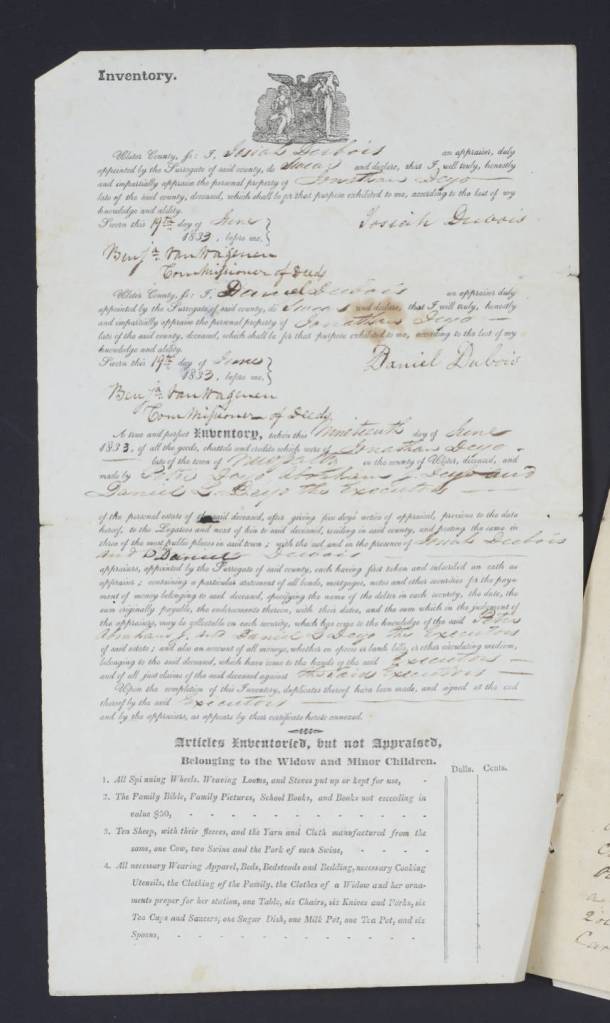
Appraisal and inventory of the Deyo family’s estate. (Images: Haviland-Heidgerd Historical Collection, Elting Memorial Library)

Works Cited

“Canton Ware China.” Collections, 2022, www.pphmuseum.org/canton-ware-china.  

“Early American Trade with China.” China Trade, 2006, teachingresources.atlas.illinois.edu/chinatrade/introduction04.html.  

“Estate Inventory and Appraisal, Jonathan Deyo (2).” New York Heritage: Digital Collections, nyheritage.contentdm.oclc.org/digital/collection/p16694coll153/id/9621/rec/2. Accessed 9 May 2023.  

Hasbrouck, Kenneth E., et al. The Deyo (Deyoe) Family. Deyo Family Association, Huguenot Historical Society, 2003.

Hibri, Cyma. “Orientalism: Edward Said’s Groundbreaking Book Explained.” The Conversation, 29 Mar. 2023, theconversation.com/orientalism-edward-saids-groundbreaking-book-explained-197429.  

Historic Huguenot Street. “Porcelain Serving Dish.” Huguenotstreet, 13 Apr. 2023, www.instagram.com/p/CNm10bRjrnn/?utm_source=ig_web_copy_link.  

Inghram, Matthew C. “Chinese Porcelain.” George Washington’s , 2023, http://www.mountvernon.org/library/digitalhistory/digital-encyclopedia/article/chinese-porcelain/.

“Jonathan Deyo – Church Records.” Ancestors Family Search, 2021, ancestors.familysearch.org/en/KJCB-SDH/jonathan-deyo-1745-1833.  

“Key Points across East Asia-by Era 1750-1919.” Asia for Educators, 2023, afe.easia.columbia.edu/main_pop/kpct/kp_1750-1919.htm.  

McGoldrick, Louise. Research about Canton Ware, May 2023.  

Oshinsky, Sara J. “Exoticism in the Decorative Arts.” The Met’s Heilbrunn Timeline of Art History, Oct. 2004, www.metmuseum.org/toah/hd/exot/hd_exot.htm.  

“Receipt, Mr. Deyo by Edward O’Neil.” New York Heritage: Digital Collections, nyheritage.contentdm.oclc.org/digital/collection/p16694coll153/id/9341/rec/10. Accessed 9 May 2023.  

Warwick, Leslie, and Peter Warwick. “New Perspectives on Chinese Export Blue-and-White Canton Porcelain.” Chipstone, 2012, chipstone.org/article.php/519/Ceramics-in-America-2012/New-Perspectives-on-Chinese-Export-Blue-and-White-Canton-Porcelain.  

Webster, Ian. “Inflation Rate between 1833-2023: Inflation Calculator.” Value of 1833 Dollars Today | Inflation Calculator, www.officialdata.org/us/inflation/1833. Accessed 9 May 2023.  

“What Is Pewter?” About Pewter, www.pewtersociety.org/about-pewter. Accessed 9 May 2023. 

The Stillwell Family Ciphering Book

Provenance

The Stillwell Family Ciphering Book was donated to Historic Huguenot Street by Richard Ordway in 1978 and is part of a bigger collection of 24 ciphering books that were hand-written. Those ciphering books were part of an even bigger collection of Stillwell/ Johnson Family papers which dates range from 1789-1943. I was unable to find any more information on the provenance of this book specifically on the Sojourner Truth Database but the collection of books was represented by a multitude of families including the DuBois and the LeFevre families, some of the most influential families known to Huguenot Street. (“Ciphering Book Collection (Ca. 1730-1849)”).

The Stillwell Family Ciphering Book includes various economic concepts like  ‘Reduction’ and the values of currencies based on location. I know, riveting. But beyond that, this book offers a look into the academic and philosophical world of the Stillwell Family and gives us a look into the mind of the wealthy in the 1800s (New York Heritage-Digital Collections).

Physical Description

This book has a brown exterior with pale yellow pages on the inside. When given a closer look the seemingly semi-bendy exterior of the book has multiple shades of brown featured in small bubbles that look similar to a petri dish of bacteria under a microscope or multi-shaded stone pavement. The edges of the exterior of the book are rounded and a lighter shade of brown. The spine of the book looks scratched fairly consistently and has a small rip towards the bottom that exposes the pages of the book. The pages of the book are written in medium brown ink and most of them look like they have some type of liquid spilled on them that seems like it could be coffee. The handwriting is a neat cursive that varies in size depending on if the writing is a title or not. This book included mathematical concepts relating to international trade and the value of the dollar in different US states in the 1800s. Additionally, more specific topics included reduction, or simplification of mathematical expressions, measurement, and direct and indirect proportion. (“Ciphering Book Collection (Ca. 1730-1849).”).

The Mind of the Stillwells and the Persistence of Human Nature

When you think of the objects surrounding the history of psychology and philosophy in the US, what do you think of? Maybe it’s quills and feathers. Maybe it’s discussion tables and grand rooms. 

One object that isn’t typically considered for its influence on Western thinking is the ciphering book.

A ciphering book is a textbook-like, handwritten booklet that was used frequently in the 1800s to teach people about mathematical concepts ranging from fractions and geometry to economics and applied math. These books also covered spelling, handwriting, and other English topics (New York Heritage Digital Collections). They often included examples, problems, and exercises and were used by educators as their main form of reference. Ciphering books’ often became students’ personal reference books to use later in their lives as well. (Library, Rauner). 

The Stillwell Family Ciphering book, in the Historic Huguenot Ciphering Book Collection, mainly deals with the application side of math in this time period and was used by the Stillwell Family for answering what they deemed to be “practical questions”. This book was also part of a bigger collection called the Stillwell/Johnson Family Papers that included documents and photos from many wealthy families in the New Paltz area (“Stillwell/Johnson Family Papers (1789-1943)”).

Wealthy families have always had more ability to expand their educational horizons through ciphering books in the US, but what stuck out to me about this ciphering book in specific was the philosophical takes featured towards the end of the book. The more practical and direct mathematical guidelines were very common for these ciphering books, but the addition of big-picture takes on philosophy and psychology was not as common. The description of this book on the Huguenot Street website features a quote from the author. It states, “Commendation commonly animates the mind” (“Ciphering Book Collection (Ca. 1730-1849).”). The anonymous author of this book believed that praise would help people think more effectively. Even though ciphering books aren’t used today, that concept still remains in education and society in general. Two more quotes that were even more shocking to see in a ciphering book, in my opinion, were first, a take on happiness that reads, “He who cannot be happy without great pains will always find his pains greater than his happiness”, and second, a take on ownership that reads, “The possession of enjoyment is better than the enjoyment of possession” (“Ciphering Book Collection (Ca. 1730-1849).”). This last quote portrays the belief that having many belongings isn’t completely fulfilling. This is interesting to hear considering the wealth that this family had and leads me to believe that the author could’ve felt like their lifestyle, although lavish for the time, wasn’t enough in terms of real happiness. Maybe they were using their wealth to fill a void that otherwise wouldn’t have been acknowledged if not for the resurgence of enlightenment principles that was apparent in this time period.

This ciphering book, in specific, could’ve been written anywhere from 1829-1842. Throughout this time period, US philosophy started to lean more toward moral concepts and was often regarded as a continuation of the European Enlightenment. Ideas that aligned with the intentions of philosophers like Francis Bacon, René Descartes, and John Locke (Hoeveler, David J) came into the forefront of society. Locke, in specific, explored the concept of happiness in a political context and deemed it a catalyst for liberty. He also believed that pursuing happiness is a core aspect of human nature (“John Locke & the Pursuit of Happiness”). This, like the Stillwell Family Ciphering Book, explores the practical applications of happiness and the more philosophical reasoning behind the pursuit of happiness. 

The proverbial language used in this book to make these claims on happiness parallels the language in the aphorisms of “commonplace books” used frequently throughout the Renaissance. Commonplace books were similar to ciphering books in that they were both an early form of the non-oral transfer of ideas and feelings. These books were used more as journals or even what we’d now use our notes app for, whereas ciphering books were used more in education, however, these books could be seen as a continuation of the tradition of these early informational outlets (Norris, R).

These perspectives on happiness are not only discussed today but also widely agreed with. It’s often hard to stop yourself from slipping into a mindset that regards history as just history-A time and place that’s separate from the here and now. But it’s important to remember that although the physical elements of history change, the human condition and the search for happiness remain constant. 

References


Library, Rauner. “Rauner Special Collections Library: Ciphering Books.” Rauner Special Collections Library, 14 Nov. 2014, raunerlibrary.blogspot.com/2014/11/ciphering-books.html.


“Ciphering Book Collection (Ca. 1730-1849).”Historic Huguenot Street, http://www.huguenotstreet.org/ciphering-book-collection.


“MSS208_001_002_p001.”Nyheritage.contentdm.oclc.org, nyheritage.contentdm.oclc.org/digital/collection/p16694coll153/id/1899/rec/1.


Hoeveler, J. David, Creating the American Mind:Intellect and Politics in the Colonial Colleges, Rowman & Littlefield, ISBN 978-0742548398, 2007, p.11


“John Locke & the Pursuit of Happiness.” http://Www.pursuit-of-Happiness.org, http://www.pursuit-of-happiness.org/history-of-happiness/john-locke/#:~:text=He%20 points%20 out%20that%20 happiness.


‌Patkus, Beth. 5 May 2023.


“Stillwell/Johnson Family Papers (1789-1943).” Historic Huguenot Street, http://www.huguenotstreet.org/stillwell/johnson-family-papers.

Norris, Rachael. “10 Fascinating Facts about Commonplace Books.” The Reader, 29 Jan. 2021, http://www.thereader.org.uk/10-fascinating-facts-about-commonplace-books/#:~:text=Commonplace%20books%20are%20a%20tool. Accessed 9 May 2023.
Delftware Pottery: Porcelain Mimicry

Physical Description 

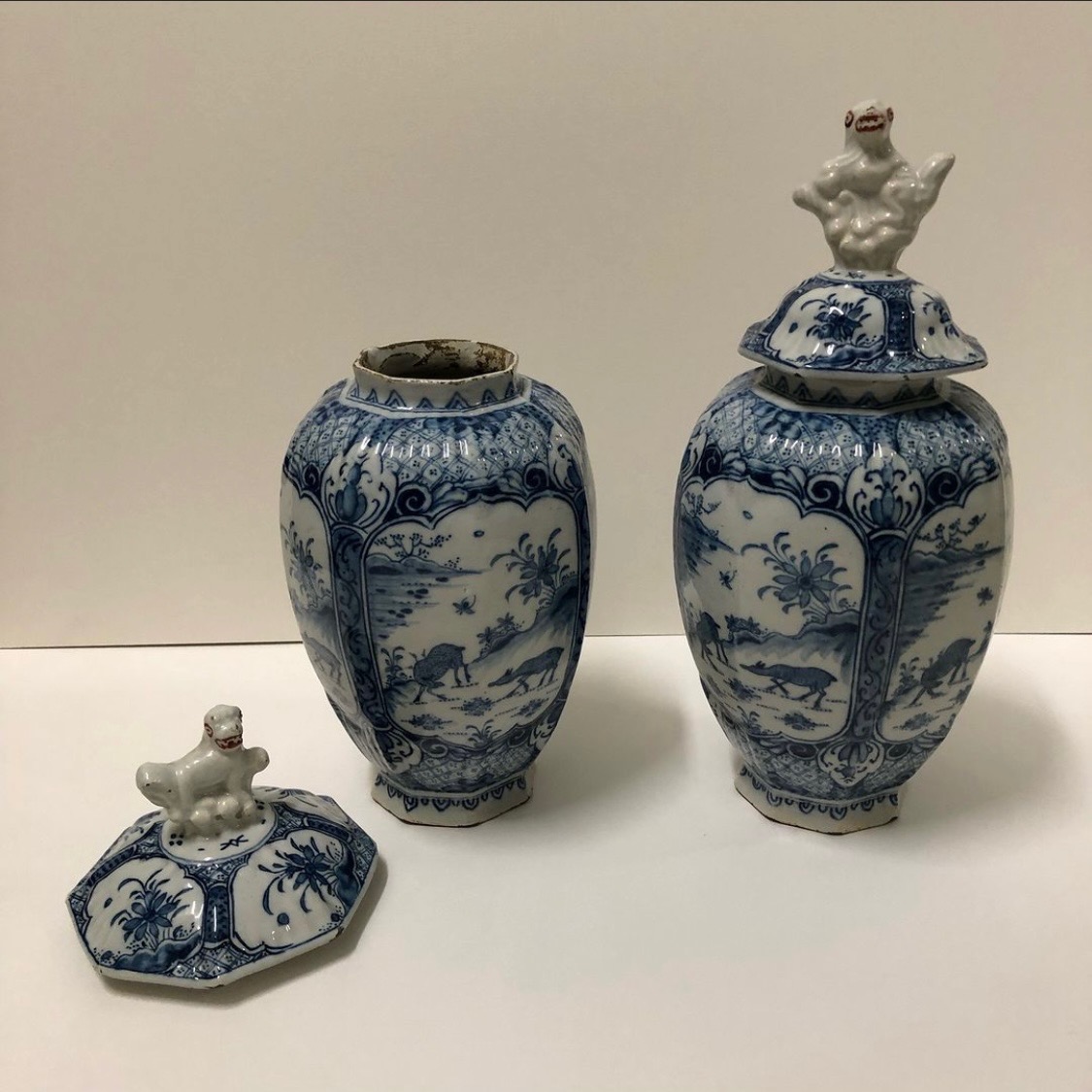
Three lidded balusters, or full bellied vases sit next to each other inside the Jean Hasbrouck house on historic Huguenot street. They stand around 13 inches tall, towering over a room of everyday useful items, as beautiful tokens to be admired, rather than used. 

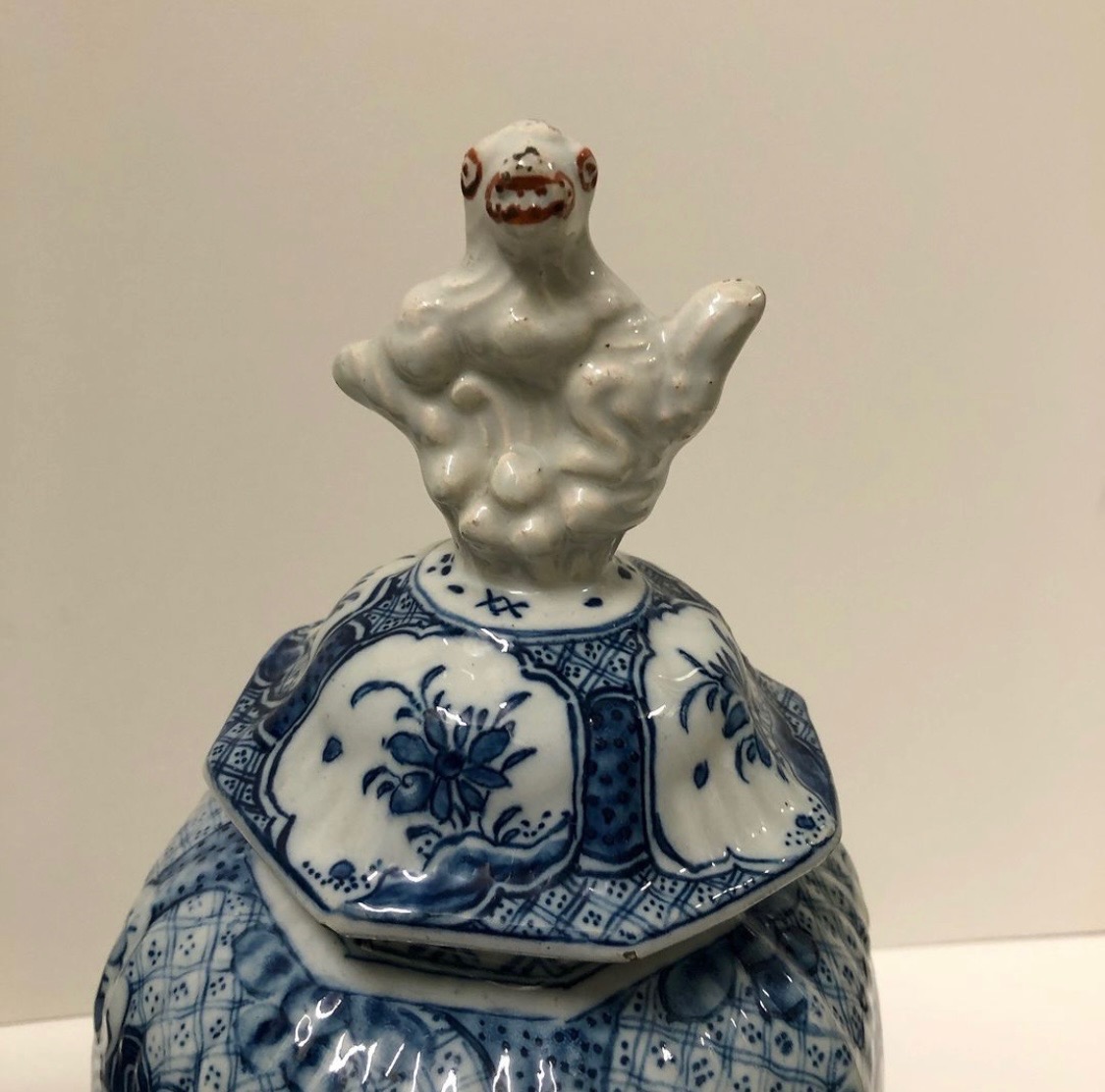
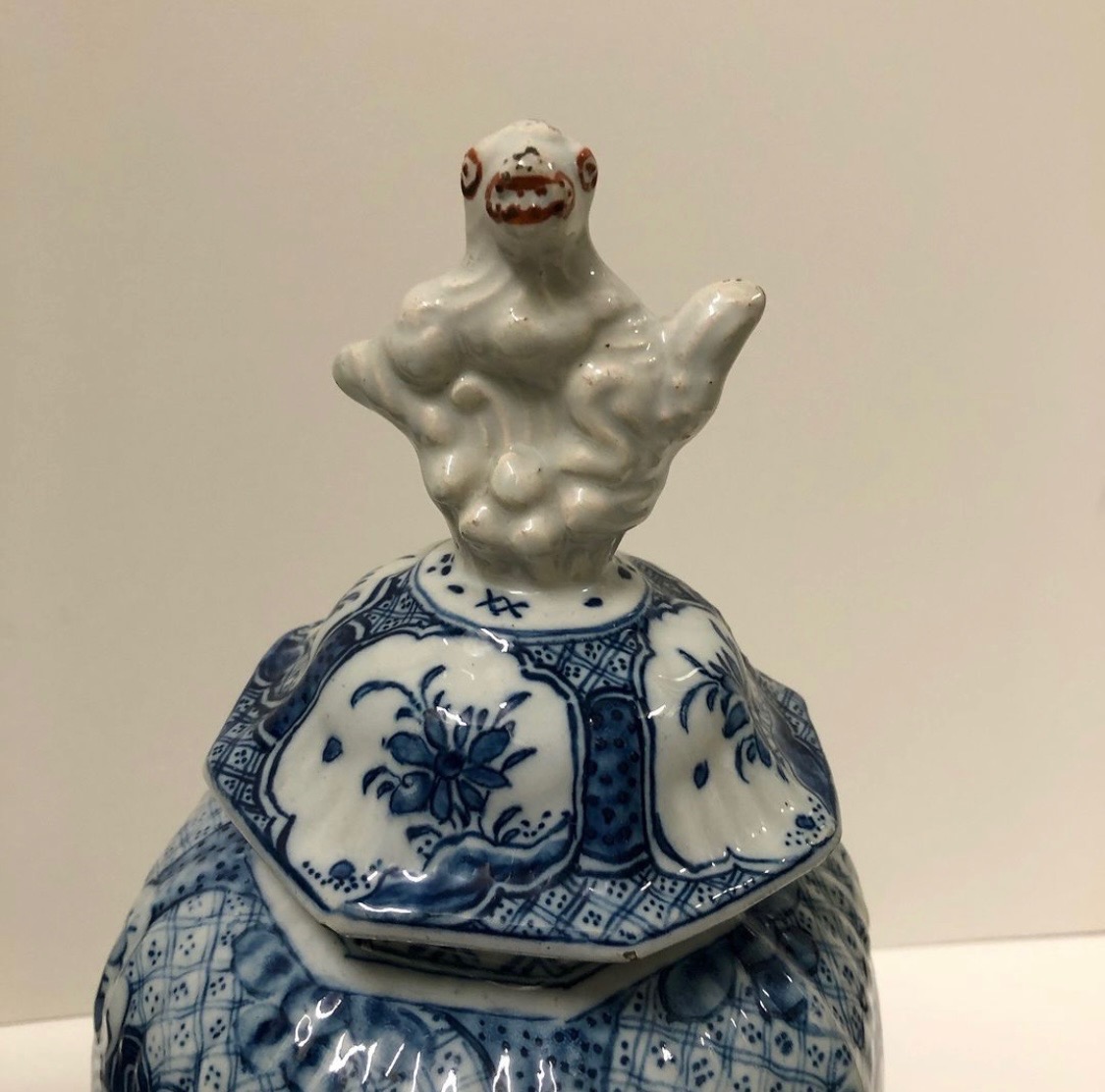
The lids are bell-shaped. Classified as inset lids, with the flange built to rest perfectly inside the mouth of the vase. Decorative handles known as finials sit on top of the lids. Here, we see a different white foo dog on each of the pieces. Their mouths are painted with a brilliant red.

The bodies of the vases are hand painted with cobalt, and display a variety of patterns, mark-making, and storytelling. A transfer decoration adorns the main panels on all four sides of each vase. They display a scene with two joyful deer in a field, and are framed with exquisite, painterly swirls.

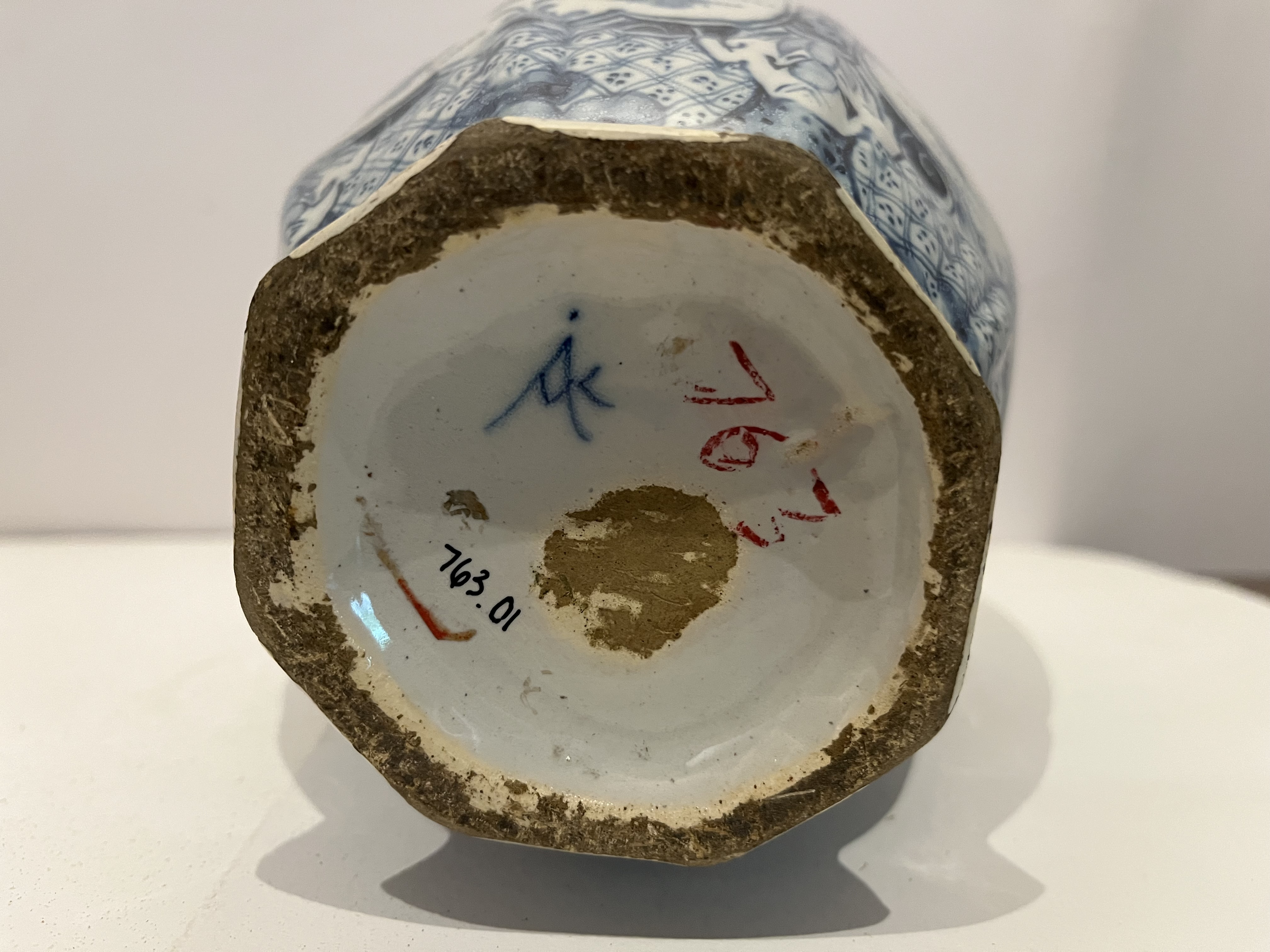
The bottom of the jar and the lid have a distinct ring of brown raw claw where they sat on the kiln shelf. It is a stark difference from the rest of the white piece. An ornate blue signature is also seen on the bottom of the vase and the lid, accompanied by a serial number written in marker. 

Provenance

Set of 18th-century Delftware Vases. 

These are made of earthenware, a common clay body found in rivers and deposits around the world. Earthenware is a dark, easily manipulated clay. It is generally dark red/brown from encountering other sediment, and lots of red iron in the ground throughout its lifetime. Due to weathering, it has a relatively small particle size compared to other clay bodies, and for this reason it is also very easy to sculpt and throw with. This is the only type of clay that was native to Europe. The natural orange look of earthenware was celebrated for centuries, most notably in Greek and Roman pottery. 

Roman Pottery, 80-250 CE, National Museum Wales

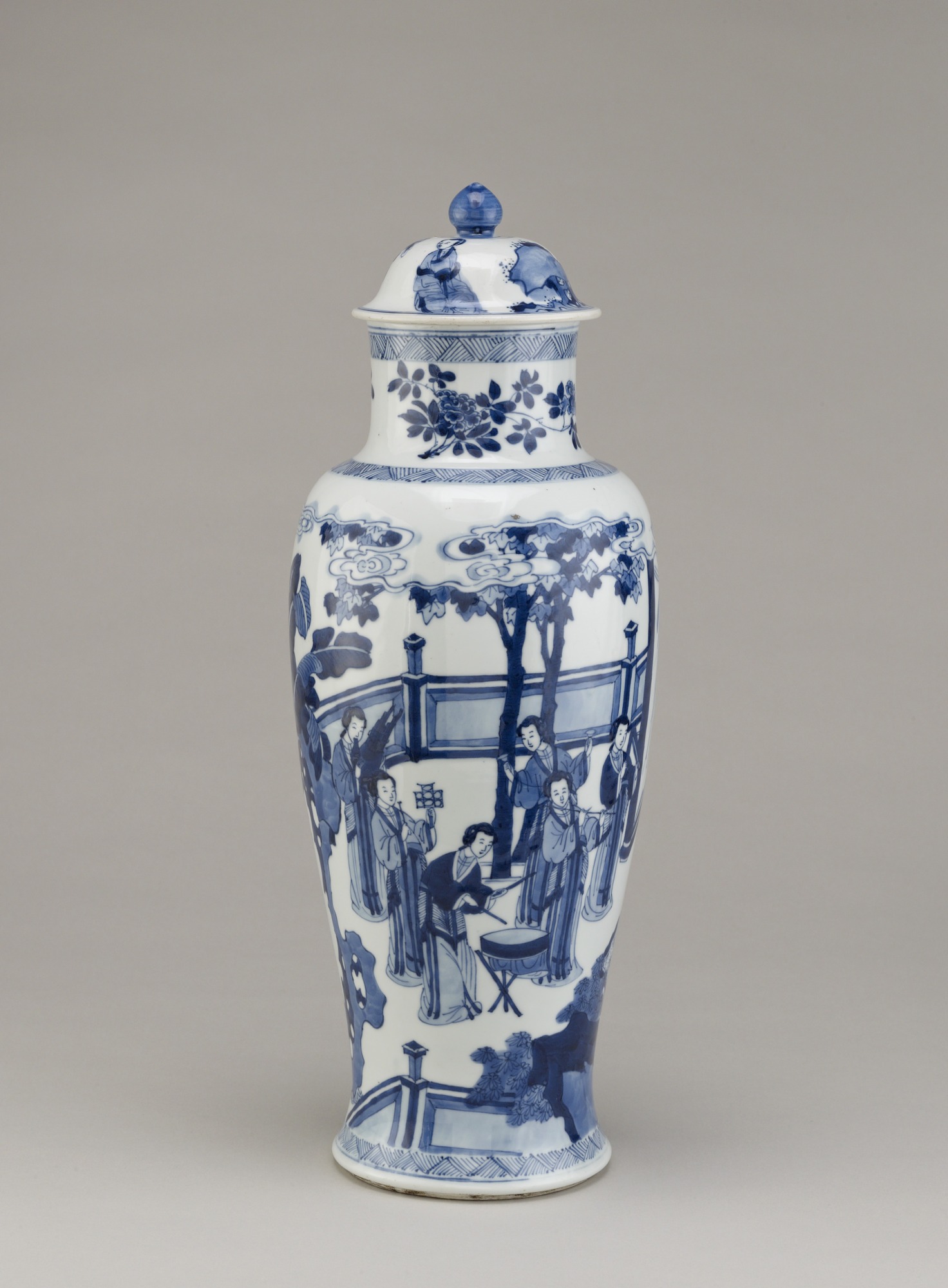
In the 14th century, Marco Polo brought porcelain to Europe. This type of clay was white and delicate, yet durable. China is rich with porcelain, a clay which has not been tainted by other colorful oxides the way earthenware is. Polo called this white clay porcellana, a term for cowery shell, which is also shiny and white. Porcellino in Italian is also the name for a little pig, whose white bellies also look like soft white clay (Force). A fascination began to brew in Europe. In the 16th century, trade routes between the Netherlands and Asia brought fine china to wealthy homes. “[Blue-and-white porcelain] went on to triumph far and wide, reshaping [and sometimes destroying] pottery traditions in virtually every society it touched, from the Philippines to Portugal” (Finlay). Since not everyone could afford this luxury, Dutch potters developed their own methods to make similar pieces. Delftware is the art of emulating traditional Chinese blue and white porcelain vessels. 

Chinese Porcelain Baluster Vase, 1662-1722, Jingdezhen, China, National Museum of Asian Art

The process of creating Delftware begins with using earthenware local to the Netherlands to create a pot. To conceal the natural color of the clay, tin is used to create an opaque white glaze. True Chinese porcelain was painted with cobalt imported from the middle east (Pierson). This was already available to Dutch artisans, and they were familiar with the material in ceramics. The tin glaze was a beautiful base for painting with cobalt atop of, and though the method produces a sophisticated result, it is actually a simple concept. It was Chinese ceramic design and painting style which really took Europe by storm, and Dutch potters used delftware to adopt Far East aesthetics in their entirety.

Delftware display window in the marketplace, Delft, Netherlands

Narrative

Three of these vases rest on top of a kasten in the Grote Kamer, or hallway, of the Jean Hasbrook House. Other delftware bowls and cups sit below, but these three have a grand place overlooking the room. In total, they were made as a set of five, but the Hasbrouck house only displays three. These pieces did not belong to the Hasbrouck family themselves, but rather represent the type of decorative artwork that a family of this stature would own at the time. The Hasbroucks’ were Dutch-American immigrants who colonized Huguenot street in the 1600’s and brought the culture of the Netherlands along with them. They were a relatively wealthy family, and we can discern their appreciation for the finer things even from the architecture of their house. As explained on a tour of the Jean Hasbrouck house, even having a hallway was a signifier of class. A handmade Hudson Valley kasten is the only furniture adorning this space, and these delftware vases accentuate the eliteness of the people who once lived here. They hold a place of honor in this home for people to understand the breadth of Hasbrouck’s riches (Hasbrouck Family Association). 

This set was produced by the DeWitte Ster Factory in the city of Delft, the Netherlands. High-quality ceramics were created at this factory from 1660 to the late 1700s. Though this factory was very good at making delftware, their mission as a company was to create all different styles of attractive high-end ceramics for aristocrats. 

DeWitte Ster’s signature on the bottom of all pieces made at the factory was a star. We can date this piece to a more specific date because accompanying the star is the initials AK. Albertus Kiell was the owner of DeWitte Ster from November 1761-December 1772. This is is an interesting mark for a production piece, giving it more depth and recognition than we may otherwise have understood. A post by Historic Huguenot street provides context to the importance these pieces may have had in a Dutch-American home: 

 “The finials of these vases represent a Dutch interpretation of a Chinese architectural ornamentation. Foo dogs, or fu dogs, are lions typically made of stone and thought to protect against evil…To the Dutch, these beasts resembled the dogs they kept as pets, and foo dogs were painted to appear more familiar and dog-like. Dogs and other animals are a common motif on delftware”(HuguenotStreet).

Though these specific vessels are not a Hasbrouck family heirloom, they were placed purposefully. It appears that these pieces were somewhere between a point of pride, a beautiful object to absent-mindedly stare at, and a good luck charm for the house. 

Work Cited

“Baluster Vase, One of Three in a Five-Piece Garniture (F1980.190–194).” National Museum of Asian Art, asia.si.edu/explore-art-culture/collections/search/edanmdm:fsg_F1980.192a-c/. Accessed 8 May 2023.

Finlay, Robert. “The Pilgrim Art: The Culture of Porcelain in World History.” Journal of World History, vol. 9, no. 2, 1998, pp. 141–87. JSTOR, http://www.jstor.org/stable/20078727. Accessed 5 May 2023.

Force, Thessaly La. “The European Obsession with Porcelain.” The New Yorker, 11 Nov. 2015, https://www.newyorker.com/books/page-turner/the-european-obsession-with-porcelain#:~:text=Porcelain%20was%20white%20gold%2C%20valued,and%20vials%20of%20musky%20scents. 

“Hasbrouck Family Association.” Historic Huguenot Street, http://www.huguenotstreet.org/hasbrouck. Accessed 8 May 2023. 
Huguenotstreet. “This week’s curatorial post features a set of 18th century delftware vases.” Instagram, 15 Nov. 2022, https://www.instagram.com/p/Ck-6OWStr_o/?utm_source=ig_web_copy_link

PIERSON, STACEY. “The Movement of Chinese Ceramics: Appropriation in Global History.” Journal of World History, vol. 23, no. 1, 2012, pp. 9–39. JSTOR, http://www.jstor.org/stable/41508050. Accessed 5 May 2023.
“Roman Pottery Beaker.” Museum Wales, museum.wales/collections/online/object/54638d3b-71e7-30f5-97f4-8fd4b479be6b/Roman-pottery-beaker/. Accessed 8 May 2023.

Where did this wallpaper come from?

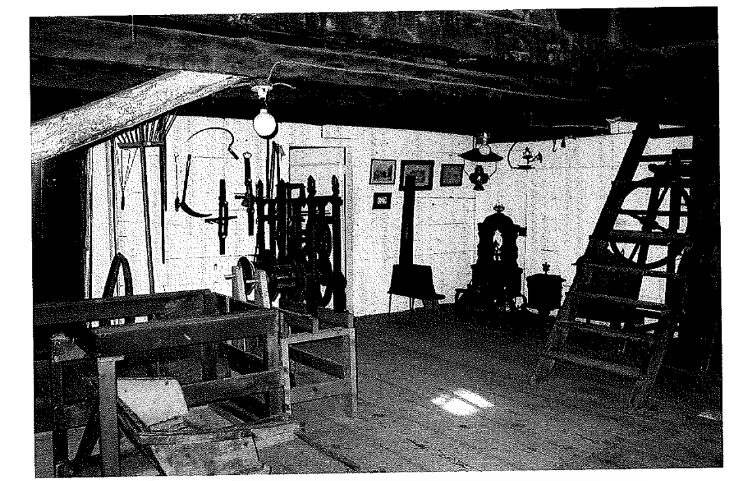
Nailed to the roof-supporting rafters above the second floor of the Jean Hasbrouck House are various boards forming a surface known as a garret – a small unenclosed attic-like space reachable by a wooden ladder in the center of the second floor. Standing underneath the garret just north of the ladder and looking up, you may notice that one of the boards, slightly darker than the two next to it, is decorated with pieces of wallpaper.

Second floor looking northwest with view of ladder to garret space. (Image: Crawford & Stearns 2002)
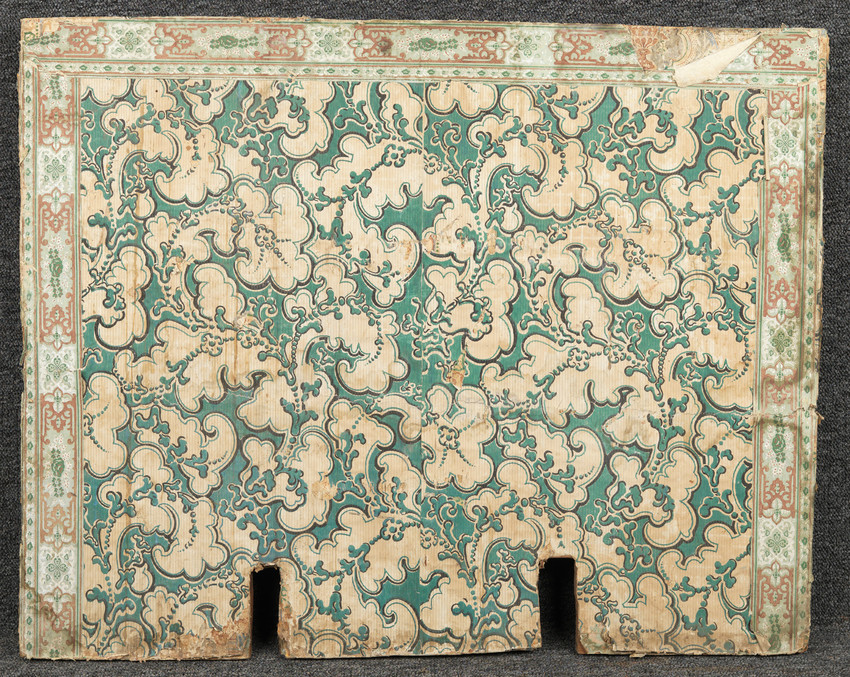
Remnants of wallpaper, located on the underside of a garret floorboard above the second floor of the Jean Hasbrouck House on Huguenot Street in New Paltz. (Image: Louise McGoldrick, 2023)

Some of the wallpaper has peeled off, but a large strip remains in the central area of the wooden plank, as well as a thin piece at the top edge and fragments on the bottom and middle. Browning from possible water damage has removed some of the color on the right side of the wallpapered board. Next to the browning there are areas of a cream paper, which seems to have been layered on top of the orange wallpaper, possibly as a border or as a later addition. Looking closely at this paper, there is a subtle glimpse of a minimalistic vine pattern. On the areas of the orange wallpaper that surround this cream paper, there are lines of white where the orange color may have been stripped when the cream paper was removed.

There are two colors used in the pattern of the wallpaper, which was probably printed on white paper – a muted orange background with foliate details, and dark brown dotting outlining the lighter elements. The pattern consists of a scrollwork motif of overlapping curves, some of which terminate in curved points. It is vaguely floral but very stylized. From the remnants of wallpaper that are visible, it is hard to see how and where exactly the pattern repeats.  

Provenance

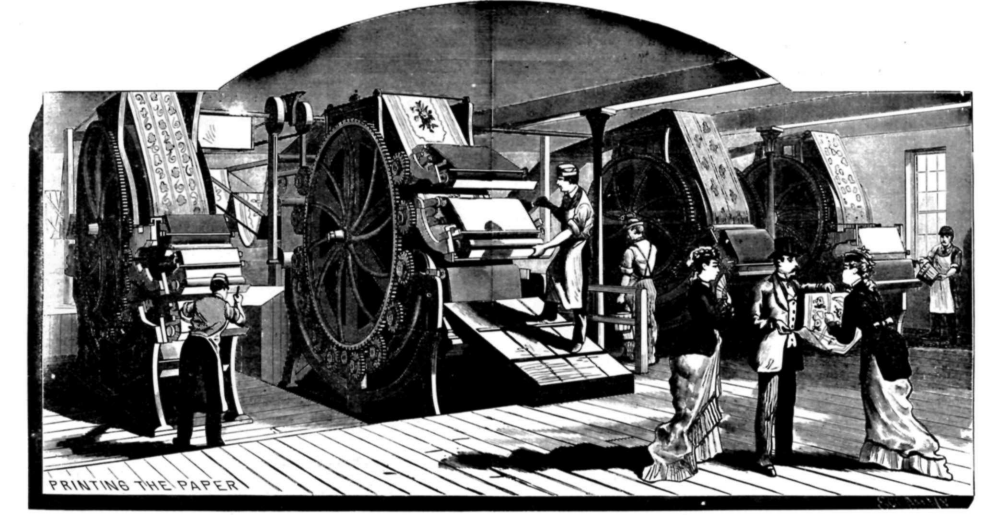
Illustration of machine-printing wallpaper in New York factory. (Image: Scientific American, 1880 in “Wallpapers in Historic Preservation”)

The design on the orange wallpaper suggests that it was machine-printed using a cylindrical stamp to create its scrolling style and thin-bodied color. This means that the wallpaper is older than 1840, when steam-powered wallpaper printing machines were developed and popularized in the United States (Frangiamore 7). The scrollwork pattern of the wallpaper was also in fashion during the mid-19th century (Frangiamore 27).  

The wooden board upon which the wallpaper is affixed has remained in its current location since around 1851, when a series of “mid-century alterations” added a room on the second floor and extended the garret above it, using the wallpapered board (Crawford & Stearns 1.31). Many of the wood planks used in the extension of the garret date to 1786, some of which have been identified as doors previously used in other areas of the house (Crawford & Stearns 2.99). However, the wallpapered board is never specifically dated in the Historic Structure Report. Presumably, the wallpaper had been on the board prior to its use as a floor plank for the garret, since none of the boards around it have wallpaper remnants on them. Also, there is no mention of wallpaper used within the Hasbrouck house, only plaster and paint on the walls of each room. 

Object Narrative

The board may have been in the house prior to its use as a floor plank for the garret, but who lived in the house in the early 19th century is unsure. In 1822, the property was inherited by Levi Hasbrouck, who also owned many other properties in the area and had the highest tax assessment in the town (Crawford & Stearns 1.54). He did not live in the house at the time, but it is unknown whether the property remained vacant or if laborers were boarded in the house. 

Between 1849 and 1862, tenant Samuel D.B. Stokes, who previously lived in Butterville on a different property owned by Levi Hasbrouck, rented the Hasbrouck house on Huguenot Street. He managed the surrounding 230-acre farm of livestock (horses, cows, oxen, sheep, and swine) and crops (wheat, rye, corn, oats, potatoes, buckwheat, peas, and beans). According to the 1850 Agricultural Production Schedule, the farm was valued at $11,350, making it “one of the largest and most productive farms in town” (Crawford & Stearns 1.31).  

Stokes hired 2 laborers as well as his own nephew to live on the property and help with the work (Crawford & Stearns 1.55). Besides these men, Rachel Stokes, his wife, and their 5 children also lived in the Hasbrouck house. The rooms on the second floor were most likely built so that the house could accommodate the large family and the hired laborers. The garret was used for storage above the second floor, with a seemingly random wallpapered board laid down as a floor plank in its construction. 

It is possible that the wallpapered board arrived at the house with the Stokes family because of the lack of wallpaper anywhere else in the house. Butterville, their original residence, is only an hour’s walk westward from Huguenot Street, where the Hasbrouck house is located, so transporting their possessions would not require a long trip. But why would they have carried over a piece of wood, specifically one covered in wallpaper?  

Objects are generally kept for either practical use, aesthetic value, or sentimentality, or more than one of these reasons. This board seems to fulfill all three. My guess is that it had previously been a fireboard at the Butterville residence, used to cover a fireplace opening during the warmer seasons to prevent anything coming in the house through the chimney. It may have been decorated with wallpaper to match the house, as was common during the 19th century (Frangiamore 41). Bringing the fireboard to the new house at Huguenot Street carried over memories as well as serving a useful purpose. Along the solid-color painted walls of the Hasbrouck house, the decorated fireboard may have seemed out of fashion, and been pushed away into the second floor, then later mistaken for an old plank and used in the construction of the garret, where it survives to this day.

The houses on Huguenot Street symbolize what many consider to be the beginning of New Paltz history: the 17th century French settlement by the 12 original patentees. But many of the houses have been transformed over time, with added levels, rooms, decorations, furnishings, and more. Each development embodies a story of the time, the people, and the place, all connected through the last few hundred years. Only by looking closely at the objects that remain can we begin to uncover these layered histories. 

Fireboard with foliate pattern wallpaper. 1855-1865, Historic New England

Works Cited

Crawford & Stearns Architects and Preservation Planners, and Neil Larson & Associates. Historic Structure Report: The Jean Hasbrouck House. 2002.  

Frangiamore, Catherine L. “Wallpapers in Historic Preservation.” National Park Service Office of Archeology and Historic Preservation, 1977, http://npshistory.com/publications/preservation/wallpapers.pdf 

Collaborative History Project: Rafaela Valle-Heckmann (Draft)

Provenance

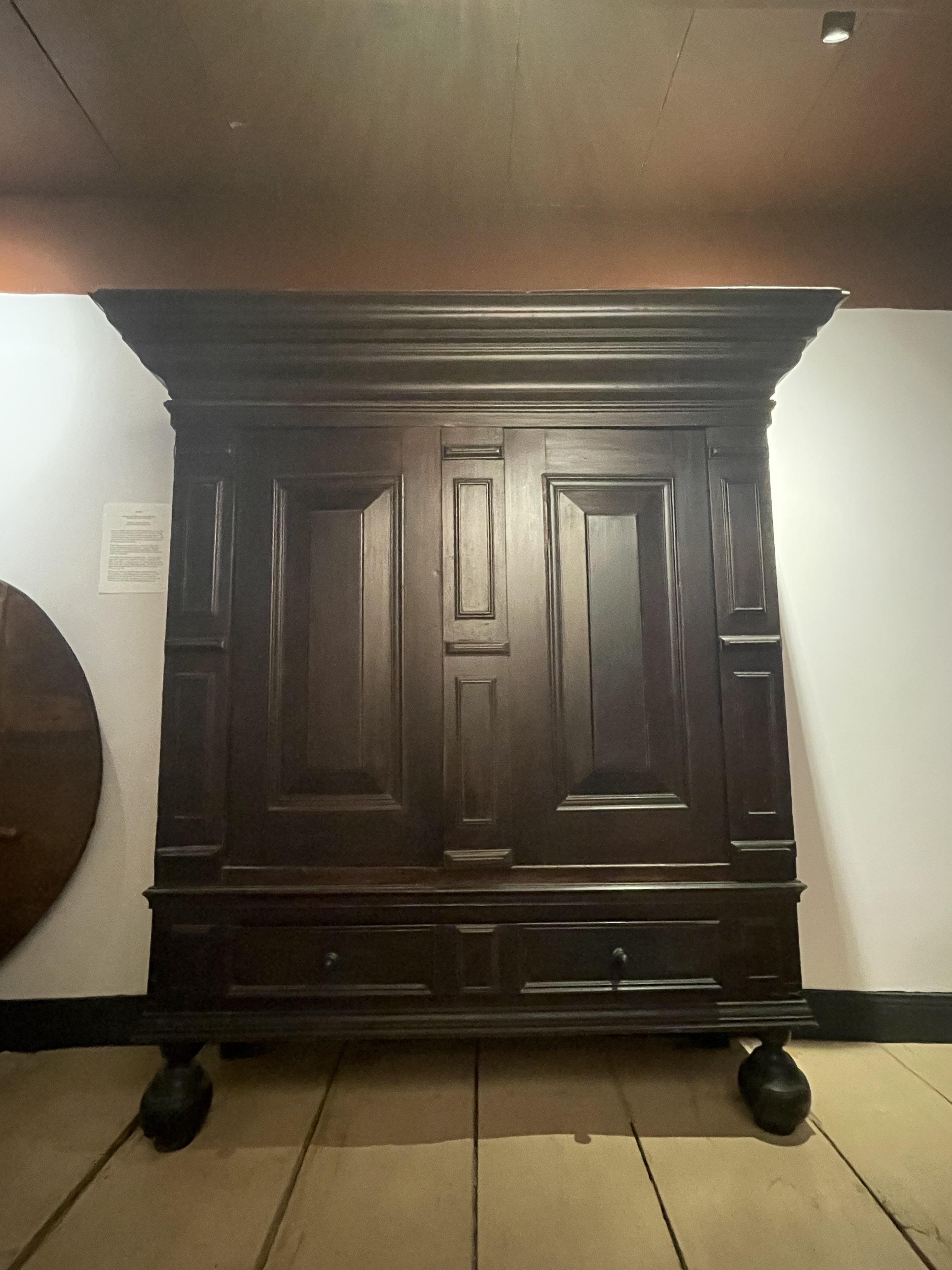
Before being donated to Historic Huguenot Street by Richard R. Hasbrouck, this kast stayed in his direct descendent, Jacob J. Hasbroucks house which was built by his father Major Jacob Hasbrouck in 1786. Of the artifacts accepted by Historic Huguenot Street from the Richard Relyea Hasbrouck estate, the Kast was known as a major central piece in colonial New York. It signified the influence of Dutch culture throughout the Hudson Valley. Since kastens were normally part of a woman’s dowry, it is possible that this kast was in the dowry for Hasbroucks marriage either to Margaret Hardenbergh (which took place from 1776-1796) in 1793 or Ann DuBois from (1777-1854) in 1799.

Object Description

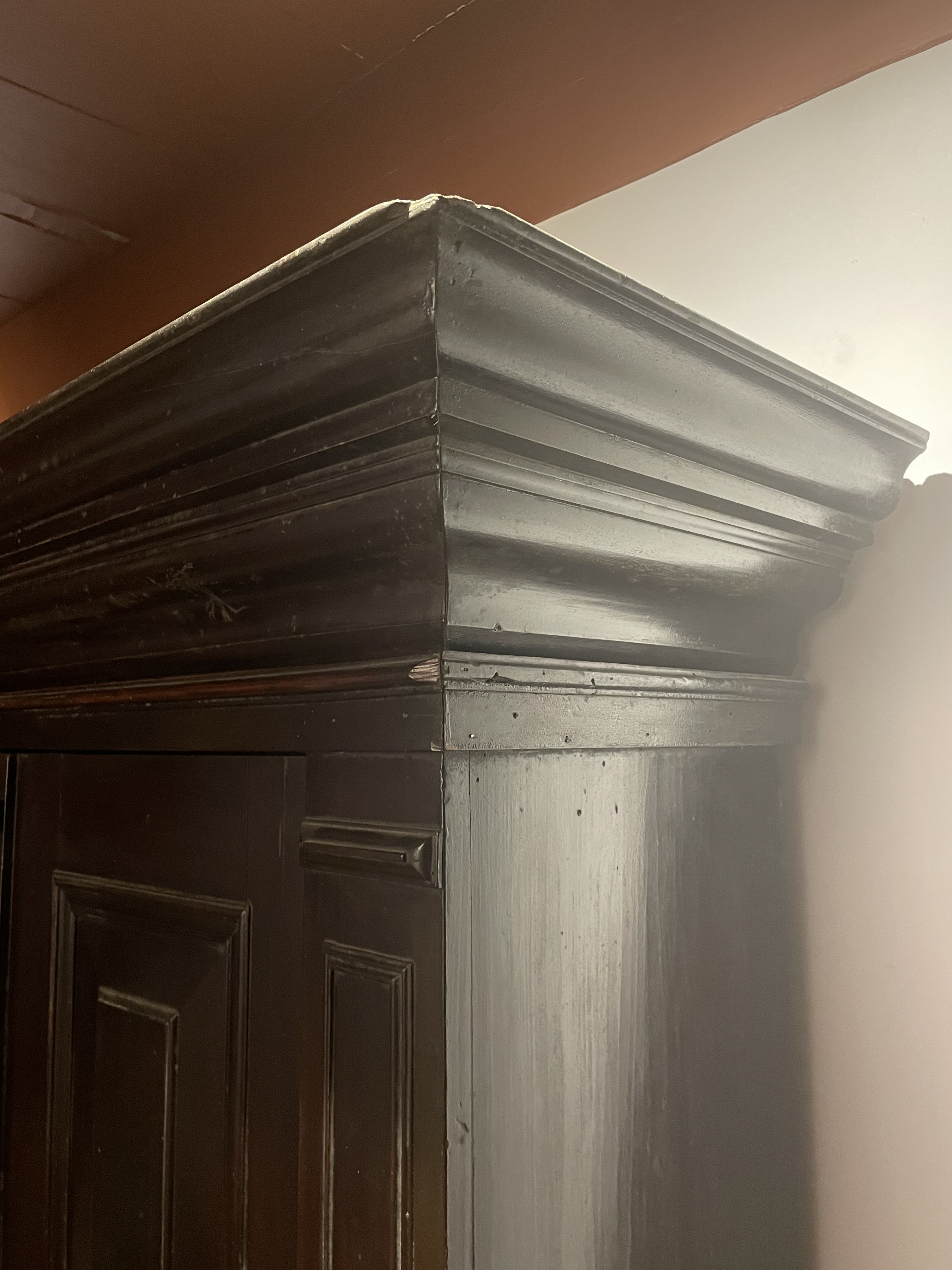
Made out of red gum, sycamore and pine, this dark brown kast stands at 73.25 in. tall and has a width of 16.5 in. measured from the middle. Starting from the bottom, this kast is standing on two ball feet in the front and two pegs the same height in the back (measurements currently unknown). As we move upwards to the body of the kast, the first part closest to the legs include two rectangular drawers side by side with circular knobs attached to both in the middle. Inbetween and on both ends of these two drawers is a vertical rectangular design the same length as the sides of the drawers. As we continue to move upwards we reach the middle of the kast that holds two large doors in the shape of vertical rectangles with two smaller rectangles on the inside of each door panel where there is a continued theme of rectangular designs. On this section there are two longer vertical rectangles placed inbetween the two doors and on both outer sides of the doors. There are no knobs on these panels so you have to open them by pulling on them. On the inside of each panel there are threee shelves large enough to fit a standard sized banker box. The top section of the kast or the cornice is angled more outwards compared to the rest of the object with a length of 67.5 in and a width of 22.5in. The wear and tear of this kast is evident in the dents and chipped paint throughout the object and also in the large chipped piece of wood on the top front left corner of the kast.

Narrative

When we think of Kastens or cupboards we just think of a place to store spare bedding, clothing or just clutter. We don’t tend to think about the impact of its physical attributes like its structure, the shape of the doors, the texture of the wood, etc. We typically have this type of furniture for its convenience, we don’t tend to perceive it as an indication of status or think about the cultural influence that led to the creation of these pieces. However, back in colonial New York with its strong Dutch influence, this kast was a staple piece in these Dutch-American homes.

In the early 1600’s the Dutch colonized the Hudson Valley as well as parts of New Jersey, Pennsylvania, Maryland, Connecticut and Delaware. They named their colony New Netherland. But after surrendering to England in 1664, the capital city of the colony, New Amsterdam became what is now New York. This meant that the Dutch influence eventually faded away within 100 years. Because of their fewer outside influences, Hudson Valley, on the other hand, remained carrying out Dutch traditions, customs and continued speaking the language for the next 100 years.

These Kasten held a lot of significance during this time period for Dutch settlers and are now major indicators of that continued influence of Dutch culture and values because of the specific design and style. “It safeguarded not ony such tangible treasures as gold, silver, and linen but Dutch notions of domestic life as well” (Berman, 1991) Becuase of it’s practicality due to storage it became an essential piece of furniture for Dutch settlers to own. But because of Dutch values, the standard kast also symbolized ones wealth and status in society. A typical Dutch family’s most prized possessions were their silver and gold items as well as textiles, so displaying their kast in thier living room for guests to see was a symbol of their achievements. Sicne these objects were considered to be too precious to leave out in the open, the kast itself became a decorative piece.

Citations

“March 2022 – Hasbrouck Family.” Www.hasbrouckfamily.org, Mar. 2022, https://www.hasbrouckfamily.org/wp-content/uploads/2022/02/HFA-Journal-for-Mar-2022-web.pdf. 

Macdonald, Joan Vos. “How the Dutch Influence Persisted across the Hudson Valley.” Hudson Valley Magazine, 27 July 2020, https://hvmag.com/life-style/history/dutch-influence-hudson-valley/. 

“News Release: HHS Presents an Exhibition and Special Tours on Kasten.” Historic Huguenot Street, https://www.huguenotstreet.org/news-release-hhs-presents-an-exhibition-and-special-tours-on-kasten-from-mid-hudson-valley-collections. 

Macdonald, Joan Vos. “How the Dutch Influence Persisted across the Hudson Valley.” Hudson Valley Magazine, 27 July 2020, https://hvmag.com/life-style/history/dutch-influence-hudson-valley/. 

Berman, Avis. “The ‘Kast’.” AMERICAN HERITAGE, 1 May 2023, http://Berman, Avis. “The ‘Kast’.” AMERICAN HERITAGE, 1 May 2023, https://www.americanheritage.com/kast.

Delftware in the Jean Hasbrouk House

Physical Description 

These two lidded vases stand at around 12 inches tall, with full bellies and rounded lids. The lids are inset, with the flange built on the lid to rest beautifully inside the mouth of the vase. They are hand painted with cobalt, and display a variety of patterns, mark-making, and storytelling. A scene with two deer in a field joyfully adorn all four panels across the belly of the pieces, framed with exquisite, painterly swirls. Each pot is topped with a different white dog figure, with glowing red eyes and mouths. 

Provenance

Set of 18th-century Delftware Vases. 

These are made of earthenware, a common clay body found in rivers and deposits around the world. Earthenware is a dark, easily manipulated clay. It is generally dark red/brown from encountering other sediment, and lots of red iron in the ground throughout its lifetime. Due to weathering, it has a relatively small particle size compared to other clay bodies, and for this reason it is also very easy to sculpt and throw with. This is the only type of clay that was native to Europe. The natural orange look of earthenware was celebrated for centuries, most notably in Greek and Roman pottery. 

In the 14th century, Marco Polo brought porcelain to Europe. This type of clay was white and delicate, yet durable. China is rich with porcelain, a clay which has not been tainted by other colorful oxides the way earthenware is. Polo called this white clay porcellana, a term for cowery shell, which is also shiny and white. Porcellino in Italian is also the name for a little pig, whose white bellies also look like soft white clay (Force). A fascination began to brew in Europe. In the 16th century, trade routes between the Netherlands and Asia brought fine china to wealthy homes. “[Blue-and-white porcelain] went on to triumph far and wide, reshaping [and sometimes destroying] pottery traditions in virtually every society it touched, from the Philippines to Portugal” (Finlay). Since not everyone could afford this luxury, Dutch potters developed their own methods to make similar pieces. Delftware is the art of emulating traditional chinese blue and white porcelain vessels. 

The process of creating Delftware begins with using earthenware local to the Netherlands to create a pot. To conceal the natural color of the clay, tin is used to create an opaque white glaze. True Chinese porcelain was painted with cobalt imported from the middle east (Pierson). This was already available to Dutch artisans, and they were familiar with the material in ceramics. The tin glaze was a beautiful base for painting with cobalt atop of, and though the method produces a sophisticated result, it is actually a simple concept. It was Chinese ceramic design and painting style which really took Europe by storm, and Dutch potters used delftware to adopt Far East aesthetics in their entirety.

Narrative

Three of these vases rest atop a kasten in the kitchen of the Jean Hasbrouk House. Other delftware bowls and cups sit below, but these have a grand place overlooking the room,. 

This set was produced by the DeWitte Ster Factory in the city of Delft, the Netherlands. High-quality ceramics were created at this factory from 1660 to the late 1700s. Though this factory was very good at making delftware, their mission as a company was to create all different styles of attractive high-end ceramics for aristocrats. 

DeWitte Ster’s signature on the bottom of all pieces made at the factory was a star. We can date this piece to a more specific date because accompanying the star is the initials AK. Albertus Kiell was the owner of DeWitte Ster from November 1761-December 1772. This is is an interesting mark for a production piece, giving it more depth and recognition than we may otherwise have understood. A post by Historic Huguenot street provides context to the importance these pieces may have had in a Dutch-American home: 

 “The finials of these vases represent a Dutch interpretation of a Chinese architectural ornamentation. Foo dogs, or fu dogs, are lions typically made of stone and thought to protect against evil…To the Dutch, these beasts resembled the dogs they kept as pets, and foo dogs were painted to appear more familiar and dog-like. Dogs and other animals are a common motif on delftware”(HuguenotStreet).

It appears that these pieces were somewhere between a point of pride, a beautiful object to absent-mindedly stare at, and a good luck charm for the house. 

Work Cited

Force, Thessaly La. “The European Obsession with Porcelain.” The New Yorker, 11 Nov. 2015, https://www.newyorker.com/books/page-turner/the-european-obsession-with-porcelain#:~:text=Porcelain%20was%20white%20gold%2C%20valued,and%20vials%20of%20musky%20scents. 

Huguenotstreet. “This week’s curatorial post features a set of 18th century delftware vases.” Instagram, 15 Nov. 2022, https://www.instagram.com/p/Ck-6OWStr_o/?utm_source=ig_web_copy_link

PIERSON, STACEY. “The Movement of Chinese Ceramics: Appropriation in Global History.” Journal of World History, vol. 23, no. 1, 2012, pp. 9–39. JSTOR, http://www.jstor.org/stable/41508050. Accessed 5 May 2023.Finlay, Robert. “The Pilgrim Art: The Culture of Porcelain in World History.” Journal of World History, vol. 9, no. 2, 1998, pp. 141–87. JSTOR, http://www.jstor.org/stable/20078727. Accessed 5 May 2023.

Collaborative History Project – Rough Draft

I will soon replace these images with higher resolution photos from Louise.

Physical Description

This diamond-shaped canton ware set includes a plate and a lid that come together as a vegetable serving dish. Both underglaze pieces are first adorned with painted scenes of a Chinese coastal village in a monochromatic cobalt blue before being covered in transparent ceramic glaze. Notably, there is a lack of people in the paintings. Instead, a calm and serene atmosphere features trees growing in harmony alongside the riverbank. In the foreground, a junk ship with raised sails is floating between a small pedestrian bridge and a Siheyuan-style courtyard with pavilion roofs. Towering mountains uniformly line the background behind French country-style houses. An oval knob-like handle protrudes from the center of the lid, which obscures part of the painting. The cover is outlined with large decorative “X” markings on top of a thick blue band. Meanwhile, the lip of the deep dish is traced with a royal blue ribbon that fades into thin lines and scalloped edges. 

Provenance

This porcelain vegetable serving dish and lid is part of Barbara Lumb Jeffers’s 38-piece donation to Historic Huguenot Street (HHS)’s permanent collection. Porcelain that was manufactured and exported from the Canton (Guangzhou) province of southern China is coined the term “canton ware.” This selection of canton ware is estimated to have been painted during the early nineteenth century (1800-1835), which is distinctly recognizable with the “blue willow” pattern. Her fourth great-grandfather, Jonathan Deyo, started collecting canton ware while living at New Paltz during the early 1800s. It would take another six generations—passing through the hands of Peter, Ira, Jacob, Florence, and Josephine—until Barbara inherited the 47-piece canton ware collection. 

Narrative

What is your first thought upon laying eyes on a canton ware that dates back to the 19th century? Before lifting the pristinely decorated porcelain lid to unveil the awaiting scrumptious contents of the vegetable serving dish, would you attempt to piece together an understanding of the depicted environment in the painting? The calm cobalt blue illustrations spanning across the canton ware are smooth to the touch and memorizing to admire. 

I have never traveled to China before. Yet, I understand that China is multi-faceted. Yes, the country was prosperous with prominent advancements in agriculture, medicine, and consumer goods. Even so, many Chinese citizens had simultaneously faced a growing social class divide, political corruption, and civil wars. However, what if this vegetable serving dish was my only one exposure to China? In thirteen colonies during the 19th century, idealized fantasies about a foreign country could have easily become mistaken for irrefutable truths. 

This particular canton ware holds a historical narrative of values from the porcelain’s first that has historically traveled back to its creation, during the 19th century. Remarkably, the last seven generations of the Deyo family have excellently preserved this piece of canton ware without a single crack or chip. They treasured their canton ware collection. 

The Deyo family is one of the French Huguenots who settled in the town of New Paltz. The family lineage is dated with influential figures including politicians. The first collector of canton ware was Jonathan Deyo, who was not a local celebrity. Yet, he upheld high religious and educational expectations for his family. 

On February 16th, 1780, Jonathan married Mary (Maria) LeFevre. They had seven children. (Unfinished draft)

Works Cited (soon to be updated in MLA format)

https://www.poughkeepsiejournal.com/obituaries/pjo066130

https://www.pphmuseum.org/canton-ware-china

Collaborative History Project- Rough Draft

Provenance- The Stillwell Family Ciphering Book was donated to Historic Huguenot Street by Richard Ordway in 1978 and is part of a bigger collection of 24 ciphering books that were hand \written. Those ciphering books were part of an even bigger collection of Stillwell/ Johnson Family papers which dates range from 1789-1943. I was unable to find any more information on the provenance of this book specifically on the Sojourner Truth Database but the collection of books was represented by a multitude of families including the DuBois and the LeFevre families, some of the most influential families known to Huguenot Street. (Ciphering Book Collection (Ca. 1730-1849)).

The Stillwell Family Ciphering Book includes various economic concepts like  ‘Reduction’ and the values of currencies based on location. I know, riveting. But beyond that, this book offers a look into the academic and philosophical world of the Stillwell Family and gives us a look into the mind of the wealthy in the 1800s (New York Heritage-Digital Collections).

Physical Description- This book has a brown exterior with pale yellow pages in the inside. When given a closer look the seemingly semi-bendy exterior of the book has multiple shades of brown featured in small bubbles that look similar to a petri dish of bacteria under a microscope or multi-shaded stone pavement. The edges of the exterior of the book are rounded and a lighter shade of brown. The spine of the book looks scratched fairly consistently and has a small rip towards the bottom that exposes the pages of the book. The pages of the book are written in medium brown ink and most of them look like they have some type of liquid spilled on them that seems like it could be coffee. The handwriting is a neat cursive that varies in size depending on if the writing is a title or not.

Narrative– *I submitted a ticket to the research department of the library to find out more about the specifics of the family and their relation to New Paltz so I can go more into depth for my final draft*

When you think of the objects surrounding the history of education in the US, what do you think of? Maybe it’s quills and feathers. Maybe it’s one-room schoolhouses and long rulers. The history of education in the US is a bulky one filled with arguably more good than bad, but nonetheless, the influence of the objects and materials that once shaped young minds is irrefutable. One object that is often overlooked in its influence on Western education is the ciphering book. A ciphering book is a textbook-like, handwritten booklet that was used frequently in the 18th century to teach people about mathematical concepts ranging from fractions and geometry to economics and applied math. Along with math, these books also covered spelling, handwriting, and other English topics (New York Heritage Digital Collections). These books often included examples, problems, and exercises and were used by educators as their main form of reference and handy teaching tool. Ciphering books’ use didn’t end in the classroom, though. These became students’ personal reference books to use later in their lives as well. (Library, Rauner). 

One ciphering book that offers an in-depth view of the peak of their use, the 1800s, is the Stillwell Family Ciphering book in the Historic Huguenot Collection. This ciphering book deals with the application side of math in this time period and was used by the Stillwell Family for answering what they deemed “practical questions”. These practical questions included mathematical concepts relating to international trade and the value of the dollar in different US states at the time (Ciphering Book Collection (Ca. 1730-1849)). 

What stuck out to me about this ciphering book in specific was the family’s philosophical takes intertwined within the pages and pages of applied math. The more practical and direct rules and guidelines were very common for these ciphering books but the addition of big-picture takes on education as a whole was not as common, and more telling in my opinion of the headspace of the author of this book. The description of this book on the Huguenot Street website features a quote from the author of this book. It states, “Commendation commonly animates the mind” (Ciphering Book Collection (Ca. 1730-1849)). The author of this book believed that praise would help people think more effectively. As much as ciphering books and that way of learning has changed drastically compared to today, that concept still remains in education and just society in general. Two more quotes that were even more shocking to see in a ciphering book, in my opinion, were first, a take on happiness that read, “He who cannot be happy without great pains will always find his pains greater than his happiness”, and second, a take on ownership that read, “The possession of enjoyment is better than the enjoyment of possession” (Ciphering Book Collection (Ca. 1730-1849)).

 These perspectives on concepts are not only discussed today but also widely agreed with. It’s often hard to stop yourself from slipping into a mindset that regards history as just history-A time and place that’s separate from the here and now. But it’s important to remember that although the physical elements of history change, the human condition of the inevitability of pain and the search for happiness remains constant. 

References

Library, Rauner. “Rauner Special Collections Library: Ciphering Books.” Rauner Special Collections Library, 14 Nov. 2014, raunerlibrary.blogspot.com/2014/11/ciphering-books.html. Accessed 30 April 2023.

“Ciphering Book Collection (Ca. 1730-1849).”Historic Huguenot Street, www.huguenotstreet.org/ciphering-book-collection. Accessed 30 April 2023.

“MSS208_001_002_p001.”Nyheritage.contentdm.oclc.org, nyheritage.contentdm.oclc.org/digital/collection/p16694coll153/id/1899/rec/1. Accessed 1 May 2023.

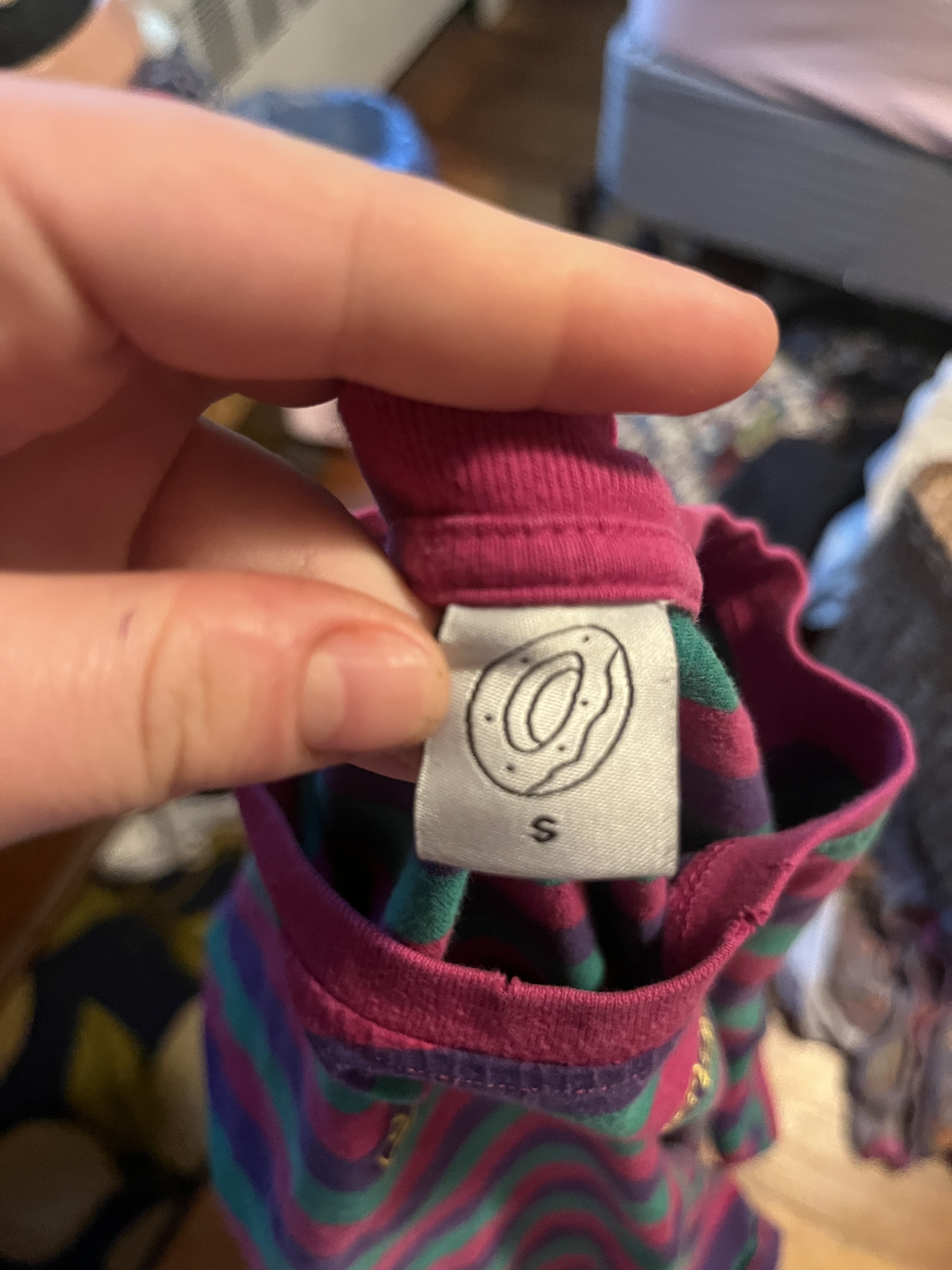
ODD FUTURE Shirt, Purchased from Depop

Short Assignment 5

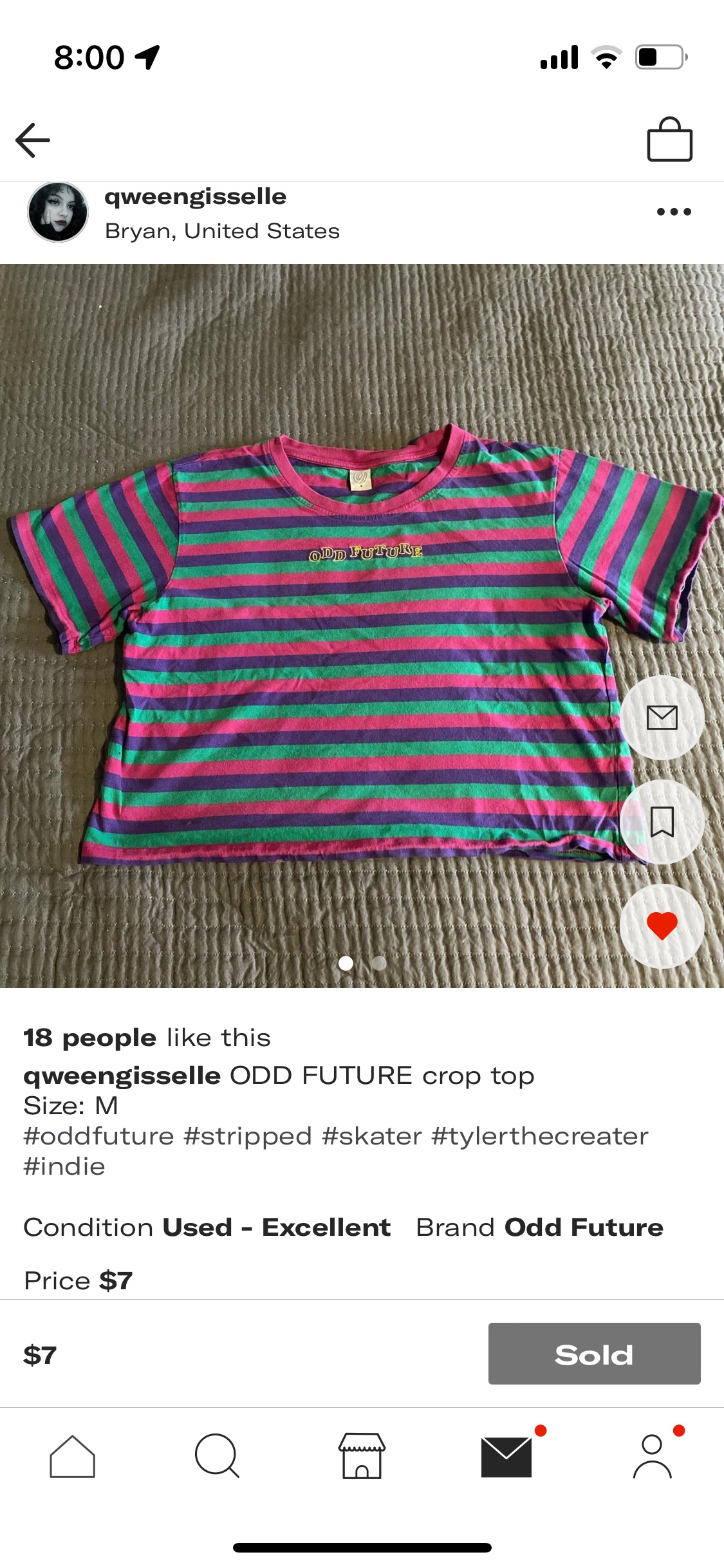
I purchased this shirt recently from Depop. Depop is a clothing resale application that I frequent. The idea is that you can buy and sell pieces, and buyers are able to ask to lower the price by writing a counter-offer. I thought this shirt was a great deal because this person was selling this vintage odd future shirt for only seven dollars! This is a piece I have wanted in my clothing collection for a long time. Though shirts like these are not very rare, the price is never this low. I suppose the seller just wanted to get rid of it. Now I am the happy new owner to a piece that means a lot to me and my generation of Odd Future/2010’s hip hop fans. I also know it will appreciate in time, and I would never be able to make a purchase like this in ten or twenty years. 

Odd Future Records - Wikipedia

Odd Future is the name of a music group started by Tyler, The Creator, which is no longer together. Since they released their first mixtape, Odd Future began releasing merch. They started the clothing brand GOLF WANG in 2010. The hip hop group’s full name was Odd Future Wolf Gang Kill Them All, and GOLF WANG is an anagram for WOLFGANG. Odd Future was always more than a hip hop group, and GOLF WANG was always more than music merch. Their songs were on the cutting edge, spitting grotesque rap verses, often using obscenities  which some people would find upsetting. However, a closer read reveals insightful social commentary on the black gay experience in America. Their music was accompanied by videos of friends messing around, doing teenage shenanigans, pranks, improv skits, skateboarding, even eating cockroaches. 

Odd Future | Listen on NTS

I will group the components of this shirt into three categories: Design, production, and distribution. 

DESIGN

The shirt itself seems like a simple striped shirt logo tee, but it means so much more within fashion, music, and culture. The context is important, because Tyler, the Creator, himself is the main designer of the clothing. Not all musicians personally design their clothing, pick out the fabric and the colors, or even care as deeply as Tyler has done from the beginning with GOLF WANG. Their status in pop culture is just as much an element of the design, and ability to sell the item as the visual appeal of the shirt. The members of Odd Future exude the stylish, cool, misfit energy which heavily influenced the trajectory of fashion in the 2010’s. In a recent interview Tyler, the Creator says, “I remember being 17 and I was the outlier… everyone was like what the f**** are you wearing? And then a few years later people were doing it too and saying n**** you know that’s cause of you!” (Frugal Aesthetic). 

Post-ODD FUTURE there was a palpable shift in what young people wore. Preppy, fitted clothes in subtle colors were replaced with bright-colored baggy streetwear. Wearing clothing against the norm on purpose actually turned into the norm. The clothing brand continued to grow and evolve ahead of the fashion brands that attempted to emulate uniqueness. The idea of making noise against the mainstream in order to push your own voice remained synonymous with ODD FUTURE. The shirts which simply say ODD FUTURE, like this one, are not necessarily cutting edge design wise; however it directly spells out the wearer’s affiliations with the brand’s purpose and history. 

I wanted this shirt specifically because they do not make ones like this anymore. Tyler, the Creator has since handed the company off to another ODD FUTURE member, Jasper, who then gave all creative rights to Zumiez. True ODD FUTURE is no longer being created.

A few examples of Tyler, The creator’s eclectic style over the years.

PRODUCTION

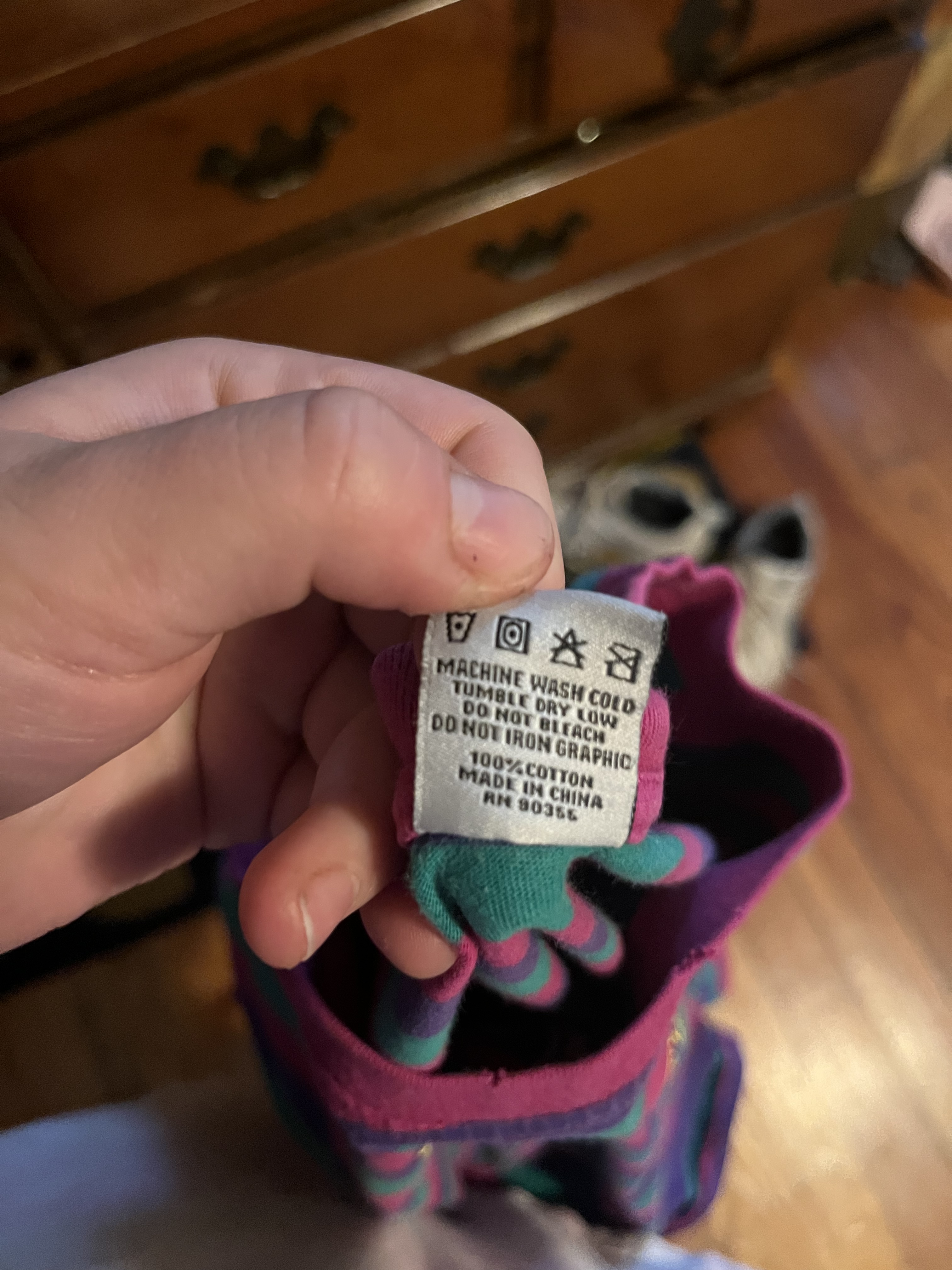
Now that the and history conceptual essence of ODD FUTURE has been established, I will dissect the physical attributes of my new shirt. After doing some research on striped clothing, it is most likely that the stripes were from separately dyed threads that were then woven to create a pattern next to each other. Some shirts have stripes which are created with dye after making the shirt, but with the quality of this shirt and the multicolored variation, the former is more probable. The tag says not to iron the graphic, however the “ODD FUTURE” text seems to be stitched directly to the shirt. Perhaps this warning only applies to garments which have decal prints on them.

The tag reveals that the shirt was made in China. I have tried to research exactly where the clothing is being created, but since this is an old piece I cannot track the exact whereabouts of production at the time. The people who did the stitching and embroidery on this shirt did a fantastic job, whoever they may be. Overall, the quality is excellent and you can tell that it is not an ultra-fast fashion garment. It is 100% cotton. There are a few small holes in the neckline from the previous owner. I do not mind about these small defects.

DISTRIBUTION

Finally, the way I personally received this item of clothing was through the app Depop. The seller was @qweengisselle or Giselle’s Closet. Depop is a really convenient way for people to buy and resell clothes, and in this case you can see that this seller is also interested in simply trading clothes. I received my package very quickly, you can see on their page it reads that their sales are often shipped in 3 days, which is even faster than some retail companies.

The package was shipped within the United States through USPS. I must mention the time spent to package and ship the item from Giselle, the hard work of the people at the post office, as well as the post office delivery workers for bringing it to my doorstep.

The Recipe Book – Collaborative History Project – Carlin Feck

Provenance 

The 1826 recipe book was donated to Historic Huguenot Street by the husband of Lois Marion Hasbrouck Simpson (1933-2017). Lois was the great granddaughter of Abner Hasbrouck Sr, a descendant of Patentee, Abraham Hasbrouck. The book was passed down from the hands of Abraham himself to his son Abner. Abner then passed it down to Miton Seymour Hasbrouck, who gave it to the donor. The contents of the book were believed to be written by Pamela DuBois Hasbrouck, wife of Abner, who lived from 1812-1893. This would make Pamela as young as fourteen years old at the time the recipe book was being used. 

Physical Description

The book consists of a small stack of yellowing, thin, fragile papers bound together by string and encased in a cover that is sturdy only in contrast to the delicate papers. Pages are stained with brown dots and smudged ink. However, the handwriting on each page is still fairly discernable. There are rips in the pages on the outside edges, as well as where the pages are bound by the string. Still, most pages remain bound, though a few have broken off and are tucked between one another. On some pages, scraps of fabric are secured onto the paper by use of a small pin. Recipes in the book written by Pamela include a recipe for fruit cake, crackers, and instructions on how to cure smoked beef. The book fits in the palm of one’s hand and is both light and compact. 

Here, the book is open to a page with two recipes. The recipes appear to be written in ink, which indicates Pamela was probably writing with a quill and ink, as the fountain pen wasn’t as widely available at this point. The pages are stained and ripping, but the recipes remain mostly legible. 

Narrative

It’s a crisp, glowing afternoon on Huguenot Street. It’s time for Pamela Hasbrouck to make dinner. There’s a whole family to feed and a whole kitchen in which to prepare. But what’s for dinner tonight? Pamela slides her brown receipt book (or recipe book, the terms are interchangeable) off the kitchen shelf. She flips through the pages, some already stained with flour and grease, deciding which recipe best lends itself to the ingredients that are already stocked on her shelves.

“Soft waffles, almond cake, potatoe pudding, bread pudding, custard, to cure smoke beef, brandy peaches, pickle plums…” 

She sets the book on the table. The pages fall open to one of her newest entries, “Amulet Omelet.” For this recipe, she’ll need “one pint of milk, four eggs, a small lump of butter, as large as a butternut.” She starts reading her own directions, written clearly for herself in quill and ink, “Put your butter in the pan and melt it first so as to grease the pan…”

Pamela has been keeping this specific recipe book for awhile. She’s still adding to it now in 1826, using it to document what she’s cooking and baking consistently, how to dye and color fabrics black, blue, and green, how to “remove grease pots from,” how to make a natural cologne water (lavender, orange, lemon, and alcohol), and even to document her spending and savings, scratching penciled addition algorithms into the margins. She’s a married woman now, but her responsibilities for keeping house began at a young age following the death of her mother. This is who Pamela is; a woman responsible for having knowledge. Knowledge that must stretch beyond the bounds of just bread pudding, that is. She clips newspapers and glues blurbs into her book, immortalizing how “To Cure Diphtheria” (smoking coal and tar out of a pipe), and keeping pages of her catechism pinned to the pages. If someone in the house or neighborhood is bit by a “Mad Dog,” if someone is hungry, if someone needs to remember how much money they deposited and when, they’ll surely come to Pamela and her records. The recipe book is essential, immortal, irreplaceable. It represents the encyclopedic knowledge of Pamela and her duties as the woman of the house. 

When it comes to the difference between the words “recipe” and “receipt,” some etymology can help us decipher why the two words arose as the names of these books. According to John Rees, “ The word ‘receipt’ derives from the Latin ‘recipere’ meaning ‘to receive’ or ‘to take.’ Both ‘receipt’ and ‘recipe’ originally referred to medicinal preparations. These would be either literally prescriptions with lists of ingredients, or loose instructions for mixing herbs, plant extractions, and foodstuffs. ‘Receipt’ was often abbreviated to a capital R with an X through it, becoming the ℞ symbol used by our modern pharmacies today” (Rees). 

As Joan Fitzpatrick writes in an essay included in Reading and Writing Recipe Books 1550 –1800, “Recipe books have not hitherto received the attention they deserve, yet they are important historical documents as well as being records of what and how people might have cooked” (Fitzpatrick, 1457). To view these recipe books as just tools from the past would be to discredit their nuance and overall storytelling capabilities. Recipe books are more than just decaying papers bound together, they’re primary historical documents. To experience the handwriting of Pamela herself is to experience more than just the reiteration of a two hundred year old recipe. Fitzpatrick continues on to say, “Anyone interested in writings about food knows that they are almost never just about food but also signal historical and cultural phenomena” (Fitzpatrick, 1458). Leafing through the pages leaves a door to the world of Pamela Hasbrouck and her home on Huguenot street open for us. 

Though Pamela’s recipe book is unique and irreplaceable in its own right, it is far from the only one of its kind. Women who kept house for their husbands, fathers, and families all over the country kept recipe books that were, on the outside, extremely similar to Pamela’s. In Bertha E. Josephson’s Notes and Documents – An Ohio Recipe Book , a recipe book from Ohio is physically described. “Indeed, what was it like to live one hundred and twenty-one years ago? That is the question that comes to mind upon examining an inconspicuous, brown leather-bound booklet, five and one fourth by seven and three eighths inches, with seventy hand-sewn pages of watermarked paper’ interspersed with blotting sheets and nearly filled with neatly written cooking and baking recipes, or ‘receipts’ as they were then called” (Josephson, 98). This quote describes a book that is nearly identical to Pamela’s. 

While her experience keeping her own book and house was unique and tells a story about Huguenot Street itself, the fact that the book was kept at all tells us a larger story about the universal experience of being a woman keeping house in the early nineteenth century. To be a woman with a recipe book was to be a woman with the responsibility of upholding her family. 

References

Fitzpatrick, Joan. Renaissance Quarterly, vol. 67, no. 4, 2014, pp. 1456–57. JSTOR, https://doi.org/10.1086/679885. Accessed 27 Apr. 2023.

Josephson, Bertha E. “An Ohio Recipe Book of the 1820’s.” The Mississippi Valley Historical Review, vol. 36, no. 1, 1949, pp. 97–112. JSTOR, https://doi.org/10.2307/1895697. Accessed 27 Apr. 2023.

Rees, John. “Digitizing Material Culture: Handwritten Recipe Books, 1600–1900 – Circulating Now from the NLM Historical Collections.” U.S. National Library of Medicine, National Institutes of Health, 13 Apr. 2017, https://circulatingnow.nlm.nih.gov/2017/04/13/digitizing-material-culture-handwritten-recipe-books-1600-1900/.