Throughout my childhood I was always reminded of the importance of family. I know that this importance is not stressed for everyone and that many people are not given families that care to uphold familial relationships, but for as long as I can remember family came first. This was especially prevalent on my Moms side of the family. As a child I was always told stories of my Nan who passed just a few months before I was born. My Moms Mother, Rosemary Catherine who I am named after, was a bright and loving soul. I’ve always been told that I am just like her and that she is where I get my artistic side from. I can remember being a small child and looking through the tons of paintings and jewelry of hers that my aunt had kept all these years. As a kid these items always gave me such comfort, they tied me to someone I had never met but made me feel like I’d always known her. In the last few years my family decided to go through all of her old jewelry that my aunt wasn’t doing anything with. When I saw one of her old Claddagh rings I felt overwhelmingly drawn to it and knew I would love to keep it.
This is a real 14k gold Claddagh ring that was my Nans. It is too small for me to wear, probably a size 5 or 6 and has a nice thin band stretched around the back of it. The hands of the ring come toward the front and surround the heart in the center. There are gaps on either side of the heart, separating the hands from it and making the design clear. The heart is topped with three connected protrusions that are rounded at the top resembling a crown. The ring to the left of it was one of her rings as well and is believed to also be a Claddagh but the engraved design has become so faint over the years that it is hard to say exactly what it is. Both rings are clearly not brand new and covered with years of scratches and dings that show their age. Although the exact year that my Nan got the rings is unknown, my mother says that she remembered them from her childhood. The many years that my Nan wore these rings are written all over their surfaces and serve as a reminder of the life she once lived.
Claddagh rings were first created in the fishing Village of Claddagh in Galway, Ireland. The original Claddagh ring was created by famous Irish goldsmith Richard Joyce. The story behind it is that he was trained as a goldsmith after being captured by pirates and sold as a slave. He created this ring for the woman that he loved with each aspect of the ring representing something different. The heart at the center represents love, the hands surrounding it represents friendship and the crown on top represents royalty. The way a Claddagh ring is worn is telling of your status of love; it was originally worn with the heart facing toward yourself if you were married and away if you were not. Throughout the years many different ways of wearing the Claddagh have been developed and each positioning of the ring has a different meaning. These rings have served as a symbol of love and friendship and are still worn amongst many Irish people to this day.
My Nan’s mother grew up in County Mayo, Ireland which is not too far from where Claddagh rings originated. She came to the United States in the early 1900’s and had my Nan in 1929. I still have family that live in Ireland, much of whom I have yet to meet. Every time I wear this ring I think of my Irish family and heritage as well as my Nan who I unfortunately never got the pleasure of knowing. I think it is really neat to possess an object that represents different aspects of my life and acts as a cultural grounding/reminder of the generations before me.
If there’s something you can learn from Slavic stereotypes—alcoholism, the post-communist brutalist architecture, chain-smoking cigarettes—the Christian devotion is one of the more truer ones.
It’s hard to imagine my Slovak heritage divorced from religion. Even a common parting word, zbohom, means “with God,” and it is a word that comes so naturally to me when hugging my relatives goodbye. Even as an agnostic, it’s hard to sequester myself from Catholicism. Yet, it isn’t just my tongue, but the objects that cling to my walls, that hang from my bedposts, that sit in my wallet, reminding me of our religious roots. One object that resonates with me is our black crucifix.
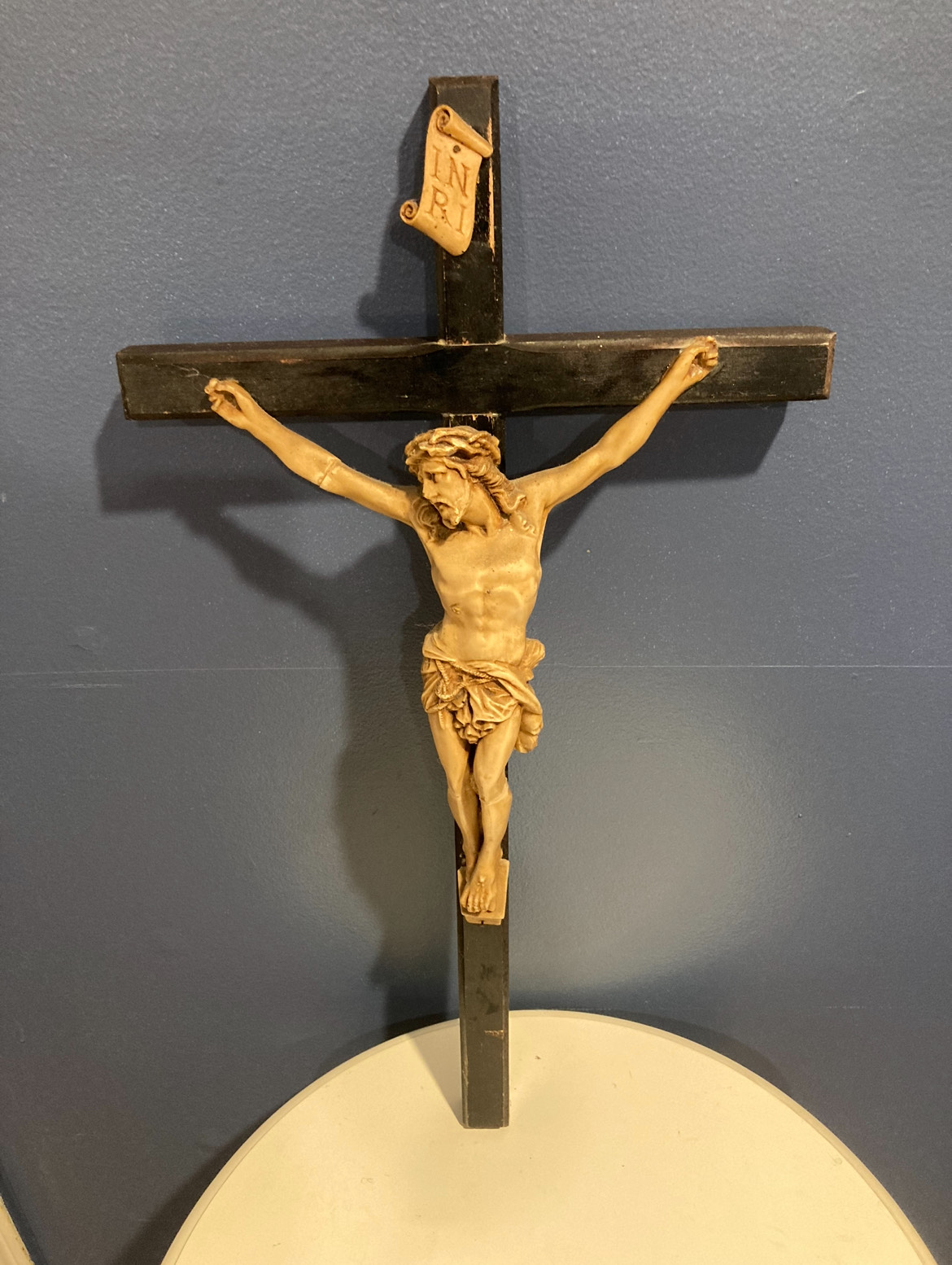
Black Crucifix, taken off the original wall, standing on my bedroom night-table.
The crucifix, standing around 25 inches long, 12 inches wide, is made from oak wood. Two pieces overlap to form the base, holding up a small wooden figure of Jesus Christ. He faces the right, clad in only a garment wrapped around his waist and bearing the crown of thorns. Inscripted in another piece of wood are the letters “INRI.” Compositionally, it is no different than any other crucifix, yet this one was an immigrant in my home, hanging in the kitchen for the first nine years of my life before moving to the hallway of our new home for the next ten (and counting!). It is an object that now exists in an unremarkable space, yet represents a deeper history of our Catholic Slovakian family.
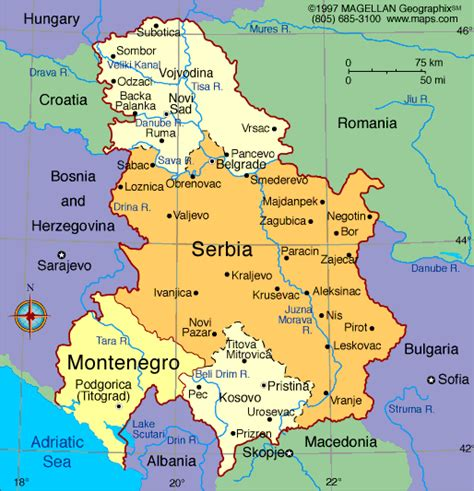
My family comes from a small village in Northwestern Serbia in a province called Vojvodina. Both my mother and father’s families immigrated here in the 19th century, leading to a collision of cultures and languages that resulted in a Slovakian-Serbian speaking region. A few empires and civil wars later, the Serbian village is still inhabited ethnically by Slovaks. My mother, who grew up in this village, could speak both Slovak and Serbian, navigating her tongue between the cyrillic script and Slovakian alphabet. My father is a native New Yorker, born and raised in Astoria, Queens, but he still frequented the village every summer. Both were raised catholic; both were raised speaking Slovak. Those two identities brought them together in union.
An image of Serbia, highlighting the Vojvodina province where my family is from. Source: toursmaps.com
But the story of the crucifix does not start here (though we will be returning); it begins thirteen hours away (allegedly by bus) in a small village called Medjugorje in Bosnia and Herzegovina (formerly part of the larger Yugoslavian empire). This is one of numerous pilgrimage sites for Catholics, having been established as such in 1981 after the apparition of the Virgin Mary.
The year was 1982, three years after my great-grandfather died. My great-grandmother, my Babička, at the time was a nun, living in Subotica and cooking meals for the bishops in a church. She was invited to live and work in Medjugorje, which had only begun to gain traction by that point. She took their offer, moving across soon-to-be-drawn international lines, and working as a caretaker for troubled youth. My Babička worked there for ten years, feeding and housing those youth in the hopes of rehabilitating them. It was during this period that she was given the crucifix from a local priest, though due to her old age and fading memory, the exact context and timestamp is not entirely certain. The crucifix did however make its way to our village in Serbia, along with my great-grandmother, once the Yugoslavian war broke out. It found a new home on her living room wall, along with countless other rosaries, statues, and books from the mountain. My Babička continued to visit Medjugorje, but she permanently settled back in our village, holding onto and eventually gifting these objects.
Something worth noting about this crucifix is its black paint. It is no accident that this is the shellac used, because this is a replica of a much larger wooden cross on top of Medjugorje. Though faded now, the black is meant to symbolize the darkest of sins, painted by those who touch its wood and soon after seek penance. Our family’s crucifix is matte black, a bit faded on the backside, but it still physically and symbolically maintains its color and meaning, as it hung from my Babička’s wall for twelve years.
The original black cross in Medjugorje. It is weathered from years of onslaught from the natural elements, but still an important cross for visiting Catholics to seek penance.
It is April 2004, and my parents are back in our small village, visiting my mother’s grandmother, my Babička, just one month before they were set to wed. It is here where the crucifix falls into my parents’ hands. It was a Catholic exchange, one not too unfamiliar within my family, but symbolically, its meaning had now changed. The matte black paint, meant to bear the weight of their worst sins, was now meant to prompt them to reconcile and to bear each other’s crosses as an act of love for each other and God. My Babička injected this new meaning into this object, handing it to them to bear and support this new crucifix in their new family til death. Fourteen years later, they filed for divorce.
For me, this crucifix exists in two contexts, pre- and post-divorce. Post-divorce, in the year 2024, it stands alone in my father’s home, sitting just above a light-switch, filling the blank blue wall between the bathroom and bedroom door. The crucifix has lost its luster, collecting dust and scuffs instead in the years of natural wear and tear. For my father, it is a reminder of his Slovak heritage and Catholic faith; for me, it is a reminder of the broken family unit betraying my Slovak and Catholic roots. It sounds grimmer than it actually feels, but looking at this cross—its inscriptions, its blemishes, its fine-wooden detailing—ultimately, it’s a part of me. It is a Yugoslavian Catholic reflection of myself and this new meaning I make of it, as time continues to pass and the crucifix still hangs.
The black crucifix in its original spot, above the light switch in my hallway, between the bedroom door and bathroom door.
When my mother was a child, her grandmother bought her a Shirley Temple doll. Manufactured by Ideal Novelty sometime between 1970 and 1979, this model of doll was a staple of the U.S. toy market and would have been a typical gift for a young girl. The doll stands at 16 inches, and has blonde, curly hair rooted to its vinyl head. Printed details depict clear brown eyes, an open-mouthed smile, and light pink blush. The doll wears a white dress with puffed sleeves, scattered with red polka dots and sporting a matching red velvet belt. On its feet are a pair of red plastic Mary Jane shoes, which would have been worn with white socks.
Ideal Shirley Temple doll and box. **This is the same model of doll, but not the specific object.
The gift came with a condition: the doll must not, under any circumstance, be removed from its protective box. One day, Grandma Minnie Strassberg told my mother, this doll will be very valuable. I don’t want you to get it dirty.
This was a big ask of my mother. Every day, against the instructions of her grandmother, she would remove the doll from its box. My mother would brush its carefully coifed hair, tweak and prod at the buttons and ribbons adorning the doll’s dress. The doll got along great with the other toys, and made friends with Raggedy Ann and Midge, Barbie’s pregnant and decidedly less glamorous friend. After playtime was over, my mother would put the doll back in its box, back in its rightful spot on her shelf, between an impressive collection of horse figurines and a box set of Nancy Drew books. By the time Grandma Minnie and Grandpa Harold and their little white dog Sherrie came around for dinner, everything was as it should be. If Grandma Minnie ever suspected what exactly was going on when she wasn’t around, she never let on.
Grandma Minnie died at the age of ninety-five on November 30th, 2010, a week after my seventh birthday. I was around the age my mother had been when she was gifted the doll. My memory of my great-grandmother exists in flashes, pale and fuzzy with age. I remember her full head of curly hair, once a brilliant red, and how small she was when I hugged her. I remember the smell of the retirement home where she lived and the overgrown garden in the back.
To know my great-grandmother is to have dinner with my family. This is where I listen to my grandfather recount anecdotes from his mother’s childhood, which was spent in her family’s Romanian restaurant in the Lower East Side alongside seven brothers and sisters. This is where, from the kitchen, I smell sweet potato and apple bake, a signature dish of Grandma Minnie’s that my mother makes on holidays.
It was several years after her death when the doll came into my possession. My grandmother came across it while cleaning out the basement and thought of me. The doll had likely been there since my grandparent’s move from my mother’s childhood home in Ithaca, when it had been packed away and forgotten. The protective box Grandma Minnie had been insistent that the doll stay inside was long gone. It was missing a hair ribbon, as well as its socks. The doll’s hair was matted on one side, a permanent case of bedhead. In its condition, and without its protective box, the doll was likely not very valuable.
I did what I could do to restore the doll to its original condition. I washed and conditioned its hair and used a pencil to recreate Shirley Temple’s iconic ringlets. I scrubbed the dirt from its face, and sewed a new pair of socks to replace the old ones. What I didn’t consider at the time, and what I understand now, is that the care I took in restoring the doll was an act of love. Now it sits on my bedroom shelf, huddled up next to a lumpy sock monkey and a long-legged ballerina. They, too, have become good friends.
Not to me, at least not at first. This object, a framed jigsaw puzzle of the Forth Road bridge, was first given to my grandfather, Martin Browne on September 4th, 1964.
September 4th, 1964 is the day that the bridge shown in the puzzle opened its gates for the first time. Specifically, these gates are depicted as a large suspension bridge with tall, dark towers that seem to pierce the sky and the Forth River below. In the puzzle, this river is shown as an expanse of different shades of blue rippling under the bridge.
The bridge is shown to be grey and light brown in color, with the entrance of the bridge being brown, and the towers being grey. In the background, there is another large structure that’s made up of a series of links. Upon further research, I found that that is the Forth Bridge, the Forth Road Bridge’s sister bridge.
It is a bridge that was built by many, many men — my grandfather being one of them.
According to my mother, my grandfather was born in Fife, Scotland, on October 6th, 1926. He was the youngest of three boys and was sent out to work at age eleven. He was alone when he was sent out to work, having to cross hills, go through towns, and do odd jobs just to survive. He did all this with no shoes, my mother stresses, and that’s why, in almost every photo we have of him, the shoes he has are shining.
There are records in the National Federal Scottish Census with my grandfather’s name. In 1939, he was listed as an Edinburgh resident. In 1941, he was listed as a Glasgow resident, and the list goes until 1946, when he settled down in Dunfermline. This census, and later, the bridge, is a testament to how far my grandfather traveled, how hard he worked, and how many lives he must’ve lived before he settled down in Dunfermline.
He crossed many things on his journey—bridges, hills, cities, and towns. I’m not sure of the nature of his lives before he met my grandmother, but I can imagine him: his black hair, determined eyes, and soft voice, going through the motions until he found his home in Dunfermline.
All this traveling is how he came to work in construction. At the time, construction was a well-paying job that offered job security. It was a stable job in Dunfermline, which was part of the reason he stayed. For my grandfather, that was everything that his upbringing hadn’t provided. Additionally, with he and his family’s upcoming move to London, as well as the fact that he would soon have a family of five, a job like this was an incredible opportunity despite the risks.
This bridge is located in Scotland. It was the first bridge of its time to be a multispan cantilever bridge that allowed for pedestrian, railway, and car access. Working on this bridge was something that my grandfather took pride in. This bridge was his labor of love.
On the back of this puzzle, the initials of the ACD Bridge Company Ltd construction company are written in pencil. These initials are written in script, the typical handwriting for educated Scotsmen during this time.
This company was founded in September of 1958, when construction for the Forth Road Bridge just began. This company is a conglomerate of different construction companies: Sir William Arrol & Company, The Cleveland Bridge & Engineering Company, and Dorman Long (Bridge & Engineering) Ltd. These companies were all established at different times but came together to oversee this monumental construction project.
Besides the signature, there is no one credited for the image that the puzzle is made up of. There are only the hastily scribbled letters on the back of the slightly browning puzzle pieces. This signature is interesting because it spans across three puzzle pieces. Because of this placement, the signature wouldn’t make sense unless the puzzle was pieced together. It makes me wonder, was it not supposed to be a puzzle? Was this signature hastily scribbled for a reason? Was it an afterthought?
My mother recalls that her father used to come home late a lot, his eyes tired, and soot staining clothes. She talks of how he had calloused hands, but how those calloused hands always held a paper-bagged gift for her and her sisters. From candy to marbles to puzzle pieces, he always thought of his family first.
To show for the hard work, he received this puzzle from his employers at ACD Bridge Company as a piece of his earnings. According to the company and online listings, there were only about 200 or so of these puzzles distributed to the workers, despite there being more than 4600 men working on it. My mother says that my grandfather was chosen to receive it because he was so handsome and because they wanted his photo for the newspaper. I couldn’t find any newspaper articles about any workers during the bridge’s opening ceremony, so I’m not sure how true my mother’s claim was, but I’ve heard it so much that I’d like to believe it’s true.
Looking at the cars shown in the puzzle, you can see that they bear the name “Dunlop”. Dunlop was a company that specialized in rubber products like tires and car equipment. Its logo is white and is shown on several cars on the puzzle.
This symbol was purposeful. This puzzle wasn’t even a true trophy, but an advertisement for Dunlop. I can imagine my grandfather’s calloused hands tracing the then fresh edges of the puzzle, wondering, waiting, if he could finally rest and if this was it.
This jigsaw puzzle is approximately 200 pieces large, with it being 14 pieces by 14 pieces long and wide. Its specific dimensions are 24 inches by 18 inches. The edges of the jigsaw puzzle are rounded with age and use, and there are smudges scattered across the pieces. The size of this puzzle, slightly more than that of two pieces of paper lined up together, pales in comparison to the actual 2.5 km bridge.
I have never seen this piece broken apart, and I have never seen the Forth River without its bridge. Both of these things are things only my grandfather experienced, and this puzzle, in a way, represents all the pieces coming together — steel, bolts, cables, and wires all coming together to form something way bigger than anything around it.
As my mother tells me this story, she pauses for a moment, smiles, and says how my grandfather came home the day the bridge opened, a smile on his face. That day, my grandfather didn’t have a single paper bag for his daughters. That was something new, because he always had a gift for them.
Instead, he had this puzzle, a few flowers Queen Elizabeth got him, and a plan. So, the first thing my grandfather had done once he brought it home was to let my mom and her sisters put the pieces together, and to rest.
My mother’s the one who, 40 years later, received the painting from my grandfather shortly before he died. It’s the puzzle she herself pieced together. It’s the puzzle she framed and placed on the wall before I could even properly walk. She mentions how she put it together as a child whenever she didn’t want to do her work, and how her sister often used it as a placemat. It is a puzzle that stands for so much and has witnessed so many memories, that it too has become an integral part of those memories.
I was never properly gifted this puzzle like my mother and grandfather were. It’s always been a part of my life — something that allows me to get to know about my grandfather.
Me and my mother love the puzzle despite it not being a true reward for all my grandfather’s hard work. But knowing the person that my mother portrays my grandfather as, I’m sure he would’ve loved it anyway.
This puzzle of the bridge, regardless of its circumstances, shows the longevity of connection — how things can be advertised, made, loved, forgotten, and forgiven.
My uncalloused hands brush across the glass that protects this puzzle that is many, many years older than I am, and I wonder what it’s like to piece together something so much larger than myself.
For the chain of ownership assignment, I have researched the history behind my mother’s tortilla press. Before starting this assignment, I was struggling to come up with an object that connected to a story of my family’s history. However, when I asked my parents the tortilla press was suggested which I was fascinated by because I did not even know this object had a story. The object is owned by my mother, Beatriz.
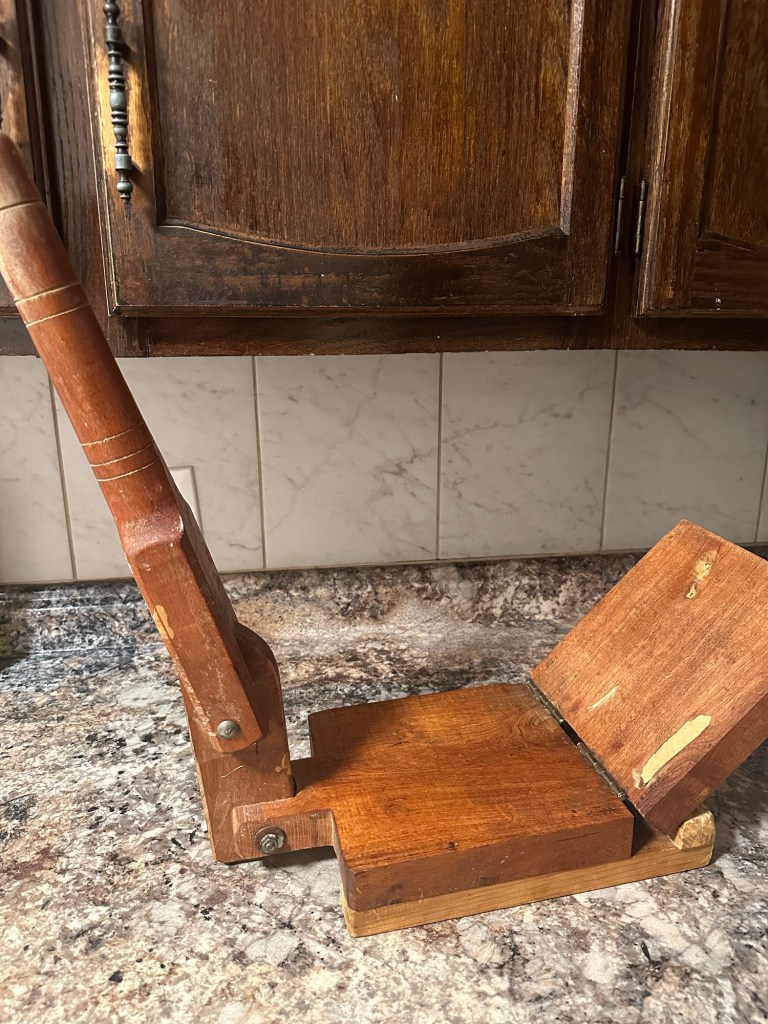
The wooden tortilla press
My mother’s tortilla press sits on the top shelf of our smaller second pantry. Most of the time it is stored away but comes out on special occasions. The wooden tortilla press is used in the process of making homemade corn tortillas. After the dough is made and separated into many small-sized balls, the tortilla press allows for an easy way to thin out the tortillas and make them the same size.
In 2001, the tortilla press was gifted to my mother as a wedding gift by my grandma’s neighbor, Efrain. This tortilla press originates from Mexico, where Efrain handmade my mother’s wooden tortilla press. Although the exact date of when the tortilla press was made is unknown, my parents expect that it was made in early January 2001. Making wooden tortilla presses was a hobby for Efrain. The wood used to make this tortilla press is most likely mahogany.
The age and use of the tortilla press can be minimally seen from the outside. When the tortilla press is closed with the handle horizontally it measures 16 inches. The top large wooden block measures 8.5 inches. The handle rests on a 4x1x1 wooden block that has two nails that are 2 inches apart. The handle has six engraved circles; the first three circles on the left are close together being 1/2 inch apart, third and fourth circles are 3 inches apart, the fourth and fifth circles are 1/2 apart, and fifth and sixth are 2 inches apart. The tortilla press is 3.5 inches tall with one inch being two 11×1.25×1 different wooden pieces that are on the edge of the bottom piece of the Mahogany.
While my mother did use her tortilla press in Mexico, she ultimately decided that it would be put to better use if she had it in New York; rather than being stored away at my grandma’s house in Mexico since this object is a prevalent kitchen appliance in Mexican households. Tortillas remain a staple in Mexico and Central America (Arnés and Astier 3). Twenty-three years later my mother still uses her tortilla press. Although today tortillas can be purchased at grocery stores or Tortilleria’s, “where the dough is mixed by machine, stamped into disks, and passed by conveyor belt over a flame” my mother still occasionally handmakes corn tortillas to maintain her traditional culinary practices and because they taste better fresh (Tortilla). I tend to eat more tortillas when they are homemade rather than store-bought.
With my mother’s tortilla press, she taught my sister and me how corn tortillas are made. Thus, anytime we make tortillas at home, my sister and I participate in the tortilla-making process. Passing down this tradition allows families to continue to engage in their cultural heritage. Not only is Mother’s wooden tortilla press meaningful to her because it was given as a handmade gift, but she was able to stay connected to her culture by bringing it with her to America.
Works Cited
Arnés, Esperanza, and Marta Astier. “Handmade Comal Tortillas in Michoacán: Traditional Practices along the Rural-Urban Gradient.” International Journal of Environmental Research and Public Health, vol. 16, no. 17, 2019, pp. 3211-, https://doi.org/10.3390/ijerph16173211.
Since being tasked with writing my previous blog post, I continued to be intrigued by the story and history behind the necklace I treasure. It only made sense to me to continue to share its story as it unexpectedly revealed itself to me. This object formerly meant (and presently still means) a great deal to me. Although, through nostalgic conversation and inquisitive questioning its meaning and importance has entirely transformed.
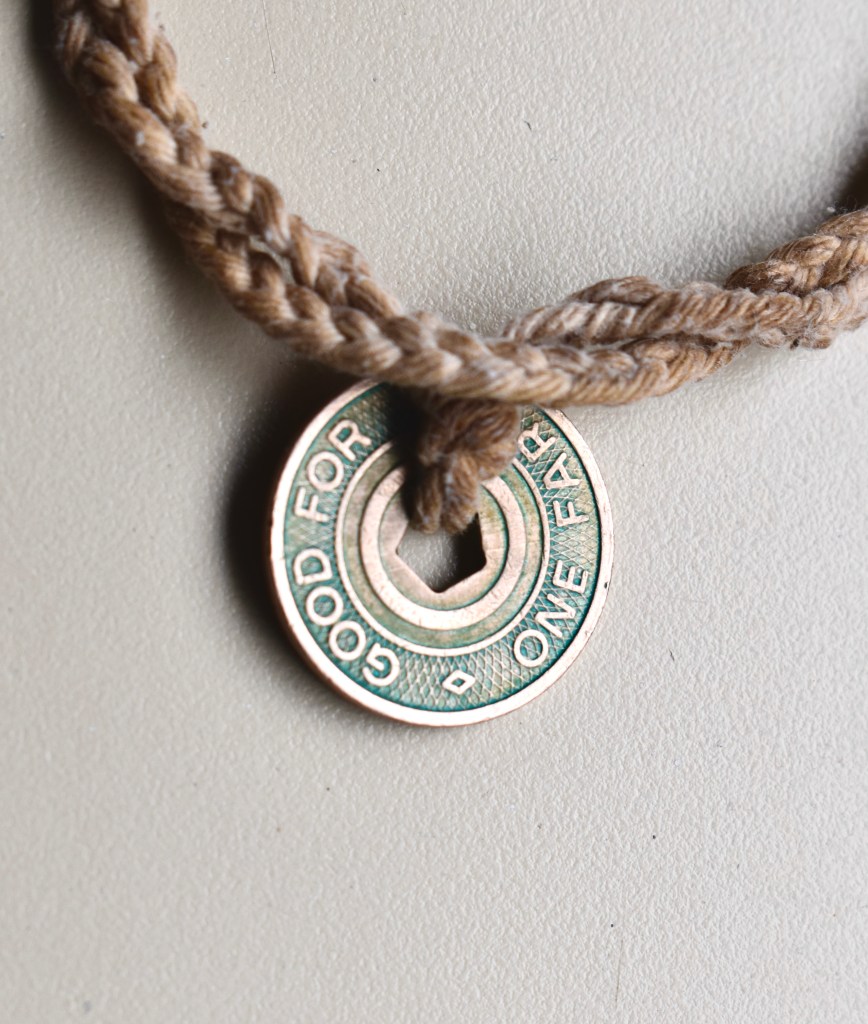
This necklace, in all its simplicity, I cherish immensely, because Eric made it and gave it to me. It hangs on the shorter side, the chain being made of a thin braid of three pieces of twine. A New York City subway token, fixed in the center of the necklace, is attached tightly with another, smaller braided piece of twine. To start off easy, I asked Eric from where he had gotten the string the necklace is made out of. The farthest back I got regarding its original location was in his pantry, but the string now resides in his bedroom. It sits there, still bundled up on a cardboard spool, waiting for the next time Eric puts his creative skills to use. The focus of my curiosity, the token, was discovered when Eric fished it out of a jar, filled with miscellaneous objects, he had found sitting in his father’s room.
About three years ago (when he first found it), Eric fashioned the token onto a metal chain that he wore around his neck consistently for quite a while. Eventually, the chain had seen better days and snapped, no longer able to hold the token. Eric kept the token, awaiting a time when he came across a more functional chain to replace the old one. That led me to question why he eventually fashioned the token onto a twine necklace and then gifted it to me. Eric said he wanted to give me a gift that was unique and special to him; it being special to him because he believed that his father kept the token for a reason. That statement sparked more interest in me, since Eric had not known the reason why his father kept the token.
Roger’s Token (front)Roger’s Token (back)
After a while of interrogating Eric, I hit a wall with the information I received, and took matters into my own hands. I sent a text to Eric’s father (Roger), this time, questioning the person I perceived to be the original owner of the token about its origins. The token’s story began to unveil itself.
Young and curious, Roger agreed to go on a trip with his father into New York City. The city was not new to his father, since he was an employee of the Long Island Rail Road and enjoyed traveling often. His father was very familiar with how to navigate the subways, so he knew what lies in store for them. As they arrived in the city, Roger’s father had told him that he wanted to show him a special place few people knew about. I can imagine that Roger was initially excited about this obscure location, but grew confused when he and his father never moved—why they never stepped off the subway each time it stopped. I can also imagine the anticipation building each time the doors opened, waiting for his father to lead the way off the rickety train, signaling they had arrived. The subway took them farther and further, deeper into the city, until finally, they stepped out.
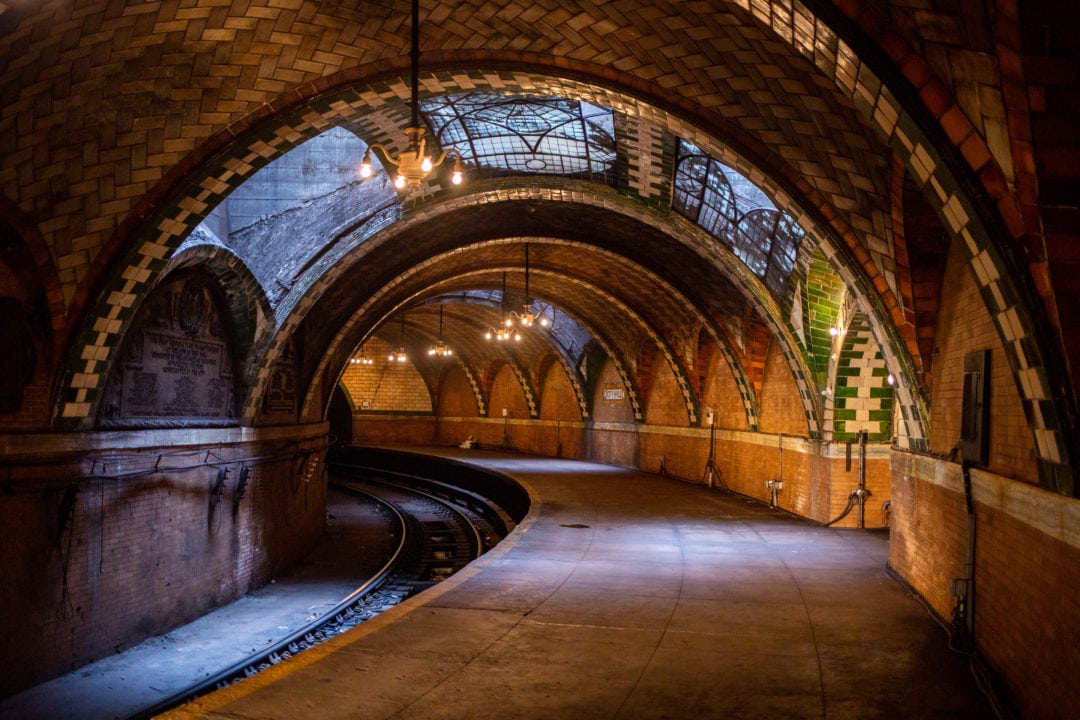
As a lover of architecture, Roger was in awe. The grand arches of Old City Hall, lined with precise tile work, bridged from one side of the tracks to the other, stretching above him and his father. Skylights made of beautifully intricate stained glass let in just the right amount of sunlight to brighten up the darkened tunnel. The lighting was soft, unlike the other subway stations where the fluorescent lights pained your eyes. Here, the natural light combined with the amber bulbs carefully placed in hanging chandeliers above the tracks, lessened the harshness of the subway station. The subway and its stations are known for being filled with antsy people, rushing to get on the train, trying to keep their child under control, hauling 5 suitcases bumping into everyone in their path. Here, time is slowed down, and wound back, back to another place in history. Back to a place where things took time, skill, and patience to create. The remnants of New York City’s transportation history remains wonderfully intact, encapsulated by the opulence of Old City Hall. As a way to remember the trip, Roger’s father had given him the subway token. Every now and then, Roger picks up the dulled token and is reminded of that day, and that subway ride.
This story not only tugged at my heart strings, but made me feel differently about the token hanging from my neck. Should I even have this? It felt wrong being the owner of something with such a sentimental and personal story attached to it (especially since it was not my story). It no longer felt like the token was mine. I expressed these feelings to Eric, who reassured me that Roger had plenty of these tokens, and he did not mind that I held on to one. This is when I truly realized, this is how objects work. They are supposed to change meaning, supposed to evolve. The token, a symbol of remembrance, once shared between a father and son, now reminds a girl of the one she loves.
The obscure location, Old City Hall Station, Photo: Alexandra Charitan
Works Cited:
Roadtrippers. “Here’s your chance to see NYC’s dazzling, abandoned City Hall station without risking a criminal trespass charge.” Roadtrippers, 16 Apr. 2019, roadtrippers.com/magazine/old-city-hall-subway-station.
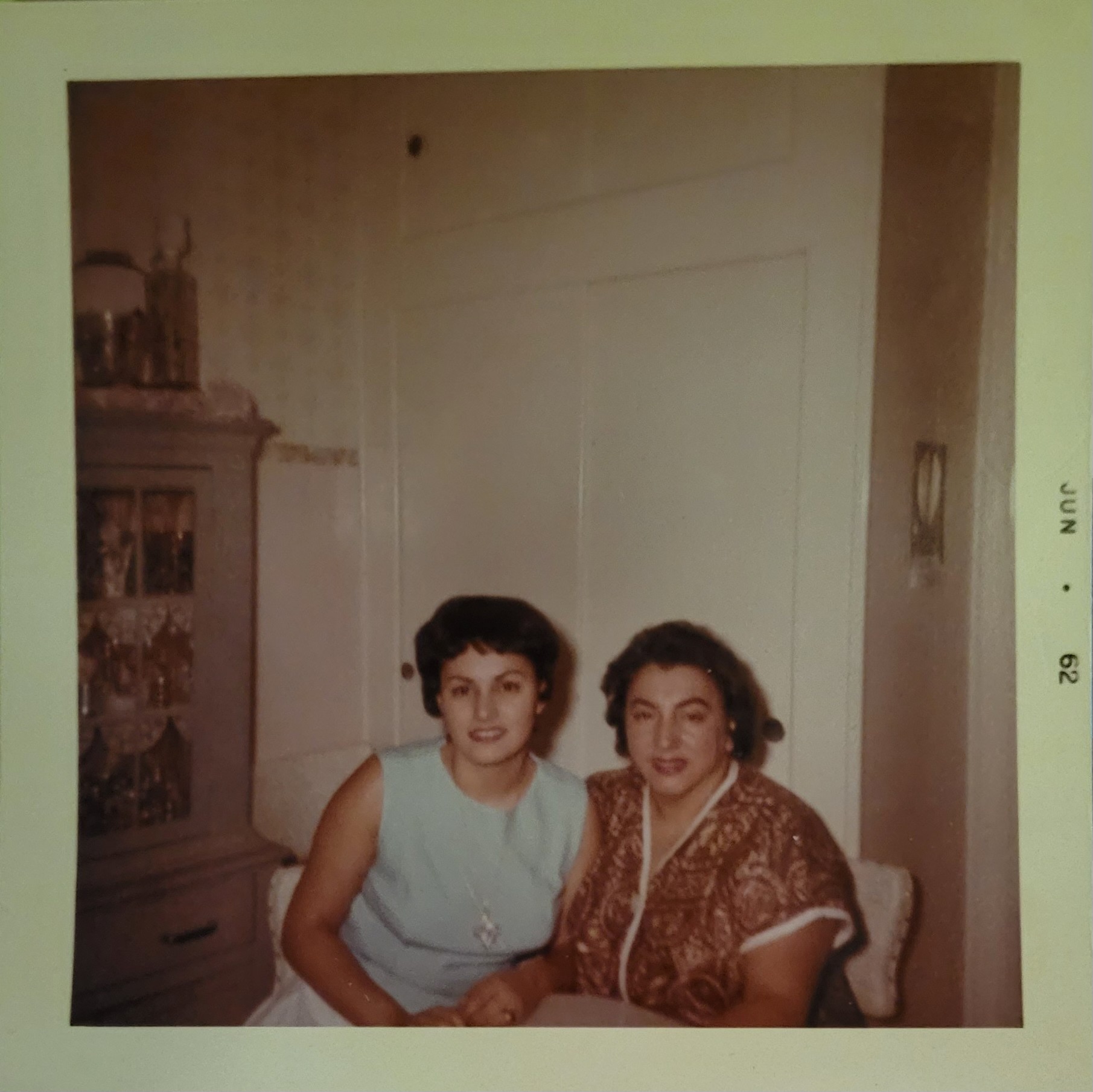
My great grandmother, Carmela, but best known as Millie, was born in Manhattan to two Italian immigrants. She lived in New York City her whole life, moving from Manhattan to Brooklyn, and along the way she met her husband Tony. In Brooklyn, she gave birth to her daughter Pamela, my Grammy. My grandmother grew up in Brooklyn, and eventually moved to New Jersey after she got married. There, she had her daughter, my Aunt Lisa. After splitting with her husband, Grammy took Lisa and moved back to Brooklyn with Millie and Tony, where she had her son, my dad Anthony.
my Grammy and my Great Grandma Millie
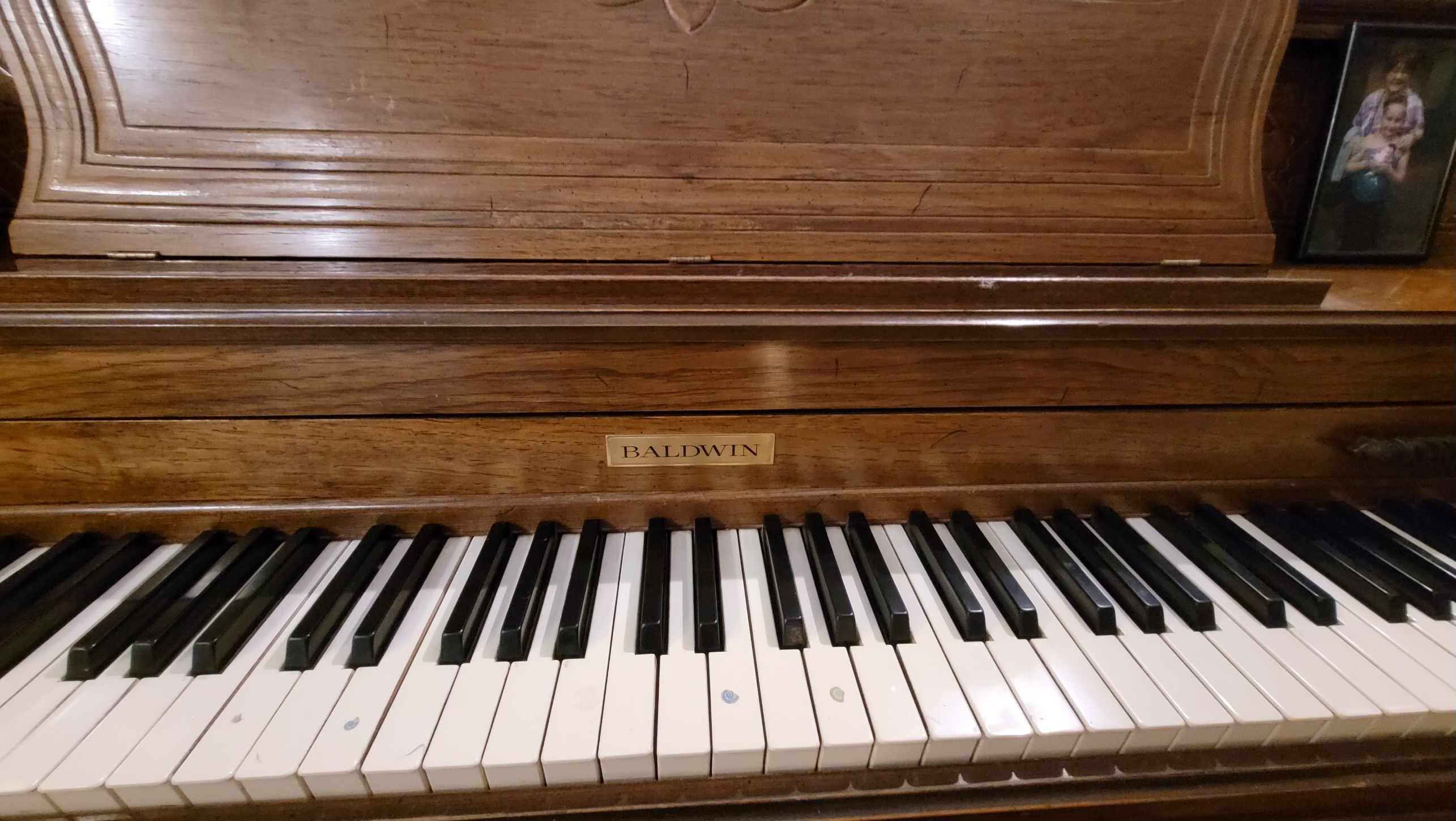
One of my great grandmother’s dreams was to have a piano in her home, and she shared this dream with her husband and daughter. She wanted her home to be filled with music, hoping her family would be able to learn to play. In 1973, my great grandmother, great grandfather, Grammy, and my aunt and my dad all had agreed to move out of their 2 family home in Brooklyn to a house in Staten Island together. They bought a house and were planning their move, when Millie passed unexpectedly from a heart attack. Her heart- wrenching passing led my great grandfather and Grammy to buy a different house, as they couldn’t bear to live in the one they had picked out alongside her. Even though she passed before she could live out her dream of having a piano in her home, my Grammy and Tony fulfilled it by purchasing a piano once the family had moved into their new house in Staten Island. They bought the Baldwin upright piano brand new in 1974, about a year after they moved.
the Baldwin label
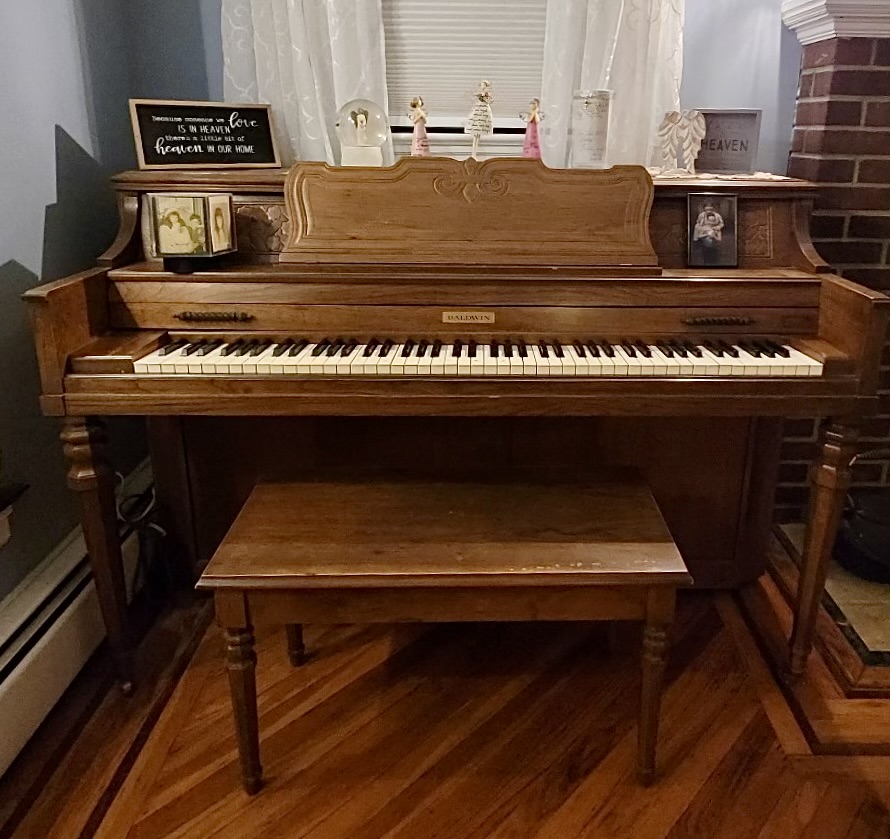
Though I wasn’t able to find how much a Baldwin upright piano would have been worth in 1974, a Yamaha upright piano would have been around $2,500, so it was most likely around a similar amount. The beautifully carved wooden piano stands at 58 inches wide, 40 inches high, and 25 inches deep, weighing about 500 pounds. It claimed its place in my grandmother’s living room from 1974 until she passed in 2019.
The piano’s first handler was my Aunt Lisa. Grammy signed up her daughter for piano lessons at the house. While my Aunt Lisa was being taught, her brother listened intently. One day, Grammy and Lisa were about in the house, away from the piano, when they heard it being played. “Isn’t that a tune you’ve been learning?” Grammy asked Aunt Lisa, as she recalls. My dad was found to be playing the song Lisa had been learning, completely by ear. Of course, Grammy signed him up for lessons as well after that. My dad was naturally musically talented, and still plays the piano beautifully to this day thanks to my great grandmother’s wish.
the keys
When I was a kid, I remember being at Grammy’s house and listening to my dad play on that piano. On every Christmas Eve spent at my Grammy’s, he’d play the music for our family sing-along and while all us kids opened our presents. I remember my brother playing Fur Elise for Grammy, but jokingly speeding up turning the song into chaos, causing Grammy to exclaim “Play it nice!”.
After my Grammy had passed, my family was faced with clearing out the many memories that house had held. The Baldwin upright piano was moved from its home of 45 years. Despite us already having a piano in our home, my dad of course took ownership of the Baldwin. Now, our piano sits in our living room across from my Grammy’s.
For this blog, I will be discussing the history of my mom’s table that she has in Ecuador. Unfortunately I don’t have a picture of the table, so I will provide a picture of the house my mom built in Ecuador for herself along with a picture of a similarish wooden table that I found on Google.
Old Wooden Table from Google (1)
Early days of my mom’s house
The table is roughly 4 feet long and 3 feet wide, and has a height of about 3 feet. I don’t know what kind of wood was used to make it, but it is a dark color similar to that of the face of the drawer in the picture. Instead of drawers like the table in the picture has, the top of the table that my mom has opens up (like a car hood) to reveal a hollow interior. The table is currently hidden in a room located in the back left corner of the house and is used solely as adornment.
The table is important to my mom because it used to belong to her grandmother. To explain why this table is important to my mom, it is important to tell her story. My mother was born out of wedlock, and was then adopted and raised by her grandparents as their tenth child. When my great-grandmother passed away on September 13 of 2011, the many properties that my great-grandparents owned were passed down to their nine heirs, of which the majority voted against my mom being included in the inheritance. One of these properties was the house in a town called Giron and is the “main” house that the family would spend most of their time in and is also where my mom was raised. Almost immediately after the funeral, my mom was (aggressively) told to remove her stuff from the house in Giron because “she was not an heir”.
Within hours of being kicked out my mom had a moving truck loaded up with all of her stuff from the house of Giron. Among these items were her childhood bed, her old clothes and books, some personal items, and most importantly an old wooden table. According to my mom, this table was the dining room table used in that house for decades (~50 years). In addition, when my mom brought the table, she also brought the stacks of fancy plates that were stored inside of the table. In the thirteen years since the death of my great-grandmother, the majority of the heirs still have no clue where this table is. I’m not condoning stealing, but I laugh every time I see the table because it shows me where I got my pettiness from. To my mom, this table represents her childhood memories and the struggles she had and still has to overcome as a result of her origin. Sometimes she’ll take out the plates and remember her old life, and sometimes she’ll even use the plates if we have a special guest over. When I see it however, I see a remnant of the family split.
If you read my previous blog, you’ll remember that I mentioned that my great-grandfather raised cattle. Unlike the other girls in the bunch, my mom tagged along with my great-grandfather whenever he was working outside, did business, rode horses, went grocery shopping, and got drunk (she didn’t drink, she just protected him). As a result, the town gave my mom the nickname “el rabo de Don Segundo” or “Mr. Segundo’s tail” and my great-grandfather was extremely protective of my mom. Unfortunately, he died on July 4th, 1985, which was three or four months after my mom entered the U.S. with my brother. Given that my mom was being raised with her aunts and uncles, that meant that she was not raised with any of her real siblings from either her mom or dad’s side. Because of this weird family position that my mom is in, there has always been an “us vs them” mentality when dealing with 95% of my family. When I was very little, my cousins and I were playmates, but as we’ve grown up we’ve adopted this cold mentality and these unspoken alliances. In other words, when my great-grandmother died, so did the family’s law and order.
I find it interesting that of all the things that my great grandparents owned, the material inheritance that my mom chose to bring with her into her “new” life is the same object that saw my great-grandparents, the heirs, and my mom sit down and eat together as a family.
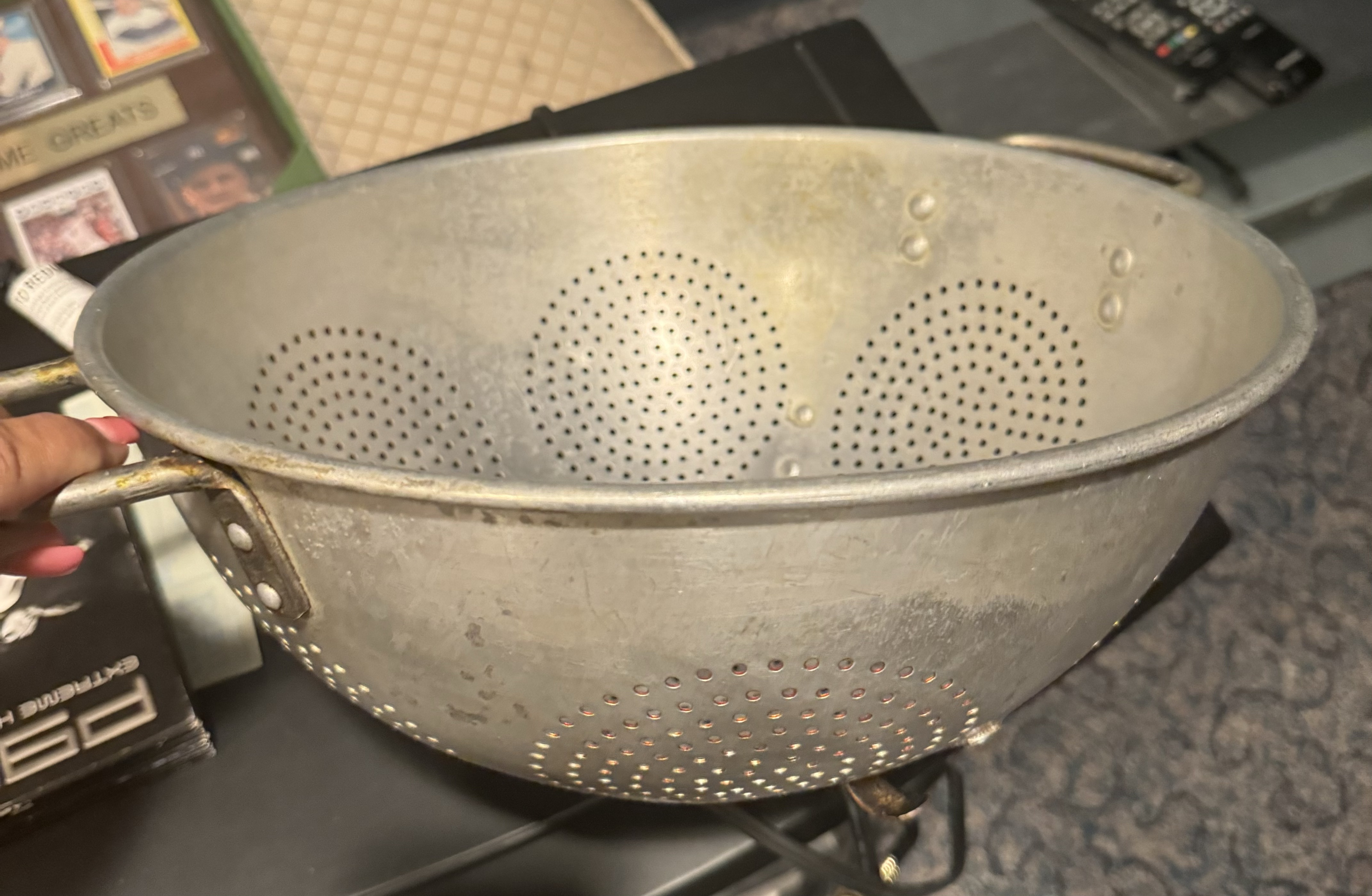
The object I will describe is a stainless steel colander that has been in my family for over 100 years. It has been passed down to generations of daughters, each using it in their own kitchens for decades. Today, the colander stays stored in my aunt’s basement until it is used for our annual Thanksgiving family dinner.
The colander is large and spherical, with a wide rim that features a small lip. Two metal handles are attached to the exterior using four oval head screws. At the base, two curved hooks likely serve to hang it on a pot rack. Inside the colander are seven circular patterns of small rounded holes, allowing it to function as a strainer for ingredients of various sizes during cooking. Despite a few rust marks on the outer edges and inside, it is in excellent condition and works properly.
The story of the colander begins with my great-great-grandmother, Catherine Gandolfo. She was born in Palermo, Sicily, on May 2, 1888, and immigrated to the United States in Pennsylvania in 1908. Catherine married Frank Gandolfo when she was 17 and had four sons and a daughter between 1909 and 1929. One of the sons was the father of my grandmother, Nana. When talking to Nana about its history, she shared that her grandmother received the colander as a wedding gift from a friend at their wedding in 1905. However, there’s a possibility that her grandmother inherited it from her own mother, making the colander even older than we imagine.
My great-great-grandmother kept the colander until 1938, the year my great-grandfather, Matthew, married his wife, Theresa. As a wedding gift, Catherine gave the colander to her new daughter-in-law, starting a family tradition in which the colander would be passed down to the next daughter of the current owner.
Theresa and Matthew at their wedding in 1938
Theresa kept the colander in her kitchen in Garden City, New York, for nearly 22 years. In 1960, she gifted it to her daughter, Nana, on the day of her first wedding. The colander was brought to her home in Commack, where it remained there for almost 30 years. Nana fondly recalls using it to strain pots of ravioli or pounds of spaghetti.
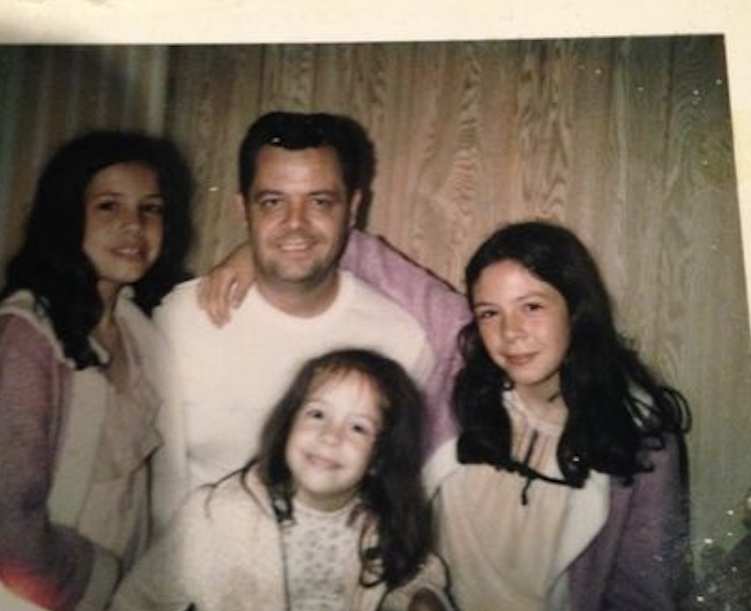
Nana’s husband and daughters in the Commack house
The colander became a staple at large family gatherings and pasta dinners during the time Nana’s children grew up. My mother, who is one of her daughters, cherishes the memories of those family dinners. Most Sundays were pasta night at the house, where there was always a big pot of sauce on the stove. For lunch those days, Nana would grab a meatball out of the pot and smash it up on a slice of Wonder bread for her and her daughters. My mother said she would always cook more pasta than the family needed. She would pour the large pot of steaming spaghetti into the colander, which held all of it without ever spilling over.
During Thanksgiving, Nana carries the tradition of preparing her famous stuffing. Using five loaves of stuffing bread and pounds of eggs, butter, and onions, she manages to perfect the recipe every year she makes it. The colander is perfect for mixing all of the ingredients and its depth easily holds the massive batch.
In 1984, after remarrying, Nana moved to a new home in Holbrook, where the colander served many more pasta nights. In 2008, after the passing of her husband, she decided to move into my aunt’s house in Sayville. She brought the colander along, hoping it would carry the memories of her Holbrook home. Since then, it’s mainly been used for making her special Thanksgiving stuffing. Nevertheless, it’s always heartwarming to see my aunt pull it out for the holidays, watching Nana’s face light up with nostalgia.
Nana with her daughters during her second wedding in 1984
The colander carries a deep history, a symbol of family and love forged through a century of shared meals. Just like the durable stainless steel that has preserved it for over 100 years, the colander reflects the strength and resilience of our family and our connection with one another. Every year, I’m amazed to see it come out from its spot in the basement, still in pristine condition. I look forward to the day it’s passed down to me, as Nana intends for me to carry on its legacy.
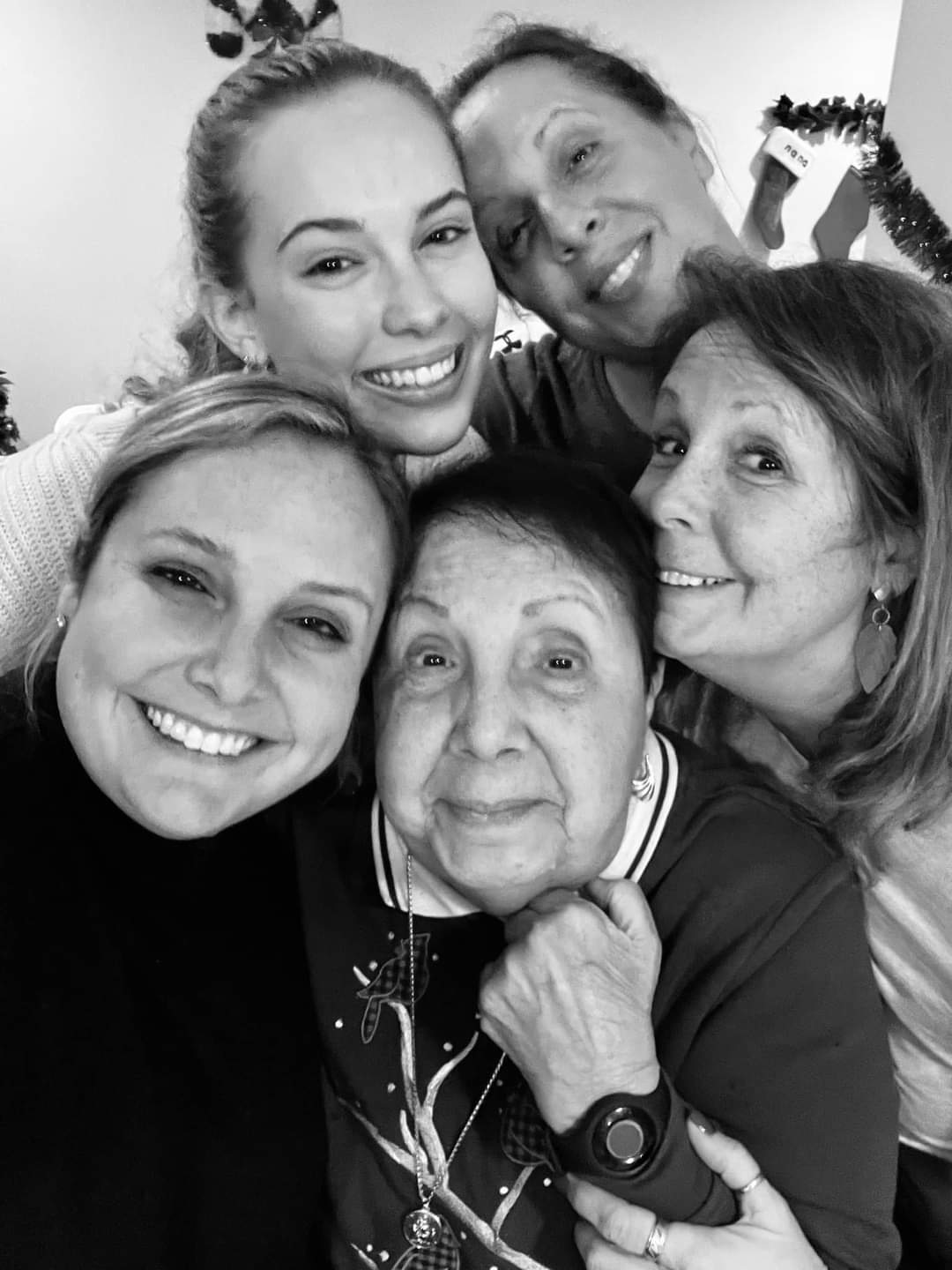
The generation of daughters now (Top: Me on the left/My Mother on the right) (Bottom: My Aunt’s Daughter on the left/Nana in the middle/My Aunt on the right)











 The Materials of History, Thought, and Art