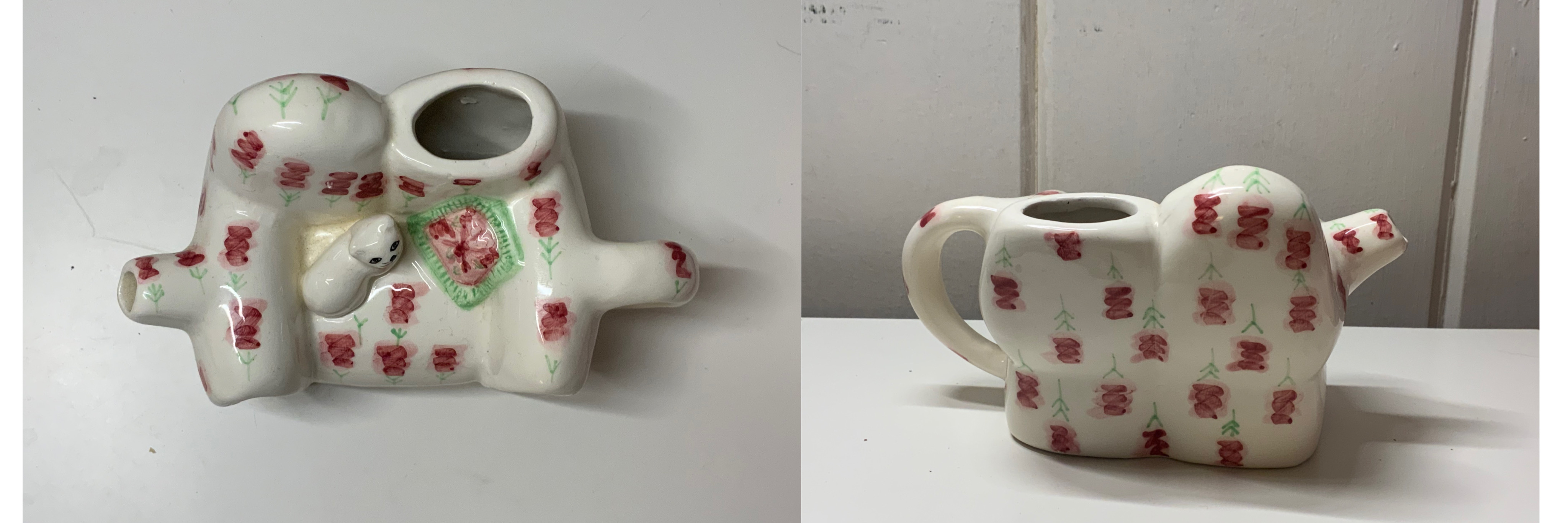
This ceramic teapot sits at only 3 inches tall and 5 inches wide including its handle, with a volume of roughly 22 cubic inches. It’s extremely light and delicate to handle, with a smooth, glossy surface all around.
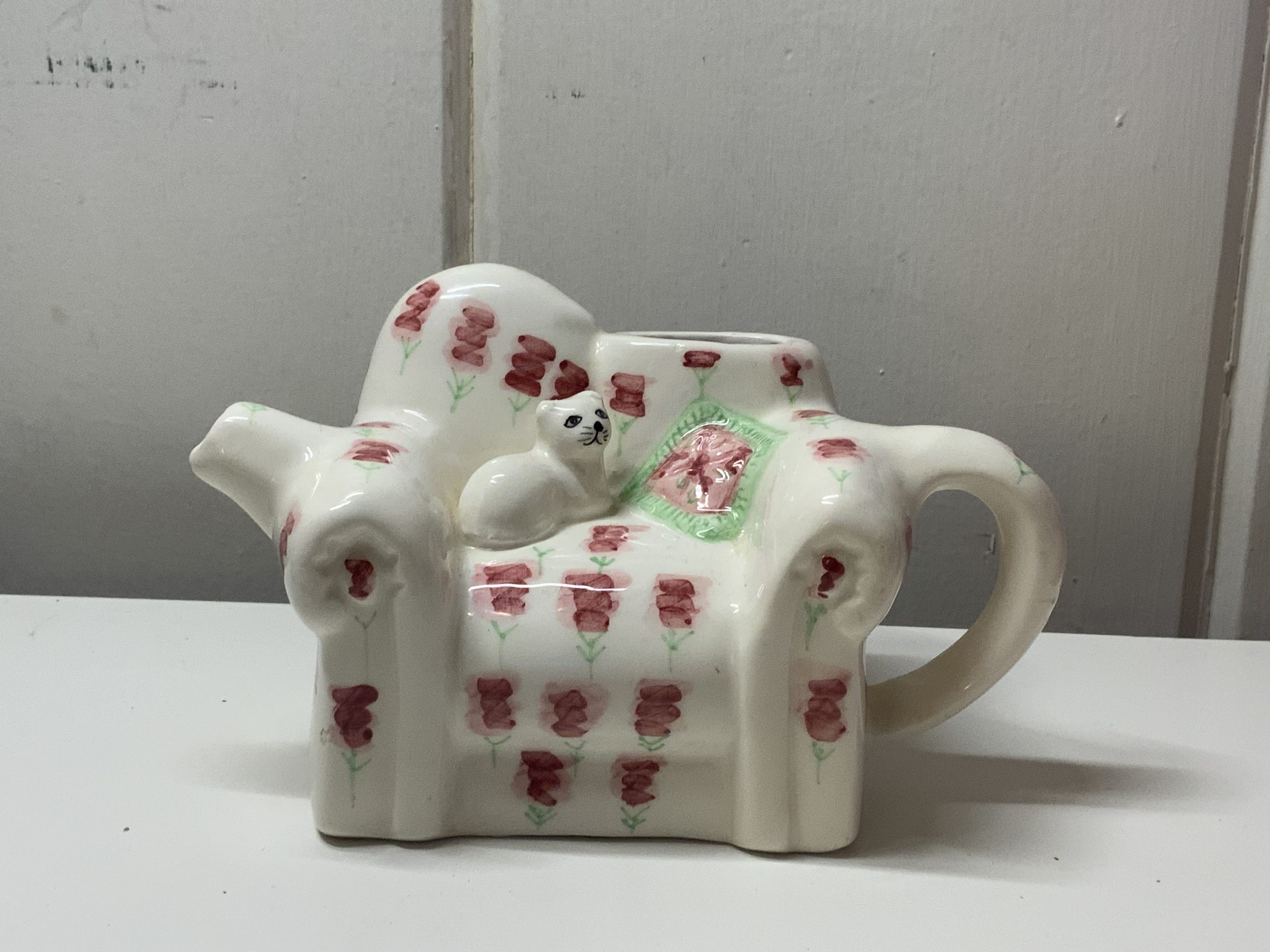
The pot is shaped as a chair, with curling armrests and a creased back. The chair is white with a floral pattern, with repeating pink petals and green stems that continue onto the spout and the handle. On the right side of the chair lies a one inch pillow, pinched in the center, with a green trim and pink interior design. To the left, a round one inch cat loafs, completely white except for its painted face- two eyes, a dot of a nose, a small curling mouth, and six whiskers, three on each side. All of this comes together to depict the scene of this white cat sitting nicely on a cozy chair.
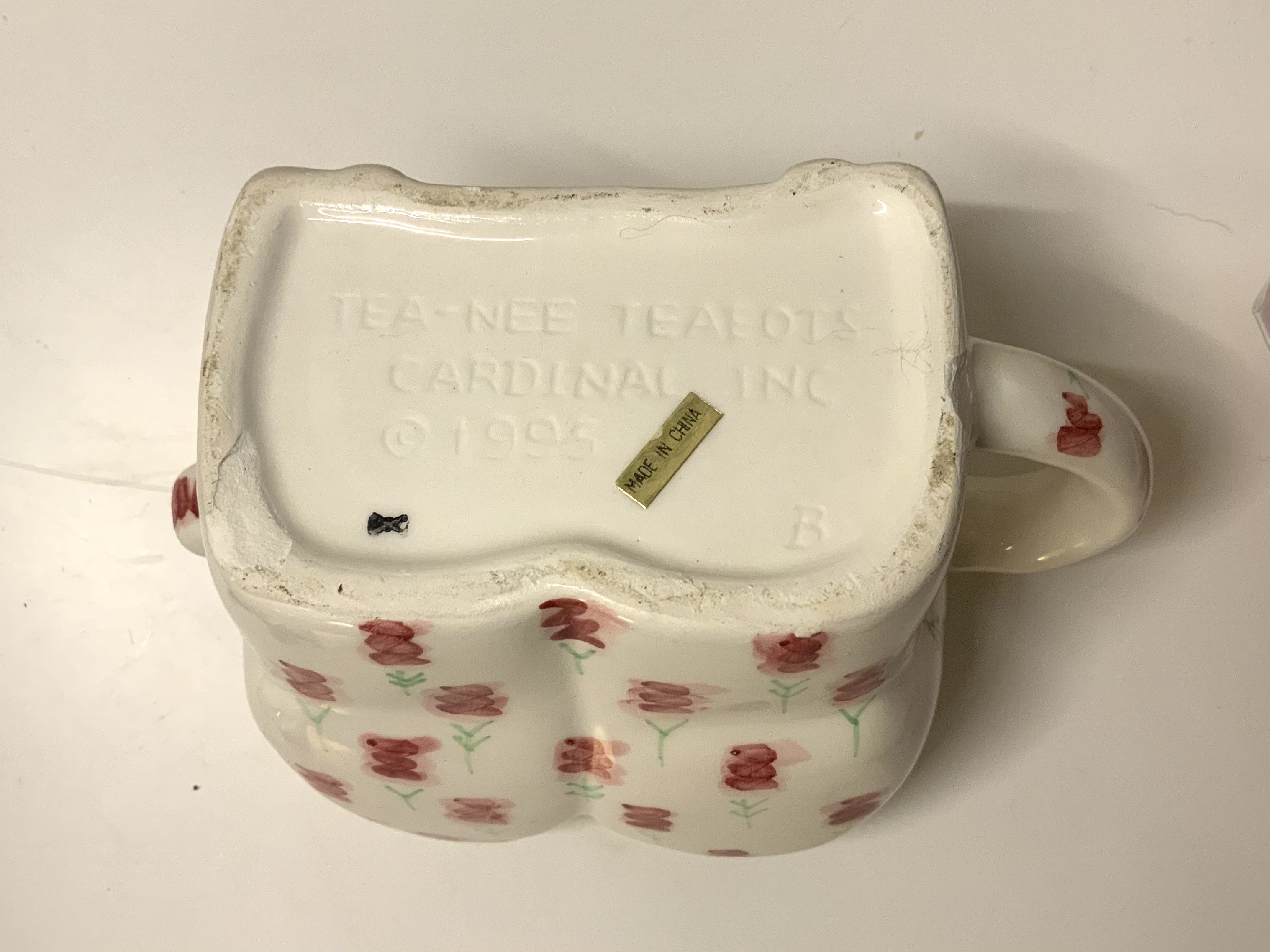
On the bottom of the object, a small gold “made in China” sticker sticks, and engraved in the ceramic are the words “TEA-NEE TEAPOTS CARDINAL INC. c 1995” and a “B” that resembles a type of signature in the bottom right corner. There is also a dark spot in the left bottom corner.
This tiny teapot was found by me in the abandoned downstairs kitchen of my grandfather’s two family home. He was helping me find any old pots and pans I could take from him for my new apartment, and while tracing my eyes over the scattered toys and papers left on the kitchen table, I spotted the white cat’s tiny face. I showed it to my grandfather, who replied “Oh yeah, look at that” as if it was the first time he’d seen it. I asked if I could take it, and he happily gave permission.
A clue to who may have used this teapot lies in the engravings at the bottom. Though I previously suspected it was solely my grandmother’s, the date 1995 suggests that perhaps my mother was the owner, though she only seemed to half remember the object when I showed it to her. Regardless, there is no true way of knowing and there are endless possibilities of who may have purchased it or who it was from, like one of my grandmother’s friends or close family members.
Now with it in my possession, it sits neatly on the corner of my desk, amongst various other knickknacks and figurines. When peering inside the vessel, its age and its history of use can be predicted by yellow discoloration, and the years of non use is shown by the dust and small debris lining the bottom. Despite my cleaning it, I don’t believe it’d be very safe to drink from after spending a large bit of time sitting in the musty downstairs of my grandfather’s house. Because of this, it seems its days of being used as a teapot have ended with me, or perhaps until it belongs to someone else.
Rose Ruocco
 The Materials of History, Thought, and Art
After hearing about this teapot in class the other day, I’m so glad to be able to see it! It’s interesting how we can see so much value and importance in an object that others, like your grandfather and mother, either don’t find valuable or can barely remember. It brings to question the influence of perspective on value.
I love that you were able to utilize this teapot with whatever time it had left. It makes me so happy to hear that your grandfather was able to rediscover it when you did. The fact that your mother was the primary user makes it so special and to know you’ll always have it with you even if it is just for decoration now.
This was so cool to see after you mentioned it in class! I think it’s sweet that this teapot means a lot to you not because you were told that you should value it for cost or for its importance to other people, but simply because you like it. Creating your own sentimentality because you just feel its cute and because it reminds you of such an ordinary but warm interaction between you and your family. I think the memory you described shows a kind and humorous side to your grandfather that I am sure is nice to be reminded of when at school.
Side note: I cannot imagine how annoying this would be to thoroughly clean out if you were using it for tea continuously. The opening is fairly small and getting into the creases just seems like a funny and challenging process.