
The object I have chosen is a tablecloth embroidered by my late great-grandmother Olive, found by my sister during one of her many escapades through our cluttered, object-filled basement. Olive would make one of these tablecloths whenever her children or grandchildren moved out and into their own homes, hoping her gift would be of use in an unfinished home. These children, including my great-aunt Flo, whose house I now live in, opted for folding and putting away these clothes for fear of tarnishing their grandmother’s hard work. This is how Olive’s gift wound up buried in piles of old letters and trinkets until my sister unearthed it and claimed it as our new kitchen tablecloth.
The white, rectangular cloth is 65 inches long by 45 inches wide. The soft, vintage cotton is thin enough to allow light to shine through, especially when pressed against a sunny window. There is a distinct lack of holes in the fabric, no evidence of a mistaken stitch or accidental pulll of fabric. The outer perimeter of the cloth is decorated with half circles of small white stitches with lines that connect the edge of the cloth to the stitched circles, imitating the look of lace. From use and time, these loops have been misshapen and pressed, leading to some being larger or more spread apart than others.
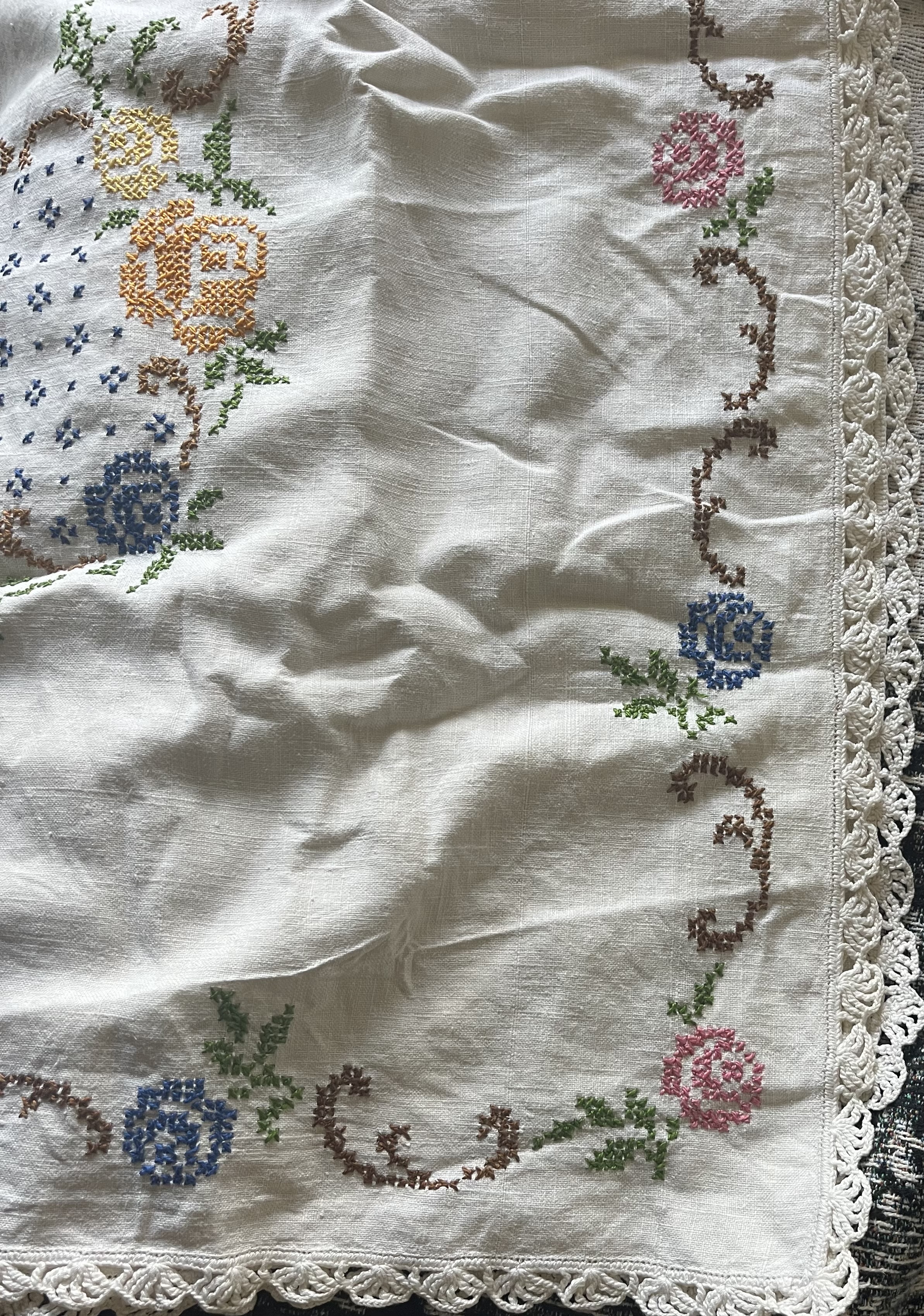
Embroidered thread of blue, green, brown, pink, and yellow line the edges of the cloth. The embroidery is done in a pattern of small x’s, x’s which you only see when examining closely; from far away, they blend together into the design. The patterns done in blue, pink, and yellow are the same; the first three stitched “x’s” make a circle, which is placed within a second, larger circle of the same color. Both these circles are embraced by a half-circle-shaped group of stitches, resembling a simplistic yet colorful rose.
To each side of these roses is green embroidery. Unlike the blues, pinks, and yellows that circle around each other and remain consistent in shape, this green reaches out in different directions; there is always one long string of green stitches with shorter lines departing from it, coming together to form leaves. The green meets the embroidered brown, a collection of stitches that form small swirls. The swirls, one larger than the other two, face in towards each other. Just as they reach their peak, they collapse in on themselves.
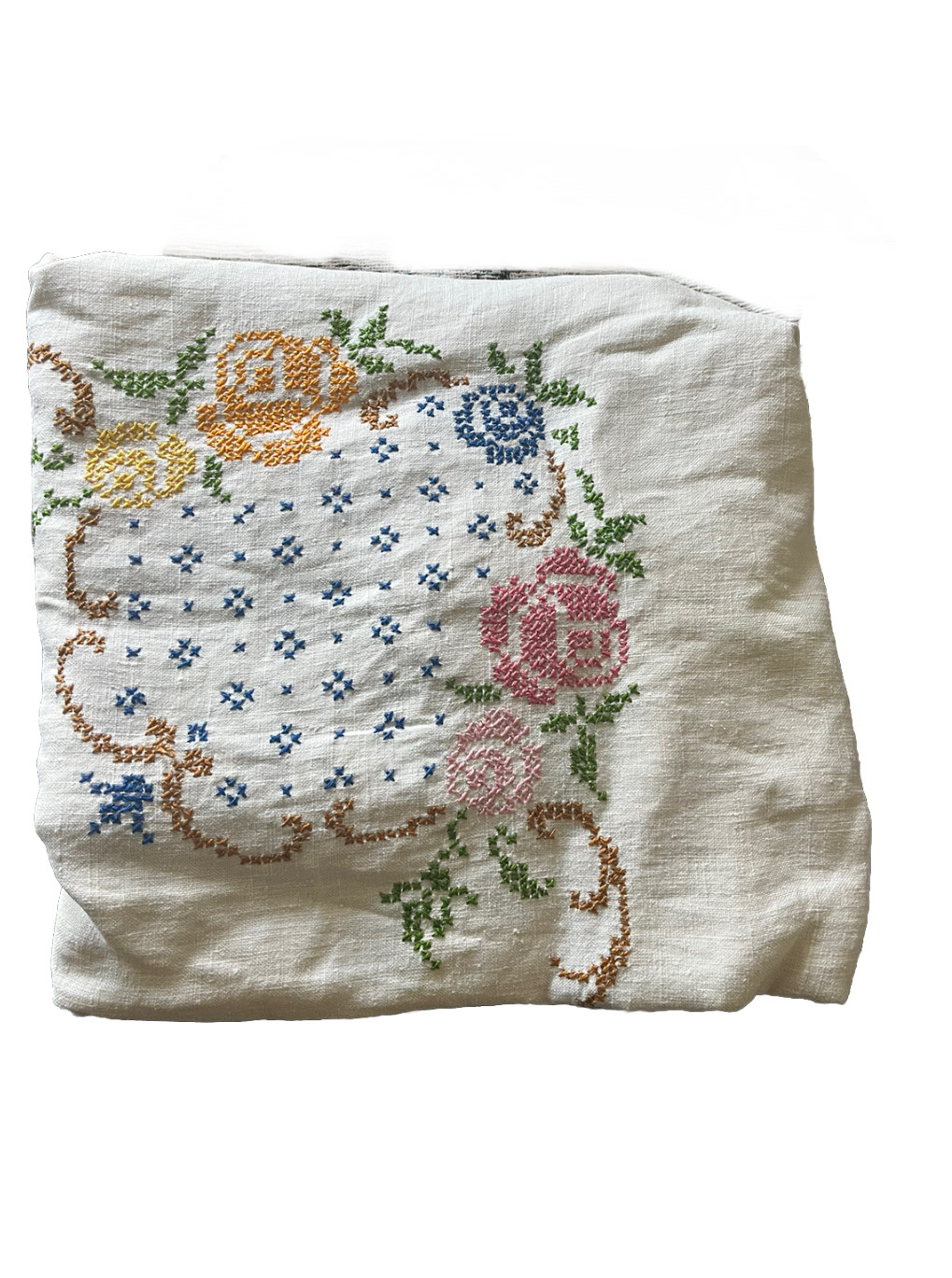
This design repeats itself, the flowers changing between blue, pink, or yellow, the green and brown remaining consistent. In the center of the tablecloth is a similar design of flowers and leaves, organized into a rectangular form. In each of the four corners of this rectangle sits an imperfect circle of embroidery; yellow, orange, blue, and two different shades of pink form the shapes of roses, although larger than the ones boarding the cloth. Green thread branches out from the spaces between the flowers, continuing the look of leaves. The brown thread is again embroidered in the shape of swirls, although this time the swirls loop together in half-circle shapes to form an ovular border. Within this oval are small, blue stitches; some of these stitches are singular, while others are done in sets of four in the shape of a diamond.
The tablecloth is not a perfect white. There are some oil stains (admittedly from a messy snack of garlic knots that my sisters and I shared) and an unknown deep blue stain in the bottom corner of the cloth, about the same size as one of the smaller flowers. When turned over, the knots and stitches that hold together the design make it clear that, although the stitching is not messy, this was done by hand, without the help of a machine. Although I may be unsettling my ancestors through the staining of this object they tried so hard to keep as perfect as it was the day it was finished, Great-Grandmother Olive intended it to be used. Sitting at my kitchen table with my sisters, mom, and grandmother as we eat on this cloth is a celebration of our dear Olive’s work. She would be happy.
 The Materials of History, Thought, and Art
The design on the tablecloth is absolutely beautiful! I love how you were able to make use of the tablecloth years later after it was put away.
Your description of the tablecloth was very in-depth. I can tell you put a lot of effort into noticing the smallest details. I also thought that the familial connection was lovely and infuses the object with meaning and connection.
You did an exceptional job describing this table cloth and I was really able to picture what it looked like even without your pictures. Your description of the material was very real too, I can easily understand exactly what it feels like and the texture of the stitching.