I have, like the majority of Catholic Irish-Americans, been to more baptisms than I can count. Considering my sizeable family—4 aunts, 1 uncle, 12 first cousins, and 14 second cousins—baptisms have seemingly become a semi-annual family reunion. The practice cleanses the newly born, washing away the Original Sin they have somehow carried into this life, symbolic of an official identification with the Church and God. It is emblematic of death and resurrection, of being reborn under holy waters blessed by the priest. It is at this practice that we are introduced to an off-white, frilly, and painfully antiquated baptismal gown with a perfectly matching petticoat.
My grandmother was the first of her siblings to have a child. Married to a newly converted Catholic (my grandfather had grown up in a French Protestant family), it seemed undebatable that their firstborn would be baptized. Standing before God with hopes of forgiveness for Original Sin, one would think to show their holiness and piety through their dress. A nicely tailored suit, maybe? Perhaps a shining cross necklace?
This, of course, is where our beloved dress comes into the picture.
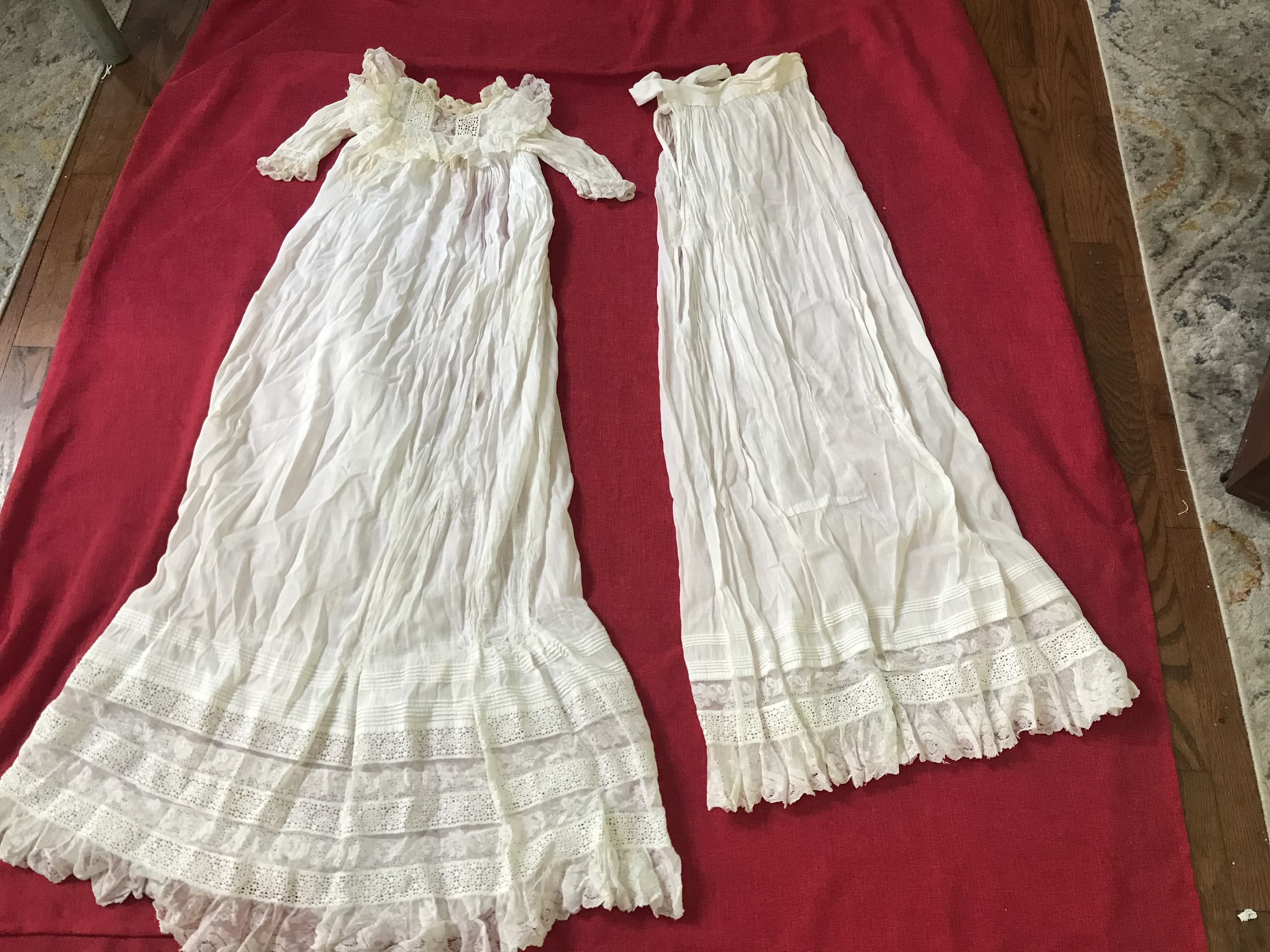
Aunt Margaret had been saving this dress—although unknown where she got it—to hopefully dress her children for their baptisms. Upon my grandmother having her first child and never realizing that hope of having children, she gave the dress to her niece. A long and delicate white cotton, the skirt of the dress flows out seemingly far too long to fit the newborn it was meant for. Around the neckline are ruffled circles of lace, sewn in a way that causes the fabric to stick out and radiate from the child’s head. Thinner strands of fabric web together to outline the more prominent details, areas of thick lace that form interwoven circles and star shapes, sometimes connecting in floral patterns. The thin strands, however, are so fine in some areas that it is difficult to make out what the design is. Flower petals? Maybe leaves?
“A beautiful Victorian vintage gown”, in the words of my grandmother. One that is apparently not too long, as some (me) may have previously thought. The length of the skirt is meant to be draped over the arms of the godparents as they present their godchild to the Church for the first time, an act that effectively shows off the lacey frills that reach the floor of the altar. This gown—tagless, perhaps handmade—is far too delicate to be passed around. We see it—perhaps if we’re lucky, feel it—only during the occasion of a baptism. My grandmother is its keeper; when not in use she protects it, afraid of its being ruined. Not only does she guard the gown itself but its history and significance that go far beyond my Great-Great Aunt Margaret. She is graciously always willing to share such intangible stories that cannot, unlike this old Victorian gown, be stained and torn.

Aunt Margaret was born to two Irish immigrants, both of whom were baptized into the Catholic Church. Her father, James Charles, was born on a family farm in County Leitrim, Clooncose townland, Ireland, and was christened at the nearby church. James was born in 1844, just a year before historians mark the beginning of the Great Famine, a very possible impetus for his decision to leave Ireland and settle in the United States. Before emigrating, however, he married a young Catholic girl named Annie Beirne. Although this story would tie nicely with an anecdote of finding unexpected love in a time of immense Irish conflict and trial, Annie lived in County Cavan, far too long of a distance from James’ family farm for the two to have met naturally. An arranged marriage, most likely.
After a year of leaving Ireland and settling in New York City alone, Annie too left Ireland to join her husband James. Although this marks quite a large gap in our story, we know that it was in New York (somewhere on Avenue C between 15th and 16th Street) that James and Annie Charles had their daughter Margaret. I don’t know much about her life, but I do know that she followed in my ancestors’ very Catholic footsteps: she was baptized, went to Church with her family, and undoubtedly wished to continue the tradition with her own children. This is why she came to possess the baptismal gown, and how it was eventually gifted to my grandmother. My grandmother who must be making her Aunt Margaret incomprehensibly happy with her continued use of the gown.
Every member of my family, since my grandparents’ firstborn, has worn this gown at their baptism. Although some larger children have had to be squeezed and shoved into the consequently unbuttonable dress (thanks to modern medicine, we no longer need to baptize infants almost immediately after birth), not a single one of us has entered the Church without our faces shining through radiating lace, without soft white cotton adorning our godparents’ arms. And the tradition will continue, so long as we make sure not to rip the fabric on the way.
 The Materials of History, Thought, and Art
Hi Makayla, I enjoyed reading the story of your families gown. In Hispanic traditions, we also dress in all white during baptism (I still have my all white suit), so I thought it was cool that there was a deeper/overlapping historical root for this. However, I thought it was cooler that this particular gown’s history starts over a century ago
As I was scrolling through each post your title immeditly stood out to me. Being such a grasping title I knew I was in a good read and you didn’t disapoint. Coming from a similar irsh catholic background I was very intrested in what you had to write about. Off the bat your use of imagry describing the baptism is so jarring but in a beautiful way, your use of language and description really just took me away. Likewise, some of your pharsing really made this story powerful: “she protects it”…”radiating lace”…”rip the fabric”. It was all just powering and really tied the story together. Lastly I wanted to note that over all the transitions I found tasteful, the idea of having this dress be sacred and a mystery in a way, to trying to uncover it’s orgins was very nicely done!