Mi Ultimá Muñeca

As a young girl, my sister and I constantly found ourselves getting lost in a fantasy world where only we and our dolls existed. In the summer of 2012, I got Taylor during a day spent in my grandpa’s apartment in Brooklyn. I saw the doll sitting on a dusty shelf, she was in brand-new condition, still wearing the original pink and brown striped dress she came in. I don’t know where or why my grandpa originally purchased a Barbie, but my sister and I pleaded for her to come home with us. She was my favorite thing, always by my side. Years later, as I grew up, this doll began to have a new meaning. In 2020, approaching my fifteenth birthday, I decided I wanted a Quinceañera. I wanted a day to celebrate my heritage and family. Unfortunately, after months of tireless planning, the party was ultimately canceled as we began to enter the peak of a global pandemic. Nevertheless, my mom made sure to gift me my last doll, mi ultimá muñeca. 

Taylor in the dress (Thanks to my sister for the picture!)

As part of the ceremony, it is tradition for the quinceañera to be gifted her last doll or ultimá muñeca. The last doll is typically made of porcelain and is gifted as a symbol of transition from childhood to adulthood. My mom, however, took this tradition and turned it into something special. My mother gifted me my doll with a custom version of my dress — a delicate dress made of pink tulle. The dress is strapless, the top has white floral lace embellishments with a long puffy skirt. The back has a corset made of ribbon, with small pearls and gems glimmering throughout the dress. 

The doll is a symbol of my childhood– an artifact from the most precious and innocent moments of my life. A faded smiley face drawn on her cheek from my sister and I’s failed attempt at giving her a tattoo. Her botched haircut from the days we swore we were hairdressers. Her body, which my sister replaced with a newer version after her old one was broken, with an arm and leg taped on. She, admittedly a bit morbidly, took the head off the old Barbie and put it on the new one, but she would’ve done anything to make me happy. Taylor watched every stage of my life. She sits on the top shelf of my bookcase, in front of my framed newborn footprints and next to my vinyl collection. She watched my bedsheets change from pink Disney Princesses to white minimalist and saw the decorations on my wall change from pictures drawn with my friends to posters of my favorite artists. She watched me go from picking my outfit out for third grade picture day, to packing up to move into my first college dorm. Taylor is my days of being a little sister growing up with her big sister. Young girls dreaming of all the possibilities life holds. 
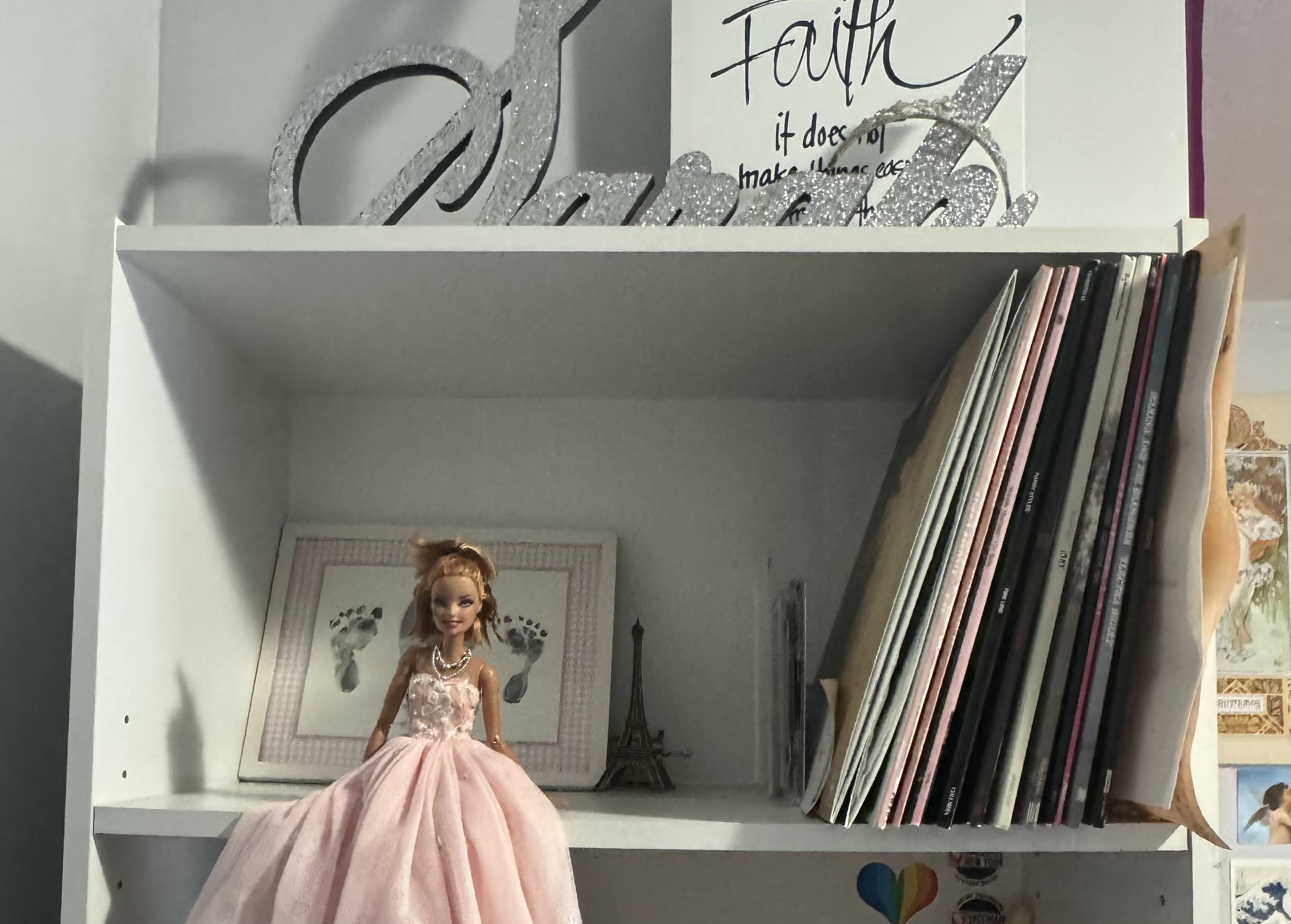
Taylor on the bookshelf of my childhood room

The dress symbolizes family, representing the bond between her mother and daughter. My mother is the strongest and most caring woman I know, and this is a reminder of everything she’s done for me. A reminder of how she spent months planning a party for me, pushing through all obstacles to ensure I had my day. One small item represents a lifetime of love and security. A lifetime of support through everything, and sacrificing what she wanted so I could be where I am today.

The dress is one small piece of a big and beautiful culture. Our Latino heritage is something that has always brought my family together. The language served as the only means of communication to my grandparents, the upbeat music filled the rooms of family gatherings. The food being an outlet for my mother and grandmother to reminisce on their childhood and the food their moms made for them. My Latina background is something my mom has always taught me to be prideful of.

My mom, sister, and I. Taken in Port Jefferson, Long Island in June of 2020. Pictures were taken prior to cancellation.

To many, this is just a doll—a simple toy played with as a child that is eventually put to the side and forgotten. To me, it holds a lifetime of stories and memories. I hope for the stories it holds to continue beyond me. I hope to have a daughter who will share this same love and joy as me— someone who is proud of her culture, the family she came from, and the person she has grown into.


The Brown-Creamer Hurley Homestead

The object I chose went beyond something you can see closely, touch, or hold in your hand. When I was asking family, specifically my mom about an object that has familial and personal history, she gave me the perfect idea. My object is my great grandmother Ruth Geiss’s house, that her and her second husband Arther Brown lived in over seventy years ago located in Hurley, NY. I was raised in Hurley, NY, so this house felt like the perfect place to learn about my past ancestors and how my family that was once separated, found each other again.

Finding pictures of the house during the time my great grandmother lived there was impossible, but my mom went to visit the house last year and the work they did to it is beautiful. Standing in front of the house on the right is my mom, Robyn Finch, in the middle is her cousin, Martie Brown-Lott, and on the left is her other cousin, Lori Creamer. The house known now as the Brown-Creamer Hurley Homestead has plenty of land surrounding it such as freshly cut grass and mulch with eight plants, four to each side of the door, with one big pink and white flower arrangement on the right, covering most of the front glass window. There are cobblestone steps from the driveway on the left side of the house leading up to the dark brown wood door. A glass window in the middle divided equally into four square sections with a minimalistic green wreath hanging center. Two grey pots that are holding more greenery on each side of door. A black lantern hanging on the upper left corner with an oval shaped bulb waiting to turn on as dusk approaches. The cream-colored home that was painted over red brick with a grey brick roof and red brick chimney is perceived to have rough texture. The black shutters equally bordering each window to make the house symmetrical on both sides. Also noticing the black lamppost on the right side of the stairs melded into the mulch to stay upright that is taller than all the women. It has a vertical infinity symbol above the middle tier. The bulb is enclosed by four glass windows and topped with a bell-like figure.

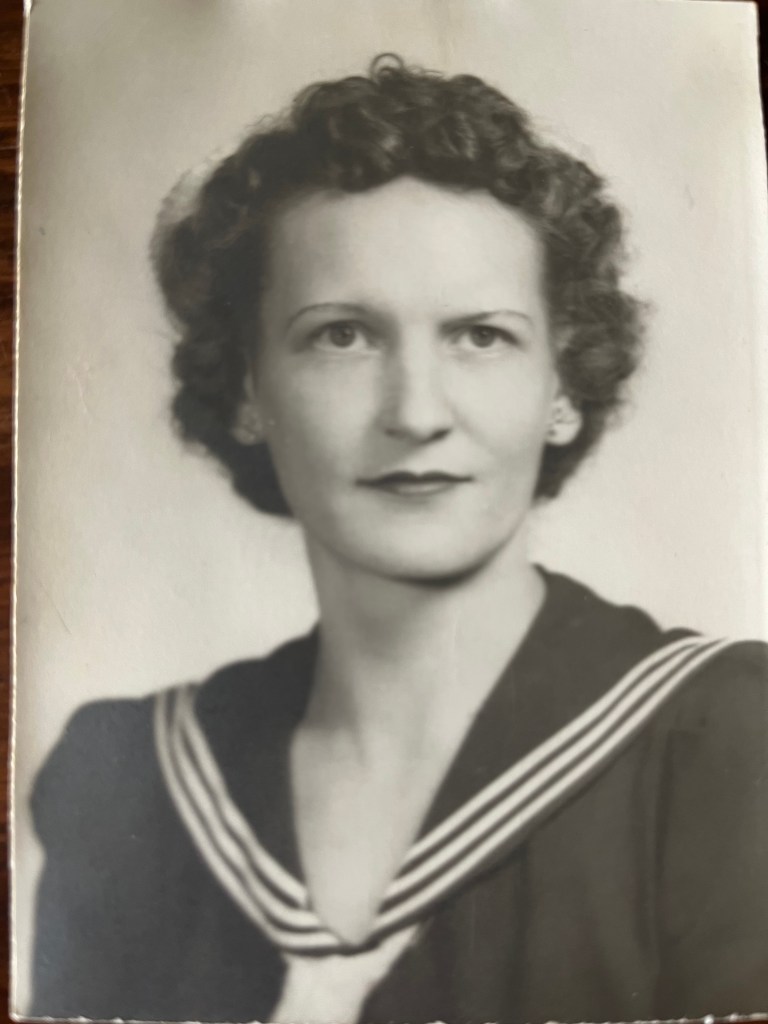
Now I want to immerse you in how this house became so prominent in my family’s history. Before the house was discovered by Ruth Geiss (pictured on the left) and her second husband Arthur Brown, Ruth originally married Douglas Creamer Sr and had three children (pictured below). One of the children being my grandmother (far right), Lorraine Creamer and her siblings Douglas Creamer Jr (far left) and Constance Creamer (middle). Unfortunately, a scandalous affair happening between Ruth and Arthur broke up the family which made Douglas Sr leave and never return. Ruth and Arthur raised her three children and had one child of their own named Lawrence Brown Jr. From there, Ruth and Arthur got married and move into the Brown-Creamer Hurley Homestead from Kingston, NY. As Ruth Geiss was suffering from uterine cancer, she died in 1953, being only 37 years old, leaving my grandmother Lorraine at only 18 years old. Lorraine took on the roll of raising her three siblings along with her stepfather Arthur in the Hurley Homestead.

The first reunion of the Brown/Creamer family in the Hurley Homestead happened in 1976. The reunion included Arthur Brown Sr who then remarried after Ruth passed to Dolly Brown. Lorraine Creamer (Finch) who married Robert Finch in 1975, their two children Robyn Finch, my mother, who Robert adopted from Lorraine’s first marriage and Joshua Finch who was Lorraine and Robert’s son. Douglas Creamer and his wife with their two twin daughters, Sherri and Lori Creamer. Constance Creamer with her husband and children. Finally, Lawrence Brown and his wife Georgette, with their two daughters Monique and Martie. Lorraine, my grandmother was closest with her youngest brother Lawrence who lived in Grants Pass, Oregon for the remainder of his adult life. Lorraine occasionally saw her brother Douglas who lived in Kansas City, Missouri, and he would often visit NY. There is an unknown reason Lorraine was least in touch with her sister Constance.

Fast forwarding to September 2018, Monique Brown, Lawrence Brown’s daughter, committed suicide. This devastating tragedy rekindled the relationship of my mother, Robyn Finch and her cousins, Martie Brown-Lott and her husband Jeremey Lott, Sherri Creamer and her husband, and Lori Creamer and her husband Jeff. Each year after, the family made it a point to visit one another to stay in touch. After Martie and Jeremy Brown-Lott adopted their son Larry in February of 2020, my mom, stepdad, sister, and I went to visit them in Pasadena, California when he was only 2 years old. After the brunt of COVID-19, in July 2022, my mom, stepdad and I went to visit Lori Creamer in Kansas City, Missouri. In September 2023, all the cousins visited Kingston, NY. Kingston, NY is where I currently live with my mom and stepdad. This past summer, June 2024, all the cousins visited Grants Pass, Oregon where Martie grew up. Each year it is the tradition of the Cousin’s Reunion. Going back to September of 2023, where the reunion was held in Kingston, NY, a return to the original family homestead was requested along with a visit to the Hurley Cemetery. My great grandfather was buried in between his two wives. In researching the Hurley Homestead, my stepdad, who has a GIS program called parcel viewer, for his commercial real estate business, found that my mother’s cousin’s daughter (on her stepfathers’ side) had bought the Brown-Creamer Hurley Homestead in 2021. Messaging was exchanged and a tour was planned for the cousin’s reunion on September 7th, 2023, to see the Hurley Homestead, 71 years after my great grandmother and great grandfather lived there.

Original Sin and an Old Victorian Gown

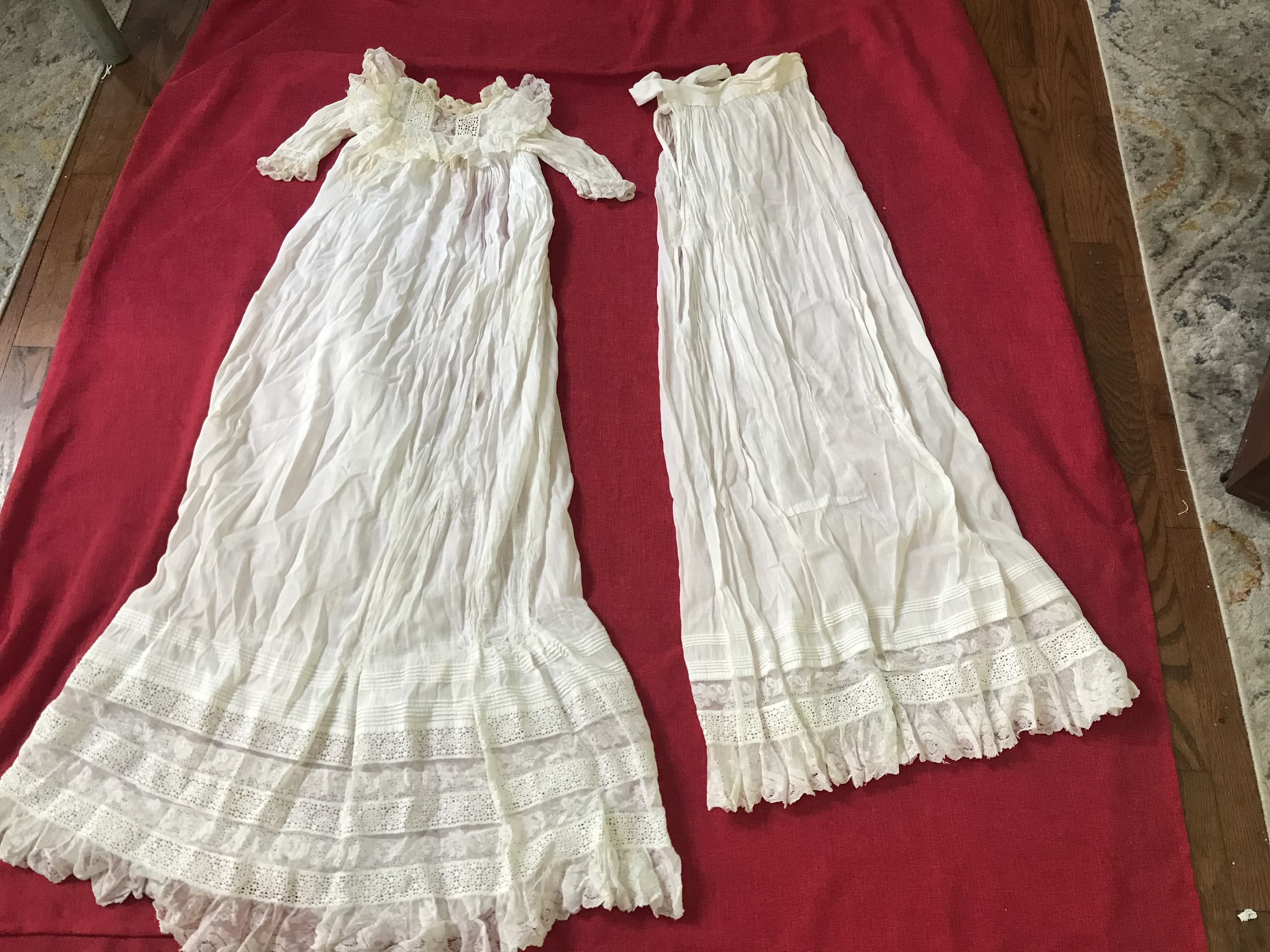
I have, like the majority of Catholic Irish-Americans, been to more baptisms than I can count. Considering my sizeable family—4 aunts, 1 uncle, 12 first cousins, and 14 second cousins—baptisms have seemingly become a semi-annual family reunion. The practice cleanses the newly born, washing away the Original Sin they have somehow carried into this life, symbolic of an official identification with the Church and God. It is emblematic of death and resurrection, of being reborn under holy waters blessed by the priest. It is at this practice that we are introduced to an off-white, frilly, and painfully antiquated baptismal gown with a perfectly matching petticoat.

The baptismal gown and petticoat

My grandmother was the first of her siblings to have a child. Married to a newly converted Catholic (my grandfather had grown up in a French Protestant family), it seemed undebatable that their firstborn would be baptized. Standing before God with hopes of forgiveness for Original Sin, one would think to show their holiness and piety through their dress. A nicely tailored suit, maybe? Perhaps a shining cross necklace?

This, of course, is where our beloved dress comes into the picture. 

Aunt Margaret had been saving this dress—although unknown where she got it—to hopefully dress her children for their baptisms. Upon my grandmother having her first child and never realizing that hope of having children, she gave the dress to her niece. A long and delicate white cotton, the skirt of the dress flows out seemingly far too long to fit the newborn it was meant for. Around the neckline are ruffled circles of lace, sewn in a way that causes the fabric to stick out and radiate from the child’s head. Thinner strands of fabric web together to outline the more prominent details, areas of thick lace that form interwoven circles and star shapes, sometimes connecting in floral patterns. The thin strands, however, are so fine in some areas that it is difficult to make out what the design is. Flower petals? Maybe leaves?

“A beautiful Victorian vintage gown”, in the words of my grandmother. One that is apparently not too long, as some (me) may have previously thought. The length of the skirt is meant to be draped over the arms of the godparents as they present their godchild to the Church for the first time, an act that effectively shows off the lacey frills that reach the floor of the altar. This gown—tagless, perhaps handmade—is far too delicate to be passed around. We see it—perhaps if we’re lucky, feel it—only during the occasion of a baptism. My grandmother is its keeper; when not in use she protects it, afraid of its being ruined. Not only does she guard the gown itself but its history and significance that go far beyond my Great-Great Aunt Margaret. She is graciously always willing to share such intangible stories that cannot, unlike this old Victorian gown, be stained and torn.

My Aunt Katie, Uncle Sean, and two cousins at their family baptism

Aunt Margaret was born to two Irish immigrants, both of whom were baptized into the Catholic Church. Her father, James Charles, was born on a family farm in County Leitrim, Clooncose townland, Ireland, and was christened at the nearby church. James was born in 1844, just a year before historians mark the beginning of the Great Famine, a very possible impetus for his decision to leave Ireland and settle in the United States. Before emigrating, however, he married a young Catholic girl named Annie Beirne. Although this story would tie nicely with an anecdote of finding unexpected love in a time of immense Irish conflict and trial, Annie lived in County Cavan, far too long of a distance from James’ family farm for the two to have met naturally. An arranged marriage, most likely.

After a year of leaving Ireland and settling in New York City alone, Annie too left Ireland to join her husband James. Although this marks quite a large gap in our story, we know that it was in New York (somewhere on Avenue C between 15th and 16th Street) that James and Annie Charles had their daughter Margaret. I don’t know much about her life, but I do know that she followed in my ancestors’ very Catholic footsteps: she was baptized, went to Church with her family, and undoubtedly wished to continue the tradition with her own children. This is why she came to possess the baptismal gown, and how it was eventually gifted to my grandmother. My grandmother who must be making her Aunt Margaret incomprehensibly happy with her continued use of the gown.

Every member of my family, since my grandparents’ firstborn, has worn this gown at their baptism. Although some larger children have had to be squeezed and shoved into the consequently unbuttonable dress (thanks to modern medicine, we no longer need to baptize infants almost immediately after birth), not a single one of us has entered the Church without our faces shining through radiating lace, without soft white cotton adorning our godparents’ arms. And the tradition will continue, so long as we make sure not to rip the fabric on the way.

Maybe Fourth Place Isn’t All That Bad

After asking my family around for objects with chains of history, I came back pretty much empty-handed apart from a few gems. One of these gems was a story from my grandfather; the story that started his pen/pencil collections.

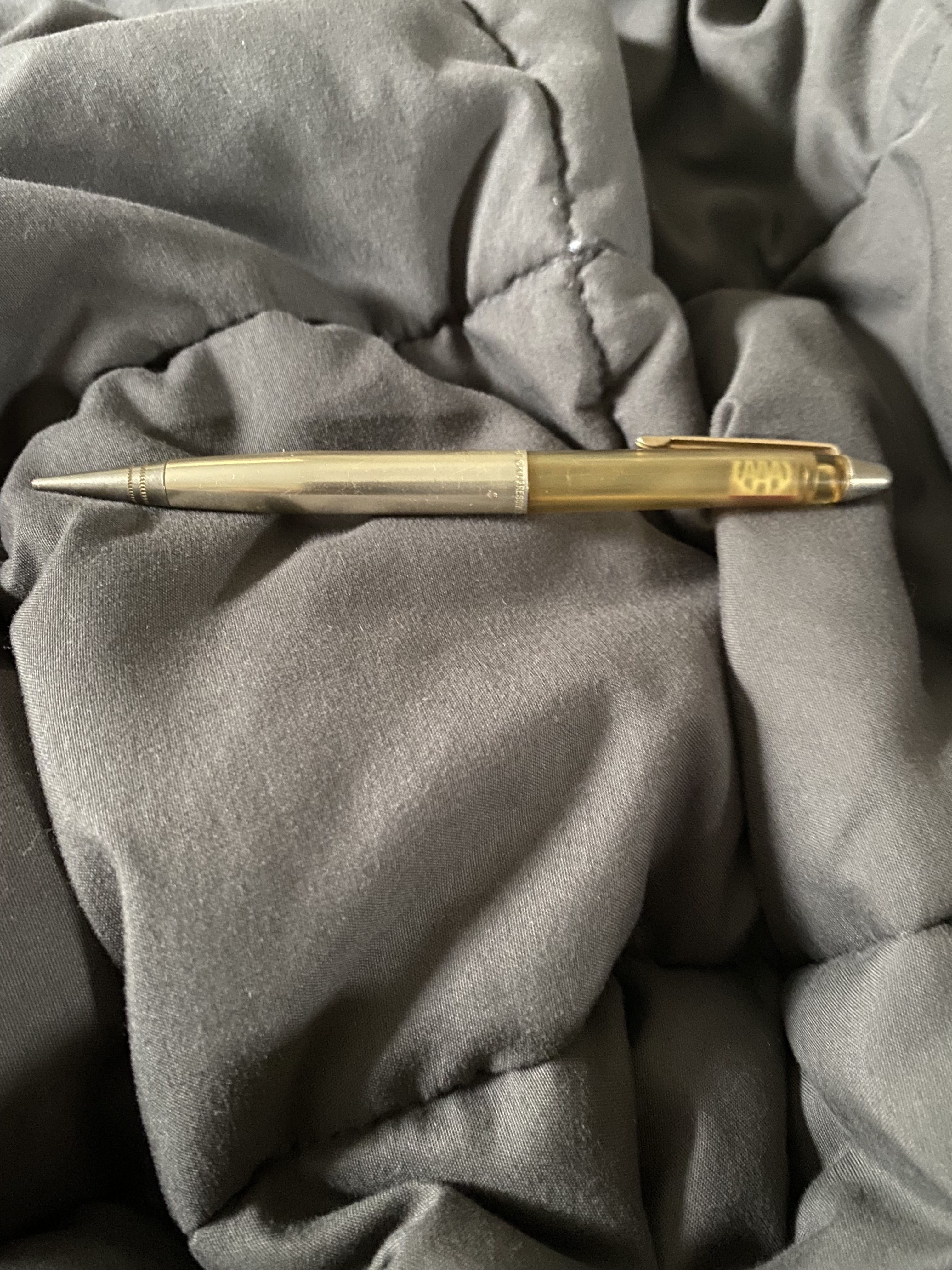
Poppy’s pencil

This object stands at about 5-1/8 inches long. From the top portion of the pencil to the endpoint, the pencil is embellished with a bronze-gold finish. The H-type lead appears out of the barrel with a continuous twist. Around the bottom is a raised surface of small, rounded ovals to create a small pattern, something to rub your finger over. A smooth nib at the top connects to a metal hook to attach to papers or your pockets. Made from plastic and metal, this pencil is special because halfway down the barrel, the pencil contains a liquid core on the upper side under the eraser. Now dried out from age, contained within the liquid core is a plastic 3-dimensional logo of AAA. Under this core lies a stamped imprint of the production. Embedded reads “Progressive Products INC. Union N.J. U.S.A.”

While I could not find the exact pencil online, I found it is “brothers and sisters” — pencils that are the same make and model but with different “themes.” I came to find the object is commonly called the “Vintage Progressive Floaty Mechanical Pencil,” and there are millions just like it. So, I kept searching. I wanted to know who created it, or more importantly, where it originated from. Upon further research, Progressive Products INC does not really exist anymore, well not the original anyway. By finding similar pencils online, I discovered a certificate of guarantee with the company name and address on the paper. It read, “PROGRESSIVE PRODUCTS INC. 701 Lehigh Avenue, Union, New Jersey.” Looking this up, you are given industrial property for sale, but no mention of the company. So, I kept looking. A New Jersey-based company product manufacturer called Progressive Promotions, now known as Dryvve, was the closest I could find, but I am unsure, mainly because they do not list an established date and look on the newer side of things. So, the trail ended here.

“Vintage 1950’s Southwestern Bell Telephone Floating Mechanical Pen Employee Award” – rubylane.com 

But the story that follows it has not ended. The story that follows this very pencil is how it became the first of his collection.

1949, in grade school, specifically Public School 12 of Troy, NY, my grandfather was in fourth grade. During this time children used to use “straight pens” which encompassed ink wells and fountain pens, ballpoints were not popular by any means.

AAA or the American Automobile Association, which began in the early 1900s, annually holds a safety poster art contest for children pre-k through 12. As part of a class project, my grandfather’s fourth-grade class must create an illustration for the contest. The goal of the contest was to promote safety messages in schools and encourage communication through creativity. The prize for this contest was that the top 3 pieces chosen would be put on display in Stanley Department Store located at Third and State Street, Troy NY, which current day I know as Hatchet Hardware.

My grandfather placed 4th. While upset about the loss, he soon found out that his piece was displayed at the store as an honorable mention. Poppy described the piece as a rugged baseball player, split in half; the left side showed the player beaten up, injured, and with crutches and a cast. On the right side, the player was healthy, bat in hand, and ready for the game. While I can picture such a drawing in my head, I yearn to know what it truly looks like and what care and skill my grandfather put into it. Did he stay up all hours of the night completing it, just like I do in the studios? Was he excited and prioritized this over schoolwork, like I do when I start painting? Was there a background? Was there text? I will not know; my grandfather can only remember so much.

Branched off from how this object got into the possession of my grandfather, what followed this story was when his collection began to grow. Around the same time as this story, while in grade school, there was a quite older gentleman in his neighborhood. He used to give my grandfather parts and broken pens. From this older gentleman, for whom I have no name, my grandfather started to fix pens. He told me all his classmates would pay him to fix their broken pens, and he made a small change by doing something he enjoyed. Life went on, and my grandfather stopped fixing pens until 20 years ago. He went to a garage sale and found broken pens for a dollar. Feeling nostalgic, my Poppy bought one, fixed it, and began to write again. To this day, he still does and encourages my grandmother to do the same as she battles Alzheimer’s.

Unfortunately, I was unable to find any news articles about this event happening, at least not in the town of New Paltz. Hopefully, when I return home, I will have to continue my findings in my town’s public library.

The Accessory Connecting Grandma to Granddaughter

During the summer of 2018, most of my mom’s side of the family gathered together for a wedding that my cousin was having in Marshall, Missouri. Marshall is between Kansas City and St. Louis but lies closer to Kansas City as it takes one hour and thirty minutes to reach Marshall from Kansas City. During the time spent there I got to see many family members, including my grandma Cecilia, where I was gifted timeless jewelry.

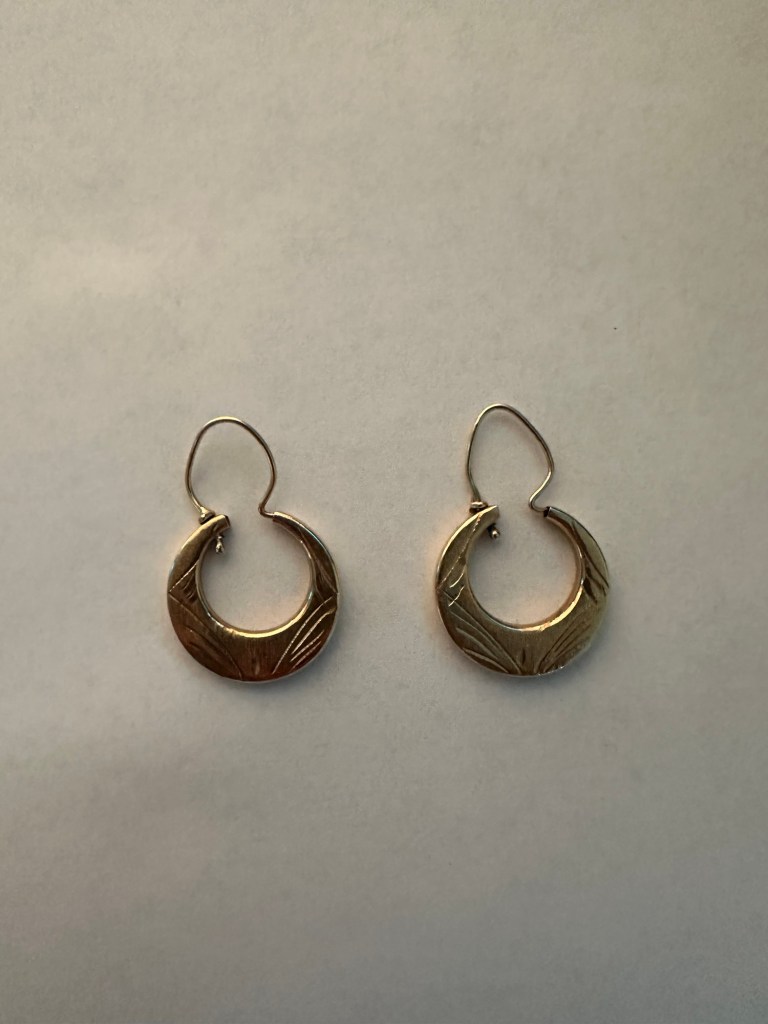
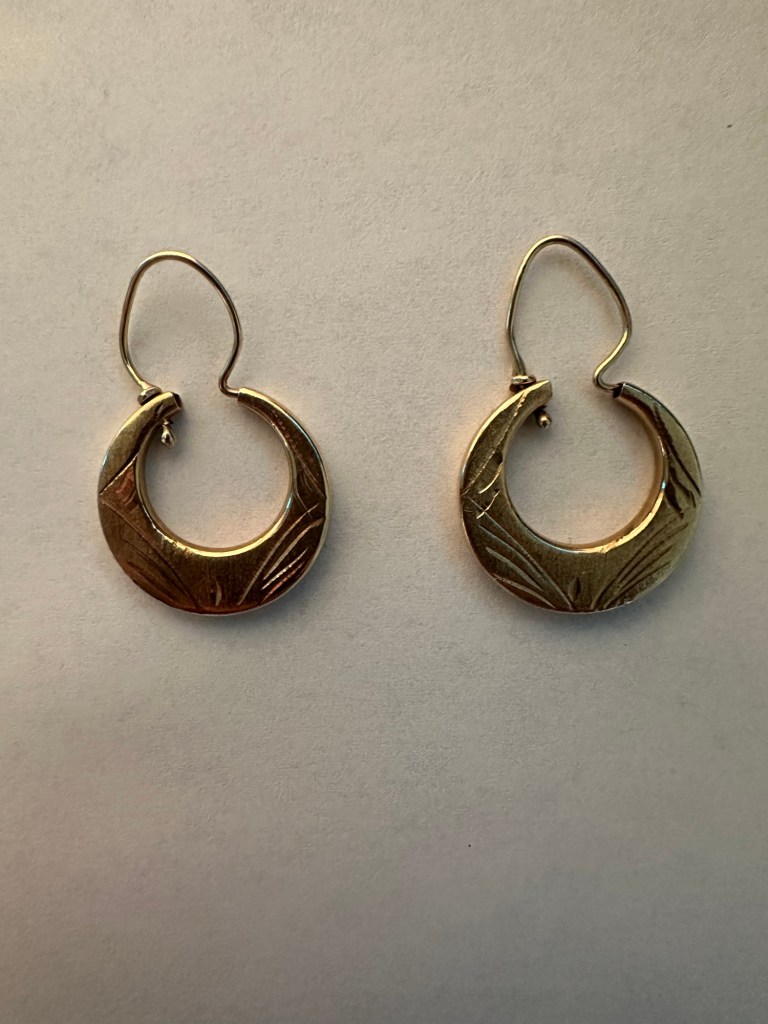
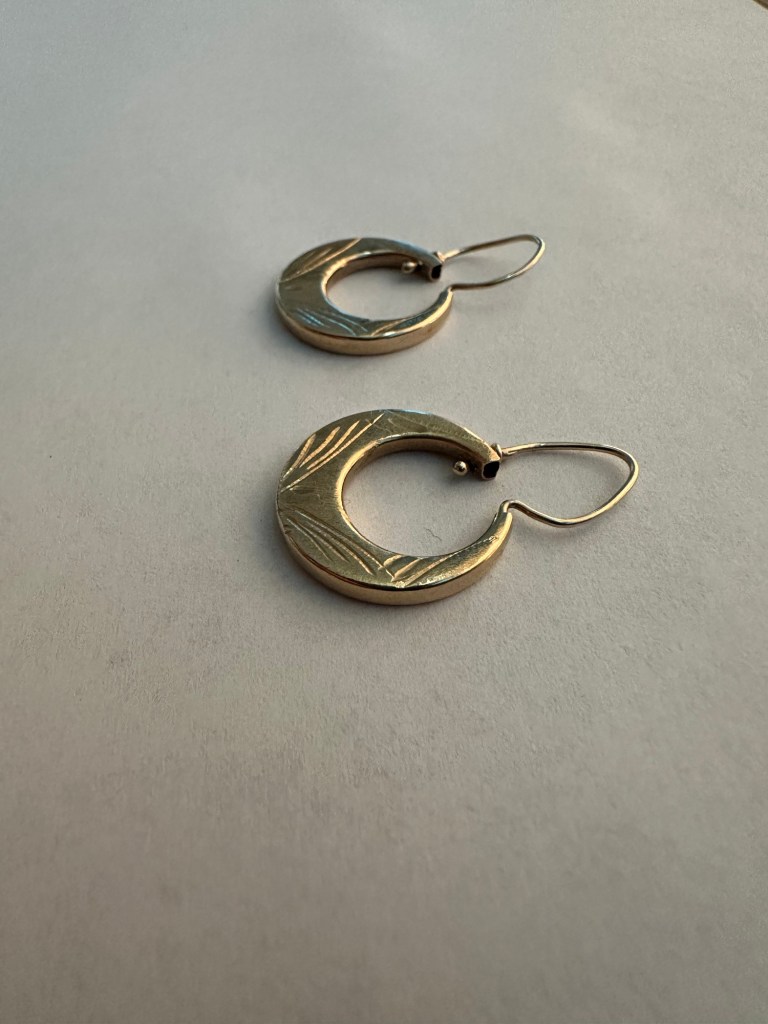
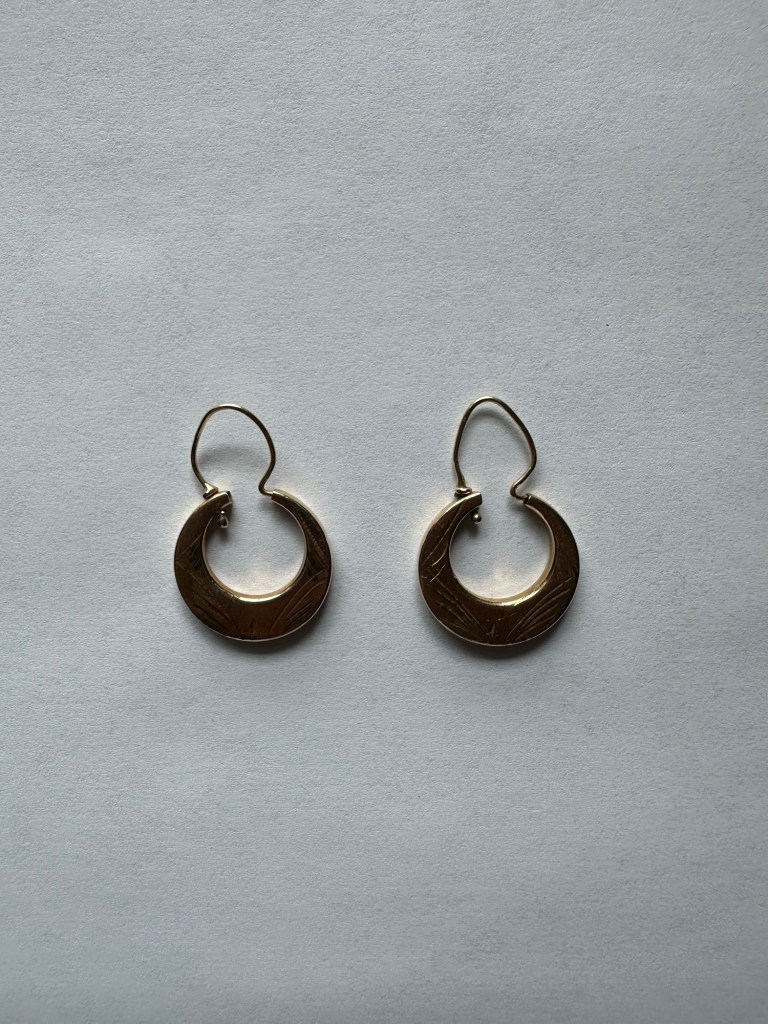
My grandma Cecilia gifted me a pair of small gold decorative accessories for me to wear on my ears. They have two main parts; the top is thin and bent in to connect to the bottom, thicker part. The bottom hoop like part of each accessory has multiple lines that showcase an intricate design.

At the point where the hoop is the widest it measures 13/16″. Measuring the top to the bottom, the length is 1 – 5/16″. The thickness of the hoop measures 1/16″.

For me to wear this gift, I must put the top part through my pierced lobes. Once, I have securely connected them on my ears. I am able to feel their weight. Typically, when I wear other accessories like this, I do not notice how heavy they feel, sometimes I even forget I am wearing them because the other pairs I own are very light. However, with these small gold hoops, their weight does not go unnoticed. Their heaviness is the dense material of the gold they are handcrafted from.

When worn the bottom hoop allows for dangling and swaying movements to occur; perhaps walking or shaking my head. Not only are these items physically close to me as I wear them on my skin, but close to my heart.

This pair of accessories is special to me because they are from my grandma Cecilia. My grandma Cecilia is my only living grandparent and the only one I remember having a relationship with. So, having a gift from her and a relationship with her is something that I cherish. She bought this unique handcrafted accessory gift in Mexico. When taken a close look, they are not identical; one of the two pieces has longer design lines craved in on the bottom hoop part than the other. Additionally, my grandma has many other granddaughters that she could have chosen to gift these earrings to.

Anytime I wear these earrings, I am reminded of my grandma. Whenever I see my grandma, she is always wearing these types of earrings. My grandma has lived in Mexico her entire life; so, when she visits the United States, or I visit Mexico, I am glad that she has gifted me something that reminds me of my family and their culture.

When other individuals point out that they like my earring and I happen to be wearing the ones that my grandma gifted me, it brings me happiness; because these earrings are not solely a form of self-expression to complement an outfit, but I get to talk about my grandma.

My House Keys and Their Memories.

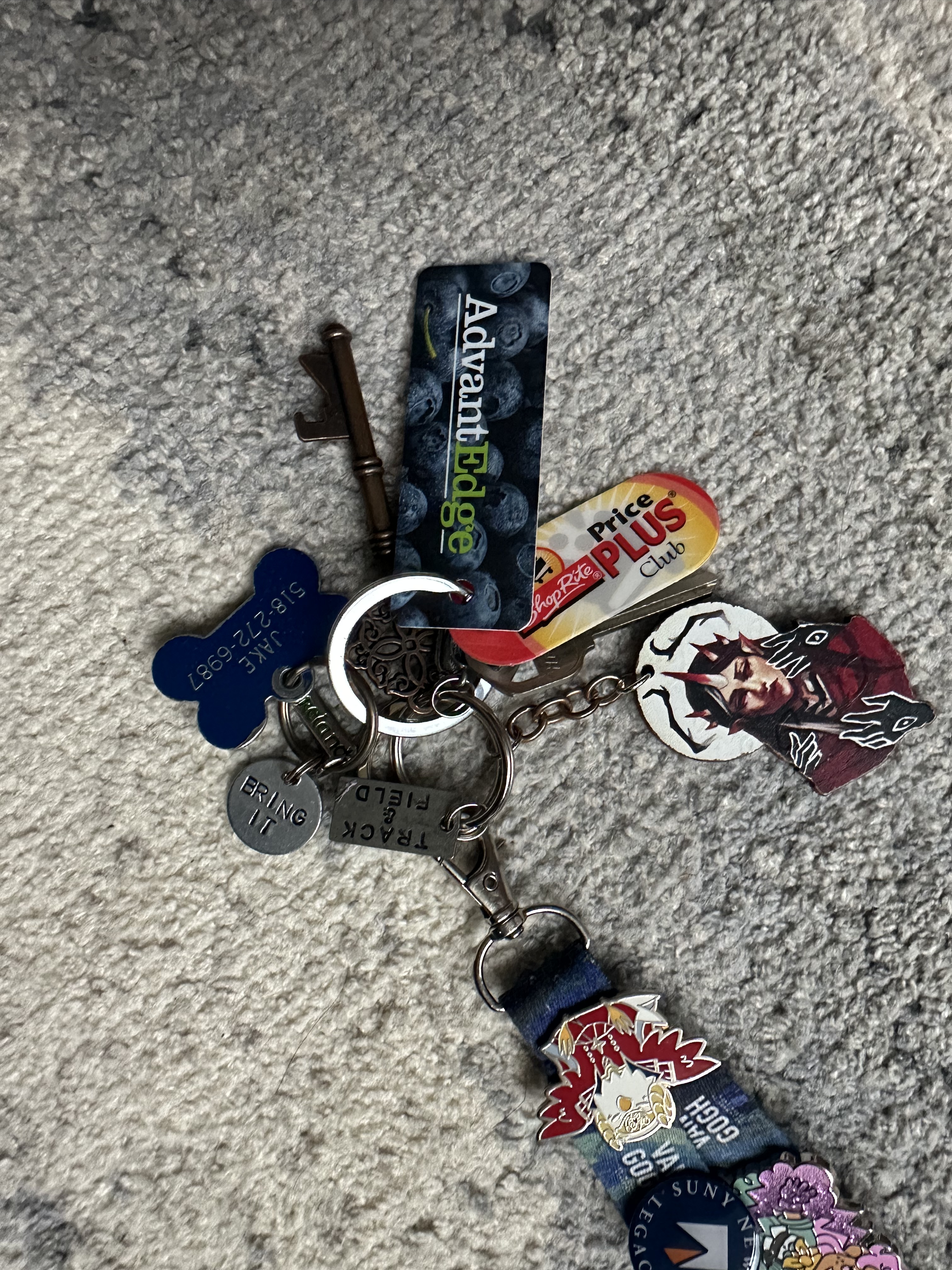
The object I chose to elaborate on and describe was from our first meeting in class: the keys to my house. They are 16 inches long and end at the clasp of the stretch-out twine, and another four inches are added via the attached mechanisms.

a frontal view of the keys

A heavy handful, when moved, makes a jangling noise. Beginning at the top of the twine, the lanyard is adorned with various materials, including enamel, metal, and plastic; all these textures and materials are formed into a specific shape. Fused to the back of the metal shapes are small needles completed by a rudder backing to keep them in place once poked through the material.

The twine itself is formed by a soft and sleek blend of fabrics. Imprinted into the twine are a series of patterns with the words “Van Gogh” perfectly spaced along the rope. In the background lie bits and pieces of the recognizable painting Starry Night. Blues, yellows, blacks, and greens all form in spirals as the painting takes shape at a glance. At the end of the lanyard is a linked half-circle metal shape, a circular clasp is attached, and a lever to the side allows the clasp to move within itself—open and close.

The attached keys *please don’t call the number, it is not ours anymore*

Shackled to the rope, are four circular rings, each able to be pulled to hook onto one another. A golden ring with six consecutive loops fixed together holds a humanoid figure with horns, brown hair, and black hands. The figure looks below, a stick-like design is presented over in the circular frame. Subsequently, another hoop is next. Three loops are locked together, one holds a key in the design of a lost artifact, bronze in color, and another is a bright silver key made from metal in the shape made for a lock, sharp and spiky by nature, with a windowish design on top. Alongside these forms, a circular metal says “BRING IT”, stamped by human hands likewise; a second medallion reads “Track & Field”. Alongside these two metal forms is a third bone-shaped metal tag, that reads “JAKE 518-272-6987”. Beside these metal medallions lie two oval-shaped plastic cards. They read “AdvantEdge” with “Advant” in white and “Edge” in green, with blueberries enveloping the background. On the flip side, there is a barcode and numbers on a white background. Paired with the second smaller card, adorned in red and yellow, reads “ShopRite Price Plus Club” with a shopping card logo. Similar to its partner, it has a barcode and numbers on the backside.

This section of the keys holds a minor part of its story, as it contains little moments from my life so far within the key rings. The small sports medallions all represent and are gifts from my senior nights of my played sports: “BRING IT” for my time as a goalie in lacrosse, and “Track & Field” for my time as an indoor and outdoor thrower. The shopping cards are all new, as they hold the rewards for my times shopping at nearby grocery stores — now as a college student. The dog tag belongs to my first pet, Jake. It was his first tag, and he has outgrown it. The number is an old landline my family doesn’t own anymore. Having this piece of him with me reminds me of him at home and how I miss him at college. The decorated keychain was a small gift from my brother on Christmas by my favorite artist Annadrawsstuff. Lastly, the keys, while one of them is my real key I use to enter my house, the other “older” looking is actually a bottle opener from a wedding I worked at. It was a party favor left behind, so in case of use, I took an extra.

Backside

Last but not least, the main element is attached in small quantities on the lanyard: pins. Nineteen in total, all ranging in sizes, shapes, and textures. Some are recognized shapes, while others are not so much. Starting from the bottom, near the metallic clasp: in a bird-like shape, a bird is posed with outward wings wearing an outfit of red and blue. It has a yellow crown and horns on its head; this is a character from a game I’ve played. Above is a small circle, dark blue with the SUNY New Paltz logo in the center, and the text reads “SUNY NEW PALTZ LEGACY” — my uncle/godfather attended the school, thus I am a legacy. Moving up, a butterfly sparkly, blues, whites, blacks, and moon phases adorne the bug – this was from a craft fair. Next, a large dark human figure wearing red and black holding scissors, they have a snarky face – this is a character from a show I watch. Above a white cat with a sword through its head, hovering over a dice with a 1 labeled on it; surrounding the cat, it reads “It’s fine. I’m fine. Everything’s Fine” – a pin that shows my love for D&D. Higher, another graphic depiction of a black and white cat with its paw outstretched, with letters that spell beans, under a spilled coffee cup in liquid spells “CAT CAFE” – a pin for my first time at a local cafe Beans! On top of this pin is a leaf-shaped dark and green plant with the letter NYBG – my first time at the NY Botanical Gardens. Next, a very tiny silver depiction of the Colosseum, engraved with small outlooks – this was from my trip to Italy. Next, another white cat is chewing on an orange fish – a gift from a friend. Lastly, on the right side is a color tube of paint, its cap black and body in an explosion of color with gold dots – this was a gift from an old art teacher.

Lastly, on the left side going down: there is an image of a yellow dog wearing a top hat, holding a mug in a dumpster on fire, with the quote “This is Fine” — a pin of my favorite internet meme. Below is a colorful pin with the logo for MoMA, my first time at MoMA. Under a black and white moth with flowers and leaves — another gift from a friend and my love of moths. Beneath a running red rabbit with wheat stocks inside — a purchase from a local thrift in New Paltz. Down a small shield-like shape, a golden touch lays inside with text reading “National Honors Society” “CSLS” — a member of the NHS for my academics in school. Below that pin is another human figure with pink and blue flowers around them, green hair and green clothes, holding a monkey spitting fire — another character from a show. Third to last is a similar circular shape with the New Paltz logo reading “New Paltz Honors Program” — I’m a member of the honors in my college. Second to last is a small, pink, shiny ribbon in the shape of the breast cancer awareness logo; this represents a fight for my friend’s mother, in which she sadly lost when we were young; we always partake in a walk for her every year. Lastly, another human figure, wearing a light blue dress, a white corset, and a yellow bandana; they have pink hair and pink lighting shooting from them. This creates a full circle around the Lanyard.

While I wish to explain and dive in more into my pins, there is only so much I can write for now as a first work in writing about objects. (I’ve definitely gone on for too long.) However, this collection has been with me for a long time, and each day a new pin may be added, which then means a new memory has been made.

Isabella Barcher

Great-Grandmother Olive’s Tablecloth

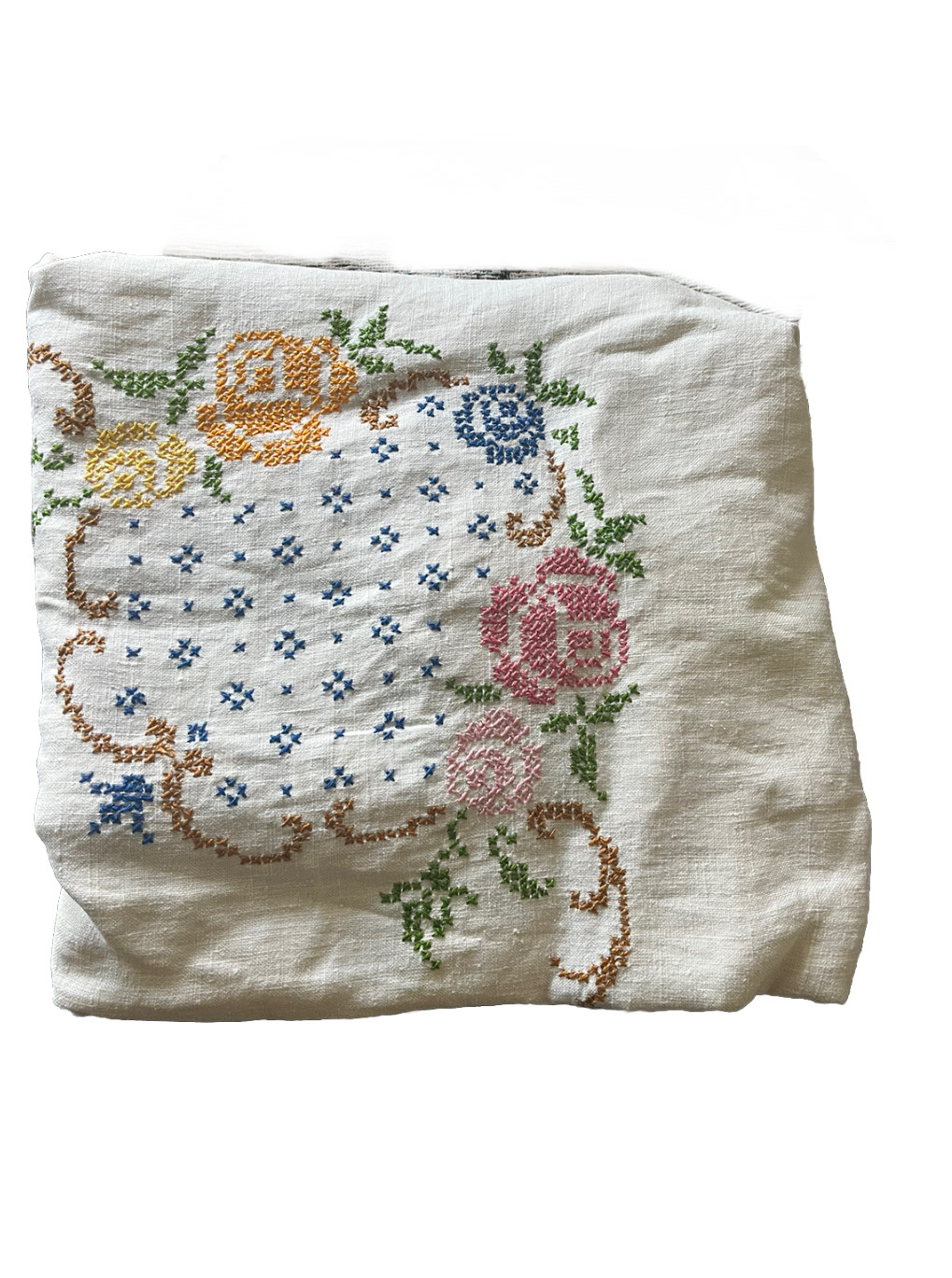
Top view of full tablecloth

The object I have chosen is a tablecloth embroidered by my late great-grandmother Olive, found by my sister during one of her many escapades through our cluttered, object-filled basement. Olive would make one of these tablecloths whenever her children or grandchildren moved out and into their own homes, hoping her gift would be of use in an unfinished home. These children, including my great-aunt Flo, whose house I now live in, opted for folding and putting away these clothes for fear of tarnishing their grandmother’s hard work. This is how Olive’s gift wound up buried in piles of old letters and trinkets until my sister unearthed it and claimed it as our new kitchen tablecloth.

The white, rectangular cloth is 65 inches long by 45 inches wide. The soft, vintage cotton is thin enough to allow light to shine through, especially when pressed against a sunny window. There is a distinct lack of holes in the fabric, no evidence of a mistaken stitch or accidental pulll of fabric. The outer perimeter of the cloth is decorated with half circles of small white stitches with lines that connect the edge of the cloth to the stitched circles, imitating the look of lace. From use and time, these loops have been misshapen and pressed, leading to some being larger or more spread apart than others.

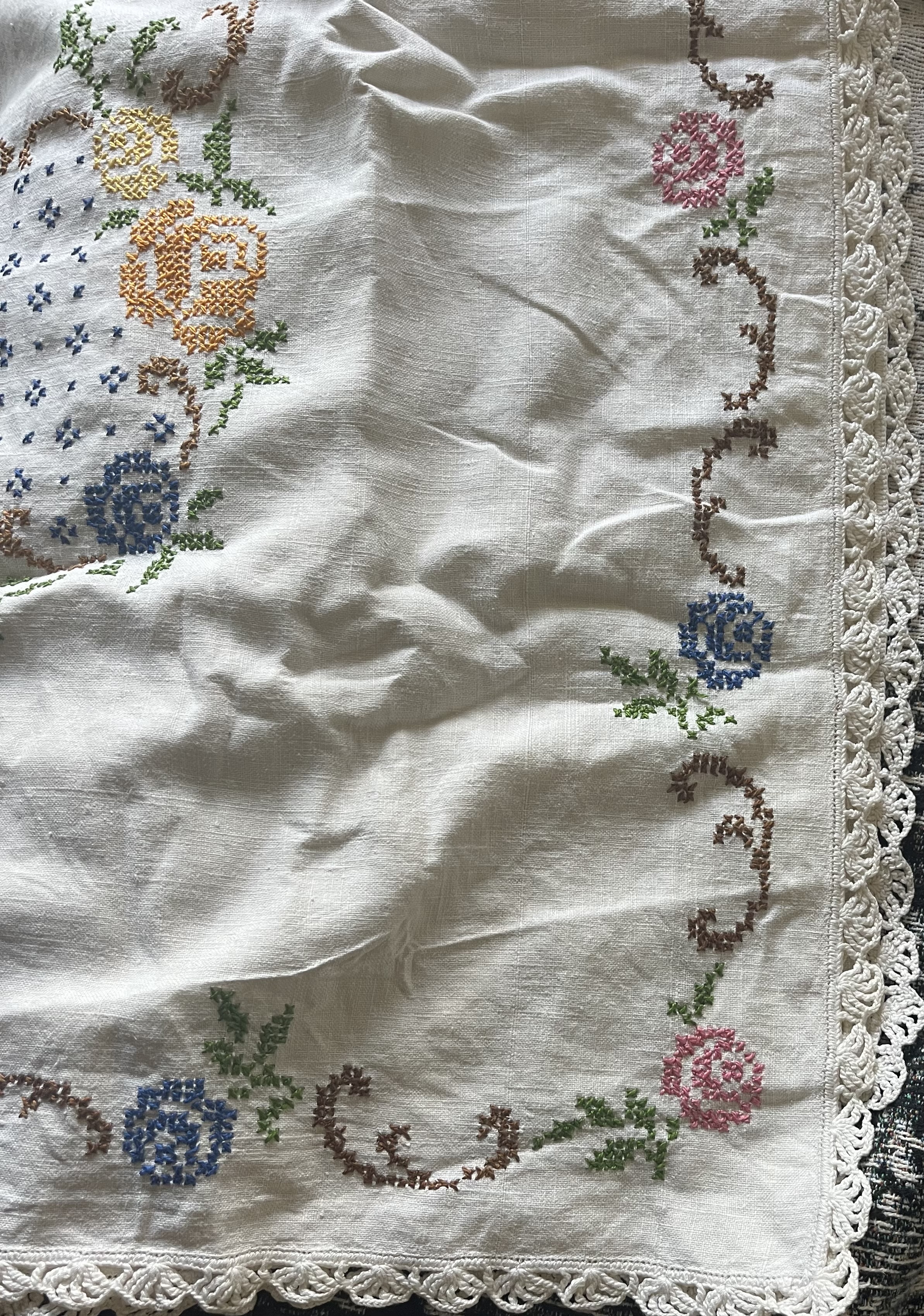
Close Up of a Corner of the Tablecloth

Embroidered thread of blue, green, brown, pink, and yellow line the edges of the cloth. The embroidery is done in a pattern of small x’s, x’s which you only see when examining closely; from far away, they blend together into the design. The patterns done in blue, pink, and yellow are the same; the first three stitched “x’s” make a circle, which is placed within a second, larger circle of the same color. Both these circles are embraced by a half-circle-shaped group of stitches, resembling a simplistic yet colorful rose.

To each side of these roses is green embroidery. Unlike the blues, pinks, and yellows that circle around each other and remain consistent in shape, this green reaches out in different directions; there is always one long string of green stitches with shorter lines departing from it, coming together to form leaves. The green meets the embroidered brown, a collection of stitches that form small swirls. The swirls, one larger than the other two, face in towards each other. Just as they reach their peak, they collapse in on themselves.

This design repeats itself, the flowers changing between blue, pink, or yellow, the green and brown remaining consistent. In the center of the tablecloth is a similar design of flowers and leaves, organized into a rectangular form. In each of the four corners of this rectangle sits an imperfect circle of embroidery; yellow, orange, blue, and two different shades of pink form the shapes of roses, although larger than the ones boarding the cloth. Green thread branches out from the spaces between the flowers, continuing the look of leaves. The brown thread is again embroidered in the shape of swirls, although this time the swirls loop together in half-circle shapes to form an ovular border. Within this oval are small, blue stitches; some of these stitches are singular, while others are done in sets of four in the shape of a diamond. 

A Close-Up View of the Corner of the Center Design

The tablecloth is not a perfect white. There are some oil stains (admittedly from a messy snack of garlic knots that my sisters and I shared) and an unknown deep blue stain in the bottom corner of the cloth, about the same size as one of the smaller flowers. When turned over, the knots and stitches that hold together the design make it clear that, although the stitching is not messy, this was done by hand, without the help of a machine. Although I may be unsettling my ancestors through the staining of this object they tried so hard to keep as perfect as it was the day it was finished, Great-Grandmother Olive intended it to be used. Sitting at my kitchen table with my sisters, mom, and grandmother as we eat on this cloth is a celebration of our dear Olive’s work. She would be happy.

Una Taza de Café 

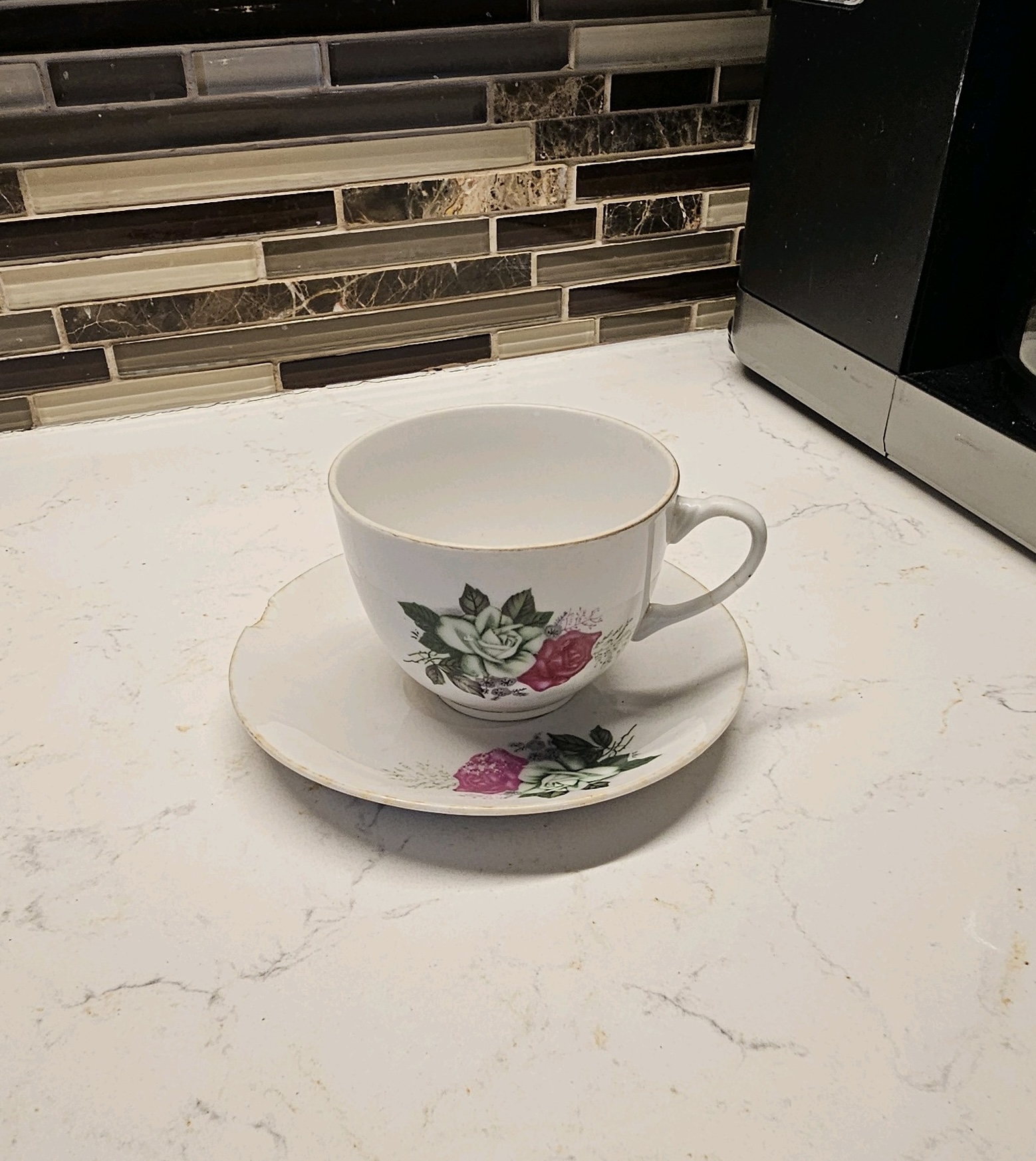
The comforting aroma of fresh coffee fills the morning air as my mom brews my grandmother her daily cup of coffee. As long as I can remember, my grandmother, Lola, would start her day with a hot cup of coffee in her signature cup. The cup is made of delicate white porcelain with a faded gold edge from years of use. Measuring two and a half inches tall and three inches wide, the size proved perfect; even in her final years, the cup fits perfectly in her frail hands. Even as Lola began to forget who she was and what was important, her cup of coffee in the morning remained consistent and something she always remembered. The saucer the cup lays on is 5 inches long, sharing the same delicate white porcelain and faded gold edge, with a slight chip on the edge from decades of love and use. The cup and plate both feature green and magenta roses, adding a floral accent found on many of Lola’s belongings.

Along with her cup and saucer is the rest of her collection of stuff to make coffee. Her colador, or cloth filter, measures eight inches long and four inches deep. The colador’s handle is white, with the cloth stained from coffee and a gradient getting darker towards the bottom, where Lola would use her hands to twist out the fresh coffee. There are two pots: the metal pot measures six by six inches and three inches tall, and the glass pot measures five by five inches and 3 inches tall. The metal pot where she would boil and stir her fresh coffee grinds has a rough feeling to it; there are cracks all around the silver body and a rusting handle. The glass pot is heavier and stained with a light brown film; there’s a spout on the edge, which she would use to pour out her freshly boiled milk. Finally is her tall kettle pot, storing all her freshly brewed coffee for the day. It stands just shy of six inches tall and five by five inches wide. There is some discoloration and fading of the metal, sharing the same rough feeling as the metal pot, and the handle stays held together with black tape. Lola would use all these items together in perfect harmony, as the sounds of the coffee grinding and boiling water created her melody. 

This set was eventually passed on to my mother. Entering the later stages of her life, Lola came to accept the kitchen was no longer a happy place for her but rather a source of stress. My mom wanted to give Lola the same sense of love and security she felt growing up, so she took care of her. Every day, she would use the same items to make Lola her coffee, remembering Lola’s joy in the kitchen and her smile while doing what she loved. Lola passed when she was 99 years old, after decades of the same routine, I wonder what everything looked like when she first got it. I wish I could ask her more about the story behind these items, why the handle has tape on it, or how her plate got chipped. Her cup now stays in the China closet in the dining room. It is one small piece of her, and it serves as a reminder of many things. It is a reminder of family, the safe place they create for you, and the love they have to care for you. A reminder to not take things for granted. That one day, we won’t be able to do what we love and will need to turn to the people we love for help. One day, you won’t be able to make your cup of coffee. 

Recording Memories: The Chi-Lites Album

Searching, digging behind numerous other records and vinyls in the back of my mom’s old storage unit, fighting against dust mites, is the first memory I have of this item. 

“It should be in there somewhere!” My mom had exclaimed from the opposite corner of the room, elbow deep in old vinyls and other items that were far too old to even name or even put an original story to. With my mother’s urges, I eventually found it, a black, surprisingly shiny, vinyl record with four men on its cover.

The disk itself was slightly poking out of the plastic casing, its scent being that of slightly burnt rubber — or something, amongst the record’s ribbed surface. But, regardless of its smell, my mother was quick to take it from me. After all, this was a record from her favorite childhood band.

That was nearly 10 years ago. I haven’t seen this record since I was 16. Since then, I’ve gone through my last two years of highschool, and 3 years of college. But it’s still just as shiny as I remember. 

My mother was excited when she heard about this project. she’s an avid collector and loves to show off her little trinkets. I chose to base it this project on memories that I recall my mother having about an object. Something older, something that has lived through much more than I currently have. 

For some reason, this record is what came to mind.

This record is approximately 12.25 inches long by 12.25 inches wide, with its thickness behind similar to that of a cellphone without a case (half an inch). The vinyl itself is much smaller, approximately 10 inches wide, with an inky black surface weathered away by years of past use. The casing is shiny with only a few scuff marks on its leftmost side. 

The record itself is black with a white and yellow band in its center of mass. On this band, the words “The Chi-Lites: Greatest Hits” are displayed in bright red letters. The record’s ribbed surface is slightly scuffed, having some of the original ridges worn away from years of use.

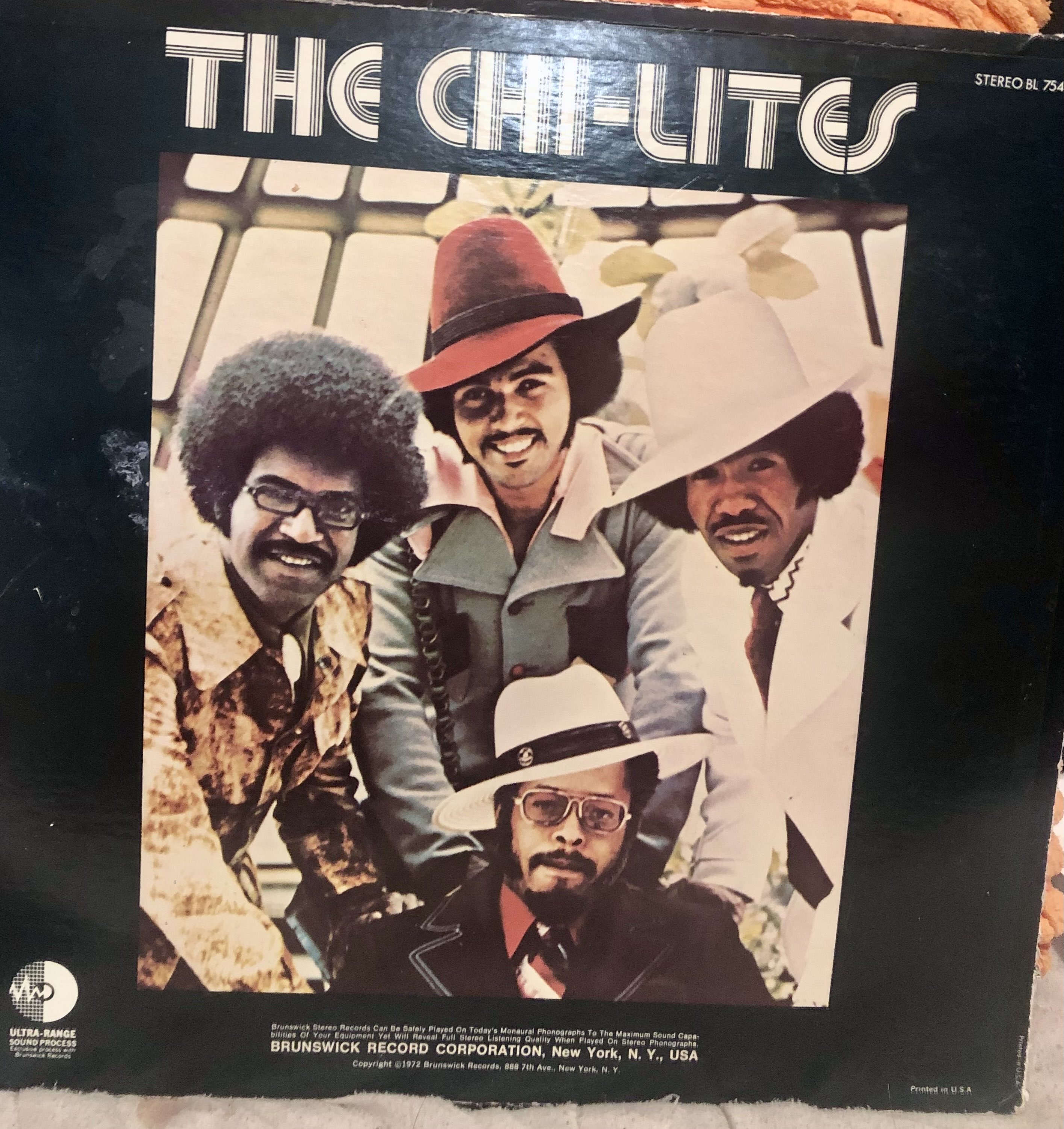
The front cover of this record, under the large “The Chi-Lites” title, features a photo of four men smiling as they look towards the camera. The names of the members of this 70s R&B group are as follows: Robert Lester, Eugene Record, Creadel Jones, and Marshall Thompson. 

These men make up the band called The Chi-Lites, a band that was put together in 1959 by Marshall Thompson, the group’s lead singer. On the record, the four men are shown all smiling. They are oriented in a diamond formation, with two of the members being at the same orientation on the left and right sides of the cover, and the last two members being on the top and the bottom of the piece. 

Robert Lester is the man on the leftmost side. He’s adorned in a faded yellow-brown blazer. He has a mustache, glasses, and is smiling.

Up top is Eugene Record, wearing a red hat and a large smile.

On the rightmost side is Creadel Jones, wearing a white hat and white suit with a brown tie.

On the bottom is Marshall Thompson, the band’s lead singer, who is wearing a white hat with a black stripe, and a black suit with a red undershirt.

Behind the men, there is a grid-like background, with the grid shape being dark in color, with white lighting protruding through the gaps in the grid.

On the bottom left corner of the record, there is a disc symbol with a lightning bolt. This lightning bolt symbol highlights the “Ultra Range Sound Process” utilized to create this record. This process is characteristic of Brunswick records, the record company who created this record.


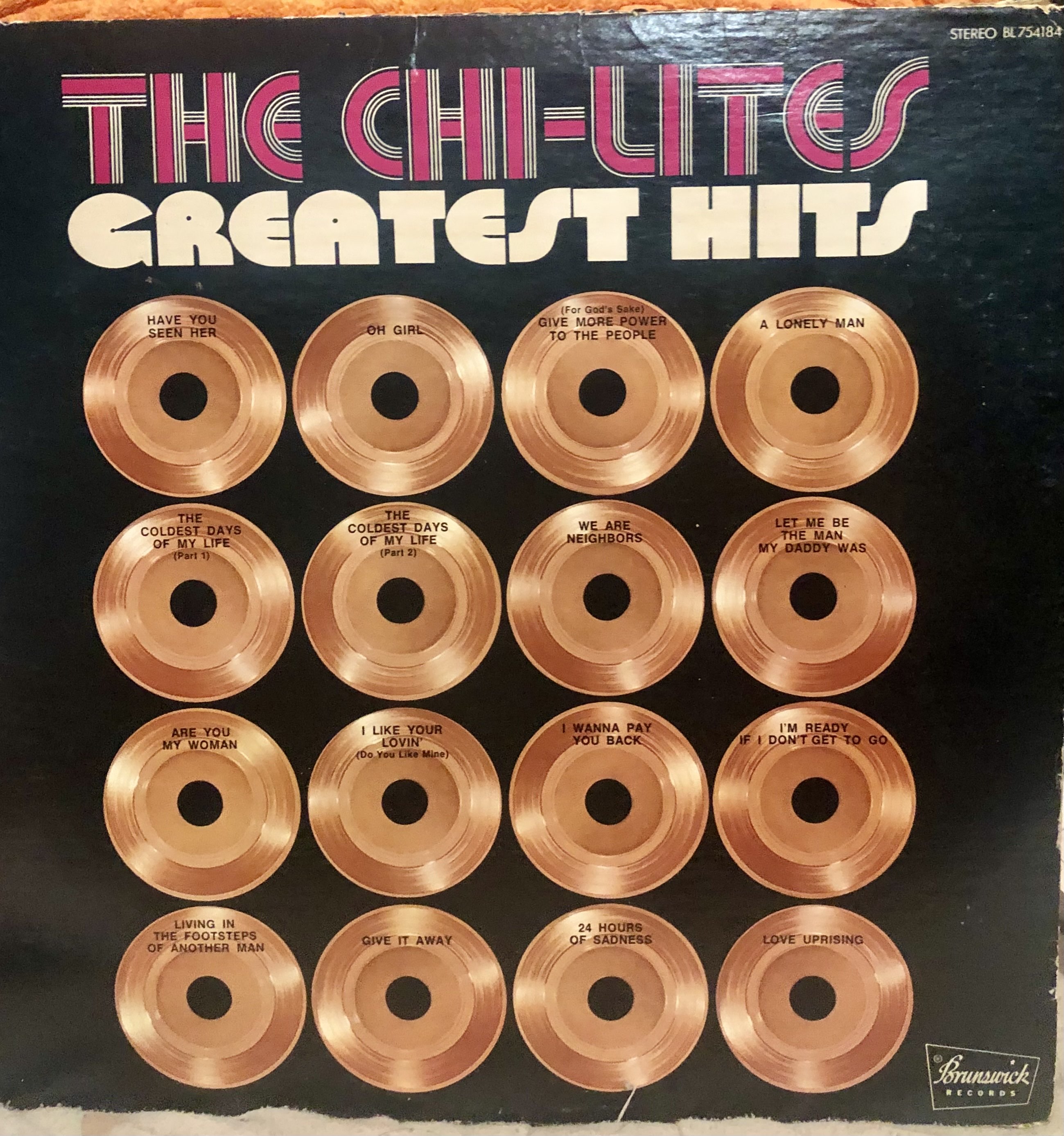
On the back of the record is a series of record discs featuring the band’s other top hits. These hits, including “Have You Seen Her”, “Have You Seen Her”, “A Letter To Myself”,“The Coldest Days of My Life”, “Stoned Out Of My Mind”, and “Oh Girl”. All of these songs are exemplified on the golden records that are shown on the back of the record in a 4×4 grid pattern. This pattern takes up approximately half of the space on the back.

I’ve only heard this record being played. It’s my mother and this record that truly lived it — the record having corners fraying, peeling, and worn by age and constant touching. This record is a, no pun intended, record of something my mother lived for when she was younger. These were her songs. Everything this record is undoubtedly hers and all that she wished to be when she was my age.

This item is primarily a dark-colored, medium-sized record from 1972. But, even with dust coating its surface, the smiles of the members are blinding.

The Necklace I Treasure

By: Charlie S.

About a year and a few months ago, Eric made me a necklace out of some string he had lying around in his room. To me, this was a grand gesture of love and appreciation for our relationship even though we have a decent distance between us most times during the year. This necklace always reminds me of him and the memories we made when we were not so far apart.

Approximately 14 inches measuring from knotted end to knotted end, the necklace falls perfectly in the concave crater created by the merging point of my collar bones. The string, most likely made from cotton, has a rougher texture in relation to other textures of string, but has softened the more I wear it. It used to be bright white, but over the long year in my possession the twine has turned brownish-yellow from my constant insistence to keep it on at all times. There is a large knot on either end of the necklace, its purpose to keep the twine from unwinding. The ends of the knots have developed short, frayed tufts of freed twine that stick straight despite being soft to the touch. The bulk of the necklace, made from three individual pieces of string, is a braid, for the reason being that Eric is unknowledgeable in how to craft any other kind of strand out of twine. Its simplicity is obvious, but the tightness of the braid itself has maintained very nicely from the tediousness of Eric’s fingers, keeping the individual pieces of string taught in the making of the necklace.

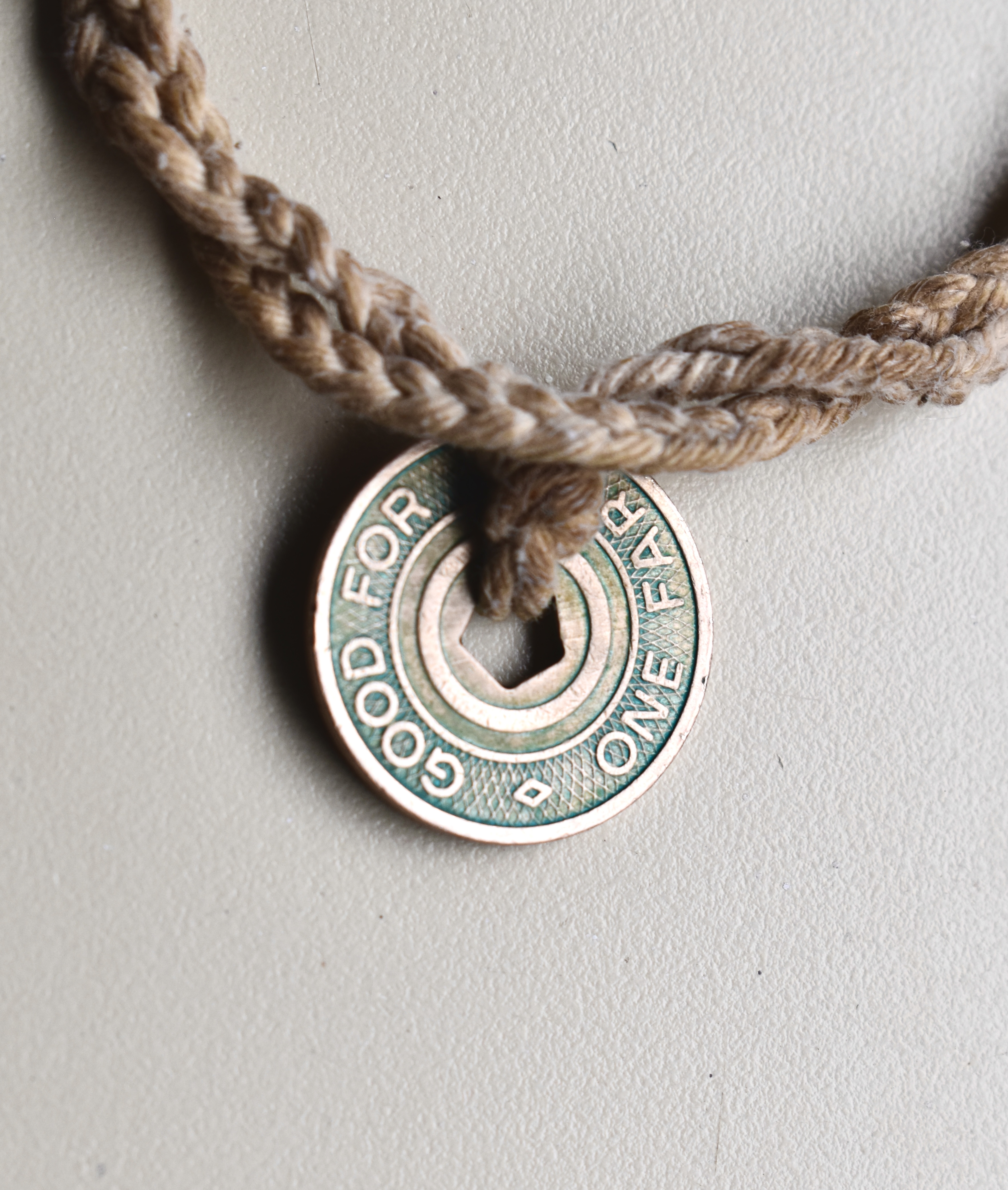
Even though it functions as one piece of adornment, the necklace is made up of two separate parts: a longer, older gift, and a shorter attachment that came with something eye-catching. The longer piece of braided necklace was gifted to me about 2 months before our first parting for the academic year. The shorter segment of the necklace, that Eric carefully crafted a few months later, was created with the purpose of being a “unique” addition to my already existing piece of remembrance. Eric managed to attach a token to the separate, smaller segment of braided twine with some sort of knot I still cannot understand (and Eric is unable to explain). I believe this might have been a thoughtless recall of Eric’s knotting skills from his days as an Eagle Scout. The segment holding the token, somehow, precisely coiled itself around the original twine necklace, perfectly centered, and has cemented itself in that exact position. 

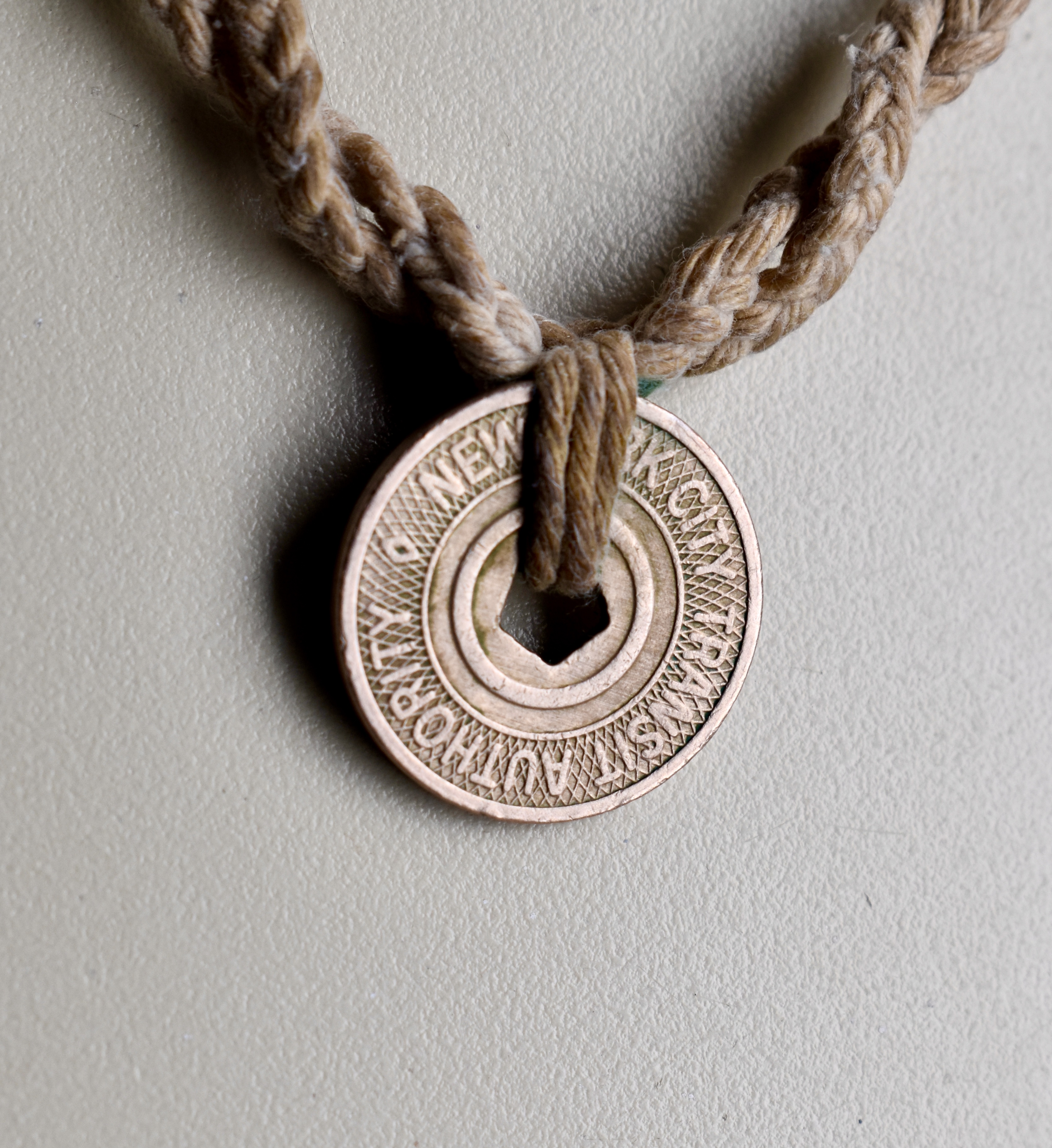
Eric eventually mentioned to me that the thing hanging from my new favorite necklace is a New York City subway token. This token being an object I had never known about until it was uttered into existence. Although the token was unfamiliar to me, I believed it to be interesting enough to wear around my neck for all to see. The token is round with a visible thickness to it, but not so thick that it is too clunky to wear around one’s neck. There is a pentagonal shape cut out from the middle, making it a perfect necklace charm. It appears to be smaller than a quarter, but slightly larger than a nickel. On the front facing side of the token it reads: “New York City Transit Authority.” The beginning of the statement is separated from the end with a small raised diamond, floating, spaced evenly between the first letter “N” and last letter “Y”. Behind the lettering is a diamond grid pattern that makes the words stand out against the monochromatic metal token. The words are surrounded by an outermost ring of smooth, unprinted metal and an inner ring slightly thinner than the outer one. Further within the slightly thinner ring is yet another ring, pressed flat enough to notice a difference in height between that and the previous ring. Repeatedly, there is then one more final ring that is the thickest in width and is raised to the same height as the outermost and inner raised rings. The final portion of the token is the center, where the pentagon shape has been pierced through a more flattened part of the token. On the opposite side, the alternating ring pattern is consistent with that minted on the front. The coloring of the backside is more greenish in contrast to the silvery front, most likely due to its age. The back also has another, differing set of words reading: “Good For One Fare.” This time, there are not one, but two raised floating diamonds: one separating the “G” in “Good” from the “O” in “One” and another separating the “R” in “For” from the “E” in “Fare.”

I have realized through this description I feel more of a connection to this necklace than some of my other pieces of jewelry. Because of the nature of its existence, this necklace never fails to make me smile each time I feel the cool, yet smooth token between my fingers. It reminds me that there is someone out there that cares about me.