White Beehive Tealight Candle

The object I have chosen to discuss is a white beehive tealight candle that I have owned for nearly a year. I bought the candle as a souvenir at the New York Botanical Garden in the Bronx. I thought it would make a pleasant display piece in my room, reminding me of the great time I had that day. 

The candle is a product of Rite Lite Ltd., which has been a leading manufacturer of occasion-based Jewish gifts, decorations, and more since 1949. Many of their white honeycomb beeswax candles are used for Shabbat and Jewish holiday celebrations. They are all allergy-free, petroleum-free, and biodegradable. The New York Botanical Garden Shop is a retailer of their products and includes their pure natural beeswax candles. By checking their website recently, I’ve noticed that they no longer sell this particular candle anymore. 

Frontal View of the Candle
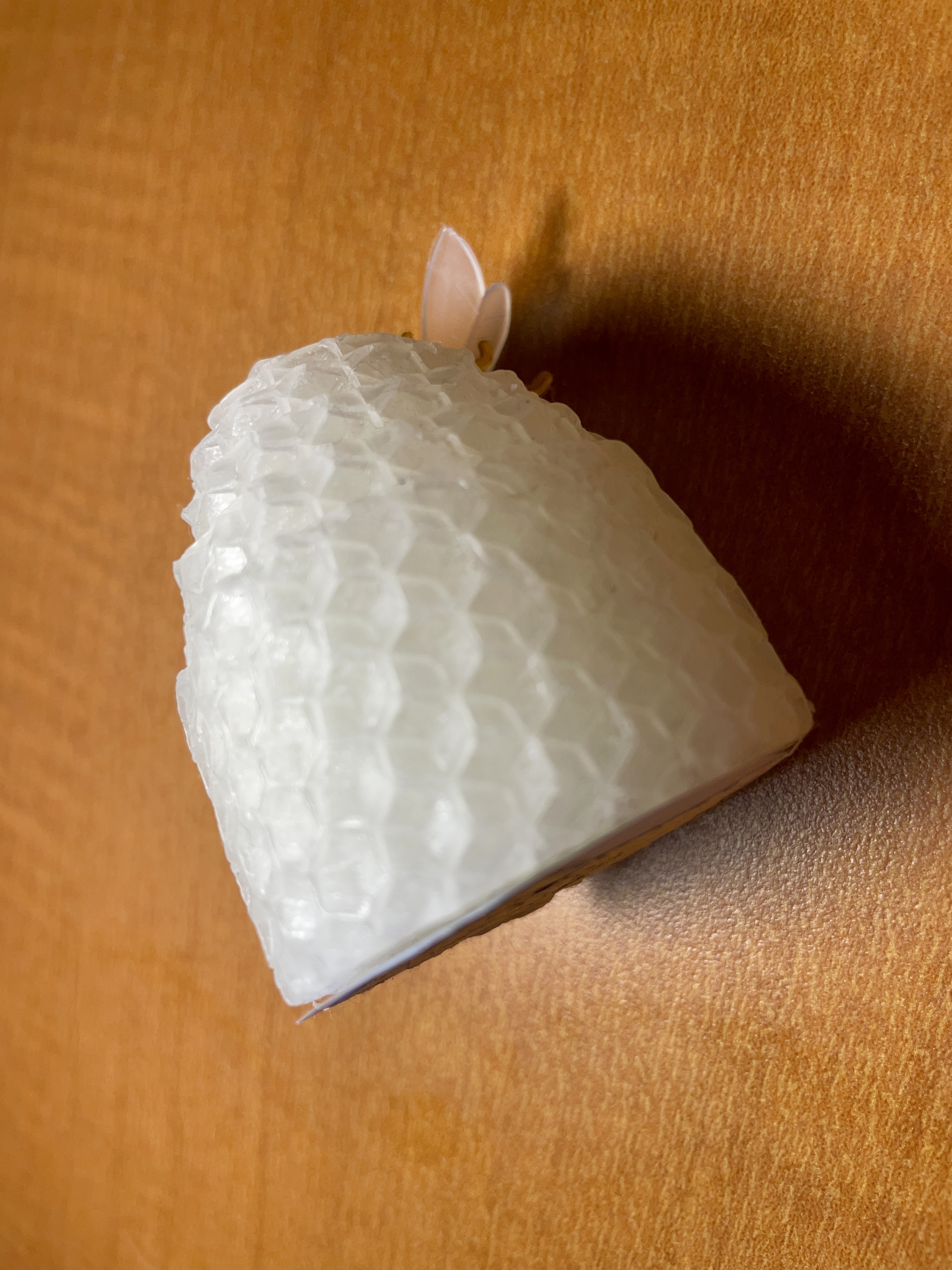
Top View of Candle on Its Side

The candle has a rounded bottom and stands at 2.19 inches in height and 1.75 inches in diameter. It’s constructed in 7 tiers, where each tier gets smaller as it moves up from the base to the top. It is modeled this way so that it can resemble the shape of a beehive. The entire surface is adorned with honeycomb-like patterns that evoke the natural roots of the eco-friendly candle. Three parallelograms are engraved into the wax within each honeycomb, which is the shape of a hexagon. 

 The object also features a miniature, golden figurine of a honey bee lying on its surface. The bee has six legs and five sections indicating its abdomen. It also has two antennas and a set of long wings with two forewings and two hind wings. The bee’s body measures 0.875 inches in size and its wings measure 1.1875 inches. The bee’s body and wings are both made from a translucent, plastic material. The body has a golden hue of yellow, resembling the appearance of natural honey. The wings, however, appear as basic clear plastic. There are small linear markings on the wings of the bee, which were likely made during the production process. The candle itself is molded from a soft wax that is very delicate. If given enough pressure, the wax could be deformed by hand. The back of the candle is slightly dented, likely due to its fragility and being moved around. 

Bottom of the candle
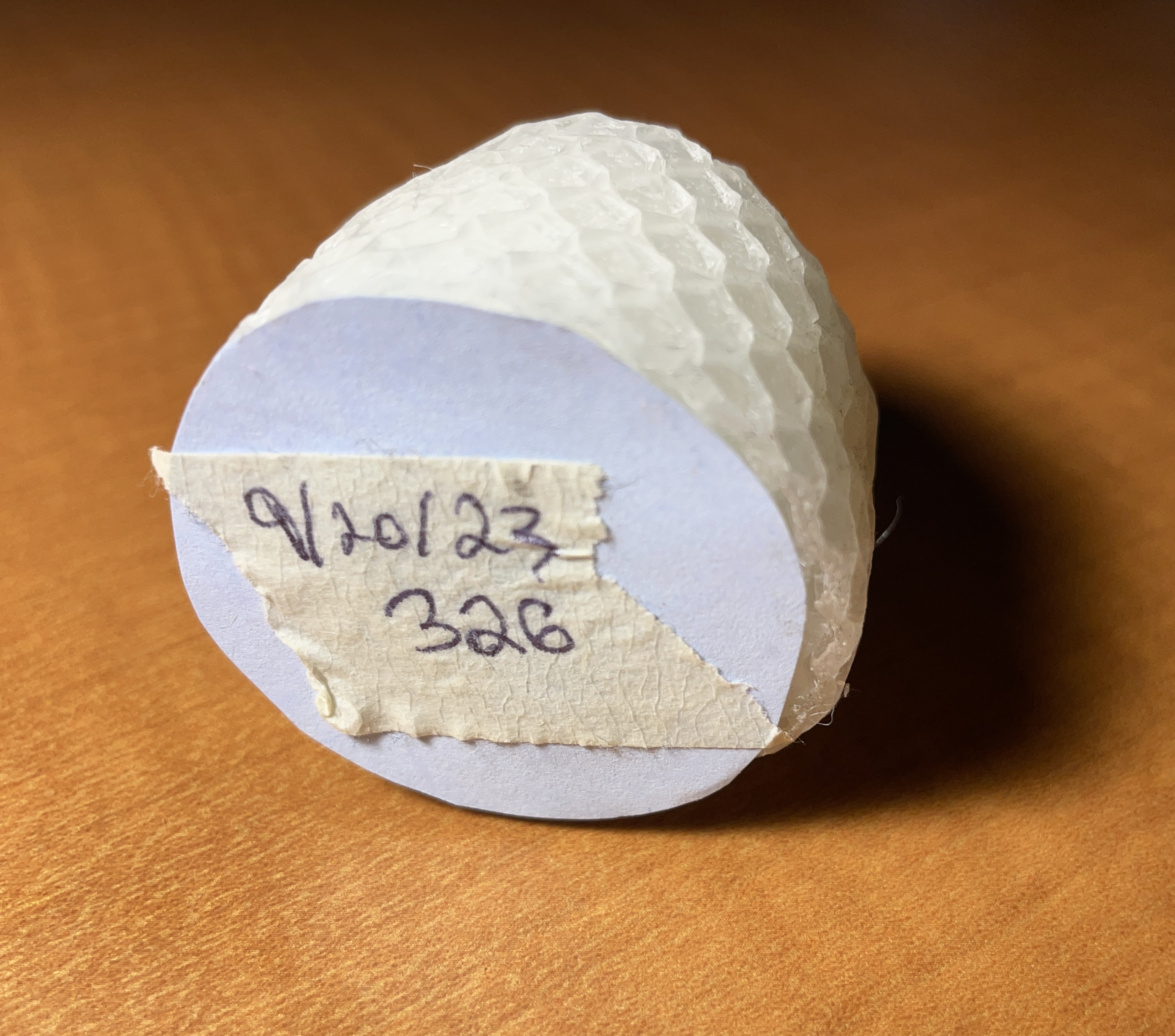
Post-It and Craft Tape Attached to Bottom of the Candle

Beneath the candle is the coiled pattern of the wax as it is wrapped in a beehive shape. This feature is covered by a piece of a light blue Post-It that is cut out in an irregular circle. The circle was made to protect the bottom of the candle so that the natural wax doesn’t leave a residue on my desk. On top of the Post-It, there is a piece of ripped crafters tape with the date “9/20/23” and the number “326” written on it in black pen. 

The wick on all of Rite Lite Ltd.’s natural beeswax candles, according to their  ingredients list, is composed of 100% cotton and are lead-free. The top of my candle, however, has no wick. This unusual detail, including the date and number listed beneath the candle, are tied to the story from when I brought this souveniur back to school with me.

I went to the New York Botanical Garden with my roommate through the honors program at SUNY New Paltz. At the time, this outing was one of our first bonding experiences as roommates. We had only known each other for a couple of weeks, having met during Welcome Week and by living together for a short time. When browsing at the gift shop together, we both fell in love with the candle and agreed that it was essential for me to buy it. 

The beehive candle found a lovely home on my desk near all of my golden butterfly cutouts and faux leaves decorations. My roommate thought that it matched the aesthetic of our room very well. Unfortunately, its place there didn’t last long since it was taken away in the next Dorm Room Check. 

The candle was confiscated since they are a fire safety hazard in the rooms on campus. Although I bought the candle solely for decoration, I didn’t realize that having an unlit, wicked candle was forbidden. 

I had numerous conversations with the Resident Assistants and Directors trying to retrieve my candle. It held sentimental value to me and the day I spent with my roommate. After some time, they gave me the candle back but required me to cut the wick off. 

Even though the resident officials informed me about the potential risks of the candle when handing it back to me, the consequences of owning it still followed me and my roommate for months. Throughout the fall semester, we received several emails about our prohibited item and were even told to attend a private meeting with the Resident Director to discuss the seriousness of our situation. 

Owning the candle caused a lot of issues between us and the resident officials, yet my roommate remained kind and patient throughout it all. Despite not owning the candle herself, she didn’t allow the inconvenience of attending the fire safety lectures to affect her opinion of me. 

I see the candle as a symbolic representation of our friendship and my roommate’s character. Her patience and forgiveness during the situation allowed us to become great friends over time. She never got upset for having to face the repercussions of my own mistake. Instead, she chose to leave this moment in the past, which allowed us to bond over how much we had in common. Now, the candle has taken a deeper meaning than a small souvenir from our trip; it symbolizes our loyalty to one another. We’re always there for each other through moments of laughter, sadness, accomplishment, or distress. The bottom of the candle dates the time my candle was confiscated, which started the never-ending series of conversations with the resident officials. Today, my roommate and I can laugh about the situation and how my innocent mistake created our origin story as compatible roommates. 

Works Cited:

“Bee Parts: Anatomy and Senses of the Bee | Celebrating Nebraska Pollinators | PBS LearningMedia.” PBS LearningMedia, 2022, ny.pbslearningmedia.org/resource/celebrating-pollinators-bee-parts-anatomy-gallery/celebrating-nebraska-pollinators-image-gallery/. Accessed 6 Sept. 2024.

“Hanukkah Candles – Beeswax, Assorted Colors.” NYBG Shop, 2024, nybgshop.org/hanukkah-candles-beeswax-assorted-colors/. Accessed 6 Sept. 2024.

“View :: Rite Lite Ltd.” Ritelite.com, 2024, ritelite.com/Products/ProductView/Category/SHAB/4829. Accessed 6 Sept. 2024.

Vintage 1981 7″ Garfield Plush

Garfield Plush front view

When moving into a college dorm, there are only so many items you can fit into a handful of milk crates. Books, mugs, and posters are staples, but there’s only so much personality you can cram into a 6’ by 4’ living space—intentionality is key. One little buddy that came with me to this small public university was my vintage Garfield plush.

Made in 1981 in Korea, standing at 7 inches tall, weighing no more than a copy of Turtles All The Way Down from the local library, this plush lives on my desk, seated next to the six-year-old dollar store bamboo plant and a coin jar I repurposed from an old ice cream container. I purchased this version of Garfield from eBay for $10 back in April 2022. I find familiarity and comfort in this plush, hence why I will refer to this Garfield as he.

Garfield sitting in his usual spot, between the bamboo plant and coin jar among other objects across my college dorm desk.

The first thing to know about this Garfield is that he is orange. Not a dark orange like a tangerine, or a rich orange like a pumpkin—his orange is lightened by years of wear and tear, leaving him a bright yellow-orange. This is more noticeable when he is sat in areas of dull colors. Just under his eyes, across his face, his cheeks are a light tan color. His ears, head, body, legs, and tail are dusted black to make up his stripes, appearing very light but still noticeable. 

Another thing to know about Garfield is that he’s soft to the touch. His fur very short and coarse but clumped close enough together to resemble the texture of a tufted rug. If you were to squeeze him in any portion of his upper body, it would be the same as squeezing any other plush toy. However, when squeezing Garfield near his legs, lower body, or tail, he is much denser, and he makes a crunching sound from inside. This is the heaviest part of him, as the stuffing there is made of shredded clippings and ground nutshells. It is how Garfield can sit upright. Only his feet and tail are moveable, though they are firm stitched to return back to their original position once let go. Otherwise, he has very few moving parts.

From the corners of the base on either side of his ears, three black strands of thread stick out, making up his whiskers.  He is completely furry, save for his eyes and nose. Those are hard pieces of plastic stitched and glued into the fabric. His circular eyes are painted, glossy and half-lidded, with minor scuffs and chips; they are only slightly separated by a thin line of fur, disconnecting his eyes, a contrast to typical comic depictions of the cartoon cat. Garfield’s nose is a much smaller oval shape and a very light pink. This nose is disconnected from the eyes, but at the very bottom, a thick black thread emerges, diverging two ways from that point and stretching a curl across his face, making up Garfield’s smile. That very same type of thread makes up his whiskers (mentioned previously) and marks the indents between his toes.

Garfield Plush side view

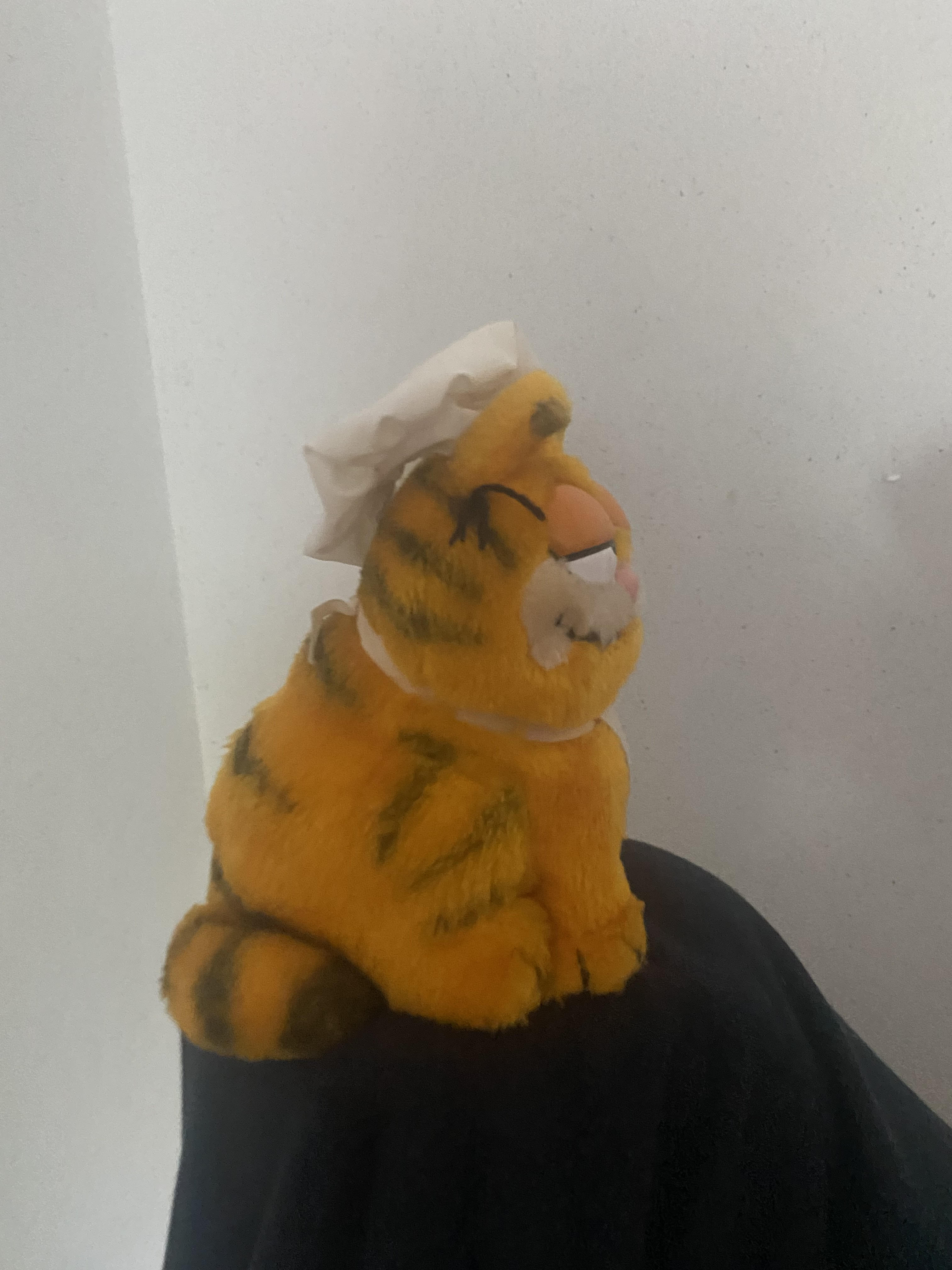
Now this all sounds like the making of America’s famous cartoon cat, but what makes this particular plush different is that he is a chef. Garfield wears a small white bib, a piece of felt sewn onto a white ribbon tied around his neck in a double knot. Though it has the capacity to become undone, the bib remains. In magenta text, center-aligned and in all-caps, the bib reads, “I LOVE LASAGNA!” He also had a hat, a small, white, thin piece of fabric stitched to make a chef’s toque. The hat has no stuffing, stitched into the back of Garfield’s head and right ear. Though the original plush had more stitches, they have since broken, and the hat is only held by two white threads, one in his ear, the other just halfway down his head. 

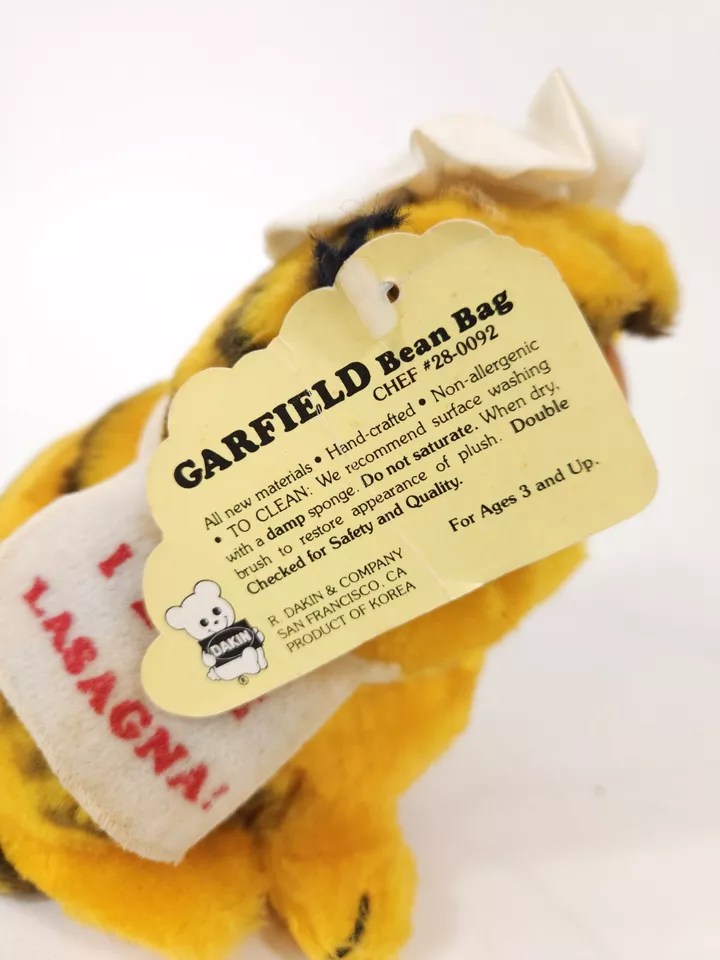
Being a vintage plushie, this particular Garfield is also made of what he is not. Newer/minted versions of this plush still retain the original tag, a red paper tag held by a thin piece of plastic hooked into his ear. The tag featured the comic version of Garfield, with a thought bubble reading, “Take me home…feed me.” On the back, instructions and other information on caring for the plush is listed. This tag did not come with my Garfield, but it is one I knew he once had. (Seen below is an eBay listing for this Garfield that has the original tags).

This vintage Garfield plushie is one of tens that circulate the eBay market, but I was drawn to him for his size and charm. He was the perfect pal to have throughout high school, and now to bring to college. He brings me back to a time when I was 11, voraciously consuming every comic I could all the way back from 1978; he reminds me of my special interest from so long ago, coming back in a new way, in a new body, in a new little chef’s hat.

Cat on a Cozy Chair Tiny Teapot by Rose Ruocco

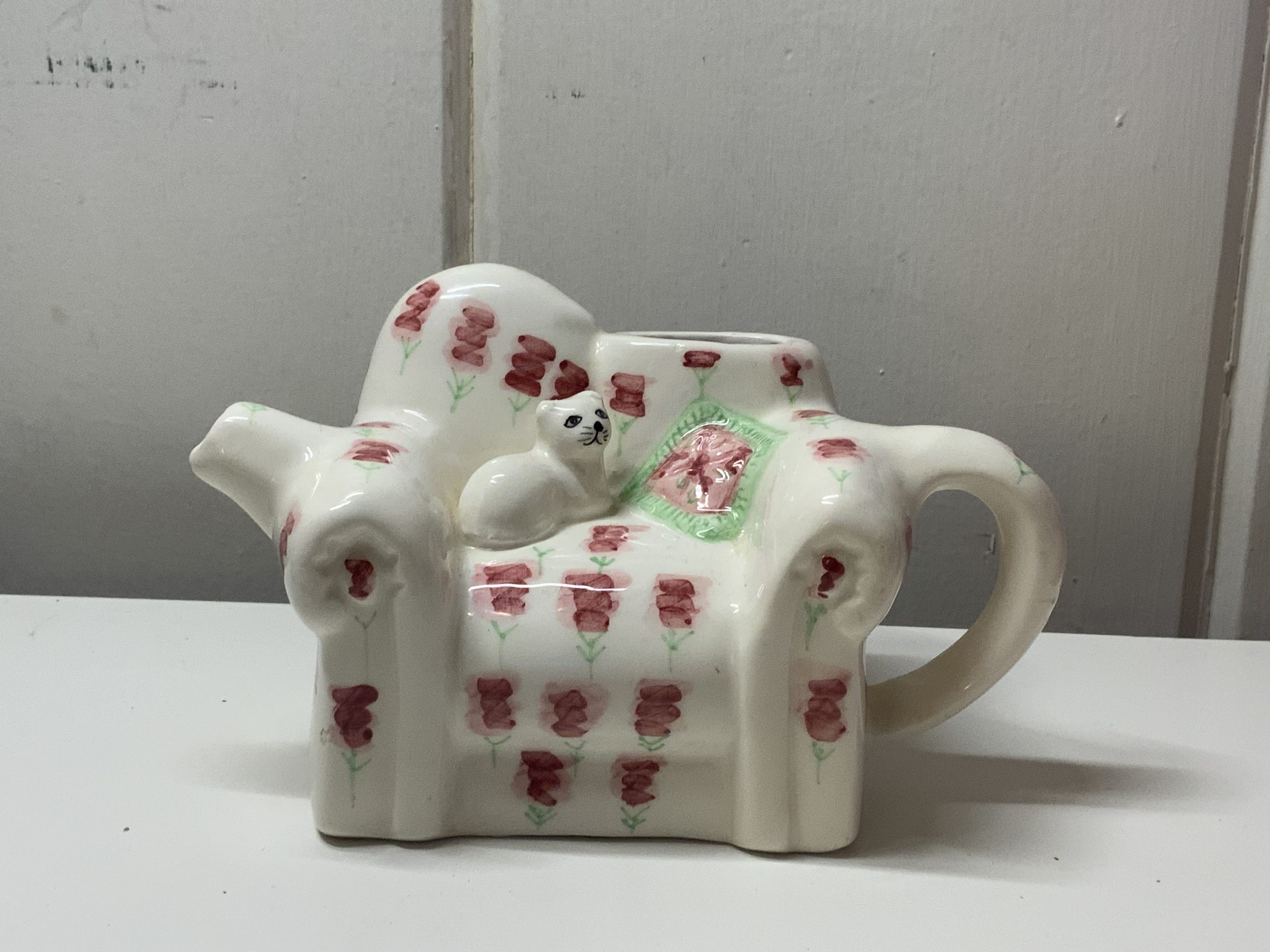
This ceramic teapot sits at only 3 inches tall and 5 inches wide including its handle, with a volume of roughly 22 cubic inches. It’s extremely light and delicate to handle, with a smooth, glossy surface all around.

from the front

The pot is shaped as a chair, with curling armrests and a creased back. The chair is white with a floral pattern, with repeating pink petals and green stems that continue onto the spout and the handle. On the right side of the chair lies a one inch pillow, pinched in the center, with a green trim and pink interior design. To the left, a round one inch cat loafs, completely white except for its painted face- two eyes, a dot of a nose, a small curling mouth, and six whiskers, three on each side. All of this comes together to depict the scene of this white cat sitting nicely on a cozy chair.

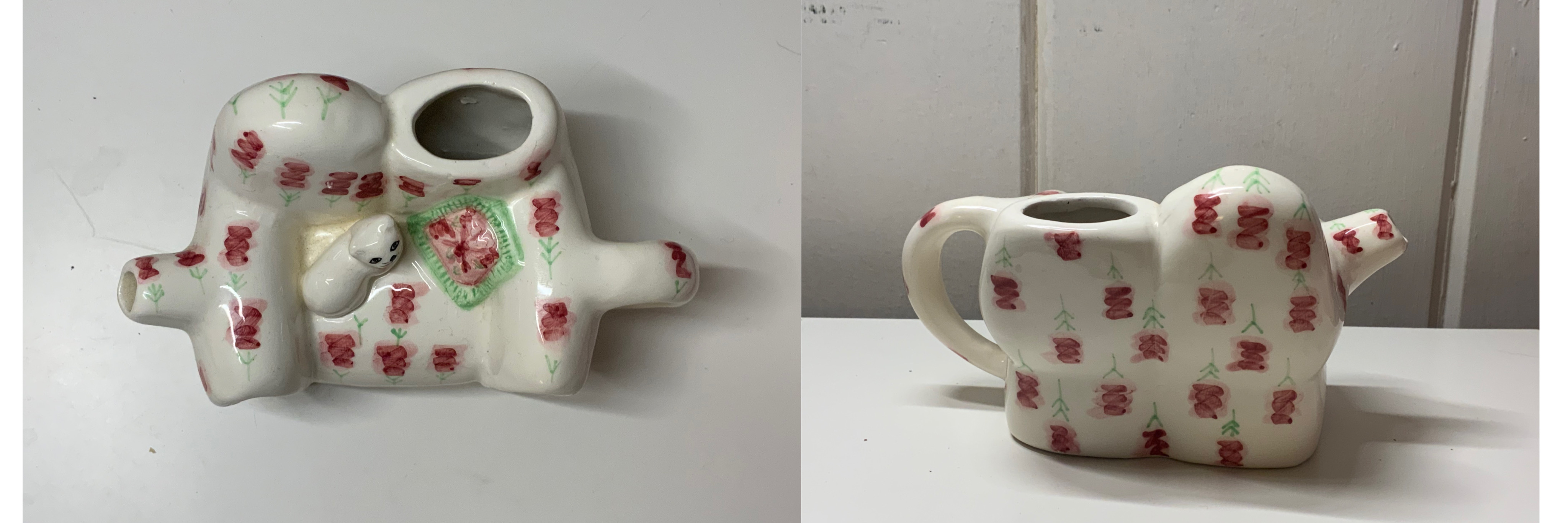
from the top and from the back

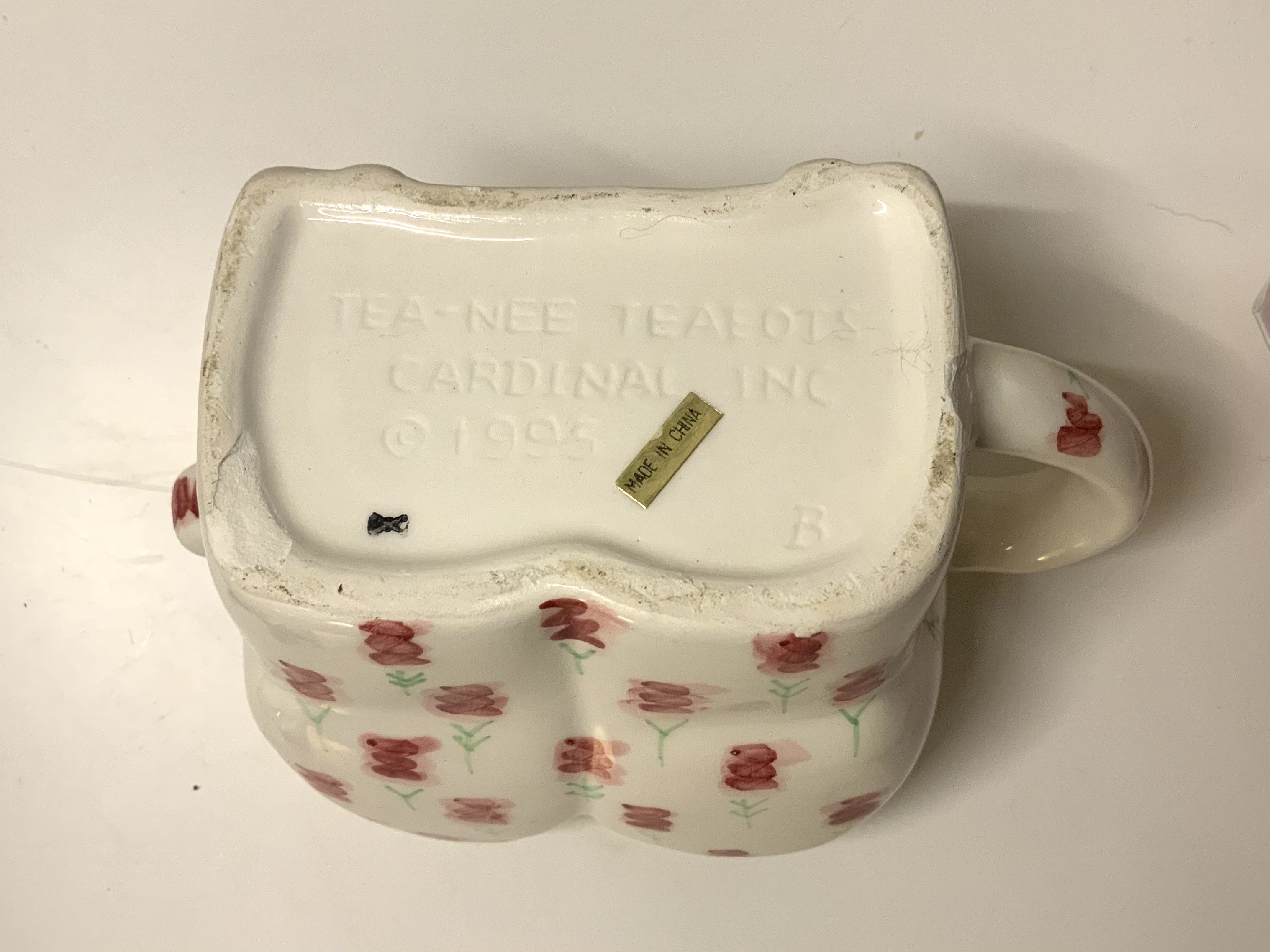
On the bottom of the object, a small gold “made in China” sticker sticks, and engraved in the ceramic are the words “TEA-NEE TEAPOTS CARDINAL INC. c 1995” and a “B” that resembles a type of signature in the bottom right corner. There is also a dark spot in the left bottom corner.

from the bottom

This tiny teapot was found by me in the abandoned downstairs kitchen of my grandfather’s two family home. He was helping me find any old pots and pans I could take from him for my new apartment, and while tracing my eyes over the scattered toys and papers left on the kitchen table, I spotted the white cat’s tiny face. I showed it to my grandfather, who replied “Oh yeah, look at that” as if it was the first time he’d seen it. I asked if I could take it, and he happily gave permission.

A clue to who may have used this teapot lies in the engravings at the bottom. Though I previously suspected it was solely my grandmother’s, the date 1995 suggests that perhaps my mother was the owner, though she only seemed to half remember the object when I showed it to her. Regardless, there is no true way of knowing and there are endless possibilities of who may have purchased it or who it was from, like one of my grandmother’s friends or close family members.

Now with it in my possession, it sits neatly on the corner of my desk, amongst various other knickknacks and figurines. When peering inside the vessel, its age and its history of use can be predicted by yellow discoloration, and the years of non use is shown by the dust and small debris lining the bottom. Despite my cleaning it, I don’t believe it’d be very safe to drink from after spending a large bit of time sitting in the musty downstairs of my grandfather’s house. Because of this, it seems its days of being used as a teapot have ended with me, or perhaps until it belongs to someone else.

Rose Ruocco

Mother’s Yearbook

I didn’t realize that my dad’s old yearbook collection would come to great use of mine when starting this class. Digging up my mom’s old yearbook from her graduating year of 1987 was mesmerizing to me. I never bought any of my yearbooks from high school, which I painfully regret now looking back at this fond memory. I was able to sit down with my mom and reminisce in what it was like for her in high school. Knowing that my family history started in Kingston and most of us still live there today is extremely intriguing. Having everyone gone to Kingston High School, it’s crazy to look back at what’s changed and seeing what’s been there for generations. My high school memories are years I am very fond of but being able to relive them through my mom was truly special to me.

When taking a closer look at the book itself, it’s about 12 inches in length to 9 1/2 inches in width and 1 inch in depth. It has a cream colored base with a maroon engraving of “Maroon 1987” and a distinguished maroon bordered rectangle on the front cover. As the book is 37 years old it has a worn look to it. It has developed a yellowish tint, specifically inside the maroon rectangle on the front and yellow-brownish spots along the middle and edges of the book. There are a very minor cracks and dents which is impressive for how old the book is. It was safely kept on a bookshelf in my dad’s house for 37 years. I’m impressed by the upkeep of the book, especially the pages in which the book is 320 pages long. They are thick felt pages that have a squeak when grabbing or turning the page. They are very glossy in which they reflect brightly when under strong light.

It’s crucial to remember that the yearbooks in this time were in black and white. In pages 1 through 15 of the yearbook, they give us some vibrant colors that are very expressive to the pictures that were used. Most are candid photos of students involved with the school whether that’s inside or outside the campus. The school portraits are everything that I’d envision an 80’s yearbook to be. Everyone in their senior portraits look like ghosts and had the most insane 80’s hairdo. My mom wasn’t fond of how her hair looked in the 80’s so she’s definitely embarrassed by this photo. My mom’s name is Robyn Finch and had short brown hair with curls that were given to everyone in my family but myself. She was wearing her black v-neck gown with a white strand of pearls around her neck for her senior portrait. Her head tilted slightly to the right as she looks past the camera with her piercing green eyes that were given to me.

One of the very first pages of the book is a picture of the Broadway side entrance of Kingston High School. The image was taken at night so the medium sized black lampposts with four sphere shaped lights in a diamond is shining the light upon the entrance. With a castle like figure, two vertically striped tan columns are withholding the triangular shaped roof with black embroidered letters that spell out “Kingston High School”. The doors that are at the end of two brick staircases is a rectangular shape with a semicircle on top grand entrance. The semicircle is divided into three sections with glass panels in between, just above the matte black doors that have eight square glass panels as well above the golden handles. Layers of brick are aligning the door and underneath both columns next to the black lampposts.

In discovering all the in and outs of my high school, it’s so fascinating to me that every person in my immediate family has history here. Being able to rediscover the activities including the sports teams and the music program is something that I’ll always carry with me. Not that I’m so certain I’ll be living in Kingston for the rest of my life, I know that I’ll always have a place to call home.

Heater and Cool Fan

ShirEl Wolfstein

Front View of the fan, Black electrical cord wrapped around the base.

Aerial view with front facing down, Control panel.

Back view

I decided to examine a fan my mother gave me on the first day of college with settings for both hot and cold. I see her specifically looking for a fan that is able to emit both temperatures such a subtle and thoughtful gesture, as I had told her that college dorms tend to be sweltering year round yet she still wanted to make sure I was warm and had options. Sitting in front of my little heating fan reminds me of her space heater when I was little and had barely any heat in her room, tucking our toes in fluffy socks in front of the heater while she did our nails and told us stories. What a subtle way to bring me comfort, but so effective. 

The fan is a matte gray plastic, the surface texture smooth, the shade of gray light with a warm undertone. The sides are rounded to match the motion of the blades but the top plateaus for a surface on which they dials lay. Around the two knobs is a black matte plastic piece with symbols in light gray describing the settings. One knob controls whether the fan is off, blowing cool, heat, and extra heated air, and the other is designated to determine the intensity of the blades and therefore air blowing. Between them is a small circular light. It is red and allows the user to be cautious should the fan be hot. 

Along the right side of the fan, given that the fan is facing forward, are small indented stripes like ribbing seated horizontally.  The left side is completely smooth, save for the indentations made for screws littered around the perimeter of the main fan. 

There is a small crack bisecting the two halves of plastic that make up the front and back half of the main plastic casing. The front piece of plastic that serves as a grate before the fan blades has a unique pattern, with lined arcs curving towards the left as they stand almost vertically. There are other pieces that mimic parabolas with their open side at the left, and one solid line extending horizontally like an equator to the grate. Directly at the center of it all sits a circular logo of the seller.

The back grate vastly differs from its counterpart. The plastic is arranged in evenly spaced and weighted rings, with arcs extended counterclockwise towards the outermost border and originating from the solid plastic circle sitting in the center of the grate. This circle remains blank aside from screw holes lined up vertically. 

The fan has a small flared base to ensure the device can stand alone and keep the fan secure. The black wire of the fan is most of the time wrapped up on the thinnest part of the base, keeping the fan as small as possible, taking up as little space as I can in my already very cramped form rooms.

Grandmother Stover’s Trimmin’ Trinkets Cupcake Topper

The object I chose is a clown shaped cupcake topper manufactured by Grandmother Stover’s, a midcentury dollhouse miniatures company. It would have been sold in a multipack, packaged in clear plastic bags and stapled shut with cardboard. The object is white plastic with printed red, green, and black details. It is about 3 ½ inches tall. A round head sits on top of a thin stem that ends in a sharp point. There is a small crack where the head meets the stem. The print job is uneven and distorted, relaying the mass-produced nature of the object. The clown dons a triangular, striped, red cap with a green tip. Its expression is one of mischief. Curved black eyes, topped with raised eyebrows, glance to the side. Red circles define the cheeks. The typical round clown nose is the only three-dimensional component of the face, and has a red circle printed on it. Four curved lines make up a smiling mouth. 

Trimmin’ Trinkets clown cupcake toppers in their original packaging.

From 1943 to 1983, Grandmother Stover’s was one of the most prominent suppliers of dollhouse furniture and miniatures in the United States. The company, based in Columbus, Ohio, was founded by John Stover in an effort to provide dollhouse accessories for his children in a time when European imports in this market were limited. John, a successful businessman who owned an advertising business, was living in Upper Arlington with his wife Elizabeth and their three daughters when he came up with the idea to start a dollhouse company. In 1941, John purchased a dollhouse and a complete set of furnishings as a gift for his daughters. He would discover that most of the miniatures were handcrafted by German artisans working out of their homes. This inspired him to create the same sort of operation in central Ohio.  

A lot of Grandmother Stover’s miniatures listed on Etsy.

John named his fledgling company after his mother, Mrs. Anna Stover. She was an essential part of the operation and would help make the very first sample products. By 1970, Grandmother Stover’s, Inc. employed 15 full-time and 25 part-time employees. The Lancaster Eagle-Gazette published an article in December 1944 titled “New Idea in Christmas Toys Named for Lancaster Woman,” which stated, “this year the toys are being shipped to large stores from NYC to Los Angeles. The demand for them is much greater than the supply.” Grandmother Stover’s was turning out miniature kitchen supplies, newspapers, decks of cards, platters of food, gilded mirrors, bedspreads, bars of soap, and any other household item, appliance, or furnishing one could possibly imagine. The company also sold party favors, cake toppers, and other small miscellaneous toys as part of their Trimmin’ Trinkets line.  

Today, Grandmother Stover’s miniatures are renowned in hobbyist and collector circles. While the company no longer manufactures miniatures, their name brand adhesive glue can be purchased from online hobby and craft stores. John’s personal collection of his favorite one-of-a-kind miniatures was donated by his family to the Georgian Museum in Lancaster in 2006.  

The Old Curiosity Shop, a shadowbox arranged with Johns’s favorite miniatures. 

Works Cited 

Harvey, Joyce. “Remember When: Jack Stover Picked ‘The Purple Pepper.’” Lancaster Eagle-Gazette, Lancaster Eagle-Gazette, 25 Jan. 2021, http://www.lancastereaglegazette.com/story/news/2021/01/25/remember-when-jack-stover-picked-the-purple-pepper/6659362002/. 

Under Armour Bookbag

Under Armour Bookbag (1)

When I was 12-13, I remember shopping in the Under Armour store at the Woodbury Commons and seeing this really cool bookbag. When I went to get a closer look, I was disappointed by how expensive it was. When I got my first job in high school, the first big thing I bought was this bookbag. At the time (2021) it cost me ~$120, but the satisfaction I had when I wore it to school for the first time was an experience I won’t forget for a long time. 

The bookbag is made of polyester, weighs about 2.5 pounds, and is roughly 7.5 inches wide, 11 inches long, and 19 inches tall (1). The flap that covers the bookbag is about 8 inches at the widest point, roughly 8 inches long, and is a little thicker than 3 index cards (if you were to stack them). On the flap, there is a small patch that reads “Project Rock” and “Under Armour” with their respective logos. This is because this bookbag was released as part of the joint Dwayne Johnson-Under Armour collection. The patch is 2.5 inches wide and 1.25 inches long. 

Patch of Logos (1)

The metal straps seen all over the bookbag are roughly 1.5 inches long, 1 inch wide, and 0.25 inches thick and they are made of stainless steel. The two mini black pockets on the left side of the bookbag (first picture) are approximately 4 inches wide, 1.25 inches thick, and 6 inches tall. The water bottle pocket (right side middle picture) is approximately 1 inch thick (can expand to ~3 inches), 4 inches wide, and 11 inches tall. The pocket on the front of the bookbag is 6.25 inches wide, 7 inches tall, and 1 inch thick. From horn to horn, the bull patch is 3 inches wide and from horn to snout it is 2.5 inches tall. In addition, the bookbag has two pockets that measure the size of the whole bookbag. The pocket in the back opens up completely to the base of the bookbag and has two big cushioned pockets to carry a laptop and has a pocket the width of the bookbag that can carry the laptop charger, mouse, etc. 

I picked out the model with the bull patch because my mom really likes bulls and it reminds me of her. For example, I can count at least 4 mini brass bulls in my living room that my mom has as decoration. My mom says it reminds her of her dad (my grandpa) and her childhood since he was a cattle rancher in Ecuador. As for the significance of my mother in my life, she is the one person that has always been in my corner in life. The bull also looks really cool on its own so that was also a factor in the decision. I like this specific model of bookbag because it is simplistic, yet big and rugged. As for the color scheme, I like the serious and neutral tone. 

Apart from visuals, this bookbag does a very good job serving its purpose. It is tight knit and thick, which means that my stuff inside has never gotten wet in the rain and my electronics have never suffered from extreme heat/cold while inside. After all these years of abuse (18 credit semesters are heavy), the only damage it’s received is a little tear on the bottom.

The bookbag on its own is cool, but I added 2 keychains that not only serve as cool decorations, but as memories and reminders. The first keychain is a mini leather boot that I got in Ecuador last year. I have a few that I collected over the years, but I chose to exhibit this boot because it looks the most elegant from a distance and it has an engraved (done using a hot pen) picture of a man riding a horse. Similar to the bull, it reminds me of Ecuador and my mom. The other keychain is a (stainless steel?) cross. I also bought this keychain last year in Ecuador, and the reason I added it to my bookbag is because it reminds me to seek strength and motivation in my faith. The boot is attached to the front of the bookbag because it fits the theme of the bull and it can be displayed better there. The cross is attached to the back pocket (where the laptop gets stored) so that it is close to me. The boot is tan, has a pocket inside, and is 4 inches tall, 2.5 inches long, and 0.5 inches thick. The cross is 2.5 inches tall, 1.5 inches long, and about as thick as a quarter. 

Works Cited

  1. “Amazon.Com | under Armour Regiment Backpack | Casual Daypacks.” Amazon, http://www.amazon.com/Under-Armour-Regiment-Backpack/dp/B07RGS66BR. Accessed 30 Aug. 2024.