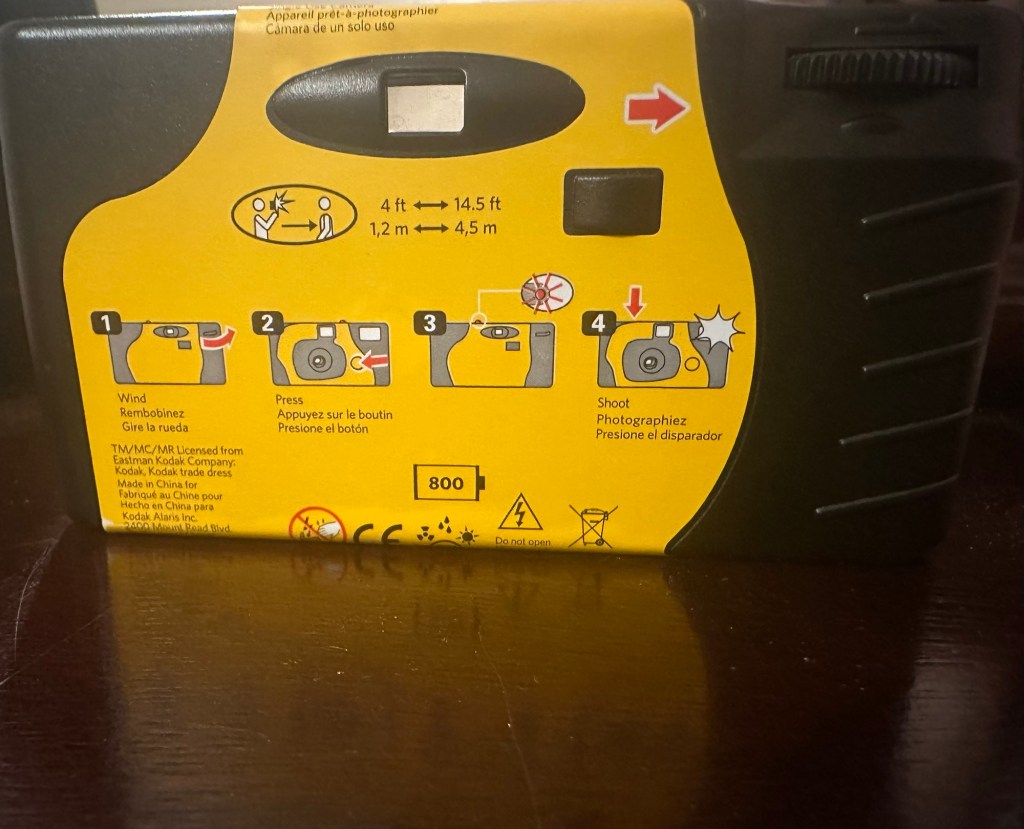
For my analog experience, I chose to work with a disposable film camera. Prior to this week, I had never used a disposable camera.
I have some photography experience from a class in high school and my interest in photography but I only worked with digital cameras. The two digital cameras that I am familiar with are the iphone camera and the Nikon D3100. I believe the camera on the iPhone 14 Pro is great. The iPhone camera allows the photographer to zoom in up to 15x. Additionally, the iPhone camera takes clear crisp pictures with minimal effort done by the photographer. I have my iphone camera settings with the grid and level on. This allows me to make sure that I am positioned correctly to create a photo that does not solely have the object in the center of the photo but rather in one-third of the image and the level ensures that the photo is straight. The Nikon D3100 camera also has the ability for the grid lines to be displayed on the screen. With both digital cameras, the photo shot can be seen and edited within seconds after being taken. It is important to note that digital cameras essentially allow for infinite photos to be captured while the iPhone may say that more storage is needed and the Nikon camera may require a new memory card, the camera itself still has the ability to take photos.
Disposable Kodak
I purchased the disposable camera from Walgreens. The film camera is a Kodak power flash disposable 800. This camera is a single use with the ability to only capture 27 images. On the body of the camera, it is labeled with directions on how to use it. The first time I went to take a picture I followed all the directions but when pressing the shot button I did not hear it go off. However, the only way to confirm that no picture was actually taken is to see the amount of pictures remaining. The amount still stated 27 so I did not do something correctly. For a moment I thought that I had bought a damaged camera. However, I figured out that I was not winding the camera all the way which hindered its ability to capture the shot. While using the disposable camera I found myself not worrying about how the photo came out as I could not view it right away, I just did my best to obtain my desired shot by how I saw the shot through the viewfinder. With each photo I took this week using the disposable camera, I tried to make sure that each picture was different because I valued that I am limited to a certain amount of photographs.
This experience made me realize the beauty of the unknown. My analog experience allowed me to not obsess over the way that the shot came out, rather I just took the shot and will see how the pictures came out after the film is developed. The process of having to wait to receive the photos is a process that is not experienced with digital cameras. I learned that I enjoy the more authentic photo that is created using the disposable film camera. In a sense that, for most of my shots using the disposable camera I had to physically move closer to the object because I did not have a lens that could zoom like digital cameras can. As I compare my analog experience with that of my digital world, I do not think one is better than the other, but the analog version brings me to keeping the photograph simple.
My analog experience began a couple weeks ago, when I decided to try to do my graphic design homework– based in digital Adobe programs– all on paper. So far, every sketch or thought has been typed on a notes app, written in a sketchbook app on my iPad, or recorded in a document online. Graphic design needed to go back to its creative basics, so I started cracking open my ninth-grade notebook.
The first thing I noted was the flexibility I had to produce meaningful work in different environments and through different mediums besides solely screens. I have actually been feeling extremely limited when completing my assignments since I need to complete them in the graphic design building on campus. Their computer labs are built to have all of these programs on their computers, and the monitors are the size I am used to working on in class, which is to say, giant. My laptop refuses to be an option as well, and other computers provided by the library or in other buildings simply don’t cut it.
When working in my notebook, I sketched everything with a pencil, took notes and ideas down on the same sheets, and physically mapped out every version of my project I had considered. Honestly, it felt odd, doing something by hand that everyone else could do with three clicks of a button, but it did get me in touch with every stroke of my pencil on paper and made me connect with the purpose of every line.
I felt in control as well, having grown up loving physical papers in front of me, I handwrote all of my notes as opposed to using our shitty, plastic Chromebooks the school provided. Lord knows I could move my hand faster than those things could load anyway. I am used to the feeling of creating with a pencil in my hand, the sensitivity and dexterity. This is why I prefer to use my iPad in many cases, but I had never even really considered how much of my assignments could be done actually on paper and not just an impression of it. Of course, some things need to be transferred to the computer and completed digitally, but it was far later in the process of my project than one would expect.
The familiarity was such a comforting feeling, allowing me to really focus on my product instead of the stress of figuring out the program I was using or who I was disturbing by being in the studios so late. My analog experience is at least shaping the way I plan to carry out the last of this semester, on paper in a notebook falling apart by the second.
Reflection of the class period itself-
At our analog cafe today, I brought in my record and sat down to color. I could choose between three coloring pages themed for Thanksgiving, one being Snoopy in a Pilgrim’s outfit holding out a pie, a page with calligraphy bubble letters spelling out “Happy Thanksgiving” with pumpkins all around it, and a page that featured a cornucopia in the center and blocky bubble letters that also spelled out “Happy Thanksgiving”. I chose to color in the festive Snoopy like a lot of my classmates.
I selected an array of pinks and reds out of the big case of alcohol markers provided by Rose, and set to coloring in my snoopy. I then colored in his clothing and hat in purple, and made his pie green. While doing so, our whole area of the table was immersed in collective conversation, springing back and forth around the room. Our class was lively and as topics flowed and changed, we weren’t cut off with intent to reach a certain goal. Many people laughed, and we were all able to compare our differently rendered Snoopies in the end.
As for the experiment, the data I observed is broken down according to the steps included in “Object Studies”.
Firstly, for the overview of the experiment, I recorded my expectations of how today would go, as well as what I wanted to look out for while the analog cafe was taking place. Due to our debate in class, I was focused on the attention spans of students and what they would be creating throughout our time in our analog cafe. Much of our discussion centered around the authenticity of art and the use of AI with modern technology, as well as the globalization of ideas and lack of inspiration.
Next, over the course of the class period, I noticed that most students had picked one craft that interested them upon arriving and stuck with it for the time we had. There were multiple creative tools available, such as air dry clay, crochet, coloring pages with colored pencils or markers at hand, a type writer, etc. Each person had enough patience to really put effort into what they were creating and never got frustrated or quit what they were doing, nor left it there without a word. Students were also able to have conversations and socialize while doing their task, opposed to how all encompassing screens tend to be, to the point where people cannot converse while doing something on their phones.
Additionally, although there were only three different coloring pages, everyone chose to complete their differently, with different colors or mediums, and each person’s final result was much different from anyone else.
As for my personal reflections, during the class time, I felt much more light and having a positive experience in class. Despite feeling very tired before and after the time slot, I was able to forget about how tired I was since my mind was actually being used. I just felt very present and as if I was able to really take in all of the information given to me in conversation with peers and other stimuli. I also tuned in and out to the background music playing because it was more up to selective hearing, instead of being bombarded with every source of art in equal measure.
To add on, I personally did not find the task of staying off my phone to be difficult. I even had the device in my pocket where I could feel any potential vibrations from receiving notifications, which many people find to be even more distracting and tempting. Yet, I was not tempted to check my phone throughout our time, since I felt fulfilled from my experience and therefore didn’t need to rely on anything else to occupy my hands or mind.
After experiencing our analog cafe, I think that more institutions should try the same thing in the future. However, there are steps to be taken first to ensure that the experience is as successful as ours. It is important to instate discussion-based assignments first– our class relies heavily on talking to our peers, which allows for friendly relationships to develop first, making the analog cafe experience better. Without doing so, our classroom would have surely been engulfed in silence, leaving many students to feel isolated and feel the need to compensate by “socializing” on their devices. Only after this should more schools use class times to complete digital free sessions– specifically with a selection including hands-on activities. These two things are things I feel are the most crucial for the success of the experiment, as students are actively engaged physically and mentally, comfortable around their peers, and not made to pay attention to a lecture that is horrendously understimulating compared to our everyday lives.
For my analog experience, I kept a daily journal. I was excited about this assignment because I keep a journal for pleasure. However, I like to include photos and drawings in my journal. With a focus on aesthetics, I can admittedly lose focus on the purpose of an analog experience and shift my focus to perfectionism. For this assignment, I simply kept a journal of my day. I was interested to see how this experience differs from my usual journaling. What is different about this experience? What is the importance of the analog world, and why has it become a lost art?
During my experiment, I journaled at different times of the day. Sometimes to start my day, alongside my daily bowl of cereal, jotting down my schedule for the day. These entries usually consisted of my plans for the day, with a to-do list highlighted and checked off by the end of the day. Occasionally, I would have a mid-day journaling session, in between classes or even at work. My favorite of these entries are those at work, with the complaints of students questioning why the mailroom hasn’t processed their package yet, but I don’t know either. Most of the journal entries were at night with a reflection on my day. From this experiment, I’ve found that my favorite time to journal is at night.
I sit at my desk, the dorm room dark aside from the lamp on my desk lighting up the blank pages of my journal. I let my thoughts flow while my hand freely illustrates the story of my day on the page. These are the entries with the most substance, each one shows a pattern. Different from the other entries, these go beyond the minuscule details of my day. These entries give more insight into who I am and how I feel. What made me happy that day, what is stressing me out, or what I’m looking forward to.
From this experience, I learned that while I still appreciate the craft behind the work in my other journal, I preferred the simplicity in this one. It’s therapeutic to remove yourself from the worries of your life and submerse yourself into your writing. Nowadays, the analog world is a lost art, no one keeps anything physical. While I understand the convenience of ranting about your day in your notes app from bed, writing in a journal is a different experience. An experience where you can learn more about who you are. When you do your favorite hobbies in analog, you gain a new love for them. Digital coloring is something I love to do, but there’s nothing like physical coloring. The art of ink from the marker filling in a blank canvas is something that you can’t replicate digitally. Doing things in analog is a deep and enriching experience, something that can be experienced more often if we unplug from the digital world. It is important to learn about who you are outside of the digital world. You have a newfound appreciation of the material world when you do things in analog.
About a three months ago, I walked into my room after coming home from work to see a journal sitting on my bed. I was leaving to come back to New Paltz in a week from what was a disastrous summer. Between work, family, and a devastating break up, I was struggling mentally. I had a challenging time opening up to anyone about the feelings I was experiencing. I was isolated in my own head and could not escape. As I sat down on my bed, I picked up the journal. This journal was vibrant in having a white background with seven stripes of colors alternating between yellow, pink, blue, and orange. The journal has a yellow strap to secure the book when closed, along with gold rings to hold the pages. The title of the journal in gold letters read “thoughts and notes.” I was skeptical of the process at first because I had never journaled nor put my thoughts and feelings into any personal writing for myself. I was scared to reread my emotions along with finding the courage to not judge myself. I wrote one entry the week before returning to school and have not touched the journal until this week. I am hoping to discover if I will allow myself to lean into the process and let my thoughts go. I have a tough time committing to experiences that I know will benefit me. It is the feeling I do not deserve that satisfaction with the choices I have made.
Finding the courage to pick up the journal after putting it down for so long was intimidating. Not taking the initiative to work on myself when I was provided with a direct source was disappointing. I knew this assignment was the perfect opportunity to dive into working on my mental health. Each night this week before bed, I sat at my desk and took fifteen to twenty minutes of silent writing. My writing was not limited to a specific topic, I let my brain release what kept my mind running. Nevertheless, I saw a pattern in my writing. I would start with how my day went and all the positive aspects I encountered. Then, if there was anything bothering me, I would elaborate in a detailed description of how it was making me feel. I would also describe its influence on other events in my life. As I described to my roommates, they noticed a new task was added into my night routine, I was releasing my bottled emotions. I have two close friends that I share every detail my life with, but instead of relying on hearing someone else’s response, I reread my entries. Funny enough, I reread my first entry that I wrote over the summer. It was a shock to see how far I have come through the hardship. I feel like a different person from three months ago and was able to reflect on only doing one entry during the time I needed it most. During that time was when I needed discipline and structure to keep writing to manage my emotions. The observed benefit I have received from this experiment is my ability to communicate with others. If you are not able to regulate your own emotions, you can not communicate properly. I pride myself on building relationships with others due to healthy communication. That idea begins with an activity such as journaling to instill this practice on social relations.
This experience surprised me that I could go through with the task of journaling before bed every night. I was able to investigate how different each day was during the week and how it made me feel. Our lives can be so chaotic that we forget to focus on ourselves and well being. Slowing down and taking the time to focus on how I felt about my day or a certain event, validated my feelings. This addition to my night routine was something I looked forward to. Within the craziness of life and school, centering my mind was crucial. I did not have to think about journaling, I just did it. The process is now ingrained into my routine. Instead of finding a distraction such as putting on a tv show or movie, taking a drive, or listening to music on my phone, I was able to be in touch with myself. I have shied away from the difficult aspects of my life and shoved emotions down till they disappeared. This experience made me want to explore other analogue experiments to contrast the influence it has on my life. Journaling is a personal and individualized experience, and I am curious to branch out to analogous that require more than one person. This experience gave me the confidence to be upfront with my emotions and to find a safe outlet to share my thoughts. In a short week, journaling has helped manage my anxiety, gain distance from my experiences, prepare for a restful night’s sleep, and boost my motivation.
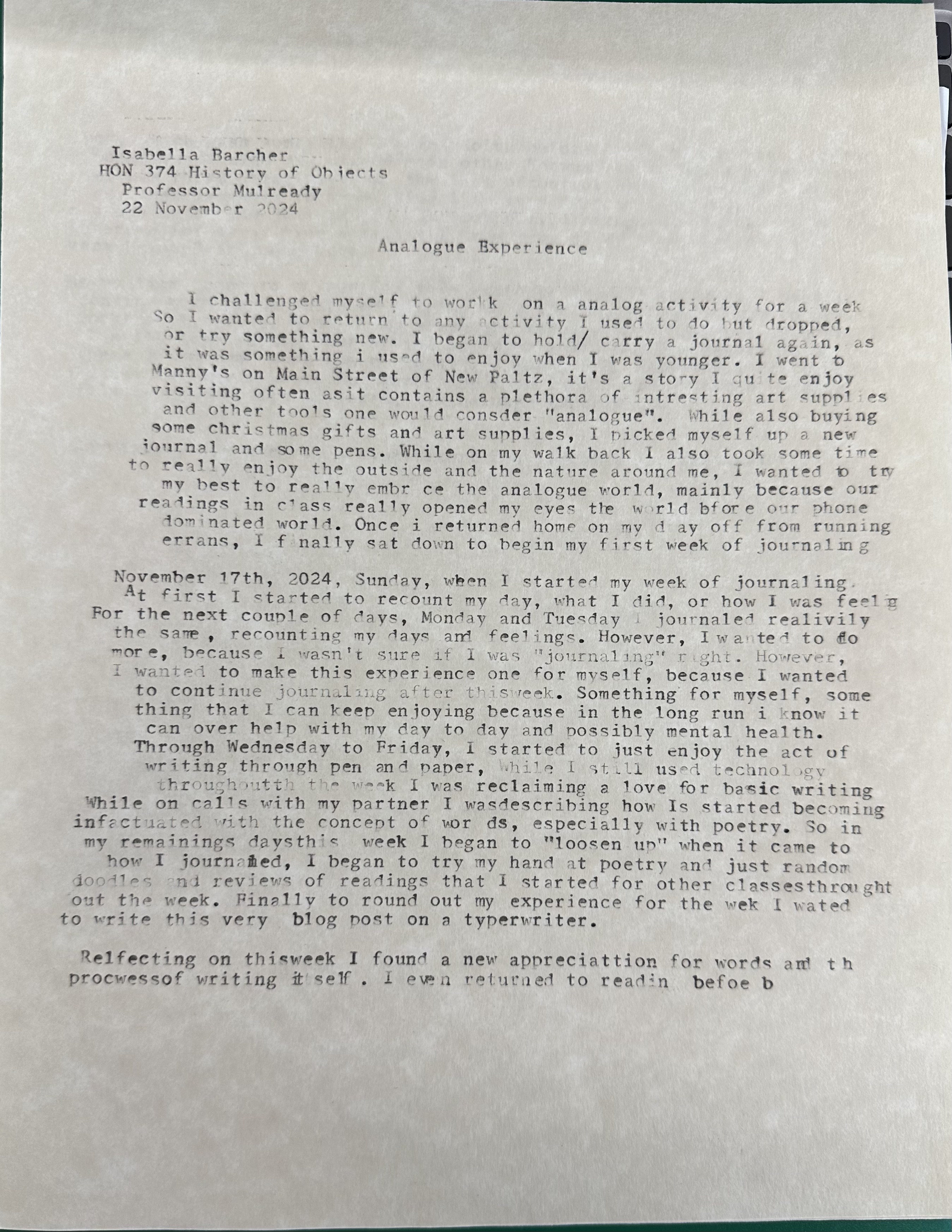
I wanted to challenge myself for my analog experiment by working on an analog task for a week. Additionally, I wanted to write this blog post on one of the original forms of writing: a typewriter.
Please enjoy this attempt and its many mistakes in spelling.
Most mornings I wake up to a bombardment of notifications from a variety of news apps—the New York Time, Le Monde, Al Jazeera, etc. The most pressing headlines, the most pertinent news that one must know. I typically scroll through the national and world news, starting my day off with a nice healthy dose of existential dread. Later in the evenings, I’ll take a walk while listening to current events podcasts, typically in French to improve my language skills.
One could say I’m a tad too dependent on digital media, especially when it comes to news. And so I decided to spend a few days buying and reading a physical newspaper.
My analog journey began on Tuesday. It was a beautiful, sunny, 60 degree day, completely normal for the middle of November in the North East (ha-ha). I asked my roommate where I could find a physical copy of a daily newspaper since I embarrassingly had little idea. They recommended I go to the gas station, and so that’s what I did; strolling off campus, crunching fallen gold leaves, listening to Janis Joplin, and contemplating the Earth’s warming.
The gas station only sells the Daily News during the week, shaking things up from my usual my usual New York Times read. It was a whopping $3.00, although it seemed like the cashier made the price up on the spot after a confused pause. I figured he probably was not used to college kids walking into the small store to buy the Daily News rather than a pack of White Claws.
I read the paper on my walk back to campus. I read all the articles in the news section, flipping haphazardly through sports and entertainment. Reading the physical paper proved to be better for remembering the smaller details; even writing this post days later, I can still recall which counties are currently under a drought warning in New York State, something I would never remember if I had read the article online. With reading digital news, my eyes seem to skip over certain information, latching onto the most “important” details that I want to remember. Each individual word of the physical newspaper captured my attention; they were part of a greater hole, no longer just black signs on a glowing screen.
The next day brought the newest issue of the New Paltz Oracle, thankfully saving me from the walk to the gas station. I came to realize how much I enjoy flipping through a physical paper, being able to smell the pages the same way I enjoy the smell of old, dusty books. Although I have preferred physical books over downloads on a Kindle or phone for years, I never considered I would feel the same with reading the news.
The final day of my experiment it rained. All day. No longer could I appreciate the warm fall scenery and crisp air; I dramatically trudged to the gas station, the $3.00 charge for the Daily News seeming much more detrimental this time around. I was generally cranky that day, and this journey seemed to make matters worse. What was the point, I wondered, of walking through the rain to get an overpriced paper that didn’t even tell me half of the information available for free on my phone?
I typically find issues with the increasingly digital world, feeling nostalgic for humanity’s dependance on analog experiences. I refuse to use Elfster for Secret Santa, I opt for buying things in person rather than ordering online. But my romanticized vision of the analog world took a blow with this experiment; never have I been more grateful for the option to have an insane amount of media available to me at the press of a button.
Admittedly, I still used my news apps during this experiment. While I did appreciate getting local and state news in the physical paper, I couldn’t give up my access to national and world events, especially not now. I am incredibly grateful to be privileged enough to have access to the internet, and even more so to a walkable town where I have enough money to buy a newspaper (plus a half and half iced tea on occasion). I did appreciate the experience of buying a physical paper, but until I have my own house and enough money to get the New York Times delivered every Sunday, I will stick with my digitized and wonderfully convenient news.
At the end of October, the Pokemon Company released a new mobile game called Pokemon TCG Pocket. For fellow nerds such as myself, this game is very fun to play since it incorporates the collecting and battling portions of the TCG (trading card game), but in a more condensed and fast paced version. My favorite part of the game is battling because I love the thrill of trying to predict and counter my opponent, so for my analog experiment I chose to play a full game of the TCG with a few of my friends.
Almost immediately after making the plan, I got hit with obstacles. First, a real TCG deck consists of 60 cards while a deck in the mobile game consists of 20. Although I have a lot of physical cards, it was very difficult to build a cohesive deck. For example, I knew I wanted to build a deck around Charizard (my favorite Pokemon), but I didn’t have enough copies of Charmander or Charmeleon to fit the mold of a deck. In the mobile game, I could have easily traded in some “pack points” for the cards I needed, but in the real world, I would have had to buy the cards as singles online. The second big issue I had was that I didn’t know the rules for a full-length battle (and neither did my friends). In the game, battles are designed so that they are between 5-10 minutes on average. If you have a question about what is happening or what you can do during your turn, the game will let you know. When we were battling with physical cards, we had to constantly open Google to figure out certain rules and technicalities.
Although it was a pain to set up and actually play, it was far more enjoyable than the mobile game for two big reasons. The first one being that I could actually put a face to my opponent and interact with him. Any actions or reactions during a turn were not confined to the limitations of my thoughts, but could be expressed with words and actions. For example, my friend “paralyzed” my Pokemon for 3 consecutive turns so I cursed him out. Obviously, it wasn’t a personal or aggressive remark, but simply a reaction that we could laugh over as friends. If I were to have a similar reaction while playing the mobile game, people would think that I’m out of my mind.
The second reason the game was more enjoyable to play physically was because I could have a conversation with the people/person I’m hanging out with. Since we only used our phones to check the rules, the only way we could distract ourselves and lower the tension of the battle was by having a conversation. There was no pressure from the in-game timer or voices in my head debating what my next move to be. These things were instead replaced by nostalgia and laughter. The flow of the battle was natural, and I think the personalities of each of us were apparent in our method of playing. I was more defensive and analytical, my friend (Michael) was more focused on playing the offensive, while my other friend (Kevin) was just playing for the vibe. The first match we played was between Michael and I, and it lasted 47 minutes with the final score being 6 – 4, where I had 6. The second battle was between Kevin and I, and it lasted 23 minutes with the final score being 6 – 2, where I had 6. The third battle was between Kevin and Michael, and it ended after 52 minutes of gameplay with the final score being 6 -5 in favor of Michael. The final battle was between Michael and I, and it lasted 72 minutes with the final score being 6 – 4 (again) in my favor.
Conducting this experiment was definitely enjoyable and had its pros and cons. However, I learned and realized a few things while playing. The first is my reliance on digital technology. Although a mobile battle is different from a physical battle, there is a lot of overlap. Despite the mobile game being the app I currently use the most, I could only remember a thing or two about the rules of battle. I realized that the only reason I know how to play the game is because the game corrects me if I’m wrong. While writing this blog, I noticed a similar trend. Although I know how to spell and write sentences, I rely heavily on autocorrect and the red/blue squiggle to pick up my slack. Another thing I noticed is I get easily distracted when I do anything on a screen. When I play the mobile game, I tend to hop in and out of different apps (such as Instagram) in between battles. While doing work on my laptop, I have the habit of Googling any random thought that comes to my mind. During the analog battle, there was no temptation to get up and do something else. Rather, my senses/mind were too busy processing and responding to what was happening in real time.
In class, we discussed how objects can become an extension of our minds. Throughout this experiment, I realized that digital technology has become an extension of me. I personally like to be in complete control of everything that I can control, so this realization spooked me out a bit, but then I realized that this extension is only ever useful if I make it useful. I find this thought interesting, and I plan on exploring it further.
Every day, I practice my religion and connect with God through reading scripture and prayer. Though I own a Bible, and have read directly from it quite a bit, it doesn’t leave its shelf during my prayer time. From the comfort of my bed, usually right before I sleep, I open a Bible app on my phone that provides me with a daily verse from the Bible, a video explaining the verse, and guided prayers. I’m also able to collect my thoughts for my own prayer by typing out what I want to communicate with God. In a world where technology has made seemingly everything more convenient than before, even things that weren’t inconvenient to begin with, even time with God has been digitized.
For my analog experiment, I wanted to turn away from my screen and look back into my many physical religious books I have stacked on my shelves. I turned towards the book Jesus Calling by Sarah Young to provide me with a daily verse, which led me into my Bible to find it. Flipping through my Holy book, I found the verse- 2 Corinthians 9:15: “Thanks be to God for his inexpressible gift!”. Instead of watching a video of someone talking to me about the verse, I read Young’s explanation of how we can receive God’s gifts. Instead of having a guided prayer pertaining to the verse ready for me to recite, I dove into a prayer book searching for one to recite related to Thanksgiving and gratefulness. And finally, instead of typing out my prayer, I hand wrote it with paper and pen, expressing the many things on my mind I was grateful for. Through this experiment, I hoped to rediscover communicating to God in a manual way, and asked the question- would I feel more connected to God if I was disconnected from my device?
In each part of my experiment, the verse, explanation, recitement, and prayer, I took note of my reactions and feelings. On the app I normally use, the verse you need is presented firstly, alone without its surrounding verses. While looking for the verse in my Bible, I enjoyed being able to flip through the physical book. It’s light and flimsy, and the pages are thin and soft to the touch. The words are incredibly small, which, to me, was delightful, as it forced me to get close to the book and skim multiple lines to find the one I was seeking. One downside I did find while reading the verse and the explanation was really concentrating on what it was saying. I found myself rereading everything at least twice, which wasn’t usually the case when I read from my phone. Also, watching a video seems to hold my attention better, and being able to see someone talking right at me gives me something to focus on. Nevertheless, reading Young’s explanation still gave me a feeling of deeper connection, and having to reread it multiple times helped reinforce what it was expressing. Normally, I spend my time on the app and when I’m done I open Instagram or Tik Tok, giving me no time to truly absorb what I’ve learned. Looking for a prayer in my prayer book made me quickly look over each page to find the right one, which had me feeling similar to how I felt when searching for the verse. Without having a prayer ready to go, I was able to make note of other prayers in my book I wanted to go back to. Finally, I feel I had the most positive experience writing my prayer out. Even though the option of typing my prayer is convenient and faster, it almost feels like I’m texting God, which honestly is pretty strange when I think about it. However, writing out my prayer felt like writing a letter to a friend, and while writing I wasn’t tempted to go back and correct myself or rearrange my prayer how I do when I type it.
Taking into account all my observations, and focusing on how I felt throughout my experiment, it’s safe to say this was a positive analog experience for me. I still feel positively towards the Bible app I’ve been using, as it does allow me to read and write comfortably from my bed at night, and the creators don’t include ads or push me to pay for a “premium” version. The videos give me a feeling of togetherness with other Christians featured in them as well. However, I feel reading from my physical books and handwriting my prayer provided more pros. I felt a deeper connection, and felt my conversation with God was more personal this way. Disconnecting from my device and its conveniences did help me feel closer to God, and helped my time with him feel truly fulfilling.
In exploring analog objects, I chose to focus on something deeply personal—my relationship with my Nana. We’ve been close since I was a young girl, and during quarantine, we developed a tradition of daily phone calls. Now that I’m away at school, we haven’t been able to talk as much as I’d like, but we’ve established a new routine of Wednesday afternoon calls. I go for a walk and chat with her, updating her all about my friends and classes, and she talks about her and the family. We easily go on for over an hour, sometimes even reaching the two-hour mark when the family drama gets intriguing.
While I love my phone calls and occasional texts with Nana, I miss our in-person talks with one another. She’s familiar with messaging on her iPhone, but Facetime is something completely out of her field of expertise. As an alternative, I thought sending her a letter would be a heartwarming surprise for her to open in the mail. I would be able to express my love and appreciation for her not only in spoken words but in the form of a handmade letter. When doing this, I wondered how creatively I could formulate these terms of endearment for her. Will using a single 8.5 x 11 paper limit how much I can write to her? Will my handwriting be too illegible for her? Should I make my handwriting larger knowing that she cannot read that well? Should I include small drawings in the letter? I hoped that after completing this experiment, I would find answers to all of these questions and discover a new form of communicating with Nana that goes beyond digital interaction. To measure the practicality of communicating through letters, in addition to our weekly chats, I asked Nana how she felt about opening the letter when she initially received it. With no surprise, she was thrilled to find her heartfelt message in her mailbox.
Observations:
The first obstacle I came across in this experiment was putting ink on paper. Between my stubborn writer’s block and the fear of not being able to erase my mistakes, it took me a while to even begin my letter. I can think of endless ways to describe my love for my Nana off the top of my head, but having to put those thoughts into physical words posed a challenge I didn’t think I’d come across. I was easily able to write birthday and Christmas cards to relatives in the past without hesitation, but now I was struggling to write an opener to my letter. Was this a creative block I had developed since being at school? Have I fallen into the comfort of typing everything on the computer without giving the delete bar and auto-correct a second thought? After these anxious thoughts left my mind, I knew I had to start writing soon and stop overthinking this task. At the end of the day, I was writing a personal message to Nana, and she was aware of how much I loved her. Anyway I express that to her would be greatly appreciated.
So I began writing. Instantly, I noticed that because I was writing in a letter format, I felt the need to sound very articulate and formal. I tried looking past this and began my letter with “To my Bestie”, a term we call each other whenever we’re together. The words that came after that opening statement flowed so freely on the page. It felt as if I was speaking right next to her at her small kitchen table. I was nervous that I would misspell or run out of space for some of my words, but writing on the paper allowed my thoughts to run cohesively onto the paper.
Overall, I was very satisfied with what I was able to write on my own. I usually rely on programs like Grammarly to autocorrect and rephrase my writing for emails and school assignments. However, I appreciated that those resources weren’t available to me during this experiment. I feel that it would take away from the intimacy of my written letter, almost in the sense that essays written with ChatAI lose their authenticity. I knew that filling the paper with my original thoughts and handwriting would be a precious gift to surprise Nana with. I ended the letter with our special goodbye to one another and dropped my pen in satisfaction.
People have always told me how admiring my relationship with Nana is. We’re able to talk to each other multiple times a week and treat each other like we are inseparable friends. I’m aware that some people my age are forced by their parents to speak to their grandparents and are praised when doing it. However, speaking to Nana has always been effortless for me. It never felt like a chore to pick up the phone with her or to go to her house to chat. When writing this letter, I felt a sense of accomplishment and pride that I’ve never felt when ending a conversation with her. I believe that is because I worked on something so meaningful for her and I was thrilled for her to receive it.
Unlike sending an email or using the phone, I needed to physically send Nana her letter through the mail. Luckily, I had envelopes and stamps in my room that I was able to use. It had been so long since I sent a physical message to someone that I Googled how to properly format the stamp and the recipient’s address on the front of the envelope. I felt embarrassed that I even had to do that, forgetting something so simple yet lost in memory. The convenience of a simple phone dial or send button had completely taken over my reality of physical communication.
Using the mail system to deliver my letter was not as easy as I assumed it would be. I wanted the letter to arrive at Nana’s house as soon as possible. This meant I needed to send out the letter on a business day before 12 pm since that is when the campus postman collects the mail each day. I also feared that the letter might get lost in transit since that has happened to me in the past. Fortunately, I was able to send out the letter before noon on a Wednesday, just in time for it to be collected and delivered to Nana within days’ notice. This entire process reminded me of the times I would send my Christmas letters to Santa, taking special care in the way I wrote my letter and leaving it in the mailbox with an endless feeling of excitement.
Reflection:
I noticed immediately when doing this experiment that I had lost my appreciation for the art of handmade things. I have always been a crafty person, especially when it comes to gifts, so my family is no stranger to receiving handmade goods or cards for the holidays. However, being at school and using my computer for most of my assignments has confined me to work electronically. Using this experiment as an opportunity to break through these technological constraints was so freeing to me. I was able to develop my creativity through the form of writing that made Nana feel so special.
This message will forever stay in Nana’s home, where she can revisit it anytime she wants as a physical reminder of my love for her. After calling her to confirm the letter’s delivery, she told me how delighted she was to open the mailbox that day and find the handwritten message. The affectionate gesture of seeing my handwritten words brought her to tears. She ensured that the letter would have a special place right next to her bedside for her to revisit.
Conclusion:
This process, which took me about an hour to complete, including the mailbox drop-off, was well worth the time. Knowing how meaningful my letter was to Nana and having her keep it as a token of our relationship encourages me to continue writing letters to her and my other loved ones. I’d like to start sending letters to my family during the holidays and birthdays so that they can receive more personal messages from me. I feel that they carry more significance than a pre-written Hallmark card or a classic “Happy Birthday” text.
Making this letter allowed me to express my thoughts in a physical form that’s unique to me and my art style. I was able to include small notes and drawings throughout the paper related to my relationship with Nana. Using my computer or phone would limit my ability to include these minor, yet expressive details. Sending a heart-eyed emoji, something Nana and I often do when texting, can never match the value of a hand-drawn picture.
I recommend that everyone should attempt to write a letter at least once. If they don’t have a special person to deliver it to, finding a pen pal would be a creative alternative to this experiment. It would allow people to develop their communication skills and form new relationships with others through their writing.
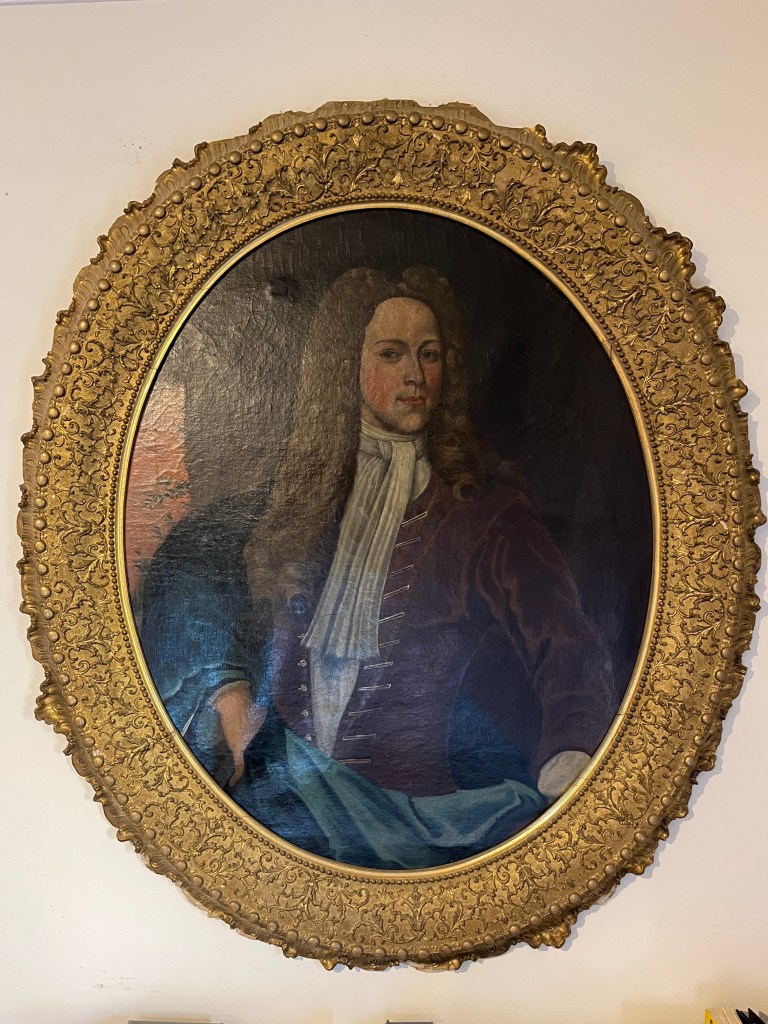
His prideful gaze washed and darkened over with aging varnish residue, a copy of Johannes De Peyster III’s portrait in New York Historical Society now resides over the desk of Grimm Louise’s Office within the historical walls of Huguenot Street. For the Huguenot Street historians he serves as a reminder to be timely with their work; but to history, it serves as a reminder of New York, and New Paltz, colonial government.
Physical Description:
The portrait is an oil on canvas in a wood gilt frame, the oval inside dimensions are 27 ¾” w x 35” h, and its frame dimensions are 35” w x 46” h. Looking at the portrait, Johannes De Peyster III, an influential businessman and Albany mayor from 1729-1733, is dressed in formal colonial attire that reflects his wealth. This features a clothing made from high-quality fabrics such as a long fitted coat, waistcoat, and lace cuffs and collar, representing status. His outfit is made of dark, somber hues such as blacks, browns, and dark greens, characteristic of formal fashion in the period.
His pose depieted in this portrait is dignified and restrained, his gaze is serious conveying the authority anticipated of a mayor. The background consists of minimalistic elements. What can be seen as a possible evening sky on the left side of the painting with muted blues and pinks coinciding with minimal dark foliage. Additionally, a dark and muted wooden structure contrasts with DePeyster’s figure and attire ensuring he remains the focal point. The color scheme of this piece consists of dark and subdued tones, with dramatic light and shadow contrasts that highlight DePeyster’s face and hands. This chiaroscuro effect highlights his features, the textures of his clothing, and the intricacies on his face. Which may show indications of age, implying his longevity and life experience
Given his age during the time of this portrait, DePeyster’s face should bear the lines and creases of age, however, in this portrait, DePeyster’s face is idealized providing the mayor with a young and glowing face, which in many historical cases reinforced their power and status. His hair, likely powdered or styled in colonial fashion, frames his face, emphasizing a receding hairline and his status as a higher-ranking official.
The portrait’s style is likely consistent with the restrained, realistic approach popular in early American colonial portraiture, which values realism, formality, and respectability above expressiveness or romanticized features. It may be heavily influenced by European, particularly Dutch, portrait traditions, demonstrating the enduring cultural linkages between colonial America and the Old World.
Provenance:
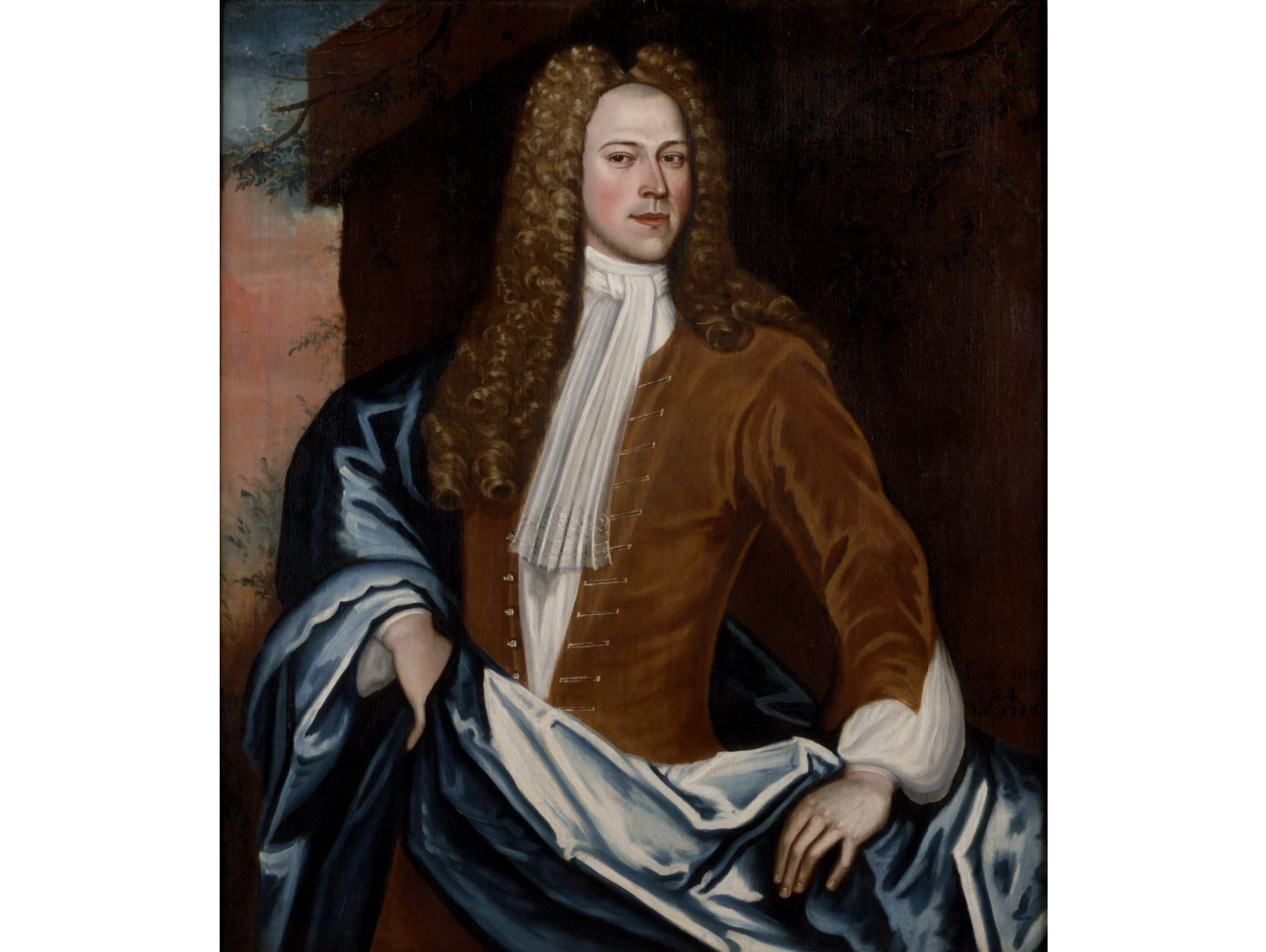
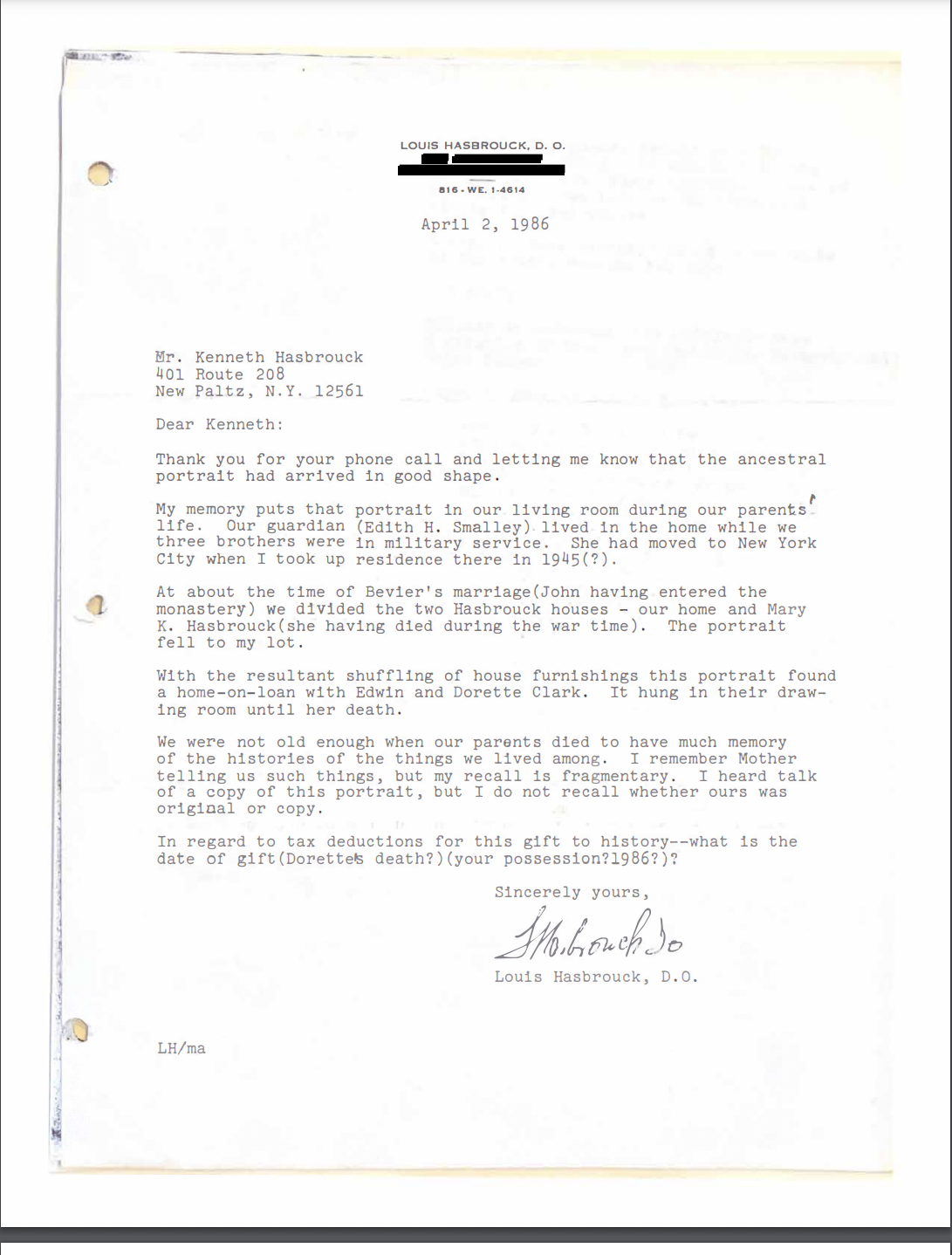
The subject of this work is Johannes DePuyster, John DePuyster Douw’s grandfather. The original portrait was painted around 1718 by Nehemiah Partridge. The original is in the New York Historical Society collection. However, this copy was donated on April 2nd, 1986 by Mr. Louis Hasbrouck to Mr. Kenneth Hasbrouck for the Historical Huguenot Street collections. The portrait found its way into the Hasbrouck family when the Donor’s mother, Helen Miller, a descendent of the subject, Johannes DePeyster III, married Levi Hasbrouck in 1918.
Mr. Louis Hasbrouck states his memory puts this very object into the living room of his parent’s estate. Their guardian, Edith H. Smalley, lived in the home while Louis and his two brothers were in military service. Smalley then moved to New York City when Mr. Louis Hasnrouck took residence in his parent’s estate around 1945.
While there isn’t any record of the exact location of the Hasbrouck family home what we do know is how such a painting ended up in Mr. Louis Hasbrouck’s lot. Bevier Hasbrouck marries and John enters a monastery. Dividing the two Hasbrouck homes, Louis Hasbrouck and his wife Susan Brunck Hinman and Mary K. Hasbrouck, who died during wartime. The portrait then fell into the possession of Louis Hasbrouck. During the division of the two Hasbrouck homes, the painting was found home-on-loan with Edwin and Dorette Clack which hung in their drawing room till death. This leads the painting to be brought back into possession of the Hasbrouck family.
“A letter from the Donor discussing the painting”“Genealogy connecting the donor to the portrait’s provenance”
Narrative
Johannes De Peyster was born in New York in 1694. He was the son of Johannes De Peyster, a merchant of Huguenot descent, and Anna Bancker De Peyster, an Albany native. His extended career in Albany and his time in military service serve as a model for success in early America.
In 1713, Johannes traveled upstate to learn business from his uncle, Albany entrepreneur Evert Bancker. In 1715, he married Albany-born Anna Schuyler, the eighteen-year-old daughter of Albany’s most important New Netherland family. De Peyster, after successfully conducting business with his uncle, then moved to his uncle’s house on the south side of State Street, Albany, where he would reside for the next seventy years. Additionally, in 1721, Johannes was elected first ward assistant, succeeding his uncle. The next year, in 1722, Johannes was elected alderman and was re-elected every year until 1726, when he was then named city recorder. Johannes was named mayor of Albany in 1729 and served until 1733. He was later elected as an alderman from 1748 to 1754. Additionally, he was a militia officer from 1717 to the 1740s. He frequently had contract business with city hall and was an active member of the Commissioners of Indian Affairs until he resigned in protest in 1746.
The object itself was originally created in 1718 by Nehemiah Partridge. Around 1718, Partridge was introduced to the society of Albany, New York, which had not yet been visited by any painters. It’s unclear how he met clients, although it might have been through Boston merchant Jacob Wendell, whose cousin Evert Bancker was one of Albany’s most influential.
We don’t have much information on our version of the portrait, we are unsure who created it or when it was copied from its original. Just like aging varnish, there is a mystery to what lies beneath the surface. However, this copy of this painting from the Hasbrouck family serves as a connection to the early European settlers in New Paltz, as well as a connection to the greater early Dutch colony of New York.
Provided documents from HHS by Louise McGoldrick, a Collections Manager at the site, connect a direct lineage to the Hasbruock family in possession of this portrait to the history of New Paltz. “There is a list of names (Louis – Louis – Joseph – Abraham – Joseph – Abraham) under the donor’s parent (G-37) that tracks the direct family line back to the Patentee, Abraham Hasbrouck (1657-1717).” (McGoldrick, 2024)
Genealogy recorded provided by Goldrick
To the history of New Paltz, The Patentees is a group of early male European settlers. These are the men who signed the 1677 land deal with the Esopus Munsee tribe, exchanging goods for permission to live on 40,000 acres of land that is now the larger New Paltz region. The Patentees consisted of men each representing French Huguent and Wallon origin, one of these men was Abraham Hasbrouck.
September 15th, 1677, the Esopus-Huguenot Land Agreement was enacted. The original boundaries of the patent contained a large part of present-day southeastern Ulster County, including portions of the towns of Esopus, Lloyd, Plattekill, Gardiner, and Shawangunk. For this land, Huguenots traded a collection of goods such as domestic supplies, tools, clothing, animals, and gunpowder and gave the Esopus the right to hunt on the lands exchanged within the patent.
The land agreement also reflects a connection to Albany and Johannes De Peyster III. From the seventeenth century through the eighteenth century, the fur trade between the Dutch and English settlers and the Iroquois nation dominated within the Capital region. Johannes De Peyster III served as mayor and a member of the Indian Affairs Commission during the major conflicts and trades between the natives and Albany settlers. The fur trade helped the Iroquois strengthen their hold in the region by allowing them to control key resources while still maintaining connections with European nations. De Peyster took part in the contacts between the two powers. De Peyster, who came from a wealthy business and political family, was a well-known fur merchant and landowner. As mayor and merchant, he was in charge of monitoring trade regulations and guaranteeing Albany’s powerful status. This contributed to the overall economic and political dynamics between the Iroquois and the British colonies.
Johannes De Peyster III’s portrait and history coincide with the history of Abraham Hasbrouck in the town of New Paltz. The two of these histories bridge to New York’s colonial history, one of major power and the other an individual rural town. Involved in fur trades and land agreements, both the influence in Albany and the smaller town of New Paltz participated in democratic interactions. These stories offer significance in a town such as New Paltz with an early Dutch influence; figures like De Peyster constituted an elite class of leaders who participated in local and regional decision-making processes. Although De Peyster is unlikely to have actually shifted voting habits, his participation illustrates the long tradition of civic duty and governance that formed colonial political culture and, eventually, the creation of American democracy. De Peyster’s family lineage connects the regions together.
We may never know what lies behind the intentions of this copy, or it’s true origins. What we can tell from his gaze is to always make sure to check our emails but to also look at the grand history of early America in the new world; connecting New Paltz to the bigger colonial history of New York state.
Works Cited
Goldstein, Jacob. “Murder in Colonial Albany: European and Indian Responses to Cross-Cultural Murders.” Order No. 1517173 The George Washington University, 2012. United States — District of Columbia: ProQuest. Web. 29 Oct. 2024.
Johannes de Peyster, exhibitions.nysm.nysed.gov/albany/bios/d/jodp.html#jdp. Accessed 3 Nov. 2024.
“Johannes DePeyster III (1694-1789).” Johannes DePeyster III (1694-1789). | New York Historical Society | Digital Collections, digitalcollections.nyhistory.org/islandora/object/nyhs%3A2121. Accessed 3 Nov. 2024.
New York Heritage Digital Collections, nyheritage.contentdm.oclc.org/digital/search/collection/hhs!p16694coll153. Accessed 29 Oct. 2024.





 The Materials of History, Thought, and Art