Charlie Strittmatter

The Clock
The wooden frame is stained to a dark brownish red that accentuates the natural grain of the wood while outlining the 20 inch tall, 17 and a half inch wide body. At the very top of this object, the wooden frame has a mirroring pattern of curvy, decorative wood carvings highlighted by the dark stain. The symmetry of the clock is conserved towards the bottom of the frame as well, but the carvings are more functional in that they serve as feet, holding the weight of the object.
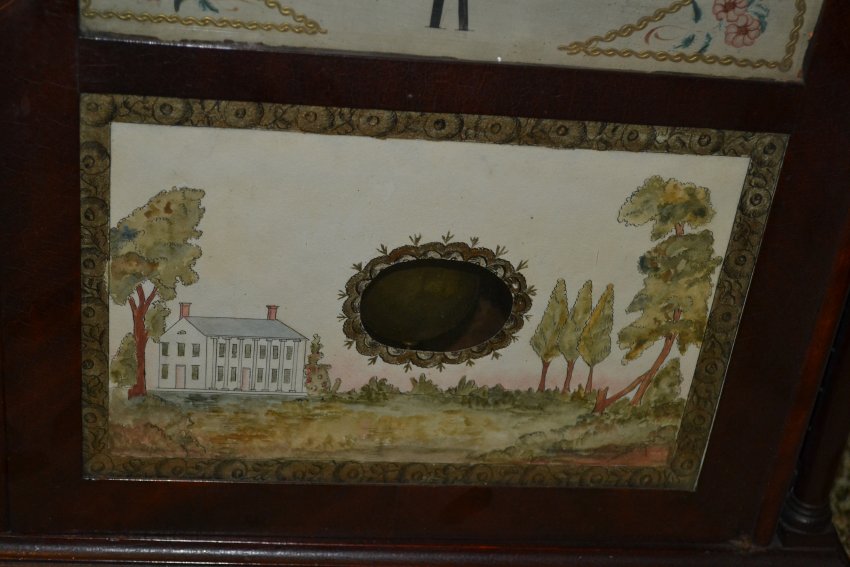
The hinged door, that reveals the clock beneath, is made of glass, to showcase the Roman numerals and pointy hands that indicate the time of day. The diamond shaped keyhole on the left side of the door stands out against the dark wood stain due to its stark white color. On the same rectangular plane as the clock’s Roman numerals, there are small, daisy-like flowers with bright green leaves painted in each corner, enclosed by squiggling gold lines. Below the clock, separated by a bar of stained wood, there is a more detailed painting of a simple landscape, which has been reverse painted onto the back of the glass paneling of the door. The painting depicts several trees growing on a lush, green piece of land with one lonely white estate rising from the grasses. There is an ellipse shaped portion in the center of the image that has been left unpainted so the holder of the object may view the clock’s golden pendulum as it moves with time.
Provenance
This mantle clock was originally made in 1830, by a company called Eli Terry & Sons of Plymouth, located in Connecticut. This company manufactured several varieties of mantle clocks of the same configuration as this one, each with their own unique decorations in the corners of the clock as well as uniqueness in the paintings below the clock. Originally, the clock was owned by Josiah Bruyn DuBois Sr. who made a living mainly as a merchant in New Paltz, with his business partner (and father-in-law) Josiah Hasbrouck. It is unknown how he obtained the clock, whether he purchased it himself or it was gifted to him by another. Being a member of an influential family in New Paltz society, the mantle clock remained as a family heirloom passed down from generation to generation.
The clock eventually landed in the hands of Josiah’s great-granddaughter, Emily DuBois Hoysradt. Emily was a local artist and included this beautiful mantle clock in one of her works. Later on, Emily gifted the clock to Historic Huguenot Street where it belongs as part of the sites’ permanent collection

Connections
At the time, a mantle clock like this one would have cost between $30 to $60 compared to now where the worth of the clock has increased to between $1,000 to $2,000 today. During the 1830s, this sum of money was not of billionaire status but it did reflect someone who lived comfortably. Josiah’s merchant business was successful enough not only for him to be in possession of this lavish clock but also to construct a home along Wallkill River on a plot of land named Libertyville, now Libertyville Road.
This land had been under the proprietorship of the DuBois family beginning with Josiah’s great-great grandfather, Louis DuBois, one of the founders of New Paltz. The house Josiah built was a Federal style estate, which was not small and typically consisted of 2-3 stories. These kinds of homes were based on symmetry, similar to the clock’s construction. Josiah’s house also may have resembled the estate depicted in the bottom left of the painting on the mantle clock, rectangular in shape with a door in the center and an even amount of windows on either side of the entrance as well as on the sides of the house. On the interior, houses like these typically were decorated with wooden furnishings and accents, curved structures, and lots of intricate molding and wallpaper. It can be imagined that the mantle clock may have been a centerpiece in a room with a cozy fireplace and plenty of places to sit. It may have been in the kind of room Josiah and his business partners conducted work, as they had their hands full with tasks so it was important they be aware of the time in case they needed to attend to other matters. This house is historically known as the Blake House although it was built by Josiah DuBois, it was eventually sold to William H. D. Blake, who’s name remained.
Josiah’s work was almost exclusively to do with money and financial activities. This included buying and selling goods from his store Josiah ran with his father-in-law Josiah Hasbrouck located in what is known as the Jean Hasbrouck House. Many of his documented sales also included goods such as magazine subscriptions, livestock, as well as enslaved peoples. Josiah also documented many exchanges of labor where workers were paid for their time and service. He handled much of his family’s real estate business as well, evidenced by the numerous documents of deeds, mortgages, maps, and legal papers meticulously dated and signed by Josiah.
Josiah’s role in the New Paltz community extended further than him being the local merchant and familial land manager. He was influential enough to be a member of the local political sphere, in which he served as Overseer of the Poor. This job was one he was elected to do, meaning one of two things, he was a trusted individual of the community or he was a member of an elite family that had the power and privilege to control certain aspects of society. Josiah’s role in this position was important for those who were not as privileged as he may have been. He provided money and resources for those in need and could not afford food, clothing, or medicine. Overseer of the Poor was a role that was common in most local communities during this time. Typically each town would have their own Overseer who distributed money to those who needed it most. Evidence of Josiah’s work was carefully documented and included every cent he authorized to be expended along with what it was used for and a reasoning why. Overseer of the Poor is interestingly an early version of the modern welfare systems we have in place today. Although Josiah’s role was limited to the local level, it can be observed that his field of work was significant and transformed into a hugely vital part of America’s modern political system.
Circling back to the object that started it all, the clock itself is reflective of the kind of lifestyle and taste Josiah DuBois had during his time of life. It serves as a reminder of the influential families that not only founded a thriving town, but also brought forth government systems and policies that are still in use today. The mantle clock emphasizes the idea that although time moves forward, systems, political practices, ways of life, and societal structure have persisted and remained as part of present day life, just like the existence of the clock, in all its antiquity.
Works Cited
Apmann, Sarah Bean, and Sarah Bean Apmann. “The Federal Style Explained – Village Preservation.” Village Preservation – Greenwich Village Society for Historic Preservation, 19 May 2020, http://www.villagepreservation.org/2016/03/30/the-federa.
CONTENTdm. nyheritage.contentdm.oclc.org/digital/collection.
Edit Cell. cs.newpaltz.edu/p/s23-06/v5/item.php?pkname=cid&i.
Eli Terrys for Sale. Prices, Appraisals and Auctions Rochester NY. http://www.cottoneauctions.com/for-sale/eli-terry.
Inflation Rate Between 1830-2024 | Inflation Calculator. http://www.officialdata.org/us/inflation/1830#:~:tex.
Miller, Ann Brush, and Virginia Transportation Research Council. Orange County Road Orders, 1750-1800. 1 Jan. 1989, rosap.ntl.bts.gov/view/dot/19247#:~:text=Ea.
Tschirch, John R. “Federal Style Houses: A History.” Period Homes, 14 Nov. 2017, http://www.period-homes.com/features/history-federal-style. Accessed 5 Nov. 2024.“William H. D. Blake Family Papers (1794-1982) — Historic Huguenot Street.” Historic Huguenot Street, http://www.huguenotstreet.org/william-h-d-blake-family-papers.
 The Materials of History, Thought, and Art
You must be logged in to post a comment.