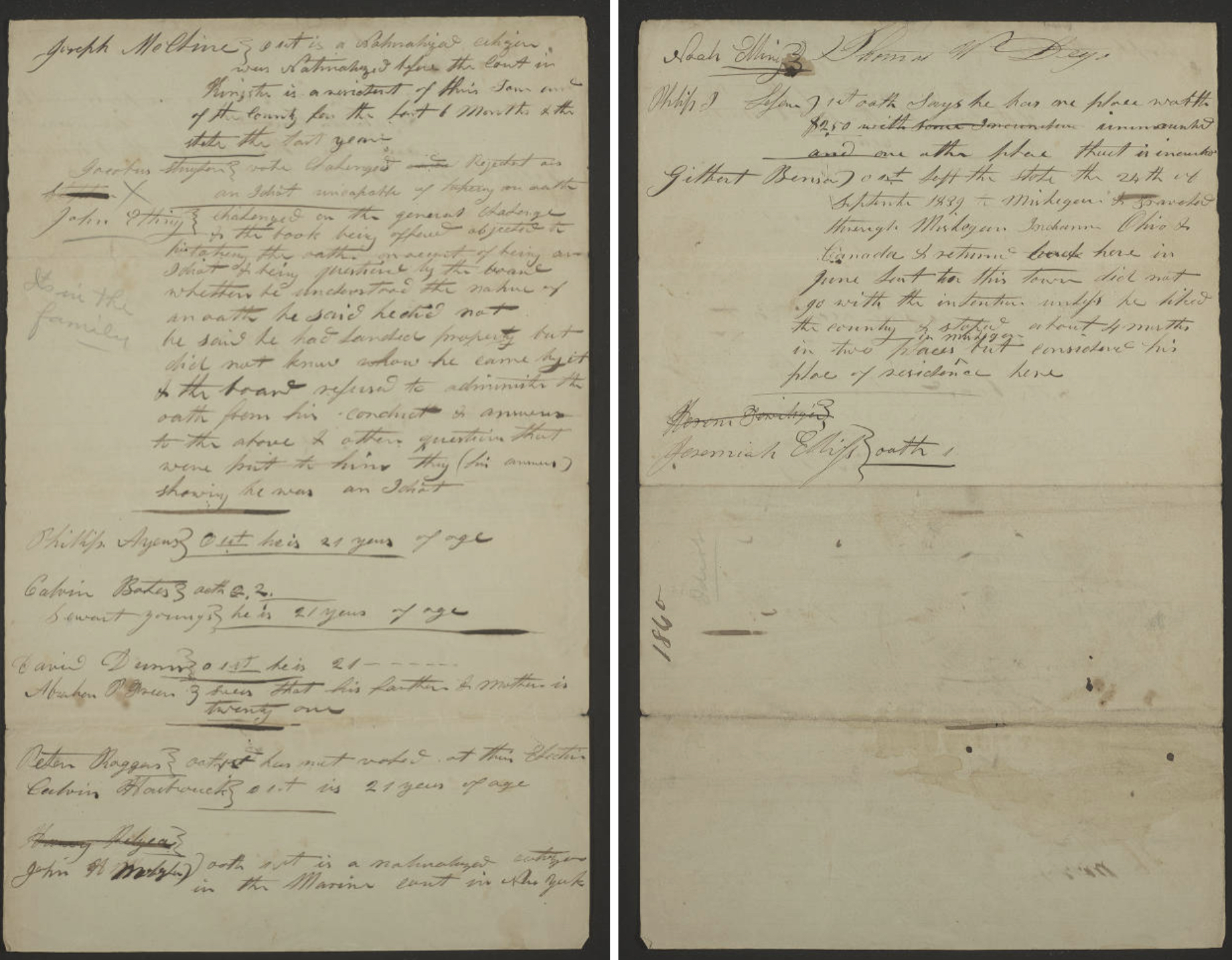
The images depict the front and back view of a document recording men in the Huguenot Street community’s information and oath status– if they took the oath to vote at the time, and if said oath was challenged on its validity. The ages and citizenship status are written down for all of these men. As well as a well known individual, John Elting, of the founding Elting family of New Paltz, whose oath was challenged and who was called an “idiot” in this legal file.
Physical Description
As seen in the photos above, the document was a single sheet of yellowed oxidized paper, due to old age. The size of the paper itself was standard for legal documents, and can be estimated to be about 8.5 by 14 inches. The edges of the paper have not been greatly affected by weathering and so they are still uniformly straight and unbent, sharp. Most of the damage to the edges of the paper are around the corners, where the paper appears to have lost the sharp corners to both ripping and folding as the paper was handled. Even so, the corners still maintain most of the precise rectangular shape, as only the very outer edges of them have been impacted. On the page itself, text is handwritten with ink and a quill in cursive English writing. There are no premade lines on the paper, and the handwriting extends throughout the full length of the front side of the paper, and about halfway down the back side.
Provenance
Within the Huguenot Historical Society’s collection page, it describes the acquisitions of the documents very vaguely. It reads, “The Huguenot Historical Society acquired its holdings of New Paltz Town Records at various times during the 20th century. The bulk of the records appeared to have been collected by past HHS President Kenneth E. Hasbrouck throughout the length of his term, which lasted from the early 1950’s to 1994” (Lefevre). Realistically, the estimated 40 some odd years is not so much of a range, considering that the full collection of files includes 160 items. Additionally, it begs the question of how the name Hasbrouck carries in such a space when it is the family name of one of the founders, along with Dayo, Elting, and more. With the lack of full disclosure about the procuration of each document, it is hard to determine the exact story of how this document fell back into the hands of those of Huguenot street. It is listed that “no direct documentation is readily available for any of these acquisitions” which are included in the collection as a whole. The chain of ownership then remains a mystery if the donation details are not yet available.
Now, the Huguenot Historical Society recognizes that the New Paltz Town Records are the legal property of the Town of New Paltz. As the current holders and caretakers of this collection of files, the HHS holds the responsibility for preserving the documents correctly and providing and allowing access to the collection to the best of its ability.
Narrative
The original collection includes documents that date from 1677 to 1932, but each object has its own time frame in which it is estimated to have been created. Originally, this document was filed within the collection as Miscellaneous court and legal records in box 12, folder 2, so a proper timeline could be from 1750-1782, and 1780-1860. With the added descriptor of John Elting being challenged in his oath which would effectively register him to vote, this range can be specified further, taking into account that the man was born circa 1812 and lived to around 1860. Eventually, it was found that the list dated back to 1860, so the events recorded must have taken place towards the tail end of John Elting’s life.
Although seemingly a pointless document, when diving into the research further, it becomes apparent that this could have been legal preparations for the next election, especially as it falls into boxes that otherwise pertain to municipal record keeping within the village government and town hall. The list of men’s names and their questioning of age and citizenship status, and the mention of oaths led to the belief that it was most likely a roster of eligible voters when it was reviewed once more during the digitization process in 2023.
Before having a system to effectively register voters the way there is today, men had to swear an oath that they met the requirements of eligibility. This oath could be challenged if there were suspicions that an individual did not truly meet the threshold. The changes put in the New York state constitution in 1821 allowed men to vote without the need to own property. Following the war of 1812, it became apparent to some people that it was not justified to have someone serve in the militia of a country and then not get a say in their government, so the motion to change the constitution was passed, 100 to 19 votes.
However, if voting was then falling into a more general sphere and voters’ rights are already being questioned, it left room for more people to question even previously registered voters. This is where the challenging of oaths comes in, and in this document, John Elting, who comes from a family that owned property, is called an ‘idiot’.
While the voting rights of migrants and the poor or working class were important to be expanded upon; the use of the word ‘idiot’ brings in the question of diability within communities long before acceptance. The word itself comes from Greek, originally meaning ‘private citizen’, but as the word translated into other languages, the meaning drifted. By the time it was used in English, it was a way to describe the ‘mentally deficient’ in the 14th century. Even more recently, psychologists in the 19th and 20th century came up with ways to determine the intelligence of a subject, and in the early 1900s, Dr. Henry H. Goddard proposed a classification system for intellectual disability based on the Binet-Simon developed concept of mental age. Those with the lowest mental age level (less than three years) were identified as ‘idiots’, referring to people having an IQ below 30. This truly begs the question if those with noticeable disabilities who may have been able to vote due to their status in society began to be pushed to the sidelines as more men became available to vote. This could have to do with the belief that an educated, disabled male is at the same intelligence level as the uneducated but unaffected, before the laws changed and non-landowning men were more valued for their effort in the army.
This unassuming document provides insight into the past of New York democracy and everchanging guidelines created to meet the needs of the people and their participation in government.
Works Cited
“Idiot Stick, N. Meanings, Etymology and More | Oxford English Dictionary.” Oxford Dictionary, http://www.oed.com/dictionary/idiot-stick_n?tl=true. Accessed 01 Nov. 2024.
“The Clinical History of ‘Moron,’ ‘Idiot,’ and ‘Imbecile.’” Merriam-Webster, https://www.merriam-webster.com/wordplay/moron-idiot-imbecile-offensive-history. Accessed 31 October 2024.
Larock, Evert. “Idiot.” Wikipedia, https://en.wikipedia.org/wiki/Idiot. Accessed 31 October 2024.
Lefevre, Ralph. “New Paltz Town Records (1677-1932) — Historic Huguenot Street.” Historic Huguenot Street, https://www.huguenotstreet.org/new-paltz-town-records. Accessed 31 October 2024.
Lippincott, Kerry. “The Ballot Box in New York State.” Historic Geneva, 16 Oct. 2020, historicgeneva.org/organizations/voting-history-in-new-york-state/. Accessed 01 Nov. 2024.
Michael H. Martella, Esq. “Law 101: Fundamentals of the Law.” HOW THE UNITED STATES AND NEW YORK STATE CONSTITUTIONS AFFECT OUR LIVES | Law 101: Fundamentals of the Law, courses.lumenlearning.com/suny-monroe-law101/chapter/how-the-united-states-and-new-york-state-constitutions-affects-our-lives/. Accessed 01 Nov. 2024.
“MSS_033_012_002_152.” Home, nyheritage.contentdm.oclc.org/digital/collection/p16694coll153/id/22735/rec/1. Accessed 31 Oct. 2024.
 The Materials of History, Thought, and Art
You must be logged in to post a comment.