
Caption:
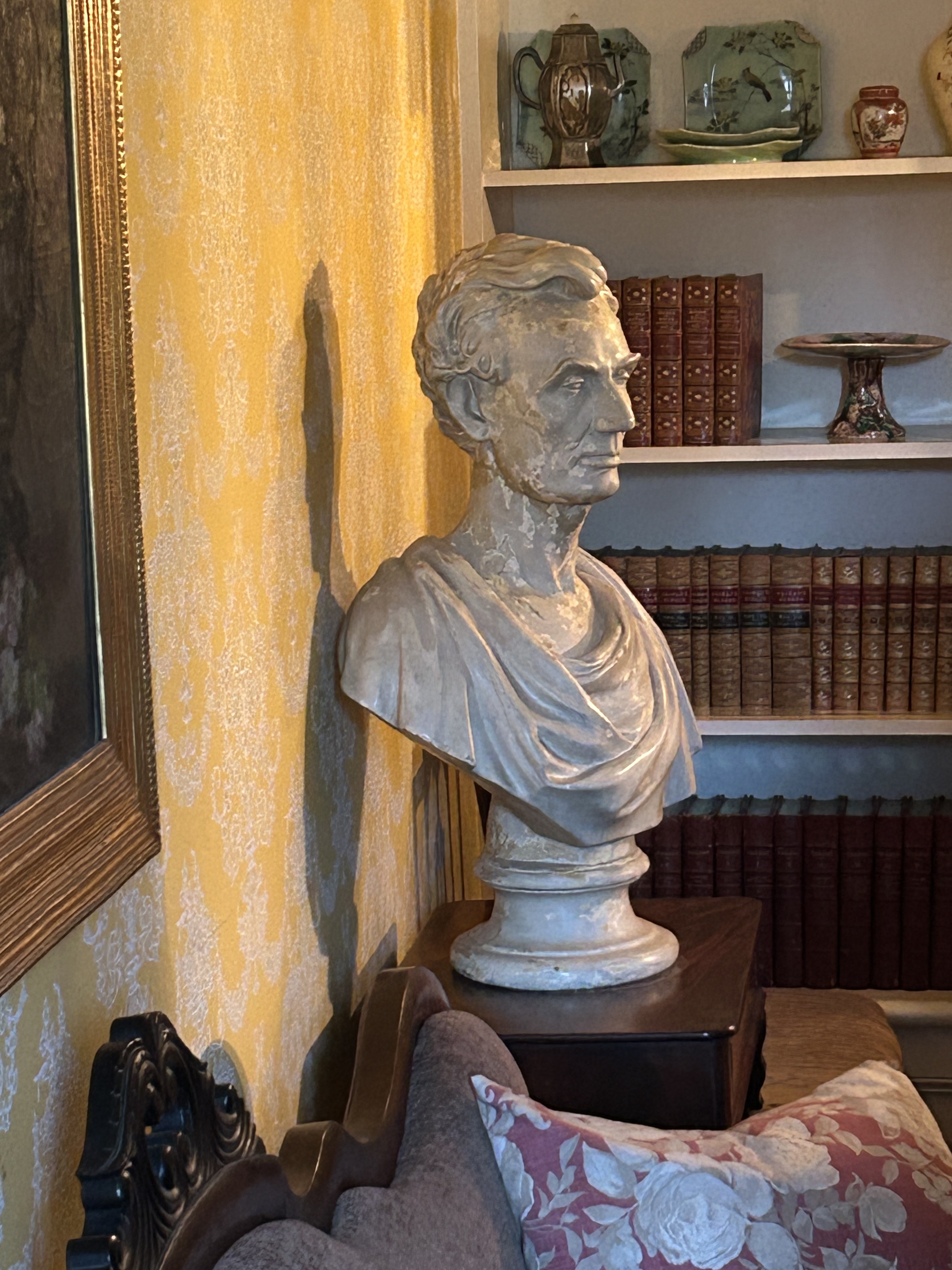
This sculptural bust of Abraham Lincoln in a Classical garment is a telling piece from the Colonial Revival. The Colonial Revival was a widespread interest in colonial styles of architecture and decor, peaking from 1880 to 1940 (Gyure). The sculpture is a glance into this period, showing with its style and concept the relation between the revival and nationalism and the rise of patriotism.
Physical Description:
The sculpture depicts a bust of the 16th president of the United States, Abraham Lincoln. The artwork is composed of plaster to imitate marble, standing at 31 inches high by 22 inches wide. Lincoln is shown in a Classical garment, most likely either a Greek himation or a Roman toga. The garment drapes around both of his shoulders. Notably, instead of being depicted with his usual beard, Lincoln’s face is clean shaven. His expression is relaxed, yet confident, and reflects typical depictions of presidents in art. With his head held high, this bust brings a sense of patriotism and pride to the living room of the Deyo House on Huguenot Street.
Provenance:
Unfortunately, this sculpture is one of the pieces in the collection that the historians at Historic Huguenot Street don’t know a lot about. The object doesn’t have an ownership history, and the bust currently in the Deyo House is a replica. The bust was most likely acquired by Abraham and Gertrude Deyo Brodhead to present a fashionable Colonial Revival interior. After going bankrupt in the early 1910s, the family lost the house and sold most of their belongings. The current items furnishing the Deyo House today, including the bust, are replicas based on 1915 auction sales and social events at the home referenced in newspapers (McGoldrick).
Narrative:
Through the analysis of its style and subject matter, it’s clear that the bust of Abraham Lincoln is a significant piece of the Colonial Revival in New Paltz during the early 1900s. Abraham Deyo Broadhead was evidently an enthusiast of the Colonial Revival, remodeling the Deyo House in 1894 to transform the original small stone home into the Queen Anne style home we see today (“Deyo House Historical Structural Report”). This transformation was also noticeable in the home’s interior decor, which is where the Lincoln bust comes into play.
In order to understand the sculpture’s significance during its time, we have to explore the Colonial Revival and its history further. The expansive popularity of the revival was due to many factors, but most importantly was because of a rise of patriotism and nationalism. After the Civil War, Americans took a new sense of pride in their country, in both the North and the South (Jost). The war transformed patriotism, solidifying the value of national unity. The reintroduction of original political values of pride and unity fueled the emergence of the Colonial Revival, and the colonial style of architecture and decor that’s at the center of the revival provides a physical representation of those values. The Abraham Lincoln bust was a piece of interior decor, specifically a plaster cast, that was mass produced during this time. During the period of the Civil War, Americans consistently made connections to classical heritage, and through participating in the replication of plaster casts, the United States began to evoke a higher reputation as a modern and confident country (Breitweiser).
Lincoln was an extremely important political figure during Deyo’s time, so it’s no wonder he would have decor honoring him, especially after his successes during the Civil War. Lincoln’s term as president preceded the beginning of the Colonial Revival, connecting it to patriotism felt by Americans during his presidency. The Classical garment Lincoln is shown wearing reflects the importance of Classics during the revolutionary period. America’s founding fathers referenced classic Greek and Roman democratic movements when creating the Constitution (Breitweiser). Showing a recent president such as Lincoln in a Classic Greek or Roman style showcases the interest and reintroduction of the original idea of what being American means.
Abraham Deyo was a political figure during his time, serving as mayor of New Paltz from 1896-1897 (“Deyo House Historical Structural Report”). As well as this, he was a founder of the Huguenot Patriotic Monumental and Historical Society in 1894, the predecessor of Historic Huguenot Street (“About Us”). Regardless of these facts, it’s clear that Abraham was in fact a patriot through his involvement in the Colonial Revival. His interest in colonialism showcases the prevalent beliefs he held, relating to nationalism and cultural heritage (McGoldrick). The Abraham Lincoln bust gives us an increased incitement on Deyo’s ideologies.
While the statue doesn’t directly relate to the history of elections and voting in New Paltz, it’s an important symbol of democracy and political ideals of the time. As mentioned before, Deyo was an involved political member of New Paltz. After his remodeling of the house in 1895, he and his wife began to welcome visitors to witness their “beautified” home in the style of the Colonial Revival (“Deyo House Historical Structural Report”). Though the architecture of the house was the star of the show, the interior decor that laid inside the house is suggestive of what values Deyo wished to convey to his guests. Specifically, the presence of the Lincoln sculpture in the living room of the home showed guests that Deyo was indeed a patriotic man, with a keen interest in colonialism and classical heritage. As well as this, it presented him as a man with confidence in his country and an involvement in its government.
Works Cited
“About Us”. Historic Huguenot Street. https://www.huguenotstreet.org/home. 3 November 2024.
Breitweiser, William C. “Plaster Cast Collections in the Colonial World”. Cornell University. January 2015.
“Deyo House Historical Structural Report”. John G. Waite Associates, Architects. 1997.
Gyure, Dale Allen. “Colonial Revival in America”. University of Virginia. https://colonialrevival.lib.virginia.edu/#:~:text=The%20Colonial%20Revival%20peaked%20in,it%20has%20never%20really%20died. 28 October 2024.
Jost, Kenneth. “Patriotism in America”. CQ Press. 25 June 1999.
McGoldrick, Louise. Email to the author. 28 October 2024.
 The Materials of History, Thought, and Art
You must be logged in to post a comment.