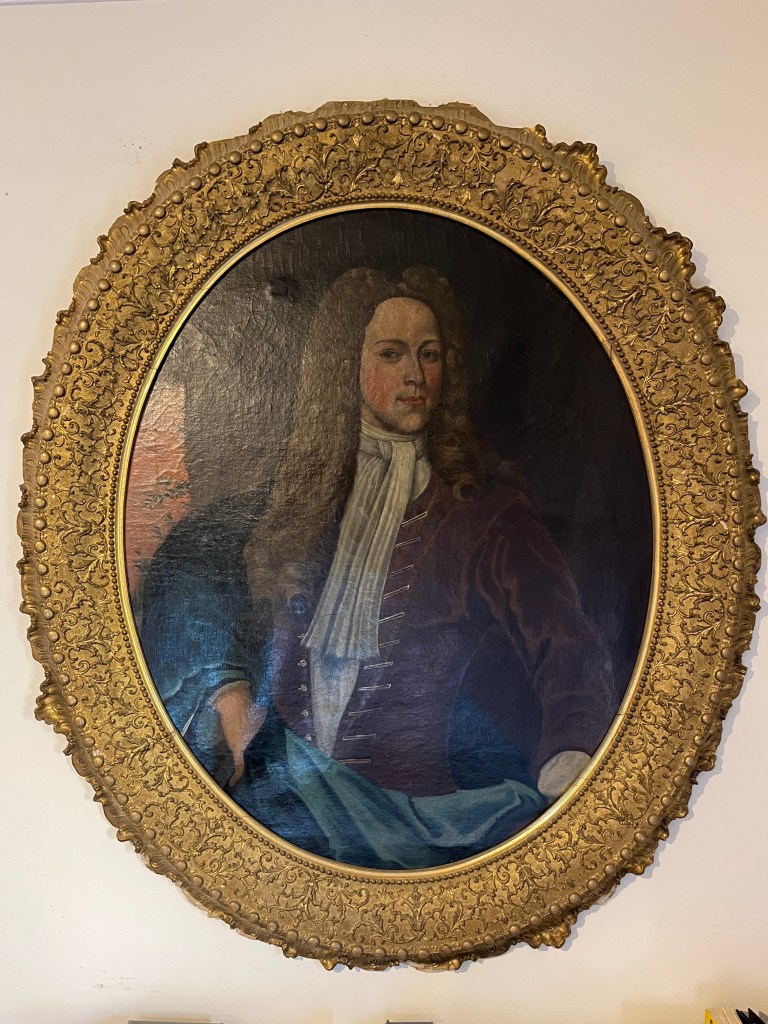
Caption
His prideful gaze washed and darkened over with aging varnish residue, a copy of Johannes De Peyster III’s portrait in New York Historical Society now resides over the desk of Grimm Louise’s Office within the historical walls of Huguenot Street. For the Huguenot Street historians he serves as a reminder to be timely with their work; but to history, it serves as a reminder of New York, and New Paltz, colonial government.
Physical Description:
The portrait is an oil on canvas in a wood gilt frame, the oval inside dimensions are 27 ¾” w x 35” h, and its frame dimensions are 35” w x 46” h. Looking at the portrait, Johannes De Peyster III, an influential businessman and Albany mayor from 1729-1733, is dressed in formal colonial attire that reflects his wealth. This features a clothing made from high-quality fabrics such as a long fitted coat, waistcoat, and lace cuffs and collar, representing status. His outfit is made of dark, somber hues such as blacks, browns, and dark greens, characteristic of formal fashion in the period.
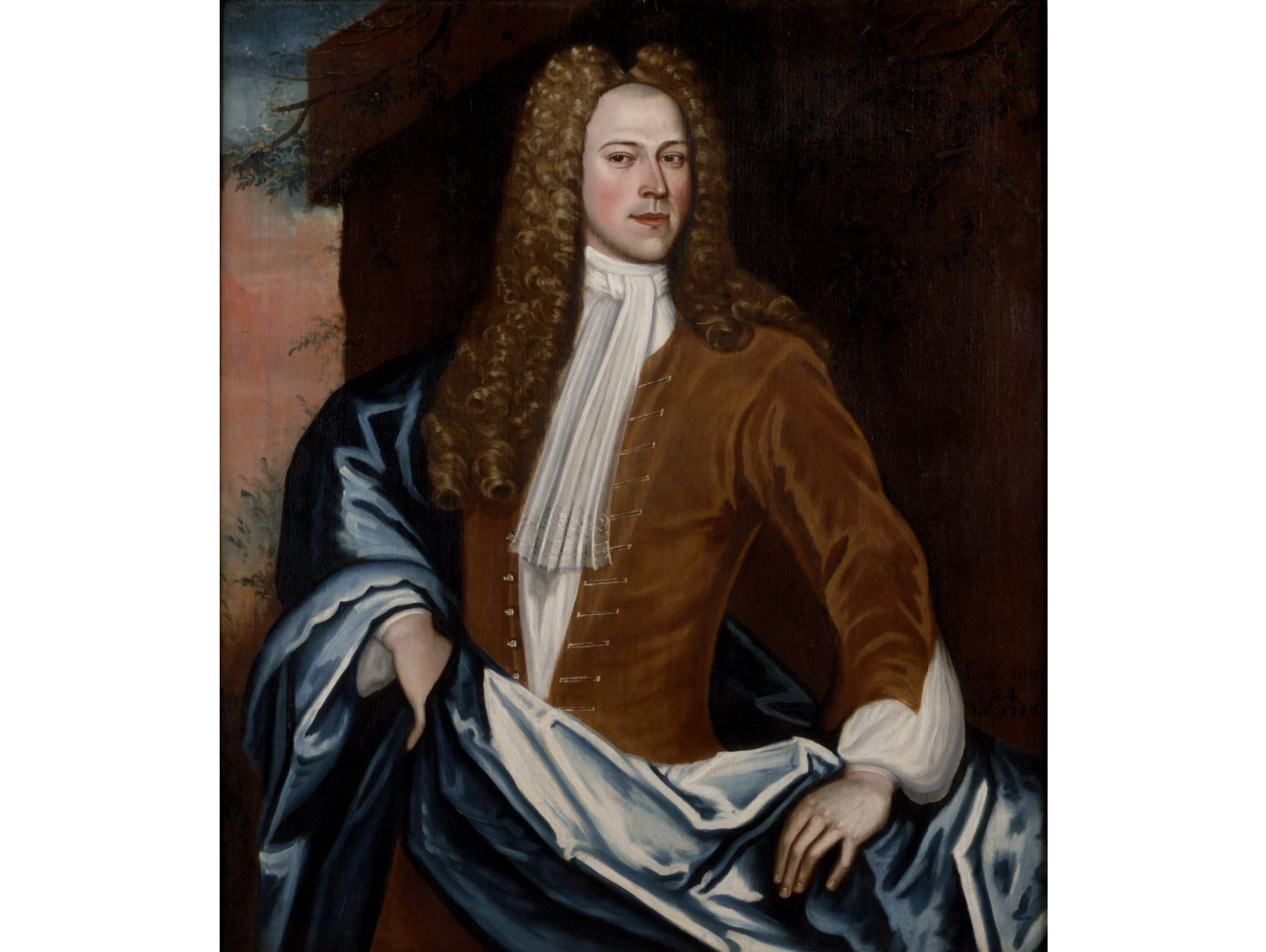
His pose depieted in this portrait is dignified and restrained, his gaze is serious conveying the authority anticipated of a mayor. The background consists of minimalistic elements. What can be seen as a possible evening sky on the left side of the painting with muted blues and pinks coinciding with minimal dark foliage. Additionally, a dark and muted wooden structure contrasts with DePeyster’s figure and attire ensuring he remains the focal point. The color scheme of this piece consists of dark and subdued tones, with dramatic light and shadow contrasts that highlight DePeyster’s face and hands. This chiaroscuro effect highlights his features, the textures of his clothing, and the intricacies on his face. Which may show indications of age, implying his longevity and life experience
Given his age during the time of this portrait, DePeyster’s face should bear the lines and creases of age, however, in this portrait, DePeyster’s face is idealized providing the mayor with a young and glowing face, which in many historical cases reinforced their power and status. His hair, likely powdered or styled in colonial fashion, frames his face, emphasizing a receding hairline and his status as a higher-ranking official.
The portrait’s style is likely consistent with the restrained, realistic approach popular in early American colonial portraiture, which values realism, formality, and respectability above expressiveness or romanticized features. It may be heavily influenced by European, particularly Dutch, portrait traditions, demonstrating the enduring cultural linkages between colonial America and the Old World.
Provenance:
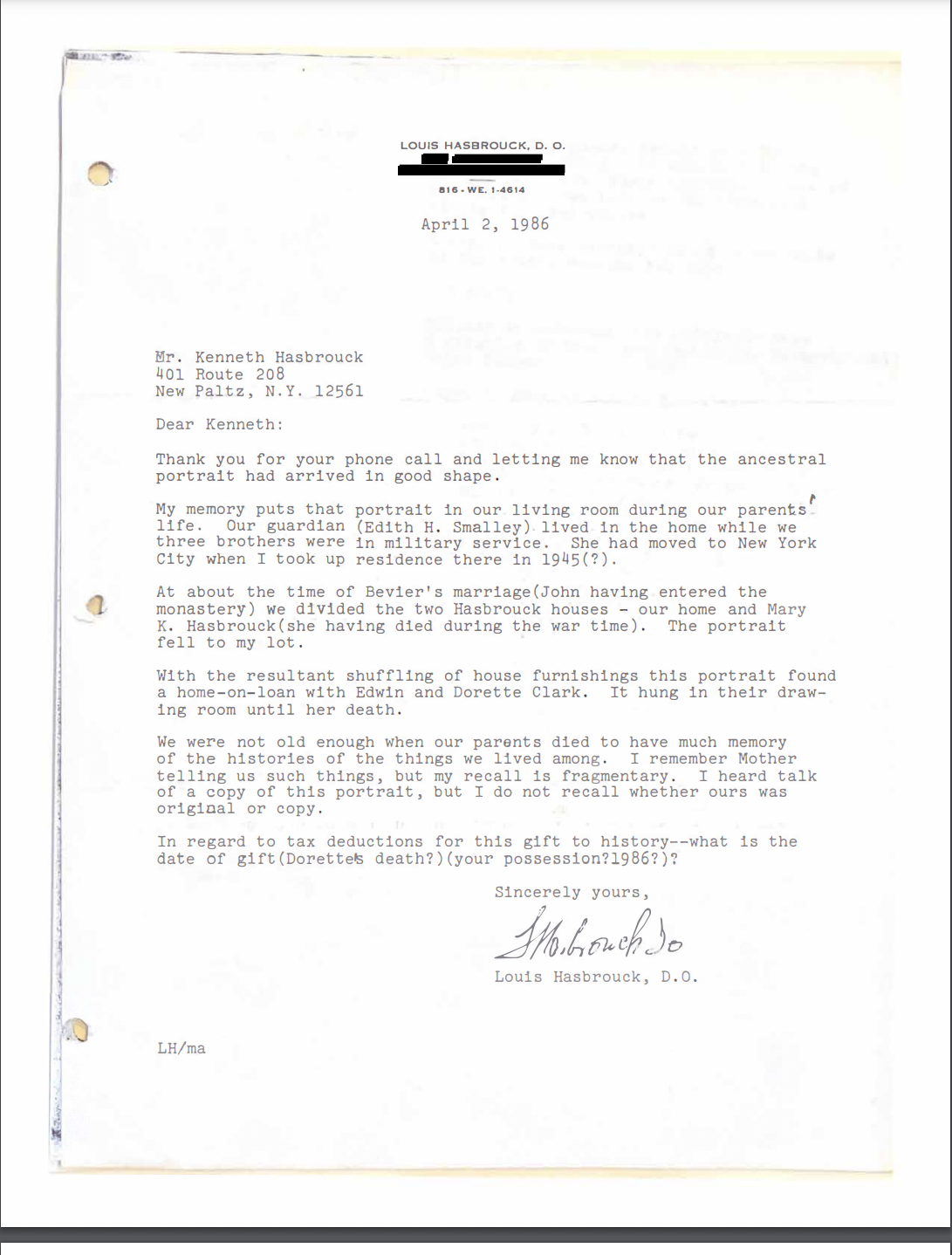
The subject of this work is Johannes DePuyster, John DePuyster Douw’s grandfather. The original portrait was painted around 1718 by Nehemiah Partridge. The original is in the New York Historical Society collection. However, this copy was donated on April 2nd, 1986 by Mr. Louis Hasbrouck to Mr. Kenneth Hasbrouck for the Historical Huguenot Street collections. The portrait found its way into the Hasbrouck family when the Donor’s mother, Helen Miller, a descendent of the subject, Johannes DePeyster III, married Levi Hasbrouck in 1918.
Mr. Louis Hasbrouck states his memory puts this very object into the living room of his parent’s estate. Their guardian, Edith H. Smalley, lived in the home while Louis and his two brothers were in military service. Smalley then moved to New York City when Mr. Louis Hasnrouck took residence in his parent’s estate around 1945.
While there isn’t any record of the exact location of the Hasbrouck family home what we do know is how such a painting ended up in Mr. Louis Hasbrouck’s lot. Bevier Hasbrouck marries and John enters a monastery. Dividing the two Hasbrouck homes, Louis Hasbrouck and his wife Susan Brunck Hinman and Mary K. Hasbrouck, who died during wartime. The portrait then fell into the possession of Louis Hasbrouck. During the division of the two Hasbrouck homes, the painting was found home-on-loan with Edwin and Dorette Clack which hung in their drawing room till death. This leads the painting to be brought back into possession of the Hasbrouck family.

Narrative
Johannes De Peyster was born in New York in 1694. He was the son of Johannes De Peyster, a merchant of Huguenot descent, and Anna Bancker De Peyster, an Albany native. His extended career in Albany and his time in military service serve as a model for success in early America.
In 1713, Johannes traveled upstate to learn business from his uncle, Albany entrepreneur Evert Bancker. In 1715, he married Albany-born Anna Schuyler, the eighteen-year-old daughter of Albany’s most important New Netherland family. De Peyster, after successfully conducting business with his uncle, then moved to his uncle’s house on the south side of State Street, Albany, where he would reside for the next seventy years. Additionally, in 1721, Johannes was elected first ward assistant, succeeding his uncle. The next year, in 1722, Johannes was elected alderman and was re-elected every year until 1726, when he was then named city recorder. Johannes was named mayor of Albany in 1729 and served until 1733. He was later elected as an alderman from 1748 to 1754. Additionally, he was a militia officer from 1717 to the 1740s. He frequently had contract business with city hall and was an active member of the Commissioners of Indian Affairs until he resigned in protest in 1746.
The object itself was originally created in 1718 by Nehemiah Partridge. Around 1718, Partridge was introduced to the society of Albany, New York, which had not yet been visited by any painters. It’s unclear how he met clients, although it might have been through Boston merchant Jacob Wendell, whose cousin Evert Bancker was one of Albany’s most influential.
We don’t have much information on our version of the portrait, we are unsure who created it or when it was copied from its original. Just like aging varnish, there is a mystery to what lies beneath the surface. However, this copy of this painting from the Hasbrouck family serves as a connection to the early European settlers in New Paltz, as well as a connection to the greater early Dutch colony of New York.
Provided documents from HHS by Louise McGoldrick, a Collections Manager at the site, connect a direct lineage to the Hasbruock family in possession of this portrait to the history of New Paltz. “There is a list of names (Louis – Louis – Joseph – Abraham – Joseph – Abraham) under the donor’s parent (G-37) that tracks the direct family line back to the Patentee, Abraham Hasbrouck (1657-1717).” (McGoldrick, 2024)


To the history of New Paltz, The Patentees is a group of early male European settlers. These are the men who signed the 1677 land deal with the Esopus Munsee tribe, exchanging goods for permission to live on 40,000 acres of land that is now the larger New Paltz region. The Patentees consisted of men each representing French Huguent and Wallon origin, one of these men was Abraham Hasbrouck.
September 15th, 1677, the Esopus-Huguenot Land Agreement was enacted. The original boundaries of the patent contained a large part of present-day southeastern Ulster County, including portions of the towns of Esopus, Lloyd, Plattekill, Gardiner, and Shawangunk. For this land, Huguenots traded a collection of goods such as domestic supplies, tools, clothing, animals, and gunpowder and gave the Esopus the right to hunt on the lands exchanged within the patent.
The land agreement also reflects a connection to Albany and Johannes De Peyster III. From the seventeenth century through the eighteenth century, the fur trade between the Dutch and English settlers and the Iroquois nation dominated within the Capital region. Johannes De Peyster III served as mayor and a member of the Indian Affairs Commission during the major conflicts and trades between the natives and Albany settlers. The fur trade helped the Iroquois strengthen their hold in the region by allowing them to control key resources while still maintaining connections with European nations. De Peyster took part in the contacts between the two powers. De Peyster, who came from a wealthy business and political family, was a well-known fur merchant and landowner. As mayor and merchant, he was in charge of monitoring trade regulations and guaranteeing Albany’s powerful status. This contributed to the overall economic and political dynamics between the Iroquois and the British colonies.
Johannes De Peyster III’s portrait and history coincide with the history of Abraham Hasbrouck in the town of New Paltz. The two of these histories bridge to New York’s colonial history, one of major power and the other an individual rural town. Involved in fur trades and land agreements, both the influence in Albany and the smaller town of New Paltz participated in democratic interactions. These stories offer significance in a town such as New Paltz with an early Dutch influence; figures like De Peyster constituted an elite class of leaders who participated in local and regional decision-making processes. Although De Peyster is unlikely to have actually shifted voting habits, his participation illustrates the long tradition of civic duty and governance that formed colonial political culture and, eventually, the creation of American democracy. De Peyster’s family lineage connects the regions together.
We may never know what lies behind the intentions of this copy, or it’s true origins. What we can tell from his gaze is to always make sure to check our emails but to also look at the grand history of early America in the new world; connecting New Paltz to the bigger colonial history of New York state.
Works Cited
Goldstein, Jacob. “Murder in Colonial Albany: European and Indian Responses to Cross-Cultural Murders.” Order No. 1517173 The George Washington University, 2012. United States — District of Columbia: ProQuest. Web. 29 Oct. 2024.
Historic Huguenot Street, http://www.huguenotstreet.org/. Accessed 29 Oct. 2024.
Johannes de Peyster, exhibitions.nysm.nysed.gov/albany/bios/d/jodp.html#jdp. Accessed 3 Nov. 2024.
“Johannes DePeyster III (1694-1789).” Johannes DePeyster III (1694-1789). | New York Historical Society | Digital Collections, digitalcollections.nyhistory.org/islandora/object/nyhs%3A2121. Accessed 3 Nov. 2024.
New York Heritage Digital Collections, nyheritage.contentdm.oclc.org/digital/search/collection/hhs!p16694coll153. Accessed 29 Oct. 2024.
“Nehemiah Partridge.” Artist Info, http://www.nga.gov/collection/artist-info.6691.html#biography. Accessed 3 Nov. 2024.
McGoldrick, Louise. Email to the author. 28 October 2024.
 The Materials of History, Thought, and Art
You must be logged in to post a comment.