

These are campaign pins preserved from the 1964 Barry Goldwater and William Miller of the Republican party. Giving the modern onlooker a glimpse into the past, these pins help contextualize the political engagement of New Paltz in its local, state, and federal elections as well as provide insight into the campaign efforts in the area.

There are seven campaign pins spread across a white tablecloth background angled in various directions. They span 1.25 inches in diameter—white with a red border and black-and-white images of the candidate and his running mate, Goldwater and Miller, though the outer edges show signs of weathering given their age (roughly 60 years). Above their heads in blue and white reads the Dutch phrase, “EEN PLOEG VOOR VRYHEID,” roughly translating to “A Team for Freedom/ Liberty.” The pins are composed of thin metal and are stored in a cardboard tube, which is marked by a red, white, and blue sticker labeled “EEN PLOEG VOOR VRYHEID GOLDWATER MILLER.”

Though the Historic Huguenot Street currently owns this, it was donated by a member of the community. Information surrounding that chain stops there. One replica of the pin is currently being sold on popular commerce site eBay, with the seller located in Greenbackville, Virginia. Its container—a cardboard tube—only contains one identifying label, which traces its roots back to a union called the International Union of Painters and Allied Trades, with Local 820 “representing sign & display workers, paint manufacturing and other industrial workers,” according to the union’s website. Local 820 falls under District 3, which serves Western Missouri and Kansas, identifying the origins of these pins in these Midwestern regions. The origins of the Dutch phrase do not produce any leads either.
The 1964 Presidential Election came at a tumultuous time, less than a year after the assassination of former President John F. Kennedy. Lyndon B. Johnson was selected as the Democratic Party nominee, while Barry Goldwater, an Arizona Senator, was selected as the Republican Party nominee.
Goldwater was controversial at the time, as he was seen as a much more extremist candidate. He was highly critical of Republican moderates, against big government involvement, and infamously voted against the Civil Rights Act of 1964. Nevertheless, he won the bid, stating in his Republican National Convention acceptance speech, “Extremism in defense of liberty is no vice” and that “moderation in pursuit of justice is no virtue.”
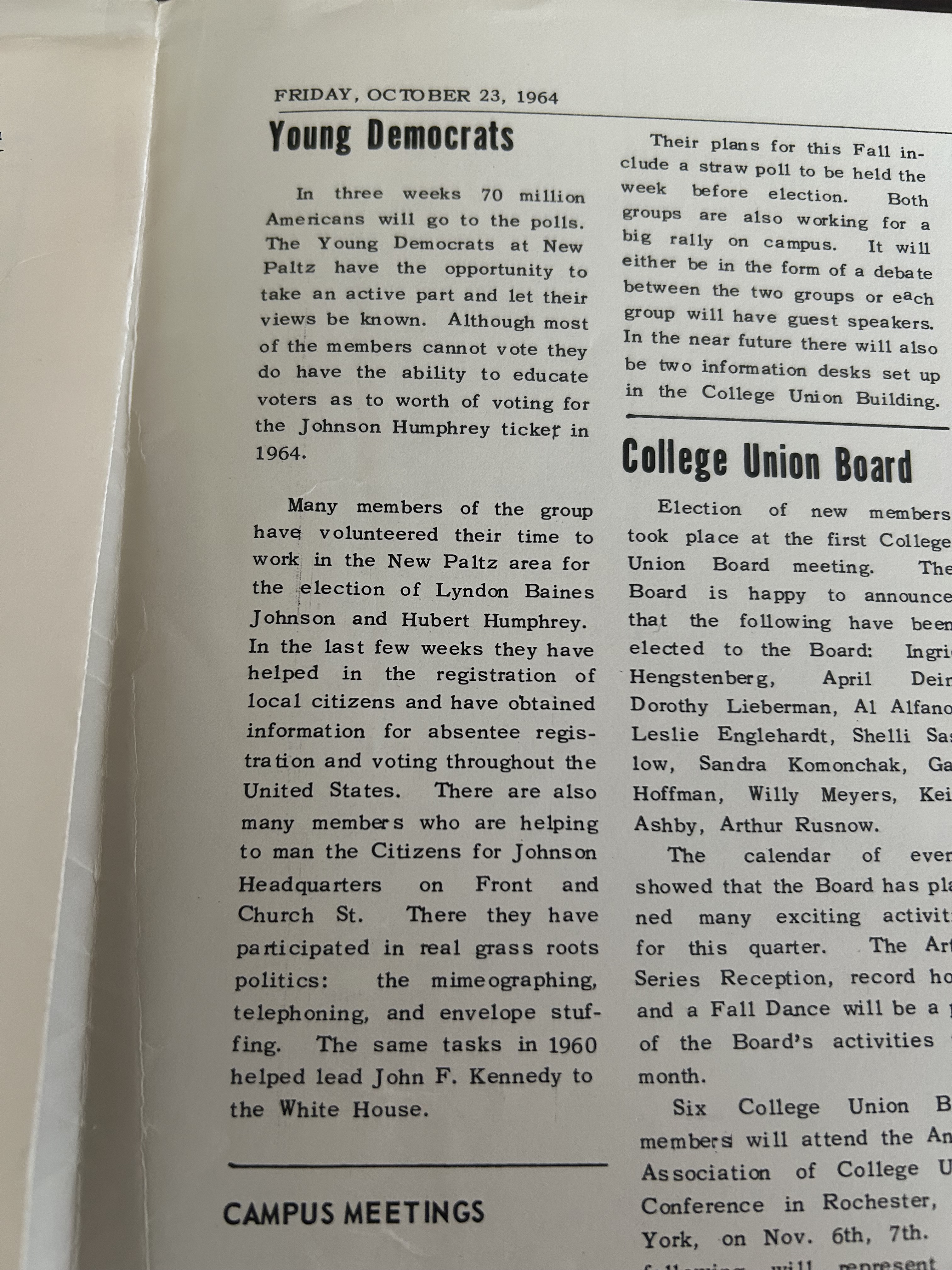
When it comes to national campaigns, local chapters and organizations bear the brunt of the education and mobilization processes, whose efforts were often reported on by local newspapers. Taking a look at SUNY New Paltz, the Social Science Club worked to mobilize students to vote. An archived paper from The Oracle, the SUNY New Paltz student-run newspaper, dating back to November 6, 1964 details the campaign efforts on campus. From the Social Science Club emerged two groups—the Young Democrats and the Young Republicans. Between October 20 to October 28, the two groups worked to sway voters in the direction of their party’s candidates. “The [College Union Building] tables were stacked with literature, bumper stickers, and bowls full of campaign buttons. In all, about 2400 buttons were given out.” It was not confirmed whether the campaign pins owned by the Historic Huguenot Street are the same pins as the ones distributed, but nonetheless they belong to the same campaigns. The two groups served as informational centers, with the Young Republicans group reportedly, “[playing] tapes of ‘Let’s Put Barry in the White House’ and ‘Keating, Keating.’” The Young Democrats, as noted in the October 23 issue, “have volunteered their time to work in the New Paltz area for the election of Lyndon Baines Johnson and Hubert Humphrey.” Much of the work these two groups engaged in contributed towards similar things: voter registration, ballot information, and engaging with local politicians. Campaign materials, such as pins, were used to further engage the voter bases at the university level. Even though many could not vote (the minimum voting age was set to 21 until 1971), education was at the forefront of their efforts.

Zooming out a bit, the presidential campaigns in the town of New Paltz were largely spearheaded by their respective party chapters—New Paltz Republican Club and the Democratic Club of New Paltz. The New Paltz Independent and Times, a local defunct paper, detailed the various events these organizations would host. One example is that the Democratic Club hosted a Torchlight Parade and Rally as well as a Voter Registration Drive (seen in the October 7, 1964 article), whereas the Republican Club hosted an event on October 13, 1964 for the SUNY New Paltz Young Republicans Club, bringing in Bernard Kramer, the secretary to Republican Congressman J. Ernest Wharton, to speak on Wharton’s policies and platform. Kramer also “reiterated [Wharton’s] support of the entire Republican ticket from Barry Goldwater down the line.” It was not uncommon for local politicians to cross these lines and endorse every member on their party’s ticket, from federal to state to local. In an editorial piece on October 28, 2024, the Democratic Club wrote to “urge [voters] to vote on November 3 for the entire Democratic team,” endorsing the Johnson-Humphrey ticket as well as every other Democrat. There was an exceptional amount of effort poured in on behalf of political organizations to ensure that every candidate on their party’s ticket was campaigned for.
In another publication, New Paltz News featured many overlapping stories in addition to a 1964 Voters Guide compiled by The League of Women Voters, a “nonpartisan organization working to promote political responsibility through informed and active participation of citizens in government.” The guide, published in the October 22, 1964 issue, listed out every local politician specific to New Paltz’s districts, providing short general descriptions of the candidates as well as their answers to questions that the League had asked, providing a database for voters to refer to on the ideas and policies of each candidate. This demonstrated how educational efforts were not just evident in the events happening in town, but the newspapers themselves.


The New Paltz Independent and Times and New Paltz News reported on the results on November 4 and 5 respectively. The town of New Paltz voted in favor of Johnson, leading by 59% in all four districts, reflecting the same Democratic percentage of Ulster County at 59.1%. Johnson ultimately won New York and its 43 electoral votes. At the national level, Johnson won 486 of the electoral votes, winning the election in a landslide.
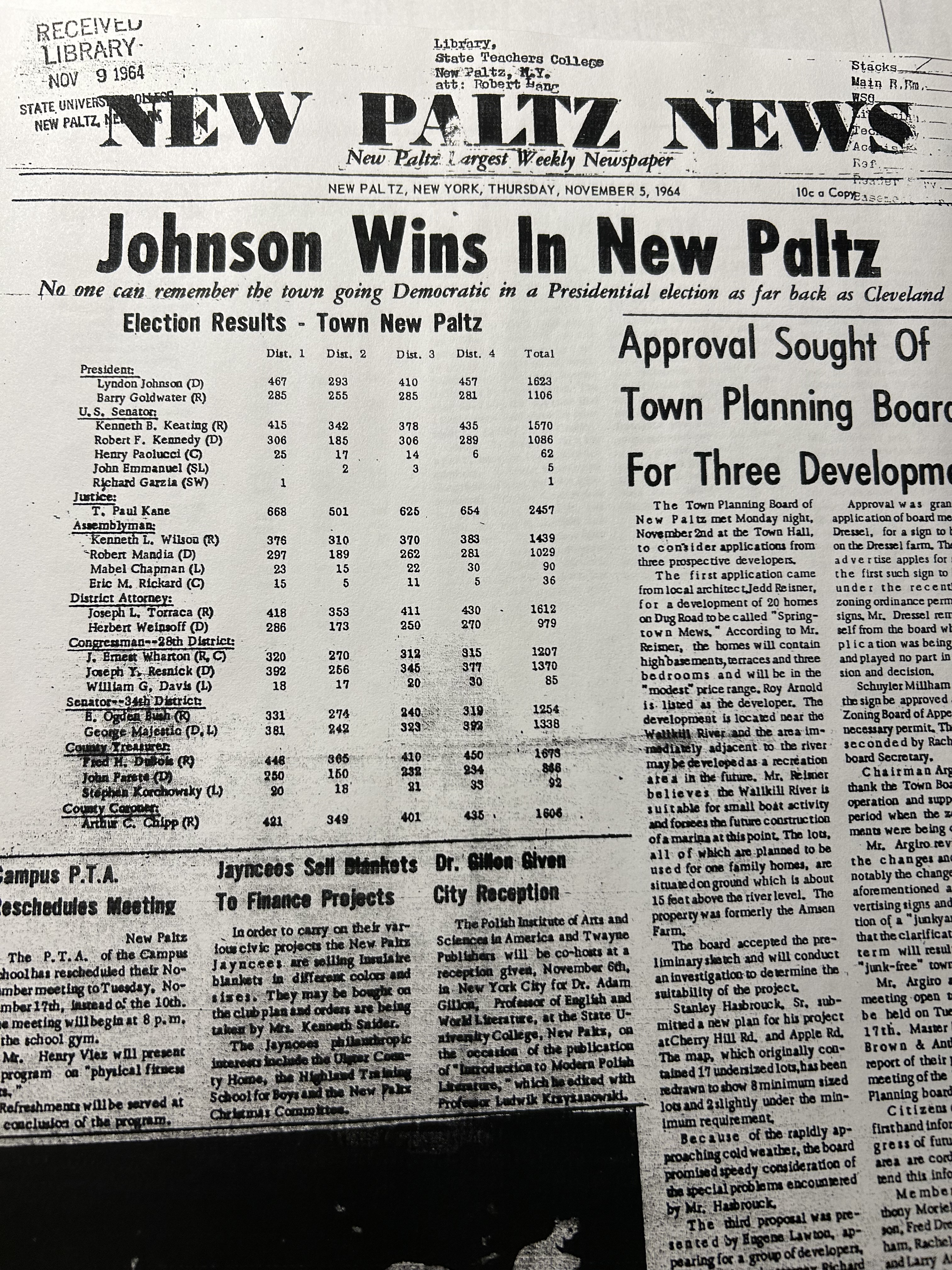

By looking through these three papers, they offer a better lens in analyzing the historical context surrounding these pins. They were part of not just the Republican party’s campaign, but a larger mobilization effort on both parties to advocate and campaign for all candidates specific to New Paltz. Campaign pins were a way to demonstrate support and further carry the messages of the politicians across communities. These educational efforts can be reflected on our own modern advocacy networks, with nonpartisan groups such as the New York Public Interest Research Group (NYPIRG) working throughout the semester up until election day to register voters, educate students on voting options, and provide resources on candidates and ballot information. Despite the 60 years that separates us from the Goldwater Miller campaign, the preservation of these campaign buttons illustrate the long-lasting work of local political organizations to sway, but ultimately, educate voters.
Works Cited
Holden, Charles J. “The Republican National Convention That Shocked the Country.” TIME, Time, 17 July 2024, time.com/6991064/rnc-history-1964-republican-convention/. Accessed 4 Nov. 2024.
International Union of Painters and Allied Trades. “Locals IUPAT District Council 3 Serving Western Missouri and Kansas.” International Union of Painters and Allied Trades District Council 3, 2014, iupatdc3.com/locals/820. Accessed 4 Nov. 2024.
Leip, David. 1964 Presidential General Election Data Graphs – New York by County. Dave Leip’s Atlas of U.S. Elections, 1999, uselectionatlas.org/RESULTS/datagraph.php?year=1964&fips=36&f=1&off=0&elect=0. Accessed 4 Nov. 2024.
McGee, Suzanne. “How Barry Goldwater Brought the Far Right to Center Stage in the 1964 Presidential Race.” HISTORY, 20 Oct. 2020, http://www.history.com/news/barry-goldwater-1964-campaign-right-wing-republican. Accessed 4 Nov. 2024.
New Paltz News. “Johnson Wins in New Paltz.” New Paltz News, 5 Nov. 1964.
The Democratic Club of New Paltz. “Vote on Nov. 3.” The New Paltz Independent and Times, 28 Oct. 1964.
The League of Women Voters. “1964 Voters Guide.” New Paltz News, 22 Oct. 1964.
The New Paltz Independent and Times. “Democratic Club Met October 1st.” The New Paltz Independent and Times, 7 Oct. 1964.
—. “Johnson Elected in Historic Landslide.” The New Paltz Independent and Times, 4 Nov. 1964.
—. “New Paltz Republican Club to Host College Students.” The New Paltz Independent and Times, 7 Oct. 1964.
—. “Wharton Record Outlined at Republican Club.” The New Paltz Independent and Times, 14 Oct. 1964.
The Oracle. “Social Science Club: New Paltz Sweep for Johnson.” The Oracle, 6 Nov. 1964.
—. “Young Democrats.” The Oracle, 23 Oct. 1964.
 The Materials of History, Thought, and Art
You must be logged in to post a comment.