
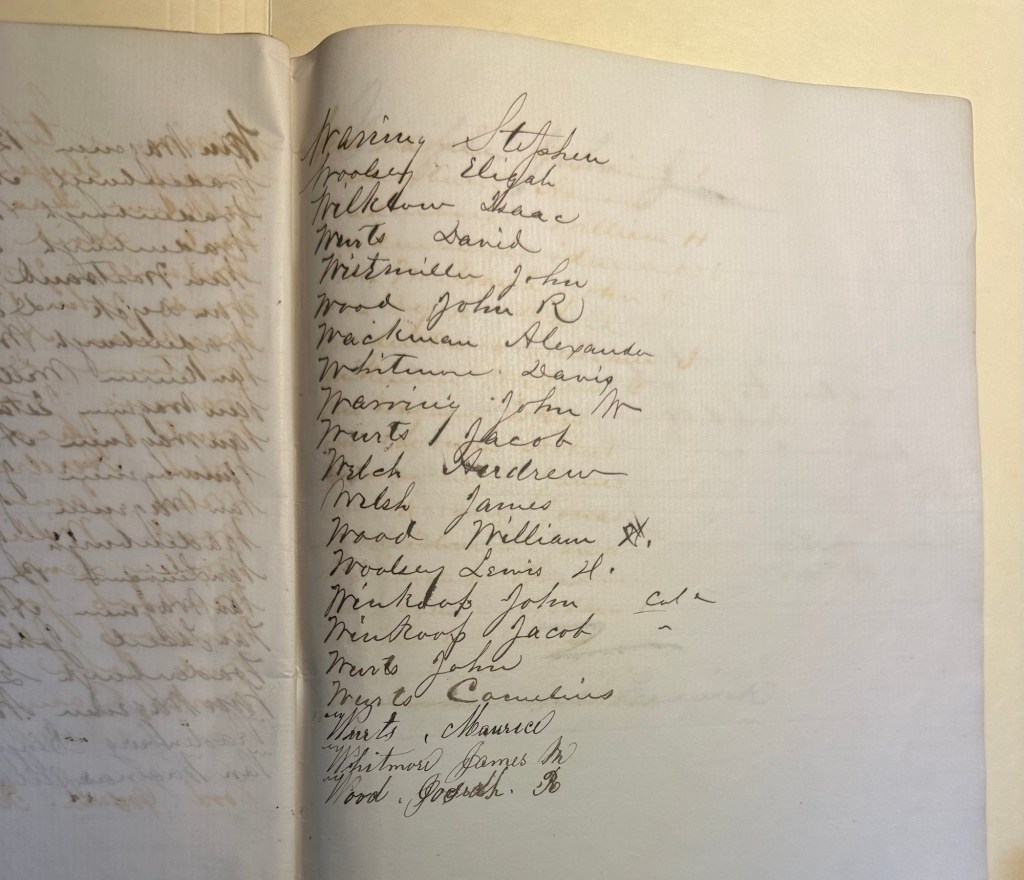
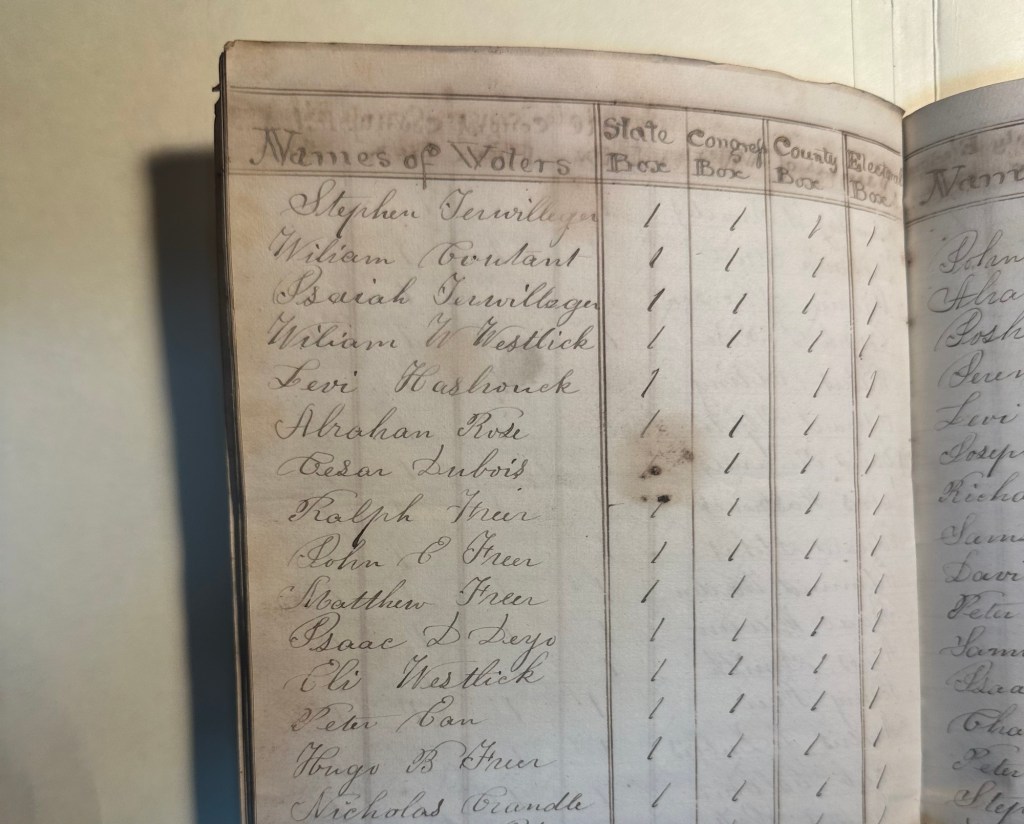
Caption: The above image is a list of registered voters in New Paltz from 1859, whose last name begins with letter H. John Hasbrouck is labeled as color on the right-hand side. Once thought to be the first Black man to vote in New Paltz, now John Hasbrouck has been stripped from that title.
Physical Description: The page that lists John Hasbrouck is contained within a booklet still in good condition. The page is estimated to be 8.5” by 11”. The booklet is kept within a manilla folder which is the legal size of 9.5” by 14.6”. The manilla folder is kept inside a file box. The booklet does have some creasing, specifically where the tab that indicates the page of the voters’ last name beginning with that letter has been dog-eared. Additionally, the ink of each page within this booklet can be seen to have bled onto the page before it. All names appear in cursive.
Provenance: Not much is known about the ownership of this document. These documents were in the possession of Kenneth Hasbrouck. Then they became part of the New Paltz Town Records Collection. These documents reside in the archives and are now taken care of and administered by Historic Huguenot Street, but they are property of the town of New Paltz.
Narrative: As the Hasbrouck family has been connected to the French Huguenots, lets consider where the Huguenots came from. The Huguenots immigrated to America either “directly from France and indirectly from the Protestant countries of Europe, including the Netherlands, England, Germany, and Switzerland”(“Huguenot History.”). This was a gain for America as the Huguenots brought “skills of finance, industry, medicine, arts and crafts”(Paley). Additionally, the moving of the French Huguenots significantly impacted the village as they brought with them their values, causing them to integrate themself with the United States government as they establish within the village of New Paltz. As a result, they become a part of the elections.
The Hasbroucks are “descended from the brothers Jean and Abraham, French Huguenots, who both arrived in America in the early 1670s” (“Hasbrouck Family Association.”). In New Paltz, NY there are two houses on Huguenot Street that were owned by the Hasbroucks are still enduring the weather conditions of the northeast. These houses are the Abraham Hasbrouck house and the Jean Hasbrouck house.
John Hasbrouck is considered to be one of the first registered colored voters in New Paltz, New York. John Hasbrouck lived from 1806 to 1879. He was not legally a slave but rather considered a “slave servant” (John Hasbrouck). Was the term “slave servant” used so that the Hasbrouck family could feel better about themselves? The account book of John Hasbrouck showcases that John received compensation for his work.
Johns’ owner by lineage of being birthed by an enslaved woman who was under Jacob J. Hasbrouck was that same individual. However, Jacob J. Hasbrouck passed in 1806; Jacob resided in New Paltz as a wealthy landowner. Due to the passing of Jacob, John was “inherited by Jacob’s son, Jacob J. jr.”(John Hasbrouck).
In 1821, there was a New York State law that stated the only possibility for an African American to vote was that they “needed to own property valued at $250 or more” (“Black Suffrage in New Paltz.”). Later in 1870, this requirement was removed as the U.S. Constitution added the 15th Amendment, which allowed all men to vote regardless of their race.
The document showcases that John was listed to vote in 1859. It can be assumed that he owned property as the advantage of owning it gave him the right to vote. However, it is clearly shown that next to John’s name the office of register denoted him as a person of color.
On a larger scale this document highlights significant facts that are still being recorded in today’s elections. “Demographic changes could continue to reshape the electoral landscape in future elections”(Igielnik). Keeping track of which individuals are registered to vote can provide insight on the expected results of an election. Today individuals need to be registered to vote at least 10 days before general elections and have their information updated to avoid being ineligible to vote.
Works Cited
“Black Suffrage in New Paltz.” Omeka RSS, omeka.hrvh.org/exhibits/show/jane-deyo-wynkoop/black-suffrage-in-new-paltz.
“Hasbrouck Family Association.” Historic Huguenot Street, www.huguenotstreet.org/hasbrouck.
“HHS_749_FULL.” Home, nyheritage.contentdm.oclc.org/digital/collection/p16694coll153/id/27329/rec/2.
“HHS_JOHNHASBROUCKACCOUNTBOOK_MSS_323_009.” Home, nyheritage.contentdm.oclc.org/digital/collection/p16694coll153/id/27278/rec/4.
“Huguenot History.” Seal of the Huguenot Society of America, www.huguenotsocietyofamerica.org/history/huguenot-history/.
Igielnik, Ruth. “The Changing Racial and Ethnic Composition of the U.S. Electorate.” Pew Research Center, Pew Research Center, 23 Sept. 2020, www.pewresearch.org/social-trends/2020/09/23/the-changing-racial-and-ethnic-composition-of-the-u-s-electorate/.
John Hasbrouck · The Missing Chapter: Untold Stories of the African American Presence in the Mid-Hudson Valley · Hudson River Valley Heritage Exhibits, omeka.hrvh.org/exhibits/show/missing-chapter/people/john-hasbrouck.
Paley, Ben. “Huguenot History.” Huguenot Museum, huguenotmuseum.org/about/the-huguenots/.
 The Materials of History, Thought, and Art
You must be logged in to post a comment.