Author Archives: allynasar
The Paltzonian of 1928
CAPTION:
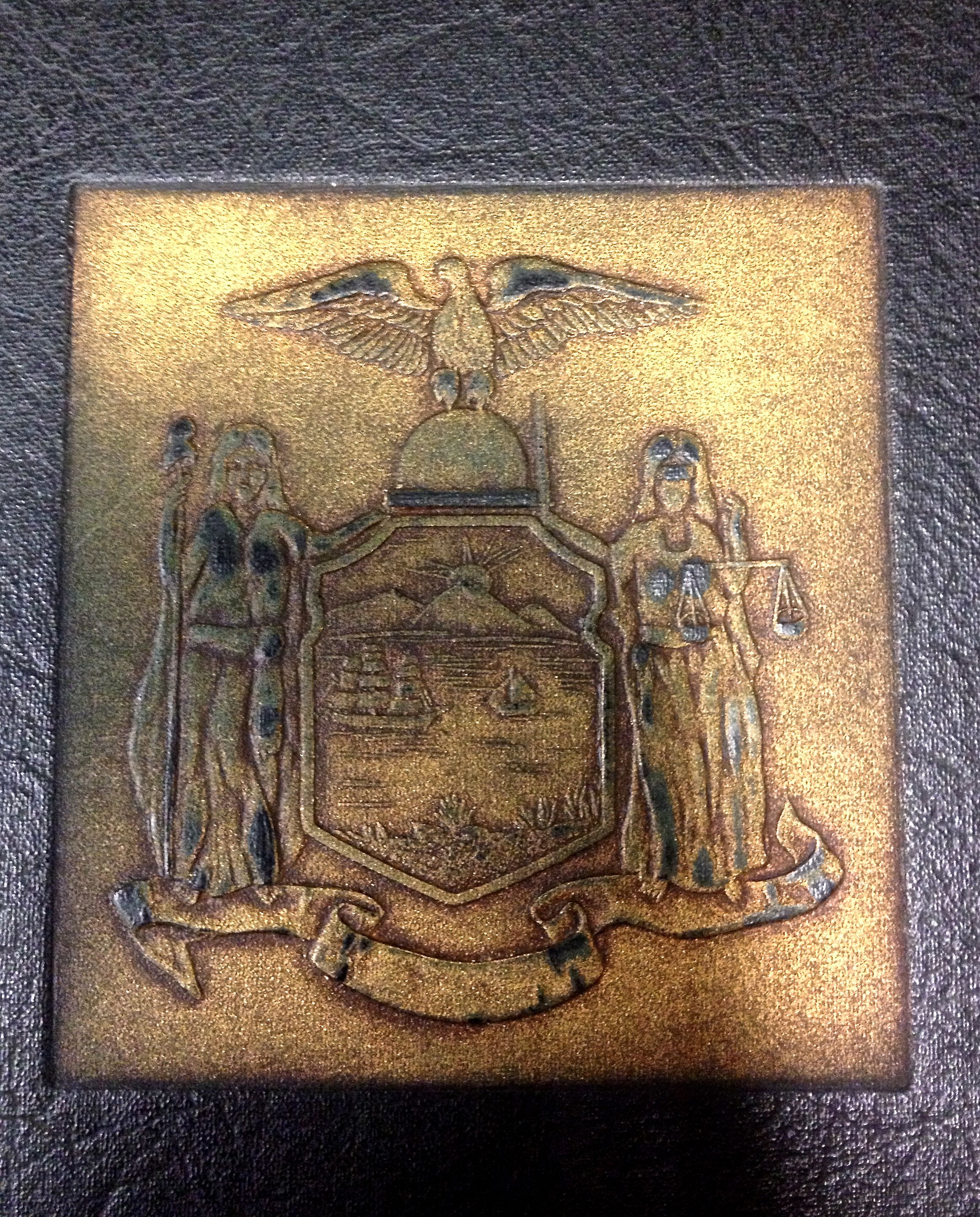
This New Paltz Paltzonian Year Book of 1928 captures the essence of the New Paltz Normal School and its culture at this time.
DESCRIPTION:
This black, hardbound book is around 8.5in by 11in. It is a little scuffed up and tattered around the edges, and has a gold colored symbol embossed on the cover that is worn with age. This symbol features and armored plate with a seascape in the background, presumably the shores settlers reached on their journey to what is now New Paltz. There is a hawk at the top, the colleges mascot, and two female figures on each side. The women are stylized with Greco-Roman influence and are draped in flowing robes. One of these figures is holding a balance scale, while the other is holding a staph.
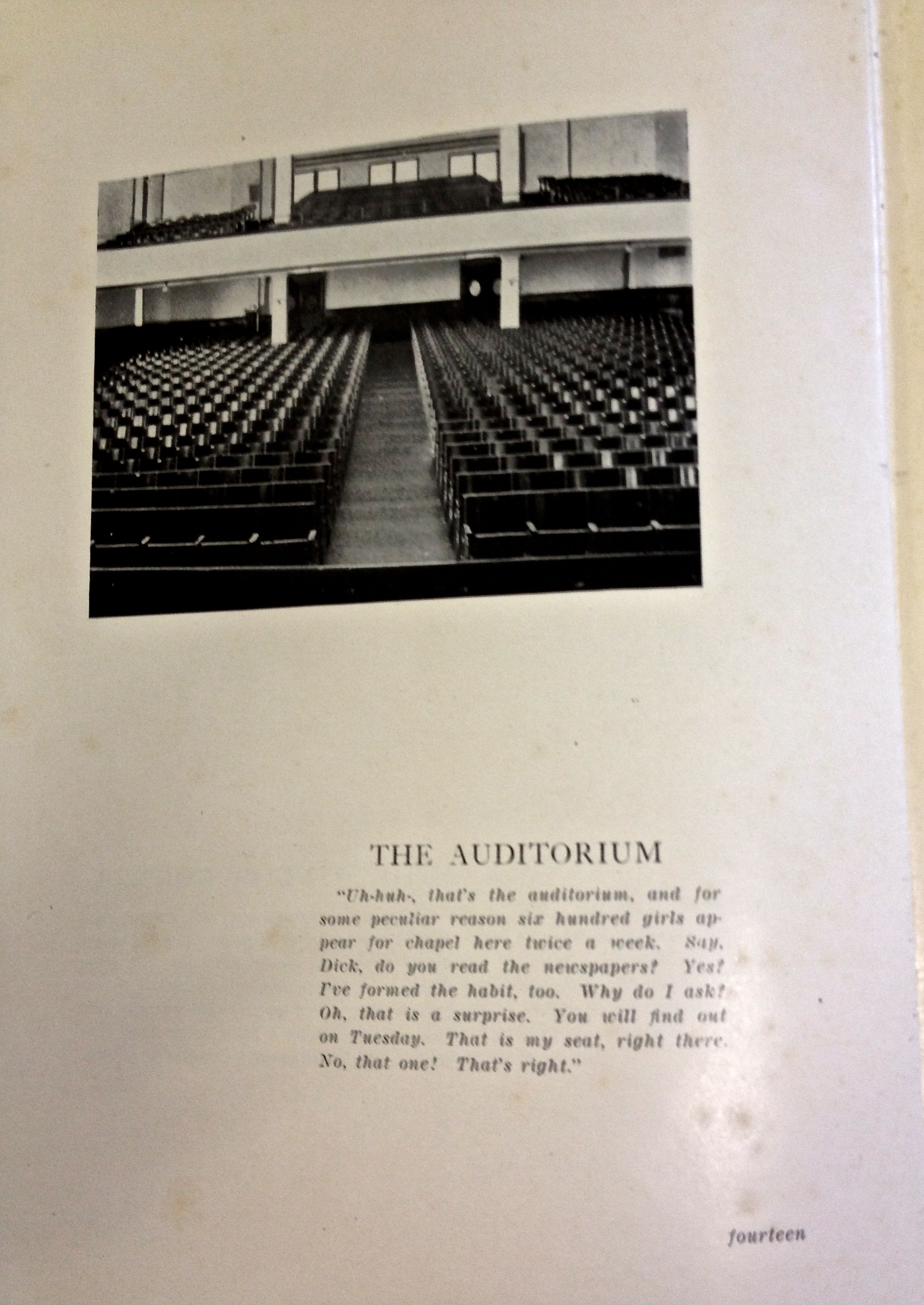
The inside of the book is detailed with 200 pages, which include a variety of content, such as numerous pictures students took around New Paltz, details of teachers and students, organizations, sororities, clubs, a literary section, sports, humor, pictures, advertisements, and contributions.
PROVENANCE:
This object was created in 1928 by the local board of the New Paltz Normal School and was saved here at New Paltz up until present day. Now it remains in the New Paltz special collections at the Sojourner Truth library.
DATE(S):
1928
NARRATIVE:
As I flipped through the dusty pages of the Paltzonian, I was taken back in time to New Paltz in 1928 at the Normal School. Being that it is a Normal School, the subjects primarily had to do with training students in education. I turned the pages and came across a list of all of the students here, the senior grade had pictures and suddenly the popular hair style for girls was dark, wavy hair cropped close to the head
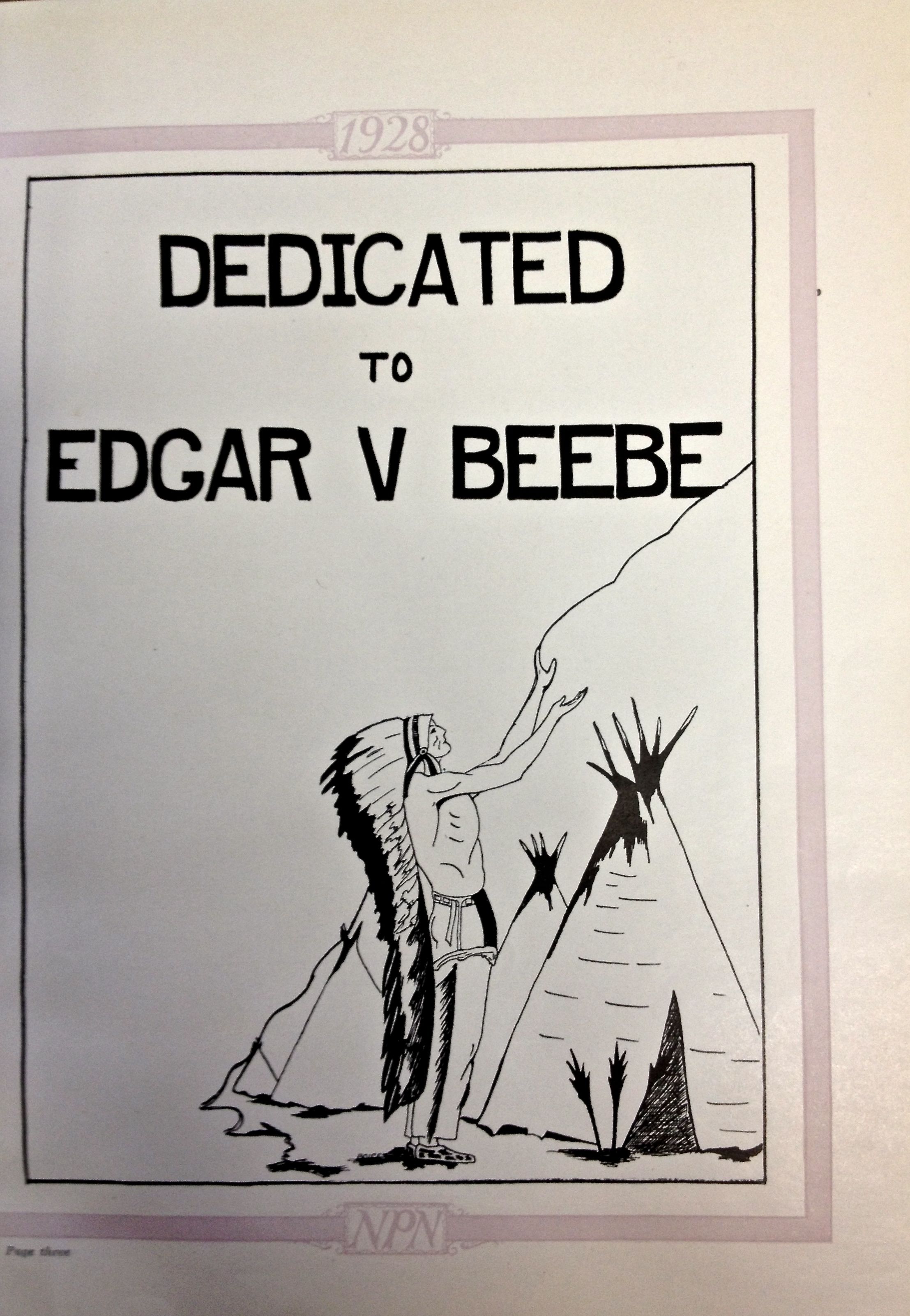
This book is dedicated to Edgar V Beebe, an obviously significant man to New Paltz at this time, as his picture takes up an entire page, making it the biggest picture of a person in the yearbook. Beebe had a doctorate in psychology and was a teacher at the Normal School who had done civil service.
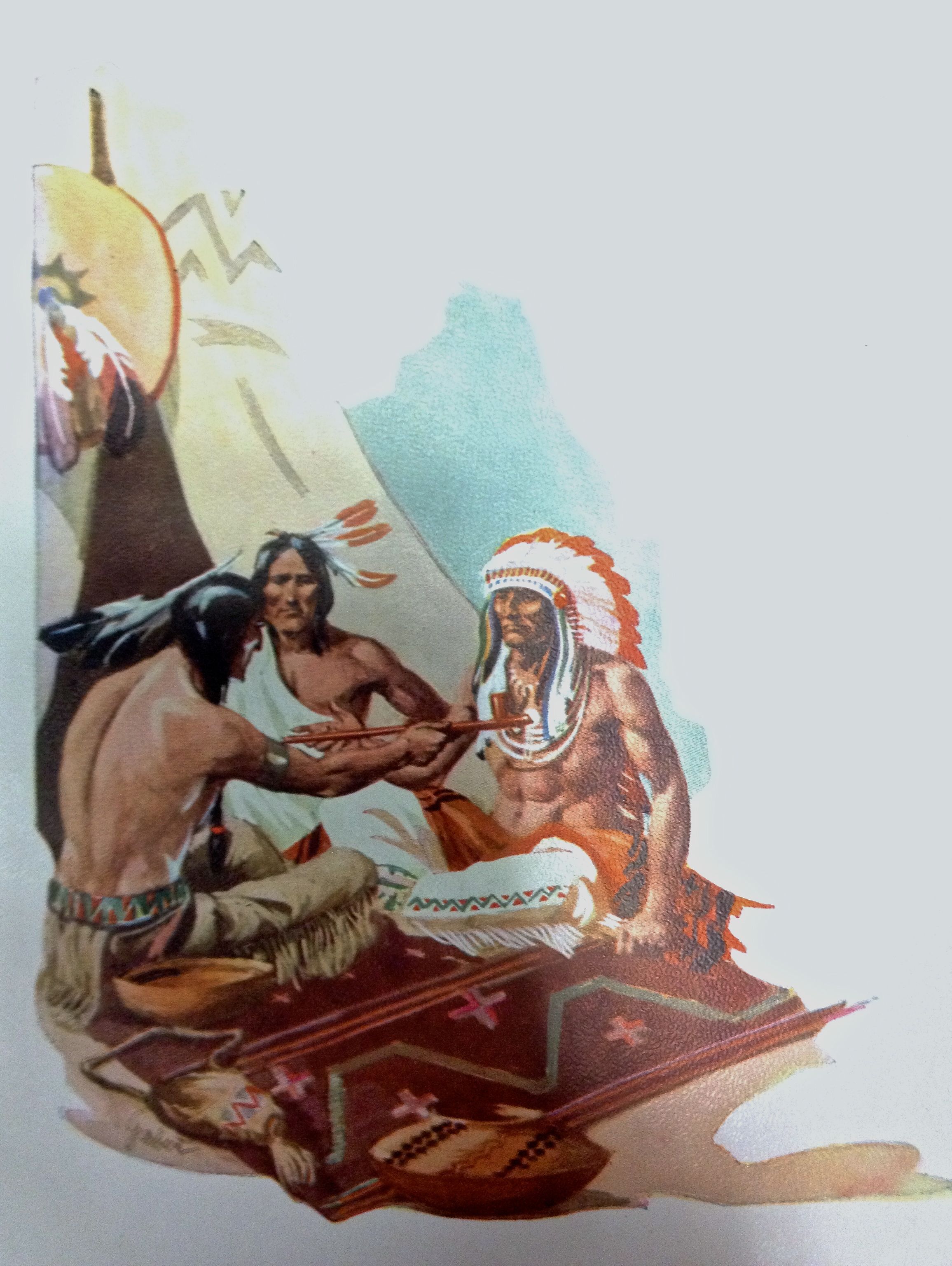
I was immediately surprised by the Native American theme throughout this book, as the settler’s taking over the Munsee Indian’s land and bringing about massacres and disease only a number of years ago should be a source of shame to me, not a source of entertainment to be taken lightly. However, as propaganda and misleading history is evident all throughout the world, this was not unfitting.
Several clubs, organizations, and Greek life was noted throughout the book, and the Kappa Pi Honorary Art Fraternity is highly likely to be responsible for creating this Asian-themed party with a giant homemade Buddha statue, as depicted in the pictures. However, the exact year this was done remains unknown, as the only record on the back of the photos is the word “Meyer”, presumably a last name.
There were several literary sections and poems featured throughout the book, and it is apparent that SUNY New Paltz has very artistic roots, even back in the early 1900s.
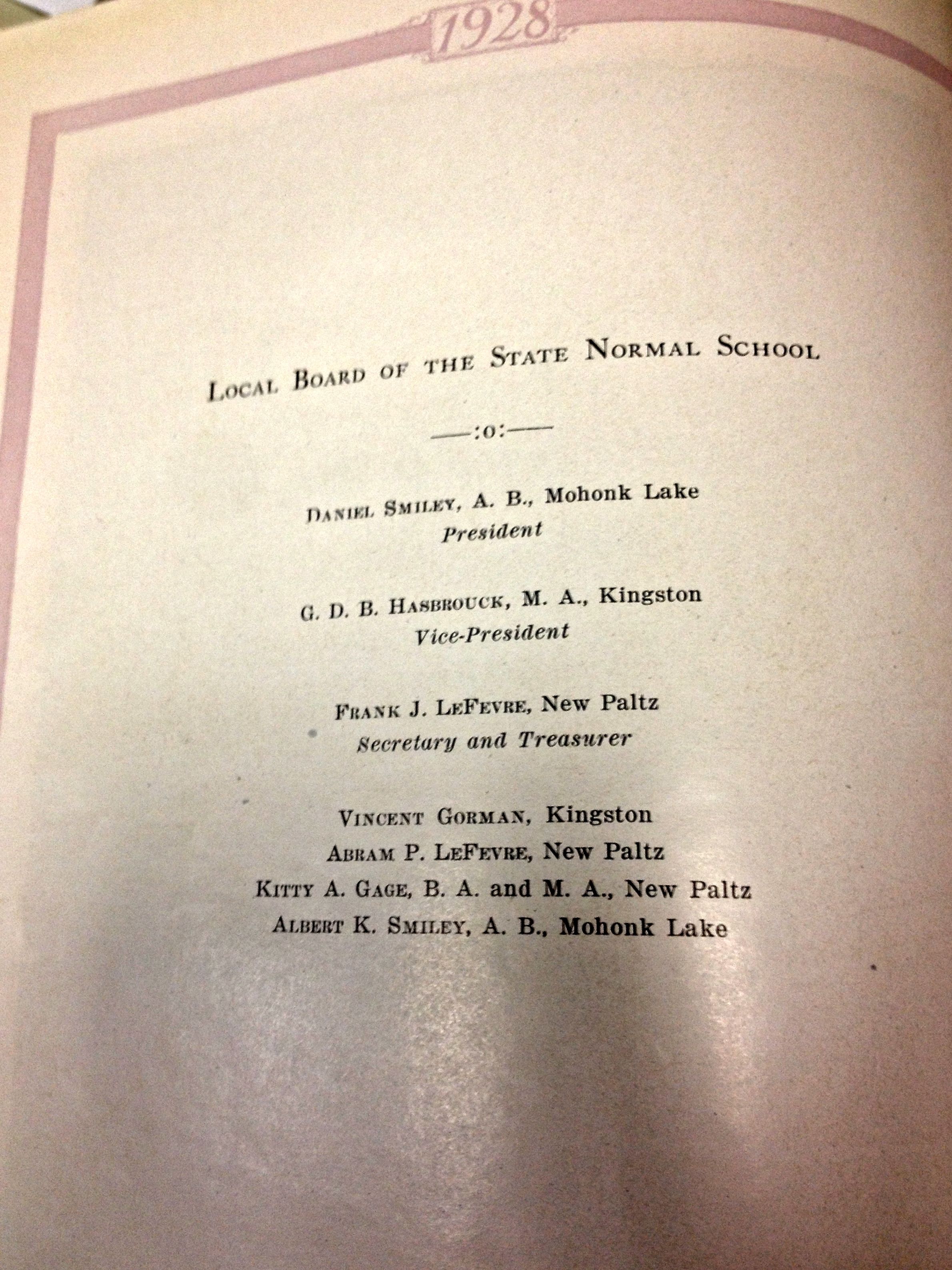
One of the last pages in the book features contributors and the local board of the school, some of whose last names reference our founding families and consequently reoccurring names on our streets and buildings in the present day, namely: Smiley, Hasbrouck, LeFevre, and Gage.
RESOURCES: to be updated soon! I need to find more resources on the New Paltz normal school at this time (and have several websites with school records to look into).
-Paltzonian 1928
-Buddha party pictures
-http://fultonhistory.com/newspaper%2010/Kingston%20NY%20Daily%20Freeman/Kingston%20NY%20Daily%20Freeman%201942%20Grayscale/Kingston%20NY%20Daily%20Freeman%201942%20Grayscale%20-%200138.pdf
Tool of the Past
CAPTION
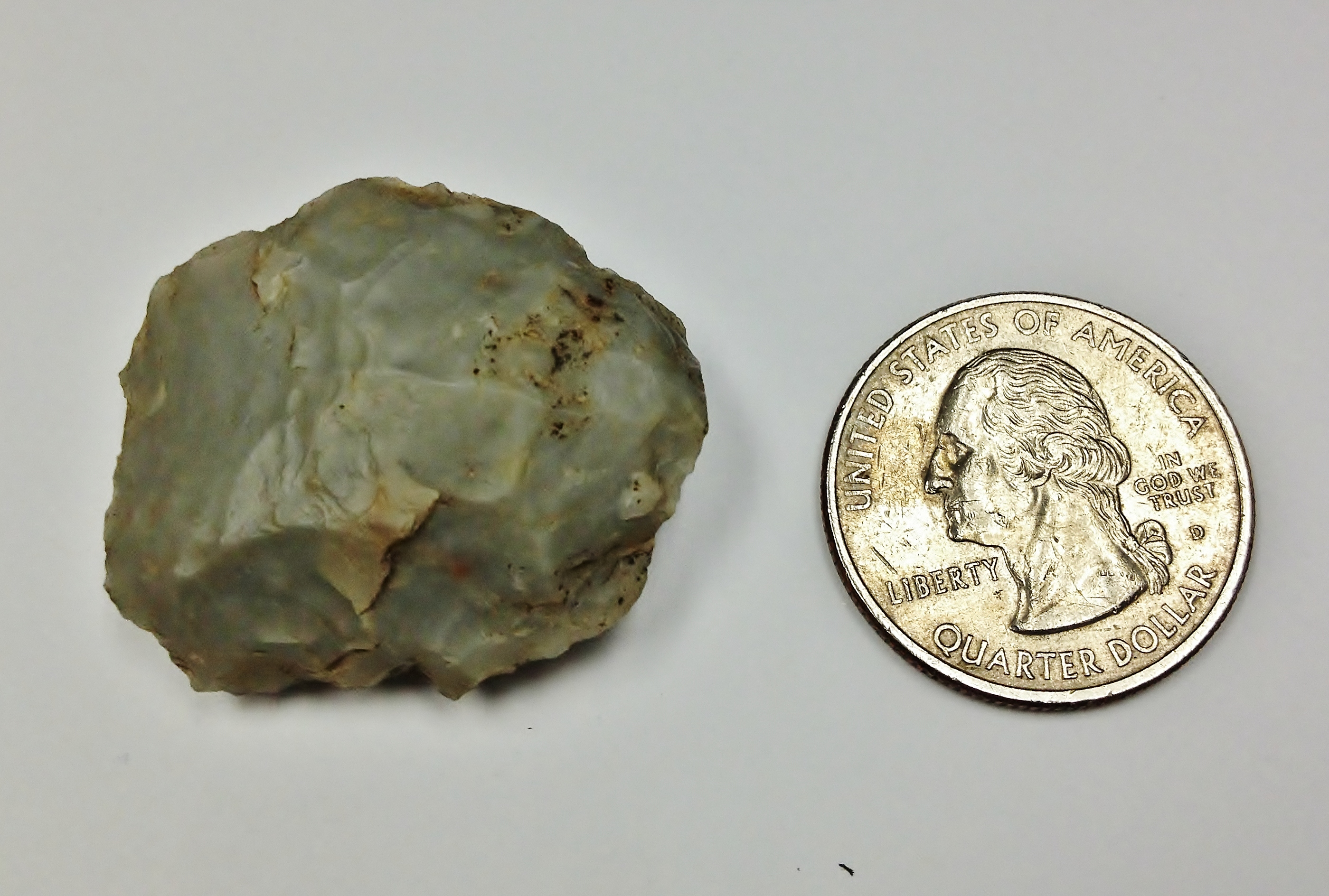
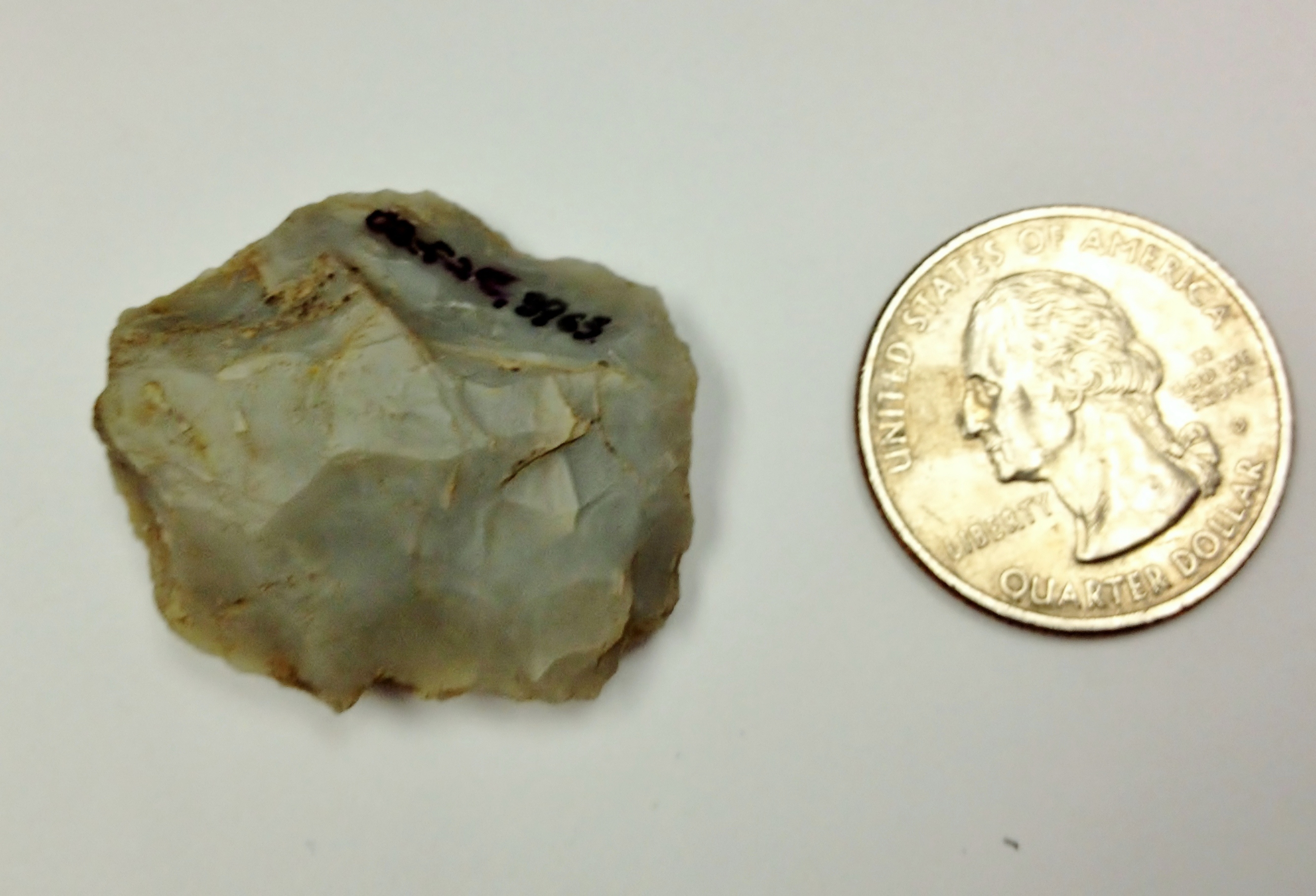
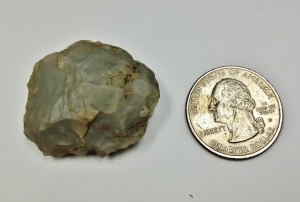
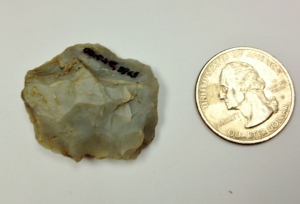
This Native American stone knife, among other stone tools, was essential to the survival and development of the Lenape civilization. It may seem insignificant, but these tools were used throughout Native American history, and it is even more effective in strength and sharpness than our steel knifes today. Because its exact date is unknown, this object speaks for centuries of history at New Paltz.
DESCRIPTION
This stone knife measures around 3.5cm by 2.6cm by .8cm. It is known as a cryptocrystalline lithic, and is made out of chert—either Eppler or Harmonyvale. It was sharpened by chipping flint, and the small sharp pieces could very well have had their own uses. It is a milky white/grey color, has percussion marks, and appears to be flat. It is temporarily non-diagnostic, which means it could have originated anywhere in the time span from 7000 BC-1678.
PROVENANCE
This artifact was found by archeologists in New Paltz on July 27th 2002, in unit 60 at the grid coordinate South 59, East 10. This is the location in historic Huguenot around the corner between the Jean Hasbrouck house and the Deyo house. It was then taken to be cleaned in a lab on August 15th of the same year. The archeologists who procured the small knife go under the initials: JG, LE, LN, and NH. It finally ended up in Dr. Joseph Diamond’s collection where it remains among several other historical and Native American objects found in New Paltz.
NARRATIVE
Native Americans from anywhere between 7000 BC and 1678 could have used these helpful objects. It is possible it was much bigger than this and chipped with age, or that it was made to be small, which can be useful as well. Perhaps it was from the earlier time periods, before the Dutch settlers came to the Huguenots to colonize. The Native Americans, known then as Munsee’s, had many stone tools like this. This particular tool is a knife, used to cut meat, vegetables, string, or create sharp flints. It is surprising how efficient these tools are, suggesting an understanding and intelligence in the Indians beyond settlers’ conception of them as barbaric. This knife, when chipped properly, is even sharper and stronger than our steel ones today. It was still widely used even after various trades were made between the Europeans and the Native Americans. In place of land, they received various metals, tools, industrial products, and alcohol. Some of these new objects were exponential to their survival, but were also the catalyst to their demise. This particular knife is significant to New Paltz history broadly, as it encompassed the lives of the ones who lived here initially. This item is indicative of how they used nature and what was around them to create sustaining lives and culture.
Because the exact date of this knife is unknown, it encompasses the entire Indian history on the land of what is now Huguenot Street, where it was found. The history of this time span is large and extensive, and takes us back from the beginning of the Indian culture in Munsee country to their demise from European settlement, war, and disease. The knife could have originated around 7,000 BCE, almost 10,000 years ago. This is very early in Native American history, when people belonging to “archaic cultural traditions” began hunting small game like deer and gathering plants more intensively in the Northeast. Between 4000 and 1000 years ago, Native American civilizations began to emerge, and their technological innovations developed, such as pottery, bows and arrows, longhouses, and vegetable cultivations.
It is likely possible this efficient tool originated around this time, or anytime hereafter, as its uses was not diminished by Native American advances or European settlers. It is necessary to unveil this timeline of Native American history in order to cover the potential histories this ambiguous object holds. Around 500 years ago Europeans began sailing to northeastern North American shores, and by 1607 it is discovered that the total Indian population in Munsee country may have been as large as 15,000 people. Around two years later Dutch merchants commissioned an Englishman named Henry Hudson to sail east to find a northern passage to the Orient. He sailed across the Atlantic to find a northwest passage instead and became the first European known to sail up the river that today bears his name. It is around this time fighting between the Indians and Europeans began, and shortly after various foreign diseases plagued the Indians, and by 1618, the 30-Years War broke out in Europe. The expansion of Europe, diseases spreading, trading, and fighting continued over the following 20 years, such as the first Mohawk-Mahican War, which ended in 1628. By 1634, the Indian population in Munsee country declined to somewhere around 6000 people, and by 1645 it dropped to 4000. In 1652, Esopus sachem Harmen Hekan, better known among settlers as Ankerop, started appearing in Dutch records, and by 1659, fighting broke out between Indians and settlers at Esopus. The Indian people living in Munsee country are reduced to less than 3000 as the colonial population in New Netherland reaches 9000 by 1664, and the Dutch signed a treaty ending the war with the Esopus, and New Netherland falls to an English fleet and is renamed New York.
Perhaps this object contains in it the more peaceful beginnings of this account of Indian history at New Paltz, being used and reused by a tribesman or woman to cut various meats, vegetables, and fashion tools and other creations. Maybe it was tossed in favor of a bigger stone that would serve more cutting purposes, or it was lost on a hunt, slipping from the strong mans hands with no time to look back. Maybe it was thrown in a desperate attempt to flee or fight as the European settlers destroyed Native American villages. It is mutually possible that it was one of the most important objects to a person’s life, as an essential key to survival, or the last thing on that person’s mind as his or her very way of existence is being changed and shaped. This small, seemingly insignificant stone knife holds in its mystery the entire Native American history here at New Paltz and our very origins.
RESOURCES
Grumet, Robert. The Munsee Indians: A History. Norman: University of Oklahoma Press, 2009. Print.
Kraft, Herbert. The Lenape-Delaware Indian Heritage: 10,000 BC to AD 2,000. Lenape Books, 2001. Print.
Diamond, Dr. Joseph. Personal Interview. 20 Mar 2013.
Response to A History of the World in 100 Objects
Upon reading the introduction to A History of the World in 100 Objects a few things in particular caught my attention. I immediately noticed and admired how the colleges of the British Museum map out their challenges in attempting to get a completely unbiased perspective on the history of the world (and almost a disclaimer that such a feat is impossible to attain in its entirety). To be knowledgeable to think beyond the context of our own cultures and aware that there are other cultures who have voiced themselves differently, or have not been able to voice themselves at all, is imperative when trying to get an unbiased account of history. Analyzing objects as a way to receive and decipher history is a great and innovative way to attempt this.
Paying more attention to writings than objects is a significant problem that they faced when trying to account for an accurate history. I thought this was very interesting, as a lot of civilizations and time periods did not use the written word. Using objects as a way to detail the past sheds a new light on this time periods that equally deserve of a rich history as the written nations. It also gives a chance to give defeated nations back a voice.
However, using objects to retrieve history is much more difficult than writings, and a great deal of imagination is necessary to put the pieces together. Fortunately though, the story of New Paltz is not quite so ancient, I believe, that we will have entire gaps of our history completely unaccounted for. I suppose that we will have the help of both the written word and old objects to construct our history, but we must always keep in mind that our account of history will never be fully complete or accurate, and sometimes we need to remind ourselves that it is possible an interpretation we have is completely inaccurate. The poem of the jade ring inaccurately being a bowl holder is a good example and reminder of that. Regardless, there is a poetic element involved in creating a history of things.
The authors of this book’s consideration in trying to get a full history through all the lenses of the world is an ambitious feat, and some of there tasks and problems could be good pointers for our own project. Such as the fact that which objects survived (typically stone and hardier ones) can add their own personal bias to the history, and the consistent ever-changing meaning of objects throughout time.
The Thinking Chair Replica
When I was little, apparently I really liked Blue’s Clues. I have a replica of the thinking chair sitting in my basement to prove it. It is approximately 4×4 feet and the back of the chair and the arms are leaning outward, stretched and slumped from years of use. The chair has a soft velvet feel to it, with light curlicues against its rich burgundy. It is outlined all around the edges with black that swirls and gets thicker at the front of the arms. The sides are mummified with tape—an attempt to cover the rips in the material, revealing its rough inside skeleton, an unpolished wooden frame held together by many nails with their sharp ends exposed. Who would think that such a lovely children’s prop with soft arms meant for a little prince would be a torture chamber on the inside? Those bits are covered though with duct tape and an affectionate resistance against getting rid of it.
My mom bought the thing from Sears, probably making a scene carrying that ostentatious chair through the lines of people and to the parking lot. It is very small in comparison with other furniture, but I don’t know any mom other than my own who would bring it home.
In Blue’s Clues, this red chair was designated to doing some serious contemplation on piecing together clues to solve the weekly mystery with Blue. The main character Steve would sit on it, cross his legs, and bring his hand up to his chin: Rodin’s the Thinker with funny hair and a green striped long sleeve shirt.
Its counterpart was brought to my house, perhaps not to think, but to play. As I got older my family and I used it as a normal chair, and friends would sit on it when the couches were filled up. Bright and red and clashing with the other colors in the family room as it was, it became rather inconspicuous, an accepted part of our space. My two cats eventually claimed it as theirs and it is now decked with little blankets and toys.
As we redecorated the house, we were going to get rid of it, but between our own sentimental value attached to it, and how fond of it my cats are, it is now the designated cat bed in my basement.
This chair has had so many different purposes in its lifetime, from being a space to think, to a space to play, to a space to sleep. Depending on the owner of the thinking chair, it was used in different ways. Much like the Netsuke in the Hare with Amber eyes was used differently depending on their owner.
As objects go through all of their different lives with different owners, they serve different purposes. Depending on the use, the role the owner gives it, the object becomes something new, embedded in it all of its past lives.
Victory Medal
The item I decided to write about today is this medal/pendant I have that I wear often on a black string. The reason I picked this object to detail is because I had absolutely no idea what it’s history is, perhaps I enjoyed the mystery of it, but perhaps it is also time to delve into it!
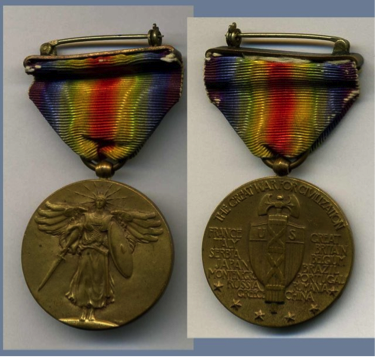
This medal is around the size of a half dollar coin. It is a light bronze color and has a semi-heavy weight. One side of the medal has the image of an angel on it. The angel’s head resembles that of the Statue of Liberty. It’s wings are spread apart and it is clad in armor. In one hand it holds a sword pointing downward and it’s other arm is hidden behind the big shield it bares. It stands face-forward on a small platform. The other side has a logo that appears to be a code of arms with “U.S” inscribed on it. The top of the coin states “The Great War For Civilization”, with the 13 countries France, Italy, Serbia, Japan, Montenegro, Russia, Greece, Great Britain, Belgium, Brazil, Portugal, Rumania, and China inscribed on the sides. There are 6 stars on the bottom and a loop for attachments on the top.
I picked this coin up late 2nd semester of last year at the antique shop in town on Main Street. I went into the shop with my friends one day because we were looking for objects to use in a rather odd art project we needed to do for Design Form. I saw it through glass casing sitting under a shelf and was immediately intrigued by it, but I didn’t buy it or inquire further.
I found myself continually thinking of it shortly after, and decided to go back to buy it. I went into town alone this time and inquired to the shopkeeper about the item. I lied and said it was a present for someone so I could ask more questions about it. Perhaps I thought it was silly to go into an antique shop alone and buy something so random for myself. The friendly, albeit strange, lady handed it to me but did not know much about it. We concluded that it must have something to do with World War I and left it at that. I thought it was curious how the coin has an angel on one side, a symbol of peace and protection, and an inscription about war on the other. I bought it for around twenty dollars and attached it to a black string.
I didn’t know why the coin was so compelling to me, or why I became so attached to it. I hadn’t the slightest clue. One of the more absurd thoughts that when through my head when I was trying to decide why this medal meant so much to me was that maybe this coin belonged to me in a past life (preposterous! I don’t even believe in reincarnation!) I thought of the religious symbolism of the angel and that perhaps it speaks to my faith. I am Jewish and believe in basic Judaic traditions and morals, however my personal beliefs are much more complicated than that and are grounded more in philosophy than religion. It was while I was pondering about this that I came to the (semi-existentialist) realization that this medal is meaningful to me because I decided it is. I imbued it with meaning. It represents the sometimes irrational or subconscious inclinations we have to find meaning or faith or mystery in life. It has meaning to me because I decided thus, and that doesn’t make it any less meaningful. Along with the representation of the side of me that is open to faith or meaning without reason, the coin came to symbolize my own inner strength. I brought it with me to Europe and wore it on all of our travel days (there were a lot of them! Plains, underwater trains, boats).
Sometimes I feel silly about giving this medal so much meaning in my life when it has no “real” significance for me. It was not handed down to me from my ancestors nor a part of my history. Yet I continue to hold it in my possession nonetheless.
I was reading this assignment and my eyes began to search for something in my room interesting to write about. They immediately fell on this coin hanging with all of my other necklaces on my dorm wall. I began to search for the coin online and found many like it, some clad with ribbons.
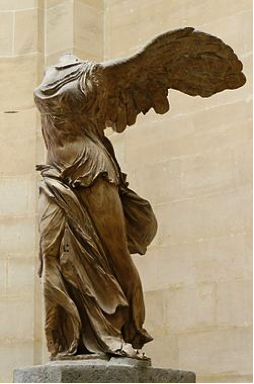
I discovered that this medal is a WWI Victory Medal. The sculptor of the medal is James Earle Fraser (1876-1953), and it is said to be his most important medallic commission. The design is based on the Winged Victory of Samothrace.
I have studied this statue before and have seen it in person and definitely see the resemblance to it, and the medals ancient Greek influences. The goddess in the medal is pointing the sword downward as a sign of peace, the cessation of hostilities brought about by the Peace of Versailles. The 13 nations on the sides of the coin are the allied nations, and what I thought was a code of arms is a double-headed battle ax surmounting a U.S shield with a bundle of sticks tied together with a ribbon, representing the unity of the Allied military. The nob at the top allowed for attachment of a double-rainbow ribbon, representing renewed beginning.
The 36 millimeter bronze medal is composed of 90% copper and 10% tin. In addition to the U.S. Mint, A miniature version was also issued for wear on formal military attire. Upon the end of the Great War, the victorious Allies decided to honor each other by making this medal a joint award. Each nation created a similar medal with compatible designs.
It was commened on Feb. 3, 1920, at the U.S. Mint. The first medal was forwarded to President Woodrow Wilson by the Secretary of War on Feb. 11. General distribution to soldiers began on June 21. It was the most widely circulated medal of its time. The award was available to all officers and enlisted personnel for honorable service in the Armed Forces between April 6, 1917 (the declaration of war against Germany) and Nov. 11, 1918 (date of the Armistice).
It was fascinating to learn about the history of my coin, and I don’t feel that the mystery of it is taken away, as I still am not sure how it arrived at the antique shop or why I decided to buy it. However, one aspect of it that possibly charmed me is its Greco-Roman influence. I had not known that at the time, but I love studying art history and learning about ancient mythology and perhaps felt its cross-cultural/historical design when I noticed it. I still wonder how it acquired all of its scratches and nicks.
This class is making me realize how rich so many objects are with history, and how layered these histories are. Just like geology and the earth, each time period an object endures is captured into the essence of the object, and we are adding to that very history by having them in our possession.
http://www.pcgs.com/News/Victory-Medal-Celebrates-Victory-Honors-Victors
Turtle Pin
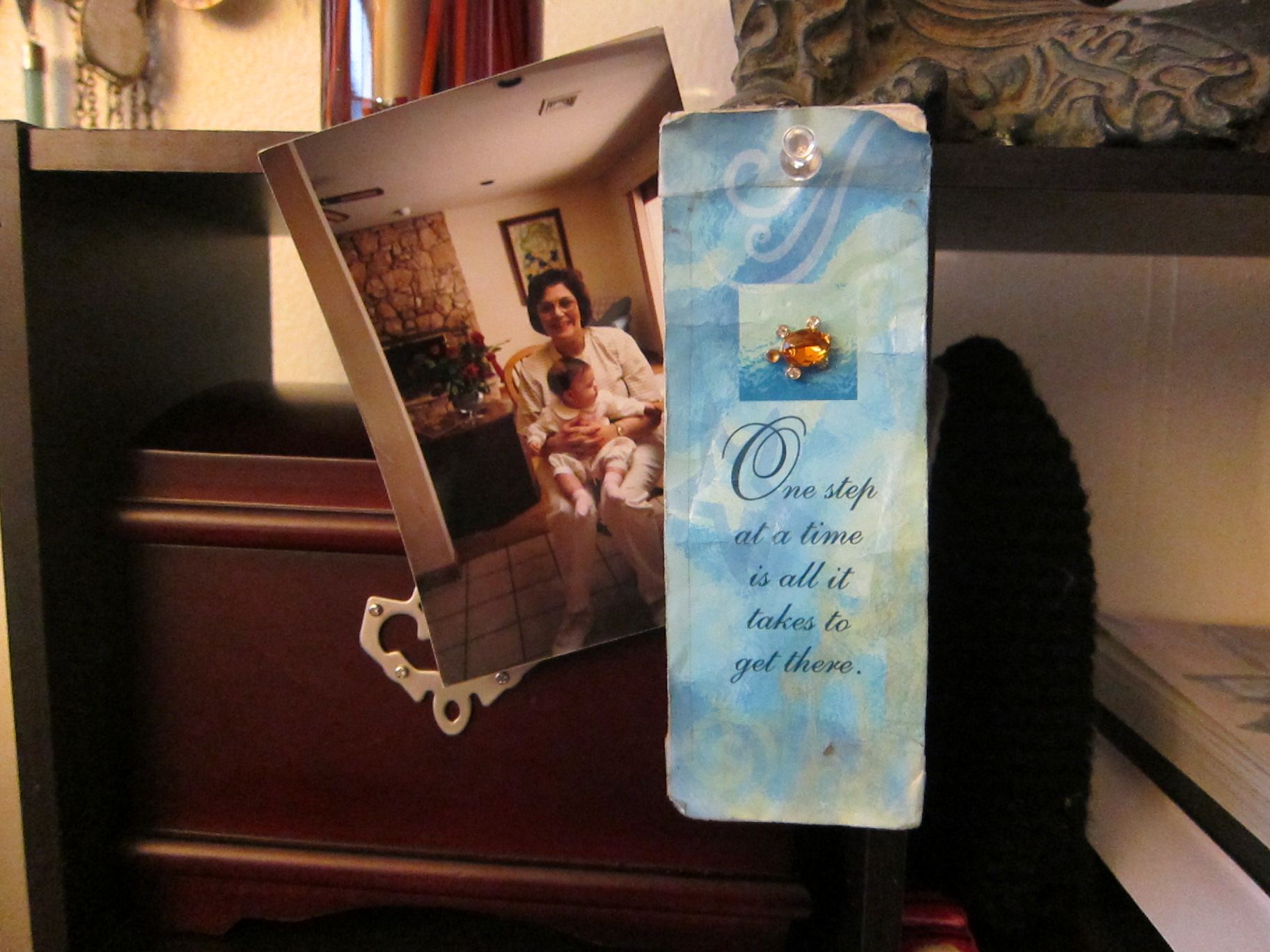
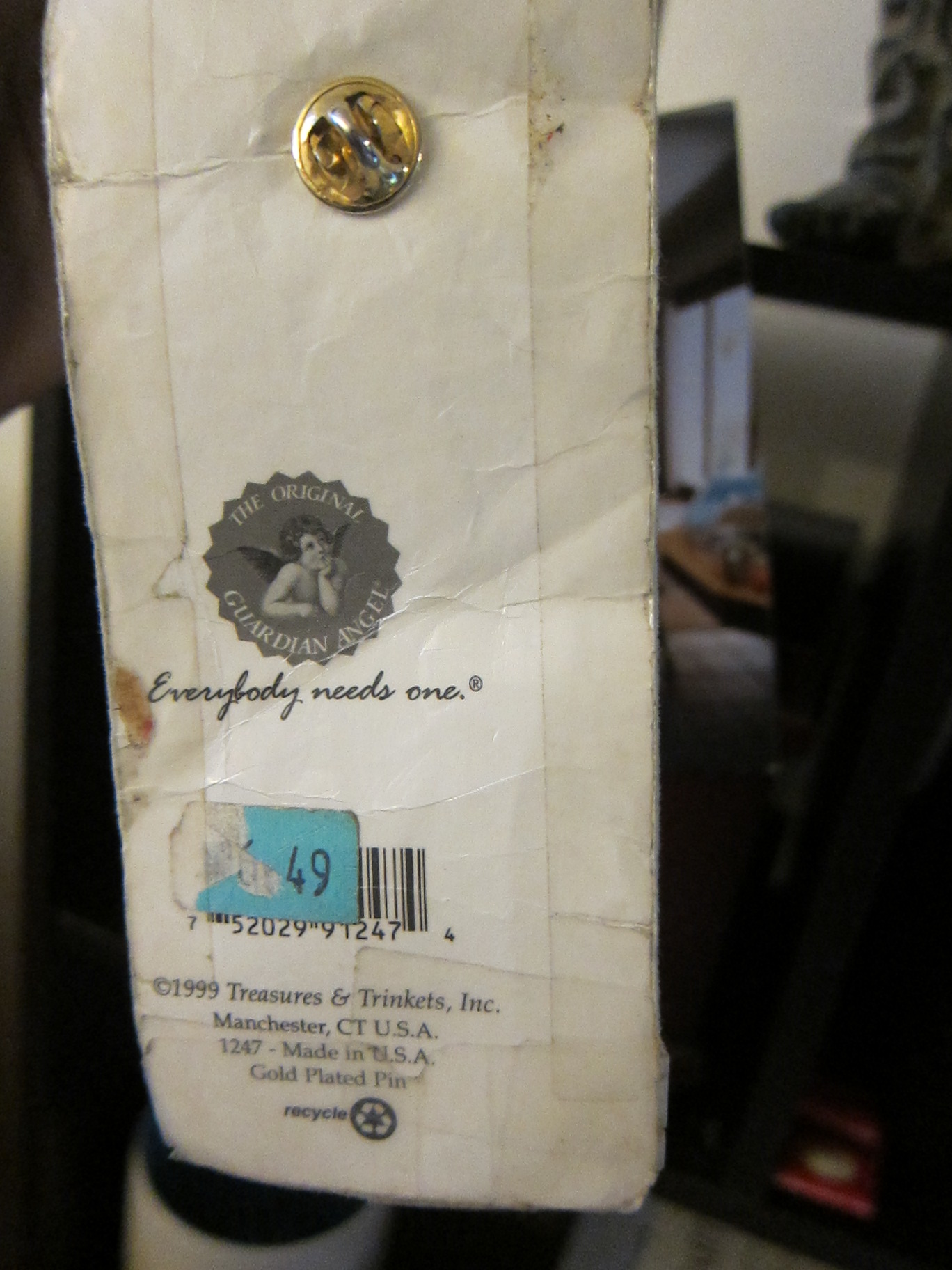
My object is a pin attached to a panel that reads in script “One step at a time is all it takes to get there.” It is roughly 4 inches long and 2 inches wide. The turtle has an amber-colored stone as its shell and little rhinestones for its feet and head; the rhinestone for the head is missing. As I turned the panel to see the back (something I would rarely do if I wasn’t trying to describe this object in full detail) I noticed that the sides are covered in tape that I used to stop the layers of paper from peeling apart. The back also has a logo with a picture of a cherub that reads “The Original Guardian Angel” and below it, “Everybody needs one.”
This pin was given to me from my late grandma when I was very young, probably around 6 or 7 years old. I loved the turtle (as I had an affinity for turtles at the time) and the little inch-by-inch square scene it was attached to. At that time I played with it, twisting the pin in the back to make the turtle rotate back and forth, as if it were swimming in its tiny seascape.
As I got older, through all of the redecorations and changes made to my room, the pin always stayed with me, in the second drawer of my nightstand. As I began to love reading I used it as a bookmark many times. I have never actually worn the turtle as a pin and it has always been attached to its paper.
I love the quote on my pin/bookmark, as it is very motivational to me. I have always had a hard time accepting that large, daunting tasks can be broken down into simple steps, and that those small steps can accumulate into something great, colossal even. I have a tendency to get too caught up in details or get overwhelmed by the apparent enormity of certain obstacles or goals, and this serves as a reminder for me to break it down into small, doable steps.
When my Grandmother died of Lou Gehrig’s disease in 2003, the pin had even more significance to me. She was the most elegant, blessed, strong person I have ever known. Knowing that she, a woman who prevailed with grace through such tragedies, believed in me is a constant source of my personal strength and inspiration. My family members often tell me that I remind them of her and I take that as a great honor.
This odd object that has never actually been used as it was supposed to be is now attached to a book stand on my desk in my dorm room, so I can look at it and remember how to tackle stressful obstacles in my life, and that my grandmas strength, grace, and vitality resonates inside of me every day.
Note: The first picture is of my turtle pin in my collage dorm, next to a picture of my grandmother and I. The second picture reveals the tattered back of the panel.