1863: A Bloody Year

Physical Description

The fabric is framed atop wood shingle with space to see the fraying and ripped edges beneath the glass in a 1-inch wooden frame. The piece was likely torn from the bottom stripe of the flag, based on the extent of the tearing on the other sides. There is an inconsistency to the red dye in splotches throughout the remnant and seems to be from a stain, which was reported to be from the blood of soldiers. The embroidery reading “1863.” is very neatly embroidered, which alludes to the use of a machine. It was pinned to blue lined paper that was removed in September of 2012 to reveal an inscription reading “Remnant of Flag carried by 156th Regt” (156th Regiment).

Provenance

This flag piece can be dated to the year 1863 from numerous angles; the type of embroidery is typical of that of 1863, the written accompanying narrative from the New Paltz Independent and New Paltz Monumental Society additionally supports this, and it is, of course, embroidered on the flag itself. It was reported to have been carried by members of the 156th Regiment–more specifically color-sergeant James Brink, Corporal Alexander Cameron, and Corporal John Scott–and is said to have the splatterings of the blood of each of these men. Its origin in the 156th Regiment further alludes to an origin in New Paltz specifically, as a majority of the 156th Regiment was recruited in and from New Paltz. At the Monumental Society, this piece was displayed and in the possession of Elvy D. Snyder, later given to the granddaughter of Cyrus Freer who married into the Snyder family. Speculation has led many to assume it was given to her as Cyrus Freer was killed during the civil war as a gift in memory of her father.

Narrative

1863 was a formative and bloody year in American history, and the year embroidered on this scrap of blood-stained red fabric. This tattered fragment of fabric was written about in the “New Paltz Independent” paper on January 6th, 1870, and described as “a relic.”

Carried in the Second Winchester Battle in Winchester, Virginia, this remnant describes a country in turmoil. The First Winchester Battle in 1862 was a decisive, threatening, and frightening Confederate victory. With Winchester, Virginia located so close to the Mason-Dixon line, this was an important location for the Union to stand their ground and push the Confederacy to retreat. The Second Winchester Battle in 1863, where this flag was proudly marched by the Union, was yet another Union defeat. It wasn’t until the Third, and final, Winchester Battle that the Union persevered. 
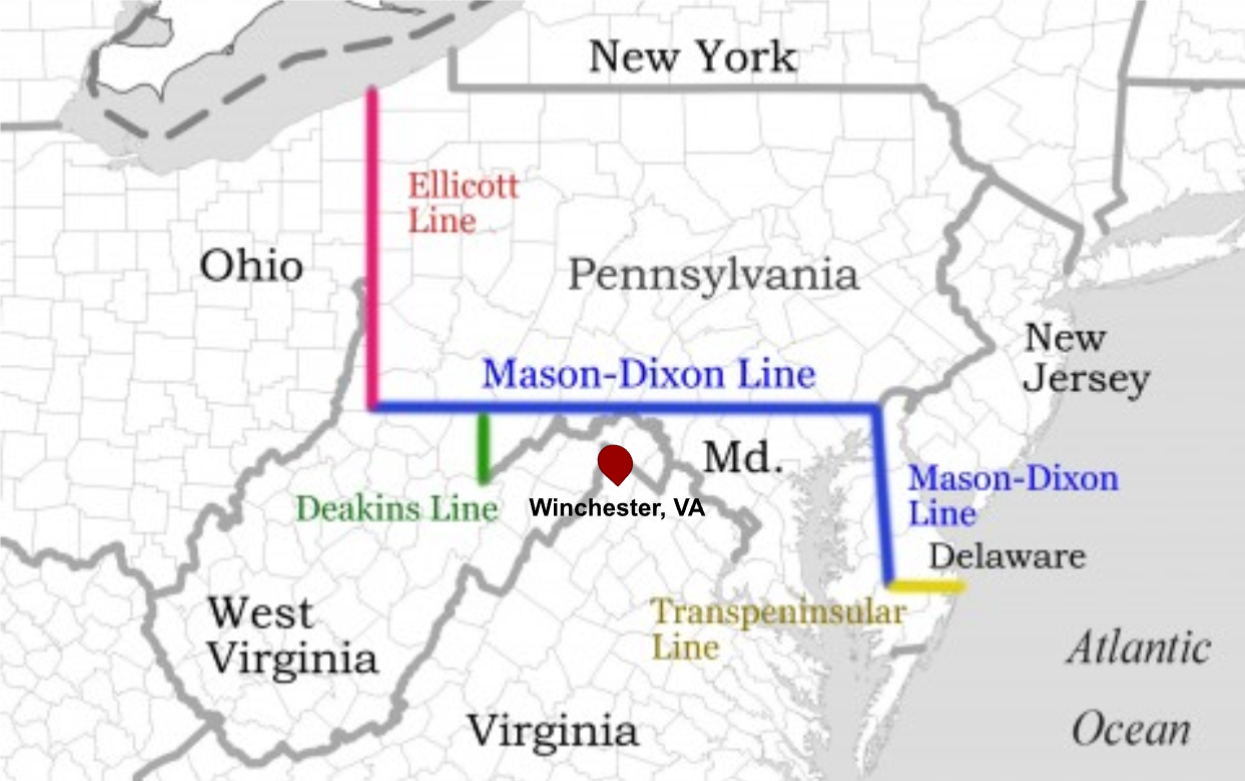
The greater flag this piece was a part of was carried by color-sergeant James Brink, who was wounded in the arm while carrying it. It is said to have splatterings of his blood and the blood of two other men: Corporal Alexander Cameron who was killed during battle after taking this flag from James Brink, and Corporal John Scott who was fatally wounded with it shortly after seizing it. In the writing sample, they write, “The stains of blood may yet be seen upon the flag!” It wasn’t until twenty days after that writing sample was written that Virginia rejoins the Union on January 26th, 1870 during Reconstruction.

The 156th Regiment, inscribed on the paper it was pinned to on the back, was composed of hundreds of men from New York, including the “New Paltz Volunteers.” The Regiment was constructed in 1862 and continued until 1865 when they were disbanded in Georgia. If the flag remnant continued with the group, this would explain the delay in its arrival in New Paltz until 1870 when it was revealed and discussed at the New Paltz Monumental Society by Elvy D. Snyder.

It is unclear as to how this piece was separated from the rest of the flag. It could be something that was torn during the throes of battle and later discovered as the piece that we currently have, though it seems more intentional to me as it contains specifically the embroidery of the year. There is a small “~” mark that appears just before the year and a “.” at the end, which seem to collectively imply that there was more embroidery around this year. This adds to the supposition that it was intentionally selected to be separated as it contained the year, which would have been important given the context of the battle it was carried into in 1863 and the men who died with it that year.

The greater flag that this scrap likely originated from can be predicted from those on coins of this era. It likely appeared very similar to those of the current flag of the United States of America, though adjusted for the number of stars based on the states that were established at the time. It is unclear if the 156th Regiment had a distinct flag, but there is no indication that they were carrying a flag different from the greater United States flag. This piece therefore likely belongs to one of the stripes, and would probably have been placed on the top or bottom stripe. As evident by the excessive tearing at the top and the relatively intact sewn line at the bottom, it seems to have been embroidered along the bottom stripe.

The use of embroidery on this piece is also of note. It was not until 1828 that machines were being invented to assist with embroidery, and by the year 1863, it had become relatively commonplace to use these machines in place of hand embroidery. The neat nature of the embroidery heavily implies the use of a machine in its creation, further indicating the time frame and context of its use and making.

This flag remnant is a time capsule of the military contexts of the time and intersects with a part of New Paltz’s history as a snippet of the greater United States experience in the bloody year of 1863.

Works Cited

“1863.” National Museum of American History, 26 Aug. 2013, 

https://americanhistory.si.edu/changing-america-emancipation-proclamation-1863-and-march-washington-1963/1863.

LeFevre, Ralph. History of New Paltz, New York and Its Old Families: (from 1678-1820) 

Including the Huguenot Pioneers and Others Who Settled in New Paltz Previous to the Revolution. with an Appendix Bringing down the History of Certain Families and Some Other Matter to 1850. Genealogical Pub. Co., 1973. 

“New York State Military Museum and Veterans Research Center.” 156th Infantry Regiment :: 

New York State Military Museum and Veterans Research Center, https://museum.dmna.ny.gov/unit-history/infantry-2/156th-infantry-regiment. 

“Second Winchester.” American Battlefield Trust

https://www.battlefields.org/learn/civil-war/battles/second-winchester.

“The Story of Virginia’s Reconstruction.” Reconstructing Virginia

https://reconstructingvirginia.richmond.edu/overview.

McGoldrick, Louise. “Freer Family Research” 12 Apr. 2023
The Bone Hall – Dehumanization Leads to Objectification

Where is the line between a living organism with stories, history, and life, and an object? At a glance, they appear to be so distinct that it is difficult to find their union, but it seems that bones comprise this societal gray area.

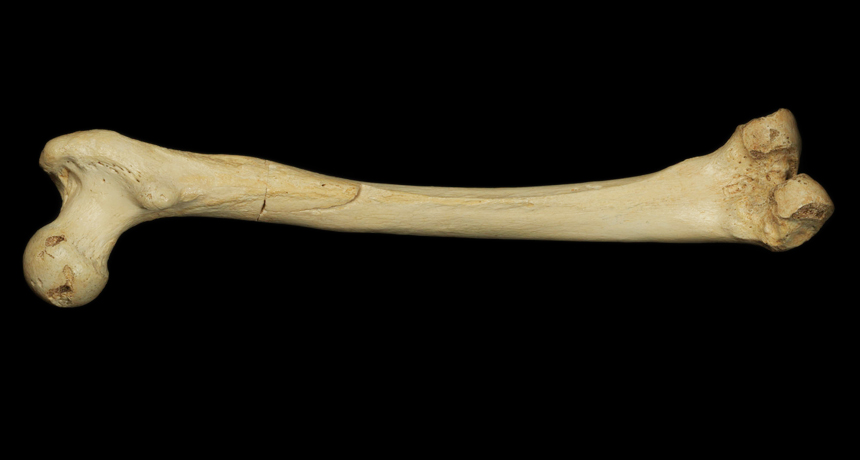
It is fascinating to think of bones as objects because they don’t seem to be objects while they are being used inside of us. I wonder the extent to which that is because they are invisible in our daily lives, but I don’t feel as though I think of the parts of my body I can see as objects either. Perhaps it is due to their different lifespans, the impermanence of hair, nails, and other parts the body naturally replenishes I am less likely to place value on. For, if they are going to be regrown, what does the object itself, that specific collection of cells, serve when separated from my body? For example, when children lose their baby teeth, they are losing bones. We don’t think of them so actively as bones because they are visible and distinct from the bones hidden elsewhere in our body, but they are bones. And, I hypothesize, because baby teeth grow back, there is not the kind of attachment we might otherwise feel. There seem to be two reasons other bones and the greater classification of “human remains” in particular feel distinct: their permanence and the attachment to our sense of self.

The permanence of bones doesn’t only exist in the sense that they physically last longer than the other parts of our body when exposed to the elements, but also that we associate them pretty exclusively with death. In order for someone’s bones to be a matter of discussion they’re either broken/in need of a relatively serious repair or the person has passed. The permanence of death is especially striking when viewing bones assembled to portray the figure of a human, as they are in museums.

Bones displayed in museums objectify the humans that used to inhabit them. Especially in noting the prominence of specific cultures and ethnicities being displayed, it feels evident that the possession of bones from specific people serves to dehumanize similar alive counterparts. It is hard to trace back the exact origins of this practice, but it is evident that the collections grew exponentially for African Americans during the Slave Trade and slavery, similar to the staggering and absurdly large increase in collecting Native American remains during the late 19th and early 20th centuries.

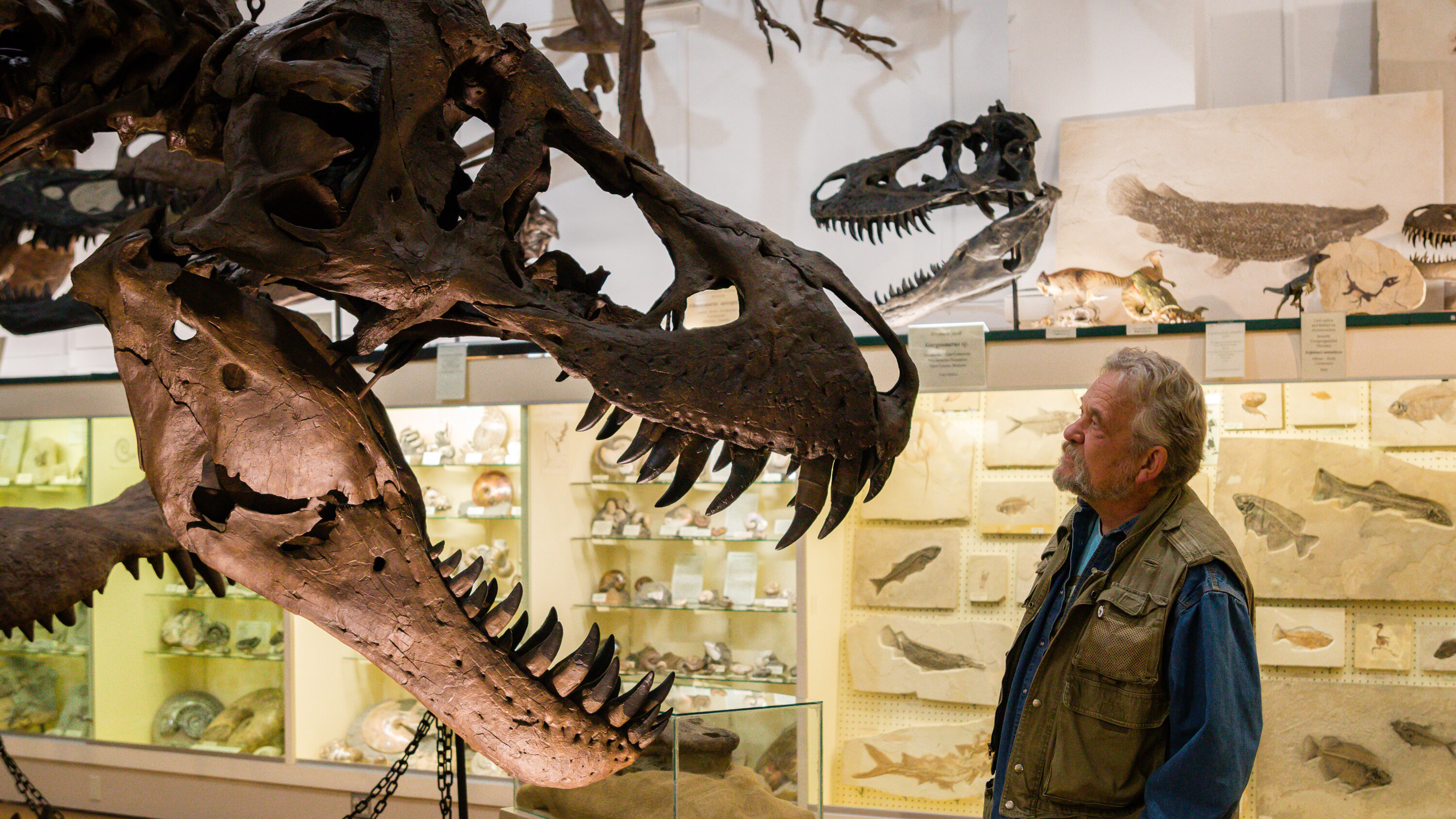
The main collection I looked at is The Bone Hall at the Museum of Natural History in New York City. This museum houses over 600 fossil specimen and over 100 dinosaur fossils, making it the largest collection in the United States. The dinosaur collection seems to not phase me–but do their bones truly become objects due to the amount of time that separates us? I wonder if it is moreso that I can reason for their lack of sentience makes it more humane. Fossils are also very expensive–to buy, store, maintain, and study. The revenue from museums helps make this possible and accessible for scientists, making me more inclined to support this endeavor. Especially because it is not a guarantee for scientists to have them otherwise: collecting these fossils has become popular for the extremely wealthy. This could pose a threat to science as scientists would lose access to fossils in private collections.

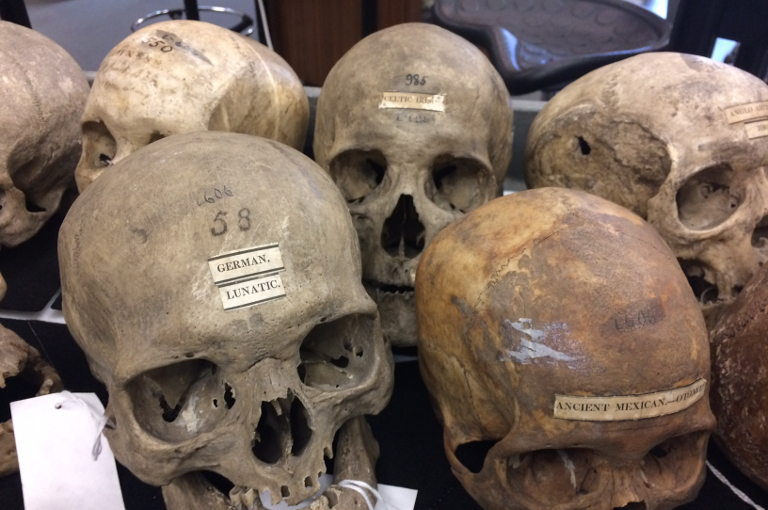
A particularly striking example of the misuse of objectifying bones is the Morton Cranial collection. This collection possesses 1,300 human skulls and was the foundation for popularizing the disproven “race science” that claimed people of color had smaller skulls and were therefore inferior. Since disproven, as the measurements were misinterpreted and skewed to represent the result they desired to achieve, these skulls remain in the collection. Retrieved largely during colonial exploits, it seems hard to reason that they “belong” in this collection–but now that they have been so thoroughly objectified that they are not connected to the people they once were, where do they go? Stripped of their name, stories, and humanity, what are bones but an object?

Lastly, returning to the Museum of Natural History, there is new legislation dictating what their policies should include for the repatriation of the dead. As previously mentioned, the number of Native American remains taken from burial sites, battle fields, and all other means, reached over 500,000 in U.S. collections. The policies surrounding this, and the repatriation of other bodies are weak. There is the 1990 Native American Graves Protection and Repatriation Act, which requires museums to return remains to tribes or lineal descendants that request them. Additionally, the Smithsonian, including the Museum of Natural History, allows remains from named individuals of any race to be claimed by descendants. While many African-American individuals in the anatomical collections are named, none have ever been reclaimed. This seems undoubtedly to be due to the initial and continued dehumanization of these people that progresses into the objectification of their remains. There is no known connections left, so the museum decides that they own any remains not claimed. This is a biased policy that allows for people who have the time and resources to find their ancestors, assuming there is even proof of lineage due to the sheer number of documents destroyed, lost, or never created. There is a reason there aren’t extensive “European” bone collections and displays, and it is because Indigenous and African people have been historically and systematically dehumanized so as to appear as objectified as possible.

Because these individuals are dead, does that mean they have no right to their bones and their bodies? I mean, they can’t, right? At least not in the way that we could know what they would want currently by asking. They are dead, after all. But, if not the individuals who grew these bones themselves–housed, harbored, protected, replenished, cared for, lived in, and existed due to these bones–then who? Their family? What if they have none or the lineage is severed? People from the same culture, religion, region of the Earth? Museums? Are these even “objects” that can be traded, bought and sold, and displayed, or should they be laid to rest? What defines how they felt about “rest” when we may know nothing about their wishes? What draws the line at humans, do all animals not grow, house, harbor, protect, replenish, care for, live in, and exist due to their bones? Why do museum collections around human bones seem so barbaric?

I don’t have the answers, and a lot of these questions are extremely complex and convoluted–but that doesn’t mean we shouldn’t be actively working to right the wrongs of previous generations. If their mistakes are excusable because  “that was just how things were back then,” what is our excuse now? I ask again, stripped of their name, stories, and humanity, what are bones but an object?

Disconnection: Scrolling and Browsing

“Scrolling is the ideal way to remain disconnected from any given activity.” That was my perspective approaching this activity.

And that appears to be perfect for what they want. They; the corporations, businessmen, the government–people outside of my reach who are never content. So, they construct algorithms that are perfect for capitalizing on shortening attention spans, increasing acceptability for and access to creating debt, and worsening social skills/environments.

However, sometimes it’s perfect for what we want too. We; the consumers, the lower and middle-class workforce, the people. We get to receive the dopamine our brains crave in the comfort of our own solitude, while still receiving all of the groceries/food, entertainment, and material goods we want or need. We love the ease, simplicity, and mindlessness of it.

It appears as though there must be a middle ground where the world can become more accessible, efficient, effective, practical, and “easy” while also allowing for sustainability, social connection, and mindfulness to thrive.

This comes from conscientious consumer decisions, which can only occur when corporations stop preying upon consumers, which only comes from conscientious consumer political decisions, which can only occur when corporations stop preying upon politicians, and the cycle persists.

It can feel extremely discouraging to be stuck in this cycle, one we had no decision in starting, and that mentality plagues every second I spend and spent scrolling.

Scrolling with the idea that the alternative was browsing in mind, it felt as though I was doing something wrong. Which, I suppose I kind of was. The sites that I know of to make online purchases are built upon foundations of inhumane labor practices and utilize systems of shipment and packaging that are destroying the environment. But, it seems like nowadays this is the default and socially acceptable, and the alternative is no longer accessible.

Is the alternative even that much better?

Going to the mall and shop seems to be fading in popularity as it does not fit into the narrative as well as it used to–it is no longer the most convenient. And, as a consumer and materialist culture, we are constantly aware of the easiest options.

I found that rather than having an eye-opening and awakening experience shopping at the mall, it was more revealing in this experiment that scrolling was an activity that is not always done with intentionality. I have conflicting feelings about this. On one hand, I feel as though I should be more aware of the time I spend scrolling, how I use it, and being aware of the systems at play. However, on the other hand, I found that it was not always something I was actively thinking about, but something I was aware of (the algorithms at play) and feel that scrolling is almost closer to browsing when you aren’t thinking about all the terrible things behind it.

My favorite part of browsing is the disconnection from work and the regular work week to get together and bond with friends. I dislike browsing in a mall for similar reasons that I dislike scrolling: flashy dishonest advertisements vying for my attention and money for greedy and destructive corporations.

I think that the “solution” (if there is one) is not to just stop scrolling. We can’t “go back to how it used to be” because it used to have its own flaws too. Malls represent, to me, the culmination of a consumer culture without access to our every second. I don’t think they deserve the glorification they have received in our culture. They served the purpose of making life easier (condensing where stores are located) but their existence beyond that feels to me like just a predecessor to the problem we have now. I think that positive change must be enacted through legislation and socially cognisant corporations that make scrolling less harmful, addictive, destructive, etc., because then we could use scrolling for all of the accessibility and efficiency that it allows for without guilt and without reliance. With that, we could be disconnected in the same positive way that browsing allows, while having time for being connected through other activities.

Both scrolling and browsing disconnect and connect us, we just have to be better about keeping these impacts positive. Or maybe the urge to make these as efficiently positive as possible is just another byproduct of the system that is not intrinsically natural to humanity–maybe the end goal is really just the process.

Military Issue

In the Sheneman family, the military tradition has thrived.

My grandfather was the second youngest of thirteen, and the last to still be born on their farm in rural Mecosta County, Michigan. With three sisters and one brother passing away in infancy, there were nine healthy young men in the Sheneman household–opportune for military drafts and service. 

  • Earl Sheneman (1915-1949) Army, WWII

  • James (Jim) Sheneman (1918-1973) Marines, WWII, South Pacific

  • Glen Sheneman (1924-1996) Navy, Korean War (N. Pacific Aleutian Islands)

  • Robert (Bob) Sheneman (1932-?) Army, Korean War

  • Fred Sheneman (1934-?) Army, ?

  • Neil Sheneman (1936-?) Army, ?

  • Keith Sheneman (1937-?) Army, ?

  • Bryce Sheneman (1938-2017) Air Force, Japan and Cold War

  • Carl Sheneman (1940-) Army and Reserves

When my grandfather was young, around 10 years old in 1948, his father passed away and his mother remarried “the meanest man in Mecosta County,” undoubtedly inadvertently preparing the young men for their difficult and challenging futures.

His eldest brothers Earl and James (Jim) were drafted by the Army to serve in World War II. Jim later told my grandfather of his experiences of the horrors of war. He spoke of the military abandoning him in the South Pacific and “sipping air through a reed” covered in mud for over a week while enemy soldiers ran nearby.

The next four men continued the tradition. Glen served in the North Pacific, the Aleutian islands in the Northern Pacific during the Korean war. As a proud German family, and a surname that made it difficult to keep hidden, my grandfather had been beaten up and called a “kraut” during the life and death of the Second World War. Once, on my grandfather’s bus ride home from school, the bus driver kindly pulled over to offer a walking soldier a ride home, only to discover that it was Glen. My grandfather recounted that “no one ever made fun of him after that.” His brothers Robert (Bob) served in the Army in Korea and Fred, Neil, and Keith served in the Army as well. Their placements are relatively historically inaccessible to me.

The youngest two were the luckiest in their placement, in terms of immediate physical harm. My grandfather’s youngest brother Robert (Bob) worked in the “Motor Pool” (a mechanic) and spent most of his time in the reserves. My grandfather would warn my parents when visiting Bob’s house that he was a thief and if they checked under any of the furniture they would find “PROPERTY OF THE UNITED STATES ARMY” stamped on it because he had access to the paperwork. As the only child to complete his high school education, my grandfather perhaps thought it was his place to help discourage this behavior from his brothers, but ultimately conceded that it was just who they were. My grandfather, slightly older than Bob, stood out among the otherwise traditional military stories for young men from rural Michigan.

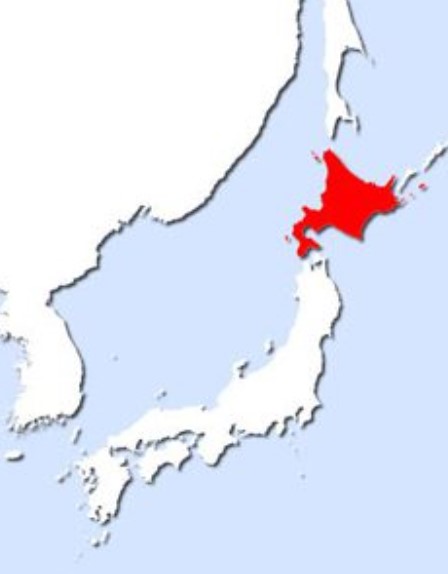
Between 1956 and 1964, my grandfather served in the United States Air Force ultimately earning the title of Staff Sergeant. The academically highest performing of the thirteen children in his farm household, he likely received high marks on entry-level examinations that kept him from being placed as a “grunt.” Instead, they taught him “diddy bop” (morse code) in basic training and sent him to Hokkaido, Japan’s northernmost island, to intercept Soviet messages. 

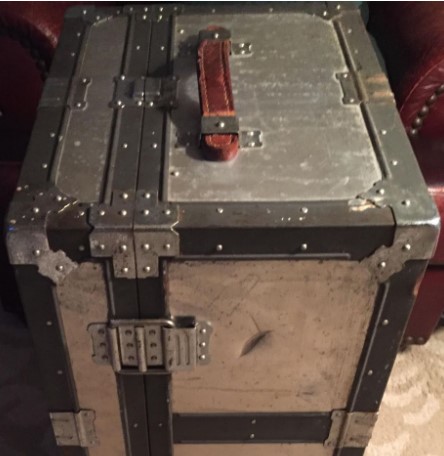
For his journey, he was issued the object that I am studying by the military: a travel trunk.

This trunk was a Korean War-era United States of America Air Force issued Aluminum steamer trunk supplied by Kowa Industry, a Japanese company. Truly a representation of primary geographic interests in the preceding and following decades, it is only fitting that its history is deeply intertwined with the Union of Soviet Socialist Republics (USSR) and the Cold War through my grandfather. The base at which my grandfather was stationed with this trunk was the base that intercepted the message and informed the president of the successful Soviet launch of Sputnik.

There are markings around all faces of the trunk, with one large gash, indicative of its experience being used, and confirming its journey overseas.

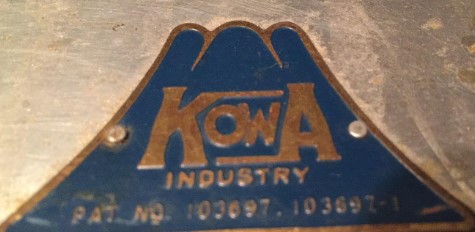
The company Kowa Industry has a logo positioned directly below the key latch in the middle of the trunk, pictured below.

The logo reads “KOWA” with the small text beneath it “INDUSTRY; PAT. NO. 103697.103697-1” enclosed in a triangular shape with a flared bottom and three curves at the top, delineating what appears to be a volcanic mountaintop. There are small screws on either side of the word “KOWA” alluding to the metallic nature of the logo, also revealed by its reflectivity under light.

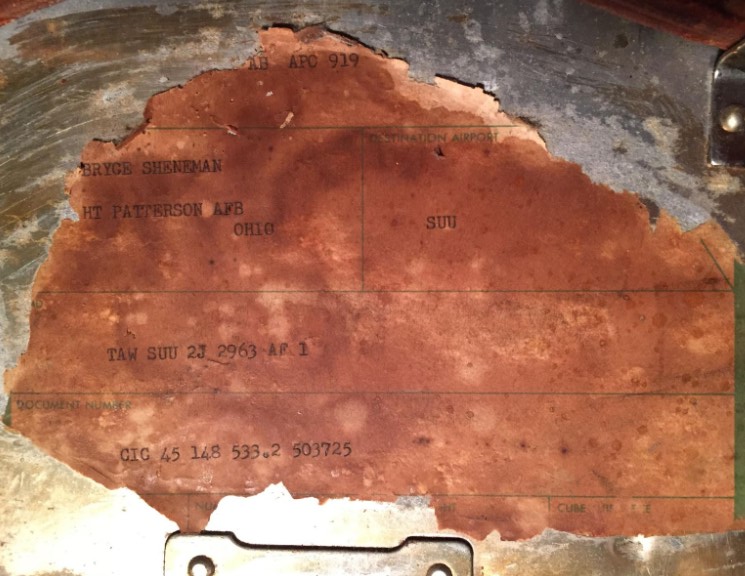
A paper on the side of the trunk without a handle, pictured below, reveals its ownership, location of departure, and its destination: “BRYCE SHENEMAN; HT PATTERSON AFB; OHIO” and in the right box labelled “DESTINATION AIRPORT”: “SUU”. Bryce Sheneman was my grandfather’s name, and his base of departure was the Wright Patterson Air Force Base in Ohio, which he only referred to as “Wright Pat.” His destination, SSU, was the military acronym for Travis Air Force Base in Fairfield, California. The labels for each of the boxes appear as though they were printed with the paper, but the information personal to my grandfather appears added as if by a typewriter.

The tattered edges make some of the information elude me, but there is also information completely present that escapes my comprehension.

My grandfather traveled throughout Hokkaido, likely using this trunk, to connect with a woman he met there. Despite never directly confirming this, except according to his sister Vivian and his only other son Kurt, he was supposedly married to a woman during his time in Japan and had a son with her, named Bryce–the same name as my dad. Upon his death in 2017, my family discovered love letters they had written to each other and a photo of them together. However, due to family conflict and ties being severed with my uncle, these letters and photo are inaccessible to me. This photo, taken between 1956 and 1960 while he was in Japan, appears to depict my grandfather (right) wearing a wedding band. This band has not been recovered to my knowledge. The story I have always heard is that during his return to Ohio, trunk in tow, for the remainder of his service, he was deciding if he should bring them to the United States or return to Japan. However, according to rumor from his sister Vivian, due to an unfortunate train derailment, they tragically passed away, and within a few years my grandfather decided he no longer desired a military career and moved back to Grand Rapids, Michigan where he remained with my grandmother, step-grandmother, and then alone. When my father was young, in the late 1960s and early 1970s, my grandfather would teach him and his brother Japanese words, per their request. He used to teach them Japanese nursery rhymes, one of which my dad can still recount (and made for a fascinating experience on a bus of Japanese tourists in the Bahamas during my parent’s honeymoon). My father said that as he grew older, before the pictures and letters, he knew this story Vivian had told was true. When prompted how he knew so certainly, he asked me, “How did he know the nursery rhymes? His friends sure weren’t learning any.”

He served in Ohio until 1964. My grandfather possessed a “crypto” clearance, a security clearance higher than the general in charge of the base. The general at the base asked him what he wanted to be, seeing as they had no use for a spy and did not want to send an intelligent soldier to be one of the first few on the ground in Vietnam, and so my grandfather became a plane mechanic and engineer. The aluminum trunk remained with him there, even during the transportation of “alien” spacecraft from Roswell, New Mexico to the base.

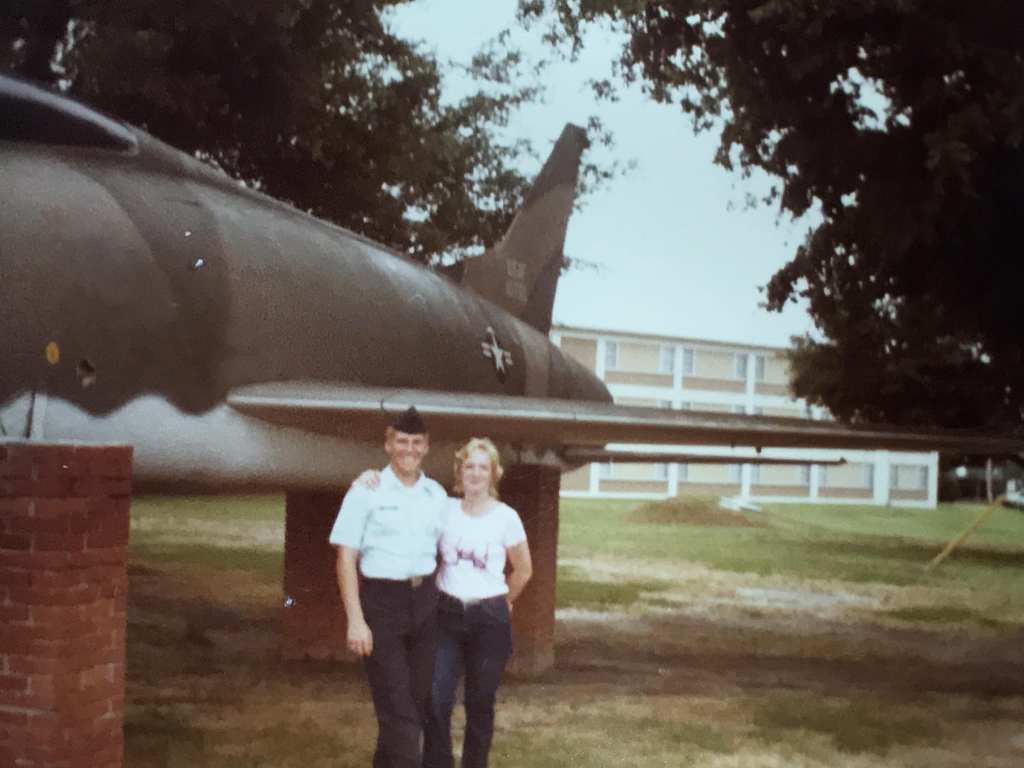
Upon the completion of his service, he returned to Grand Rapids, Michigan where the trunk rested in his closet at my father’s childhood home where my grandfather would spend the rest of his life. It acted as storage still, only in an altered context to its previous travels. He would say it was, “just taking up space.” When my parents moved into their home, my childhood and lifelong home, in 1996, my grandfather offered it to my mother who happily accepted, and my grandfather was no doubt pleased to give it to her. Despite its industrial appearance and damage, my mother sought to repurpose it as storage for her sewing and craft materials. For the next few years and into my lifetime (2002-) it has been in my parents’ bedroom sitting in their closet, holding my mother’s crafting supplies. I had always thought it was my father’s as they share the name “Bryce Sheneman” and share the experience of serving in the Air Force (photo 1: my father in the 1980s near the Air Force Base in Fairbanks, Alaska, left; photo 2: my father and his mother upon his completion of basic training in the early 1980s).

Sometimes more accessible than others with the clutter a household with young children produces, the trunk has only recently been discussed more for its history and importance, especially following the passing of my grandfather. 

Now that the military tradition in my lineage has come to an abrupt halt, with my sister and I as well as my uncle’s children not serving, it is unclear who it will be passed along to. As per tradition, I suppose the eldest children get to make that determination. However, and perhaps only because I am the youngest and most invested in the history of this object, I am eager to break that tradition as well.

Citations

“Ditty Bopper.” The American Legion, 1 June 2016, https://www.legion.org/stories/my-time-uniform/ditty-bopper.

Kindy, Dave. “75 Years Ago, Roswell ‘Flying Saucer’ Report Sparked UFO Obsession.” The Washington Post, WP Company, 17 Oct. 2022, https://www.washingtonpost.com/history/2022/07/08/roswell-flying-saucer-ufo/.

“Oct 4, 1957 CE: USSR Launches Sputnik.” National Geographic Society, https://education.nationalgeographic.org/resource/ussr-launches-sputnik.

Sheneman, Allyson. “Oral History of Bryce D. Sheneman Recounted by Son Bryce W. Sheneman.” 12 Feb. 2023.

Sheneman, Allyson. “Sheneman Family Tree.” Ancestry Family Tree, Genealogy & Family History Records, 12 Feb. 2023, https://www.ancestry.com/family-tree/tree/189111176/family?cfpid=242450233905&fpid=242450248756.

“Vintage Kowa Aluminum Steamer Trunk, circa 1940’s.” Vintage Furnishing , https://www.1stdibs.com/furniture/more-furniture-collectibles/home-accents/trunks-luggage/vintage-kowa-aluminum-steamer-trunk-circa-1940s/id-f_26950522/.

My Name Inscribed on a Dog Tag

I chose to describe my dog tag which was made by my grandfather and mother for me when I was a toddler.

The metal is shaped in a rounded cornered rectangular form. It is two inches long from the farthest sections of the outward bulges on the short sides, and one and one-eighth inches wide across the flattened sides. On the externally protruding side, there is a ridge that lines the outer edge of the shape about one-sixteenth of an inch across. The inner portion of the shape dips slightly downward toward this region before the lip abruptly curves upwards and flattens out to line the figure. 

On the left side, flush against the ledge, is a hole that penetrates through the object and measures one-eighth of an inch in diameter. As though a hole puncher had pierced through the object to create the hole, there is a small ring around the hole that extends just above the flattened surface that surrounds it. This is supported by the slight dip in the cavern seen from the back surface. This back surface does not possess a ridge around the edges, though there is the faint silhouette that appears from the tarnished and scratched surface supported by a small line giving the impression of an edge as it matches the width and shape of the other side, but is flat to the surface. 

The surface is heavily scratched, though still entirely smooth to the touch, with most of the markings running horizontally on the same plane as the text. The marks reveal a slightly illuminated shade to the metallic surface. The scratches are of varying length, from merely a speck decorating the surface to a mark nearly an inch across on the back that fills in the space not occupied by the text. There are additional marks that appear as dark streaks running vertically in small clusters on the back, with a few horizontal ones on the front lower right region. These dark streaks create contrast with the much brighter illuminated scratches as well as with the generic color the metal possesses. The primary color of the object is gray with some silver and shine. However, because the most prominent feature of the metal is the general dull tone as opposed to shine, the metal is certainly an aluminum derivation. This is compounded by the lack of rust and scratch proneness that is characteristic of aluminum. 

Somewhat tilted so as to run ever so slightly higher on the left side than the right side as handmade things have a tendency toward, there are the letters inscribing “ALLYSON C SHENEMAN” that appear as though stamped into the surface to protrude upwards, similar in feeling to running your fingers over braille imprinted into metal signs. From the back surface, the letters can be seen mirrored along the horizontal axis, reflected from the front of the object. 

This dog tag was made for me when I was three years old to honor my family’s long military history. As such a prominent influence in my life, I went to flight school in preparation to join the Air Force, and used this as my good luck charm, despite my generally not superstitious tendencies. My life plans and aspirations changed due to medical complications, but I continued to keep this dog tag with me on every journey on which I embarked. Following the passing of my grandparents it has doubled as a memento to bring them with me everywhere I go.

Picture 1 (above). My dog tag pictured from the front

Picture 2 (above). My dog tag pictured from the back

Picture 3 (above). A penny for scale comparison above the dog tag