I’m a collector of shirts
Of pictures
And bottles
Because my mother is the artist who finds beauty in a pulled thread or a burned match
My house was filled with crap
And no one understands that we are the creators of worlds
The gilded pieces on our walls float from the rubble which coat the concrete basement
And creep up the ceiling until they themselves are found
as gifts under lover’s trees
“Aesthetic Waste” is not a singular project. It is the theory and inspiration behind this art installation, the title of this poem, and the ongoing mindfulness within my life. The original goal was to bring awareness to material usage and waste in the artistic community. However, as the project progressed from an idea to a reality, I found the idea of self-worth coming up in terms of what is being thrown away.
This installation involves ceramic work that was intended to be thrown away by myself and seven other artists, plus a plethora of found items that were going to be used for art projects and abandoned. I realized in the quest for perfection in craft, we sacrifice the reality of the art-making process. Pieces that aren’t “good enough” are thrown away, even those that are still usable. Pieces that break do not get repurposed as they could be most of the time. Miscellaneous art materials purchased with intention are often tossed into a corner to collect dust. In this piece I chose to celebrate these lost ideas through objects intended for the landfill.

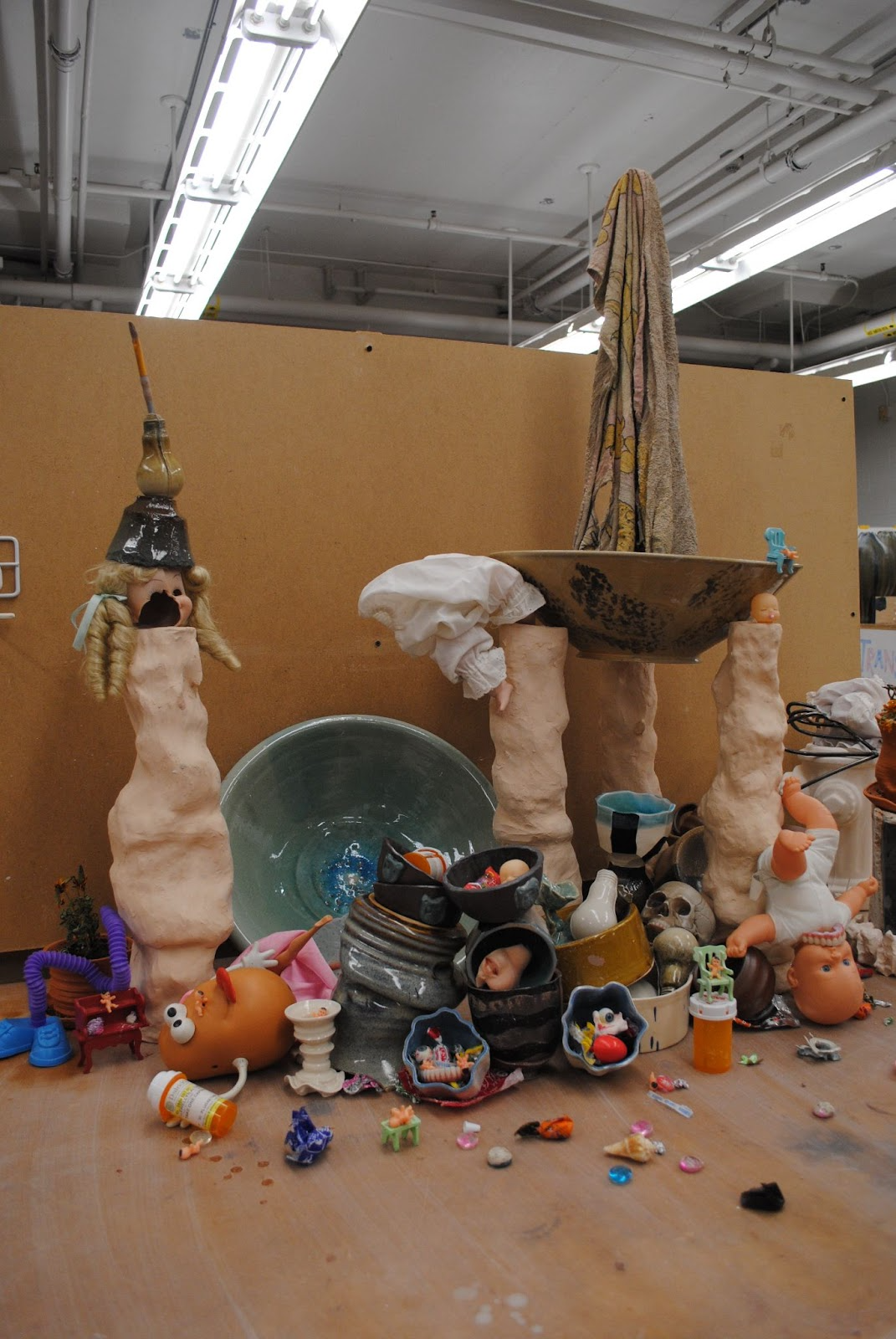
Last semester in the ceramic studio I realized that in college, professors don’t refer to what we make as “artwork.” They call it “work.” It is work. It is patience. It is practice. It is mindfulness. As a collector of things, I accumulate objects that other people consider to be waste. I have been meaning to make a “shit sculpture” (for lack of a better word) for quite a while. Preparation for this installation involved finding objects that fit my criteria, unwanted items like broken pottery and old art projects. I intended to create a pseudo-landfill filled with life and hope-even in the face of death. Tiny baby dolls are juxtaposed with skulls and dead flowers, while broken and unsatisfactory pots rest atop unfired and abandoned work. At the top, a crusty towel stands on its own, begging the viewer to see a waterfall, thereby creating a visual hint to what our mind views as landscape. Aspects of the scene are disturbing and grotesque, while other parts are playful.
As finals approached, I saw how excessive my material usage is. The catalog of pieces due the week of May 15th was 20 large-scale drawings, a sculpture made of steel and plaster, 140 realistic Ancient Roman cups and bowls, and my own personal ceramic work to apply for senior studio. My craft is being honed and my eye attuned to details as never before. The work I have accomplished is very important to me. I now notice the difference in thickness of a pot by the sound it makes when I tap it. To get to this place has yielded one piece I am proud of for every 50 that are not successful. It pains me how much material was wasted with all the pieces I was unimpressed by. I realize that disappointment within myself is not enough to warrant added excess trash on Earth.
My life experiences, thoughts, and feelings are processed the most deeply through creation. However, this is not always the most conducive lifestyle for how the world operates.
I will never forget the day that one of my toughest and most influential professors used the term “the artist’s curse.” He explained the phenomenon as “never satisfied with anything you create.” It is really about being your own hardest critic. The process of dealing with how you view yourself and how others view you is painful. Even though my art is not me, it is an extension of me which has no other way to be seen. I have heard people talk about “the artist’s curse” in terms of success and money and how society does not value the work of artists to allow for consistent income, except for a chosen few. For this reason, the act of being an artist becomes a political statement within itself. As artists we constantly defend the work we do. We do not choose to make art because it is lucrative, it is because we must do it for ourselves and society.








 The Materials of History, Thought, and Art