I wanted to challenge myself for my analog experiment by working on an analog task for a week. Additionally, I wanted to write this blog post on one of the original forms of writing: a typewriter.
Please enjoy this attempt and its many mistakes in spelling.
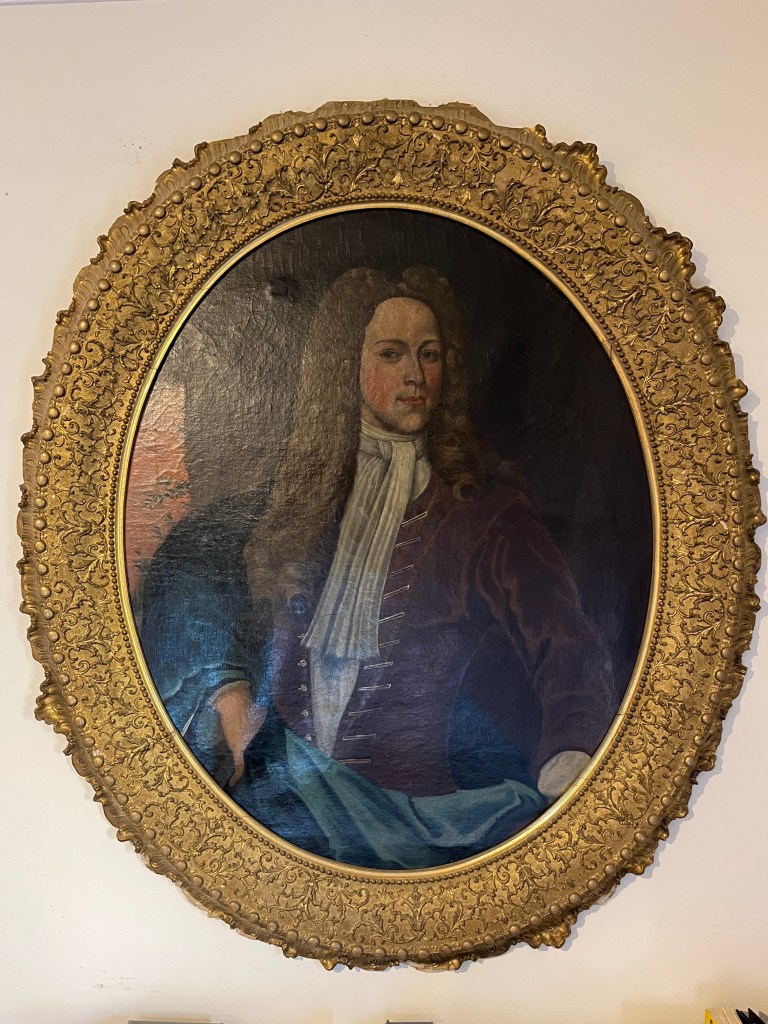
His prideful gaze washed and darkened over with aging varnish residue, a copy of Johannes De Peyster III’s portrait in New York Historical Society now resides over the desk of Grimm Louise’s Office within the historical walls of Huguenot Street. For the Huguenot Street historians he serves as a reminder to be timely with their work; but to history, it serves as a reminder of New York, and New Paltz, colonial government.
Physical Description:
The portrait is an oil on canvas in a wood gilt frame, the oval inside dimensions are 27 ¾” w x 35” h, and its frame dimensions are 35” w x 46” h. Looking at the portrait, Johannes De Peyster III, an influential businessman and Albany mayor from 1729-1733, is dressed in formal colonial attire that reflects his wealth. This features a clothing made from high-quality fabrics such as a long fitted coat, waistcoat, and lace cuffs and collar, representing status. His outfit is made of dark, somber hues such as blacks, browns, and dark greens, characteristic of formal fashion in the period.
His pose depieted in this portrait is dignified and restrained, his gaze is serious conveying the authority anticipated of a mayor. The background consists of minimalistic elements. What can be seen as a possible evening sky on the left side of the painting with muted blues and pinks coinciding with minimal dark foliage. Additionally, a dark and muted wooden structure contrasts with DePeyster’s figure and attire ensuring he remains the focal point. The color scheme of this piece consists of dark and subdued tones, with dramatic light and shadow contrasts that highlight DePeyster’s face and hands. This chiaroscuro effect highlights his features, the textures of his clothing, and the intricacies on his face. Which may show indications of age, implying his longevity and life experience
Given his age during the time of this portrait, DePeyster’s face should bear the lines and creases of age, however, in this portrait, DePeyster’s face is idealized providing the mayor with a young and glowing face, which in many historical cases reinforced their power and status. His hair, likely powdered or styled in colonial fashion, frames his face, emphasizing a receding hairline and his status as a higher-ranking official.
The portrait’s style is likely consistent with the restrained, realistic approach popular in early American colonial portraiture, which values realism, formality, and respectability above expressiveness or romanticized features. It may be heavily influenced by European, particularly Dutch, portrait traditions, demonstrating the enduring cultural linkages between colonial America and the Old World.
Provenance:
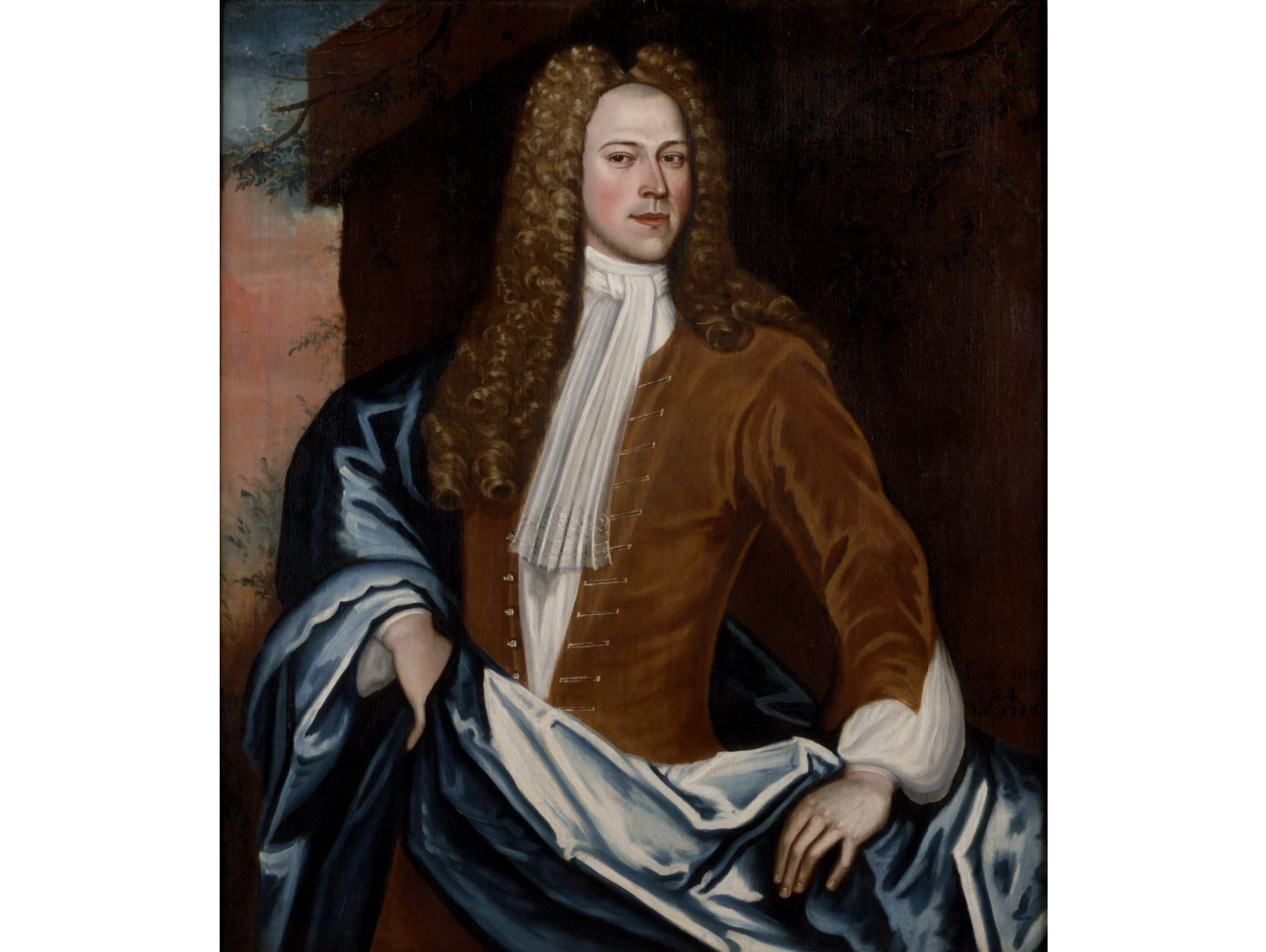
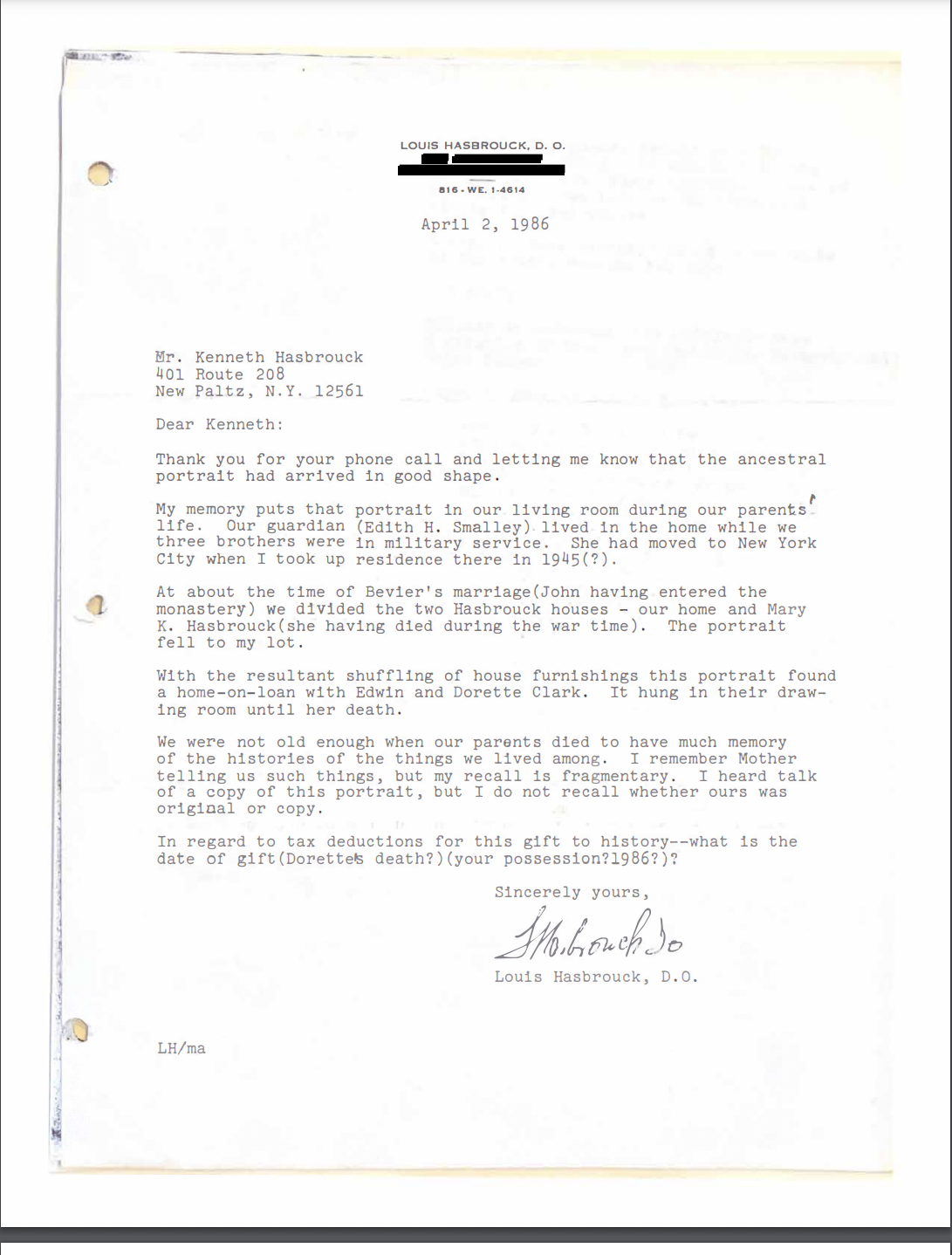
The subject of this work is Johannes DePuyster, John DePuyster Douw’s grandfather. The original portrait was painted around 1718 by Nehemiah Partridge. The original is in the New York Historical Society collection. However, this copy was donated on April 2nd, 1986 by Mr. Louis Hasbrouck to Mr. Kenneth Hasbrouck for the Historical Huguenot Street collections. The portrait found its way into the Hasbrouck family when the Donor’s mother, Helen Miller, a descendent of the subject, Johannes DePeyster III, married Levi Hasbrouck in 1918.
Mr. Louis Hasbrouck states his memory puts this very object into the living room of his parent’s estate. Their guardian, Edith H. Smalley, lived in the home while Louis and his two brothers were in military service. Smalley then moved to New York City when Mr. Louis Hasnrouck took residence in his parent’s estate around 1945.
While there isn’t any record of the exact location of the Hasbrouck family home what we do know is how such a painting ended up in Mr. Louis Hasbrouck’s lot. Bevier Hasbrouck marries and John enters a monastery. Dividing the two Hasbrouck homes, Louis Hasbrouck and his wife Susan Brunck Hinman and Mary K. Hasbrouck, who died during wartime. The portrait then fell into the possession of Louis Hasbrouck. During the division of the two Hasbrouck homes, the painting was found home-on-loan with Edwin and Dorette Clack which hung in their drawing room till death. This leads the painting to be brought back into possession of the Hasbrouck family.
“A letter from the Donor discussing the painting”“Genealogy connecting the donor to the portrait’s provenance”
Narrative
Johannes De Peyster was born in New York in 1694. He was the son of Johannes De Peyster, a merchant of Huguenot descent, and Anna Bancker De Peyster, an Albany native. His extended career in Albany and his time in military service serve as a model for success in early America.
In 1713, Johannes traveled upstate to learn business from his uncle, Albany entrepreneur Evert Bancker. In 1715, he married Albany-born Anna Schuyler, the eighteen-year-old daughter of Albany’s most important New Netherland family. De Peyster, after successfully conducting business with his uncle, then moved to his uncle’s house on the south side of State Street, Albany, where he would reside for the next seventy years. Additionally, in 1721, Johannes was elected first ward assistant, succeeding his uncle. The next year, in 1722, Johannes was elected alderman and was re-elected every year until 1726, when he was then named city recorder. Johannes was named mayor of Albany in 1729 and served until 1733. He was later elected as an alderman from 1748 to 1754. Additionally, he was a militia officer from 1717 to the 1740s. He frequently had contract business with city hall and was an active member of the Commissioners of Indian Affairs until he resigned in protest in 1746.
The object itself was originally created in 1718 by Nehemiah Partridge. Around 1718, Partridge was introduced to the society of Albany, New York, which had not yet been visited by any painters. It’s unclear how he met clients, although it might have been through Boston merchant Jacob Wendell, whose cousin Evert Bancker was one of Albany’s most influential.
We don’t have much information on our version of the portrait, we are unsure who created it or when it was copied from its original. Just like aging varnish, there is a mystery to what lies beneath the surface. However, this copy of this painting from the Hasbrouck family serves as a connection to the early European settlers in New Paltz, as well as a connection to the greater early Dutch colony of New York.
Provided documents from HHS by Louise McGoldrick, a Collections Manager at the site, connect a direct lineage to the Hasbruock family in possession of this portrait to the history of New Paltz. “There is a list of names (Louis – Louis – Joseph – Abraham – Joseph – Abraham) under the donor’s parent (G-37) that tracks the direct family line back to the Patentee, Abraham Hasbrouck (1657-1717).” (McGoldrick, 2024)
Genealogy recorded provided by Goldrick
To the history of New Paltz, The Patentees is a group of early male European settlers. These are the men who signed the 1677 land deal with the Esopus Munsee tribe, exchanging goods for permission to live on 40,000 acres of land that is now the larger New Paltz region. The Patentees consisted of men each representing French Huguent and Wallon origin, one of these men was Abraham Hasbrouck.
September 15th, 1677, the Esopus-Huguenot Land Agreement was enacted. The original boundaries of the patent contained a large part of present-day southeastern Ulster County, including portions of the towns of Esopus, Lloyd, Plattekill, Gardiner, and Shawangunk. For this land, Huguenots traded a collection of goods such as domestic supplies, tools, clothing, animals, and gunpowder and gave the Esopus the right to hunt on the lands exchanged within the patent.
The land agreement also reflects a connection to Albany and Johannes De Peyster III. From the seventeenth century through the eighteenth century, the fur trade between the Dutch and English settlers and the Iroquois nation dominated within the Capital region. Johannes De Peyster III served as mayor and a member of the Indian Affairs Commission during the major conflicts and trades between the natives and Albany settlers. The fur trade helped the Iroquois strengthen their hold in the region by allowing them to control key resources while still maintaining connections with European nations. De Peyster took part in the contacts between the two powers. De Peyster, who came from a wealthy business and political family, was a well-known fur merchant and landowner. As mayor and merchant, he was in charge of monitoring trade regulations and guaranteeing Albany’s powerful status. This contributed to the overall economic and political dynamics between the Iroquois and the British colonies.
Johannes De Peyster III’s portrait and history coincide with the history of Abraham Hasbrouck in the town of New Paltz. The two of these histories bridge to New York’s colonial history, one of major power and the other an individual rural town. Involved in fur trades and land agreements, both the influence in Albany and the smaller town of New Paltz participated in democratic interactions. These stories offer significance in a town such as New Paltz with an early Dutch influence; figures like De Peyster constituted an elite class of leaders who participated in local and regional decision-making processes. Although De Peyster is unlikely to have actually shifted voting habits, his participation illustrates the long tradition of civic duty and governance that formed colonial political culture and, eventually, the creation of American democracy. De Peyster’s family lineage connects the regions together.
We may never know what lies behind the intentions of this copy, or it’s true origins. What we can tell from his gaze is to always make sure to check our emails but to also look at the grand history of early America in the new world; connecting New Paltz to the bigger colonial history of New York state.
Works Cited
Goldstein, Jacob. “Murder in Colonial Albany: European and Indian Responses to Cross-Cultural Murders.” Order No. 1517173 The George Washington University, 2012. United States — District of Columbia: ProQuest. Web. 29 Oct. 2024.
Johannes de Peyster, exhibitions.nysm.nysed.gov/albany/bios/d/jodp.html#jdp. Accessed 3 Nov. 2024.
“Johannes DePeyster III (1694-1789).” Johannes DePeyster III (1694-1789). | New York Historical Society | Digital Collections, digitalcollections.nyhistory.org/islandora/object/nyhs%3A2121. Accessed 3 Nov. 2024.
New York Heritage Digital Collections, nyheritage.contentdm.oclc.org/digital/search/collection/hhs!p16694coll153. Accessed 29 Oct. 2024.
The time is a quarter to twelve. The bells have stopped ringing and the ventilation keeps on humming. My sole creator, I am a tool for them. While I am much use for her, I’m dying.
The focus of an artist cannot be broken without disturbance. In this state, I am thrown and clattered onto a nearby table as she franticly paints her world. I often ponder if she thinks of me, while I am just a brush historically I am an ever so crucial tool. To many of her kind, I offer control, precision, and efficiency to tasks that require my work. I am unique in every way, my brothers and sisters are also the same. From bristle to handle I suit a specific need. I am a long-handle flat brush, I have synthetic filaments, and I’m durable and large enough to aid my user in many forms.
To her, I am one of her favorites, mainly because I am one of her biggest brushes. She uses me to create bold strokes, and large washes of color, and to fill wide spaces in her world. I make textures and shape the starting process of her work, I am the coworker to her sketch, and I lay the foundation. However, I am only a brush. I have my limitations.
As I am drowned in gamblin solvent, a paint thinner, my bristles gulp down the liquid. As I approach the canvas with a bright shade of phantom blue on my hair, once I touch down on this desert plain the combination of paint thinner and oil paint sizzles. I’m tossed, slammed, and pushed into the gessoed bare white canvas. It is rough and unmerciful. I groan across the fabric. This hissing is what she’s after. The thinning of paint mixed with oil paint creates the perfect atmosphere for blending. The rich colors mix well together, blue and yellows wisp around each other as I gracefully dance on the canvas. Yet, she is still unsatisfied.
SLAM. Aggressively she throws me back onto the work, I’m not blending like she wants me to. A huff of frustration escapes her lips. It’s one in the morning now, and she is beginning to tire. Quiet halls, and a cool darkness flooding outside, disappointment is taking over. I’m trying my best, there is only so much I can do. She is attempting a landscape, a subject she is not fond of creating herself. It’s new uncharted territory and I have become a victim of exploring it. More time passes, more anger and mishandling are had. Others in the studio walk by and complement our work. I wonder if they ever see me. Do they wonder if I yearn for escape, or help? It’s complicated my situation in the grand scheme of things. After all, I was a gift from my creator’s brother. He used too much of her other supplies so I was brought into her life as a “sorry”.
The beautiful color is pattered as my work comes to a close. My tired body has completed its job. I hear my creator is satisfied with her labor. The witching hour is approaching. I sense a notion of sadness in her hands as she holds me. I am dying.
Solvent and abuse have worn out the glue that holds me all together. I am manipulated, my head can be twisted and ripped off my neck. I shriek, “I am falling apart.” If it wasn’t obvious to my creator my bristles have started to fall all over her canvas as she used me, she even noticed one or two and yanked them out as they “bothered her”. Acknowledging my fate she knows what has happened, she knows who I must belong to now. She’s had me for quite some time, she’s used me in every work since now.
One by one she takes her last minutes to use me to my full potential. I am glad she now sees me for this. I create beautiful textures for her and offer her time-saving washes over her canvas. She wants me to be used as much as I can before I go. She begins to slowly remove my bristles, a way to estimate how much time I have left. However, that is now. Paint-covered fingers remove my head as she grips me one last time and walks over to the trash. She keeps my body made of wood, she may have uses for it later. The last time I saw my artist she thanked me, and I was gently tossed into a soft cushion of crumpled-up oil paint and water-covered paper towels in this trash can. I find it surprisingly It is comfortable, as I end my time here. I am glad I was of use to her.
Blue skies, wind in your hair, and past the salt farms, the Giuseppe Whitaker Museum, located on the little island of San Pantaleo off the western coast of Sicily, features an excellent collection of Phoenician artifacts collected by amateur archaeologist Joseph ‘Giuseppe’ Whitaker. Whitaker, renowned for his work featured in the States for his collection of Tunisian birds in the Natural History Museum, is more notable in Italy for his amateur work in the archaeological field; his focus is the rich history of the ancient city of Motya.
This vast collection of Phoenician objects is displayed at an expansive location of the Giuseppe Whitaker Museum, housed in the villa Whitaker himself lived in. Most of the objects featured within the space hail from the island it currently stands on, formerly known as Motya. The Whitaker Collection comprises inscriptions and masks, ceramics, gifts from Motya’s ancient necropolis, amphorae, tombs, lamps, and stunning ex-votos. All encased in vitrine sculptures are placed so that the viewer can walk 360 degrees around them. These were artifacts placed as gifts to fulfill vows or express appreciation for healing from an accident or illness.
The museum itself is contained on the first floor, with room after room of artifacts; several vitrines contain small objects such as fragments or coins, and giant objects such as pottery and sculptures. With each object, from full artifacts to fragments, each piece is labeled. The collection is split chronologically into parts based on the main stages of Mozia’s history (Prehistoric/Phoenician and Punic/Youth of Mozia). This collection serves as a reservoir of Phoenician and Punic legacy and a symbol of cross-cultural exchanges between ancient Mediterranean civilizations.
Within our research, an important consideration that crossed our path was that while Whitaker is an ornithologist, which is the study of birds, it wasn’t until the end of his life that he decided to take a chance on archaeology. It brings into question whether the rich history of Motya might not have been known for centuries, possibly even lost. Whitaker’s excavation of Motya was an essential turning point in the study of Phoenician civilization in the Mediterranean, contributing greatly to our understanding of ancient marine societies.
If someone were to visit the Museo Giuseppe Whitaker, a major suggestion would be to immerse yourself in the untold history of this island. Get close to the objects, examine them, and think of their context and perspectives. Take your time looking at each object one by one, even if it is as small as a fragment: ask yourself questions. As art historians and artists, we want to encourage different views; we want to know what your mind leads to, too. So instead of walking past each piece in quick succession, find one. Observe, and see where your mind takes you.
Department of Greek and Roman Art. “Athenian Vase Painting: Black- and Red-Figure Techniques: Essay: The Metropolitan Museum of Art: Heilbrunn Timeline of Art History.” The Met’s Heilbrunn Timeline of Art History, 1 Jan. 2000, http://www.metmuseum.org/toah/hd/vase/hd_vase.htm.
“Fish Plate: The Walters Art Museum.” Online Collection of the Walters Art Museum, 1 Aug. 2022, art.thewalters.org/detail/4530/red-figure-fish-plate/#:~:text=First%20produced%20in%20potters’%20workshops,are%20depicted%20on%20fish%20plates.
Hiding behind a book on your desk, holding a pencil, or even taking a nap on your favorite shelf. Smiski are curious little creatures that love hiding in small spaces…and glow in the dark. For my object of choice, I wanted to discuss a consumer good where I really didn’t know what I was buying.
Smiskis are part of a series of small green plastic figurines. Ranging in different types and sizes, each is unique and filled with its own personality. In a “Blind Box” with foil wrapping, you may ask yourself, “What is a Blind Box?” A Blind Box is a type of packaging that keeps its contents hidden. Depending on the brand, there is no way to tell what is contained in the boxes. Some, like this toy, are also wrapped in foil, which deepens the mystery of the toy. The only way to find out what you want is to buy! (kidrobot.com 2024).
Additionally, blind boxes like Smiskis have different odds of finding figures. Each option for a figure is always displayed on the outside of its boxes; some display the odds, while others don’t. Chase figures or “secret” figures are items that have the lowest odds of being found within a set number of boxes. However, this set doesn’t include one.
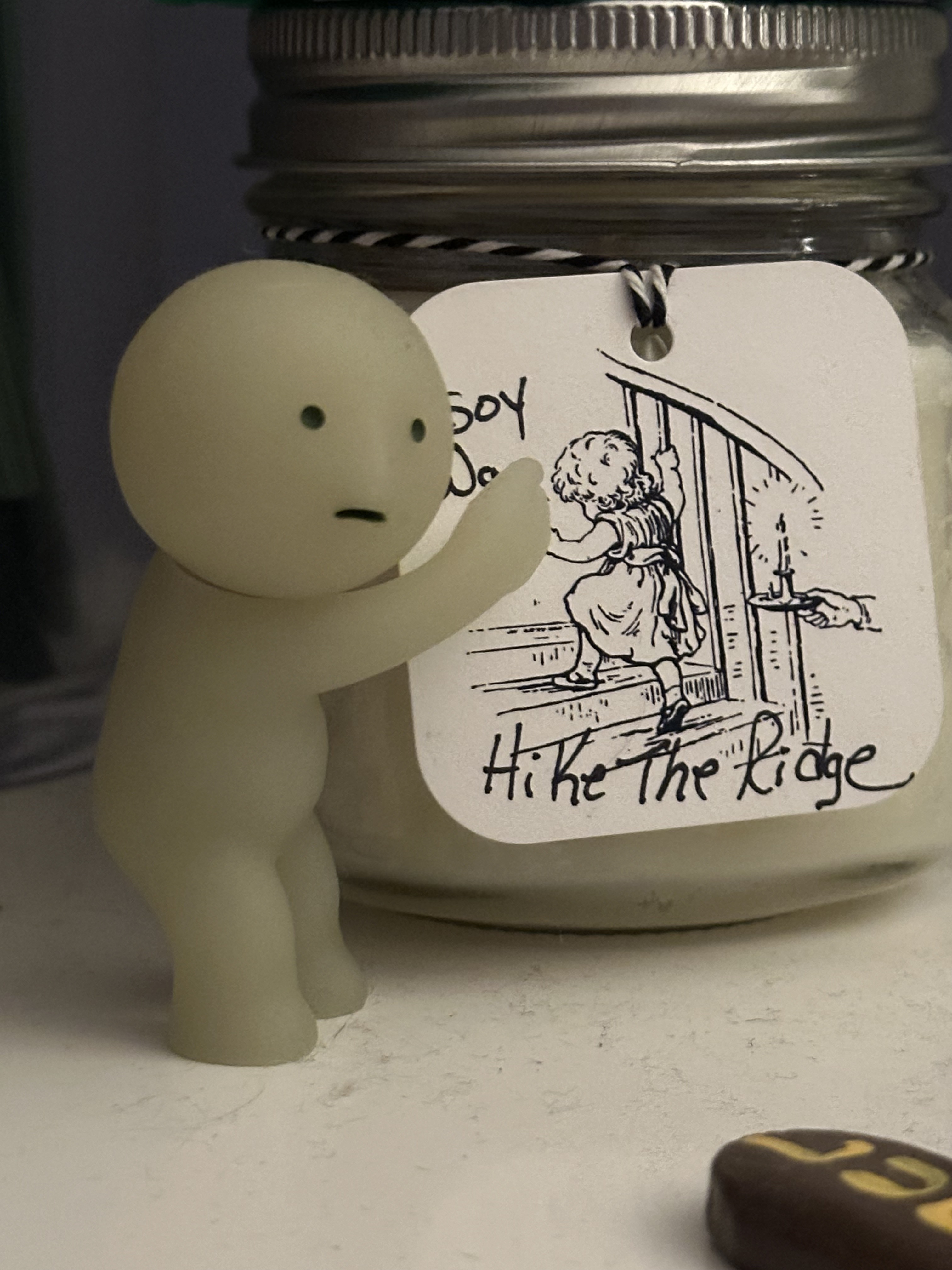
Smiski holding a candle on my dresser
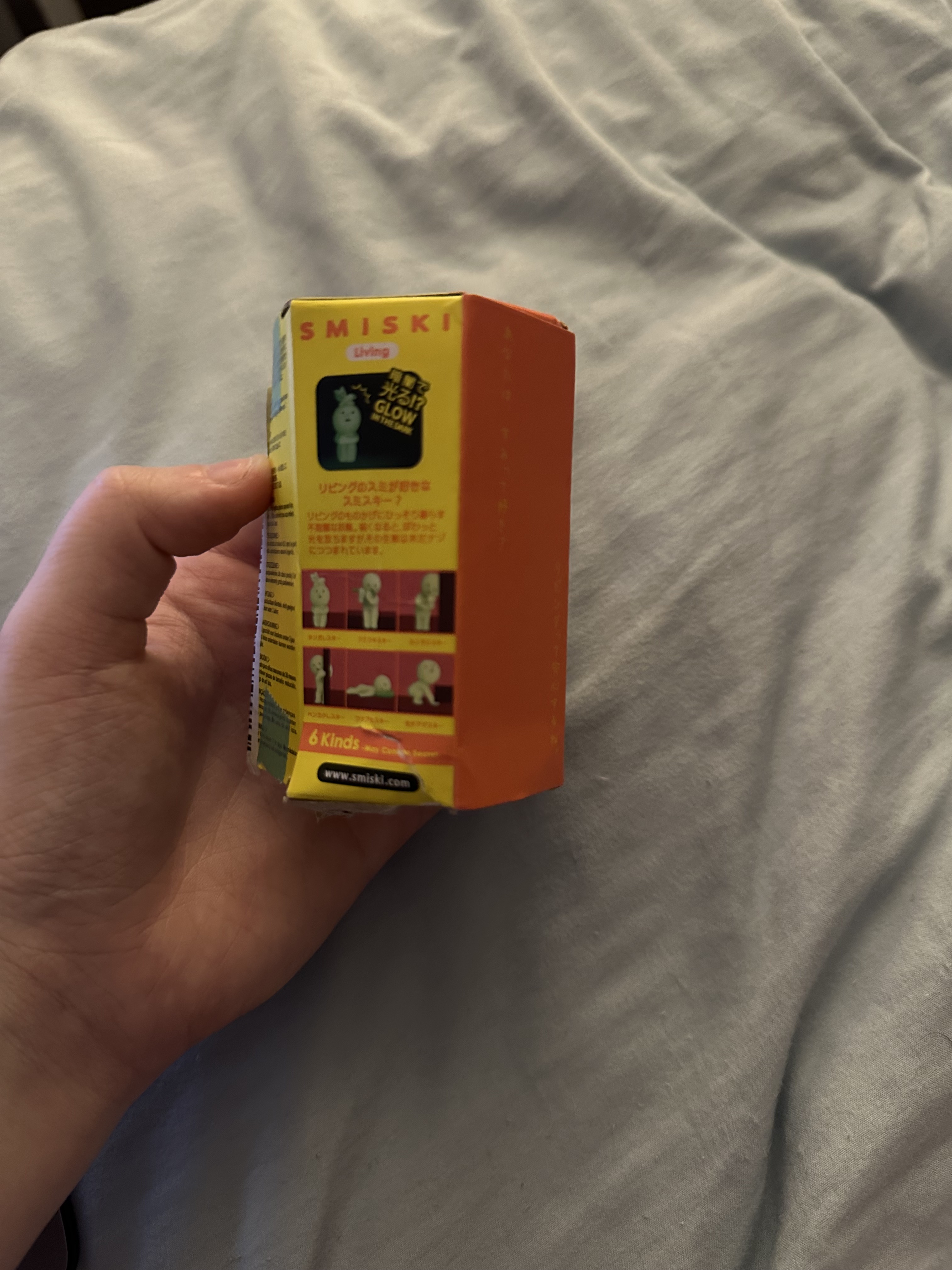
The series I bought from was the Smiski Living series, which features a few of our beloved friends sleeping, lifting, or even playing the flute. Out of the six possible options, when I received my package, I was granted the figurine “Smiski Hiding.” This figure stands at about 2.75 inches tall and about 1.5 inches wide (measuring with its arms). It has its arms outstretched with a space big enough to hold the average pen, pencil, or hiding spot.
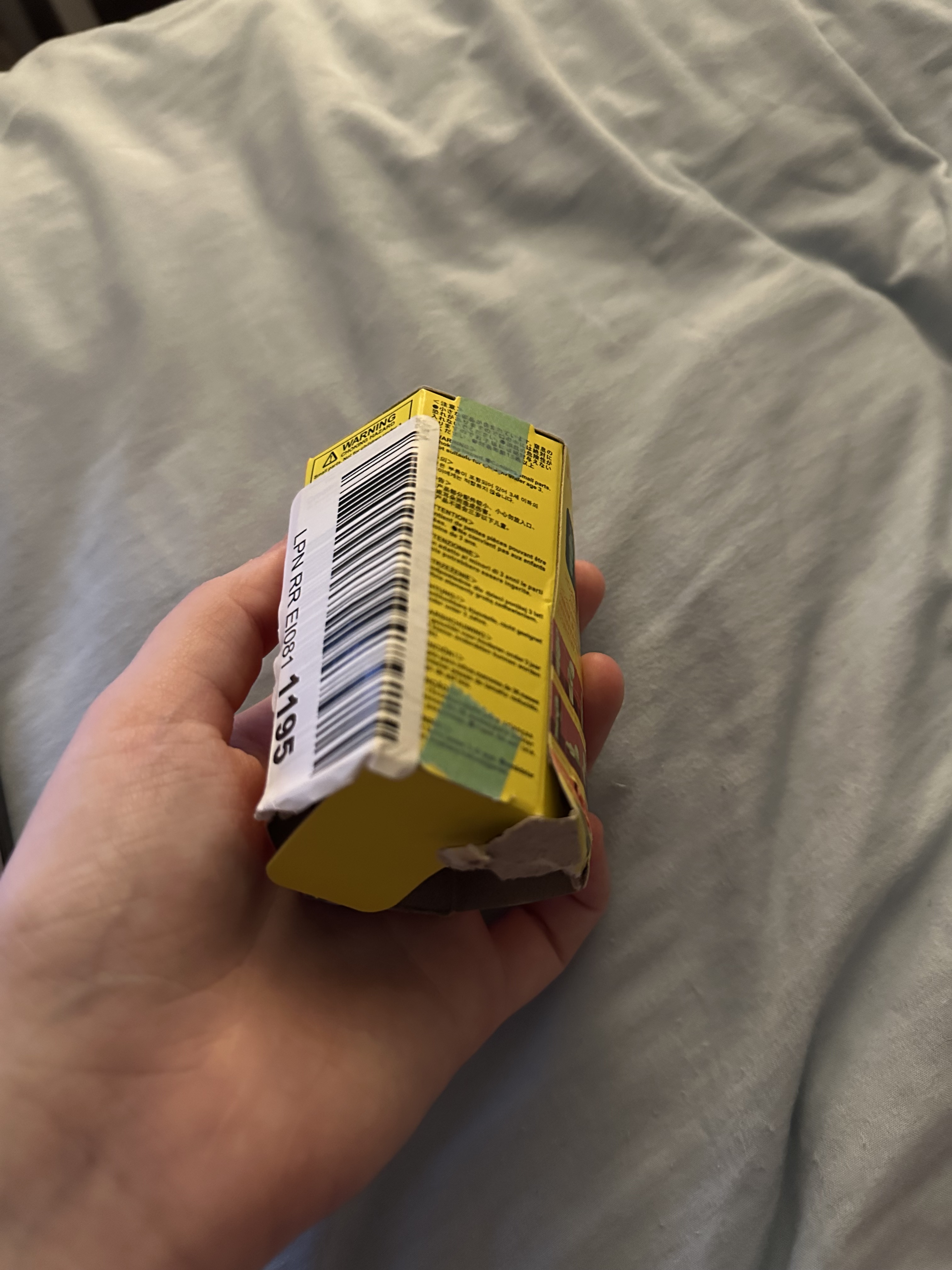
Its packaging, like its other brother and sister series, is all shaped in a hexagon. The outer layer is made with colorful cardboard describing the product and possible figures included. Standing at 3 inches tall, each panel is 1 inch wide. Within, there is a bright yellow and silver foil with the word “SMISKI” printed all over and a mini booklet showcasing all the released series by the company, Dreams. The next task is I wanted to take another look at its packaging and its journey from Japan to my hands.
Smiski, depending on where you live, is relatively hard to find in stores. Smiski was originally a Japanese goods store established in 1996. Over time, and with the major popularity of their objects, they opened a business in America and Korea. According to their website, employees get 8 hours of work Mon-Fri, with a 1-hour break, along with benefits such as transportation, salary, and social insurance. Through my research, the exact labor cost per Smiski and the production information produced by Dreams Inc. is not publicly available due to company confidentiality. However, we can speculate on likely stages of production such as mold creation, casting, hand painting, assembly, and quality control. While I was unable to find information on specific labor, I was able to find some information regarding the production of objects through the Dreams INC wholesale website. This is where my trial ended.
Where I’m from, not many places sell them, and I’ve really wanted one. Amazon, the great big website itself, offered me the opportunity to purchase one! While there are many storefronts on Amazon when searching for this specific series, the only available one was from a seller on Amazon named “Japan Mart JP.” According to their storefront, they sell various toys and games. However, under Detailed Seller Information, it states that the “Business Name: Masumi Yoshikawa” and “Business Address: 8-15 Kaminagaya 6-chome Kounan-ku, Yokohama-shi Kanagawa-ken 2330012 JP.” (Amazon 2024). Moreover, looking for this information online yielded not much more info—which often seems to be a recurring case in most Amazon storefronts.
However, within these interactions and my research, another question was considered. Thinking about these mass-produced objects led to the thought process of toy production in China, especially the idea of the blind box within marketing. China’s blind box industry has successfully entered the peak of development and consumerism over the past four years. This can be highly attributed to younger generations and social media trends; for example, a mega trend and hype surrounding “Sonny Angels,” which became one of the largest blind box products of the year and caused major hype around the product through TikTok and other social media platforms. Buying and sharing blind boxes has become a new consumer trend, a trend that targets a young consumer market.
Taking a look at a report by Yuqing Yang called “Analysis on the Marketing Strategy of Blind Box,” Yang takes an approach to further explore the level of marketing and strategy of the blind box movement. They briefly discuss the overarching consequences for consumers but also the benefits for the companies themselves, even in China. Yang makes a point at the beginning of their work that I found interesting: “This trend of toys targets the young consumer market, stimulating consumers to buy and rebuy. Blind boxes’ unknowability can pique customers’ curiosity, increase their readiness to buy, better activate the market for consumer goods, and boost their potential for consumption.” (Yang, 2023).
The marketing/culture that surrounds blind boxes offers this type of relationship between online and offline stimulation for younger audiences. Blind boxes, while the plastic within is not very useful, foster an environment for young people to consume and to be noticed within a collectors’ community. The excitement of buying a box, the tension of opening the box to see if you get the one you wished for, and the reaction afterward fuel stimulation among friends and collectors. Such marketing pushes you to buy more and more, a gambling dilemma, to get the one you really want or the entire set.
Taking these products into account adds a new layer to how these products are created and consumed. I am a victim of it, buying my own fair share of Smiski’s. This leads to my next section: the journey of my Smiski itself.
Ordered on May 22, 2024, I received my new little friend on May 31, 2024. Due to its later shipping and the location of the seller, I can only assume my new object traveled from overseas. Opening the white bubbled package, I found my new Smiski friend packaging to be covered in dents, tape, and overall unkemptness. This box certainly had a journey. Partly crushed, the box had an extra-large barcode sticker and two smaller pieces of blue tape on its sides. From this, I could determine that perhaps this box was damaged before it was even shipped. The blue tape seemed to be holding the top and bottom together. The bottom piece was completely dented in… the more I looked, the more I feared I was scammed. The possibility of this item being opened and then shipped was real. However, this was not the case; my figure and the products inside were all there, nothing missing.
So I began to think about this assignment…how did my box end up like this? Where was it sitting in Japan before an American bought it? A warehouse? I’ll never know. But I can take into consideration what the dents and damage look like, and how it traveled over 6,000 miles to get into my possession. Did the plane ride have a lot of turbulence? Is the seller too rough? Were the millions of potholes scattered around Troy, NY too much for the little package!? I’d like to think so. Maybe all along that’s why my new friend is hiding…they’ve seen so much of the world.
Yang, Yuqing. (2023). Analysis on the Marketing Strategy of Blind Box. Advances in Economics, Management and Political Sciences. 27. 26-30. 10.54254/2754-1169/27/20231206.
After asking my family around for objects with chains of history, I came back pretty much empty-handed apart from a few gems. One of these gems was a story from my grandfather; the story that started his pen/pencil collections.
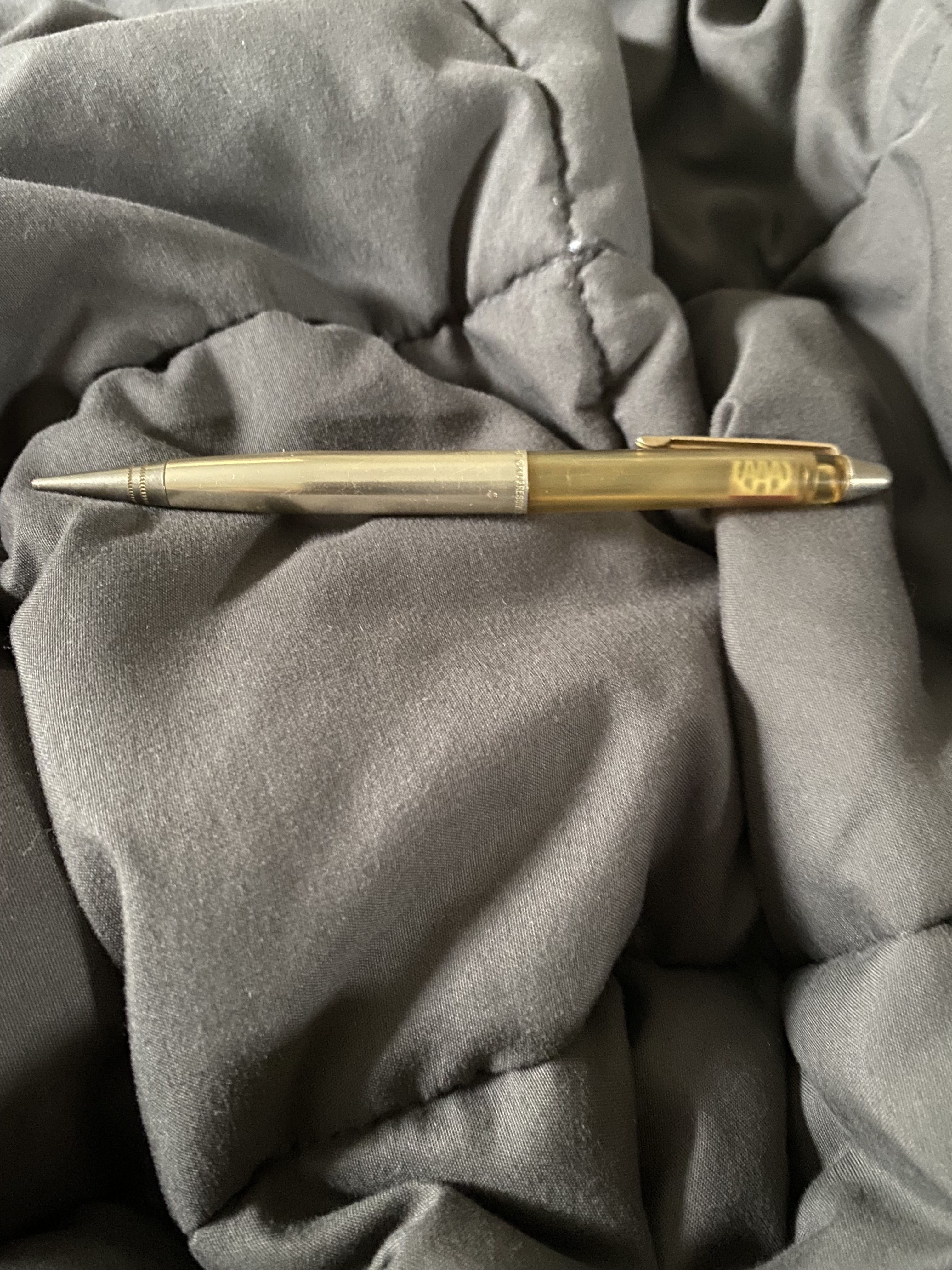
Poppy’s pencil
This object stands at about 5-1/8 inches long. From the top portion of the pencil to the endpoint, the pencil is embellished with a bronze-gold finish. The H-type lead appears out of the barrel with a continuous twist. Around the bottom is a raised surface of small, rounded ovals to create a small pattern, something to rub your finger over. A smooth nib at the top connects to a metal hook to attach to papers or your pockets. Made from plastic and metal, this pencil is special because halfway down the barrel, the pencil contains a liquid core on the upper side under the eraser. Now dried out from age, contained within the liquid core is a plastic 3-dimensional logo of AAA. Under this core lies a stamped imprint of the production. Embedded reads “Progressive Products INC. Union N.J. U.S.A.”
While I could not find the exact pencil online, I found it is “brothers and sisters” — pencils that are the same make and model but with different “themes.” I came to find the object is commonly called the “Vintage Progressive Floaty Mechanical Pencil,” and there are millions just like it. So, I kept searching. I wanted to know who created it, or more importantly, where it originated from. Upon further research, Progressive Products INC does not really exist anymore, well not the original anyway. By finding similar pencils online, I discovered a certificate of guarantee with the company name and address on the paper. It read, “PROGRESSIVE PRODUCTS INC. 701 Lehigh Avenue, Union, New Jersey.” Looking this up, you are given industrial property for sale, but no mention of the company. So, I kept looking. A New Jersey-based company product manufacturer called Progressive Promotions, now known as Dryvve, was the closest I could find, but I am unsure, mainly because they do not list an established date and look on the newer side of things. So, the trail ended here.
But the story that follows it has not ended. The story that follows this very pencil is how it became the first of his collection.
1949, in grade school, specifically Public School 12 of Troy, NY, my grandfather was in fourth grade. During this time children used to use “straight pens” which encompassed ink wells and fountain pens, ballpoints were not popular by any means.
AAA or the American Automobile Association, which began in the early 1900s, annually holds a safety poster art contest for children pre-k through 12. As part of a class project, my grandfather’s fourth-grade class must create an illustration for the contest. The goal of the contest was to promote safety messages in schools and encourage communication through creativity. The prize for this contest was that the top 3 pieces chosen would be put on display in Stanley Department Store located at Third and State Street, Troy NY, which current day I know as Hatchet Hardware.
My grandfather placed 4th. While upset about the loss, he soon found out that his piece was displayed at the store as an honorable mention. Poppy described the piece as a rugged baseball player, split in half; the left side showed the player beaten up, injured, and with crutches and a cast. On the right side, the player was healthy, bat in hand, and ready for the game. While I can picture such a drawing in my head, I yearn to know what it truly looks like and what care and skill my grandfather put into it. Did he stay up all hours of the night completing it, just like I do in the studios? Was he excited and prioritized this over schoolwork, like I do when I start painting? Was there a background? Was there text? I will not know; my grandfather can only remember so much.
Branched off from how this object got into the possession of my grandfather, what followed this story was when his collection began to grow. Around the same time as this story, while in grade school, there was a quite older gentleman in his neighborhood. He used to give my grandfather parts and broken pens. From this older gentleman, for whom I have no name, my grandfather started to fix pens. He told me all his classmates would pay him to fix their broken pens, and he made a small change by doing something he enjoyed. Life went on, and my grandfather stopped fixing pens until 20 years ago. He went to a garage sale and found broken pens for a dollar. Feeling nostalgic, my Poppy bought one, fixed it, and began to write again. To this day, he still does and encourages my grandmother to do the same as she battles Alzheimer’s.
Unfortunately, I was unable to find any news articles about this event happening, at least not in the town of New Paltz. Hopefully, when I return home, I will have to continue my findings in my town’s public library.
The object I chose to elaborate on and describe was from our first meeting in class: the keys to my house. They are 16 inches long and end at the clasp of the stretch-out twine, and another four inches are added via the attached mechanisms.
a frontal view of the keys
A heavy handful, when moved, makes a jangling noise. Beginning at the top of the twine, the lanyard is adorned with various materials, including enamel, metal, and plastic; all these textures and materials are formed into a specific shape. Fused to the back of the metal shapes are small needles completed by a rudder backing to keep them in place once poked through the material.
The twine itself is formed by a soft and sleek blend of fabrics. Imprinted into the twine are a series of patterns with the words “Van Gogh” perfectly spaced along the rope. In the background lie bits and pieces of the recognizable painting Starry Night. Blues, yellows, blacks, and greens all form in spirals as the painting takes shape at a glance. At the end of the lanyard is a linked half-circle metal shape, a circular clasp is attached, and a lever to the side allows the clasp to move within itself—open and close.
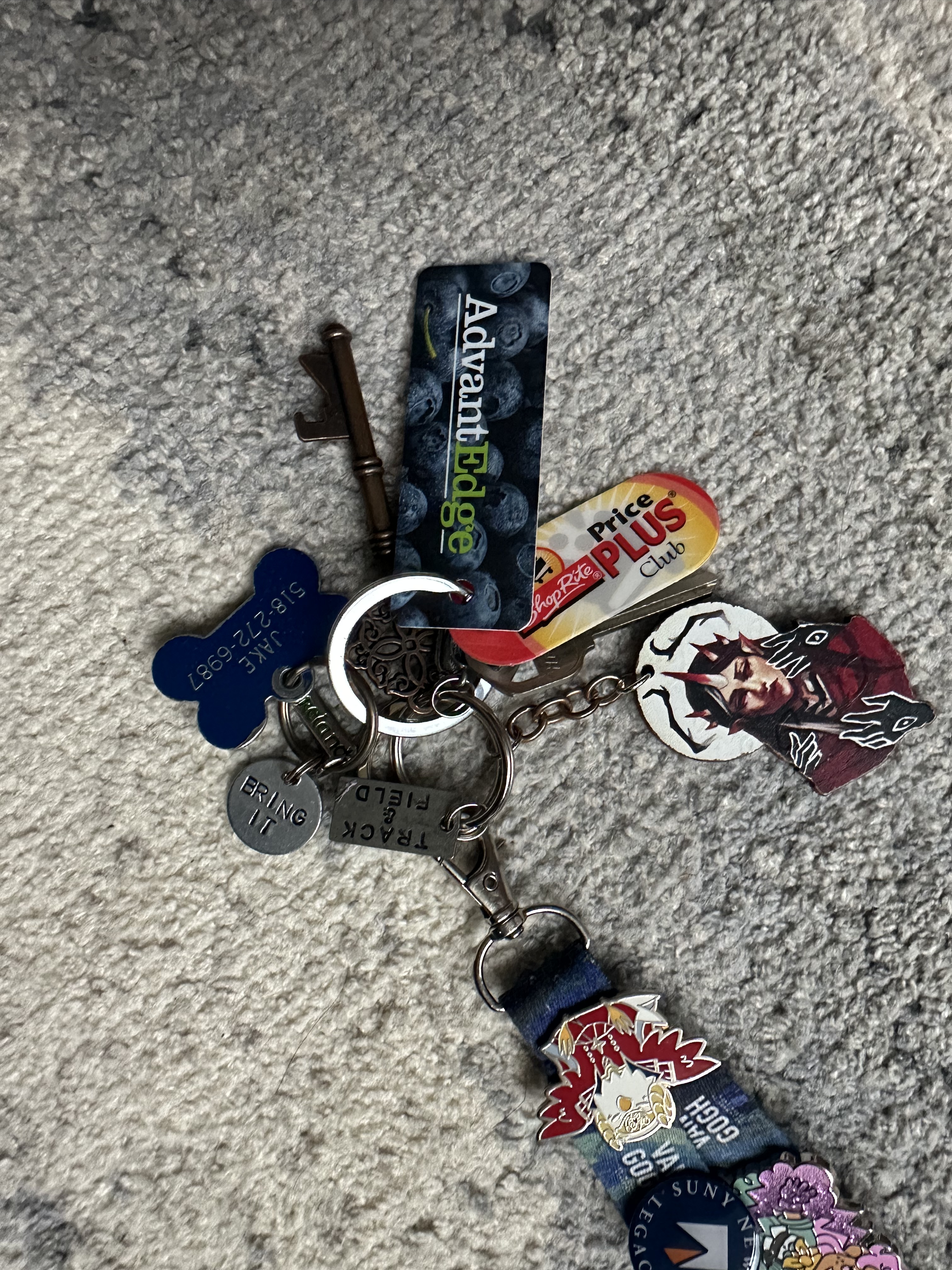
The attached keys *please don’t call the number, it is not ours anymore*
Shackled to the rope, are four circular rings, each able to be pulled to hook onto one another. A golden ring with six consecutive loops fixed together holds a humanoid figure with horns, brown hair, and black hands. The figure looks below, a stick-like design is presented over in the circular frame. Subsequently, another hoop is next. Three loops are locked together, one holds a key in the design of a lost artifact, bronze in color, and another is a bright silver key made from metal in the shape made for a lock, sharp and spiky by nature, with a windowish design on top. Alongside these forms, a circular metal says “BRING IT”, stamped by human hands likewise; a second medallion reads “Track & Field”. Alongside these two metal forms is a third bone-shaped metal tag, that reads “JAKE 518-272-6987”. Beside these metal medallions lie two oval-shaped plastic cards. They read “AdvantEdge” with “Advant” in white and “Edge” in green, with blueberries enveloping the background. On the flip side, there is a barcode and numbers on a white background. Paired with the second smaller card, adorned in red and yellow, reads “ShopRite Price Plus Club” with a shopping card logo. Similar to its partner, it has a barcode and numbers on the backside.
This section of the keys holds a minor part of its story, as it contains little moments from my life so far within the key rings. The small sports medallions all represent and are gifts from my senior nights of my played sports: “BRING IT” for my time as a goalie in lacrosse, and “Track & Field” for my time as an indoor and outdoor thrower. The shopping cards are all new, as they hold the rewards for my times shopping at nearby grocery stores — now as a college student. The dog tag belongs to my first pet, Jake. It was his first tag, and he has outgrown it. The number is an old landline my family doesn’t own anymore. Having this piece of him with me reminds me of him at home and how I miss him at college. The decorated keychain was a small gift from my brother on Christmas by my favorite artist Annadrawsstuff. Lastly, the keys, while one of them is my real key I use to enter my house, the other “older” looking is actually a bottle opener from a wedding I worked at. It was a party favor left behind, so in case of use, I took an extra.
Backside
Last but not least, the main element is attached in small quantities on the lanyard: pins. Nineteen in total, all ranging in sizes, shapes, and textures. Some are recognized shapes, while others are not so much. Starting from the bottom, near the metallic clasp: in a bird-like shape, a bird is posed with outward wings wearing an outfit of red and blue. It has a yellow crown and horns on its head; this is a character from a game I’ve played. Above is a small circle, dark blue with the SUNY New Paltz logo in the center, and the text reads “SUNY NEW PALTZ LEGACY” — my uncle/godfather attended the school, thus I am a legacy. Moving up, a butterfly sparkly, blues, whites, blacks, and moon phases adorne the bug – this was from a craft fair. Next, a large dark human figure wearing red and black holding scissors, they have a snarky face – this is a character from a show I watch. Above a white cat with a sword through its head, hovering over a dice with a 1 labeled on it; surrounding the cat, it reads “It’s fine. I’m fine. Everything’s Fine” – a pin that shows my love for D&D. Higher, another graphic depiction of a black and white cat with its paw outstretched, with letters that spell beans, under a spilled coffee cup in liquid spells “CAT CAFE” – a pin for my first time at a local cafe Beans! On top of this pin is a leaf-shaped dark and green plant with the letter NYBG – my first time at the NY Botanical Gardens. Next, a very tiny silver depiction of the Colosseum, engraved with small outlooks – this was from my trip to Italy. Next, another white cat is chewing on an orange fish – a gift from a friend. Lastly, on the right side is a color tube of paint, its cap black and body in an explosion of color with gold dots – this was a gift from an old art teacher.
Lastly, on the left side going down: there is an image of a yellow dog wearing a top hat, holding a mug in a dumpster on fire, with the quote “This is Fine” — a pin of my favorite internet meme. Below is a colorful pin with the logo for MoMA, my first time at MoMA. Under a black and white moth with flowers and leaves — another gift from a friend and my love of moths. Beneath a running red rabbit with wheat stocks inside — a purchase from a local thrift in New Paltz. Down a small shield-like shape, a golden touch lays inside with text reading “National Honors Society” “CSLS” — a member of the NHS for my academics in school. Below that pin is another human figure with pink and blue flowers around them, green hair and green clothes, holding a monkey spitting fire — another character from a show. Third to last is a similar circular shape with the New Paltz logo reading “New Paltz Honors Program” — I’m a member of the honors in my college. Second to last is a small, pink, shiny ribbon in the shape of the breast cancer awareness logo; this represents a fight for my friend’s mother, in which she sadly lost when we were young; we always partake in a walk for her every year. Lastly, another human figure, wearing a light blue dress, a white corset, and a yellow bandana; they have pink hair and pink lighting shooting from them. This creates a full circle around the Lanyard.
While I wish to explain and dive in more into my pins, there is only so much I can write for now as a first work in writing about objects. (I’ve definitely gone on for too long.) However, this collection has been with me for a long time, and each day a new pin may be added, which then means a new memory has been made.













 The Materials of History, Thought, and Art