The Happy Planner®’s (To-Date) Worst Planner

We had spoken in class about how our phone devices have become an extension of ourself, used to store information that would traditionally be stored in our heads or on paper, such as phone numbers, calculating, reminders, the list goes on. During this conversation in class, my mind was drawn to my personal experience with keeping myself organized, or lack thereof, between school and work. I remember every year from elementary school to my senior year of high school, we were given an agenda to write down our homework assignments. Embarrassingly, I could go the entire school year without touching this spiral bound notebook. In replacement, I would use my phone notes to make a checklist of each assignment or task I had for a night. I started using my phone notes as my checklist sometime in high school, and carried this out for the rest of my academic career. Even when this exact “Analog Experience” assignment was due to appear on my radar, I found myself typing it into my notes app. For this analog assignment, I decided to use a physical planner for a week. Starting the process, I was curious to see how my analog version would affect my productivity or readiness to complete the tasks at hand. In addition, would the physical action of hand writing each task, rather than typing, impact my ability to remember the assignments I had? Would I feel more organized? Or lost in the inconveniences of flipping to a page in a book rather than the one-touch accessibility on my phone?

To start my process of this experiment, I dug out a completely bare and blank planner gifted to me by my mother earlier this year, and jotted down “analog experience assignment, due dec. 3rd”. This was the first line of writing to start my process. I began to write down some other assignments for classes. I was unsure if I wanted to organize my assignments in a particular way the way another student might practice, or messily type out nonsense with no order or organization the way I am comfortable with. I decided to exercise this approach the way the planner would want me to. The planners are designed to promote organization, and despite my natural instincts to think differently, I decided to embrace the structure set for me. I neatly wrote down all my assignments I had on my radar for the week. Later that day, I completed one assignment for a design class. I had my first exciting moment in this process: the ability to cross out an assignment with a pen. The touch of a pen tip to paper, scratching out a task I considered completed and off my mind, was the first rewarding experience. I noticed there was an innate difference between the physical material of crossing out a task, over the simple deletion of a task, or checking it off with a tap. Because I would have to physically use the materials of pen and paper, I felt more satisfied with my accomplishment. I continued the exercise for the rest of the week.

I noticed several patterns during the exercise of using a physical planner versus my phone notes app. I felt more inclined to do my work, because I saw the assignments in front of me, rather than hidden away in my phone. The exciting crossing-out-part was also a motivating factor. Despite these benefits, there were also several instances where I was inconvenienced by the physical space of the planner. It’s a bit twisted, but I am admittedly lazy and reliant on everything being right in my hand, as an extension of myself. And so, when I was in my bed late at night and wanting to remind myself of my tasks for the next day, I wasn’t too thrilled to know my physical planner was sitting at the bottom of my bookbag, which I was not of interest to get. Also, because the habits of my mind are accustomed to my “to-do’s” existing within my phone, I often forgot I was using the planner and barely brought it out in class.

There was one last significant obstacle I found throughout this process. I was experiencing impostor syndrome. Even though the objectives of staying organized are consistent in both the physical and digital approaches, I felt like I was taking on a completely different personality during this experiment. I find it interesting how the use of an analog object can completely transform your experience, and in this instance, transformed how I viewed myself. I found myself uncomfortable with the experience, because this type of organization just does not work for my needs. However, I know that I can only speak for myself, and someone else may view their physical planner as a lifeline. To each their own.

For amusement, here’s a few embarrassing screenshots of what my nonsense “digital planner” looks like in my notes app, misspellings and all.

Spinning Wheel of the Dubois Estate

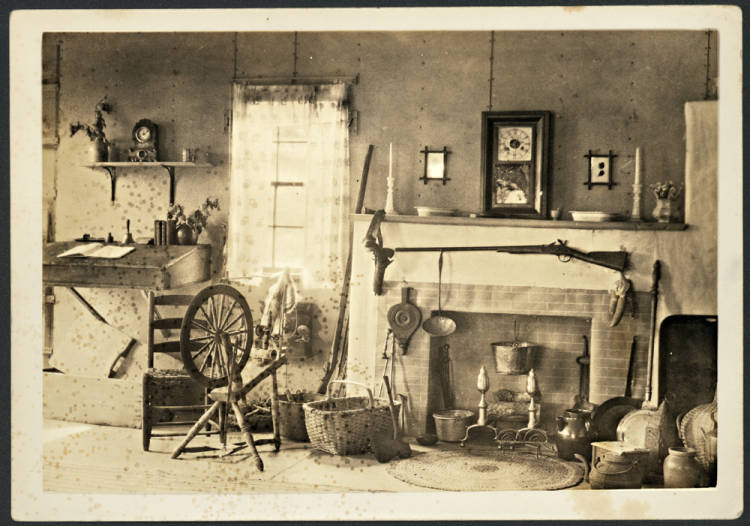
In the “Estate Inventory of Cornelius DuBois Jr.” (1816), among many other items, “2 old spinning wheels old out of repair,” is listed. A spinning wheel is generally known as some sort of old machinery used to create yarn or thread. This type of machinery has grown completely obsolete in the 21st century, which begs the question: despite being useless now, how did this object once play a fundamental role in New Paltz life during the year 1816? How does this object play a role in the specific circumstances of Cornelius Dubois Jr’s life? 

As previously mentioned, a spinning wheel is an early machine used to turn fiber into thread or yarn, which was then woven into cloth on a loom. Typically carved out of hardwood, the structure would support the main fly wheel, the wheel that rotates when treading and causes other parts of the spinning wheel to operate. The band would attach from the fly wheel to the flyer whorl. This apparatus developed from a single spindle, into a wheel structure based on a basic pulley system. The source of energy turning the main fly wheel can come from either the hand or the feet. Typically, the threads or yarn made from the spinning wheel would then be woven into cloth on a loom. The end result could range from clothing fabric to blankets for warmth. The first spinning wheels were likely invented in India or China in between 500 and 1,000 A.D, and later introduced to European countries by the 12th century through the Middle East in the European Middle Ages. As colonizers traveled from Europe to America, European ideas and machinery were brought in. The spinning wheels would be introduced to the New Paltz region at the earliest, during the late 1600s. 

Spinning Wheel
Spinning Wheel seen in unidentified room from Huguenot Historic

The first Huguenots of New Paltz were French, with the goal of finding sanctuary during the religious tirades of Louis XIV during the 1600s. One of the twelve founding families to develop community and settle to the Wallkill River Valley was the Dubois family. Louis Dubois and Abraham Hasbrouck began constructing homes in the year 1678. After several generations, Cornelius Dubois Jr. was born on June 6, 1750 to Cornelius Dubois and Ann Margrietje Hoogteeling. Cornelius Dubois Jr. married a woman named Gertrude Bruyn, and had a total of 11 children. Two old “out of repair spinning wheels” were found in the estate owned by Cornelius Dubois Jr. and his wife Gertrude, considered to belong to the family. The family most likely would have bought spinning wheels from a local craftsperson. 

In addition to the spinning wheels, other supporting materials were listed throughout the pages of the estate inventory. The inventory lists, “½ of 7 U of thread” for what appears to be worth $19.50, as the time. Other mentions of materials include: “1 quill wheel and & 2 swifts,” “19 weavers spools,” “1 pair of weavers brushes,” and “33 seanes of yarn & 52 flax”. Despite all of these items being listed as a belonging of Cornelius Dubois, it is more likely that his wife Gertrude, or another older female figure in the house, put these objects to use.

During the 1700s in America, a spinning wheel was known to be a machine women used, as they contributed to household labor. The women’s jobs and responsibilities were a reflection of cultural attitudes about differing abilities between men and women, and gender roles within a family. In the 1700s, men typically took on roles that required heavy and fast moving machines, such as farming equipment, due to their greater physical strength and physique. In contrast, women were reserved for more delicate and detailed oriented jobs, such as the spinning wheel. In addition to the cultural attitudes of the time, the description of both spinning wheels as broken may insinuate something about the technological advancements at the time. By the late 1700s, most women did not need to spin their own yarn because they could purchase fabric at a local store. Fast-forward, the Industrial Revolution normalized fast-paced large-scale machinery and factories for something that was once known as an individual and tedious task.

This document of Cornelius Dubois Jr’s estate inventory is great primary source to show the relevance of spinning wheels in households of the 1800s. The object of the spinning wheel tells a story of not only its use, but gender roles and cultural attitudes during the time. Due to the extreme shift of the Industrial Revolution, we now expect to see this work occur in factories. As technology progressed, the need for this 19th century spinning wheel vanished, but the lifestyles and stories of the Dubois’ family and other Hugeunots are preserved, through documents such as the Estate Inventory.

“About Spinning Wheels.” The Spinning Wheel Sleuth, https://www.spwhsl.com/about-spinning-wheels/. 

African American Presence in the Hudson Valley, Historic Huguenot Street. “Cornelius Dubois Jr. Inventory, April 1816.” New York Heritage Digital Collections. 1816-04. https://nyheritage.contentdm.oclc.org/digital/collection/hhs/id/1921/rec/3

Mary Anne Thorne Chadeayne Collection, Historic Huguenot Street. “Interior view, unknown house, ca. 1900.” New York Heritage Digital Collections. 1900. https://cdm16694.contentdm.oclc.org/digital/collection/hhs/id/1113/rec/3

Metmuseum.org, https://www.metmuseum.org/art/collection/search/7748. 

“Spinning Wheel.” Encyclopædia Britannica, Encyclopædia Britannica, Inc., https://www.britannica.com/technology/spinning-wheel. Wosk, Julie. “Women and the Machine: Representations from the Spinning Wheel to the Electronic Age.” Woman’s Art Journal, vol. 24, no. 1, 2003, p. 56., https://doi.org/10.2307/1358833.

Wosk, Julie. “Women and the Machine: Representations from the Spinning Wheel to the Electronic Age.” Woman’s Art Journal, vol. 24, no. 1, 2003, p. 56., https://doi.org/10.2307/1358833. 

Too Many Pants for Only Two Legs

My closet’s overabundance of pants seems to be the category in most need for Marie Kondo’s “joy test”. In the past, I’ve made jokes about how there is only two categories of objects I seem to have no self control over: pants I’ll never wear and sketchbooks I’ll never fill. Since I recently moved into my apartment this past August, I was forced to bring only the pants I would see myself wearing. Once I got to New Paltz, I still continued to purchase pants even when I knew I had no room. Funny how that goes.

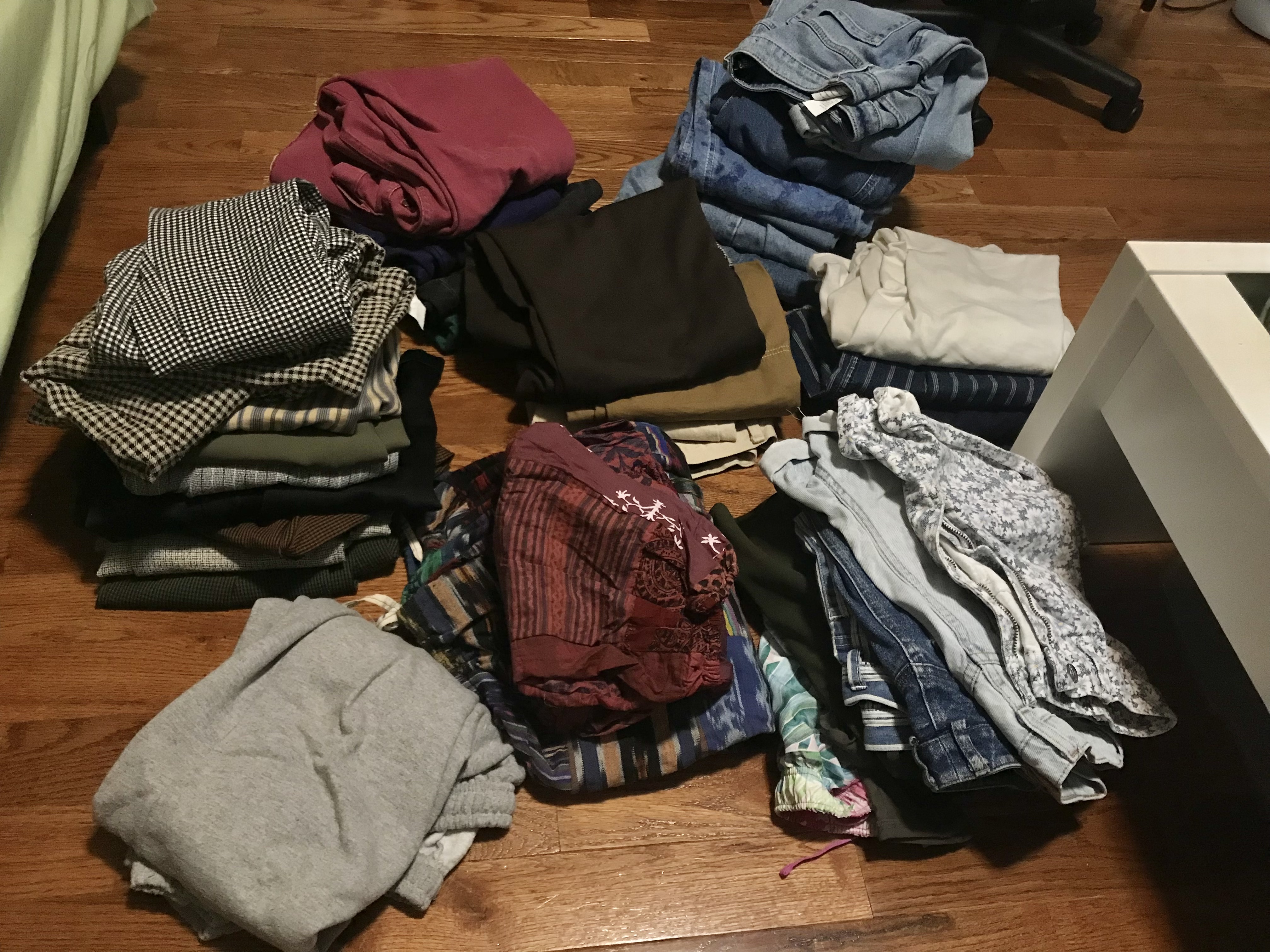
As Marie Kondo suggested, I took out every pair of pants that I had with me and spread them out on the floor. I (embarrassingly) counted 7 pairs of blue denim, 6 pairs of colored denim, 4 khakis, 9 linen/fitted pants, 3 sweatpants, 4 denim shorts, 4 active wear pants, and 2 patterned wide-leg pants. Thirty-nine pairs of bottoms total, and that is only the items I consciously decided to bring to New Paltz, from the larger collection at home. 

The starting pile of pants.

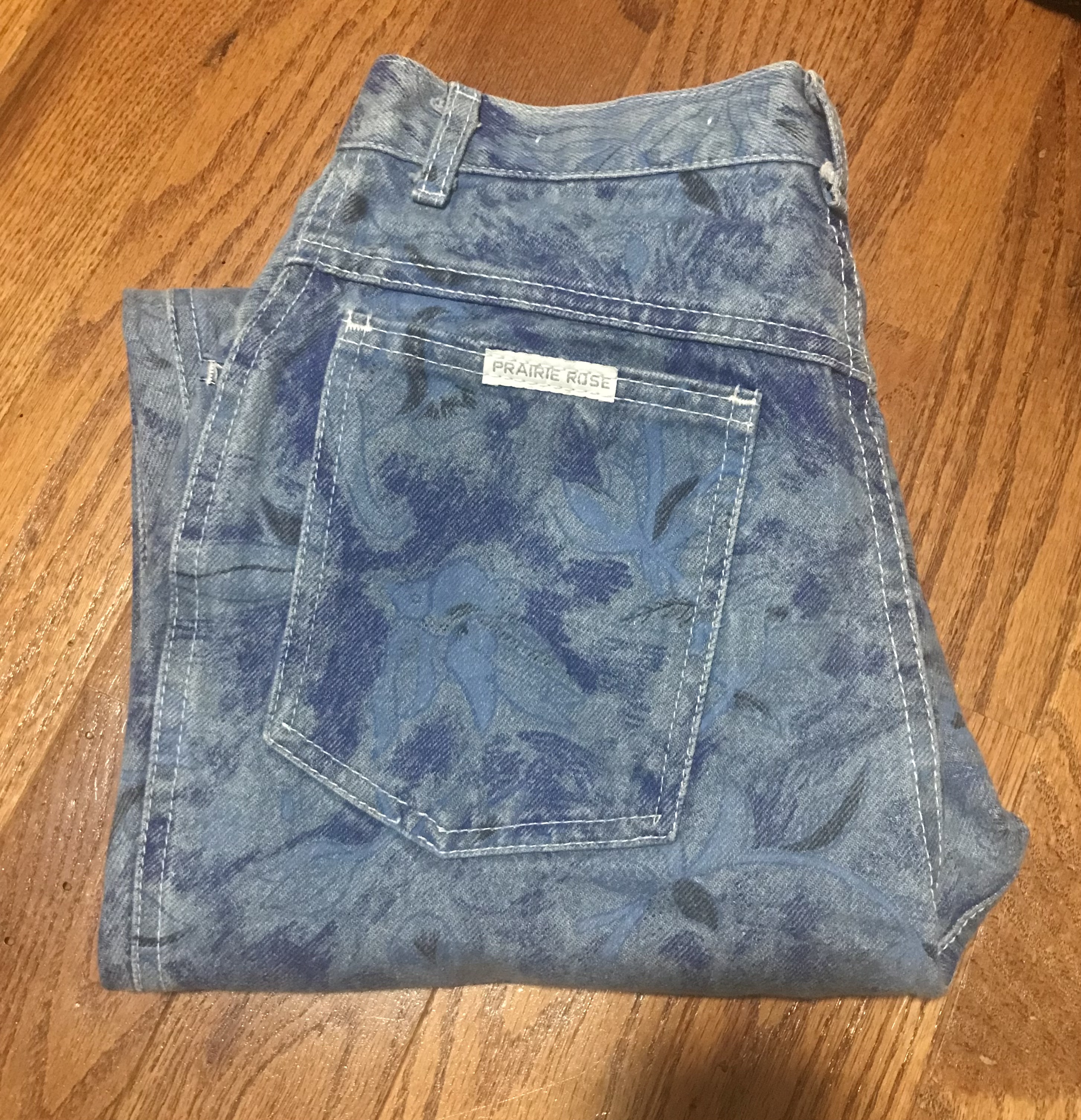
With that, I started the process of holding each individual pair of pants and asking myself if it sparked joy. When I took my pants out of the drawers, I had already categorized them by style/material. I started with my 7 blue denim jeans. I immediately decided to keep 2 medium washed jeans that fit just about perfect. I then had 5 pairs left to consider. One pair was my go-to in high school. They still fit well, look good, but the spark that once lived in the pants has dimmed. I felt the lifespan of the jeans were coming to a close. I thanked the pants for the life it served, and added it as the first discarded item. Another pair struck a response within me. They are paisley jeans that I acquired less than a week ago, gifted from my close housemate. My roommate thrifted them for me, stating “the pants reminded me of you”, and despite her having no idea what my pant size was, she decided to take the risk and bring them home. To our surprise, they fit perfectly. Not only did I have sentiment attached to the jeans because they were gifted, I think the fact that they fit perfectly by chance adds its own magic; this is the joy Marie Kondo is talking about. 

The gifted paisley patterned denim jeans from my roommate.

Next, I moved to colored jeans. I love the pop of color for each of my colored jeans, and that “spark” happened once again, because I was excited at the thought of bright eyeshadow colors I could wear in partner with the pants. I continued this process with each subcategory of pants. I could see my collection gradually getting smaller as more pants were being moved from the floor to my discard dump. After the process was completed, I turned 39 pairs of pants into 19. I looked back at the discard pile and felt no emotional response. The discard pile is fabric, the keep pile is a collection of pieces that express myself and my style.

The pile after exercising Marie Kondo’s joy test.

Reflecting on the work I had just done, I recognized a couple of patterns. Cost of the item never crossed my mind, as the stakes were always low. This is because I was gifted or thrifted every item in my pants collection, with maybe a few coming from the back clearance wall of a JC Penneys. I do not own any articles of clothing that I consider an investment. If anything, I consider value based on the strokes of luck I have with how cheap the deal was. Psychologically, there’s a part of me that likes to brag about “what a good deal I got”, as if it’s some testament to how smart or lucky I am. So when considering the root of “joy”, I might have a brighter spark for a brand new pair of vintage Wranglers that I got for $5, rather than a Forever21 pair of jeans for $15. 

Another pattern I noticed is that I found myself keeping items that are a part of a specific outfit I like to wear. By itself, a pant might not stand out as a stellar item that needs to be kept, but I recognize that it is owned to a larger look. Therefore, the article of clothing must be kept, or else the spark of “joy” the outfit brings would be lost. 

Lastly, I recognized my struggles of letting go seemed to root from the idea that each pair of pant was different. I have this distorted perception in my mind that I should own every style, pattern, and color, of each pant that ever exists, when in reality there is no need. 

Closing the experiment, I was left inspired to actually start donating clothes, considering I could probably eliminate 20 pairs of pants from my closet and feel just alright. However, I know myself too well, and know I would find another 20 new pairs of pants to fill my drawers.

Village Candle meets the Village of New Paltz

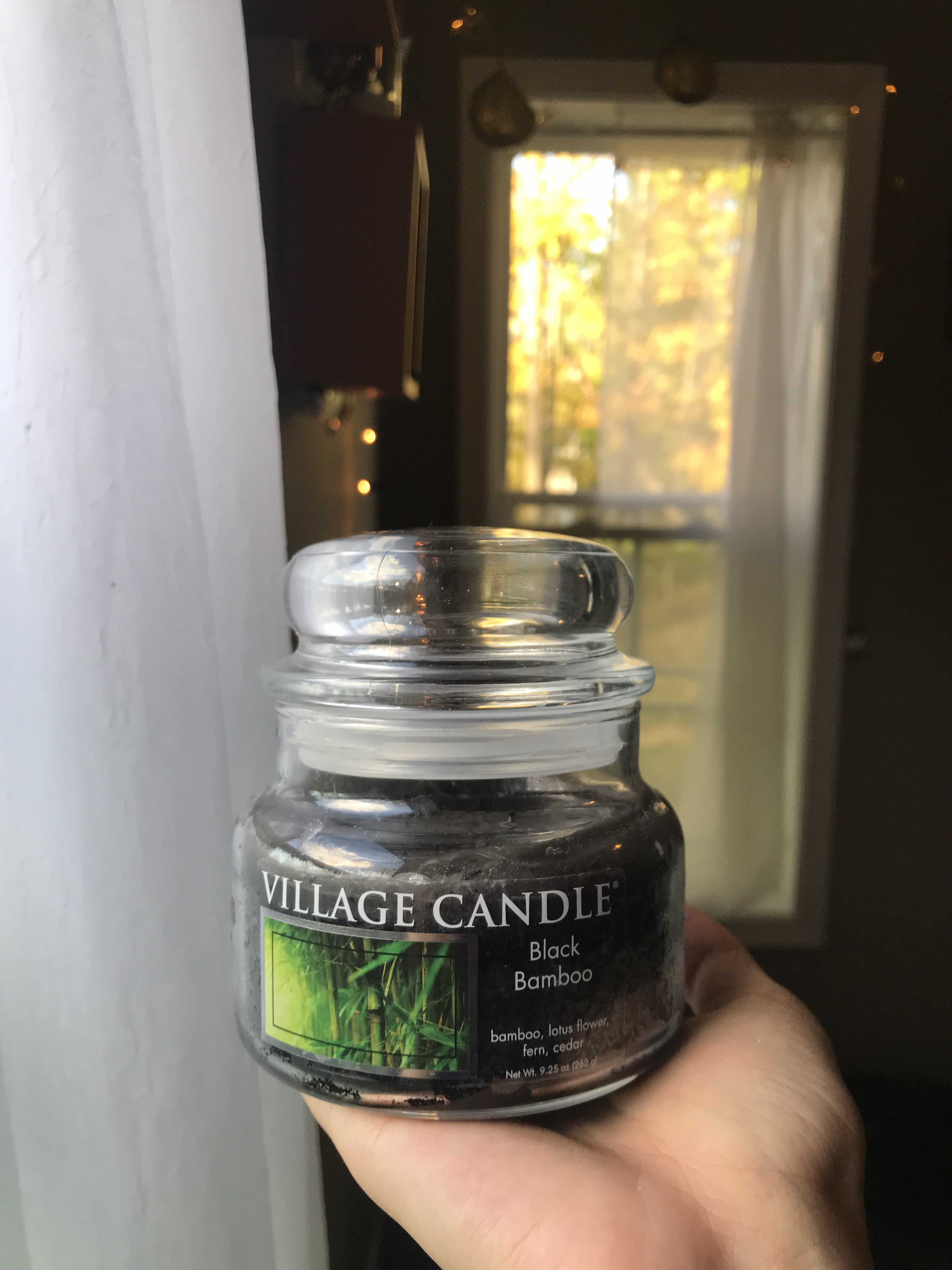
Just this past Tuesday, I had walked into aisle 14 of Tops and bought a Black Bamboo candle by the brand of Village Candle. The object itself is a glass jar about 4 inches wide, with black scented candle wax inside, 2 wicks, and a glass lid with a rubber seal. A sticker label on the bottom of the glass jar states the candle is made in “Wells, Maine, U.S.A”, which gives me some sort of geographical insight. As I looked closer, on the edge of the rubber seal, “MADE IN THE USA” is printed, which confirms to me that in addition to the candle, the glass jar is also produced in the United States. 

I began to research a little bit about the company. How did this company start? Where was it founded? According to the Village Candle website, the Village Candle company started in 1993 on a kitchen stovetop in the home of, founder, Paul Aldrich. He pursued his candle-making hobby as a business and as demands grew, he was able to move his at-home business to a 2,500 sq ft space in Yarmouth, Maine. With continuing success, Village Candle grew into a large candle company owned by the parent company of Stonewall Kitchen, with both United States and international sales. 

Self proclaimed on the website, the candles are born in Maine with meticulous care and craftsmanship. Each candle is crafted with a blend of food grade paraffin wax for a clean and safe burn. With the emphasis of cleanliness and safety, I decided to first take a look at the wax. Paraffin wax is derived from petroleum, coal or oil shale- that consists of hydrocarbon molecules containing 20-40 carbon atoms. Historically, paraffin wax was first created by the German chemist Karl von Reichenbach in 1830. The creation of paraffin wax paved way for developments in candlemaking, because it was clean, reliable, and cheap. With the addition of stearic acid, the candlemaking industry was able to produce efficiently made candles with high melting points. During the early 1900s as meat and oil industries grew, paraffin and stearic acid were byproducts of these productions- leading to a growth in paraffin wax production. For paraffin’s manufacturing process, slack wax is used as the feedstock, which is a byproduct from the refining of lubricating oil. To remove the oils from slack wax, the wax goes through a process of heating, resulting in crystallization and separation between oil and wax. The wax is then filtered and further processed. Because the paraffin wax is naturally white, liquid dye is used to add the black color of my candle. In addition to candle making, paraffin wax is commonly used for lubrication, electrical insulation, cosmetics, and crayons. Throughout my deconstruction research process of paraffin wax, I found out that word itself can be deconstructed. Paraffin derives from the latin word, “parum” which means “lacking affinity” or “lacking reactivity”. Paraffin wax has such an unreative nature, which allows for many different uses.

Besides wax, the fragrance is one of the most important components of a candle. They state that the fragrances include pure essential oils and plant extracts from around the world. My Black Bamboo candle states it includes bamboo, lotus flower, fern, and cedar fragrances. These plant extracts for the fragrances derive from oils, which come from their various native areas of the world; bamboo and lotus flowers are native to Asia, ferns are native to eastern North America, and cedar is native to the Mediterranean region. At around 185 degrees Farenheit, the dye and fragrance oils are able to chemically bond with the paraffin wax. Once prepared, they are distributed into the glass jars, along with the paper and pure cotton core wicks. 

Stated on their website, each candle is quality checked and the wicks are hand trimmed by the Village Candles team. I imagine after my candle jar is filled, hardened, and cured, the jar was checked for any errors by detail driven workers. Once screened, the wicks are hand-cut and placed in boxes, ready to be shipped at the designated locations. Shipped from Wells, Maine, in a truck- the candle travels to New Paltz and distributed at the local grocery store, for a likely young part-time student to unpack and place on the shelf. Through this journey of preparations, manufacturing, packaging, and transportation, the candle finally finds a home in my bedroom of New Paltz.

Sources:

https://www.prweb.com/releases/2018/04/prweb15418054.htm

https://www.stonewallkitchen.com/village-candle-behind-the-scenes/village-candle-behind-the-scents.html

https://web.archive.org/web/20120630024342/http://bitumenengineering.com/materials/paraffin-wax

https://www.oxfordlearnersdictionaries.com/us/definition/english/paraffin

Behind the Badge

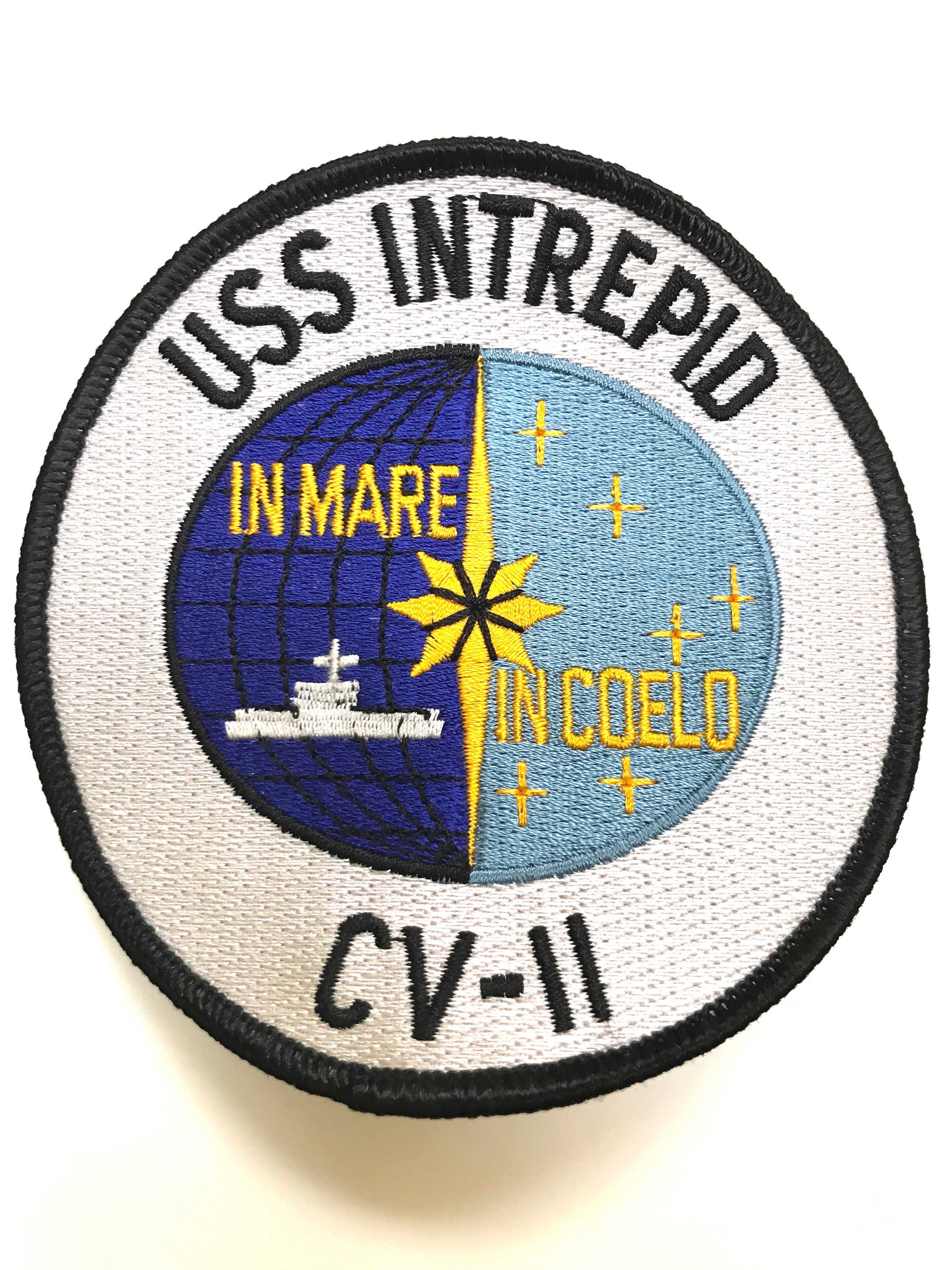
As a college student pursuing graphic design here at SUNY New Paltz, I can share my pride over one of my grandfather’s designs, specifically the badge of the USS Intrepid. The Intrepid is an Essex-class aircraft carrier built for the United States Navy, used in World War II, the Cold War, and the Vietnam War.

Growing up, I had always seen this badge design sitting on a shelf in my grandparents house. To my knowledge, it had become an ordinary decor piece. As a young girl, I was blatantly uninterested in learning about anything to do with the Navy, and so despite my grandfather’s attempts to explain his stories- they were not remembered. As I grew older, however, I became more interested in the story behind the badge. For the interest of this assignment, I had my grandfather tell his story to my father, who had taken notes to send to me.

The badge, designed by my grandfather

The badge itself is 4” wide, in near perfect condition. There are several badges floating around our family, this specific badge photographed is owned by my father in our home of Clinton, NY. Iron-on backing unused, without any loose threads. Preserved with care. So, how is this badge important to my family?

My grandfather, Norbert Blum, had joined the Navy on July 14th, 1952 at the age of 19. He had just recently graduated from high school in a small town south of Rochester, NY. He had always found a passion for art and design growing up, but was drafted to the Navy before any academic plans were pursued. He found himself on the Intrepid, working as a radarman during the Korean War. On the ship, there was a newspaper that was published once every month. The paper included news journals, cartoons, and entries by the sailors themselves. One day in 1955, the newspaper announced a contest for a sailor with a knack for design to create a logo for the ships crew; the best design would win the honors of reproduction. 

With previous interests in art, my grandfather took the opportunity to enter a design. He wanted a design that represented the two parts of the Intrepid; the ship, and the aircraft carrier. He divided the patch into two parts. On the left side of the patch states, “IN MARE”, which translated from Latin, means “on the sea”. On the right side states, “IN COELO”, which translates to “in the sky”. The left half design is a globe with latitude and longitude lines, signifying the sea. The right half design is blue with stars, signifying the sky. In the center, acting as the dividing line, is a compass needle. “USS INTREPID” curves at the top of the design, “CV-11” curves at the bottom. As my grandfather states, “CV-11 is Navy code for the Intrepid ship, us Navy guys would know”. 

He submitted the design, and soon later heard the Admiral Commanding Officer announce great news: his design won. 

As a material object, I think a logo design is particularly interesting to choose because it has great personal value to my family, yet, it is not a privately valued item. The aircraft carrier docked in the Hudson River in New York City has turned into a museum, The Intrepid Museum, where visitors come and go. Out for public display, my grandfather’s design is painted largely on the inside of the ship, and embellished on countless items in the gift shop. My grandfather had gotten an original copy of the patch before he left the navy, but the patch that my father owns today is bought from the gift shop when my father and grandfather visited the Intrepid Museum in 2010. When noting this specific badge’s chain of ownership, I can discuss the passing of the gift shop, to my grandfather, to my father, to me. However, I see a wider picture. The design is intended to be owned and shared by the public, including the tens of thousands of sailors that served. I believe the design’s ability to serve the public is what makes the object so great, what makes it valuable to our family.

Image from the Intrepid Museum, pictures my grandfather standing next to his design (2010)

It is important to note that for me personally, the badge is not of interest to me in content. In other families, this badge may serve as a reminder of the struggles and sacrifices of a family member in their service to our country. Others may have their own personal stories, memories, and feelings, that they attach to this badge. While I can acknowledge the service of my grandfather, the spark of excitement comes from the design and aesthetics of the badge. I am inspired by my grandfather and his pursuit and success in art and design. Proven by the badge, design is in the bloodline.

Kim Blum, Waterbottle Description

I have chosen to technically describe my waterbottle. This is an object I’ve brought with me everywhere for the past 4 years. Despite the lack of any historical significance, this bottle has witnessed both large and small intimate parts of my personal life. 

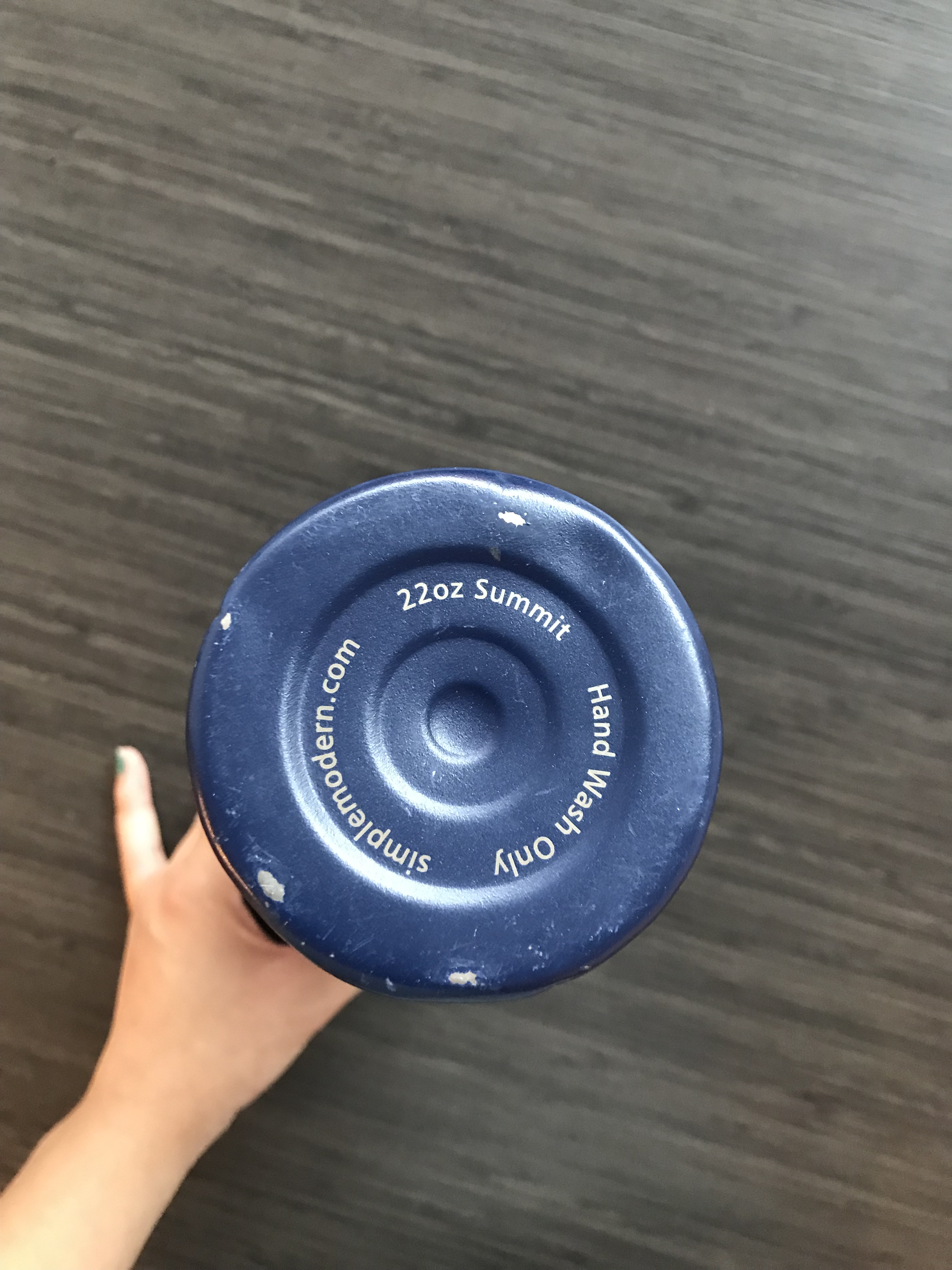
The bottle measures at 10 ¾ inches in height, with a 1 ⅝ inch radius. The body of the waterbottle is a stainless steel metal, a silver color. The outside metal body is thinly covered by a navy blue paint. On the body, there is a silver geometric line design. The geometric design is the result of the navy paint color being removed, to reveal the contrasting silver steel color of the bottle underneath. This is possibly the result of a laser removal process. At the bottom of the bottle, the silver letters S and M (the bottle company’s logo) are revealed in the same manner, sizing at about the size of a thumb print. When running your fingertips along the side of the bottle, you can feel the fine ridges where the paint layer has been removed for the design. The bottle has a few notches, scratches, and dents, mostly at the bottom of the bottle where the edge of the bottom and side surfaces meet. At the bottom end of the bottle, there are three circle ridges centered inside one another. The text, “Hand Wash Only, simplemodern.com, 22oz Summit” follows the circular circumference shape of the bottle bottom. The body of the waterbottle itself has no curves. It is a long cylinder shape, sized to fit inside the palm of a hand perfectly. There is one ridge at the top of the metal bottle, created for the edge of the body to meet the screw-on plastic cap. 

The cap of the waterbottle is thick black plastic. The cap has a cylinder base, with a handle extending outwards at a 90 degree angle. The handle does not move or rotate in any capacity. Rather, it is a full extension of the main cap base without any seams. The cap can be unscrewed to access the bottle, for filling and emptying. To drink, the cap has a small spout at the top, where the user can unscrew a small ridged cap to access. The spout can be measured to the size similar of a quarter. The cap has scratches and dents everywhere, hinting towards it’s age and use. 

There is one singular sticker on the waterbottle, placed at the top half of the bottle. The sticker is rectangle shaped, with curved corners. Centered on the sticker, a brown and white dog smiles. The dog is framed by a thin purple circle outline. The background behind the dog’s circle frame is a red and white diagonal striped pattern. The sticker clearly has wear, inferring the sticker has existed on the water bottle for quite some time. The top right corner of the sticker is completely worn off. The colors of the sticker are faded, possibly from water damage or sun damage. To the touch, the sticker has lost any glossiness it might have had, and has worn down to a paper texture.

The bottle is empty, resulting in a deep hollow echo as it knocks against anything. However, these hollow sounds are temporary- lasting until I thirst again.