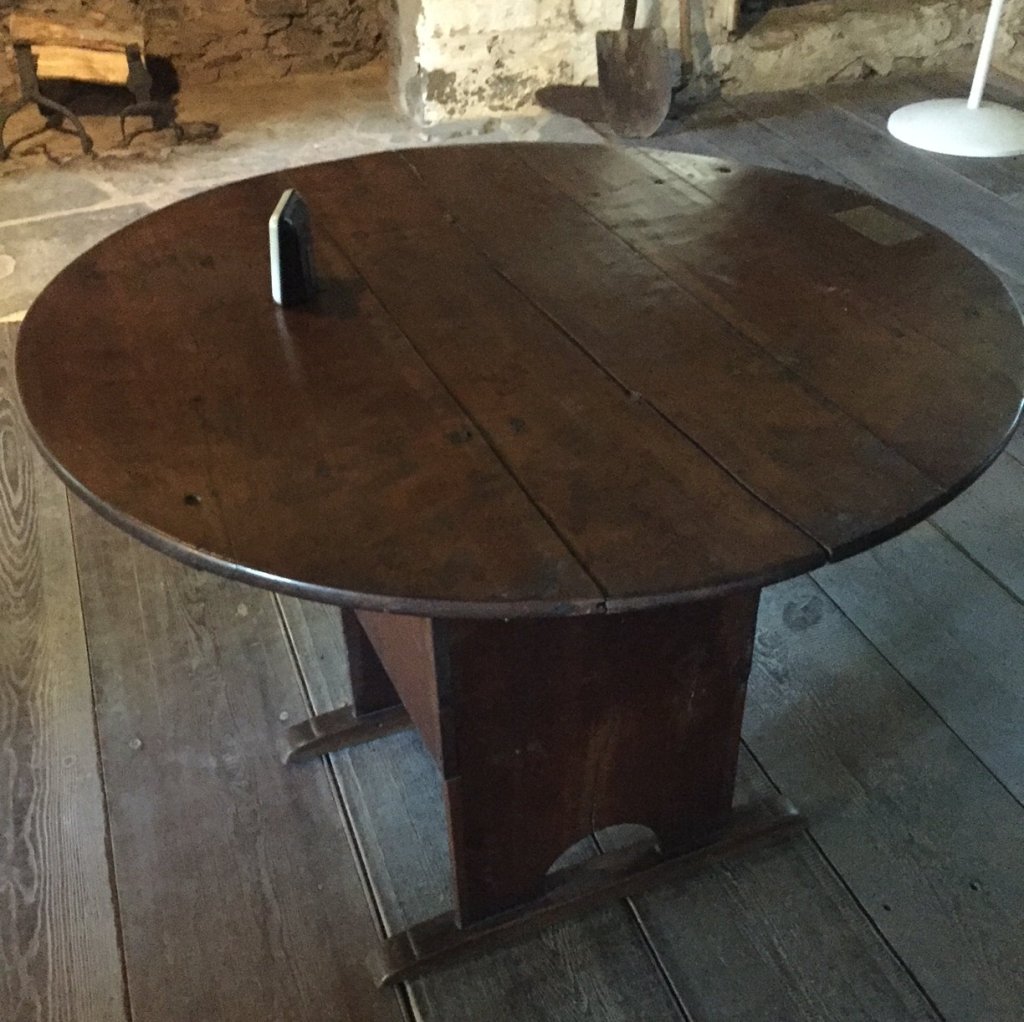
Is this a chair or a table? Yes.


Pictured above is a piece of furniture that serves a dual function as both a table and a chair.  Known as a hutch table, it has a top that can either be flipped up or removed to reveal a convenient place to sit for the user.  It is a very effective piece of furniture when it comes to saving space and convenience.


When exploring Huguenot Street and all of the historic objects it holds, I was immediately drawn to a piece of furniture within their collection.  The object appeared to be a table, but upon looking closer, I found that it also functioned as a chair. I was informed that it is called a hutch table.  It serves the purpose of a table when the top is down, and then when the top is flipped up, the chair portion is revealed. The duality of use for this piece of furniture is something that does not appear as often in today’s consumer society.  However, the space saving aspect of its functionality is still prevalent.

Description

Generally speaking, hutch tables are a piece of furniture that serve the purpose of both a chair and a table.  The specific table being presented is wooden with a round table top attached to a square base. While it is known that the Tilson Hutch Table at Huguenot Street is made of wood, the wood is not specified.  According to Common Sense Antiques by Fred Taylor, it is likely made of a “soft wood” such as pine. The table top is split down the center by a large crack.  Some discoloration has occurred, though not much, which leads to the belief that this hutch table has been refinished since its original creation.  There are a variety of chips and scratches on the surface of the hutch table. On the round top, there is a rectangular metal plaque that is about the size of a credit card.  There is an inscription that reads, “Job and Esther Freer Tillson/ Presented by/ O.J. Tilson II/ 1968”. When in the table position, the hutch table measures 39 inches in length and 29 inches in height.  The square base rests on feet with an arch and long supports, known as shoe feet. The top is connected to the base by a hinge that allows the top to tilt up and form a chair. There is also a knob that allows the table top part to be taken off (Trainor).

Provenance

The specific hutch table which caught my attention came to reside on Huguenot Street through the donation of Oliver J. Tilson.  It resides in the Bevier House Cellar Kitchen. The hutch table was donated in 1968. This piece of furniture is far from the only object donated by Oliver Tilson.  He donated enough objects for an entire room to be deemed the Tilson room. The original owners of the hutch table were Esther Freer Tilson and Job Tilson. Esther lived from 1778-1851 and Job lived from 1766-1853.  The hutch table was owned by the couple during that period of time. Together, they had four children, and the donor of the hutch table, Oliver Tilson, was one of their descendants.

Narrative

Picture this: You enter the main room of your home in New Paltz, New York after a long day.  You want to sit down. You spot your hutch table still in the table position from breakfast this morning.  You flip the table up and take a seat in the too small chair that forces you to sit in a terribly uncomfortable manner, though with great posture.  You look regal with the background of a table top behind you, and the wind is being blocked from your face with little effort. You have tons of leg room because there is no table in your way.

While the description above may not be a scene one would see in a house today, it does reflect furniture used in homes during the 19th and early 20th centuries. In the late 19th century, multi-use furniture rose to popularity.  One furniture purchase for a multitude of uses sounded like a phenomenal concept. This trend can be seen with cabinet beds, murphy beds, and more (Safford). However, this double function can be traced back to the late 17th century.  Dual functioning furniture can be seen with the chair table, or the hutch table. One purpose behind this furniture concept is storage (Taylor). Storing a table vertically takes up significantly less space than if it were placed horizontally.  Another purpose of the hutch table, when in the chair position, is that the vertical table top blocks the wind from the user, as colonial houses are not as air tight as houses now, the wind was likely prominent indoors (Taylor). While this furniture can be referred to as having a dual purpose, a table and a chair, it provides many more, such as the two listed above.

Hutch tables can range from simple to extravagant, though they all have the basic structure of a base and a top.  In many cases, the top can be removed. Despite the varying degrees of affluence, the majority of furniture in the colonial period was expensive, and, therefore, a luxury. It is important to note that this expense did not mean that the furniture would be comfortable.  One purpose was actually the opposite of comfort. In order to look of a certain status, the uncomfortable furniture would force people into with a “properly respectable and refined posture” (Crowley). It would also frame their clothing in a way to add to this refined look.

Space saving furniture was popular in colonial households, as there was often a lot of people in a small amount of space.  Another example of space saving furniture popular at the same time as the hutch table is the leaf table. A leaf table is a table with a removable piece of wood that can be added to lengthen the table when more people will be using it.  However, while the hutch table is no longer prominent in society, the leaf table is still commonly used to this day. It is possible that the death of the hutch table is due to the lack of need in modern day society for some of its many functions.  Houses are no longer drafty to the point of needing to block the wind with a table, or at least not commonly, and comfort is valued more.

Comfort is a key factor for many modern day people when it comes to purchasing chairs.  This focus can be seen in the creation of arm chairs, rocking chairs, and recliners. However, in the nineteenth century, as long as a chair “suggests lineage, hospitality, and good taste in the owner, it is much sought after and universally admired” (Modern Chairs).  With this shift in societal comfort standards, the disappearance of the hutch table can be seen.  While a direct connection between the two is not concrete, it is definitely a possibility.

In any case, hutch tables and their variety of functions can give us a glimpse into the lives of those who lived in colonial society.

Works Cited

Crowley, John E. “The Sensibility of Comfort.” The American Historical Review, vol. 104, no. 3, 1999, pp. 749–782. JSTOR, www.jstor.org/stable/2650987.

“Modern Chairs.” The Decorator and Furnisher, vol. 23, no. 1, 1893, pp. 29–30. JSTOR, www.jstor.org/stable/25582554.

Taylor, Fred. “TRUE MULTI-PURPOSE FURNITURE: The Hutch Table.” Antique Shoppe Newspaper, vol. 32, no. 1, Sept. 2018, p. 12. EBSCOhost, search.ebscohost.com/login.aspx?direct=true&AuthType=ip,url,uid,cookie&db=vth&AN=131678647.

Trainor,  Ashley. Personal Interview. 18 April 2019.

Safford, Francis Gruber. American Furniture in the Metropolitan Museum of Art. Vol. 1, New Haven, Conn. ; London : Yale University Press, 2007.


The 9/11 Memorial and Museum

Brooke, Chris, Gabi, Robyn

The 9/11 Memorial and Museum was erected to memorialize the events of September 11th, 2001, and February 23rd, 1993.  On both of these dates, the World Trade Center was attacked by terrorists. On February 23rd, a truck bomb was detonated below the World Trade Center. Six died and thousands were injured, though little structural damage was done.  After this attack, several safety measures were improved and implemented, these new safety features are often credited with the survival of many after the second attack. On September 11th, 2001, four passenger planes were hijacked, one crashed into the Pentagon, two crashed into the Twin Towers, and one crashed into a field in Pennsylvania. 184 people were killed both in the Pentagon and aboard the plane which crashed into it. The two planes that crashed into the Twin Towers lead both the North and South towers to collapse, killing over 2,500 people and leaving thousands more injured. On the fourth plane, the 40 crew members and passengers were killed.  These events were devastating and continue to impact society today.

It is suggested that one looks up the museum prior to arrival in order to know what to expect, especially for younger audiences. The official 9/11 Memorial and Museum website has a warning that the material may not be appropriate for children under 10, though they do have an online self-guided tour should an adult decide to bring a child there.  The average time spent inside the museum is two hours, and ticket prices range from $15-$26, with discounts offered to children, college students, and U.S. veterans. However, the memorial with the names of all those who died is located outside of the museum and is free.

The Memorial Twin Reflecting pools are located within footsteps of where the Twin Towers once stood. The names of every person who died in the 2001 and 1993 attacks are inscribed into the bronze panels edging the Memorial Pools. The Memorial Museum itself is located quite uniquely. It is within and surrounded by remnants of the original World Trade Center site this is known as the archaeological heart of the World Trade Center.  It contains a permanent collection of more than 11,000 artifacts including ephemera, textiles, artwork, oral histories, books and manuscripts. Also, it possesses over 300 moving images, and more than 40,000 print and digital photographs. The largest of the spaces inside the Museum is Foundation Hall. Here, there is a room with ceilings ranging from 40 to 60 feet high and nearly 15,000 square feet of floor space. Within this room is the slurry wall. The slurry wall is a retaining wall originally built to hold back the Hudson river, as well as the remnants of cutoff box columns that once formed the exterior structure of the Twin Towers.

The museum is broken into two main exhibitions: the Historical Exhibition and the Memorial Exhibition. The Historical Exhibition is split into three parts: before 9/11, the day of 9/11, and after 9/11.  The Memorial Exhibition commemorates the lives of those who perished on both February 23rd, 1993 and September 11th, 2001. This exhibition contains several interactive exhibits.

One of the most significant collections this museum is the Tribute Collection. This is a larger collection of objects, consisting of multiple sub-sections, that came together through compiling items from those who lost loved ones during the attack, or were merely affected in some manner. Tanya Hoggard, a flight attendant who volunteered at the World Trade Center site following the 9/11 attacks, is responsible for organizing the specific tribute collection known as the “Dear Hero” collection. She recognized that children were coming to show their support from around the natio by delivering letters and artwork to the firefighters and recovery workers who were present the day of and after the fact. Seeing just how positive of an impact this had on those involved, she began compiling these “objects” to ensure they would be preserved and eventually become part of a larger collection, which became the 9/11 Memorial Collection.

Inside the 9/11 Memorial Collection, there are a myriad of structural objects which help shed light on the fateful events on the morning of September 11th, 2001. After extensive research, our group has narrowed down the entire collection of recovered architectural artifacts to three objects: An elevator motor, a staircase, and a small collection of glass fragments from a shattered window. Each of these objects tells a story of how people stuck in the World Trade Center (WTC) attempted to escape the deadly terrorist attack.

The museum contains several objects that have been donated by families and friends of those who perished.  These objects include photographs, notes, momentos, videos, and even voice recordings. Today, the museum continues to reach out to the families of those who died in order to share their stories.  A family member or friend can bring objects to the museum, mail them, or even create a recording of themselves talking about the person being memorialized and submit it to the museum via internet, phone, or in person.

Works Cited:

Editors, History.com. “9/11 Timeline.” History.com, A&E Television Networks, 21 June 2011, www.history.com/topics/21st-century/9-11-timeline.

“Home | National September 11 Memorial & Museum.” Home | National September 11 Memorial & Museum, www.911memorial.org/.

Kennicott, Philip. “The 9/11 Memorial Museum Doesn’t Just Display Artifacts, It Ritualizes Grief on a Loop.” The Washington Post, WP Company, 7 June 2014, www.washingtonpost.com/entertainment/museums/the-911-memorial-museum-doesnt-just-display-artifacts-it-ritualizes-grief-on-a-loop/2014/06/05/66bd88e8-ea8b-11e3-9f5c-9075d5508f0a_story.html?noredirect=on&utm_term=.49984e9f768b.

A Compass With No Directions

My metal compass

This week I would like to focus on an object that I have owned for a year and a half, but that I have only recently started using on a near daily basis.  This object is my compass. It is not the type of compass that depicts what direction one is facing, but the kind of compass used to make perfect circles.  I purchased this object for a class two fall semesters ago, yet we only needed to use it twice. However, this semester I am enrolled in a class by the name of Axiomatic Geometry, a class in which the compass is a vital tool.  

My compass opened to the fullest extent

My compass is metal, however they may be plastic as well.  One side of the compass has a thick, needle-like structure on the end.  The opposing side is created to hold a golf pencil (a small pencil, approximately four inches in length that does not have an eraser).  The two sides are joined by a mechanism that allows them to smoothly glide in and out, changing the distance between them. The distance set will determine the size of the circles created.  The compass has distance measurements in both inches and centimeters. The distance markings refer to the size of the circle’s diameter. The compass has no indication of what company created it, it merely says made in China and possesses no other identifying marks.

Despite the lack of identifying marks on the compass itself, I am able to track its origins from my Amazon order.  According to my order history, this is a Charles Leonard Ball Bearing Compass. This brand has been around for over seventy years in the office supply industry.  For this reason, on Amazon, the company writes a claim that they can guarantee quality and value. The compass is able to create circles with up to a twelve inch diameter.  It has increased in price by $0.33 since I purchased it in August of 2017. The price I paid was $4.31, the compass now costs $4.64.

The first known compasses did not have a pencil or a pen on one end, but a needle on each end.  It was invented by Galileo in the late 1500s in an attempt to create a universal mathematical tool for arithmetic and geometry.  This compass would make circles and arcs by leaving scratch marks on the surface. Compasses can also measure length and move a length, despite the fact that the unit of measurement for the length will not be provided by the tool.

I have now learned how this tool works in the geometrical context.  While it can technically only make circles and arcs, the circles and arcs can create so much more.   For example, using only a line segment and a compass, one can create a perfect equilateral triangle. Other examples of what can be created on a mathematically perfect level include angle bisectors, replications of a given angle, replications of a given quadrilateral, a perpendicular line, etc.  I was unaware as to how much could be done with this tool until I began taking a class that focuses on it. I find it fascinating how sometimes the simplest mechanisms can do so much.

Sources:

https://brunelleschi.imss.fi.it/esplora/compasso/dswmedia/storia/estoria1_st.html

http://www.historyofpencils.com/drawing-tools/drawing-compass/

https://www.amazon.com/Charles-Leonard-Bearing-Diameter-80360/dp/B00290LPDU/ref=sr_1_fkmrnull_1?keywords=Charles+Leonard+Ball+Bearing+Compass+with+Golf+Pencil%2C+Metal%2C+Up+to+12+Inch+Diameter%2C+Silver+%2880360%29&qid=1551683146&s=office-products&sr=1-1-fkmrnull

A Little Ring

I have claimed in the past that I have no family heirlooms.  I guess whether or not that is true depends on what one considers an heirloom to be.  I don’t have an object that represents my heritage or culture and has been passed down for generations.  I think a reason for this lack of cultural object has to do with the fact that no one in my family has immigrated here recently,  my parents, grandparents, and even some of my great grandparents were born in the United States.

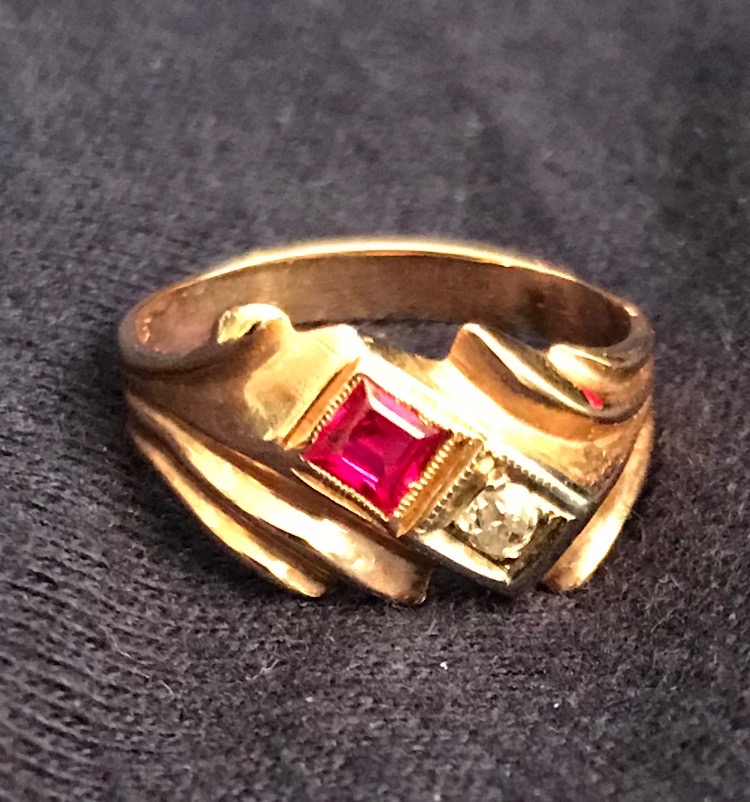
However, I came to the realization recently that I have a ring that was given to me by my grandmother.  She received that ring from her grandmother. I am the oldest granddaughter on my dad’s side of the family, for this reason, I was the recipient of a small, golden ring with two diamond shaped gems, one clear and one red.  This ring is the right size for a relatively thin pinky or a eight year old girl’s finger. Luckily, I was eight when I was given this ring, and currently, it still fits on my pinky finger.

I received this ring for the religious sacrament know as Communion in the Catholic religion.  Unlike a cross to a baptism or a ring to a marriage, a ring holds no relevance to the ceremony of Communion.  However, this ring became something of a religious symbol, as my grandmother also received it as a Communion gift.

Unlike the necklace from my grandmother I wrote about in my last post, which I wear every day, I have never worn this ring.  However, I always make sure that I know where it is. I am very nervous about losing this ring. My fear changes the function of it from being a piece of jewelry meant to be worn, to a memento of a religious sacrament and of my grandmother.  I would like to make this ring an heirloom for my family in the future, something to be passed down through generations to come. I do not know if the ring will continue to be passed down for one’s Communion, but my hopes are mainly just for it to be passed down in general.

I know little about the origins of the ring.  I know that it was purchased as a gift for my grandmother, and not originally owned by her grandmother.  My grandma received Communion when she was eight, sometime in the 1950’s. Meaning that the ring was purchased around this time.  My grandma then kept that ring with her all throughout her childhood and adult life. She decided to hand it down not to her daughter, but to her granddaughter.  After receiving this ring, I immediately gave it to my own mom to hold onto for me until I grew older. Around age seventeen, my mom and I were going through the jewelry in her closet and we found the ring.  She told me how I had received it and returned it to my custody, nearly ten years later. From then on, I kept the ring in the box in which it was given to me, which was not the original box. I bring the ring with me to wherever I reside at the time.  There it remains, unworn, in a box.

Necklace? Ring? Same Thing.

The object I have chosen to discuss for this blog post is one that is very near to my heart, quite literally.  It is a necklace that I have worn every day for over a year now. I have taken it off less than five times since the day I first put it on, one of those times being a few minutes ago while taking photos of it for this post.  When I first began wearing this necklace, I had no clue that it held and historical family value. I found it in one of my old jewelry boxes while looking for a new necklace to wear.

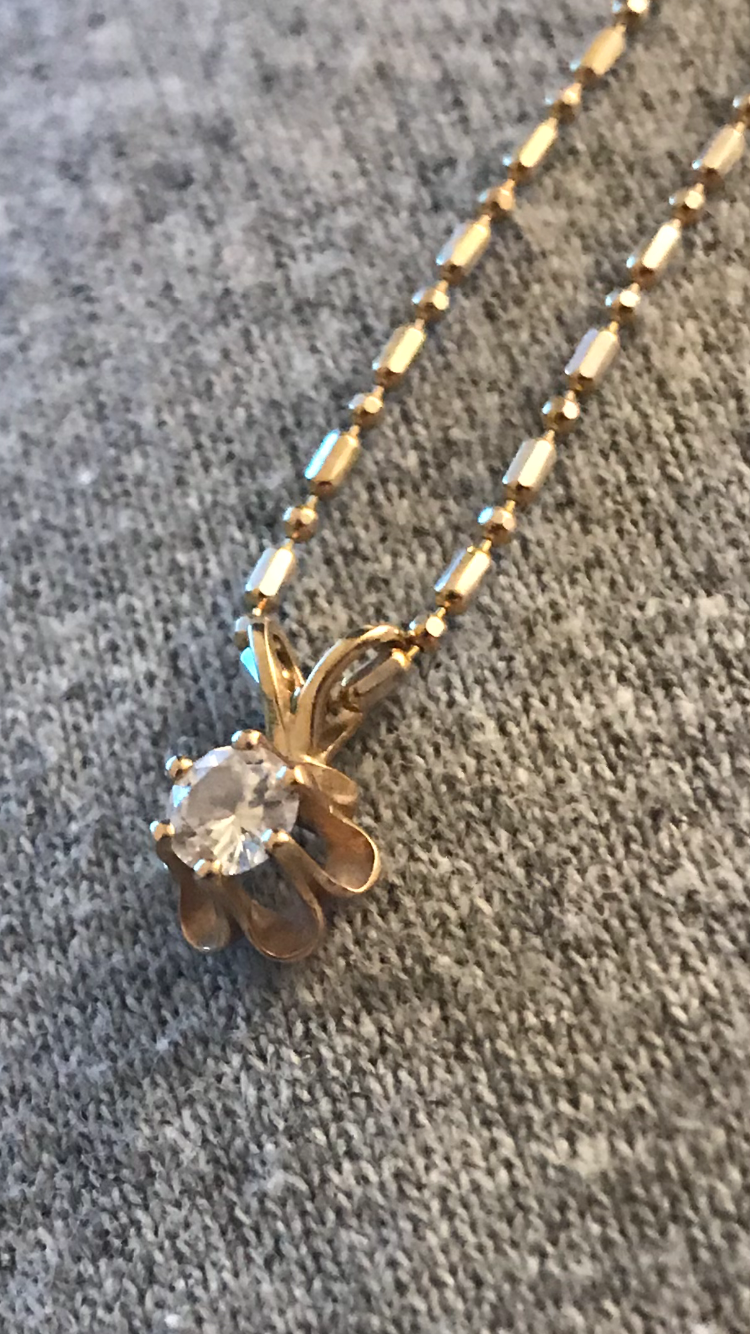
The necklace I currently wear every day.

When I was younger, I had a bad habit of hoarding necklaces that I would never wear.  About three years ago, I decided that I would only wear one necklace and that I would not take it off or replace it until it either broke or began to tarnish, or a year had passed.  I would keep the necklace on at all times, even while exercising, swimming, or showering. I knew that if I were to remove it, even briefly, the likelihood of putting it back on would be slim to none.  I had successfully worn two necklaces to the breaking point before wearing the one pictured, a gold colored necklace with a unique chain made up of shapes similar to cylinders and spheres, though more angular and connected by pieces of chain so thin they sometimes appear to be floating.  The charm is gold colored and resembles a flower, with the center being a small stone that I assumed was cubic zirconia. This necklace originally served the function of being worn until it breaks to prevent myself from purchasing any more necklaces.

My necklace continued to serve this purpose until a day in July this past summer.  I was wearing it, as I had for nearly seven months at that point, when my grandmother said “I love that you always wear that necklace”.  She said it in a way that made me curious, what was so special about this necklace? I’ve had it for years and it had just been sitting in a box.  I inquired further and my grandmother revealed that she had given the necklace to me when I was very young and that not only were the gold and gem real, but that the gem was originally a part of her engagement ring.  She at some point several years ago had had the ring reset and a gem was removed. She had it made into a necklace for me, her oldest granddaughter.

I do not know where exactly she had the necklace created.  I would guess that it was at a gold jeweler in New York City, as I remember going there with her and my mom as a child.  I was not there when the necklace was made, but I remember my grandmother telling me that it was her favorite jeweler and that she went there for most of her jewelry needs.  The clasp of the chain has some markings, but I think they are to show that the necklace contains a certain amount of gold. They do not seem to indicate any one specific jeweler.

I had no idea that this necklace that I continue to wear around my neck everyday has so much family significance.  In that moment, the necklace took on a new function. It now serves as a reminder of the love between my Grandma and Grandpa that has survived for over 50 years.  On my Grandma’s eighteenth birthday, she moved out of her childhood home. My Grandparents got married a few days later. I know consider this necklace symbolic of my grandparents love and it often serves as a comfort to me.  I have a habit of playing with it when I am nervous, by holding it, I am reminded of its origins and I smile.

This necklace has changed my routine of purchasing a necklace once a year as well.  It is very well made and I intend to wear it for a very long time. I have mentioned in class that my family does not have heirlooms, however, I hope to one day pass this necklace down to my own children.

UCB Comedy Sticker

The item I have chosen to describe is a sticker that I acquired this past June at the Del Close Marathon in New York City.  The sticker is specifically from The Magnet Theater, where I spent the majority of my time during the 10 hours in which I attended the improv marathon.

The sticker measures 4” long by 3” tall and is less than a 32nd of an inch thick.  The front of the sticker has a very plasticky feel and, while it looks flat, if you run your finger over it you can feel that the plastic is raised in several places.  The item appears bent in several places and no longer lays completely flat. The back of the sticker is covered by a material that feels similar to cardstock. Two pieces of this material cover the back of the sticker and can be peeled away to reveal an adhesive substance that will allow for the sticker to stick.  However, the white cardstock material remains intact.

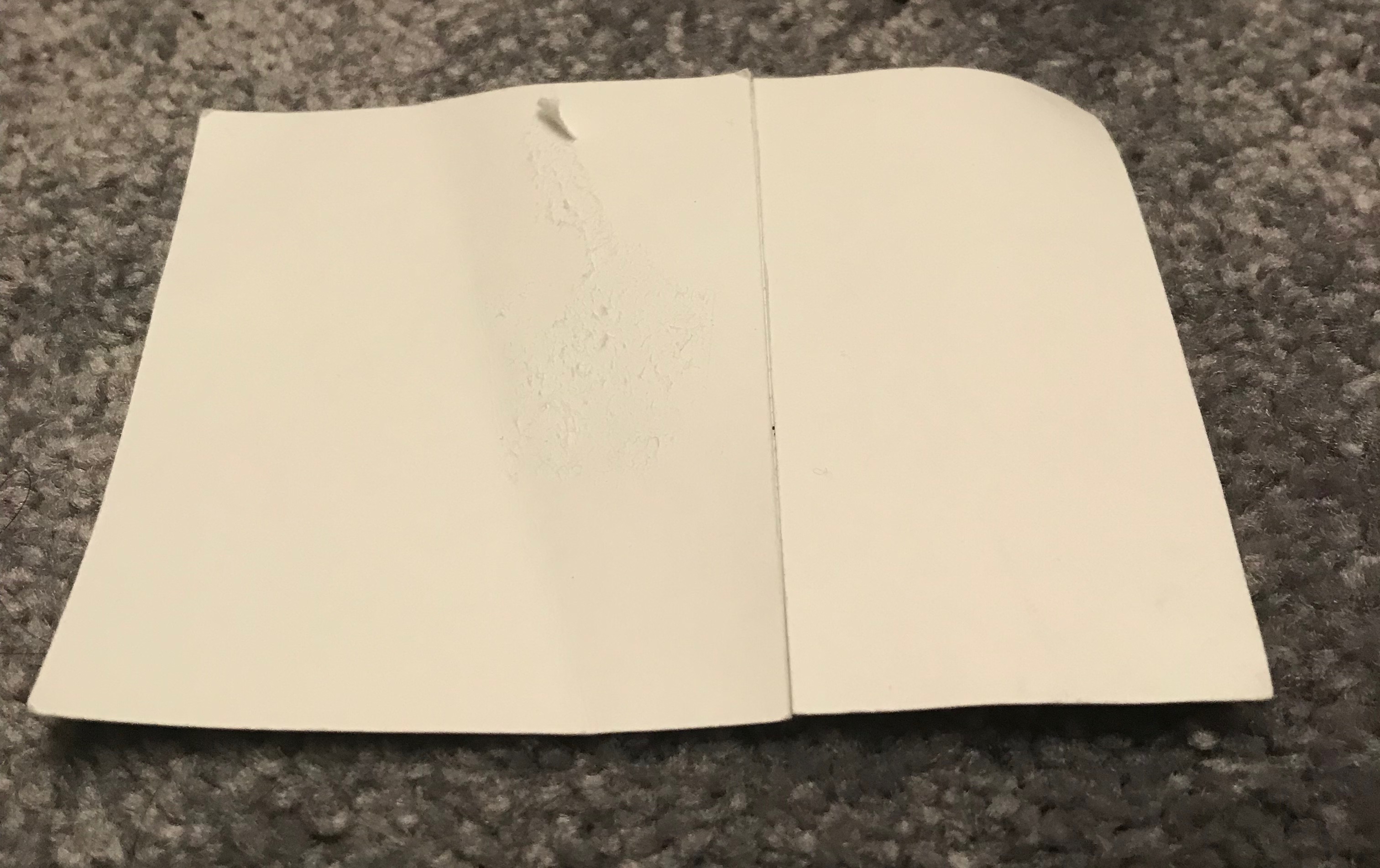
Upon further analysis of the two back pieces, it can be seen that one of them is quite worn and a layer has peeled off, though it still protects the adhesive.  This wear comes from tape that had been placed on the back to hang the sticker on the wall without having to remove the cardstock. Tape was used so that the function of the sticker would remain and it would be usable on a future surface, as I move locations approximately twice a year in New Paltz and want to use this sticker as a decoration repeatedly.  If the cardstock is removed, the adhesive will likely work effectively only once and will be difficult to remove cleanly. If I peel back the cardstock I can feel the adhesive. It is quite strong and feels glue like. It could likely remove paint from something if stuck there and later pulled off.

The front of the sticker reads “UCB COMEDY”.  This print covers a little over half of the surface.  The letters “UCB” are tan and rest on a black background.  The word “COMEDY” is also written in a tan color, but lays on a red background.  In smaller font on the bottom of the sticker, it says “UCBCOMEDY.COM” in tan and on a black background.  The purpose of this print is to direct the public to a website explaining what UCB Comedy is. The letters “UCB” stand for “Upright Citizens Brigade”.  The Upright Citizens Brigade is a comedy hub dedicated to original comedy. Each of the printed letters is raised slightly and you can feel each individual letter when running your fingers across the sticker.  

In the top left corner of the sticker, some semblance of a human face can be seen and is created using a tan and black color scheme.  There are very thick glasses perched on a sketch of a nose. This image is the symbol of the United Citizens Brigade. This symbol is also the one that my improv troupe, TBA Improv, has adopted. The similar symbols make this sticker even more meaningful to me.  While this object may not be old or objectively valuable, it is extremely valuable to me. It reminds me of arguably one of the best nights and most unique experiences of my life to date. It is also a memento of an experience I will likely never have again, as the marathon is moving to California next year.  It is a reminder of the only time I have ever performed and probably the only time I ever will perform on a New York City stage, at one in the morning, with several close friends. It is a sticker. It isn’t worth much money, if any (I got it for free) and yet, it brings me so much joy. I intend to bring this sticker with me wherever I move and hang it up on display so that I can look at it every day.  This sticker reminds me of a night that I will talk about for years to come.

The KonMari Method

I decided to tackle the clothing category for this assignment.  I partially chose this category because it is the first one discussed in Marie Kondo’s book.  I also believe that tidying up my clothing made the most sense, as I do not have most of my books or sentimental items with me at school.  As for papers, I finally decided to start throwing them away after finals last semester, when I had the realization that I have never looked at any of the papers I had kept from both freshman and sophomore year.

Prior to attempting the KonMari method I was feeling a little bit nervous.  I’ve tried to organize and minimize the amount of clothing I have many times.  Usually I have a lot a trouble getting rid of clothes and keeping them organized.  I often make excuses for keeping clothing, such as, “I may need this one day”, “I’ll wear it soon”, “I’ll wear it when it gets warmer”, etc.  It took me a while to finally dive into my clothing, as I expected it to be a long and daunting task. However, once I began, I found myself sorting relatively quickly what items I wanted to keep based on the joy test.  

I started with many more items than I anticipated (I had no idea my closet could fit so many clothes) and ended with several empty hangers. I went from around 70 items to about 50. While going through the clothing, I felt as though I lacked any sentimental feelings towards any of the items.  There were two exceptions, a green jacket that I found in a thrift store that reminds me of the television show Freaks and Geeks and a shirt I received for being initiated into an organization.  I believe this lack of attachment was mainly because I only went through a subcategory of clothing (jackets, sweaters, and what I categorize as ‘nice’ shirts).  I have a plethora of t-shirts and a few sweatshirts that hold a high sentimental value.

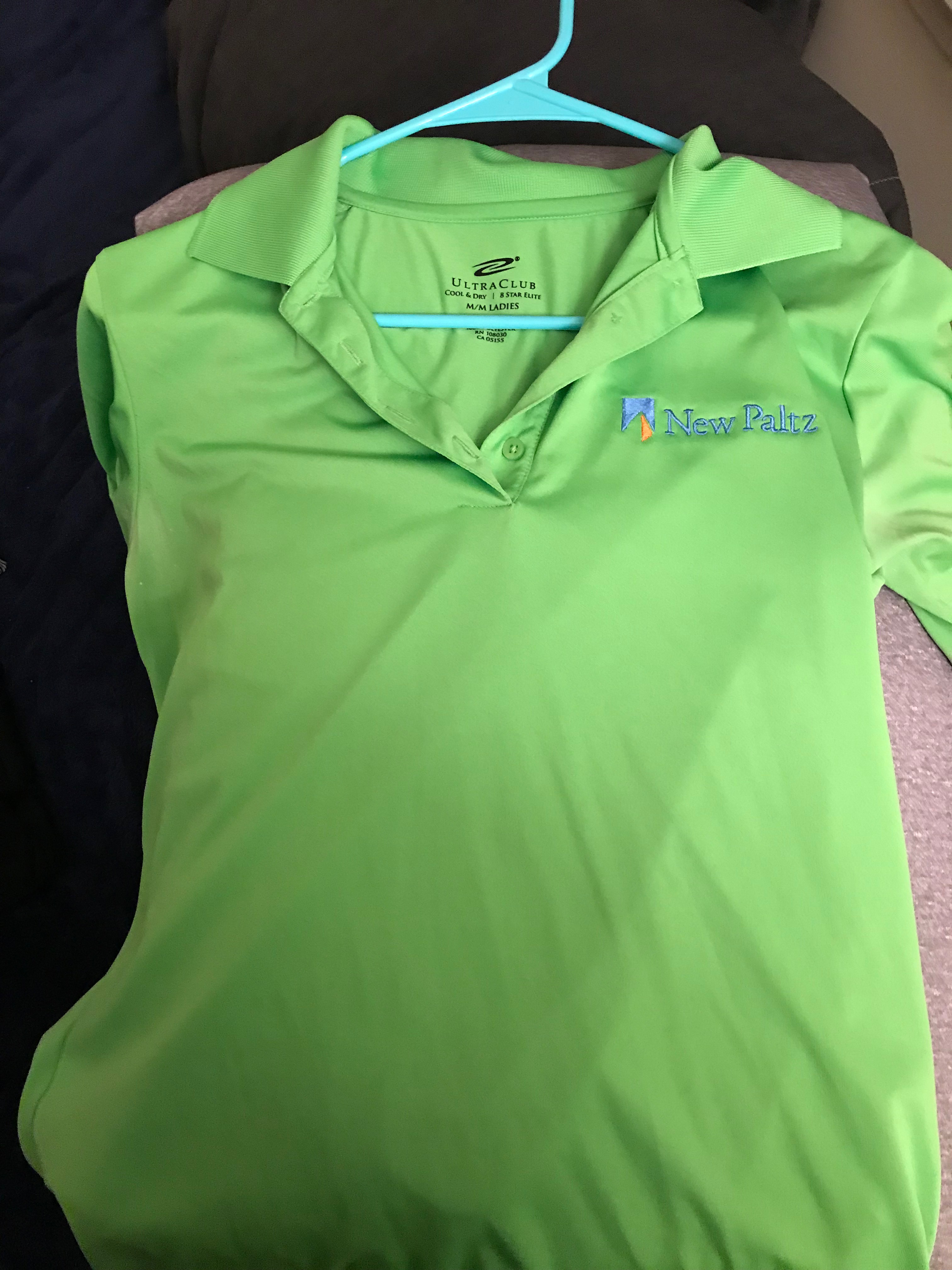
A photo of my ugly, but functional, green polo

I found the joy test to be helpful when it came to certain items, however, there are items that are necessary for me to keep regardless of how I feel about them.  For example, I have two polos that I need to wear when I work certain events. One of the polos is particularly ugly (pictured). While this item certainly brings back fond memories and makes me laugh, I have no reason to keep it when I no longer work the job that requires it.  I also found myself keeping items that failed the joy test when they were things that I wore frequently, such as plain black or white tank tops. I found that with items like the tank tops, functionality outweighed joy when it came to deciding what to keep.

It was definitely a nice experience to go through the clothing I have at school and I intend to try this method again when I return home.  Most of my clothes for the warmer weather are not here and I think that I could tidy up much more when I have access to them. I enjoyed thinning my closet and making it easier to find the clothing I chose to keep through reorganization.  I would like to try a more thorough version of the KonMari method in the future.