When I first heard of this assignment, I thought of two things: what should I look into buying that would benefit me and be of use, and wow, I’m so glad that this project is when all the Black Friday sales are going on.
It didn’t take too long for me to settle on an object. I’ve had the same pink bedsheets since my freshman year in college, and, the other day, I stumbled across a photo of my bed at that time. At the time, my bedsheets were a bright, eye-catching pink, with little pink hearts adorning the top.
The same bedsheets are now incredibly faded, with the hearts turned into distorted, bleach-stained blobs. Next semester will be my last at SUNY New Paltz, so this wasn’t just about practicality—this bedding had been with me through the ups and downs of college. It felt symbolic to start fresh as I approach graduation.
And so, I turned to online shopping. I’m a chronic window shopper, so I already knew what websites to look at, what filters to put, and how exactly to get the good deals.
For the sake of quick shipping (the mailroom will be closing soon!), I immediately went to Amazon. Within seconds, I had more options than I could process, and the variety was both exciting and overwhelming.
I initially typed out “pink and white bedding”, clicking the search key with little trepidation. True to my search, the first 20 or so results showed a variety of different types of pink bedding. They all were rated about 4.4/5 stars, which seemed like a good thing.
However, a lot of the reviews were a mixed bag. Reviews like “These sheets are the best thing ever!” were followed by “1/10, would not recommend ever.” It was hard to determine what was the truth and how exactly bedsheets could garner such a low rating.
After the first 20 or so searches, the beddings stopped being pink and white. Sometimes they were only pink, other times they were only white. There were often red and black sheets scattered in there. If I were more of an adventurous person, maybe I would’ve checked those out. However, if I couldn’t see them in person, I felt no need to search for something I wasn’t specifically looking for.
Shopping online always feels impersonal to me. I love being able to touch the items and run my fingers along them to see if they have any divets. Additionally, clicking “Add to Cart” didn’t carry the same satisfaction as physically selecting an item and carrying it to the check out.
Once Amazon failed me, I bounced between other websites. JCPenney, Target, Macy’s… the whole 9 yards. I was met with frustration when I couldn’t find anything whose appearance and reviews matched my ideal bedding set.
As I scrolled through these websites and viewed the deals, I reflected on the old sheets that I had bought for my first dorm. It was nice to be able to replace them at this point — especially with all the deals! I did feel a bit nostalgic at the concept, but a bit disappointed too, since I couldn’t seem to find anything even when granted an endless maze of options.
I decided to give myself about an hour or so to search. If I didn’t find anything reasonable during that time, I would get ready to look for new bedding in person. I’m fortunate enough to live in New York City, so there are plenty of clothing stores around that I could check out. This online method was more for seeing how convenient this process could be.
I didn’t end up buying any of the sheet sets I found online. Despite them looking nice, it was different to determine whether or not they’d be right for me. I sew so I take fabric quality very seriously. Because of that, I didn’t feel right picking something that I’d basically be living on. This process seemed like convenience came at the cost of that initial connection, and I wasn’t willing to sacrifice that for something I’d be using so often.
Experiment 2: Browsing
Armed with my Black Friday sales determination, my bedsheet journey continued!
New York City does have a lot of stores, but its mall scene is quite lacking. Because of that, I ended up venturing to the Newport Mall in New Jersey. Whenever I say that I go to New Jersey to shop, I always get weird looks, but I promise that this mall is worth it!
I continued this journey on the day of Black Friday itself, so I had expected the stores to be crazy and/or empty of items. Part of that was true — the store was bustling with shoppers, carts filled with discounted TVs and holiday decorations. However, there was still plenty of stock left, and I was able to happily zigzag in between all the stores.
Macy’s and target proved to be busts. Though their selections were nice to be able to touch, they didn’t have the shoes I wanted, and their sales were often bit too far out of my price range. It was nice to be able to form my own reviews of the items as I travelled through the store, but ultimately my hard work came up short.
Then JCPenney was the store I chose. Walking through the aisles brought a sense of nostalgia. I remembered shopping with my mom for those freshman year sheets here, and how we spent hours going between the different sheets, arguing about quality and appearance. Now, I was here alone, facing the same questions but with more experience behind me.
JCPenney had better deals, though it was hard to find the bedding aisle. After navigating the maze of aisles, I managed to find it. I was met with a view of blankets upon blankets — some stacked on beds, other nestled away in shelves.
I immediately ran my hands over the different sheets. Some flannel, some cotton, others polyester. Being able to feel it was an experience only in-person shopping could offer, and I was glad to be able to see how the quality of the sheets were.
Around me, other people shopping for similar items were chatting. Shoppers discussed between prints, others lamented about the deals. It was nice to see that others were engaging in the same activity that I was.
The primary downside of this method, aside from having to travel an hour to get there, was that the sales were below my expectations. 50% off $100 is still $50, which is way out of my price range! Online, sales were way cheaper, so I was mentally cursing at myself for not just going with the online versions.
Because I’m terrible at making up my mind, I didn’t end up buying anything. The materials were nice, but I didn’t find anything in my price range that bit the aesthetic I wanted to go for. I did have fun though!
Reflection: Comparing the two methods
Though I didn’t end up buying anything, I can say I did enjoy the experience. I love shopping and seeing what things are out there, and approaching shopping for one item in two different ways allowed me to see the pros and cons of both approaches.
Online shopping allowed me to spend less time traveling between stores. It offered more speed, convenience, and endless filters to help me find bedding that fit my exact wants. However, it lacked the satisfaction of touching the fabrics or seeing the colors in person. I found myself overthinking and second-guessing my choices, relying heavily on often finicky reviews to fill in the gaps. The experience, though efficient, felt detached and transactional.
in-store browsing was definitely more immersive. Walking through the aisles, reveling in all the options, definitely felt a lot more fun than just mindlessly scrolling. This method also carried a sense of nostalgia that online shopping did not, reminding me of shopping for college supplies with my mom all those years ago. This would’ve been different for me if my Black Friday shopping experience was as bloodthirsty as it usually is, though. I’m sure if I would’ve loved the crowds as much. Still, the in-person experience felt richer, as I could engage with the product directly.
This act of browsing reminded me just how much I liked to be in the moment. I feel like with phones, it’s difficult to be fully present in what you’re engaging in. In person, things definitely felt more intentional, and it required less work than online shopping (though it did take more time). That being said, I agree with Guriel’s argument that we should browse more and scroll less. Browsing allowed me to revel in this transitional experience of getting something new. It was a less convenient experience, sure, but I was lucky enough to have the time to indulge in it and have more of a connection to the sheets I was looking at. Overall, the browsing experience is what reminded me that shopping isn’t just about getting the sheets that best fit what I want, it’s about engaging and creating stories with the materials — something that’s difficult to obtain if you’re only scrolling.
Nestled in the cozy, leaf-strewn neighborhood of Historic Huguenot Street, the Jean Hasbrouck house stands, a relic of time, waiting for curious minds to venture in and uncover its history. Stepping inside this stone house and traversing down the small, 5-step stairs that are embedded in the wooden floors, allows you into the store’s ancient store space, otherwise known as the Hasbrouck Tavern.
Physical Description of the Object:
In the center of this floor space lies the Bar, a large counter-space about 42.25 inches tall by 83 inches wide. This space is about the space of a typical cashier counter today, so it is easy to imagine patrons nestled around it, eager to purchase their goods. The concave front side of the bar is painted a faded greenish-blue color. The coloring is splotchy and reveals a pale brown undertone. There are two vertical lines cutting down the bar vertically, both about 5 inches wide. There is one line of wood paneling cutting across those vertical lines. This line is also about 5 inches wide.
Wooden grilles protrude from the top in a stockade-like appearance. These bars were “a standard element of 18th century colonial taverns” (Indian King Tavern News). These grilles are presumably made of wood that is more lightweight than oakwood, most likely timber or pine. These bars could have prevented customers from reaching over and grabbing items in an unruly manner. This bar’s outer curve comprises about 9 reddish-brown timber oak panels about 4-6 inches wide. This curve is surrounded on all four sides, creating a shelf-like space behind the front of the counter. This shelf-like, curved space provided enough room for at least one other person to be standing behind the counter, monitoring the goods that would have been being sold.
The topmost counter of this bar has a dark stain, its wood being less faded than the wood below it. This dark stain does have its share of bumps and scratches, with some minor chipping and scuff marks scattered across this surface. This wear and tear was done after the store closed in 1911, but it is not unlikely that a patron once might have gotten and, as one might do even today, scuffed the counter themselves.
Provenance:
Photo courtesy of The Library of Congress
It is in the Jean Hasbrouck house where the bar stood. The floor plan of the Jean Hasbrouck house (pictured above) is one that shows its three floors, with a main floor, second floor, and a basement space. The house is characterized by its stone walls, low ceilings, and the presence of this very bar front in this building’s Northeast room. This store space, known as room 103/R103 in the floor plans, was not always a storeroom, this space and the item only being added to the house in 1786. This addition was one that took time, money, and family members that were willing to pass down their family’s history.
The Jean Hasbrouck House went through generations of owners, starting with Jean’s son Jacob Hasbrouck, who took care of Jean before he passed. Jacob lived in the house with Jean so taking on the day-to-day responsibilities of his father’s investments and farms after his passing was no challenge. Shortly after Jacob’s 26th birthday, he oversaw and took possession of Jean’s estate. The house that the bar is in was not built and completed until 1722, 8 years after Jean’s passing (Jean Hasbrouck House Historic Structure Report). Jacob Hasbrouck’s inheritance positioned him as one of the richest and most influential figures in the New Paltz community. Jacob designed a house that was constructed with a striking departure from the usual architectural style in New Paltz, yet it was still designed within the parameters of the community building’s traditions (Jean Hasbrouck House Historic Structure Report). In the 1700s, stone was a novel material in local architecture, but it began quickly to be used in traditional buildings to reflect the increasing wealth and evolving class consciousness of Dutch farmers in the area (Jean Hasbrouck House Historic Structure Report). Jacob believed to build the house from stone to reflect the economic and class standing of its builder. Jacob Hasbrouck, who was the father of Josiah and Jacob Hasbrouck Jr., passed down the family’s real estate and investments. When Jacob Jr. got married, his father Jacob decided to retire which led him to assume his position with the Elected Twelve Men (otherwise known as the Dunzine), a group of men responsible for making local decisions, resolving disputes, governing the land, and maintaining order in the community. This system of governance persisted in New Paltz until the early 19th century.
Jacob Hasbrouck Jr. never met the original owner of the house, Jean Hasbrouck, but he lived and served in this house and inherited it when his father, Jacob Hasbrouck, died in 1761 (Historic Huguenot Street).It is disputed that Jacob Jr. Was the one who initially created the store in the Jean Hasbrouck house, because while Ralph LeFevre insinuated that a store had existed in that house for “probably half a century before,” there is no real documentation to suggest that this is true. Due to the lack of evidence, it is more likely that Josiah, his son, began the business instead. Josiah was a very work-oriented man and there are “many aspects of Josiah’s life and times that support this initiative as well as the change it represented to the household and family economy” (Jean Hasbrouck House Historic Structure Report) that suggest his likeliness to have created the store. However, if this bar really was in the possession of Jacob Jr., then he was the owner of the business at the Jean Hasbrouck house throughout the Revolutionary War, serving as the bar’s owner even as he “became a major in the Ulster County militia and was known thereafter as Major Hasbrouck” (Hasbrouck Family). In 1786, Jacob Hasbrouck Jr. would have turned the bar over to his oldest son, Josiah Hasbrouck. It was Josiah Hasbrouck who took it upon himself to renovate the storefront space and the house to accommodate his growing family.
Additional rooms, fireplaces, windows, and more were added to the Jean Hasbrouck house to accommodate Josiah’s growing family and dedication to modernization (Jean Hasbrouck House Historic Structure Report). These extra rooms include the same bar space, accompanied by the fireplace at the back of the bar and the bar counter itself. This space thrived from 1786 to 1811, when the storefront was closed and more focus was placed on Locust Farm, the farm that the Hasbrouck family had begun to cultivate. Though the store was no longer running, the bar remained in that space, waiting for the next day someone would use it.
This bar became detached from its original room following house renovations in the 1970s and 1980s, though the is no exact documented date of this detachment. This bar was built into the Jean Hasbrouck house, against a wall to allow for more item security behind its curved countertop, but now stands as a free-standing feature in the center of the room. Due to this removal and its detachment, the bar underwent some alterations and obtained the wear and tear that can be found on its countertop.
The Jean Hasbrouck house “was the first structure purchased by the Huguenot Patriotic, Monumental, and Historical Society (the original name of Historic Huguenot Street) and has been in operation as a museum since 1899” (New York Heritage). It is because of this and the Hasbrouck family’s dedication to the preservation of its history that this bar can remain in the very same space where it was used over two hundred years ago.
Narrative:
To us, this location is a gateway to the past and history of this storefront. However, to the people living and visiting these spaces all those years ago, it was a tactile way to establish themselves in the Huguenot culture.
The Bar in the Jean Hasbrouck house provided a public gathering space for the residents of the town, serving as a community hub for discussions and all sorts of chatter. It was a site for political debates and meetings, reflecting the evolving political climate of the time and providing a space for local leaders and citizens to engage in discourse about issues affecting the community, including slavery and abolition.
As a family that has always been involved in politics, the Hasbrouck family was known for its involvement in the establishment of the “Town of New Paltz in 1785” (Jean Hasbrouck House Historic Structure Report). This role was played by Josiah Hasbrouck who, following in his father and forefather’s footsteps, “served nearly continuously as either the Town Clerk (a position he initiated) or Town Supervisor from 1782 to 1805, with periodic interruptions while occupying state and national offices” (Jean Hasbrouck House Historic Structure Report). Additionally,Josiah Hasbrouck served as a lieutenant in the Revolutionary War, and “served in the House of Representatives during the terms of Presidents Adams and Jefferson”(Historic Huguenot Street) With the ownership of Jacob Jr. and Josiah Hasbrouck, it is said in the 1760s that “a store was opened in the house” (Jean Hasbrouck House Historic Structure Report). Despite this establishment, Josiah continued to serve his role in local politics, maintaining his place in the town’s government, as a town clerk and a town supervisor. He continued to serve in elected office, including his final term in Congress in 1819.
Josiah Hasbrouck’s ideals aligned with the Democratic-Republican Party of the time. This political party, also known as the Jeffersonian Party, reflected the idea of limited government intervention and democracy. These views aligned with those of his forebears, valuing the original ideals of the original Huguenot settlers, who prioritized things like land ownership, community, and liberty in the face of the establishment of federalized power. Though there are no documents to be found about conversations that might have occurred in this bar, it is likely that this bar served as a social space to share these political ideals. The Hasbrouck family, especially Josiah himself, might have used this space to gauge the political ideas of the town’s residents and used that information to secure himself a position in the town’s government.
As said in the Jean Hasbrouck Report, “There are account books and a large collection of receipts and records that authenticate a store function for the house during his son Josiah Hasbrouck’s period of occupancy” (Jean Hasbrouck House Historic Structure Report). Even though Jacob Jr. could have been involved in the set-up, Josiah took over the business and made his project come to life. Josiah wanted to “diversify his income by opening a store in the village, this business, providing a wide range of food, liquor, textiles, household, supplies, farm tools, and construction materials in exchange for marketable, agricultural products, such as wheat, flax, flaxseed, butter, ashes, nuts, and beeswax” (Jean Hasbrouck House Historic Structure Report). In needing a partnership to overlook the day-to-day operation of the store, he brought Josiah Dubois, his son-in-law, so he could enter state politics, specifically the New York State Assembly in 1796 (Jean Hasbrouck House Historic Structure Report). Regarding the bar itself, itis proven that the things kept behind the bar’s shelf were liquor due to drinking being a common bonding practice at the time, but receipts of Josiah Hasbrouck and Josiah DuBois involving the store located at the Jean Hasbrouck House on Huguenot Street indicate that not just liquor was sold here. This document, spanning from 1794 to 1847, is one with about 136 pages worth of store receipts and other financial documents. This book documents the sale of liquor, bread, and even butter from this establishment, marking down the names of those who visited the store, the day, and how many shillings they owed. Considering Josiah Hasbrouck was the Overseer of the Poor at the time, it was important for him to keep this record of how much he was spending, who was coming in, and, most importantly, what was being sold at this bar.
The bar’s curvature and grilles offered a secure storage space for valuables and fragile items along with the storage of alcohol. The cage bar was a familiar asset, in which most were a recreated version, but were what served patrons alcohol during the Revolutionary War (Indian King Tavern News). According to input from Louise McGoldrick and Beth Patkus, archivists and historians at Historic Huguenot Street, there is no direct record of why these bars were established.
However, upon further research, it could be found that these grilles reflect the “cage” or “frame” bar aesthetic that was common in 18th century colonial taverns. It is because of the bars that this cage was comprised of that the modern term “bar” was established (Indian King Tavern). In the 18th century, alcohol was often very heavily regulated and policed by government officials. As a result of this, many bar owners were required to document their sales of alcohol and constantly take inventory. The grilles on this bar could have been to help the bar employees manage the sale of their items and make it more difficult for people to potentially steal their alcohol. The bars reflect a controlled environment, showing people that this bar has it under control and that it was adhering to the alcohol standards of the time.Additionally, these wooden bars could reflect the house itself, with the house’s many partitions to help separate the private living quarters from the store and from any of the slave quarters.
Socially, this bar served as a space for people to congregate and buy the items they needed. However, as a space in a very Eurocentric, white-dominated neighborhood, it is important to consider the social status of this time, as well as what that meant for enslaved people.
The Hasbrouck family is a family that has a documented history of owning enslaved people. Jacob Hasbrouck’s will suggest that there were quite a few slaves in his possession. In 1798, when slaves were enumerated by the assessors for the U.S. Direct Tax, Jacob Hasbrouck, Jr. and his son Josiah owned 13 slaves, 8 of whom resided with Josiah in the homestead house (Jean Hasbrouck House Historic Structure Report). Additionally, a document provided by New York Heritage called “New Paltz Assessment Book, 1798, enumerating dwelling houses, land and other buildings, and enslaved persons” (New York Heritage), creates an enumerated list of enslaved peoples in the town at the time, listing them based off gender and age.
Considering the dedication that Josiah Hasbrouck spent documenting his receipts and documents as the Overseer of the Poor, the fact that the names of his store employees are not written anywhere is perplexing. It could be assumed that Josiah himself worked at the store, but his busy nature as well as his participation in town activities make it unlikely that he would be able to work the store at all hours. If Josiah himself were not working at the store, it is puzzling why there is no true documentation of who was employed to work behind the bar. Unless it is because those who worked at this store were not considered full people by the owners of the house at the time. Due to the confirmed presence of slaves in Jean Hasbrouck’s house, it is likely that the workers at the store during this time were slaves owned by Josiah himself. The lack of documentation of slave names and ages can be found in other documents surrounding Historic Huguenot Street, such as Josiah Hasbrouck’s record of the birth of an enslaved girl as the First Town Clerk, signaling a common theme on the perspective on slaves during this time.
While New York, and consequently the Town of New Paltz, began to emancipate their enslaved people in the early 19th century, enslaved individuals still faced systematic discrimination even after gaining their freedom. The lack of documentation in the bar, as well as stories like The Springtown Merchant of 1800, shows that this bar perpetuated those unfair societal standards.
Conclusion:
Now, Historic Huguenot Street currently interprets its history in a manner that seeks to honor the lives of the people who were part of the street’s history and the Jean Hasbrouck Bar. This honor is shown through these resources through Historic Huguenot Street, where the acknowledgment of the Hasbrouck family’s role in building the town and its political views are shown. Additionally, through the attempt to understand how the lives of enslaved people, whose names are not known, shaped the development of the town we now reside in.
Marin and Michaela Bar/Tavern in Jean Hasbrouck House very ROUGH draft
Caption: To be Determined
Physical Description of the Object:
Nestled in the cozy, leaf-strewn neighborhood of Historic Huguenot Street, the Jean Hasbrouck house stands, a relic of time, waiting for curious minds to venture in and uncover its history. Stepping inside this stone house and traversing down the small, 5-step stairs that are embedded in the wooden floors, allows you into the store’s ancient store space, otherwise known as the Hasbrouck Tavern.
In the center of this floor space lies the Bar itself, a large counter-space that is approximately 42.25 inches tall by 83 inches wide. This space is about the space of a typical cashier counter today, so it is easy to imagine patrons nestled around it, eager to purchase their goods.
The front side of the bar is painted a faded greenish-blue color. The coloring is splotchy and reveals a pale brown undertone. There are two vertical lines cutting down the bar vertically, both about 5 inches wide. There is one line of wood paneling cutting across those vertical lines. This line is also about 5 inches wide.
As pictured, the bar is curved with a concave front. This curved orientation would have allowed for someone to stand behind the bar and facilitate any transactions that were to have occurred.
Wooden grilles protrude from the top in a stockade-like appearance. According to input from Louise McGoldrick and Beth Patkus, archivists and historians at historic Huguenot street, there is no direct record of why these bars were established.
Ultimately, these bars could have prevented customers reaching over and grabbing drinks freely to contain behavior. Additionally, these wooden bars could reflect the house itself, with the house’s many partitions to help separate the private living quarters from the store and from any of the slave quarters.
This bar’s outer curve comprises about 9 reddish-brown timber oak panels about 4-6 inches wide. This curve is surrounded on all four sides, creating a shelf-like space behind the front of the counter. This shelf-like, curved space provided enough room for at least one other person to be standing behind the counter, monitoring the goods that would have been being sold.
The topmost counter of this bar has a dark stain, its wood being less faded than the wood below it. The primary material the Jean Hasbrouck house was made out of, besides its stone exterior, was Oak and Maple timber wood paneling. This dark stain does have its share of bumps and scratches, with some minor chipping and scuff marks scattered across this surface. This wear and tear were done after the store closed in 1911, but it is not unlikely that a patron once might have gotten and, as one might do even today, scuffed the counter themselves.
Provenance: In Progress
It is in this house where the bar stood. The floor plan of the Jean Hasbrouck house is one that shows its three floors, with a main floor, second floor, and a basement space. The house is characterized by its stone walls, low ceilings, and the presence of this very bar front in this building’s Northeast room. This store space, known as room 103/R103 in the floor plans, was not always a storeroom, this space and the item only being added to the house in 1786. This addition was one that took time, money, and family members that were willing to pass down/add to their family’s history.
The Jean Hasbrouck House went through generations of owners, starting with Jean’s son Jacob Hasbrouck, who took care of Jean before he passed. Jacob lived in the house with Jean so taking on the day-to-day responsibilities of his father’s investments and farms after his passing was no challenge. Shortly after Jacob’s 26th birthday, he oversaw and had possession of Jean’s estate. The house that the bar is in was not built and completed until 1722, 8 years after Jean’s passing. Jacob Hasbrouck’s inheritance positioned him as one of the richest and most influential figures in the New Paltz community. Jacob designed a house that was constructed with a striking departure from the usual architectural style in New Paltz, yet it was still designed within the parameters of the community building’s traditions (Jean Hasbrouck House Historic Structure Report). In the 1700’s, stone was a novel material in local architecture, but it began quickly to be used in traditional buildings to reflect increasing wealth and evolving class consciousness of Dutch farmers in the area (Jean Hasbrouck House Historic Structure Report). Jacob believed to build the house from stone to reflect the economic and class standing of its builder. Jacob Hasbrouck, who was then the father of Josiah and Jacob Hasbrouck Jr., passed down the family’s real estate and investments. When Jacob Jr. got married, his father Jacob decided to retire which led him to assume the position with the Elected Twelve Men. However, Jacob Jr. dedicated his life to working on the farm, profiting more on the largest Dutch barn in the town.
Jacob Hasbrouck Jr. never met the original owner of the house, Jean Hasbrouck, but he lived and served in this house and inherited it when his father, Jacob Hasbrouck, died in 1761. He was the owner of the business at the Jean Hasbrouck house throughout the revolutionary war, serving as the bar’s owner even as he “became a major in the Ulster County militia and was known thereafter as Major Hasbrouck” (Hasbrouck family). In 1786, Jacob Hasbrouck Jr. turned the bar over to his oldest son, Josiah Hasbrouck. It was Josiah Hasbrouck who took it upon himself to renovate the storefront space and the house to accommodate his growing family.
Two additional rooms were added to accommodate his five children and growing family. These extra rooms include the same bar space, accompanied by the fireplace at the back of the bar and the bar counter itself. This space thrived from 1786 to 1811, when the storefront was closed and more focus was placed onto Locust Farm, the farm that the Hasbrouck family had begun to cultivate. Though the store was to be no longer, the bar remained in that space, waiting for the next day someone would use it.
The Jean Hasbrouck house “was the first structure purchased by the Huguenot Patriotic, Monumental, and Historical Society (the original name of Historic Huguenot Street) and has been in operation as a museum since 1899” (New York Heritage). It is because of this and the Hasbrouck family’s dedication to the preservation of its history that this bar can remain in the very same spot where it was used over two hundred years ago.
Narrative : ROUGH (very much in progress).
To us, this location is a gateway to the past and history of this storefront. However, to the people living and visiting these spaces all those years ago, it was a tactile way to establish themselves in the Huguenot culture.
(Summary of this object’s importance on the economics, politics, and society of the town will go here).
With the ownership of Jacob Jr. and Josiah Hasbrouck, it is said in the 1760s that “a store was opened in the house” (Jean Hasbrouck House Historic Structure Report). Regarding Josiah’s role in local politics, he was involved in town government, either continuously serving as town clerk or town supervisor from 1782 to 1805. He continued to serve in elected office, including his final term in Congress in 1819. As said in the Jean Hasbrouck Report, “There are account books and a large collection of receipts and records that authenticate a store function for the house during his son Josiah Hasbrouck’s period of occupancy.” Even though Jacob Jr. could have been involved in the set-up, Josiah took over the business and made his project come to life. Josiah wanted to “diversify is income by opening a store in the village, this business, providing a wide range of food, liquor, textiles, household, supplies, farm tools, and construction materials in exchange for marketable, agricultural products, such as wheat, flax, flaxseed, butter, ashes, nuts, and beeswax” (Jean Hasbrouck House Historic Structure Report). In needing a partnership to overlook the day-to-day operation of the store, he brought Josiah Dubois, his son-in-law, so he could enter state politics, specifically the New York State Assembly in 1796 (Jean Hasbrouck House Historic Structure Report)
Regarding the bar itself, itis proven that the things kept behind the bar’s shelf were liquor due to drinking being a common bonding practice at the time, but receipts of Josiah Hasbrouck and Josiah DuBois involving the store located at the Jean Hasbrouck House on Huguenot Street indicate that not just liquor was sold here. This document, spanning from 1794 to 1847, is one with about 136 pages worth of store receipts and other financial documents. This book documents the sale of liquor, bread, and even butter from this establishment, marking down the names of those who visited the store, the day, and how many shillings they owed. Considering Josiah Hasbrouck was the overseer of the poor at the time, it was important for him to keep this record of how much he was spending, who was coming in, and, most importantly, what was being sold at this bar.
Socially, this bar served as a space for people to congregate and buy the items they need. However, a sit was in a rich person’s home, it also perpetuated social status, and the idea of labor.
It is important to consider social statuses of this time, as well as what that meant for enslaved peoples. The Hasbrouck family is a family that has a documented history of owning enslaved people. (Will utilize the Tax Documents, census, and town records to identify the names of these enslaved people).
Haphazardly thrown against the back of his wooden desk chair, the red varsity jacket lay. It was an odd piece of decoration for his otherwise empty room, but it remained — a constant: dark, wrinkled, and slightly dusty, a silent reminder of things left unsaid.
Jackets of this type weren’t usually his style. He was more of a hoodie kind of guy, where he didn’t have to worry about whatever he put under it (if he even chose to do that), and where he could use the hood to obscure himself from the world around him.
So, this jacket, with its lack of a hood, open front, and bright color, was a lot different than what he would usually wear. It was one he never would have bought himself, one he probably would’ve thrown out, and one that definitely wasn’t his proper size.
But… it was a gift.
“Hey, take this,” she had said one chilly afternoon, draping her red jacket over his shoulders. “I don’t understand how you never manage to dress for the right weather!”
She wasn’t wrong. The second the jacket was draped around his shoulders, as soon as she helped his arms into the slightly too-small sleeves, he was engulfed in warmth. Warmth from the thicker cotton fabric, remnants of warmth that was hers, and a warmth he couldn’t name — one too fond, too new, and so wonderful.
She fiddled with the lapel of his jacket, closing the small, circular buttons. When she was done, she smiled at him in the same caring way that she always had, looking at him as if he was the whole world, as her hands lingered against his collar for a second too long.
“…Whatever,” he’d mumbled, in his typical “above-it-all” attitude, but he hadn’t taken it off. That was her — persistent in her own quiet way, always wanting the best for him. At his words, she giggled, her laughter lingering in the air, filling the area around him with the warmth he didn’t know he craved.
It was a gift.
That was ages ago. He had tried to return it the next time he saw her. In fact, he had always carried it around, using it as an excuse to see her again. But she shook her head, even when he practically thrust the jacket into her arms, insisting that he keep it.
He hadn’t expected to wear it after that — especially not nearly every day. Each time he put it on, he told himself it was just because it was practical for the cool autumn days that were stretching into winter.
It totally wasn’t because, to him, the truth of this jacket was so much more than that. It was a reminder of her. Of the way she laughed, the way her fingers always smoothed his collar down, and the way her hand brushed his when she eventually had to pull away.
She was gone now, but the jacket remained.
He sighed as he sat up in his bed, automatically reaching for the jacket from its place on the chair. The weight of it settled on his shoulders, heavy like her absence and all the things he had to leave behind.
He always thought it carried a faint scent of her perfume. Or maybe that was his imagination, filling in the gaps that time had caused to fade.
“Hey,” he’d said back then, when it was just the two of them. The air had grown colder, and his breath caused a warm fog to rise into the air.
“Yeah?” she asked, her eyes twinkling. She stopped where she was stepping ahead of him, her own pink jacket hung loosely from where her arms were stretched out by her sides.
The jacket sat snug on his shoulders. It clung to him like glue — a bit too tight, a bit too much.
“Why don’t you want it back?” he asked. He reached forward, his hand extended between them. The motion caused one of the too-small jacket’s buttons to pop open, but he didn’t move, instead allowing his hand to hover in the space between them.
She didn’t immediately respond, instead smiling that all-knowing smile of hers. Instead, she leaned to the side, and instead of taking his hand, tugged on his sleeve so that he stepped closer to her.
“Well….” she lingered, reaching up and closing the button that had popped open. She stepped back to admire him with a proud smile on her face. “I love it on you.”
Her approval was a warm glow — subtle comfort he hadn’t known he craved. He had never cared about his clothes, opting for whatever was the bare minimum. But that day, with that confession, this jacket had changed into something more — it was her touch, her laugh, her smile.
But that was years ago, before life pulled them apart. Before she moved to a different city with the promise of keeping in touch and when hangouts became less frequent, until they stopped completely. Life happened, just like it always does, and the jacket became another random item in his room, gathering dust.
Feeling a million miles away, the jacket was all he had left of her. He wore it because it was the only thing that felt right, the only thing that made sense. Each time he pulled it on, it was like he still had some sort of connection to her — keeping her with him in the only way he knew how outside of a few fleeting text messages.
The fabric was thin and worn now, fraying from too much use. The cuffs had permanent wrinkles in them, and the buttons she liked to fiddle with had long fallen off. This jacket wasn’t just old and worn — it was unraveling, it was broken, much like he was.
Today, he stood there, tracing the frayed edges of the jacket with his knuckles. It was warm outside now, the sun shining bright even through his closed curtains. It had been a long time since he had seen her, let alone since it was cold out.
He wasn’t sure what he was even holding onto anymore. Was it her? Was it the person he was when he was with her — the man who wore this jacket because it made her happy?
Now, it was a weight — a reminder of what had slipped away from him. A reminder of smiles he didn’t deserve, a too-small red jacket that wasn’t supposed to be his, and her.
But she wouldn’t have wanted him to feel like this. He realized that now, with the sound of birdsong through the window, and the jacket’s faint scent of her rose perfume.
He took the jacket off slowly, careful not to lose any more of the buttons. He folded it onto the back of his chair, not throwing it there like he usually did. He stood up and picked a T-shirt out of his closet, a dark red one — a piece of clothing that wouldn’t let him hide himself in the way he had gotten used to.
For the first time in a while, he stepped outside. The warm air hit him as he stepped out, and he was almost glad he hadn’t worn a jacket. He felt lighter, as if the weight of the jacket and her absence had both finally eased.
He knew he would wear it again someday. Maybe tomorrow, maybe the next day, probably soon. But, at this moment, he just wanted to feel the air on his skin and to face the future feeling light.
In his dark room, the jacket was still there, waiting for him. Yet, as he stepped towards the sunlight, feeling its gentle warmth, he realized that some things, objects, feelings, or gifts, even when left behind, always found a way to stay.
Although we learn about the Space Race in high school, we will never be able to experience the thrill of being the first country to land on the moon. However, we can still look at the objects left behind by the Apollo 11 mission and try to piece together their story. Destination Moon is an exhibition at the Smithsonian that showcases the critical role of Apollo 11 on space exploration. This exhibition, consisting of over 100 objects, celebrates the 50th anniversary of the Apollo 11 mission of the first human Moon landing on July 20th, 1969.
This exhibition consists of several vitrines that contain 1-20 objects each. This exhibition has clearly labeled plaques to the side of each object. These plaques highlight the object’s stories, owners, and how they were used for the Moon mission. The objects in this collection were chosen based on their relevance and involvement in the Moon mission. These items range from technological marvels (Columbia Command Module), to small things like pens and many, MANY urine tubes. Besides reminding us of America’s victory in the Space Race, these items also highlight the hard work that was done for this mission.
Though the Space Race is not the main focus of this exhibit, the exhibition’s focus on technological advancement is one that reflects the core ideas of the Space Race. This race occurred as a result of political rivalry which turned into the desire to prove one country’s superiority over another. By commemorating these items that allowed for America’s Victory in the Space Race, the museum is showing how, even in history, the victor is who is celebrated.
Although Americans pride themselves on being the first to travel to the Moon, the reality is that they only invested in the program because the Soviets were looking into it first. NASA’s success led to a better understanding of aviation, space, and earth science, which allowed an era of global innovation. For example, nine years after the Apollo 11 mission, the first GPS satellite was launched. Today, we use GPS for navigating, weather reporting, and even watching foreign Netflix (Lipowicz). The fact that we can casually have a serious conversation about colonizing mars and moon vacations as if they are an everyday thing shows how much the Space Race and subsequent space exploration has influenced our culture.
If you were to visit this collection, it would be more insightful if you viewed each section chronologically. Doing so allows the story of the Apollo 11 mission to flow better since you get to learn about the “mini stories” that build up to the big story. It would also be wise to consistently remind yourself that it took 11 years and thousands of people to make this mission happen because it becomes very easy to forget the scope and importance of such a project.
This exhibition is one that many are encouraged to visit since it serves as a reflection of such a pivotal part of space history. Specifically, the exhibition represents the development of many technologies and humanity’s ability to surpass their earthly bounds as well as demonstrate our tangible connection to the moon. Without this mission, the thought, or even hope, of space travel would not be possible. As such, this collection shows how “an extraordinary combination of motivations, resources, and technologies made it possible for humans to walk on the Moon” (Smithsonian) and why we want to go back today.
BIBLIOGRAPHY:
Apollo11Space. “Apollo 11 Spacecraft.” Apollo11Space, 4 May 2024, apollo11space.com/apollo-11-spacecraft/.
Contributors to Voice over and Voice Acting Wiki. “Apollo Creed.” Voice over and Voice Acting Wiki, Fandom, Inc., voice-over-and-voice-acting.fandom.com/wiki/Apollo_Creed. Accessed 10 Oct. 2024.
DiLisi, Gregory A., et al. “The Legacies of Apollo 11.” AIP Publishing, 1 May 2019, pubs.aip.org/aapt/pte/article/57/5/282/1016306/The-Legacies-of-Apollo-11.
Farrington, M.C. “A Ringside View of the Moon Shots, Part 3: The Countdown Kit.” Hampton Roads Naval Museum, 17 July 2019, hamptonroadsnavalmuseum.blogspot.com/2019/07/a-ringside-view-of-moon-shots-part-3.html.
“Hatch, Crew, Apollo 11.”National Air and Space Museum, 3d.si.edu/object/3d/hatch-crew-apollo-11%3Ae7514eea-3f12-490d-a2d0-999f2a1a70f7#:~
“Heat Shield, Fragment, Ablated, Apollo.”National Air and Space Museum, airandspace.si.edu/collection-objects/heat-shield-fragment-ablated-apollo/nasm_A19731423008#:~
For this assignment, I wanted to see if I could trace the history of a piece that I created myself. As such, I chose to focus on this hand knit blanket that I made for my friend’s birthday last month.
Screenshot
The photo above shows the blanket folded into a rectangle shape. The blanket is about 3 feet wide with 5 feet long. This blanket consists of a textured design comprised of woven braids, each connected through small loops that I hand-knit. The blanket’s reds, whites, and pinks are splashed sporadically throughout the yarn, giving it a unique, splashed appearance. This blanket took four spools of yarn, $20, and 4 hours to make.
Since I made this blanket, it does not have a tag to trace its origins. Because of this, I chose to focus on who made this yarn, the history of the store I bought it from, and how this yarn came to be.
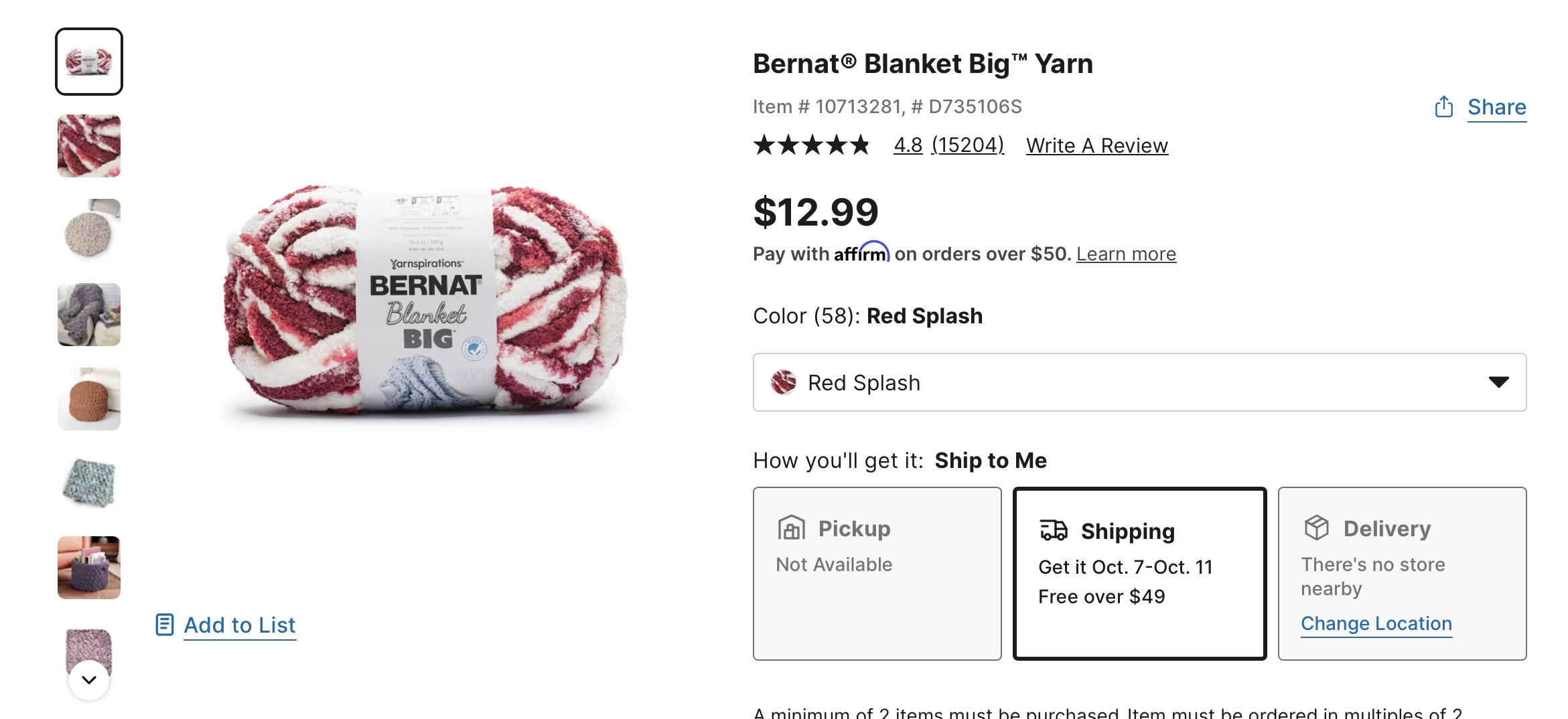
The yarn I used for this blanket was Bernat® Blanket Big™ Yarn in the “Red Splash” variety, as characterized by its red splotches against its white base. I bought this yarn online from Michaels, a widely recognized arts and crafts store.
This blanket was made of four spools of Bernat® Blanket Big™ Yarn. The color it came in was the Red Splash variety, as told by this yarn’s characteristic red splashes across its white base. I bought this yarn online from a Michaels store. A photo of this yarn on the Michaels website is shown below.
Screenshot
Established in 1973, Michaels is a famous craft store that’s known for its specialization in arts and crafts. With its 1300+ stores in 49 states, Michaels is a store that offers lots of art supplies both in-person and online (Michaels). I specifically ordered my yarn to be picked up at the NYC Michaels location that’s located in the Chelsea neighborhood of Manhattan. Though I did pick my order up from there, my package likely travelled from one of Michaels’ many distribution centers or warehouses by Michaels’ UPS delivery service.
I can imagine my yarn traveling in the back of the UPS van, nestled between all the other Michaels-brand supplies, and packaged in its plastic packaging that likely came from China, the “primary plastic supplier in the world” (Grand View Research). Understanding the origin of this packaging shows us how far parts of this blanket have travelled to get all the way to New York (and then SUNY New Paltz!). This plastic, derived from things like petroleum, was underground for so many years before humans decided it had another purpose — to protect the history and the work behind this blanket’s yarn.
The history of this yarn is where the Bernat Yarns Company comes into play.
The company that made this yarn is called Bernat Yarns. Originally founded in Hungary, the company relocated to Boston in 1902. Initially, Bernat focused on dyeing fabrics and restoring tapestries. Their expertise in needlework extended into fine arts, embroideries, furniture weaving, tapestries, and dye refining, exemplifying the Bernat Yarns Company’s skill with textiles (Jamaica Plain Historical Society).
In the 1950s, the Bernat Company was a pioneer in the textile industry, commercializing the use of acrylic yarns as opposed to woolen ones (Bernat). These acrylic yarns, with their polyester and nylon bases, were found to be much softer, easier to care for, and more affordable than traditional wool. This innovation allowed the Bernat Company to increase their sphere of influence, spreading through the United States and Canada. This innovation also allowed them to maintain their trademark — that baby blankets and winter items are some of the best items to make with their product.
The acrylic base of this yarn makes me think about the dyeing methods that were utilized to make the yarn the way it is now. Though the Bernat company does not have a specific process that I could find about dyeing their wool, I can infer that they likely utilize synthetic dyeing methods. I once tried to do the general cotton dyeing method with Sherpa fabric (another acrylic base). Because of the atomic composition of plastic fabric as opposed to cotton fabric, the dye did NOT hold and I was left with only grey-stained pink fabric instead of the black that I wanted. Synthetic dye, for polyester fabrics, is the only thing that will hold.
This type of dye was discovered in 1856 by William Henry Perkin, whose failed chemistry experiment created a whole new world of clothing dye (Science Museum). This dye allowed for fashion to suddenly become a whole lot brighter, and a fashion revolution in almost any shade imaginable. These dyes are now a staple in most clothing design spaces, as colors like blue and purple are very hard to come by naturally.
In 1992, the Bernat Company was bought by a Canadian company. This caused some of its doors in the United States to close, but for their outreach to grow much bigger. By the late 1990s, Bernat solidified its reputation with “the launch of staple product lines such as Bernat Softee, an affordable and durable acrylic yarn that remains a popular choice for knitters and crocheters alike” (Jamaica Plain Historical Society). This yarn is the sister of the yarn that I used for my blanket, and helped pave the way for other “chunky yarns” to become more popular.
I had assumed that the yarn was likely spun in a place where more synthetic products were generated (Asia). However, the Bernat company states that their products are mostly made in the United States and Canada by established weavers. So, for the most part, this yarn (and the blanket it became) hadn’t strayed too far from its original home.
Ultimately, though this blanket is one that was made with my very own two hands, it is a blanket that has travelled many places, and is a result of a lot of scientific innovation.
Not to me, at least not at first. This object, a framed jigsaw puzzle of the Forth Road bridge, was first given to my grandfather, Martin Browne on September 4th, 1964.
September 4th, 1964 is the day that the bridge shown in the puzzle opened its gates for the first time. Specifically, these gates are depicted as a large suspension bridge with tall, dark towers that seem to pierce the sky and the Forth River below. In the puzzle, this river is shown as an expanse of different shades of blue rippling under the bridge.
The bridge is shown to be grey and light brown in color, with the entrance of the bridge being brown, and the towers being grey. In the background, there is another large structure that’s made up of a series of links. Upon further research, I found that that is the Forth Bridge, the Forth Road Bridge’s sister bridge.
It is a bridge that was built by many, many men — my grandfather being one of them.
According to my mother, my grandfather was born in Fife, Scotland, on October 6th, 1926. He was the youngest of three boys and was sent out to work at age eleven. He was alone when he was sent out to work, having to cross hills, go through towns, and do odd jobs just to survive. He did all this with no shoes, my mother stresses, and that’s why, in almost every photo we have of him, the shoes he has are shining.
There are records in the National Federal Scottish Census with my grandfather’s name. In 1939, he was listed as an Edinburgh resident. In 1941, he was listed as a Glasgow resident, and the list goes until 1946, when he settled down in Dunfermline. This census, and later, the bridge, is a testament to how far my grandfather traveled, how hard he worked, and how many lives he must’ve lived before he settled down in Dunfermline.
He crossed many things on his journey—bridges, hills, cities, and towns. I’m not sure of the nature of his lives before he met my grandmother, but I can imagine him: his black hair, determined eyes, and soft voice, going through the motions until he found his home in Dunfermline.
All this traveling is how he came to work in construction. At the time, construction was a well-paying job that offered job security. It was a stable job in Dunfermline, which was part of the reason he stayed. For my grandfather, that was everything that his upbringing hadn’t provided. Additionally, with he and his family’s upcoming move to London, as well as the fact that he would soon have a family of five, a job like this was an incredible opportunity despite the risks.
This bridge is located in Scotland. It was the first bridge of its time to be a multispan cantilever bridge that allowed for pedestrian, railway, and car access. Working on this bridge was something that my grandfather took pride in. This bridge was his labor of love.
On the back of this puzzle, the initials of the ACD Bridge Company Ltd construction company are written in pencil. These initials are written in script, the typical handwriting for educated Scotsmen during this time.
This company was founded in September of 1958, when construction for the Forth Road Bridge just began. This company is a conglomerate of different construction companies: Sir William Arrol & Company, The Cleveland Bridge & Engineering Company, and Dorman Long (Bridge & Engineering) Ltd. These companies were all established at different times but came together to oversee this monumental construction project.
Besides the signature, there is no one credited for the image that the puzzle is made up of. There are only the hastily scribbled letters on the back of the slightly browning puzzle pieces. This signature is interesting because it spans across three puzzle pieces. Because of this placement, the signature wouldn’t make sense unless the puzzle was pieced together. It makes me wonder, was it not supposed to be a puzzle? Was this signature hastily scribbled for a reason? Was it an afterthought?
My mother recalls that her father used to come home late a lot, his eyes tired, and soot staining clothes. She talks of how he had calloused hands, but how those calloused hands always held a paper-bagged gift for her and her sisters. From candy to marbles to puzzle pieces, he always thought of his family first.
To show for the hard work, he received this puzzle from his employers at ACD Bridge Company as a piece of his earnings. According to the company and online listings, there were only about 200 or so of these puzzles distributed to the workers, despite there being more than 4600 men working on it. My mother says that my grandfather was chosen to receive it because he was so handsome and because they wanted his photo for the newspaper. I couldn’t find any newspaper articles about any workers during the bridge’s opening ceremony, so I’m not sure how true my mother’s claim was, but I’ve heard it so much that I’d like to believe it’s true.
Looking at the cars shown in the puzzle, you can see that they bear the name “Dunlop”. Dunlop was a company that specialized in rubber products like tires and car equipment. Its logo is white and is shown on several cars on the puzzle.
This symbol was purposeful. This puzzle wasn’t even a true trophy, but an advertisement for Dunlop. I can imagine my grandfather’s calloused hands tracing the then fresh edges of the puzzle, wondering, waiting, if he could finally rest and if this was it.
This jigsaw puzzle is approximately 200 pieces large, with it being 14 pieces by 14 pieces long and wide. Its specific dimensions are 24 inches by 18 inches. The edges of the jigsaw puzzle are rounded with age and use, and there are smudges scattered across the pieces. The size of this puzzle, slightly more than that of two pieces of paper lined up together, pales in comparison to the actual 2.5 km bridge.
I have never seen this piece broken apart, and I have never seen the Forth River without its bridge. Both of these things are things only my grandfather experienced, and this puzzle, in a way, represents all the pieces coming together — steel, bolts, cables, and wires all coming together to form something way bigger than anything around it.
As my mother tells me this story, she pauses for a moment, smiles, and says how my grandfather came home the day the bridge opened, a smile on his face. That day, my grandfather didn’t have a single paper bag for his daughters. That was something new, because he always had a gift for them.
Instead, he had this puzzle, a few flowers Queen Elizabeth got him, and a plan. So, the first thing my grandfather had done once he brought it home was to let my mom and her sisters put the pieces together, and to rest.
My mother’s the one who, 40 years later, received the painting from my grandfather shortly before he died. It’s the puzzle she herself pieced together. It’s the puzzle she framed and placed on the wall before I could even properly walk. She mentions how she put it together as a child whenever she didn’t want to do her work, and how her sister often used it as a placemat. It is a puzzle that stands for so much and has witnessed so many memories, that it too has become an integral part of those memories.
I was never properly gifted this puzzle like my mother and grandfather were. It’s always been a part of my life — something that allows me to get to know about my grandfather.
Me and my mother love the puzzle despite it not being a true reward for all my grandfather’s hard work. But knowing the person that my mother portrays my grandfather as, I’m sure he would’ve loved it anyway.
This puzzle of the bridge, regardless of its circumstances, shows the longevity of connection — how things can be advertised, made, loved, forgotten, and forgiven.
My uncalloused hands brush across the glass that protects this puzzle that is many, many years older than I am, and I wonder what it’s like to piece together something so much larger than myself.
Searching, digging behind numerous other records and vinyls in the back of my mom’s old storage unit, fighting against dust mites, is the first memory I have of this item.
“It should be in there somewhere!” My mom had exclaimed from the opposite corner of the room, elbow deep in old vinyls and other items that were far too old to even name or even put an original story to. With my mother’s urges, I eventually found it, a black, surprisingly shiny, vinyl record with four men on its cover.
The disk itself was slightly poking out of the plastic casing, its scent being that of slightly burnt rubber — or something, amongst the record’s ribbed surface. But, regardless of its smell, my mother was quick to take it from me. After all, this was a record from her favorite childhood band.
That was nearly 10 years ago. I haven’t seen this record since I was 16. Since then, I’ve gone through my last two years of highschool, and 3 years of college. But it’s still just as shiny as I remember.
My mother was excited when she heard about this project. she’s an avid collector and loves to show off her little trinkets. I chose to base it this project on memories that I recall my mother having about an object. Something older, something that has lived through much more than I currently have.
For some reason, this record is what came to mind.
This record is approximately 12.25 inches long by 12.25 inches wide, with its thickness behind similar to that of a cellphone without a case (half an inch). The vinyl itself is much smaller, approximately 10 inches wide, with an inky black surface weathered away by years of past use. The casing is shiny with only a few scuff marks on its leftmost side.
The record itself is black with a white and yellow band in its center of mass. On this band, the words “The Chi-Lites: Greatest Hits” are displayed in bright red letters. The record’s ribbed surface is slightly scuffed, having some of the original ridges worn away from years of use.
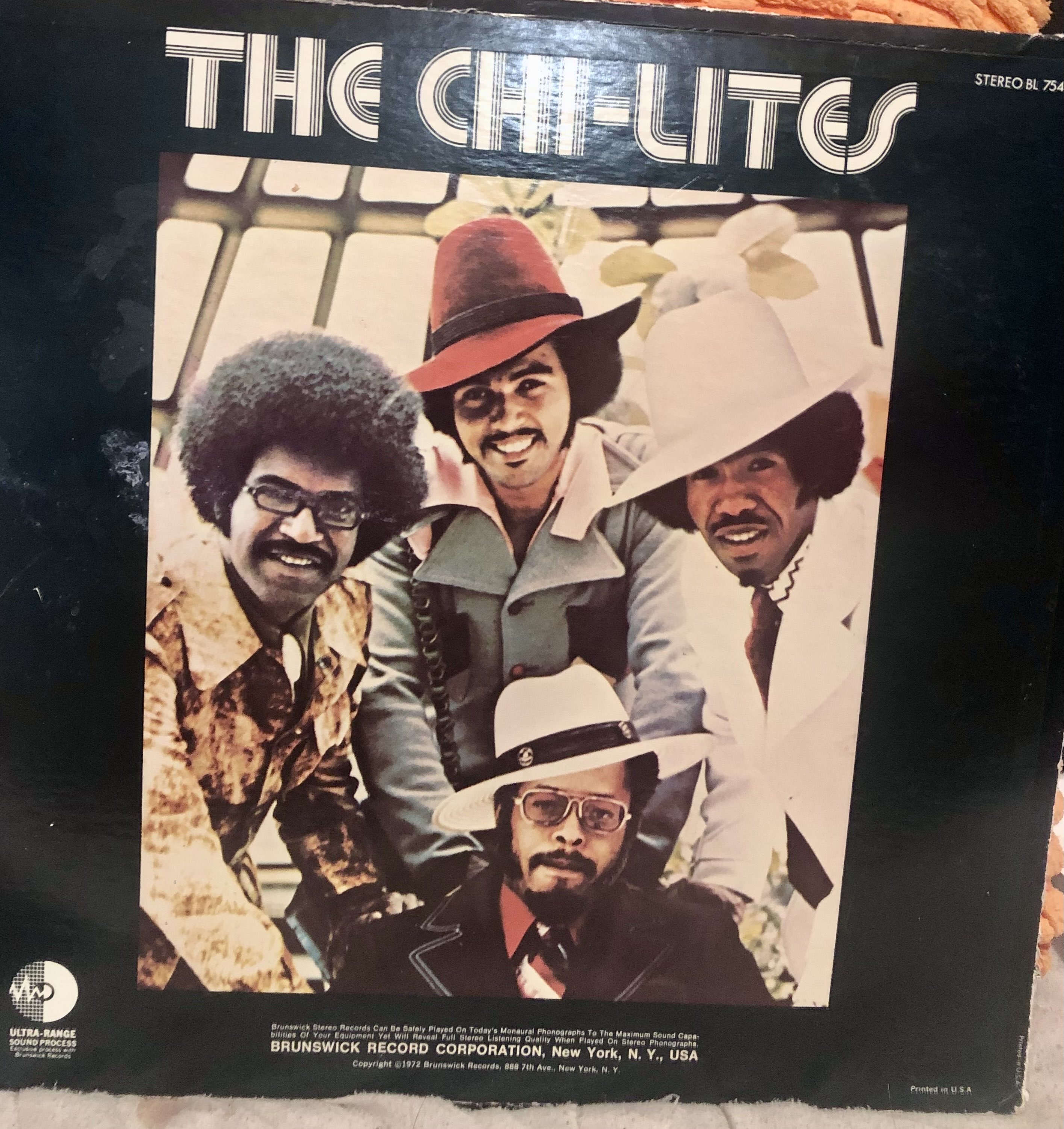
The front cover of this record, under the large “The Chi-Lites” title, features a photo of four men smiling as they look towards the camera. The names of the members of this 70s R&B group are as follows: Robert Lester, Eugene Record, Creadel Jones, and Marshall Thompson.
These men make up the band called The Chi-Lites, a band that was put together in 1959 by Marshall Thompson, the group’s lead singer. On the record, the four men are shown all smiling. They are oriented in a diamond formation, with two of the members being at the same orientation on the left and right sides of the cover, and the last two members being on the top and the bottom of the piece.
Robert Lester is the man on the leftmost side. He’s adorned in a faded yellow-brown blazer. He has a mustache, glasses, and is smiling.
Up top is Eugene Record, wearing a red hat and a large smile.
On the rightmost side is Creadel Jones, wearing a white hat and white suit with a brown tie.
On the bottom is Marshall Thompson, the band’s lead singer, who is wearing a white hat with a black stripe, and a black suit with a red undershirt.
Behind the men, there is a grid-like background, with the grid shape being dark in color, with white lighting protruding through the gaps in the grid.
On the bottom left corner of the record, there is a disc symbol with a lightning bolt. This lightning bolt symbol highlights the “Ultra Range Sound Process” utilized to create this record. This process is characteristic of Brunswick records, the record company who created this record.
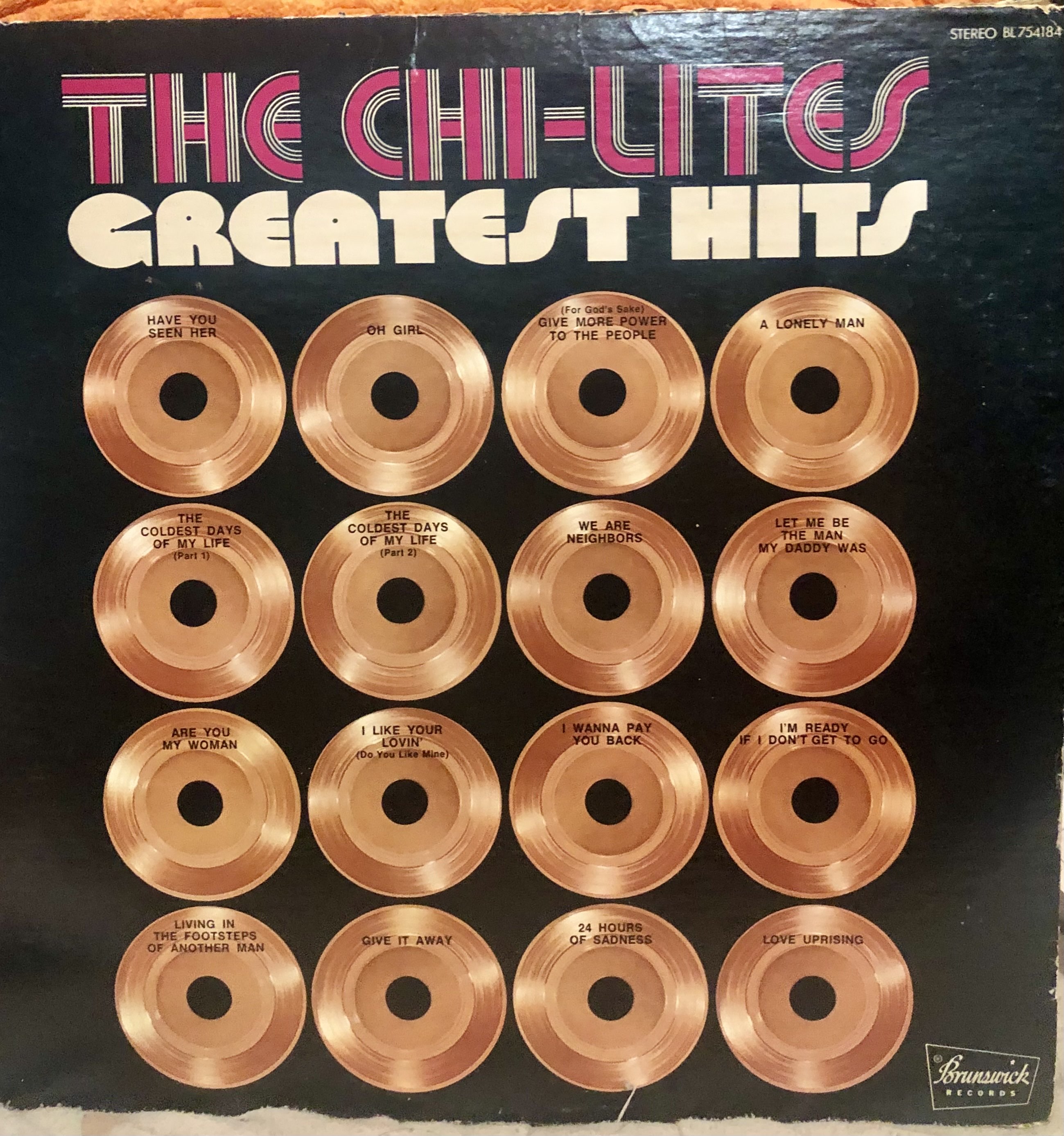
On the back of the record is a series of record discs featuring the band’s other top hits. These hits, including “Have You Seen Her”, “Have You Seen Her”, “A Letter To Myself”,“The Coldest Days of My Life”, “Stoned Out Of My Mind”, and “Oh Girl”. All of these songs are exemplified on the golden records that are shown on the back of the record in a 4×4 grid pattern. This pattern takes up approximately half of the space on the back.
I’ve only heard this record being played. It’s my mother and this record that truly lived it — the record having corners fraying, peeling, and worn by age and constant touching. This record is a, no pun intended, record of something my mother lived for when she was younger. These were her songs. Everything this record is undoubtedly hers and all that she wished to be when she was my age.
This item is primarily a dark-colored, medium-sized record from 1972. But, even with dust coating its surface, the smiles of the members are blinding.