A Cell Phone Surprise

I chose to talk on the phone as my experience with analog technology. I actually am a big phone-talker, so what I will be describing won’t necessarily be an entire new experience, but I think it is one worth writing about because I have never actually sat down and analyzed why I enjoy the experience so much, or what I think it has to offer.

The digital technology that I am going to define as the “opposite” of talking on the phone is the action of texting. On a general day to day basis, I text more than I talk on the phone. There are about three people currently in my life who I text on a daily basis, plus the handful of friends who text me, or who I contact more sporadically. The experience I have with texting is somewhat of a mixed bag. I enjoy being able to speak to my friends throughout the day and keep in touch, without always having to rest my sole attention on the conversation. If I text, I can still run errands, do homework, or relax with a book or a TV show. But this very benefit of texting is also what stresses me out. Receiving jolts of incoming text-tones often stress me out. Sometimes it does not feel good to be constantly interrupted, even if I am enjoying the conversation I am having. Because of texting, and all the other features my cell phone can offer, I find that I carry it with me everywhere I go, even if I am only walking across the room. Sometimes this makes me feel trapped, and I have gotten into the habit of turning off my cell phone when I feel this way. Overall, texting is very convenient because it is fast and doesn’t require a lot of energy. But once again, its strength is its downfall. Sometimes I have gotten so much into the habit of texting, that I will text in order to contact someone even when it is less convenient.

I like the conversations I have with my friends over text and the ability texting gives me to talk to them more often, but nothing beats the experience of talking over the phone. This week, my friend texted me asking if I could help her with her English paper. I began to type out my thoughts on the thesis she had texted to me, and then decided this would be the perfect opportunity to give my analogue experience a-go. Talking on the phone is not out of the ordinary for me, but it is in terms of simple conversations like this one, where all I was being asked to do was discuss a thesis. I called the friend to answer her that way, and this was our first phone conversation. I was completely focused on the conversation—as one has to be when actual engaging in auditory conversation—and helped my friend plan her paper. Then we began to talk about other things, and ended up having a wonderfully fulfilling conversation which lasted over an hour. I don’t know if we would have had such a long and deep conversation had we only spoken through text. It was a pleasant surprise to bond further with this friend in an unexpected way. Even the act of talking into a phone was more satisfying that having to type out long messages just to get an idea across.

I am definitely more likely to talk on the phone now for simpler reasons. Normally I call a friend and prepare for a three hour catch-up conversation. But I wonder what else I could experience if I used the phone as a means of communicating small things as well. Will I end up feeling closer to the people I text every day?

It is interesting to think that with the same object, I can have two entirely different experiences even though both texting and talking on the phone are options the device gives me to communicate almost instantaneously with others, no matter how far away they are. It is also odd to think that I can have an analogue experience on a cell phone. Go figure.

Gertrude M. Deyo’s Autograph Book

Image

gertrude

Before students used yearbooks and social media to record memories and stay in touch, they wrote in autograph books. This autograph book belonged to Gertrude M. Deyo. It is full of elegant signatures from Gertrude’s friends and schoolmates— many of whom left witty poems, notes, and wishes for her to look back on.

IMG_1009Description:

This autograph book has a teal, velvet cover. It is dulled and worn, like an old, dusty carpet or a stuffed animal which has been washed one too many times. There are creases in the velvet along the spine, and when you open the book you can see that many of the pages are ripping from its binding. The inside flaps are made of a shiny, hard paper with a rugged texture that looks much like fingerprint bands. The paper might be water-repellent and is peeling away from the velvet, indicating that the teal covering must have been attached with glue. The pages within the book are slightly yellowed, and are most likely made out of straw or wood-pulp, as was common during the nineteenth century. The two right corners of every page are rounded, and the edge connecting them is painted gold.  

The first right-hand page of the book says “Autographs” in an elaborate font with gold letters and a black outline. Two gold lines border the edges of the page. On the following right-hand page there is a pink, rectangular paper glued slightly off-center. The name “Gertrude M. Deyo” in printed in a different, black, fancy font. A natural brown border has appeared along the edges of the pink label, which is physical evidence of the book’s age—approximately 135 years old! Below Gertrude’s name, “A Christmas gift from her mother” is written in script and with pencil.

Following this page, there are over fifty others with notes from her friends, family members, and school mates. The entry dates range from 1882 to 1887, many are not in chronological order, and there are a number of pages with stains or stray marks. Almost every signature is accompanied with a date and location, if nothing else. This seems to be the expected template for Gertrude’s autograph book, after which personal anecdotes and doodles could follow. Poetic messages are especially common, and one might wonder whether these rhyming messages were thought up on the spot, over the course of the visit, or perhaps in advance.

18297030_1572294069448149_912609362_o

Maggie DuBois, 1882

While some entries are as simple as Maggie DuBois’ note, for instance, and contain nothing more beyond the “template,” others, like Jennie Keaton’s entry, are witty, thoughtful, and can serve as a door into the mind of a young school girl during the late eighteen hundreds. One must wonder what Gertrude talks about with friends like Jennie on “stormy Saturday nights”—a note written on the edge of Jennie’s entry, which says: “Love not the boys, / Not even somebody’s brother. / If you must love / Why, love your mother.”

18339268_1572296832781206_451226651_o

Jennie Keaton, 1883

18297165_1572357219441834_444207819_o

Etta’s written side of a dialogue between herself and Gertrude, possibly while they are sitting in church, 1887

There are also entries in Gertrude’s autograph book which have been in the hands of more than one person, and show a spontaneous dialogue between friends. Sometimes these entries are so full of messages, poems, and jokes, that, without proper context, they are nearly illegible and incomprehensible. Although a general sense of such entries can be acquired, one could only truly understand their nature of the entry if they, themselves, were a part of the group of friends writing in Gertrude’s book.
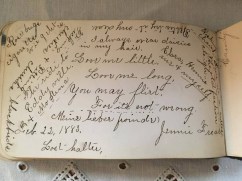
 

18318151_1572310586113164_1466904711_o

“Love me little, / Love me long, / You may flirt, / For it’s not wrong,” and other messages from Gertrude’s friends, 1883
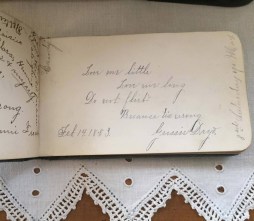
18338866_1572357212775168_1108743541_o

A  response to the previous page from Jessie Deyo: “Love me little / Love me long / Do not flirt / Because tis wrong,” 1883


Gertrude’s autograph book can now be found in the music room of the Historic Huguenot Street Museum’s Deyo house in New Paltz, New York. It sits on a table by the window, beside a music box and a photograph of Gertrude M. Deyo, herself.  The book’s natural resting page is around the halfway mark, where if laid flat, it will stay open. It can be assumed that the book has been kept in this position for an extended period of time, perhaps for as long as it has been on display. This physical element of the book is characteristic of the multiple lives an object can have as time passes. First, it is a gift to a girl from her mother, then an object to be passed between friends, and lastly, a piece in a museum, which recreates the life of the person who once owned it.

Provenance:

Although neither a name or company is printed on this particular book, it was most likely been made by what was called a “journeyman printer” (19th-Century Printing). A journeyman printer is a person who has completed an apprenticeship in printing, and then has worked in a printing office, where books and stationery were printed and sold (19th-Century Printing 15, 13, 19). An autograph book would fall under this category. Autograph books were popular among graduating students during Gertrude’s time, and it would not be a stretch to guess that Gertrude’s mother could have found a book such as this one up for sale in a number of shops—printing related or otherwise.

Because of the inscription on the second page, which records that the autograph book was “a christmas gift from [Gertrude’s] mother,” it is most probable that the book was donated to Historic Huguenot Street by someone within or connected to the Deyo family line. The donor might have written in this note before handing it off. The note could have also been written before hand by any other person of connection to Gertrude who may have had access to the book after her passing in 1926. 

Narrative:

Gertrude M. Deyo’s autograph book gives a snapshot of the social life of young woman growing up in the Hudson Valley in the late nineteenth century. In 1878, ten-year-old Gertrude graduated from The New Paltz Academy, a school for local children, but the earliest entries recorded in her book are from 1883, when Gertrude was fourteen years old. Although only two of Gertrude’s friends, Henry D. Freer and George Deyo, explicitly call themselves her “schoolmate,” it can be assumed that most of the entries were written by her school peers and that many of these peers had autograph books of their own. 

IMG_0976Autograph books were first developed in sixteenth-century Germany as a networking tool for university students. They were called Album amicorum in Latin, and contained the names of students and faculty along with words of advice. In the mid-1800s their popularity made their way to America, and the books became a way for young students to keep record of one another, while also giving them an opportunity to express their affection (Elgabri 2015). The most typical autograph entry follows along the lines of Sara D. LeFevre’s message to Gertrude. She writes: Though many a joy around the smiles / And many a faithful friend you make / When love may cheer life’s dreary way / And turn the bitter cup to sweet, forget me not.” 

Gertrude is nineteen years old when the entries end in 1888—only three years before she marries Abraham Deyo Brodhead. The messages from Gertrude’s friends over the five year time period are youthful, clever, and beautiful to the eye, so much so, that is sometimes easy to forget that these entries are written by adolescents. For example, there is an entry signed “H. (Hennie) Keaton” in 1883 which quotes a line from Shakespeare’s The Tragedy of King Richard The Second. She writes: “The purest treasure mortal times afford is spotless reputation.” Another friend, Jennie A. Burgher, quotes a phrase from Lord Tennyson’s “Locksley Hall,” a poem which discusses the peaks and valleys of youth, and writes, “knowledge comes, but wisdom lingers.”

The handwriting of these messages complement the tone of such phrases, for nearly every entry is written in careful, and sometimes elaborate, script. In the 1800s, penmanship began to play an important role in the lives of Americans. If you had “pleasing” penmanship, it was a “sign of gentility” (Florey 47). It is clear from these entries that handwriting was important to Gertrude’s friends. Some friends even decide to focus on writing their name in calligraphic letters, as opposed to writing an actual message.18289971_1572310589446497_136226741_o
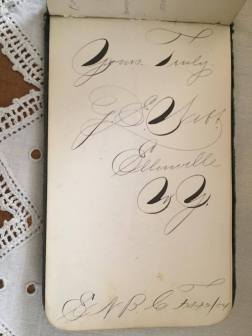
Writing in script became a standard, yet, in a way, these autograph entries gave young students an opportunity to establish one’s self as intellectuals and as social elitists. The “Father of American Handwriting,” Platt Rogers Spencer, was the first to institute schools in America wherein handwriting would be prominent part of the curriculum (Florey 63). “From before the civil war to the end of the Victorian Era,” Kitty Burns, an expert on the history of penmanship, in her book, Script & Scribble, writes, “the hegemony of Spencerian was a testament to an appreciation for beauty that lurked in the souls of Americans….High-class script,” she continues, “[was] surely the mark of a gentleman or a lady (Florey 69).

Interestingly, Platt Rogers Spencer was born on the Hudson River. The birth of penmanship in America, therefore, begins not long before, and in the very same region, as Gertrude’s ascent from childhood to adulthood. With this knowledge, Gertrude’s autograph book can be considered from an entirely new angle. Not only is it an account of the social climate of young New Paltz students through their thoughts, jokes, and wishes, but it is also an object which represents the inception and effects of the cultural movement to value penmanship and presentation—a cultural movement which permeated throughout the entire country, and greatly characterizes the Victorian Era as a whole.

Bibliography:

Elgabri, Alexa. “Leaves of Affection: A Look at Autograph Books of the 19th Century.”              Leaves of Affection: A Look at Autograph Books of the 19th Century. Ohio Memory, 4            Dec. 2015. Web. 23 April. 2017                               <http://www.ohiohistoryhost.org/ohiomemory/archives/2546>

Florey, Kitty Burns. Script and Scribble: The Rise and Fall of Handwriting. Brooklyn:                Melville House, 2013. Print.

Old Sturbridge Village.19th-Century Printing.”  Old Sturbridge Village. , n.d. Web. 22   April. 2017. <https://www.osv.org/19th-century-printing>


The Next Keeper of the Belt

17093059_1500558743288349_616668208_o

The last two objects I wrote about were pieces of jewelry that did not have much of a life to track. They both went from the factory, to the store, and then into my hand. This is why I decided to return to one of my original objects—my grandfather’s belt. I brought this belt with me on the first day of class because I have held onto it, and even brought it with me on campus, without being fully aware of the role it played in my life. I hold a strong connection to this belt because it reminds me of my mother and her side of the family, yet I didn’t think the belt had much meaning other than that. When I was younger, my gave me the belt. She told me in Russian that it belonged to her father and not to give it away. So I didn’t, and that was all it really meant to me.

This belt seems to be made out of material that feels plastic. It could be a form of rubber, but I am not so sure. It has a woven design, where different colored strands of brown and beige are braided into each other, resembling the stitch of a basket. It is a rather small belt.

All I know about this belt is that it supposedly belonged to my grandfather. I never met him because he died when my mother was very young. From its length I can assume that he either had a very small waist, or that it was his as a child’s.

My grandfather was born in Odessa, Ukraine (It’s funny to think that De Waal’s netsuke are connected to this location and so is my object.). II tried searching the history of belt production in the Ukraine on Google, but I couldn’t find much of anything. There were a lot of websites selling belts from the Ukraine presently, but this wasn’t what I was looking for. It was time to call in a family member for help.

I called my grandmother, and she remembered the belt almost immediately after I described it. She said that my grandfather already owned the belt when she met him. They way she spoke about it, it seemed like the belt was one of his favorites, or at least something he often wore. She told me it was hand-made, and that he most likely bought it at a flea market. This explained why I couldn’t find anything like it produced from a factory when I looked online. When I asked her about the size, she said my grandfather was very in shape and had a very small stomach, which explains the short length of the belt.

My grandparents settled in Kiev, and after my grandfather died the belt remained in their home. When my grandmother immigrated to America with her mother, my mother, and my aunt, she found the belt as they were settling in. She unpacked it, gave it to my mother, and in Russian, told her that it belonged to her father and not to give it away. Nothing else was spoken in relation to the belt after that, and my grandmother never saw it again. She had nearly forgotten about until I called her, asking about the belt’s history.

In summation, this belt most likely was made in Odessa, traveled to Kiev where my grandparents began their family, sailed to New York City upon my family’s immigration, and then found its way to the suburbs of Atlantic Beach, Long Island, where my mother moved with my father to start their family Now, the belt is sitting in my drawer in a SUNY New Paltz dorm room. I expect it to travel with me whereever else I go, until I pass it down one day to my children. I had no clue my mom told me the very same words my grandmother told her. I feel a deep sense of obligation to keep this chain going. Writing this post and uncovering the secrets woven into the belt has increased its meaning and value to me tenfold.I had no clue it was going to be such an important item in my family—nor did I know how important it already was.

High-five If You Have A Hamsa!

16936115_1493175444026679_1451912371_o

Behold another necklace! This necklace has a silver colored chain but it is not real silver. The pendant shape is called colloquially known as a “hamsa.” This word comes from the Arabic word, Khamsah, which means five. The number five refers to the number of fingers on a hand. The number is also connected to protection against the “Evil Eye.” It was traditionally an amulet, and many describe it to be a representation of the hand of God. Somehow this symbol has made its way into popular culture—specifically a Jewish one. Any young woman who has traveled to Israel returns to the United States with one for herself, and possibly with some extra for her friends and family. Young Jewish women—observant or secular—can be spotted wearing this necklace in all different shiny colors. I’d love to see men wear them, but I haven’t so far.

The pendant itself is nothing but a little piece of cheap plastic with little reflective flakes. My necklace in particular is white with green and blue flakes, but there are pink pendants, red ones, blue, etc. These necklaces are worn more often and openly than a Jewish star necklace, believe it or not. It’s like being in a club. If you see someone wearing it, it is not uncommon to start a conversation with that person, even if you have never met them before, and say “Hey! I’ve been to Israel, too,” or to ask “Hey, when did you last go?”

I have been to Israel twice. The first time I went, I really wanted to get the necklace, but I was low on cash and I didn’t. There was something so appealing about a small piece of cheap plastic. The necklace is definitely mass-produced and made in a factory. It is completely commercial. There is nothing unique about it, and yet I, like many others, felt an immense pull to buy one. During my second trip to Israel I finally bought one. I had found a bunch of these necklaces hanging in a small tourist jewelry shop in the Old City of Jerusalem. There was an older woman in the shop who sold the necklace to me for 32 shekels. This is the equivalent of about eight dollars in Israel. I bought it on Israel’s Independence Day. Outside a parade was about to start. The only two necklace colors available where white and blue, which are the color’s of Israel’s flag.

So first, this necklace was made in a factory in who knows what country, sent to a gift shop in Jerusalem, and then bought by me and brought to America. I wore it every day after I got it—right up until I started wearing my turtle necklace which I previously talked about in my blog. This necklace symbolizes my trip, my at times strained but beautiful connection to Judaism, and is a token of my honorary membership to the “I went to Israel” club.

Turtle Love


This is a necklace that I have been wearing nearly every day as of the last six months or so. It’s pendant is relatively light–perhaps the weight of a quarter– and it is of a turtle. The body of the turtle is formed from a sturdy, but to my guess, relatively available metal. It is rose-gold in color, and based on my limited knowledge of manufactured jewelry, I would assume that it has been coated in this color to make the pendant appear more attractive and expensive. “Gold” jewelry often gives off this effect.

The head of the turtle is small. It is about the shape and size of a singular “Nerds” candy pebble. On each side of the head there is a small circular indent, like someone had pushed the tip of a pen into soft metal. These are the eyes of the turtle. A loop of metal connects to the head. This is the loop through which the chain goes through. This loop is not meant to be noticed, which is why it was attached to the backside of the pendant. It is not a part of the turtle’s structure, but it is necessary to secure the pendant to the chain. I’ve actually never paid attention to this element of the pendant before, and the loop looks a bit like a nose for the turtle–turning it into quite a different creature from that angle.

The appendages of the turtle stick out from its shell. The arms are curved downward and fin-like. Fine lines are engraved into the arms to give the turtle a little bit of texture. The bottom legs are slightly smaller, straighter, and without deliberate lines. A very small tale sticks out from the bottom of the shell. These bottom parts of the turtle have a couple of lined creases in the metal. It is hard to tell whether they are intentional, but they do give the pendant a more “crafted” feel to it. The arms and legs are exactly symmetrical or the same shape. This adds personality to the piece. I can imagine a jeweler sitting at his or her work-place making this necklace, as opposed to some sort of manufactured process. I am not actually sure how this necklace was made, however.

The shell of the turtle is adorned with six evenly spaced out pink, iridescent semi-circles, and a complete circle in the middle of the shell. It seems like this material was placed on top of the rose-gold shell. The decoration on the shell is what helps establish the pendant as a turtle, and it is what, I believe, gives the necklace it’s appeal. The baby pink material and its light-reflective greenish tint complements the rose-gold base very well. When flipped over, the backside of the turtle shell has small little dots indented in it, and some sort of jewelry notation.

The chain of the necklace is thin and of a gold color. I do not think it is real gold either. It is made of up really small linked boxes. Next to the latch of the necklace are two small knots in the chain, because I had gotten the chain knotted up and not put in the energy to take the knots out. It doesn’t affect the appearance of the necklace because they can’t be seen behind my neck.

For the longest time, this has just been a pretty necklace for me. I happen to like turtles, but they are in know way my favorite animal. Lately this necklace has meant a lot to me because I got it when I was with my mother. We were are a department store such as TJ Max or Macy’s,  and I picked it out of the glass case. It probably fell between a twenty and thirty dollar price range, and it meant the world to me that my mom bought it for me. Now I associate the necklace with her, and I wear it as a means of keeping her with me, for she had passed away a couple of years ago. Although this complicates my relationship to the necklace, it is also a “joy” object for me as well, because it reminds me of a good memory with my mom, and because I like the color pink and I think the turtle is rather cute.

A House Has Many Lives

I wanted to use this blog post to go into more detail about the materialistic environment of my house, being that this is one of Miller’s main focus points. As I had mentioned in class earlier today, my family structure, as well as the structure of my house, began to change tremendously since my dad remarried in my junior year of high school. The shift of objects and spaces in my house is quite fascinating, and it is something that I have always been rather mindful of, even before taking this class. Originally, my house was a mish-mash of 90s pastels and Russian eccentricity. My father was born and raised in Brooklyn, whereas my mother was born in Kiev, Ukraine, and traveled to the United States when she was sixteen.

Structurally, my house is build exactly the same as every other suburban, Long Island  house on my block. But growing up, the inside was quite different. The first thing you would see when you opened the door to my house was a wooden and glass, vertical display case, filled with matryoshka dolls, ceramic plates that I had made in art school, and a photograph or two. A plastic Czarina doll from Russia stood on the very top of the display case, with a large headdress and fixed blue eyes, which gazed directly at the front door (A little creepy, yes. But Russians are generally very spiritual/holistic people, and my mom liked the idea of having a “guard,” so to speak, watching over our house.). To me, this image really sets the scene for what my house was like. A unique cabinet, facing a not-so-unique, white, suburban door.

My house, at the time, had bright green oriental rugs, pictures of the family, paintings of forests, and lots of mirrors. I liked how my mother’s Russian accents brought color to diluted 90s atmosphere. The balance made it homey. It made it lived in, and different from whatever I could imagine my neighbor’s houses to look like, as Miller mentions, most “families never actually see their neighbours’ homes” ( 97).

When my dad remarried, he and my stepmom slowly began to renovate the house.  “Homes are the elephants of stuff” (81), Miller notes, and this is a phrase I like very much because it perfectly highlights just how big of a process “accommodating” (96) a home to your needs can be. The renovation began with the kitchen, being that my stepmom is an orthodox Jew, which entails many different kitchen alterations in order to keep up with the proper kosher rules. The following shifts in design began  in the living and dining room, in order to better accommodate guests for Shabbat dinners on Friday nights, and then the bathrooms, their bedroom etc. My house now serves an entirely different functionality from how it used to, and it is interesting to see the how the small changes accumulate to reflect the new dynamic of my home. The walls are now painted silver for a sleek look. The carpets are white, the couches are gray. We now have a new display case with little tchotchkes and little glass figurines that originally belonged to my stepmother’s family. The case has been moved to the dining room. There are less mirrors, but no paintings to replace them, other than a variety of Jewish pieces. My parents are still in the deciding process in terms of paintings–one that has been in motion for nearly two years. It seems the decisions they make in this “new” old house are so crucial, that they can almost not be made at all.

On the outside, our home is being reworked for functionality and for show. It looks stylish and tasteful to our guests, but I find is not as comfortable to live in. Yet, these spaces are important to my parents in more ways than simply meeting the peering eyes of our neighbors. This is most evident in the fact that my stepmom has painted all her closets in loud, obnoxious colors. Her clothing closet is hot pink, her linen closet bright blue. Her small office downstairs is purple. But these are all hidden from the outside. I find this to be quite funny. These colors make my stepmom happy, and even though our house now also belongs to her, it seems there is an image she wants to portray to our neighbors that I believe stops her from actually decorating the house in the way maybe Kondo would recommend. In this sense, our house can often feel like a museum. Everything is strategically placed to create a specific effect. But in my room, I have bright orange walls that are not hidden, decorations catered to me, and objects which I have accumulated over time that are staying exactly where they are. My room belongs to me, and in it I have power over my objects in a way that I do not anywhere else in my house. It is, as a result, my favorite place to be in.

Papers: The Kondo Method!

For me, cleaning is an ongoing process. I am naturally a messy person, but I don’t actually like living in a disorganized environment. It makes me feel less put together. Unfortunately, my cleaning tactics have not actually helped me sustain a tidy environment. I used to do a little bit every day, but this wasn’t successful because as the day progressed the part I had cleaned before had gotten messy again. Thus, I would only end up cleaning the same portion of my room over and over again, while mess would continue to accumulate everywhere else.

I chose to use Kondo’s approach to go through the papers in my dorm room. I did not start with clothes because all the clothes I have in my room has already been sorted out from what I have left at home, and I like all of it. In contrast, I have papers from this semester and last semester which have accumulated all over my room. It has come to the point that I didn’t even know what I had in the piles of papers, and so I thought it was a good place to start.

I was surprised with how many things I had kept that I forgot about. I had playbills from on-campus productions, study sheets, cards, receipts, and the like. I took all the papers and put them in one pile on my bed, which is something I normally wouldn’t do, but was a necessary step in Kondo’s tidying process. It turned out that most of the papers in the pile were useless. For example, I had a whole stack of flyers representing a club I was barely a part of, and which I had no intention of handing out. Why was I keeping all these things? It was eye opening to really get a good look at the objects I kept around me.

Overall, throwing out papers unneeded papers was easy. But I was drawn to the ones which held memories, like the cards and the playbills.  They reminded me of my friends and the experiences I had. I decided it was okay to keep those because I didn’t have too many. Did I need them? No. But they gave me joy and I could always put them on my wall and use them as decorations. This is what I did for some.

But there were some moments during this process that I did find oddly difficult. For instance, it was really hard for me to throw out a Spanish grammar sheet. I knew I was never going to need it because I decided not to take Spanish in college, and because I could look up the information if I did need it for some reason, and yet, it was hard to let go. I kept thinking about the possibility of needing it later. But, eventually I realized I was being silly—it was just a grammar sheet!—I threw it out.

I liked using Kondo’s method because it helped clean out parts of my room more efficiently, however it was still hard not to get distracted. It’s a big process and it takes a certain amount of time that I may not have had, if this wasn’t a homework assignment. Thinking back, I didn’t experience too much “joy” with my papers, because they were, well, papers. However, there were a couple of momentos that made me happy to reflect on. This project has made me realize that I keep a lot of things around me that I don’t need in the slightest. I hope to be more mindful with the objects I collect in my future. And now, I have a clear desk! It’s a nice feeling!