A Gorgeous Coverlet and the Industrialization Mindset

Caption

This eight by seven-foot double cloth coverlet is a stunning work of art, showcasing the intricate design and skillful weaving techniques of the Libertyville Woolen Mill with its stunning crests and floral patterns, natural dyes, and elegant craftsmanship. Donated by Ruth O’Hara, this coverlet is not only a stunning work of art but also a symbol of the rich history of textile production and the families who ran the factories in Ulster County.

Physical Description of the Object

Double cloth refers to the interlacing of two separate sets of wool, and allows for the creation of such remarkable crests and floral patterns. The fascinating range of dulled yellow and black demonstrates the complex nature of the dying of fabrics during this time period. “Many of the dyes used came from plant sources such as indigo, madder, and weld. These dyes were often used in combination to produce different shades and tones” (Lemire 356). With these dyes creating the 3 primary colors, it’s remarkable that the natural dyes could have such a wide range of color as demonstrated by this coverlet. Upon closer inspection, one can see that in the center of the coverlet four bald eagles proudly spread their wings over a crest, symbolizing the American flag and virtue. The corner of the coverlet proudly reads the description Libertyville Ulster County NY demonstrating that this is a locally sourced coverlet. Along with that the name Dinah Roosa is displayed on the corner as well presenting who this coverlet was given to and who owned this coverlet. This cloth’s beauty stands as a testament to both the skill of the weavers and the designers of the Libertyville Woolen Mill. 

Provenance

This coverlet is one of only eleven coverlets owned by Historic Huguenot Street. This coverlet was woven by the owner of the factory during the 1850’s Jacob Lowe, during this time it was gifted to Dinah Roosa. Eventually this coverlet was gifted to Ruth O’Hara, who kindly gifted it to Huguenot Street. While the details of how Ruth O’Hara came to possess the coverlet are also not known, the fact that the coverlet has remained in the possession of a small number of individuals over the years is significant, as it suggests that the object has been valued and cared for.

Narrative

This woven coverlet tells a significant story about the values and products exported and sold in Ulster County. The wealthy LeFerve family purchased the Libertyville Woolen Mill during the 1800s. Descended from French Hueguenot settlers, they became very wealthy through the buying and selling of land and crops. Involved in local government and politics the LeFevre family was integral to the growth of Ulster County. While the exact year is unknown and reason as to why Jacob Lowe sold the mill, during the late 19th century the LeFevre family gained possession of the mill. The LeFevre family as intelligent business owners expanded the factory, making the Liberty Woolen Mill one of the largest places of employment and production in Ulster County. This factory played a major role in the local economy as it encouraged local farmers to produce wool and other goods that could be utilized in factory production. 

  New technological innovations allowed for coverlets like Dinah’s to be created. Joseph Jacquard was a revolutionary inventor who created the Jacquard loom. This loom allowed for complicated patterns to be quickly woven automatically into textiles. In Jacquard’s letter to the Prefect of Lyon he states that, “by means of this new machine the most beautiful fabrics may be woven, with designs varying from the simplest to the most complex, and all with the utmost precision.” This invention allowed for complicated crests and patterns to be made at a quicker speed, allowing for mass production of such gorgeous coverlets. Despite new advancements in technology, a significant amount of physical labor was still needed. Often factories relied on immigrants for this labor in factories. After the LeFevre family expanded upon the Liberty Woolen Mill, there was a significant increase in the amount of immigrants from Germany, France, England, Ireland, and other European countries in Ulster County. 

As demonstrated from the 1880’s United States census, there are a significant number of people on this census in Ulster County whose birthplace was in Germany. This influx in immigrants has had a significant impact on New Paltz today as so much of the population and culture around Ulster county has been based around people coming to America for a better life.

While addressing the possibility of utilization of immigrant workers it is important to consider the idea of maltreatment of these workers as well as the incorporation of slavery in the workforce. While these conversations can be uncomfortable and difficult, it is important to address the entirety of history to get a holistic and accurate perspective. While slavery was abolished in New York in 1827, looking back at the family history of the LeFevre’s reveals the family’s ethics and values that affect the local politics, economy, and factory. In the United States census for 1800, one of the first members of the LeFevre family to immigrate to America from France was on the list. 

The LeFevre family owned four slaves during this time period, much of the wealth that the family earned through farming and textiles during the 1800s was from the slaves in the family. It is essential to address that the industrialization of the Libertyville Woolen Mill and expansion and success of the Ulster County economy had foundations in slavery. Acknowledging the contributions made by enslaved individuals to the economy is of utmost importance, as it highlights the profound impact that their labor had on successful businesses such as the Libertyville Woolen Mill. Understanding this history and its lasting effects can help pave the way for a future marked by equity and justice.

Work Cited

Jacquard, Joseph Marie. Letter from Joseph Marie Jacquard to the Prefect of Lyon, March 16, 1804. Textile History, vol. 16, no. 2, 1985, pp. 135–142. JSTOR, www.jstor.org/stable/27768154.

Lemire, Beverly. “Textile Dyeing Technology in the Late Nineteenth Century.” In The Industrial Revolution in America: Iron and Steel, Railroads, Steam Shipping, edited by Kevin Hillstrom and Laurie Collier Hillstrom, vol. 4, 349-366. Santa Barbara, CA: ABC-CLIO, 2002.

“United States Census, 1800,” database with images, FamilySearch (https://familysearch.org/ark:/61903/1:1:XH5T-XC4 : accessed 25 April 2023), Phillip Le Feve, New Paltz, Ulster, New York, United States; citing p. 242, NARA microfilm publication M32, (Washington D.C.: National Archives and Records Administration, n.d.), roll 21; FHL microfilm 193,709.

“United States Census, 1880.” National Archives and Records Administration, 1880. Accessed April 24th, 2023.
Spoken Passwords

What do shibboleth, coffin varnish, monkey rum, and tarantula juice have in common? They are all spoken passwords! Spoken passwords were one of the earliest forms of keys. Instead of a physical key, it was a spoken word to allow entry or access into a place. Earliest uses of the spoken password were used in warfare. In Ancient Rome spoken passwords were referred to as “watchwords” and the watchword would be spoken around an encampment to ensure no spies had infiltrated. While it had several practical uses in warfare, the spoken word password erupted in popularity after the 18th amendment had passed. Speakeasies erupted out of the ashes of prohibition, but a code was required for entry. Oftentimes this code was a ridiculous string of words such as panther sweat, but regardless of what the spoken password was it kept people drinking and the law enforcement out!

Spoken passwords are another form of keys, instead of relying on an object such as a chest, another person acts as the chest while the key is the password! Spoken passwords resulted in personal connections as this key would have to be talked about and spread around to ensure that all “keyholders” had access. Instead of physical keys being lost, the equivalent was a code word being forgotten. While someone can steal a key to get into a locked location, spoken passwords have different weaknesses. Vulnerabilities of spoken passwords consist of people eavesdropping to get the key.

An extreme example of the spoken password being used and eavesdropped was the complex code communication methods of World War II. During a time when radio calls could be intercepted over air, the only way to communicate secretly was through spoken passwords. Nazi Germany was dominating the spoken password system during World War II. Code “Ultra” was uncrackable and the key was right in front of the allied intelligences. The Enigma Machine was the key to the spoken password yet was almost impossible to crack. It took several mathematicians and years of work to crack. Eventually the spoken password was cracked by Alan Turing and resulted in the beginning of the turn of the tide in World War II towards the allies. Since the allies now had the key to the code, the chest of military intelligence and top secret information was now open.

In the 21st century, spoken passwords are a less common form of password as many different technologies make spoken passwords obsolete. The 21st century rendition of a spoken password is computer recognized vocal recognition. Instead of relying on a person saying a code word a computer listens to a person’s voice tone, pitch, and accent as the key to a locked location. With less vulnerabilities as it is nearly impossible to crack the code of someone else’s voice, computer recognized vocal recognition provides the most up to date and secure version of the spoken password.

In conclusion the key of a spoken password has been modified and adapted for uses in warfare and speakeasies. With its new adaptation in the 21st century of technology providing the new spoken key of a person’s voice, the spoken key has survived throughout history and remains relevant to today.

The Hunt For a Sweatshirt… Scrolling vs Browsing

Recently I have been interested in buying a new sweatshirt. My criteria was that it had to be comfortable, creative, and affordable. Whenever I shop online I always enjoy using Etsy. I feel guilty whenever I use amazon or other sites that may not be treating workers as well. However I do believe that the convenience and prices of those sites will often compromise my morals! But for the online portion of this assignment, I will be browsing on Etsy. After putting “çomfy sweatshirt” into the search bar, I was immediately bombarded with many options. While exploring the search criteria there are several things I consider. The credibility of the seller, the cost of the item, and the design of the item. Once an item peaks my interest I can view more images and consider sizing options. Upon clicking there are several images and often a detailed description explaining why you need this item. There is a sense of urgency that comes with online shopping, text boxes stating “20 people have this in their cart” or “only 2 of this item left” makes you almost want to buy it without even thinking! One perk of online shopping is that you never have to worry about a sweatshirt not being your size as you can simply just change the size with a click of a button. Overall the experience on Etsy is very easy to use and can give you very specific items you may be interested in. However there is a sense of urgency that makes shopping stressful or very wallet draining!

Shopping in-person is a very different experience. Walking into stores there is immediately a different “vibe” from store to store. Specifically at New Paltz there is also a very friendly energy when you walk into stores! Some stores burn incense and have relaxing music playing to have a comforting energy. Other stores have rock music and band sweatshirts to match the environment. Talking with shop owners sometimes can be a little stressful as sometimes there is also an urgency to buy sometime. However there is a significant connection with browsing rather than scrolling. In the case of a sweatshirt, you can hold it to your body and see how it would look on you, some stores even allowed me to try it on. This connection to the item makes it difficult to not immediately purchase! Knowing that I don’t have to wait a few days for shipping is also a great perk of in person shopping. Being able to feel the fabric and know that the sweatshirt is soft makes for additional sensory enjoyment that scrolling does not provide. Overall I do agree with doing more browsing rather than scrolling, taking the time out of your day to explore and enjoy stores and sweatshirts makes for an overall more rewarding and fun experience! 

Grandfather’s Pliers

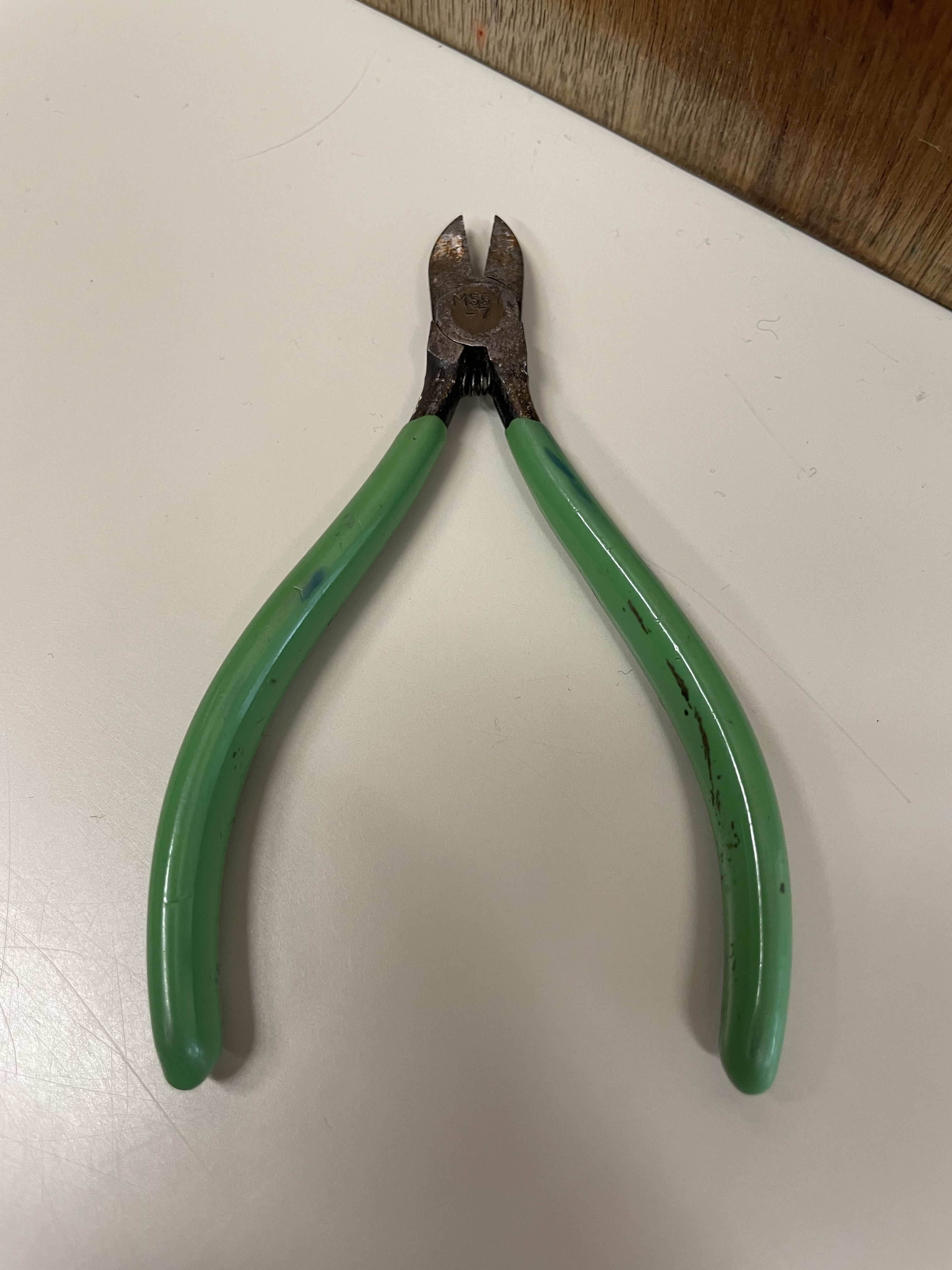
During the early months of 1942, while men over the age 18 were either drafted or enlisting in the military, my grandfather Romeo had to stay at home as he was only 14 years old. While his siblings and cousins went overseas to fight he was upset that at his age he couldn’t fight. During this summer, my grandfather decided that it would be a productive idea to get a job. As a first generation immigrant it was difficult to find work due to discrimination or language barriers. He went to a local summer camp and asked if they were in need of workers. Upon hearing that the pay was only a couple cents for a few hours of work, he exclaimed, “That’s basically slave labor!!!” and immediately looked elsewhere for work. 

My grandfather is remarkably intelligent, and realized that because all resources, metals, and technology were in demand for the war, being a repair mechanic would be a very lucrative career. He studied up on how to fix up different radios and taught himself how to solder. After a couple weeks he began to market himself as a repair mechanic, with each fix only costing a few dollars. There was such a demand for radio repairs that he was making upwards of 15 dollars a week! While that may not seem like a lot of money nowadays, calculating inflation would be the equivalent of making around 300 dollars a week at 14 years old! His business was so successful that he decided to purchase high end tools to enhance his repairs. That is when he purchased these small green pliers.

Over the course of the next few years he would use these pliers for radio repairs or projects around the house. After marrying and starting a family, these pliers played a very important role in the family. Romeo would teach his sons how to solder and repair radios and other technology. This led to his sons gaining a fascination in science and engineering. With one son going into chemical engineering and the other son (who is also known as my dad) going into computer science, these pliers served as the catapult that launched his kids into STEM related education! After these kids moved out the pliers remained dormant in a tool shed. Never forgotten but laid to rest for a while as the pliers waited for the next opportunity to be used. Only after my dad brought up my passion for jewelry making to Romeo did the pliers find another use. Once my grandfather discovered that I was cutting wire for jewelry making, he rushed towards the garage to give me these pliers. 

These pliers now serve once again for a small business! I constantly find myself using these pliers for cutting wire for creating chainmail jewelry. Despite the age of the pliers and the wear on them, they cut beautifully and better then most modern pliers! As I type this assignment I even have a cut from where I accidentally clipped my skin while working with these pliers! These pliers really tell a beautiful story about my grandfather’s values in life. They were used to construct the best life for him and his family, and are still used to this day to support the family he created.

Grandfather’s Pliers

For the past few years I have been utilizing pliers in my metalworking that I received from my grandfather. He used to use these pliers for radio repairs when he was around my age, as he was too young to fight in the second world war, he worked fixing radios. When I told him that I began to work with wire, he excitedly gifted me these pliers. 

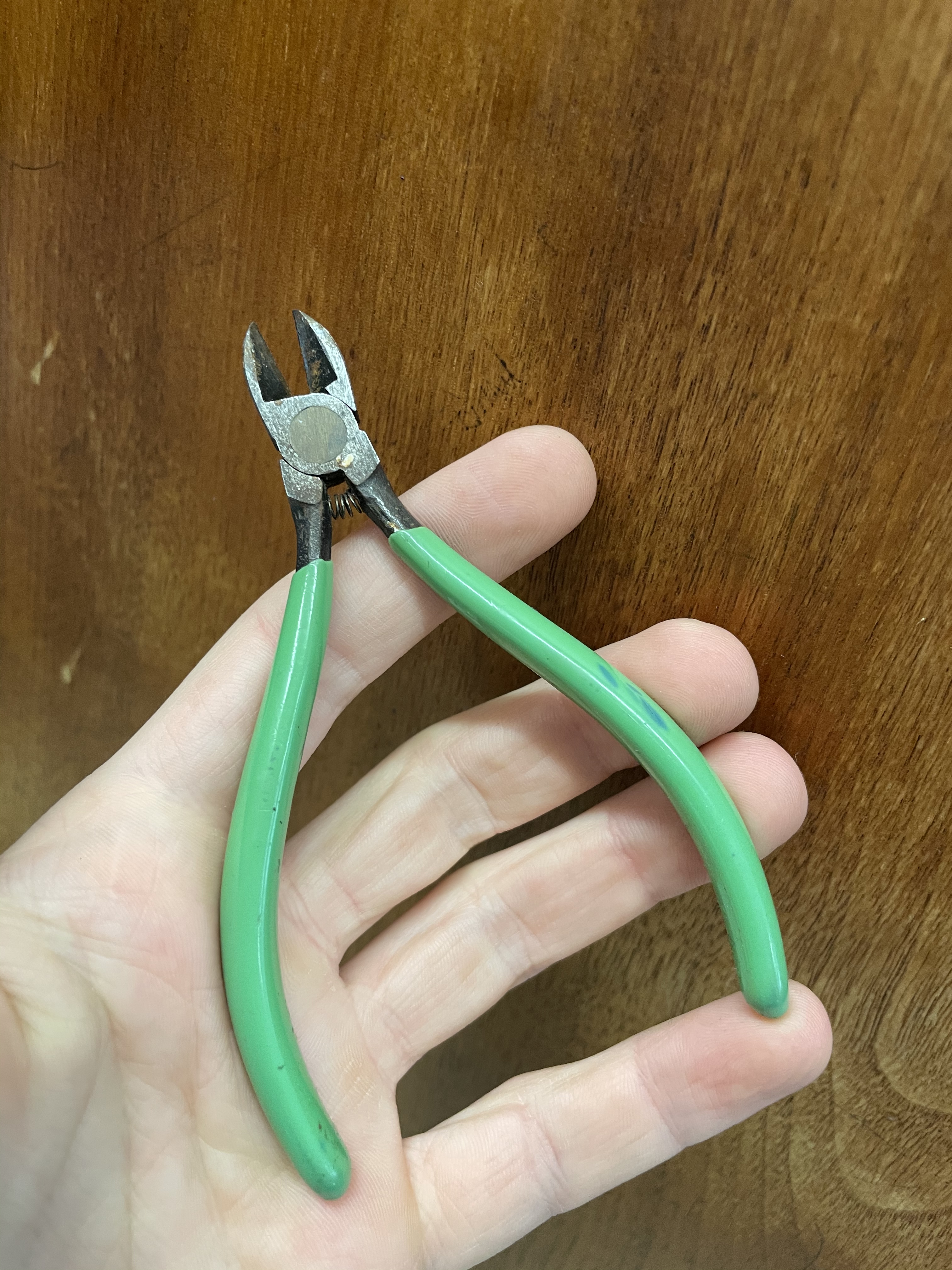
These pliers are three inches in length and an inch and a half in width at the widest point. The pliers are remarkably thin and modest, and almost remind me of an ant. While small in size ants are capable of great feats of strength, these pliers are capable of such fortitude despite the miniscule proportions. The pliers are surrounded by a layer of rubber, this rubber is worn and slightly discolored as layers of metallic dust, sweat and residue have inlaid its way into the plier.

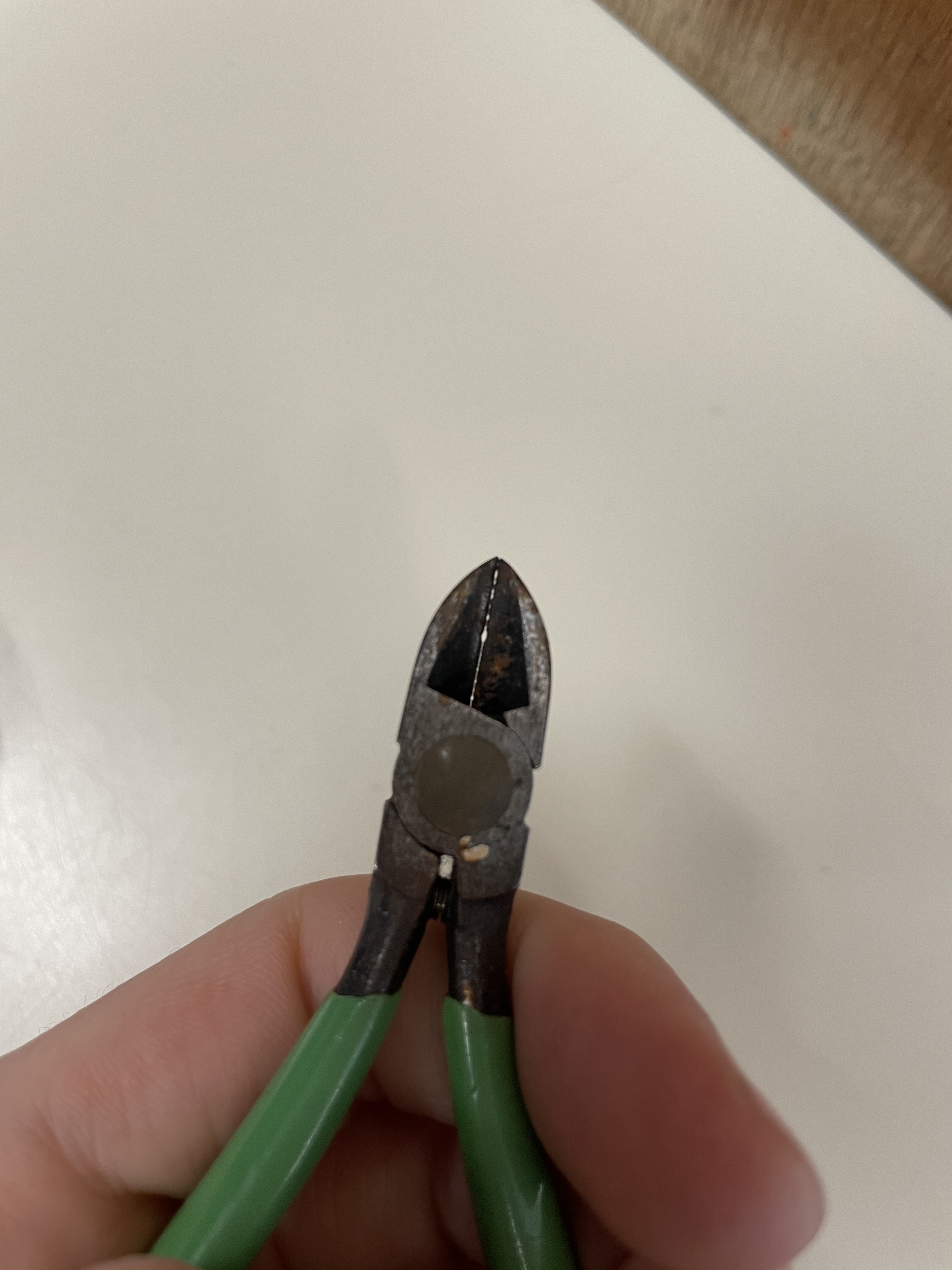
The metal that is not encapsulated by a thin green rubber sheath is covered in a patchy layer of rust and oxidation. The backside of the pliers display the numbers MS54-7. These numbers are not cast onto the plier through heat, but instead are stamped onto the bolt used to help the pliers swivel. When squeezed the pliers demonstrate the simplicity behind the mechanism, two sharpened metal rods rotate towards each other until finally connecting. Despite years of usage the mechanism runs perfectly, and there is no squeaking to establish its age or rust to slow the mechanism and expose its inadequacy. 

The sharpened blades tell a story of their own as they have been worn down over time, upon close inspection light passes through different areas of the blades. One large gap displays a story of a foolish grandson who tried to cut a large piece of steel with the pliers, leaving a dull area in the midsection of the plier blades. Despite the dulled areas of the pliers, they are still razor sharp and threatening. The rust and residue remaining on the sharp blades indicate that this is not a welcoming area for fingers but instead strictly for non-ferrous metals. 

In the center of the metal lies a spring. Despite the pliers age and heavy use, the spring still recoils with a sense of vigor. When squeezed you can feel the tension build as the plier fights to reopen against your grip. When wire is caught between the plier the spring begins to strain as the stress begins to grow between the wire and the mechanism. In due time the wire always surrenders to the pliers strength and launches into two divided parts. 

These pliers allow me to have a direct connection with my family history and always serve as a reminder of how important my lineage is. Combined with the value of pliers spanning from generation to generation as well as its almost pristine cutting ability, these pliers are a demonstration of my family’s values as craftsmen and artists as well as the value we hold in family.