Tools of a Trade

img_4524.jpg

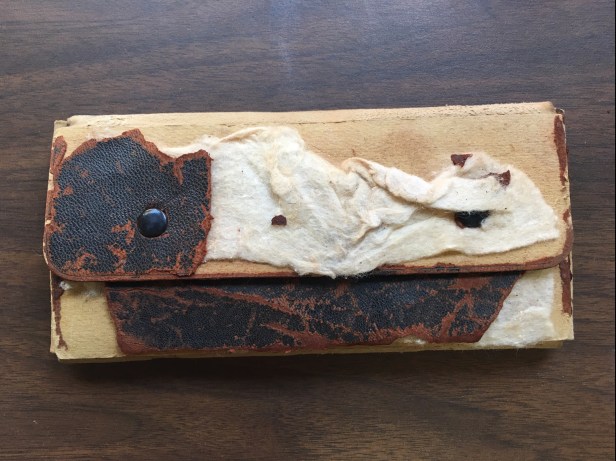
There is much to this object at first glance: the tattered case, the various tools within, the licenses approaching a century of existence; this set of tools speaks on behalf of a dying art, an art that has enabled feats of engineering inconceivable for us to live without.
img_4528.jpg


Battered and torn, decrepit and worn, the old brownishcase sat among three similar objects on the table of the Research Library at Historic Huguenot Street. Immediately I took an interest in it above the others; there was something about this one. A greater amount of associated information, of course, was notable to me, and certainly played a role in my selection of the object; but there was something else, something I couldn’t ascribe to a single feature—the whole pulled me more than any of its parts. It was just begging to be chosen. The other objects that the lady working there had retrieved for me were fine, but only this one intrigued me. So completely and utterly worn – and not just from age, either; it was clear that this wear was from decades of use – it almost felt as if this tool set was so incredibly accustomed to being employed in all sorts of endeavors that it longed to be touched, inspected, handled, used in some way, any way; even if only for a minute before being returned to the dark, solemn archive that must offer it such an uneventful subsistence.

Slowly and carefully, the lady assisting me folded back the flaps of the case, revealing the century old instruments within. There was no rigidity at all; not in the least. The flaps had been opened and closed so many times that they fell along their folds as if they were paper—folded back and forth along a crease so many times that separation seemed imminent. Written in thick black ink on the bottom right of the inner case that holds the tools is a name, “H. Keator,” a place, “Kingston N.Y.,” and a year, “1908.”

But we are ahead of ourselves. What is this thing? —this “tool set,” as I’ve called it.

Before the widespread availability of computer simulation services and computer aided design in general, it was necessary that professional engineers and land surveyors master the process of drafting. This now nearly extinct practice is patently artistic, requiring an array of different tools, all tailored to specific purposes, as well as a high degree of patience, dexterity, and a well-developed capacity for mental imaging. The instruments required in order to draft successfully are organized into drafting sets, and the object of this research is, indeed, one of these sets. This particular set contains space for ten tools, one of which is missing: from the shape of its space, the missing tool seems to be a smaller version of the one directly below it. The set is comprised of several sizes and varieties of compass, used to make circles and certain other shapes; as well as a few dividers, used primarily to segment lines. Also in the kit is a small metal container of Red Top Eversharp pencil leads.

In theory, this drafting set could have been used by anyone for just about any purpose requiring clean, exact drawings or schematics; the set itself is not enough to tell us about its history. Luckily for us, however, the set contains a few research leads. Firstly, and most significantly, inside of the case there are two licenses: one is stapled to the right hand flap, the other is free. The licenses, pictured below, certify one Harold E. Keator as a professional engineer and land surveyor for the years 1926 and 1935, respectively. The licenses and the inscription are enough to deduce that Harold E. Keator was the owner of this drafting set; perhaps the man can give us some hints about the history of the object.

IMG_4525

Research indicates that Mr. Keator was born around the year 1888 and lived in Kingston, New York. He had a wife, Adelaide, and a son, Harold E. Keator Jr. (Ancestry, 1940 Census). An attendance report from the 1912 meeting of the Society of Automobile Engineers at Madison Square Garden lists Keator’s name, followed by “Draftsman, Wyckoff, Church & Partridge, Kingston, N.Y.” (SAE Transactions). Wyckoff, Church & Partridge was a New York City based automobile company that took over the W. A. Wood Automobile Company in Kingston in early 1911 (W. C. & P. Reorganizing without Stearns). Being a resident of Kingston, it is likely that Keator worked at the Wood manufacturing plant, as opposed to at W. C. & P. itself.

Further research revealed much more about Keator. I was able to uncover a grayscale PDF of the Wednesday, March 23, 1960 issue of the Kingston Daily Freeman, which contains the obituary of Harold E. Keator Sr. of Lake Katrine, NY. According to this obituary, Keator – or “Knobby,” as he was apparently called – died on 3/23/1960 after being ill for a short while. Further information about his family is included: his mother’s name was Carrie, his father’s, Edgar; and his son, Harold Jr., had two daughters, Christine and Kathleen. Most relevantly, the obituary confirms that the Harold E. Keator in question was, indeed, a professional engineer, and that he retired from the New York Central Railroad sometime during 1953—for me, this statement removes any doubt of this being the same Harold Keator who owned the drafting set. Keator was also very active in his community: he was a member of the Kingston Kiwanis, several rod and gun clubs, as well as the Ulster County Chapter of the New York State Society of Professional Engineers (Local Death Record).

Though the obituary confirms that Harold Keator was a professional engineer employed with the New York Central Railroad, the story may go a little deeper. The New York Central Railroad was a massive railroad conglomerate, buying dozens of smaller rail systems and individual railways and incorporating them under the NYCR umbrella. Indeed, one of the rail systems purchased by New York Central was the West Shore Railroad, in 1884, which, under its umbrella, controlled the Wallkill Valley Railroad.

The Wallkill Valley Railroad was operational from 1866 to 1977. It ran from Kingston, through New Paltz, and down to Montgomery (Wikipedia). Though currently defunct, much of the railroad was converted to foot trails, the Rail Trail running through New Paltz being one of them.

Harold Keator was born over a hundred and thirty years ago and was not famous, so it is difficult to reliably determine the course of his professional career. So, based on the information obtained during the course of my research, I want to speculate on what I feel to be the most likely trajectory of the professional life of Harold Keator, and, thus, the working life of this drafting set.

Recall that the date written on the set itself is 1908, when Keator was twenty years old. As a young man just starting out, it is conceivable that the drafting set was gifted to him by family or friends: perhaps he had just gotten the job working at the Wood automobile plant, which we are reasonably sure that he was working at only four years later. It is likely that, as a draftsman for an automobile manufacturer, Keator would have used his tools to draft designs of either cars themselves or of car components. I was unable to find any information bridging the gap between Keator’s years with Wyckoff, Church & Partridge and the beginning of his employment with New York Central, unfortunately; but, based on the date of the first license (1926), I am inclined to speculate that it was at least sometime during the 1920’s, perhaps the early 30’s. I suspect that he would have needed prior certification in order to begin working for New York Central, so I don’t think it was any earlier than that.

Now, as mentioned earlier, New York Central was gigantic, and thus to work for New York Central did not necessarily imply that you worked for any of its main branches or offices; indeed, as a resident of Kingston, it is highly probable that Keator, during his employment with NYCR, actually worked on the Wallkill Valley Railroad. If this is indeed the case, then the drafting set of my research may have been used for a variety of different purposes as Harold Keator worked to maintain and improve the Wallkill Valley Railroad, and he would have been doing so during the 1930’s, 40’s and 50’s, when the railway was bringing characters of all walks of life from New York City and elsewhere to and through the New Paltz/Kingston area, many of whom were likely vacationing to the Mohonk Mountain House.

It is fun to think of Mr. Keator toting this humble drafting set up and down the lengths of what is now our beloved Rail Trail; and though he is a stranger to me in time and in relation, I imagine him at work, perhaps reclined against the base of a tree alongside the tracks, his trusty drafting set opened up on a rock next to him as he sternly sketches the course of the track—perhaps it was a particularly rainy spring and the track must be slightly diverted around unstable ground. Absorbed in his drawing, he sets his compass down next to him in haste as he reaches to grab a more suitable tool before he loses the image in his head, and next thing he knows the one he set down has vanished, never to be seen again. Please excuse my wildly speculative narrative; obscurity invites invention.

Unfortunately, I was not able to obtain any information about the chain of ownership of this object: the documentation that I received from the Historic Huguenot Street staff did not indicate the donor, though I do know that it was received by HHS in 2013. I allow myself to speculate one last time, however, as it seems to me most likely that, after Keator’s passing, the set collected dust for half a century, eventually being donated by one of his children or grandchildren. Regardless of its journey from Keator to HHS, this object fascinates me, as do its connections to New Paltz and the surrounding area, vague as they may be; and together they demonstrate to me the importance of conducting research into the materials of history.

  1. SAE Transactions, Volume 7, Part 1. Vol. 7. New York, New York: Office of the Society of Automobile Engineers, 1912. Part 1.Google Books. Web. 21 Apr. 2017.
  2. “Harold Keator in the 1940 Census.”Ancestry. N.p., n.d. Web. 21 Apr. 2017.
  3. “W. C. & P. Reorganizing without Stearns.”The Automobile. Vol. 24. N.p.: n.p., 1911. 752-53.Google Books. Web. 3 May 2017.
  4. “Local Death Record.”The Kingston Daily Freeman 23 Mar. 1960: 10. Web. <http://fultonhistory.com/newspaper%2010/Kingston%20NY%20Daily%20Freeman/Kingston%20NY%20Daily%20Freeman%201960%20Grayscale/Kingston%20NY%20Daily%20Freeman%201960%20Grayscale%20-%201501.pdf&gt;.
  5. New York Central — Historical Information, Mohawk & Hudson Chapter, National Railway Historical Society. Ed. Ph.D. Steve Sconfienza. N.p., 10 May 2001. Web. 03 May 2017. <https://web.archive.org/web/20060717080407/http://www.crisny.org/not-for-profit/railroad/nyc_hist.htm#westshore&gt;.
  6. https://en.wikipedia.org/wiki/Wallkill_Valley_Railroad


Writing Longhand

For my analog experience I decided to write this week’s blog post longhand. Being as that the experience has literally just begun, and thus I have nothing to report yet, it seems that the only way to overcome this paradox is to say what I’ve just said. See, now I have like two sentences. Three. Four. Ha. I’ve already made some observations. First, my handwriting sucks unless I focus on making it neat: I think it’s just a matter of being accustomed to proceeding quickly through a sentence when typing; plus I suppose I just don’t write by hand often enough to have become well practiced at maintaining consistent legibility. Second, I am noticing that flow is indeed easier, though I’m not sure why: perhaps having actually transcribed the words has left them more pronounced in my working memory, and thus what follows is better able to derive itself from that which came before it.

Editing is a little more difficult, especially since I’m using pen and can’t erase; however, having to cross things out of and interject things into sentences has left me with a better picture of the evolution of what I’ve written. If I were typing instead, my words would always look as if that was how they had always been, and I would have no real record of any changes I made unless I specifically remembered them.

I feel that the enhanced flow is compensating somewhat for my tendency to jump around while I write. Also, sometimes I want to quickly transcribe starting points of several thoughts: this is very easy on a computer, as I can just type quick fragments wherever and then expand and arrange them later; but, at the same time, this paragraph that I am currently writing was (ironically) expected by me to be an example of this fragmentation, but here I am a minute later and what I suspected would come out as fragments that I would need to figure out how to manipulate on the paper medium has cohered into a paragraph requiring nothing of the sort.

My hand is getting a little tired.

This is such a weird, self-perpetuating blog post. I was expecting to have a lot more difficulty. I was also expecting my spelling to suffer a little bit, but I guess I’m less reliant on spell check than I thought; though I feel like writing this by hand has evoked a less formal vocabulary than I would use if I was typing.

I’m not going to abandon the digital word processor, but I definitely intend to explore ways to incorporate longhand into my writing: perhaps hand-writing small segments of something to be later integrated into an evolving digital document. We shall see. I definitely prefer to look at what I’ve written through the aesthetically superior lens of a type font, though, so I don’t think I’ll change my ways too much.

Lastly, dealing with a physical piece of paper really conveyed the feeling of creating something more than pixels on a screen typically does; though the printed version of something I typed may find greater favor with me than something I wrote longhand.

All in all this was a fun an interesting experience.

H. Keator’s Drafting Set

This is not pieced together yet and I still have a lot more that I want to add


Before the widespread availability of computer simulation services and computer assisted design in general, it was necessary that professional engineers and land surveyors master the process of drafting. This now nearly extinct practice is patently artistic, requiring an array of different tools, all tailored to specific purposes, as well as a high degree of patience, dexterity, and a well-developed capacity for mental imaging. The tools required in order to draft successfully are organized into drafting sets, like the one pictured here. This set contains space for ten tools, one of which is missing: from the shape of its space, the missing tool seems to be a smaller version of the tool directly below it. The set is comprised of several sizes and varieties of compass, used to make circles and certain other shapes; as well as a few dividers, used primarily to segment lines. Also in the kit is a cool little metal container of Red Top Eversharp pencil leads. The case in which the tools are situated is in very poor condition. The outside is quite literally falling apart, and the folding flaps are in bad shape. Written on the inside of the case, next to the tools, is “H. KEATOR    KINGSTON N.Y.    1908.” As such, it is highly likely that this H. Keator first came to possess this set of tools in the year 1908. According to the 1940 census – to be elaborated on later –  he would have been twenty years old in 1908—the tools may have been a gift to him from a friend or family member upon his deciding to study engineering and seek certification. Inside of the case thee are two certification cards: one from 1926, the other from 1935………


This particular set of drafting tools belonged to a man named Harold E. Keator. He lived in Kingston, New York, and the 1940 census indicates that he was born around the year 1888. He had a wife, Adelaide, and a son, Harold E. Keator Jr. An attendance report from the 1912 annual meeting of the Society of Automobile Engineers at Madison Square Garden lists Keator’s name, followed by “Draftsman, Wyckoff, Church & Partridge, Kingston, N.Y.” Wyckoff, Church & Partridge was a New York City based company that took over the W. A. Wood Automobile Company in Kingston. Further research revealed much more about Keator. I was able to uncover a grayscale PDF of the Wednesday, March 23, 1960 issue of the Kingston Daily Freeman, which contains the obituary of one Harold E. Keator Sr. of Lake Katrine, NY. According to this obituary, Keator – or “Knobby,” as he was apparently called – died on 3/23/1960 after being ill for a short while. Further information about his family is included: his mother’s name was Carrie, his father’s, Edgar; and his son, Harold Jr., had two granddaughters, Christine and Kathleen. Most relevantly, the obituary confirms that this Harold E. Keator was, indeed, a professional engineer, and that he retired from the New York Central Railroad sometime during 1956—for me, this statement removes any doubt of this being the same Harold Keator who owned the drafting set. Keator was very active in his community: he was a member of the Kingston Kiwanis, several rod and gun clubs, as well as the Ulster County Chapter of the New York State Society of Professional Engineers.

As a professional engineer confirmed to have been employed with the New York Central Railroad, it is very likely that Keator worked on the Walkill Valley Railroad, which was purchased by New York Central in 1884. If this is the case, Keator and his drafting set would have operated in and around the Kingston area, including New Paltz. Though the Walkill Valley Railroad is now defunct, the Rail Trail now residing where the rails once did, the railroad had a massive effect on New Paltz, bringing characters from all walks of life from New York City and elsewhere, many of whom were likely drawn by the Mountain House.


1894: It was a very good year for topical outlines

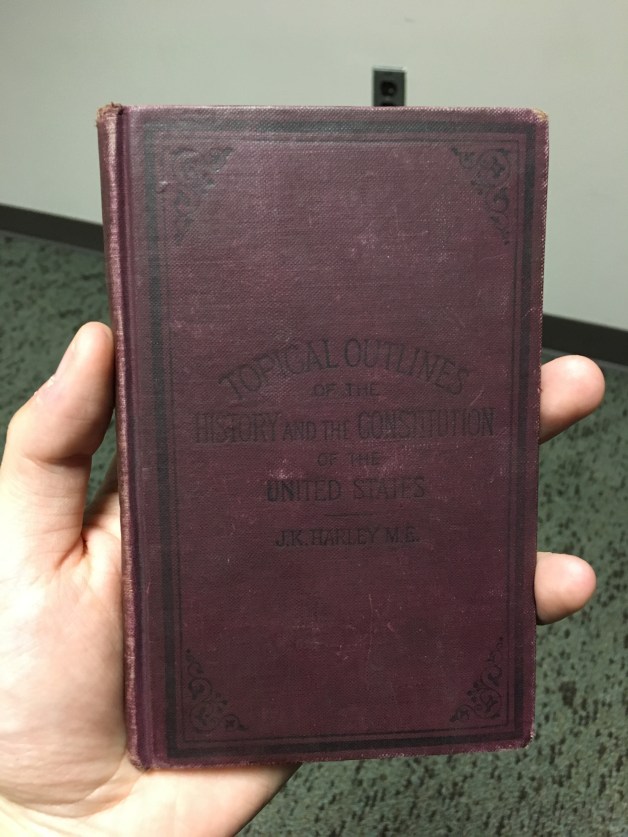
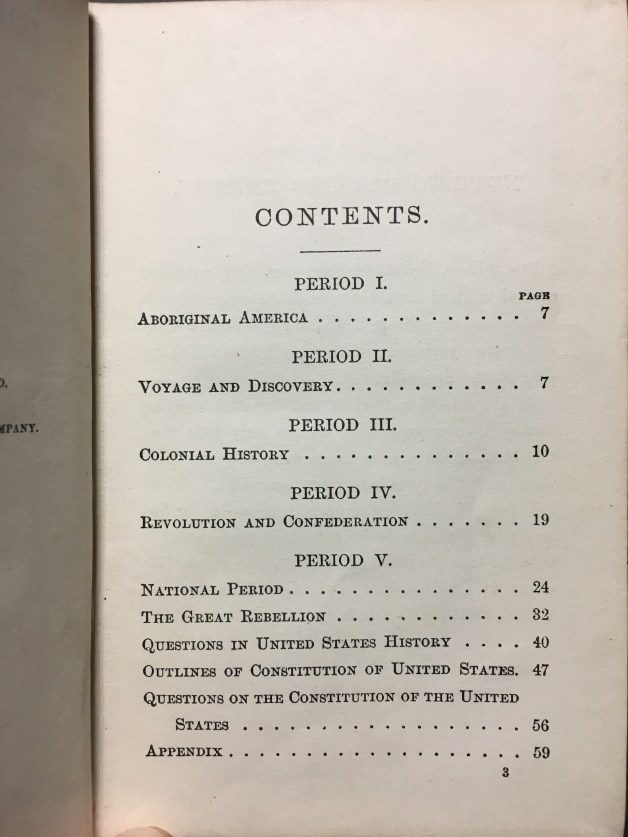
For this post I am going to discuss an odd little book that I own—an 1894 US History and Constitution topical outline written by J.K. Harley. I say that it is odd because, well, it isn’t really a book, even though it is technically a book, as it has a cover, back cover, and pages in between: but it is not a book insofar as a book presents information about the aspects of some subject or range of subjects; this one, rather, presents the aspects themselves. The book contains everything that there is to know about the history of the United States and its constitution, but tells the reader nothing about any of these things; and, in my opinion, it is this characteristic which makes the book so interesting. Never before have I encountered a book that is so immensely lacking in immediate discussion, but is, at the same time, so incredibly useful.

Imagine yourself as a poor young adult in America in the year 1900. You intend to become a teacher someday, and thus wish to undertake a full study of US history, but you cannot afford university. You go to the city library, and, after some searching, come face to face with a shelf about eight feet high and fifteen feet wide, filled completely with books about the history of the United States, hundreds and hundreds of them; and behind this shelf are ten more just like it. Where do you start? Intimidated, you pick one off of the shelf, open it, start reading, and the author is rambling about some random subject that literally couldn’t confuse you any more than it does. You have no internet to turn to for guidance, and the librarian may not have the slightest knowledge about US history; perhaps you could find a professor or scholar at a nearby university to point you in the right direction, but this is still an arduous route to take. Enter this topical outline, published in 1894, inside of which is delineated every single relevant term, historical event, important person, etc., that you could possibly need to know about in studying the history of the country and its constitution. This little book, not even 50 pages long, and not containing a single sentence of elaboration or detail, will now become the centerpiece of your study. It tells you exactly which random historical happening you need to look for on that packed shelf, and places it in the context of other events and pieces of information in a highly structured fashion.img_4395

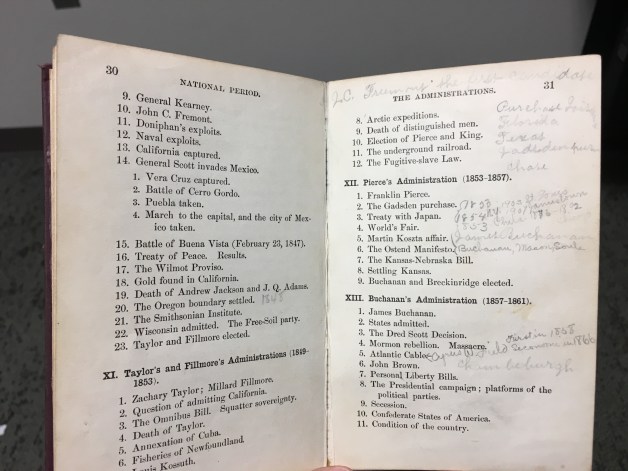
img_4394img_4396img_4397On to the history of this book. I purchased it for a dollar at a massive book sale at our campus library last semester; before it was there, it had been in the possession of the Gardiner Library, as far as I am aware. I am pretty sure that Gardiner may have collected books from various local libraries for this sale. Before Gardiner had it, however, I have no idea, so we will need to jump back in time to find more information. It is likely that this book was owned by a single student (the handwriting is consistent throughout, which leads me to believe it was not owned by any other students). As can be seen in the above pictures, the book is littered with scribblings and notes and dates and such. However, at the beginning of the book, on the first page, is the name of a person, written in ornate script; what looks like the name of a place, perhaps a school; and a date below it—April 3rd, 1907. These names and the date are written differently and in much larger print than any other handwriting in the book, and their position at the front and the style in which they were written leads me to believe that this is the name of the owner, the place or school s/he lived or attended, and a date that, for some reason, was noteworthy to the owner; I will assume that this is correct, otherwise I won’t be able to proceed. So, 1907. A hundred and ten years ago. The owner of this book was to the Civil War as we are to Vietnam. The name is oddly written and a little hard to read, but I think it says “Otta S. Robley:”probably a female name. The place/school seems to read “Mapleton Depot,” but it is hard to make out. However, if my reading is correct, then it is possible that this Otta girl lived in Mapleton, PA, about five hours away.
Anyway, so Otta seems to have owned this book for a while, and given serious attention to it, as her writing is scattered all throughout the book (except, I may add, in the section dealing with the constitution; I guess she wasn’t interested). Now, having established the probable original owner of the book, and knowing the last few stops that it has made on its long journey, I think the most likely scenario is that, after Otta stopped using it, she kept it somewhere in her house – attic or basement along with other old school stuff, maybe – and, eventually, she either decided to clean house and donated the book to the local Mapleton Library, or she might never have done so, dying with the book still tucked away somewhere. Maybe her children or spouse or some other relative donated it after she died when they went through her stuff. As I said, this seems to me the most likely story of this book, but my speculation is by no means whatsoever authoritative. If I am right, however, then it is potentially possible that Mapleton was one of the libraries that contributed to the book sale on campus. I will talk to some of the library faculty and see if I can find out any more information.

Dagger

I would like to answer this week’s assignment with an exploration of an antique military dagger that my parents own. I do not have access to it now, unfortunately, so I cannot provide any pictures. The dagger blade is about 8 or 9 inches long and resides within a sheath—both are a dark steely grey color. The sheath is decorative, which keeps with the overall theme of the object. Inscribed on the blade, near the base, is a name: Trota, if I remember correctly. The handle is royal looking, even sporting golden tassels, which, in a combat setting, would serve only to hinder the draw and wield, so it is likely that this dagger belonged to an officer—likely one high ranking and far enough removed from the melee environment to sacrifice some functionality in return for aesthetic appeal. On the center of the handle is an eagle symbol, wings outstretched, and beneath the eagle is a swastika. Did I forget to mention that it’s a Nazi dagger? Anyway, moving on.

The dagger was likely manufactured in Germany in the 1930’s or early 40’s, and would have been one of many issued to Nazi officers throughout the war. Also likely, is that the original owner of this particular dagger was, indeed, the man whose name is inscribed on the blade: the aforementioned Trota. The engraving does not look like one done by an amateur, so my guess is that it was done by supply command before it was issued to Trota. I know nothing of this man besides that he is a deceased Nazi officer; even though, as far as ownership goes, my parents are only twice removed from him. As far as I am aware, the dagger was taken from Germany by my grandfather at the end of the war: I do not know any nitty-gritty specifics, but I imagine it is more likely that the dagger was picked out from amongst other seized personal effects, than that it was taken directly by my grandfather from the late Trota.

Regardless, the dagger has been on quite a journey: It was born in a factory in Germany, furnished to the Nazis, hung on Trota’s hip, sat in on God knows how many events and secret meetings—and probably frequented many a Nazi officer’s club; it was then taken into American possession, stowed away in my grandfather’s Alice pack, shipped across the Atlantic, to then reside in my grandfather’s house for decade, after decade, after decade; and then, finally, was given to my parents. After all this time, the dagger – probably manufactured for a few reichsmark worth of materials – has accrued a value of approximately $1400. What was first designed, technically, to kill men, was likely never used for such purposes, instead decorating the belt of some Nazi officer; further, this same object witnessed the fall of – as Miller would say – the big beautiful fascist whole of which it was an infinitesimally minute part, then traveled thousands of miles across the world in the hands of its owner’s enemy, eventually winding up in a house in New York, only to be written about in a blog by someone its original owner would have happily used it to kill.

A Hapless Gator

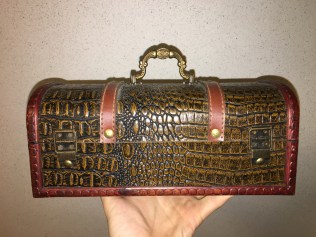
For this blog post I will discuss and describe an antique box that I own. Let me preface this by saying that this box, despite my having owned it for several years, is still quite an enigma: I know little more about it now than I did when I procured it. Speaking of which—I did not obtain this box by any conventional means: it had been abandoned by its previous owner and, for some unknown reason, was neglected by many different and unconnected people who had the opportunity to take possession of it. Nevertheless, I seized the opportunity when it arose, and here we are. Anyway, all I know about the box is that it sports an alligator skin exterior and is wooden—and seemingly old. Not exactly a gold mine of information. There is nothing – no company or personal name – inscribed or printed anywhere on the box. As a result of this lack of search criteria, the best I was able to do was to find some obscure online Chinese antique seller who had boxes that were similar to mine; so, I suppose mine may be of Chinese style or origin, but who knows. As for its value, again, I do not know. I once took it to a pawn broker along with some other objects, and, upon seeing that I was probably ignorant of its value, he quickly offered me twenty dollars for the box, ignoring everything else I had with me—so I figure that it’s worth maybe fifty to eighty bucks, depending on how bad the pawn guy was trying to screw me. Regardless, I declined his offer and have no plans to sell it.

img_4312img_4313img_4314img_4317

Over the years – in addition to its unwavering role as a decorative conversation piece – the box has served a couple purposes: first it held cables for various devices, now it sits on my desk and holds miscellaneous objects; I should probably think of a better use. Anyway, on to its description. Firstly – from a frontal perspective – the measurements of the box are 12” wide, 7” front to back, and about 6” tall, excluding consideration of the handle. As mentioned previously, the box is wooden – cedar, perhaps? – and is outfitted with alligator skin. Additionally, it is fitted with straps made of leather, which, I presume, lend support to the structure and prevent the skin of the murdered alligator from lifting off of the wood. The straps are riveted to the box quite effectively; it is evident that the box was made by hand—and rather expertly, at that. The trimmings seem to be wood, and are affixed to the box with very small nails. At the front of the box is a screw mounted latch with a swivel mechanism that I am very much a fan of: it allows for swift unlocking, but, when locked, keeps the box firmly closed. On the reverse of the box are two metal hinges, each fixed in place with four Philips head screws and a single rivet.

The top of the box is fitted with a metal handle, the bases of which are attached to the box with a total of four Philips head screws. I do not know which type of metal the handle is made of, but my guess would be brass. The style of the handle is rather ornate, and at its focal point is what appears to be – at first glance – a star with eight points; however, if you’ll allow me a moment of wild speculation, I think that this “star” is no star at all. Now, we’ve already established the somewhat remote possibility that the box – at least as far as its style goes – is of Eastern, particularly Chinese origin; and, upon closer inspection, it appears to me that the “star” looks more like a flower. In the Buddhist religion (as well as in other Eastern religions), the Padma (lotus flower) is a very important symbol. The lotus is an aquatic flower which often grows in swampy, muddy waters; however, the flower itself is divinely beautiful, and the vulgar murk and mud of its birth never adheres to its petals, and this effects a striking and symbolic contrast between the gorgeous brilliance of the flower and the aesthetic dearth which surrounds it. As a result of this peculiar nature, the Padma has come to represent purity of being and freedom from attachment to the world, and the unfolding of its petals symbolizes the expansion of the soul toward enlightenment. In Buddhism, the lotus is often depicted with eight petals, each corresponding to a step in the eight-fold path to enlightenment. It is my conviction – despite how incorrect it very well may be – that the “star” symbol present on the handle of my box is, indeed, a Buddhist lotus flower. Compare below:

The Shogun

I’m going to write about the living environment of one of my roommates, Shogo; hopefully he wouldn’t mind. I live in a Lenape suite, so I have another roommate as well. The latter roommate is very similar to me in a lot of ways: we grew up in similar settings, have similar ideas about things, and live within object environments of similar magnitude. Even though we try to limit the amount of objects that we bring up to college with us, it never works out, and we always end up with more crap than we wished to bring. Our spaces begin neat and then slowly degrade, and after a little while we get tired of the encroaching chaos and clean up—this repeating inexorably. Shogo, on the other hand – though he has slowly adopted some of our living practices – still differs greatly. He is an international student from Japan (and yes, his name derives from the feudal position of Shogun). As a result of this, he was constrained to severely limit the objects that he brought with him, and this has led to his space being populated by the things that are most important to him and most integral to his functioning and happiness.

A little more background on Shogo. Firstly, his work ethic is impeccable: he is awake every morning by 7:30, regardless of whether or not he has class; and, once awake, he immediately gets on his laptop – his portal to the realm of incessant scholastic exertion – and starts getting stuff done—sometimes even before he is fully awake. The stuff on his desk is (almost) exclusively school work related, and it can sometimes seem like he is working perpetually, merely suffering to take food, sleep, and friend/fun breaks; while my other roommate and I seem to do, perhaps, the opposite. Secondly, he’s a stylish dude. His wardrobe is one of the object networks that is most important to him. In the past, when I’ve commented on his dope ass style, he has claimed that it’s a Japanese thing: apparently in Japan his sense of style is average, and we think he looks good because Americans, in general, are lacking in the style sense department. I was going to argue with him on this point, but a quick glance in the mirror disarmed me. Anyway, as I was saying, his wardrobe is important to him. All three of us are moving off campus next semester, and though Shogo is by no means whatsoever a picky person, when we were looking at apartments it was obvious that closet space was a significant selling point with him—even more so than personal space itself. He didn’t care too much about the size of the room he would be living in, just as long as it had a decent closet to house his superior threads. I mean, don’t get me wrong, I love nice clothes—and when it comes to suit attire I’ll give the Shogun a run for his money; but as far as the remaining clothing categories go, I suppose I am indeed afflicted by American stylistic inferiority. Oh well.

Our objects – just by our being related to them – reveal an incredible wealth of information about us as people. As seen in Miller’s The Comfort of Things, the information broadcast into the world by our objects is often so substantial that, with careful consideration, it becomes possible to paint a portrait of us based almost entirely on information discerned from our relationships with objects.

Having come to know Shogo pretty well now, I think the objects that are important to him speak very much about him as a person. His wardrobe, the centerpiece of his palace, displays a taste that fits his kind personality, intelligence, and strong character beautifully. Shogo is also one of the most hardworking people that I know. His laptop is one of his most used objects – perhaps even rivaling his phone – and its screen is nearly always filled with something school related; he even leaves it open with the screen on when he leaves the room, as if he wouldn’t be able to return to the task he was working on if he were to shut the lid.

Joy Test Report; Discussion of Object Relationships

img_4255

Before. Sorry for the crappy lighting

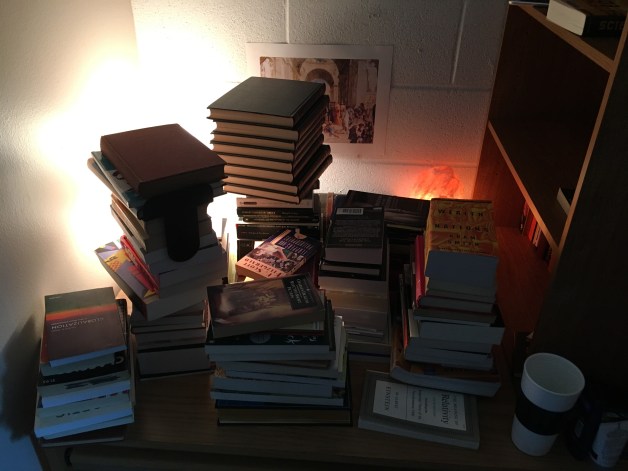
Like many other students, I decided to use KonMari’s joy test on my books. I removed all books from the three tier shelf on my desk, gathered the stacks in the other room, and piled everything on my desk: in total, they numbered about one hundred and fifty volumes. Now, as there was never any possibility that I was going to dispose of any of them, my only purpose in this exercise was to isolate that specific group of books which I would like to keep on the shelf that I stare at every day­­—as KonMari would say, those which gave me a “tokimeki” (props to my Japanese roommate for knowing the word for “spark of joy”) and move all others to a different location. I broke this down further, dividing tokimeki books into four categories: principal characters—this includes volumes that I engage with very often, such as Cooper’s edition of the Platonic corpus, a collection of Jung’s writings, Shakespeare’s Sonnets, and perhaps a dozen or so others; auxiliary characters—this being the largest category, incorporating all books that I engage with often to semi-often, and which round out the different sections of my library; present engagements—i.e. books that I am currently reading, but which may not necessarily be returned to regularly once I have finished them; and, lastly, books that are in semi-dormancy—i.e. books that I am reading, but at super-snail pace, sometimes with weeks between readings. Books that fit any of these categories were maintained on my shelf; all others were relegated to stacks in another room.

img_4256

After

The process of filtering out books that gave no tokimeki was somewhat familiar, as I had unconsciously used similar techniques in the past; but employing KonMari’s method consciously was interesting nonetheless. I will say, however, that, while books are certainly objects, I disagree with KonMari’s seemingly commonplace characterization of them: I think that books are particularly peculiar objects with which we form equally peculiar relationships. I will now attempt to explain what I mean by this in a long, drawn out, painful fashion:

No relationship that a person may have with any object is static: this would require that both parties to the relationship remain entirely static, which ­– considering that one party is living – is impossible. All objects that we acquire ­– or meet somewhere – begin either as strangers (when we have no familiarity with the object itself or with its essential characteristics), or from some level of familiarity: say, perhaps, that a person has never encountered pen X before, but is familiar with pens in a general sense: thus, pen X is not entirely foreign to the person. This external general familiarity is automatically imported to the relationship that the person forms with the specific pen X. From here there are, again, two options: first, the person may never encounter pen X again—this would seem to indicate that the relationship with pen X would remain static – in limbo, so to speak – but, in reality, the relationship on the human side will alter and degrade with time as the person changes and as the characteristics of pen X are slowly forgotten; second, the person may re-encounter pen X—it may be generally stated that the person who encounters pen X again will encounter it n times, n being the number of instances in which the pen is encountered before the person never sees it again. Now, each time that pen X is encountered, the relationship (insofar as it is dependent on the ever-dynamic human system) will update to integrate the circumstances of the newest instance. For the vast majority of objects, each update is minuscule, with the change between some instances even approaching negligibility (some updates, of course, may be significant, but this is uncommon and is more dependent on typically unpredictable external happenings involving both us and the object, than on the interaction based evolution of our relationship with the object itself); but, nevertheless, the relationship will not remain static—we may notice changes in the way that we feel about an object when considered over medium to long time frames. However, there is, of course, a minority of objects which do not correspond with the characterization that I just explained: these include, for example, computers and books/documents. Objects such as these are still objects, but our relationships with them have the potential to change far more rapidly than can our relationships with objects such as pen X. Why is this?

Here I will illustrate by considering an arbitrary relationship between a person and a book. First comes initial contact: the person is drawn to the book, perhaps because s/he has heard of it, or of the author, or is merely interested in the topic (the other option is that the person encounters a book about which nothing is known, but I will not consider this option here); let us say, for simplicity, that there is nothing printed on this book except for its title and author, so this is all that is readily discernible about the book without opening it. The person buys the book, brings it home, and it is placed onto a shelf where it resides for some time. As long as the person sees or touches the book, but does not read from it (and hears nothing regarding the content of the book from external sources), the relationship will proceed as would a relationship with a typical object—that is, at an almost negligible rate; however, once the person begins to read, the course of the relationship is altered drastically. From thereon out, the book becomes a medium for a relationship between the reader and the thought and feeling of the person who wrote it; but the information that is gleaned from the text by the reader also becomes inextricably related to the object that is the book itself: thus, each time the book is read from, the relationship that the person has with the book is updated, and these updates have the potential to be quite significant in comparison with the updates discussed for typical objects: perhaps this is why relationships that people have with books can become so intense. Further, information that we learn in a setting entirely removed from the book may also, upon a later reading of the book, give new meaning to text within the book that we did not initially recognize as significant: thus allowing for an even greater alteration of our relationship with the thought of the author and with the object that is the book.

So, even though books are technically objects, the relationships that we form with them seem to occupy some finely integrated grey area between an object relationship and a personal relationship—something that cannot be said of pen X. It is for this reason that I call books peculiar objects.