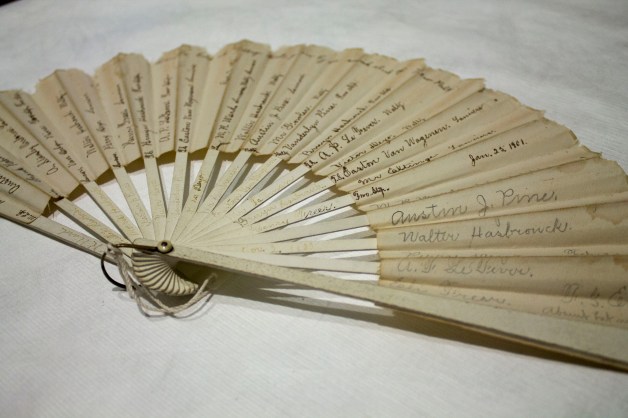
Here is a hand fan showing all the signatures from various men that signed during the dances. Some of the repeat names are interesting in that it shows a probably acquaintance or friendship with our mystery woman.
The hand fan seen above dates back to around 1901/1902, based on the dates inscribed in pen and pencil beside the names. It is made of wooden sticks stacked on top of each other and fastened with a metal rod, loose enough so that they can fan out and spread out the papery material attached to the wooden sticks—which look like longer, thinner popsicle sticks but are probably much more classy. On each “web” and stick of the fan are written names on the paper of various men who attended Village Hall dances in 1901 and 1902. Some names are written on the wooden sticks above the paper. On the rounded edge of the fan, it says: “Dances held at the Village Hall, given by the social club of New Paltz.”
While the fan originally came from New Paltz, it somehow found it’s way to Wooster, Ohio. It was then donated back to Historic Huguenot Street by Cecil Leslie in 2010, who found it in his possession (Graham). Unfortunately, we do not know the name of the woman who owned this fan, b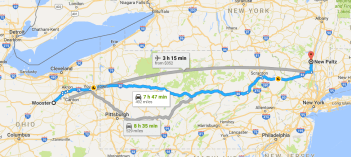 ut the names that adorn it are more than ordinary. Some of the wealthiest, most famous names of historic New Paltz are written here; the last names Hasbrouck, Deyo, Lefevre, and Elting, among others, are a marker of this fan’s importance and its role in history.

When our unnamed woman entered the Village Hall of New Paltz in 1901, she would have brought with her this fan. The building into which she entered, now the Goodwill Church, formerly Barnaby’s Steakhouse, acted as a meeting place for New Paltz’s society in the early 1900’s.
The building itself is a physical manifestation of the history of New Paltz; one can see just by the various manifestations of its space all the evolution of New Paltz that has happened over the last 116 years. Yet what it interesting about this object is not the building that it is tied to, but the essences of the people who touched it that it preserves.
This hand fan was used by a nameless woman from 1901-1902. Over a hundred years old, we will probably never know the name of the woman that carried it. What we do know, however, is that this fan was used to mediate a courtship dancing ritual. To make sure every women who attended these dance parties at the Village Hall had a partner, they would use these fans. The woman would allow the man to inscribe his name on the fan, plus the type of dance, and sometimes the date they danced. When asked to dance, if she wanted to accept she touched the fan to her right cheek. One can imagine in these rituals (where just a simple “yes, thank you” would do) a kind of elaborately Pride-and-Prejudice-esque ball (the 2005 version).
Unfortunately, our Elizabeth is lost to us forever. What we do have is our Darcys—though perhaps some of them were Mr. Collinses. Among the names on the fan are some of New Paltz’s famous gentlemen: Walter, Morris, and Bruyn Hasbrouck, A.P. Lefevre, Victor Deyo, Mr. Eltin, Phillip Dubois, and Pierre Deyo. These names populate the streets and buildings of New Paltz, our version here of royalty. Among these is Easton von Wagernen, who would not be quite old enough at this time to have served, but whose father by the same name served in the Civil War for the Union. Many of these names appear multiple times, indicating a close relationship with some of these men, a family connection, or perhaps even indicating that our woman had a stalker or two. The exact connections are hard—perhaps impossible—to parse out; the probability that the fan belongs to one of their wives is high.
It is ironic at best, indicative of women’s lives at worse, that the artifact of a woman survives, yet she continues on in memory nameless. What survives are the man that led her around the ballroom. She held this fan throughout 49 dances, but we know nothing about her except that she liked to dance.
We do know, however, that this is not an isolated object; this particular fan comes from a long tradition, dating back to Egypt, 4,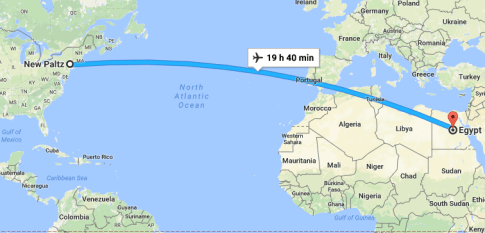 000 years ago (“A Brief History”). Hand fans have been used for many different purposes, a sort of multi-use tool for women across ages and cultures. It seems to be one of the most ubiquitous female objects in the world, and yet I’m sure even the innate feminine quality of the fan could be questioned, made more complex.
The origin of the fan is Eastern, becoming a European trade good around the sixteenth century (“A Brief History”). Of course, because of the exotic nature of the object, the fan was considered a marker of class status, as well as monetary wealth. As many “exotic” objects were, the fan was appropriated into the European lifestyle. However, it became so common throughout history that there are only faint signs in today’s culture that point back to its origins, the movie Mulan being one of them. Dance fans in particular came with a hook that attached to the woman’s dress and also was able to hold a pencil, so that the man had everything he needed to sign and dance: the woman, the fan, and the pencil (“A Brief History”).
This particular fan is somewhat a mystery to us, and will always be that way. It is unlikely anyone will be able to figure out who which woman the fan belonged to without major detective work. But we do know some other, maybe just as important things. One, that New Paltz in the early 1900s was very fashionable. Given that fans were generally a sign of status and money. We know for sure that these dances were fashionable; the remnants of the families who attended still linger in New Paltz today on street signs and building names. This object, above us, is a reminder that even in 1901, people in New Paltz were still having fun and dancing. Perhaps it is a reminder to us that we should never stop dancing, or forget how to.
Works Cited
Graham, Katie. “Dancing Queen.” Object of the Week. Historic Huguenot Street, 6 Aug. 2014, https://hhscollections.wordpress.com/2014/08/06/dancing-queen/. Accessed 15 May 2017.
“Online History – A Brief History of the Hand Fan.” Purdue University, https://web.ics.purdue.edu/~salvo/@SEA/exhibit/history.asp#nogo. Accessed 15 May 2017.




 The Materials of History, Thought, and Art