Experience with a Quiet De Luxe Typewriter

It’s strange to think that for over one-hundred years—from the late 1860s to the 1970s—typewriters were the fastest, most efficient way to write. The invention of the QWERTY keyboard and conversion of printing press technologies into a single machine eliminated the need for legible handwriting and allowed for an entire letter to be written with one push. Yet, the sudden decline in usage after the invention of computer typing makes the typewriter seem like an ancient technology to us today. I’ve always found this rapid decline in the technology’s use interesting, after all it is not like handwriting has gone out of style. There are a few obvious reasons for why computers so easily eclipsed typewriters, but I wanted to try one for myself to get a real feel for the differences. 
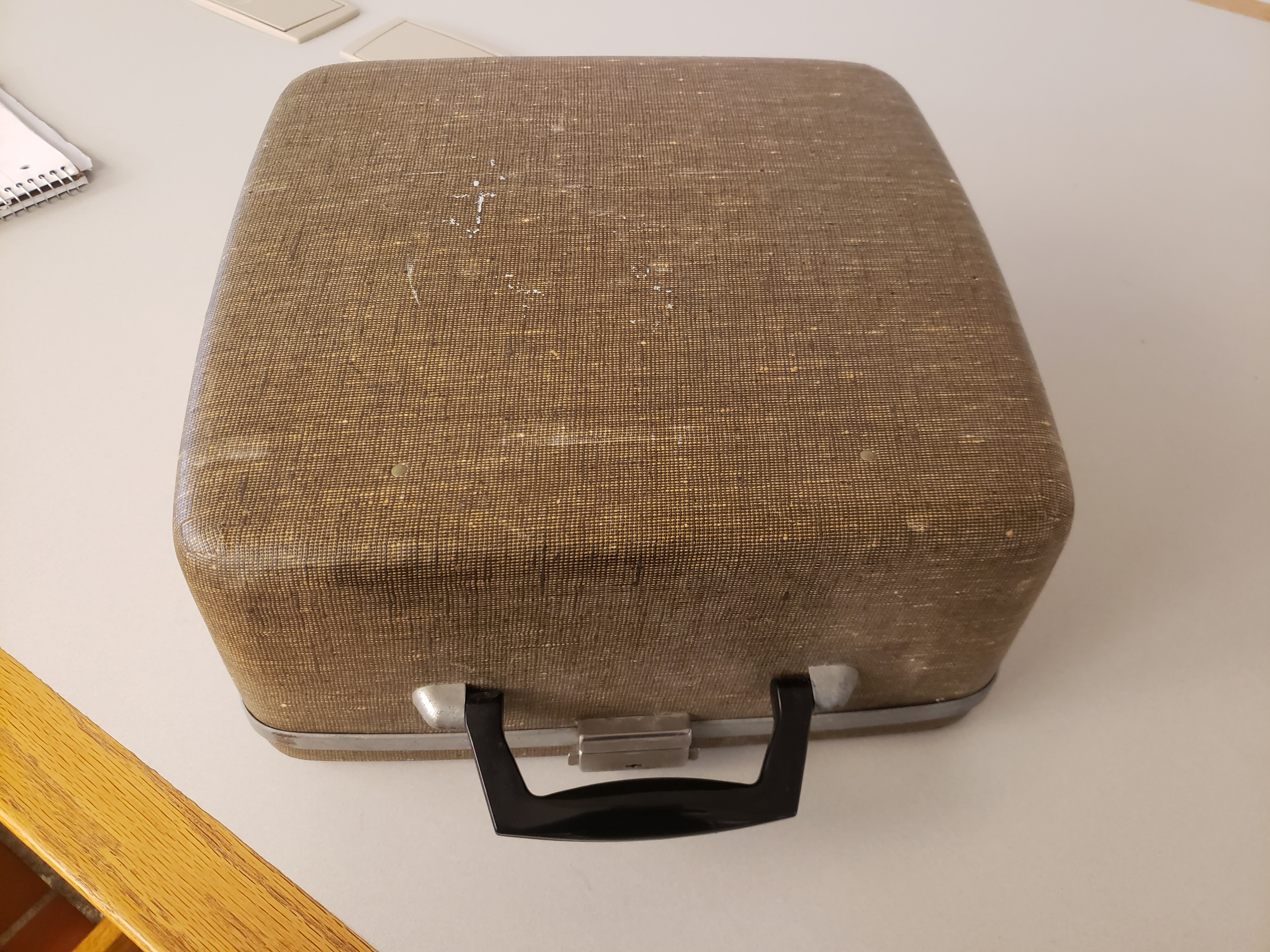
To this end I tested out the Quiet De Luxe typewriter in the Honors Center. The very first thing I noticed about it was its case. The actual machine is ensconced in a hard plastic case with trimmed metal edges. A rather unintuitive latch holds the case closed for transportation. Once unlatched, the case fall opens with a satisfying weight. Contained within the sturdy frame are four rows and thirteen columns of splayed out keys connected to a semicircle of metal tines. A vast collection of carved symbols sit on the end of each rod, each one ready to be inked after long years of disuse. The cool mint color of the body gives the apparatus a gentle charm, the perfect color to envelope one’s vision while writing a heartfelt letter or a lovesick poem. 

As I moved closer to touch the keyboard, I was struck the nostalgic smell of musty old books. My fingers stretched out to cover the plastic of the keys and found them to be slightly cool to the touch. I pressed down. The corresponding metal limb rose up just above it’s peers, nowhere near high enough to hit the black cylinder at the back of device. I pushed harder, forcing the tine up and into place. To quick, I went to press another key and the two limbs collided as they tried to force their way past one another. I let go of both and they sunk back into place. I tried typing again as if I were using it for real. I pretend to write out something like “this is harder than I thought.” The writing was awkward, clunky, slow. The completeness of a press needed to successfully input on the typewriter was so alien to hands use to touch typing on a computer keyboard. Certainly, today’s keyboards were a marked improvement on this design.
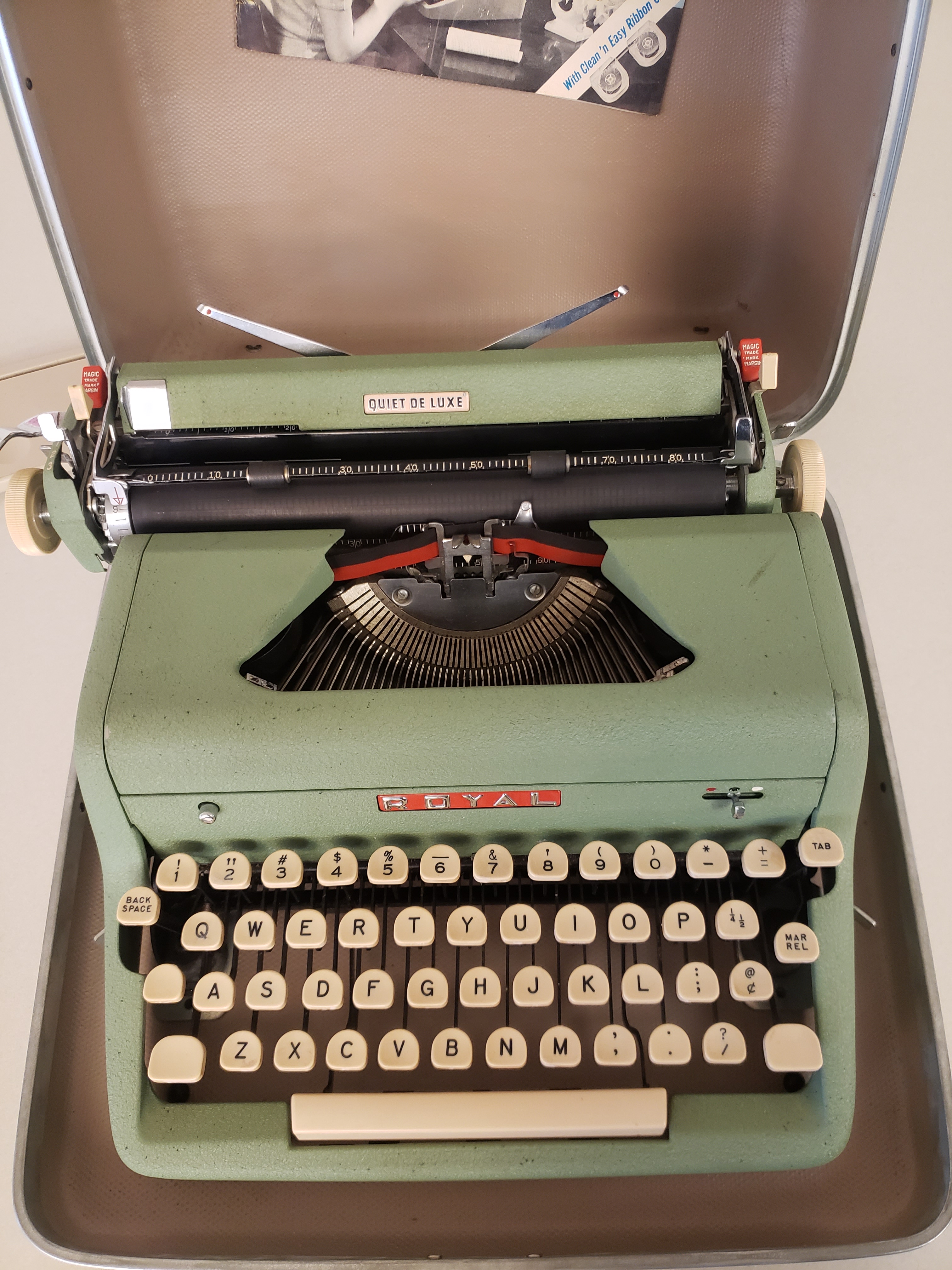
I sat back and jotted down my notes. Midway through critiquing the physical commitment that it took to get a single letter on the page, I realized that perhaps the difficulty was a feature not a bug. Probably the single biggest difference between typing on a computer and typing on a typewriter is that on a computer one can easily edit their work with zero consequence and therefore mispressed keys or hastily spelled words present no significant problem. A typewriter by contrast puts real ink on real paper and the errors must be overwritten in post. The deliberateness of pressing each key matches the deliberateness one needs to have when typing something that cannot easily be edited. The space bar especially has a delightful weighty pop to it. The wait of the key matches the weight of finishing a word that you hope is and will remain the correct one. 

Gripped to the ceiling of the case by a thin metal clamp is an advertisement for the Quiet De Luxe. The ad features an archetypical 50s housewife using the machine with the words “your new ROYAL portable” written next to them. This particular seems to be one of the many amenities that single income family households could afford after the war. The ad recalls memories of learning about the demotion of typewriting as an occupation once women were allowed into the profession. Once women were let into—or forced into—the workforce, most recording and secretary jobs were given to them and such occupations receive a sharp decrease in pay and prestige. 

After attempting to use this older technology, I am extremely grateful for what we have today. As someone who needs to see a sentence written out on paper to determine its quality and edits constantly, I would waste trees worth of paper for each page trying to come up with a way to express my thoughts. At the same time, being in front of a typewriter is several leagues less distracting than being in front of a screen that can display the bottomless multitudes of the internet with a single click. As someone who is easily in these vast digital caverns, I might try to actually write something on a typewriter one of these day. Maybe I’d even finish that book…

Tea & Tea Chests in the 18th Century

Much can be learned about a piece of history from listed accounts of possessions of people, both as individuals and as members of a society. I transcribed part of  “The Estate Inventory of Corenlius Dubois, 1816”. While transcribing, I found on the second page—buried in a list of kegs, tubs, and casks of various meats—that Cornelius Dubois Jr. owned a tea chest worth about twelve pounds. Tea, of course, is an important part of the founding mythology of the United States and presence of such a chest sparked my curiosity. Tea now plays second fiddle to coffee in American culture, we hardly give consideration to it’s production or how it arrives to the supermarkets where we purchase it. However, during the life of Cornelius Dubois Jr. (1750-1816) the movement of tea from its sources to its customers in North America was a much more arduous process that made the cost of tea significantly higher than anything we would consider reasonable today. The fact that Cornelius Dubois Jr. had a chest to store such a luxury illustrates his position and relative wealth in the colonial Hudson Valley. 

Tea originates in Yunnan Region of Southern China and its first recorded use was as a medicinal herb during the Shang Dynasty. Tea became a substance of immense cultural significance throughout East Asia in the following centuries with various cultures creating rituals around the drink. In Japan the Tea Ceremony or Chadō has evolved its own specific aesthetic and practices over centuries that people spend their entire lives trying to perfect. The fixation of the herb likely stems from its health benefits as an immune system booster which in combination with boiled water helped people recover from illness. 

The first Europeans to bring tea back to the West were Portuguese merchants and missionaries after they reached China in the 16th Century. Although throughout most of Europe tea never became nearly as popular as coffee it caught on in the British Isles and the demand for tea exploded. Due to China’s virtual monopoly on tea trade and production, the price to import it back to Europe was ruinously expensive. The price decreased gradually over the course of the century, as more Dutch and British merchants brought tea back from China. Even with this increase in trade, the drink remained a luxury because of China’s unwillingness to accept anything but silver spiecie in return for Chinese goods. Thus a search to break the Chinese monopoly was on. In the 1820s, as the British East India Company began to conquer India, they introduced the plant to the northwestern Assam region which proved to be the perfect climate for its mass production. Under British rule India became the largest producer of tea in world, much of which was exported very cheaply to Britain itself.

However, this development—which allowed even the British working class to easily afford tea—didn’t occur until several years after the death Cornelius Dubois. To me this is just further evidence of Dubois’s wealth as a pound of tea could be as expensive as twenty shillings. Perhaps, he was a lover of tea or simply displayed the tea chest as a symbol of his wealth and status within the New Paltz community. 

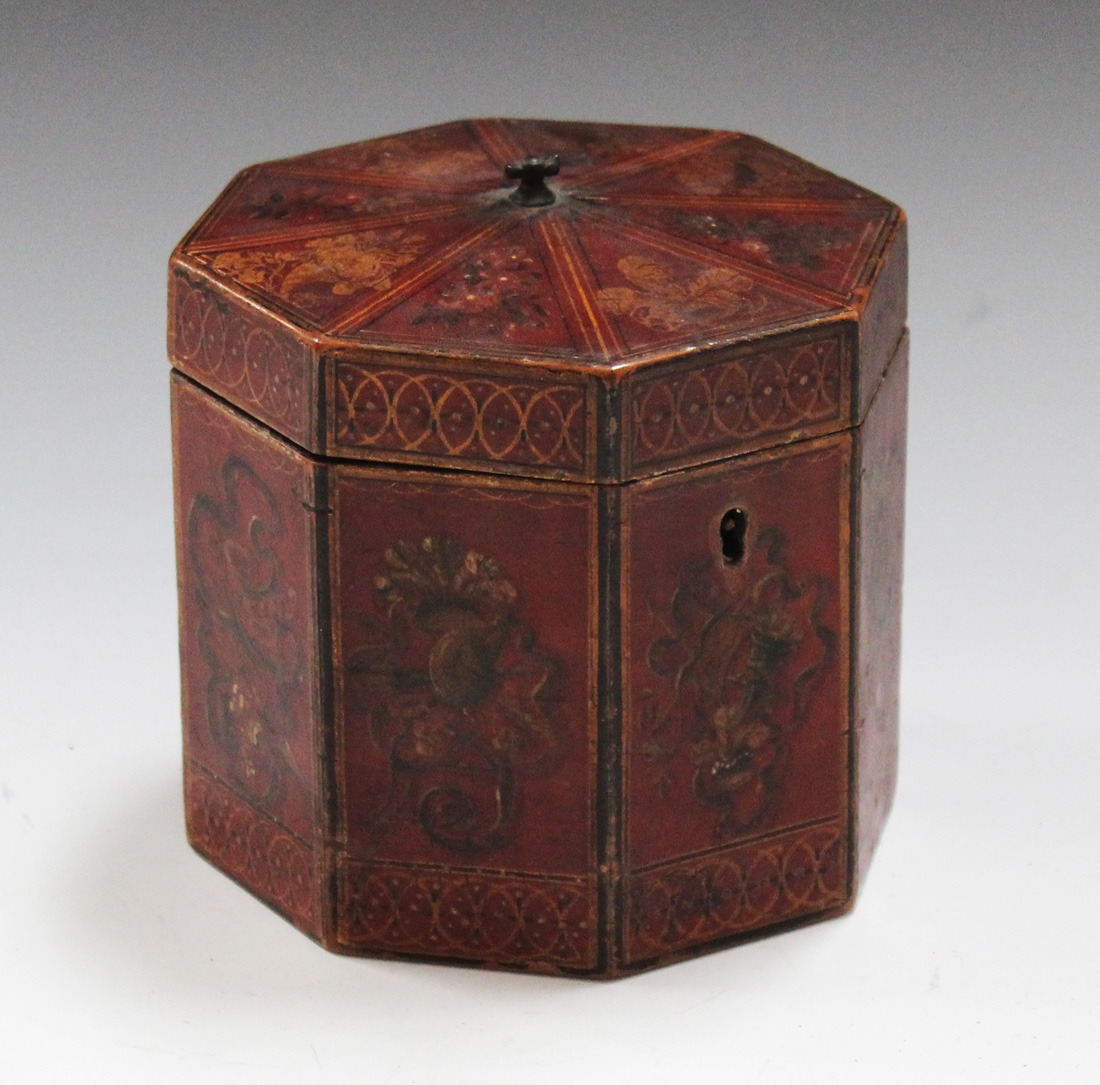
The tea chests themselves—much like tea—were initially imported from the East as well. Chinese tea chests or caddies were designed to hold approximately a pound of tea at a time. Though often made of wood, these caddies were sometimes made of pewter and even ivory or tortoise shell. The containers came in various shapes depending on their origin and typically had intricate designs fashioned from silver, brass, copper or gold. They could also come in a variety of shapes though the most common were rectangular and octagonal.

Fig. 3

However, the entry on the inventory reads “tea chest” instead of “tea caddy” inclining me to believe that Cornelius Dubois had a larger container more befitting of the title “chest”. Tea chests made in England began development soon after tea’s arrival. These containers tended to lack the opulence of the Eastern chests and were typically much larger than the caddies. Chests were frequently designed to be able to store multiple tea caddies that could in turn hold several different kinds of tea. Unfortunately, the design and detail of the box in question is unknown to us and could feasibly vary widely. Though Fig.3 and Fig.4 can give us an idea of how it might have looked. We do know however, that the chest itself was valued at twelve pounds, indicating it was likely on the nicer side of things. That and the fact that no tea caddies are listed in the inventory leads me to believe that Dubois’ chest was a small, but finely made piece for craftsmanship.

Fig. 4

The Lillians’ Ring

My Grandmother’s Engagement Ring, Scottsville VA, June 2018

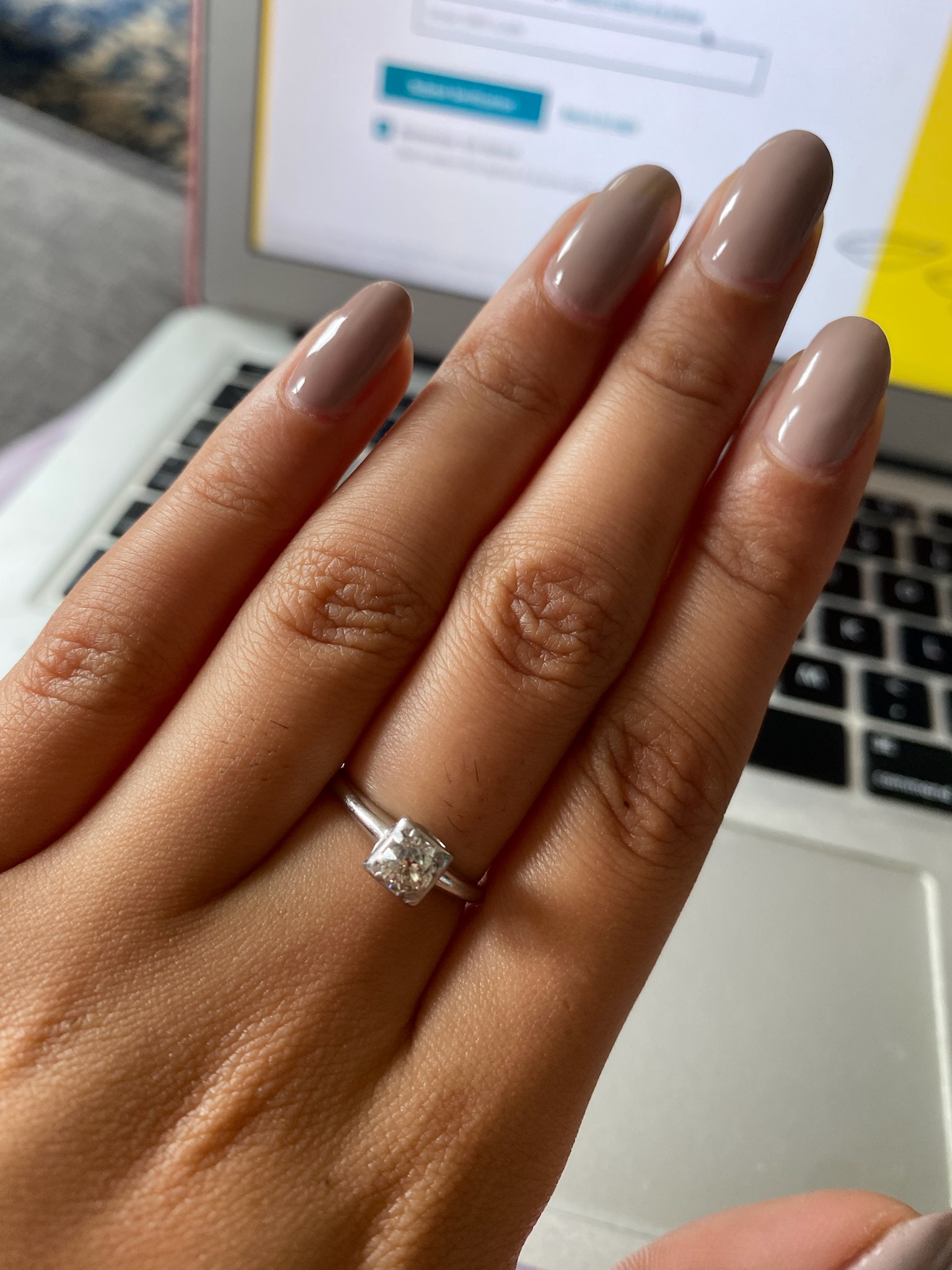
My sister has a ring. It’s not too old, only coming into our family in 1946, but an heirloom nonetheless. It was given to her a few months after she turned twenty by our great-grandmother at a family reunion. The gift giving was a moment of joy for some, a moment of jealousy for others, and it was also the last time I saw my father’s mother’s mother alive. 

My paternal grandmother has ten siblings, six of them sisters, all of whom have children and grandchildren of their own. So why, pray tell, out of all the options, all the daughters, grand-daughters and great-granddaughters, was the ring bestowed upon my sister? This silver band studded with a diamond suited perfectly to its size. It might have something to do with the fact that my grandmother is her oldest, my father my grandmother’s oldest and my sister my father’s. It could be that, a logical chain of primogeniture succession. It could be that, unlike many others, my sister had never shown any interest in possessing the ring, a ring central to the mythology of our paternal family. Perhaps. Or it could just be that out of all of my great-grandmother’s progeny, all of the many many grand-children and great-grandchildren, my sister was the only one named for her. The only other Lillian.

My Sister’s Hand, Boston MA, Sept.16th 2021 Circa 1:30PM

This state of affairs, that is the fact that only one person was named after a woman who had eleven children, is particularly egregious once you take into account that almost every firstborn son in the family has Eugene as either their first or middle name, including my father. Eugene being the name of her husband and my great-grandfather. It’s really quite sad to think how utterly surprised she was when my mother and father told her that their first child would be named after her. So, of course, my sister got the ring. From one Lillian to another. An unassailably sensible decision. But how did the elder Lillian come to have it in the first place? 

We go back to the end of WWII and Operation Magic Carpet. It’s January 1946 and Gene Hamshar is getting off a ship in his hometown of NYC. He’s been away for years, seen hell, fought from the shores of Normandy, to the Hürtgen Forest, to the Baltic. He saw friend’s die in the Battle of Bulge, only surviving himself with the help of some Belgian women who dutifully changed their flags from German to British back to German several times a week. And after all that he was back and nothing had changed. Well nothing besides the fact that he now had a low-interest mortgage and an addiction to liquor. 

Something that had certainly not changed throughout his time at war, was what the first thing he was going to do when he got back. Though he had promised to go straight home as soon as he got back to American. Instead, Gene elected, as his first action back in the U.S., to go to a pawnshop. I couldn’t tell you the name of the place or how long he stayed there or even how many different shops he visited. I can tell you that by the time he walked up the steps of the Hamshar home in Queens, he had a diamond ring burning a hole in his pocket. And standing before him was the beautiful woman he wanted to put it on.

The woman at hand was Lillian Herndon. Lillian was not a city girl. Nor did she ever expect to even see a city much bigger than Charlottesville. But here she was in New York staring down at the man she met all those years ago, before the war took him over to Europe. The two had met when he was in her home town of Scottsville, Fluvanna County, Virginia. One of those tiny Mid-Atlantic towns in a empty county with soil still badly damaged from generations of tobacco planting. The town, village really, was exceptionally quiet Lillian’s whole life. Until one day it was flooded with young men from FDR’s Civilian Conservation Corps (CCC). Eugene Hamshar was one of these young men.

Lillian Herndon and Eugene Hamshar, Queens NY, January 1946

After years apart and days spent waiting for him at his parent’s house, Lillian didn’t have it in her to wait a second longer. She rushed down the stairs, threw the door open and wrapped her arms around her Gene. And that’s when he asked her to marry him. Still in his uniform, he got down on one knee, beseeching her in that soft, polite voice of his, and without a second’s hesitation, she gleefully accepted. Having caught wind of what was happening outside, the Hamshar family joined the couple on the steps and officially and likely tearfully welcomed their only son back home. At some point, someone thought to commemorate the day with a photo. A photo now tucked safely away in their eldest daughter’s desk.

Eugene and Lillian were married on February 23, 1946 in Scottsville, VA. and the engagement ring was replaced by a golden wedding band. Safely retired to a mostly vacant jewelry box, the diamond studded loop of silver awaited an heir for the next seventy-two years. Only being brought out for annual resuscitations of the story that brought a truly prodigious family into being. A family that altogether now constitutes about a third of the Scottsville corner of Fluvanna County. Though, of course, that’s not exactly a whole lot of people.

My Aunt’s Black Stratocaster

When I was six years old, I gave up the guitar. Figured it wasn’t for me. I had played it for only a little over a year, most of which had been full of steady enjoyable progress and musical bliss. But, in the way of a mind working with a barely developed prefrontal cortex, one bad experience was enough to knock me off the proverbial horse. I won’t go into the details. Suffice it to say, I couldn’t handle the paternal pressure. Besides, i’ve never been good at sticking to one thing for an extended period of time and when I decide I’m done with something that decision is more or less set in stone. Or more accurately, deep within my synapses. 

So imagine my surprised when an black and white Stratocaster was forced into my hands by my Aunt Sarah and, at its touch, ten years of neurological connections were fried in an instant. She had had it since she was my age, sixteen, but somehow the guitar was pristine. Well not quite pristine, but at that point I wouldn’t have noticed the slight divots pressed into each nickel-silver fret. I plugged into one of the unused amps that were scattered around the house, took at least a minute to get my hands in the right position after a decade of inactivity, and strummed a single G chord. The sound tore through the hallways, reverberating of the walls and killing any remaining doubt about this sleek, six-stringed instrument.

I can’t say I’ve managed to keep the guitar in the same condition as my Aunt. The black laquer of its body is covered in fingerprints. The hand sized space between the bridge and the fretboard has an almost worrying accrual of dandriff. The plastic covering now grips the mother of pearl pickguard façade less like an infatuated lover and more like a mother trying to keep ahold of a wayward child. The strings, although I feel as if I changed them just yesterday are already staring to tense and fray. And most subtlety, but perhaps most demonstrative of my indulgent affection, is that those six divots in each fret on its long rosewood neck have deepened. 

You likely wouldn’t guess that the instrument is made almost entirely from wood, because the sheen of the black finish gives the material of the body the look and feel of some high quality poly-fiber plastic. Somehow its frame still maintains a certain softness to it that allows it to sit in my lap and be cradled by my hands for hours. Eventually, the guitar almost feels like a musical limb of my body as it fades into my hunched form. The neck is hard but smoothed and sanded so thoroughly that it also doesn’t feel much like wood.  

At the lower end of the fretboard, hiding under the strings are four rows of small metal nubs peaking out from the white pickguard form the guitars pickups. Some of those nubs are touched with dusty red rust. Further down the board we come to a bridge crowded with the saddles responsible for holding the strings at the correct high above the fretboard. They always look a bit desperate to me, shivering each time I strike a chord, as if they’ve taken on a job they can’t quite handle, but insist on preforming anyway.  

Moving up the board we can see that the strings eventually end. Tied up and threaded through the holes of little metal towers. The towers are arrayed in a diagonal line with the tower farthest from the guitar’s center holding the thinnest cord and the closest tower holding the thickest. A curious but necessary arrangement. Compared to the saddles opposite from them, the towers appear strong and stately. Calm and confident in their duties. 

Perhaps most important of all is the sound of the thing. When played by itself, the guitar seems meek, unsure. Good for playing sweet, though slightly flat, dewy morning tunes. But as soon as the amp cord slides into the output jack, the instrument gains the power to start a riot. Even with the settings at low on both guitar and amp the sound is more than enough to fill a room. And as the melodies rip through the air and flow from its body into mine, I can tell it’s chomping at the bit to fill something bigger, a building or even a stadium. A journey I fear I’m incapable of taking it on.