The Bigger the Better

Context and Research

In Thomas Okey’s An Introduction to the Art of Basket Making, he details the experience one would have weaving a basket, right down to the tools used and the names of each type of strand of material. To form the “butt” of the basket, the basket-maker would first create a cross with pairs of smaller pieces (Slath-rods), and proceeds to weave a longer piece over and under the crossed pieces. To keep it still, the basket-maker takes one of the slath-rods, “brings it tightly over to his right, and lays it alongside the two sticks under his right foot… (Okey, 25)” This process created the bottom of the basket.

…and as the basket-maker weaves upward, we see the piece come to life.
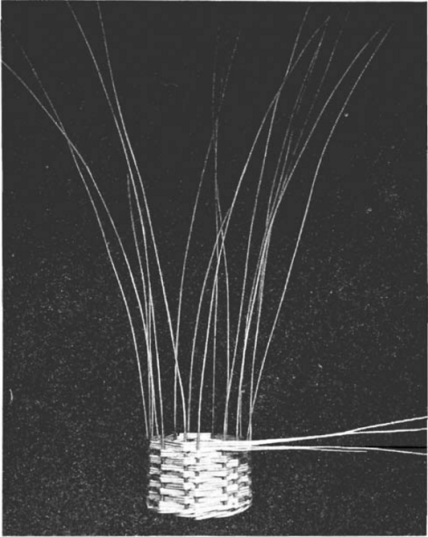
in progress example

An example of a basket in progress. Okey, 31


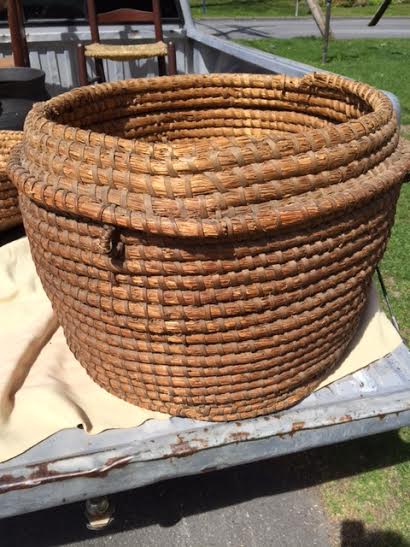
A lot of physical effort had to be put into basket making, using all parts of the body. My particular basket (pictured below) is huge, much wider than the example used by Okey. It is evident that a great effort must have been put into this creation by the particular basket-maker. Basket weaving has been one of the most common practices throughout human civilization. Instead of Glad tupperware containers like we have nowadays, people had baskets. They held everything from foods, to clothing, to seeds and crops, and were also used to transport goods. This enormous basket could have easily fit a relatively large toddler inside of it. It is rounded, composed of rawhide, reed, and is bound with straw. It is also tightly woven, with two small loops of either side, possibly to string some kind of strap through them. It now resides in the Jean Hasbrouck house, sitting flush against the wall of Joshiah Hasbrouck’s shop as part of the current interpretation of the room.
77301

Here it is, the big man. Photo courtesy of Ashley Trainor.

The family lore attached to this basket claims that it arrived in America with Louis DuBois in the 17th century, when the Huguenots originally fled religious persecution. In actuality, it is said to most likely be a 19th century basket. This is a period of 200 years that could separate fact from fiction. From the beginning, I knew I would have to do some mythbusting. After researching general material on Artstor, I’ve found that there are many more results for “19th century basket” than the term “17th century basket.” The first search also yields many similar looking artifacts: woven baskets, some of them enormous. Right off the bat, this makes me believe that the family lore is simply lore indeed. But, to add only more confusion, the basket was also mislabeled as a clothing basket upon its donation by Evelyn DuBois McLaury. The donation date is prior to 1990, however there is no exact date.

Still on my general ArtStor search, I found several sketches of cotton pickers. Pictured were slaves carrying enormous baskets full of cotton. After seeing those images, I immediately thought that this basket was used for farming. Since it is so large in size and so tightly woven it would make sense that it was used for storing freshly picked crops, specifically grain or seed. Since it is so tightly woven, it seems as if the person building it wanted nothing to fall out. If I were to go down the 19th century track, this would be the most plausible assumption.

Narrative

When fleeing to the new world in the late 17th century, this basket was brought by Louis DuBois in his escape from religious persecution. With them, the Huguenots brought the only things they knew: their families, their religion, and food. When settling on the banks of the Wallkill River, they constructed the notable stone houses that can be found on Historic Huguenot Street today. And inside are interpretations of their lives. This basket, being made of rawhide, this indicates that it is made of animal skin. Assuming the basket was made locally, it most likely would have been made of cow or sheep skin. Josiah Hasbrouck owned a country estate called Locust Lawn, located in present day Gardiner (“A Notion to Sew”). Crops grown there included rye, oats, corn, wheat, and apples. Animals owned were milk cows, chickens, beef cattle, and pigs, all of which were used completely to their full potential (“A Notion to Sew”). Photos collected in New Paltz Revisited indicate that a popular crop grown in New Paltz and surrounding areas were potatoes and other spuds (Johnson). Soil was rich in nutrients due to the establishment being along the banks of the Wallkill River. According to “New Paltz Town Records,” it states that once the town of New Paltz was founded, it “survived for the next two hundred years as an ‘isolated, conservative, tightly-knit farming community.’” Additionally, the Huguenots worked on a maintaining a healthy and prosperous relationship with the nearby Esopus Native Americans (Esopus Trails).

Throughout the Huguenot’s years establishing the town of New Paltz, they became an independent and self-sustaining community. Farming was the primary means of acquiring food. In addition to harvesting and maintain their own crops, there were also small shops set up, much like the one Josiah used in the preserved Jean Hasbrouck house, to sell goods, which was only the beginning of the exchange economy we have today.

Although I have absolutely no information on this basket’s creator, I can very well infer that it was made with the intention to be used in farming. The tightness of the winding and the sheer size of it indicates that it was used for something with harvesting crops: to gather as much as possible at one time, to store a large amount without fear of anything seeping into it, among countless other possibilities. Agriculture is a huge component of every early civilization’s way of life. It was what the Huguenots knew in France, and it was something they brought over to the Americas upon fleeing for life.

 Special thanks to Ashley Trainor and Carrie Allmendinger for all of their assistance!

Works Cited

“A Notion to Sew.” Hudson River Valley Heritage. N.p., 2 May 2008. Web. 28 Apr. 2017.

Esopus Trails: The History of Esopus Township. Ulster Park, NY: Maple Ridge School, Maple  Ridge Bruderhof, 2005. Print.

Johnson, Carol A. New Paltz Revisited. Charleston, SC: Arcadia Pub., 2010. Print.

“New Paltz Town Records (1677-1932).” Historic Huguenot Street. N.p., 27 June 2005. Web. 3 May 2017. <http://www.huguenotstreet.org/new-paltz-town-records/&gt;

Okey, Thomas. An Introduction to the Art of Basket Making. N.p.: n.p., n.d. Google Books. 13 Apr. 2013. Web. 2 May 2017.
 

A Voice in My Head, Not a Text on a Screen

For my analog project, I decided to call someone on the phone. It was still my cell phone, but there is a certain joy in hearing someone’s actual voice. I did this in two parts. I called my mother yesterday for only a brief 10 minutes, and today, I called my Nonna. The past few days were the type of days where everything seems to go wrong, and in combination with the crappy, cloudy weather, mother nature managed to make my days as gloomy as they could get. After calling my mom, I felt significantly better. We talked about as much as we could: how my classes were going, how that geology test went, how the show was coming along, and if I needed my parents to bring anything on Saturday when they visit. Although I only had this small amount of time between classes, I was grateful that I was able to speak with her because of the fact alone that she is my mom. Even when I’m supposed to be a grown up, independent college student, I can’t help but get homesick sometimes.

The second part of the project was calling my grandmother. When I’m at home, my Nonna lives about 40 minutes away from me, so it’s not the easiest trip. Unfortunately, I don’t get to see her very often, and it is especially hard when I am up here at school. My only way of communicating with her is through facetime if my mom or cousins are at her house, or through the telephone. So, this morning I decided to give her a call. She answered with a confused “hallo?” because my number comes up with a weird Caller ID that isn’t actually my own name (I don’t know why, this has happened since I got my first cell phone). I said it was me, Emily, and I could practically see her face light up in my mind when she said her signature, heavy Italian accented “OHHHHHHHHHHH, Emily!” and I could really feel how happy she was that I decided to call her out of the blue. She asked me where I was, what I was doing, and we talked about my upcoming plans of studying in Ireland for a few weeks this summer. I’m going to send her a postcard. The conversation lasted about 5 minutes only because I had to get ready for class, but it felt so good to hear her voice after such a long time.

I have never liked calling people on the phone with the exception of my parents. It’s just been one of my anxieties since I was very young, and I am still working on it. I decided to call people because not only would it test my ability to do so, but it also contributes to the practice of calling people. The practice will help ease my anxieties about the act of calling on the phone, and hopefully one day I will completely get over this irrational fear. But, today wasn’t that day.

This is a giant basket!!! (very rough draft)

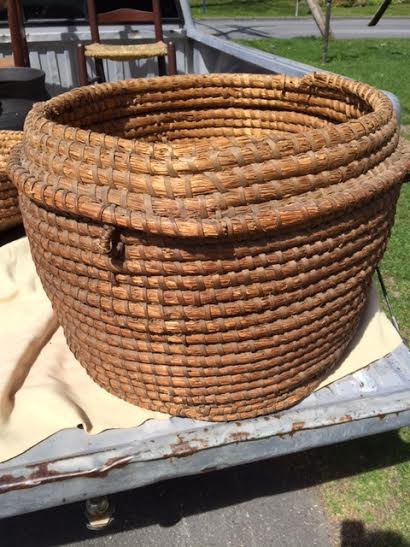
Basket weaving was one of the most common practices throughout early human civilization. Instead of Glad tupperware containers, people had baskets. They held everything from foods, to clothing, to seeds and crops, and were also used to transport goods. The item I have chosen is an enormous basket. It could probably fit a relatively large toddler inside of it. It is rounded, composed of rawhide, reed, and is bound with straw. It is also tightly woven, with two small loops of either side, possibly to string some kind of strap through them. It now resides in the Jean Hasbrouck house, sitting flush against the wall of Joshiah Hasbrouck’s shop as part of the current interpretation of the room.

77301

The toddler sized basket.  Photo courtesy of Ashley Trainor.

The family lore attached to this basket claims that it arrived in America with Louis DuBois in the 17th century, when the Huguenots originally fled religious persecution. In actuality, it is said to most likely be a 19th century basket. This is a period of 200 years that could separate fact from fiction. From the beginning, I knew I would have to do some mythbusting. After researching general material on Artstor, I’ve found that there are many more results for “19th century basket” than “17th century basket.” The first search also yields many similar looking artifacts. Woven baskets, some of them enormous. Right off the bat, this makes me believe that the family lore is simply lore indeed. But, to add only more confusion, the basket was also mislabeled as a clothing basket upon its donation by Evelyn DuBois McLaury. The donation date is prior to 1990, however there is no exact date.

Being made of rawhide, this indicates that it is made of animal skin. If it was made locally, it most likely would have been cow or sheep skin. On a nearby farm called Locust Lawn, located in Gardiner, crops grown included rye, oats, corn, wheat, and apples. Animals included milk cows, chickens, beef cattle, and pigs, all of which were used completely to their full potential.

Also while on my general Artstor search, I found many sketches of cotton pickers. Pictured were slaves carrying huge baskets full of cotton. My immediate thought is that the basket was used for gathering crops. Since it is so large in size and so tightly woven it would make sense that it was used for storing freshly picked crops. If I were to stick to the 19th century track, this would be the most plausible assumption.

Stress Relief – For a Very Good Cause

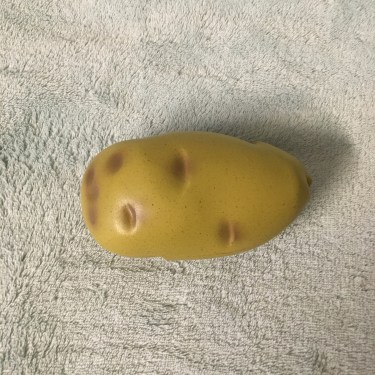
This week, I have decided to examine a potato. Not a real potato; a stress potato. It is a stress ball in the shape and color of a literal potato. Though the color is more green than a perfect Idaho potato would be at the store, it has a realistic representation of dents and eyes on real potatoes.

IMG_1437.JPG

I received this potato from my neighbor, Heather, who my mother is good friends with. They moved in next to us when I was 5 years old. They have been next to us so long that I remember when they brought their baby daughter home from the hospital, and this year, she’s turning fifteen. The potato is four to five inches in length, and on one side it says “green chimneys” with a drawing of a house containing a plant, pet, and two people. The sun is shining down on the house.

I was over at their house one day having dinner. I spotted it on their kitchen counter and immediately picked it up. I was just staring at it, and I heard Heather say, “Em, you can have that if you want. Carter doesn’t use it anymore!” So, of course, the stress potato was mine.

After doing some brief research, I discovered that Green Chimneys is a learning environment dedicated to special needs children who have emotional and mental health disorders. It is centered around animal assisted therapy. It is located in Brewster, New York, and it began as an “unusual boarding school,” as the biography puts it. Sam and Myra Ross are the creators of what Green Chimneys is known for now, but in the beginning, it was simply a boarding school with students between the ages of three and six. It opened in 1948. The home like setting of this boarding school, prepared by Sam’s father, was only part of the unique environment; attending school here came with the opportunity to interact and care for animals.

As Green Chimneys’ history goes on, in the 50s, it gained a reputation of helping students with special needs, and thus blossomed into what it is today: there are more than 200 students attending Green Chimneys today compared to the 11 when it began in 1948. It hosts therapeutic day programs as well as their residential year round school programs, and of course still has the innovative animal-assisted therapy. The Green Chimney’s Farm and Wildlife Center houses three hundred domesticated farm animals and wildlife.

Green Chimneys expanded in 2008 with a brand new campus in Carmel, New York, showing that their services are extremely beneficial, and will continue to be in the future.

Heather’s son, Carter, had serious trouble attending school when he was young. I assume this is one of the places he attended, and it has very clearly paid off. He can function in a learning environment, and is even on his college search right now. After knowing him for basically his whole life, I’m very proud to say the least. I’m really glad my stress potato has come from such a loving and caring place which focuses on emotional well-being while learning, as it has genuinely aided me in times of stress.

This Camera is Older than Me

I have chosen a new object for this blog post: my Polaroid camera. It is a legit Polaroid camera, and it is legit from the 90s. I recently started using it again. I remember using it when I was very young, probably not more than 6 or 7 years old. We have Polaroid pictures scattered around our house from me and from my parents using it when my brother and I were very young. About one year ago now it popped back into my head. I have always loved the aesthetics of Polaroid film, but I didn’t like that sizing of those itty bitty Fujifilm frames. It seemed too small to capture anything. I researched Polaroid film online and found a company that produces the 3.3 in. by 3.3 in. frame that I desired. It’s called The Impossible Project. They managed to save the last standing building that produced the original Polaroid film long ago, and out of there they produce today’s film with a new recipe. You can purchase it on amazon; the colored bordered film is a little cheaper than the white bordered film, but either way they estimate to be between $23 and $25 a pop.

(And you only get eight photos in each pack, yikes!).

My interest started up again as I said about one year ago, and I have slowly gotten more into photography since then. I wanted to purchase a digital camera, as my phone camera was not satisfying enough, but I didn’t want to spend the five hundred or six hundred dollars to take ridiculously clear, digital pictures. I decided to investigate something I already had. Somewhere, stowed away in my parent’s bedroom was our old Polaroid One Step Flash camera. I asked my mom about it, she confirmed it still existed, and the next day it was in my hands. I didn’t want to risk spending money on expired film, though the vendors said it had been stored in the refrigerator and unopened (since the ‘90s? Wow). I found the above mentioned film company and have been purchasing with them ever since. I have had some really nice results!

The history of the Polaroid company stems back all the way to the 1920s, when the founder Edwin H. Land, left Harvard after his first year to research light polarization. He later collaborated with a former professor of his. In 1948, the first Model 95 Land camera was sold, and this was the prototype for all of Polaroids later models. This specific model, Polaroid 600, was released in 1981.

My mother purchased the camera for her wedding to my father in November of 1991. They left it out on a table with film, a notebook, and a glue stick for guests to make their mark in. My mom said she took it to California for their honeymoon. She took pictures of the Redwood forest and Yosemite National Park. I think there is a photograph somewhere at home of my dad standing in one of those tunnels made through the redwood tree base. The tree is dumbfoundingly huge. The purpose of it then seems to be to remember really important events in my parents’ lives, specifically their wedding and honeymoon. I now have the camera and I have to make sure it’s really something I want to take a picture of, given the high price of the film and only getting eight exposures per pack. I don’t yet have an album like they did, so right now all the pictures I’ve taken here are sitting in a pile in one of my drawers. I like the idea that it was passed down from my mom to me. Since I have such a limited means of taking these pictures, I feel like it gives me more of a chance to decide upon the really important moments in my life that are “worthy” enough for me to take an instant photograph. Also, in every picture there is some little imperfection. There are odd spots that look like the film got messed up from the heat or cold, but it’s not so prominent that it messes up the whole photo. It gives the pictures personality. If someone were to view all the pictures I’ve taken with this camera, it would give insight to my life; the events that happen and the choices I make. It’s unique. These little imperfections in the film it gives life to it and the camera itself after all it’s been through. It’s traveled across the country!

I Need ’em to See

Besides needing my glasses for practical uses, such as seeing everything, I am also using it for this blog entry. Running about five inches across the face, they are jet black there and along the sides. A small curve of clear plastic along the rear of the face gives it a little more reinforcement.


I have had these glasses since I was in the tenth grade. My fifteen year old self wanted glasses like The Doctor from Doctor Who, and after a long stay at the Lenscrafters at some mall, she ended up settling on these ones. They have held up well over the years; never cracking or breaking. They’ve been through a lot.

There is casual wear and tear, but some of the coloring on the inside, when they’re on my head it’s directly beside my left eye, has rubbed off never to return. On the left and right of the inside, there are the small metal hinges that allow them to fold up and go into their case at night, and then unfold once again in the morning. From the hinges come a longer metal piece that extends all the way back. At first glance, they seem to be sparkly silver decorations. As I looked closer, I realized they are the entire side piece, and the black design of the plastic my glasses are made of are molded completely over the elongated metal. On the inner right piece, there are numbers: 52, a square, 17. A large space. 14, and then everything is faded beyond that. I’m only assuming these to be something about the certain style of eyeglasses I have because I cannot find anything about the brand online. I did get them nearly 6 years ago at this point. Things change.

lenses

As I said earlier, these poor glasses have been through a lot. At this very moment, there are fingerprint smudges, dust in the corners of the lenses, and scratches that are clearly visible. They also have nearly flown off my face in the midst of coughing fits these past few days. The scratches pictured in the middle of the right lens are the results of my poor decision to wear them to the beach. Or, that is what people told me. Do they not want me to be able to see? In 2015, I was on a month-long trip to Italy, the area my group and I were staying in was about one hour away from the beach town, so on our first weekend there we decided to go. I thought I was being careful, putting my glasses away so I could lay my head back and relax, but as I was putting them away, they fell out of my hand and into the burning hot coast of Rimini, Italy. So, there is some sentimental value to them because of how long they have been with me. They have obvious signs of wear simply because I’ve worn them so much and for so long. They have gone through everything with me from age 15 onward; high school graduation, high school itself, falling outs with friends, the making of new ones, two loves, my first job, family deaths, and now, they’re going through college with me.

It’s strange to think about an object you never usually think in depth about. My immediate thoughts when I realize I don’t have my glasses on are, “whoa, everything’s pretty blurry.”

House versus Home

I found an interesting concept on page 90, when Miller talks about au pairs and the rooms their host families prepare for them. It sparked the thought of “house vs. home.” Both in my life and my friends, the topic of a house versus a home has come up. We are all in college, and for some of us it was a difficult adjustment. “I want to go home” was a phrase I said an innumerable amount of times my freshman year, but some people have said “couldn’t you have just gone back to your dorm room?” The answer is no. There is a distinct difference between a physical house and what someone may consider home. It can also be a mental state. To think of one’s home and a “home away from home” is represented by college life extremely well.

“It seems that most families didn’t think twice before deciding that IKEA represented the perfect au pair style. Not just IKEA in general, but specifically white melamine IKEA furniture, which was found in approximately half of the photo-documented au pairs’ rooms we studied (90).” This bland colored living space made for au pairs by their host families represents the ease of simply replacing something or somebody. IKEA furniture is fun to put together, I will be honest, but after a few years of wear and tear, it might not even function correctly. Their products are cheap, very affordable, and will surely only last a few years. Miller describes this IKEA furniture in the UK as “cold” and “anonymous.” Plain, white, and there to temporarily serve. This is the au pair’s house. What items they choose to place inside of it will make it their own, their home. Additionally, if they do choose to call it “home,” that is their choice, and backs up the statement of home being a state of mind.

On the following page (91), Miller talks about having the autonomy to be able to put things in your house. Say you have purchased a house. You will reside there long-term, maybe start a family, host your own family for holidays. If you’re going to be living there for years to come, you should make it your own. This is where the items come in; pictures, furniture, electronics, appliances. The ability to feel comfortable in a space and call it your own is what makes a home. In my own dorm room, I have posters of my favorite TV shows and pictures of my friends and family. Whenever I go back to it at the end of the day, I feel welcomed. I feel safe. If I see someone’s dorm room and the walls are bare, I am confused. They are just going back to an empty space, but that is also their choice. I wanted my dorm room to be warm and welcoming, and I wanted it to feel like a home instead of a hotel. Some people have an easier time thinking to themselves that college is only permanent, so maybe that is why they have nothing on their walls to welcome them back at the end of the day. I won’t know, though, unless I ask them. If there is nothing in someone’s home, I can assume they are boring, bland, extremely minimalist, or anything else that pops into my mind. The only thing that will explain a complete lack of items is what they have to tell (much like George’s in “Empty.”)

I firmly believe that a house is the building. A home is something you make your own through your objects and personal expression.

Decluttering the Desk

I found this reading timely. I just moved into a new building on campus last week, so my things, especially small things, were strewn around my new room in comforting chaos. My desk both at home and here is the go-to spot for little papers, junk in my pockets, as well as my laptop, vitamin bottles, and anything else imaginable. So, you can imagine what it looked like in the recent days while I was unpacking all my bins. While doing this reading, I was sitting at said desk in Lefevre Hall. I suddenly became horrifically aware of everything that was in front of and around me. There was, at the time, a bright orange file holder (of which I put things in never to take them out again), a notepad labeled “shopping list,” a stray dryer sheet, my favorite pen with no cap, my checklist for the day, one of those round Eos chap-stick things, and a mug of tea. Those being but a few of the items, I immediately felt the need to clear my workspace. I contemplated using the “joy test” that KonMari praises and recommends, however, I thought the junk on my desk was not up to the standards of the joy test. If I applied the joy test, my desk would probably be totally empty. After our discussion in class on Tuesday, many of the things on my desk were those practical items; my set of mini drawers holds writing supplies and post-it notes, which I need but do not necessarily bring me joy. If the joy test extends beyond the object itself, though, then you could say it does bring me joy. If I did not have any pens, pencils, or post-it notes, I would have to take the bus that always runs late, as I do not have a car. Alternatively, I could walk to the store in the freezing cold. So, all in all, those pens and pencils in my little green set of drawers in a way does give me joy.

I picked up each item, trying not to think in such an extended way. Instead, I asked myself “do I need this?” I am usually a “I might need this later” type person, but once in a while, I get into those moods where I need to clear everything out. This turned into one of those moods. I picked up small papers that laid helplessly around and got rid of them. I put the chap-stick away in my first aid box. The dryer sheet found a permanent home in the garbage, and the orange file holder found a temporary home under my bed and out of the way.

It was strange going through my items, I think because I used a modified version of what we read about. Instead of asking if my shopping list notepad gave me joy, I asked myself if I really needed it. I became acutely aware of each item I had on my desk. Some of them were there because it held objects I needed like pens, scissors, and erasers. Some of the things were there simply because I placed them there days ago while unpacking, and I forgot about them. It was definitely not difficult because, as I stated before, the items I was dealing with were practical. Not a lot of them gave me any kind of joy. I am glad I got to do this experiment while also experiencing this move across buildings. If I hadn’t been assigned to do something like this, the poor desk would most likely be cluttered until the end of time.