Venerable Veneer: The Bronze Door Knob and Escutcheon on the Deyo House

The front entrance of the Deyo-Brodhead house.

The Deyo-Brodhead house.                                           -Picture Credit: Elise Bruce                                  
Door1

Picture Credit: Elise Bruce

Caption

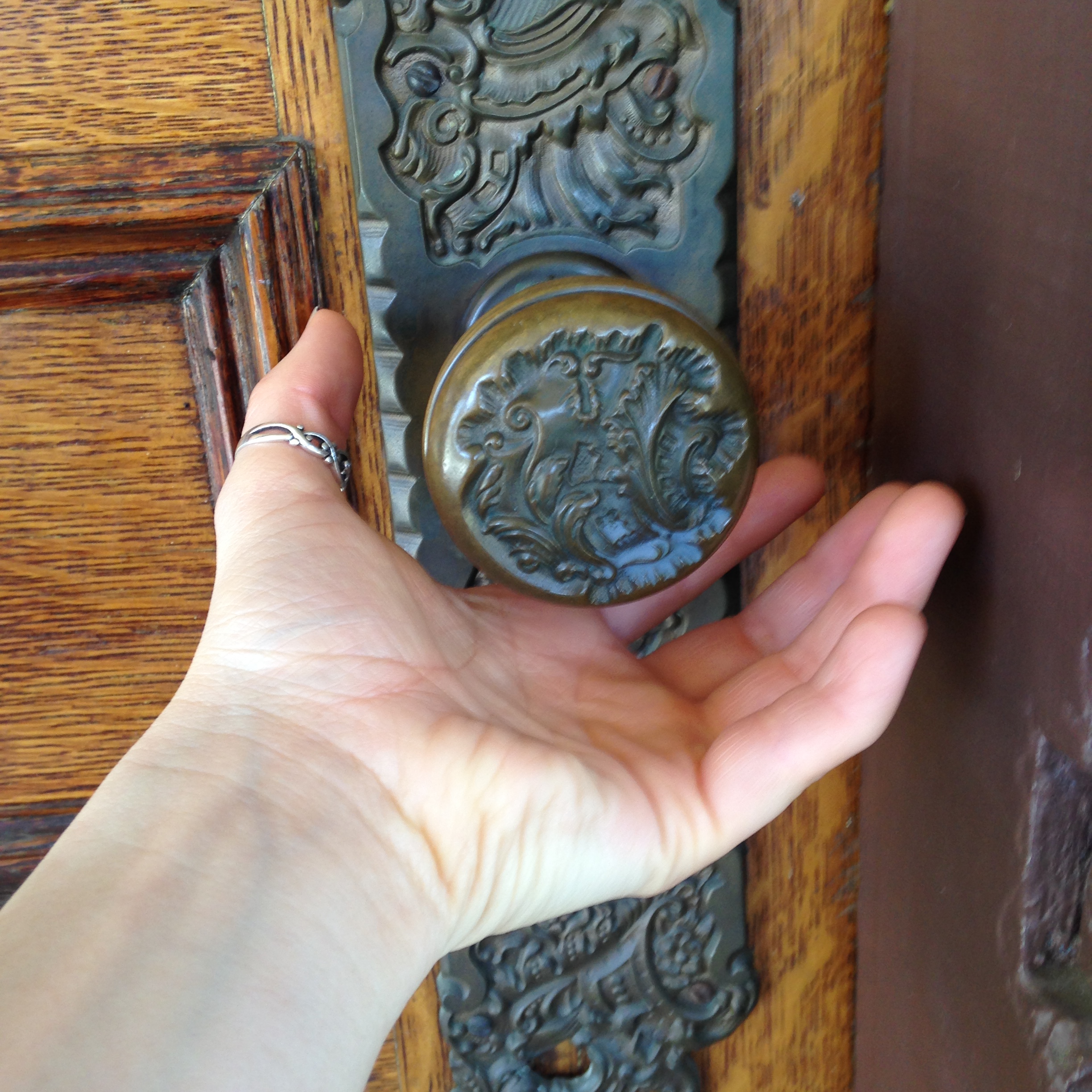
On February 27, 1895, Abraham and Gertrude Deyo-Brodhead opened the doors of their newly renovated home, “fitted up in the most elegant manner,” to “a large company who had come to pay their respects” (“At Home”). With their rococo design and burnished gold finish, the bronze door knob and escutcheon which grace the front door of the Deyo House are the first of many elegant fittings meant to impress visitors. Yet, their highly ornamental nature hints at the economic and cultural impact of the Industrial Revolution on the New Paltz community as well as one family’s fall from fortune.

Physical Description

Both the knob and the escutcheon have an elaborate floral pattern cast on the surface, giving the set an eye-catchingly elegant (or ostentatious, depending on one’s tastes) air. The escutcheon is especially attention-grabbing. Measuring sixteen by three inches, it is a roughly rectangular shape. However, the top and bottom have been molded into the form of acanthus leaves, creating an asymmetry that draws the eyes away from the relatively simple wood door to the more impressive hardware. Although the bronze has become dull and tinged with verdigris, one can imagine that its original burnished gold color would have made the set even more beautiful to those coming to greet the Deyo-Brodheads as they settled back in, particularly when it was lit by the house’s recently installed electrical lighting, a feature that would have been something of a luxury at the time.
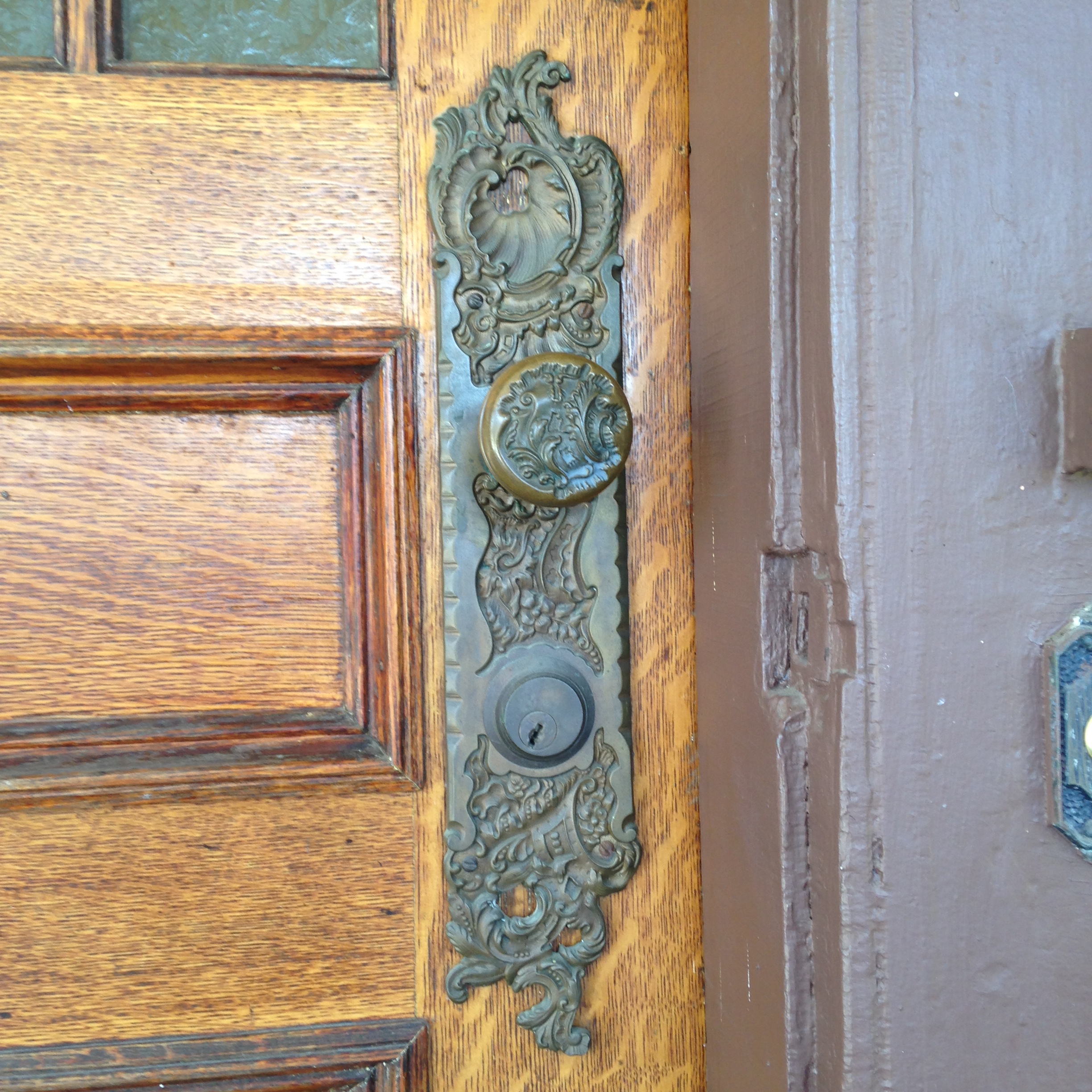
The acanthus leaves  at the top and bottom of the escutcheon are beautifully molded, giving the otherwise rectangular shape a fluid appearance.

The acanthus leaves at the top and bottom of the escutcheon are beautifully molded, giving the otherwise rectangular shape a fluid appearance.       Picture Credit: Elise Bruce

Provenance

Picture credit: Reading Hardware Catalogue

Picture credit: Reading Hardware Company
Reading Hardware

Picture Credit: Reading Hardware Company

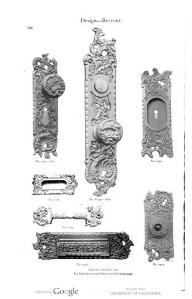
The set was manufactured in the late 1800s by the Reading Hardware Company, located in Reading, Pennsylvania. According to Morton L. Montgomery’s history on the area, the company, founded in 1852, specialized in “furnishing all the necessary hardware in the construction of large hotels and office buildings” in large cities such as New York and Chicago and was particularly well known for its “unique and artistic designs in fine bronze” (Montgomery 189). The design found on the Deyo house knob and escutcheon, a rococo style called Belfort, was available for purchase through the company’s widely circulated Illustrated Catalogue of Fine Locks and Builders’ Hardware. It is likely that the Deyo-Brodhead’s selected the door knob and escutcheon from this catalogue as they planned their renovations. The set has remained on the front door ever since although the house has changed hands three times. The last owner, Harold L. Wood, sold the house to the present owner, the Huguenot Historical Society, in 1972.

Historical Narrative

The knob and escutcheon embody a much larger struggle in terms of the culture and economy in New Paltz at the turn of the century, a struggle that comes to a head in the 1895 renovation of the Deyo house. Built by Pierre Deyo around 1692, the original Deyo house was modest stone structure not unlike the neighboring Bevier-Elting house. While later descendants added a wing to accommodate the growing family, the exterior of the house otherwise remained relatively the same. This changed when the Deyo-Brodheads inherited the house in 1893. Although indubitably proud of their Huguenot heritage (both could trace their lineage back to Christian Deyo, patriarch of the Deyo family and one of the twelve signers of the original patent), Abraham and Gertrude nonetheless desired a much more ornate space than the stone house built by their ancestors. As Jaquetta Haley notes in her summary of Deyo House history, the couple was highly involved in New Paltz social life, at one point even hosting a masked ball for a group of notable local figures (8). Their decision to modify and expand the house seems motivated partially by their desire “to entertain on a grander scale” (8).

Yet, Haley implies that the couple’s social ambitions may have been curbed had it not been for a modest inheritance bequeathed by a wealthy relative. Although they owned a significant amount of land in New Paltz area, the Deyo-Broadheads were not a particularly wealthy family. Instead, their social prominence was tied to the family’s deep roots in the area as well as the Deyos’ long standing participation in community leadership, starting with Christian Deyo and extending on through Abraham’s great grandfather (a judge) and grandfather (a local sheriff). However, in 1890, the death of one of Abraham’s paternal great uncles left the newly wed Abraham and Gertrude with $150,000 (Haley 7). While it was not a huge sum, this inheritance allowed the couple to pursue their interests on a much larger scale than they had previously. For Abraham, this meant investing in the construction of a small horse racing track, the Brodhead Driving Park. Built on some of Brodhead’s holdings on the other side of the Wallkill, the track helped to supplement the couple’s income as well as bolster their reputation in the community. Although it is less clear what Gertrude’s interest were, Haley indicates that she enjoyed her role as a “social doyenne of New Paltz” (17). It seems plausible, then, that in her drive to throw larger and more tasteful events, Gertrude would be the one to prompt the renovation of the old stone house into the elegantly fitted space that so impressed the reporter of the New Paltz Independent on that February night in 1895.

Regardless of who proposed the renovations, the Deyo-Brodheads began making plans to modify the house almost immediately upon taking ownership, transforming it from a simple stone house to a Queen Anne Style manor. It is in, in the words of Kenneth Hasbrouck, “an example of how a residence must submit to remodeling as the occupants acquire wealth” (Hasbrouck). Hasbrouck’s comment hints at the discomfort with which New Paltz residents met the Deyo-Brodhead’s plans to renovate. An article in the New Paltz Independent dated July 13, 1894 laments, “The changes in the building will make it scarcly [sic] recognizable” (NPI).  Indeed, the stone first floor is the only vestige of the original structure still visible. The same article argues that “at least of them [the old stone houses on Huguenot Street] should be set apart and strictly guarded from the march of modern improvement in order that future generations may know in what manner of houses their ancestors lived” (NPI).

The fear of “modern improvement” obscuring the historical character of New Paltz indicates the community’s fierce loyalty to their heritage, but it also suggests the conflict between traditional local values and the cosmopolitan trend towards the ornate, even theatrical, sensibilities amongst the area’s wealthy citizens. Almost every feature of the Deyo-Brodhead’s home is meant to inspire reverence and respect not only for the Deyo-Brodhead’s heritage but also the family’s more recent wealth and achievements. Positioned prominently on the front door, the bronze door knob and escutcheon affirm this prestige, reminding all visitors that this house belonged to influential individuals. Yet, the grandeur rests on a certain superficiality made possible in part by the relatively new ability to mass produce luxury items using machine labor. The result was seemingly elegant items that were relatively affordable, especially when bought in bulk. The advertisement in the Reading Hardware Company’s catalog notes that the Belfort knob and escutcheon could be purchased for around $3.90 (roughly $100 today) (RHC). While that might seem expensive for a door knob, it pales in comparison to the cost of purchasing a similar piece from a blacksmith.

However, what they might have saved by buying machine fabricated hardware, the Deyo-Brodheads spent or invested elsewhere, requiring them to eventually take out two mortgages on the property. A confluence of financial problems, starting with the collapse of the race track as a source of income, would at last cause the couple to lose the house and their ancestral land holdings. Unlike most of their property, which was auctioned off to recoup the family’s losses, the grand door knob and escutcheon would remain with the estate, a silent testimony to their hopes and dreams as well as an embodiment of the changing times.

.

References

“At Home.” New Paltz Independent. 1 Mar. 1895. Print.

Blumin, Leonard. Victorian Decorative Art: A Photographic Study of Ornamental Design an Antique Door Knobs. California: Victorian Design Press, 1983. Print.

Davey, Weston. Personal Interview. 9 Apr. 2015.

Haley, Jaquetta. “Furnishing Plan: Deyo House.” New York: Huguenot Historical Society, 2001. Print.

Hasbrouck, Kenneth E. Old Stone Houses: Huguenot Street, New Paltz, N.Y. New Paltz: n.a., n.d. Print.

Montgomery, Morton L. Historical and Biography Annals of Berk County, Pennsylvania. Chicago: J.H. Beers & Co., 1909. Print.

New Paltz Independent. 13 Jul. 1894. Print.

Reading Hardware Company. Illustrate Catalogue of Fine Locks and Builders’ Hardware. New York: 1899, Print.

Hand Forged to Machine Cast: Metal Work on Huguenot Street

Ironobj1Door1

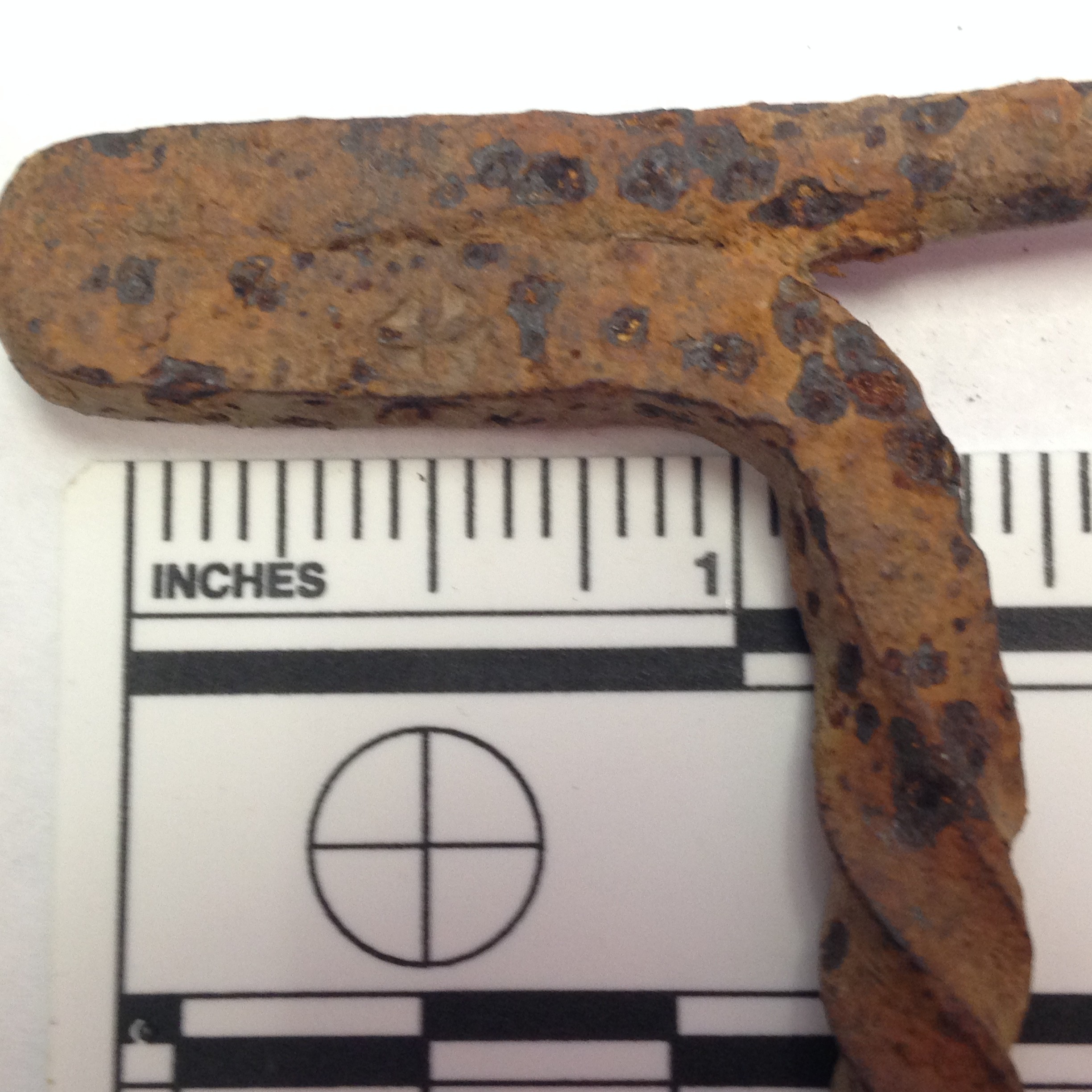
This iron object may be a simple screwdriver or part of an old shutter fastener. Although its age and exact purpose are unknown, it is clearly the work of skilled blacksmith who poured time and sweat into its crafting. In contrast, the bronze door knob and escutcheon on the Deyo House, made in the late 1800s, were likely machine cast and mass-produced. Together, these objects chart the economic and cultural impact of the Industrial Revolution on the New Paltz community.

Roughly three and a quarter inches long and three inches at its widest point, the iron object resembles a rusty capital “T.” A close inspection of the wide bar indicates that the object was formed by hammering a single piece of iron into shape, making one end of the bar a little thicker than the other. It also reveals a small maker’s mark on one side, a little cross engraved into a circle, so small it is almost lost in the rust. Extending perpendicularly from the wide bar is a long shaft that spirals into a long flat point similar to the tip of a flat head screwdriver. The similarity has raised the possibility that the object is an unusual but well-crafted screwdriver. However, the spiral of the shaft and the delicate taper of the wide bar also resemble the decorative elements found on wrought iron shutter fasteners. Attempts to establish a more concrete identity for the object have been foiled by its sheer uniqueness.

Just above the half inch mark on the rule lies the faint imprint of a maker's mark.

Just above the half inch mark on the ruler lies the faint imprint of a maker’s mark.

If the iron object is too unique to be defined, then the bronze door knob and escutcheon (the decorative plate around the keyhole) are perhaps too common although they might not appear so at first. Both the knob and the escutcheon have an elaborate floral pattern cast on the surface, giving the set an elegant, eye-catching air. The escutcheon is especially attention-grabbing. Measuring sixteen by three inches, it is a roughly rectangular shape. However, the top and bottom have been molded into the form of acanthus leaves, creating an asymmetry that draws the eyes away from the relatively simple wood door to the more impressive hardware. Although the bronze has become dull and tinged with verdigris, one can imagine that its original burnished gold color would have made the set even more beautiful. While there is no visible indication of who made the set, Weston Davey, Historic Preservationist for the Historical Huguenot Street, suggests that it was probably machine cast (Davey).

The acanthus leaves  at the top and bottom of the escutcheon are beautifully molded, giving the otherwise rectangular shape a fluid appearance.

The acanthus leaves at the top and bottom of the escutcheon are beautifully molded, giving the otherwise rectangular shape a fluid appearance.

Found during a recent archeological excavation near the Deyo house, the iron object’s ownership remains as much a mystery as the date of its making and its true function. However, Joseph Diamond, a professor at SUNY New Paltz and the head of the excavation, notes that if it is indeed a screwdriver, it is possible that it came from a kit used to maintain muskets (Diamond). If this is true, then the object would likely be carried around with its owner in times of conflict or on hunting trips in order to make potentially life-saving adjustments. Yet, it is just as possible that the object was once attached to one of the several structures that used to exist on the lawns between the Deyo house and the Bevier-Elting house, making it a far more stationary, and perhaps less dramatic object. Regardless of whether it was a tool kept close at hand or a piece of house hardware, it seems likely that the object served some functional purpose in the daily life of an early New Paltz resident. Perhaps even more importantly, the maker’s mark on the side indicates that it was the work of a craftsman who took pride in his work and wanted it to be recognized.

In contrast, the door knob and escutcheon, were likely purchased from a catalogue by Abraham and Gertrude Deyo-Brodhead when they chose to renovate the Deyo house in 1895. They have remained there ever since although the house has changed hands three times. The last owner, Harold L. Wood, sold the house to the present owner, the Huguenot Historical Society, in 1972.

The tension implied between the handcrafted, locally made iron tool and machine produced, nationally distributed door knob comes to a head in the 1895 renovation of the Deyo house.  Built by Pierre Deyo around 1692, the original Deyo house was modest stone structure not unlike the neighboring Bevier-Elting house. While later descendants added a wing to accommodate the growing family, the exterior of the house otherwise remained relatively the same. This changed when the Deyo-Brodheads inherited the house in 1893. Abraham and Gertrude were proud of their Huguenot heritage (both could trace their family line back to Christian Deyo, patriarch of the Deyo family and a signer of the original patent), but they nonetheless desired a grander space than the stone house built by their ancestors. In her summary of the Deyo house history, Jaquetta Haley suggests that their ambition was curbed only by a lack of funds. Most of the couple’s income was drawn from relatives or revenue from the horse racing track that Abraham had built across the Wallkill. However, in 1890, Abraham’s paternal great uncle died, leaving the family a substantial amount of money. Almost immediately after taking ownership of the house, the Deyo-Brodheads began making plans to renovate, transforming it from a simple stone house to a Queen Anne Style manor.

Almost every feature of the house is meant to impress even, as we have seen, the door knob on the front door. Yet, the grandeur rests on a certain superficiality made possible in part by the relatively new ability to mass produce luxury items using machine labor. The result was seemingly elegant items that could be afforded by the rich and the aspiring rich alike. The bronze door knob and escutcheon are an excellent example. The beautiful acanthus design gives the impression of being well-crafted. However, a quick scan of the door knob and lock section of the Montgomery Ward and Co.’s Catalogue and Buyer’s Guide for Spring of 1895 (around the time the renovations began) reveals several similar knob and escutcheon sets all selling for around a dollar (approximately twenty-five dollars today). This reproducibility signals a changing dynamic for the residents of New Paltz. Not only were craftsmen such as the blacksmith who made the iron object rendered obsolete, hastening a shift in the local economy, but the culture had also shifted from the practical aesthetic of the early settlers to an aesthetic of ornate imitation.

Reference

Davey, Weston. Personal Interview. 9 Apr. 2015.

Diamond, Joseph. Personal Interview. 13 Apr. 2015.

Haley, Jaquetta. “Furnishing Plan: Deyo House.” New York: Huguenot Historical Society, 2001. Print.

The Paradox of a Narnian Box

The Collier Books 1970 Box Set Edition

The Collier Books 1970 Box Set Edition

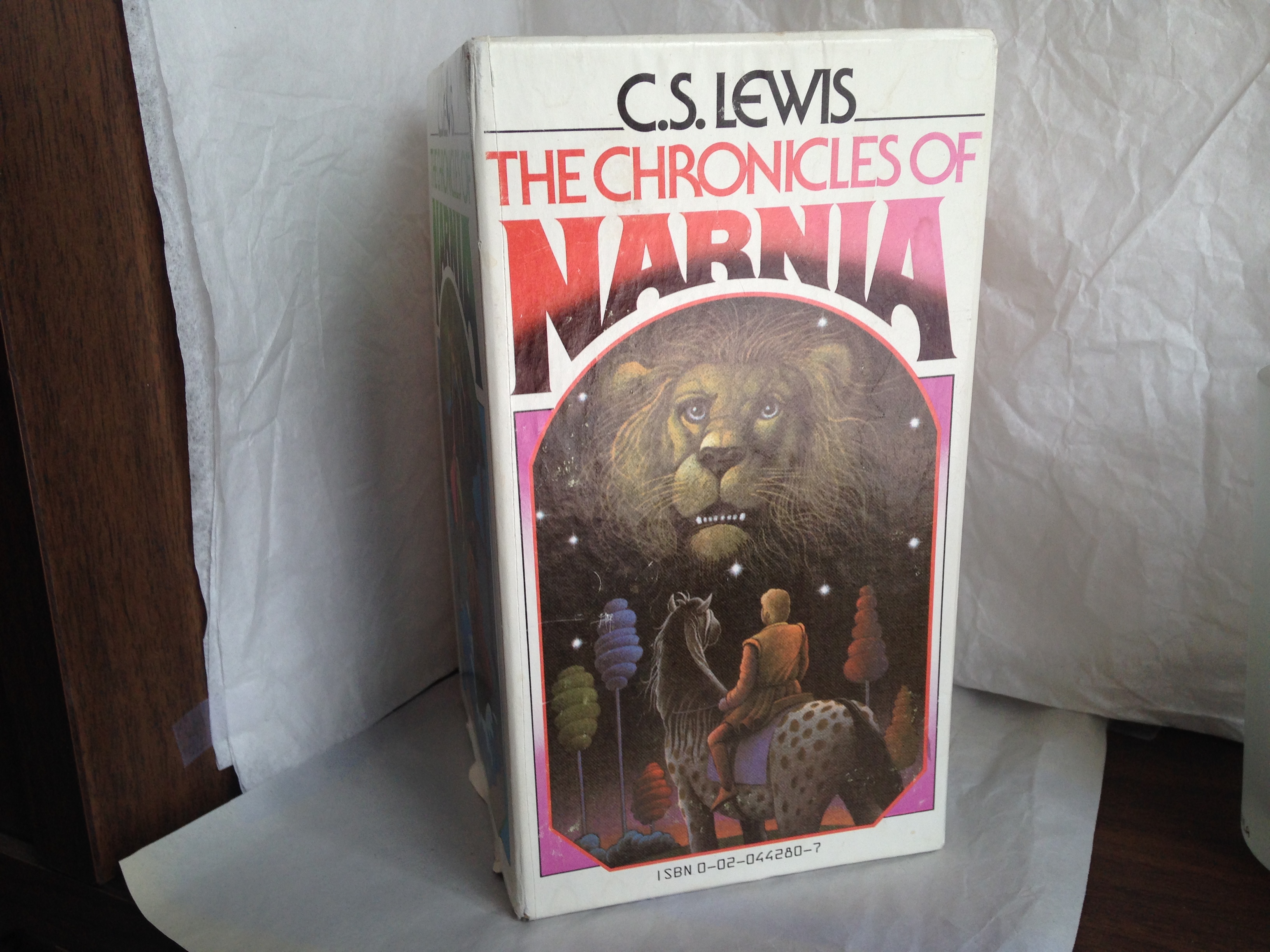
During the fall semester of 2013, I was lucky enough to land a spot in the ever popular course on Classic Juvenile Fantasy. A peek at the required reading list revealed that I had already read many of the texts as a kid, a discovery that understandably excited me.  Not only would I have a legitimate reason for rereading some childhood favorites during the semester (a luxury I cannot generally afford when faced with the stack of reading for my various English classes), but I also figured I could save a few dollars by borrowing most of the texts from my parents’ house. However, when I called my mom to share my thrifty plan with her, she informed me the several of the books had been donated to the local library. Oh well, thought I, it was worth a shot. My mom took it more seriously, and, on her next visit, she presented me with a used boxed set of C.S. Lewis’s Chronicles of Narnia. Like many children born after 1950 (the year in which the first chronicle, The Lion, The Witch, and The Wardrobe, was published), I read most of Lewis’s adventure in Narnia and was utterly charmed by Aslan the lion. At the time, I held the not so secret hope that if I did not receive an owl that I would at least find a wardrobe into another realm. However, in 2013 when my mom handed me the boxed set, it had been years since I had even thought of Narnia. To be honest, I do not quite remember what my childhood copy of The Lion, The Witch, and The Wardrobe looked like. It was certainly newer than the set I now own. However, what it lacks in youth, the set makes up in character and an interesting, albeit mysterious, background.

IMG_0654.JPGpub

Formerly Crowell-Collier, Collier Books was a product of a merger with the Macmillan Co. in 1960.

Released in 1970 by Collier Books, a subsidiary of the Macmillan Publishing Company, the box set is technically the fourth edition of the series to be released in America since Macmillan premiered the series between 1950 and 1956. The need for more editions indicates the ongoing popularity of the series, but it also offers an interesting reflection of the publishing business at the time. This is the only edition of TCON to be released under the Collier Books imprint, as eight years later the subsidiary would be sold to Harper & Row, concluding a relatively short business relationship between the Collier group and the Macmillan company. With the advances of printing technology, including the addition of computers in 1970, the publishing world seems to have been in a state of flux with new companies gathering steam and older companies choosing to merge to keep themselves afloat. There is an extreme ambiguity about this period that stands in sharp contrast to the material objects it produced. For instance, try as I might, I could not track down the actual printing company that assembled the box set. It is as if some distributer at Macmillan/Collier Books waved his or her arms and the set just magically appeared on book shelves everywhere.

Left side

Left side

Right side

Right side

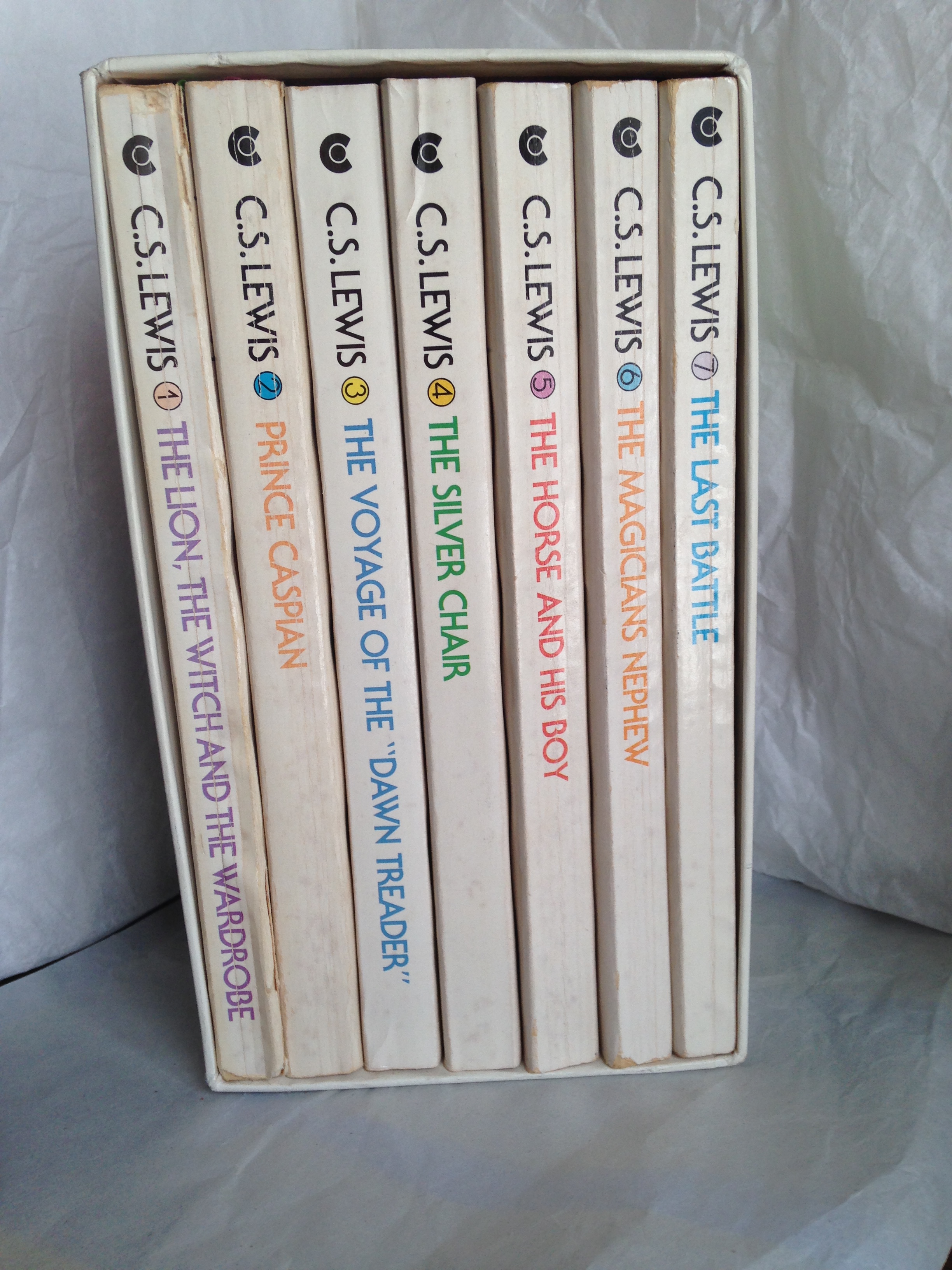
Yet, the set is clearly the product of a material process, be it an automated procession line or human hands. After all, something had to assemble the box, arrange and print the pages, etc. The box measures roughly four by four by seven inches, about the size and shape of a lunchbox. In order to fit in the space allotted, the seven chronicles have been condensed into slim paperback form, each being no more than half an inch thick and a little less than seven inches tall. In most places, the eleven-point font crowds the page to ensure that none of the action is lost. Both the box and the books feature key scenes from the novels, rendered with dynamic colors and shapes. Exposed to the sun, the colors on the box have faded. However, the book covers stored safely inside suggest how bright they must have been.

All seven chronicles. Note that the books are numbered in order of publication rather than chronologically as they are often numbered today.

All seven chronicles. Note that the books are numbered in order of publication rather than chronologically as they are often numbered today.

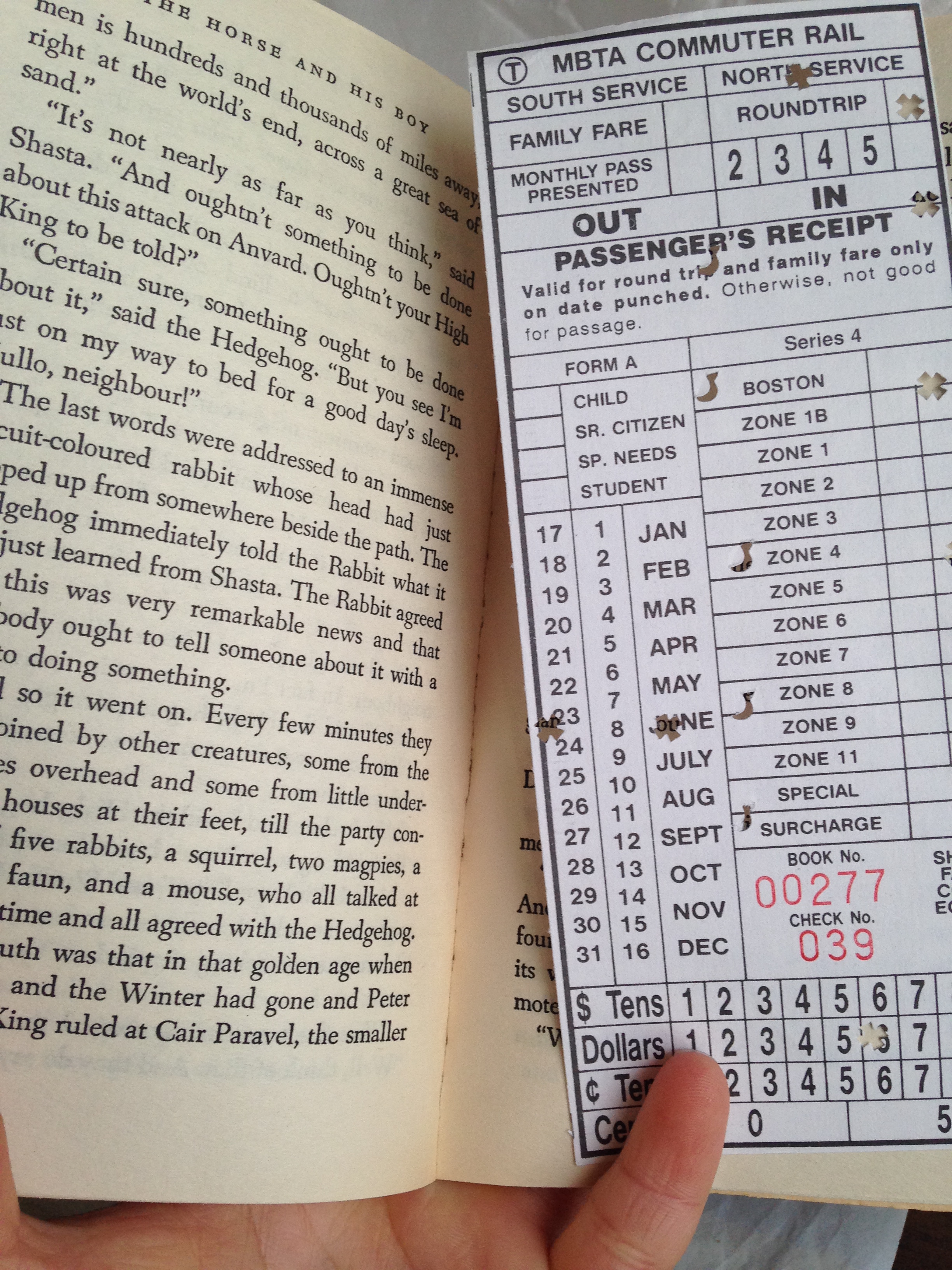
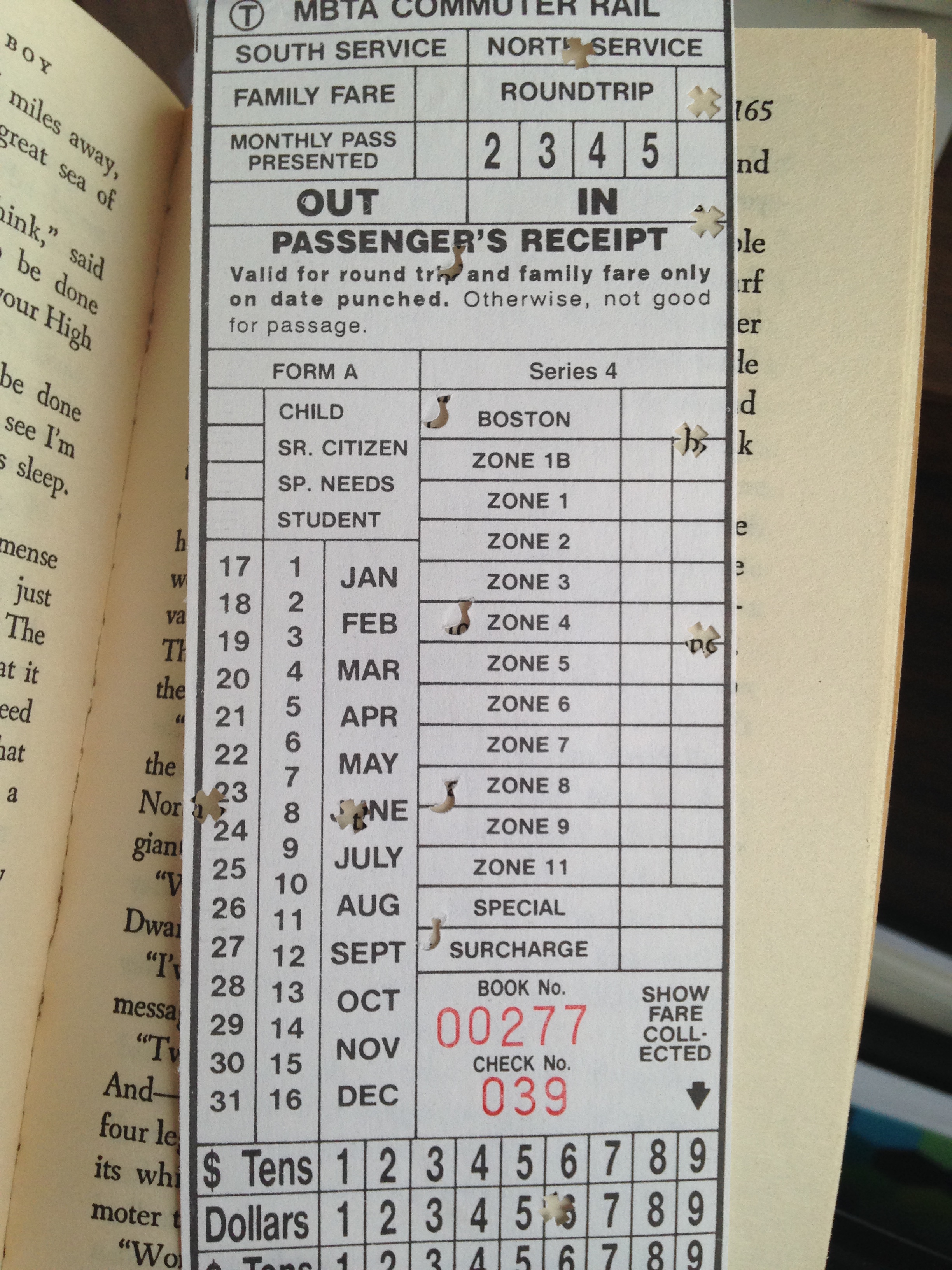
The set has certainly seen better days. The box is light shelf wear, particularly noticeable on the corners. One can see from the crinkling of the spines of the books that the glue that holds the paperboard binding together is beginning to degrade. At some point during its time in my backpack during the fall semester, the front cover of The Lion, the Witch, and the Wardrobe began to fall off. I have yet to take my sticky notes back out. In spite of some patches of wear and tear, the collection as a whole is still pretty hardy. In addition, the books themselves are compact and lightweight enough that they can easily be transported to be read on a trip. One of the previous owners seems to have done exactly that, leaving a Massachusetts Bay Transportation ticket tucked in between the pages of The Horse and His Boy. It is a round trip ticket for a day trip to Boston stamped June 23. Thrilled to find another ticket, I tried to track down the exact route this anonymous reader had taken, but I honestly believe that the MBTA is even more oblique than my own murky family history.

Another ticket!

Another ticket!

Where exactly are zones 4 and 8?

Where exactly are zones 4 and 8?

Still, discovering the ticket cast the box set in a whole new light. Although I knew the set was used, I had not previously stopped to consider what the previous owners had done with it. Now on top of wondering where they came from, I am also wondering how many trips these slim little volumes have been on and what they have seen. Where did the previous owner buy them? Were they new at the time? What did they look like on his or her shelf? The only things I can be sure of is that someone else held them in their hands and carefully turned the pages.

Works Consulted

For A Brief Overview of the Printing Process through the Ages:

http://www.hrc.utexas.edu/educator/modules/gutenberg/books/printing/

For More Information about Collier Books:

http://ketupa.net/crowell.htm

For More Information about Macmillan Publishing Co.:

http://archives.nypl.org/mss/1830#access_use

For Helpful Information Regarding the Various Editions of The Chronicles of Narnia:

http://inklingsfocus.com/en_US/amer_1950-1956.html

Habitus in Miniature: How Our Bookcase Represents Our Home

The Bookcase

The Bookcase that is Home

Trying to keep up with my great-grandparents as they jump from El Salvador to Guatemala to France to Spain has left me a little winded, not to mention more than a little envious. As I look out my kitchen window I can see teensy little snowflakes falling, triggering, yet again, a longing for warmer climes. In an effort to keep myself from spending all my savings on an impulse trip to San Sebastian, I have decided to remind myself about the things I like about my own life. So, this week’s post will not feature the ticket or the de Jaureguis, but, if it is any consolation, it will feature Arnold Schwarzenegger (sort of).

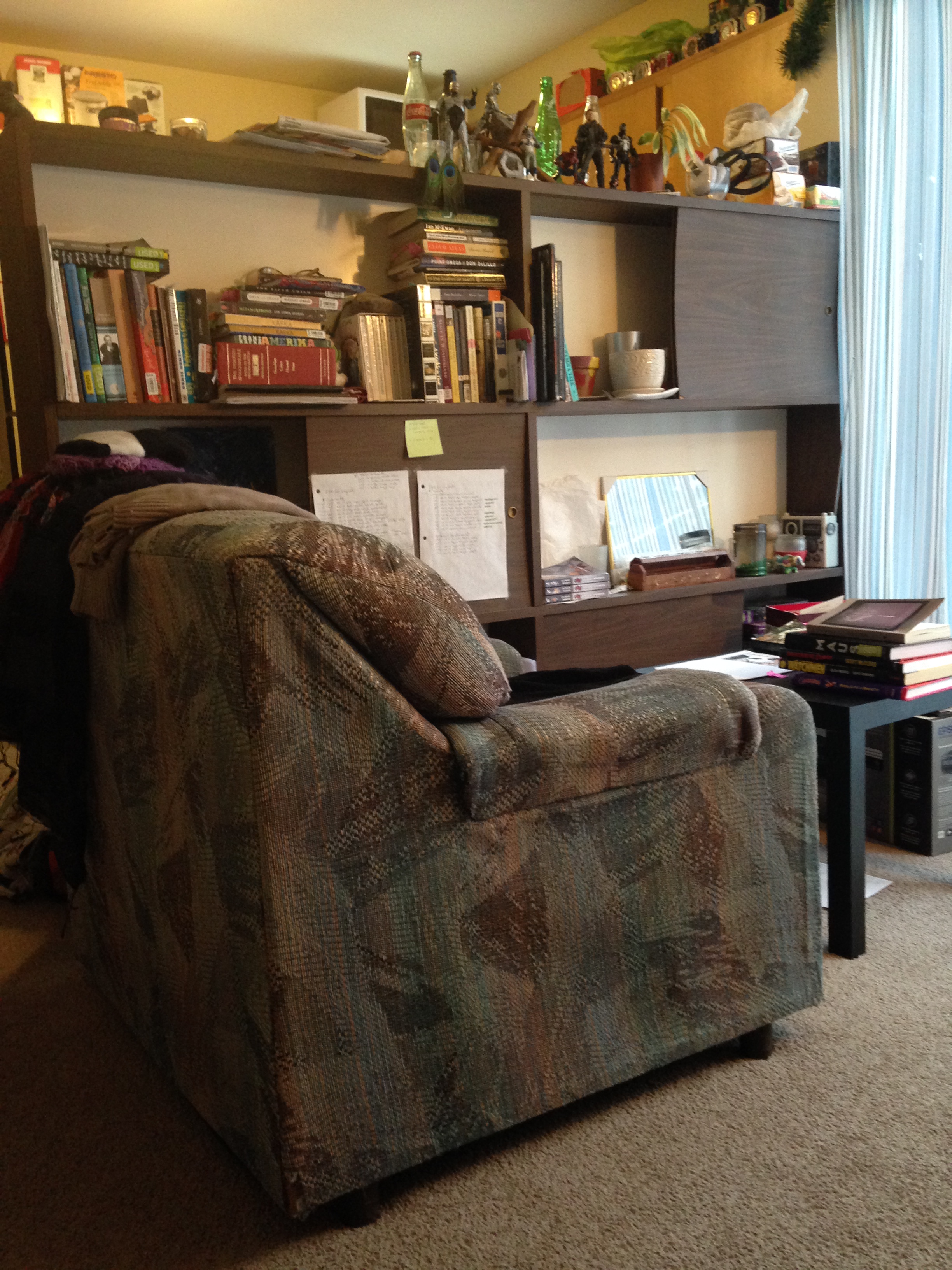
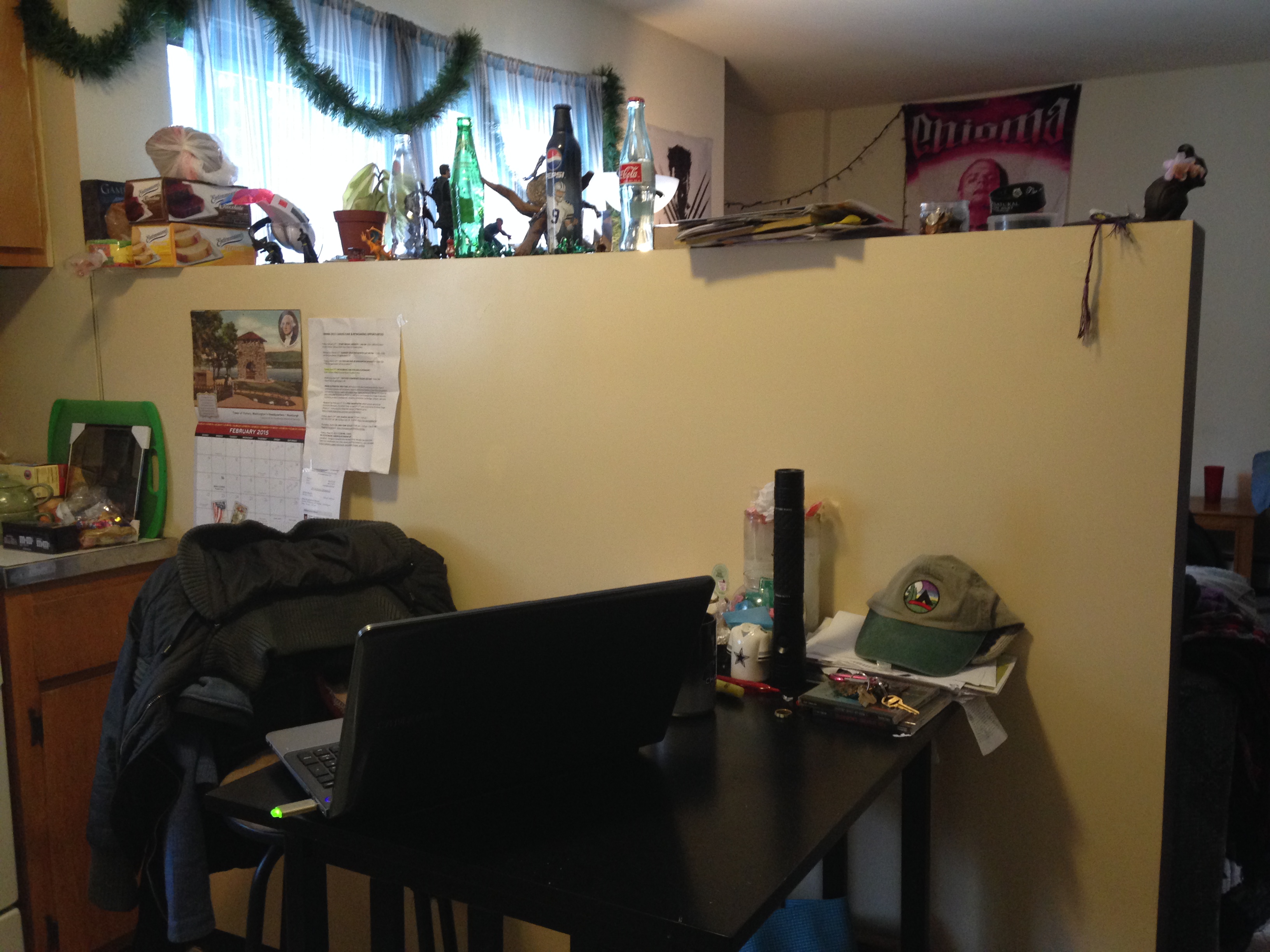
For the last two year, my longtime boyfriend and I have shared a small studio apartment at Southside Terrace Apartments. It is a plain space, much the same as any other apartment in the complex. The walls are painted the same shade of dubious light beige, the bathroom has a small medicine cabinet with mirrored sliding doors mounted to the wall, and the carpet is a knobbly beige just a little darker than the walls. In addition, it has a large bookcase which serves as a barrier between the kitchen and the living room/bedroom. The backside is towards the kitchen, creating a sort of half wall where I have chosen to hang our joint calendar listing important dates such as birthdays, our anniversary, and, less romantically, when the electric bill is due. The front of the bookcase faces the living room/bedroom. It is divided into six cubbies (each roughly two and half feet wide and a foot and half tall) accommodating some of our favorite belongings. Although this bookcase is not unique (all of the deluxe studios here at Southside have them), it is the most fascinating aspect of the apartment and it is the chief feature in evoking the sense of this apartment as a home. More specifically, I would argue that it is the primary feature that evokes the sense that this apartment is our home.

The kitchen side of the bookcase. The joint date calendar is to the left.

The kitchen side of the bookcase. The joint date calendar is to the left.

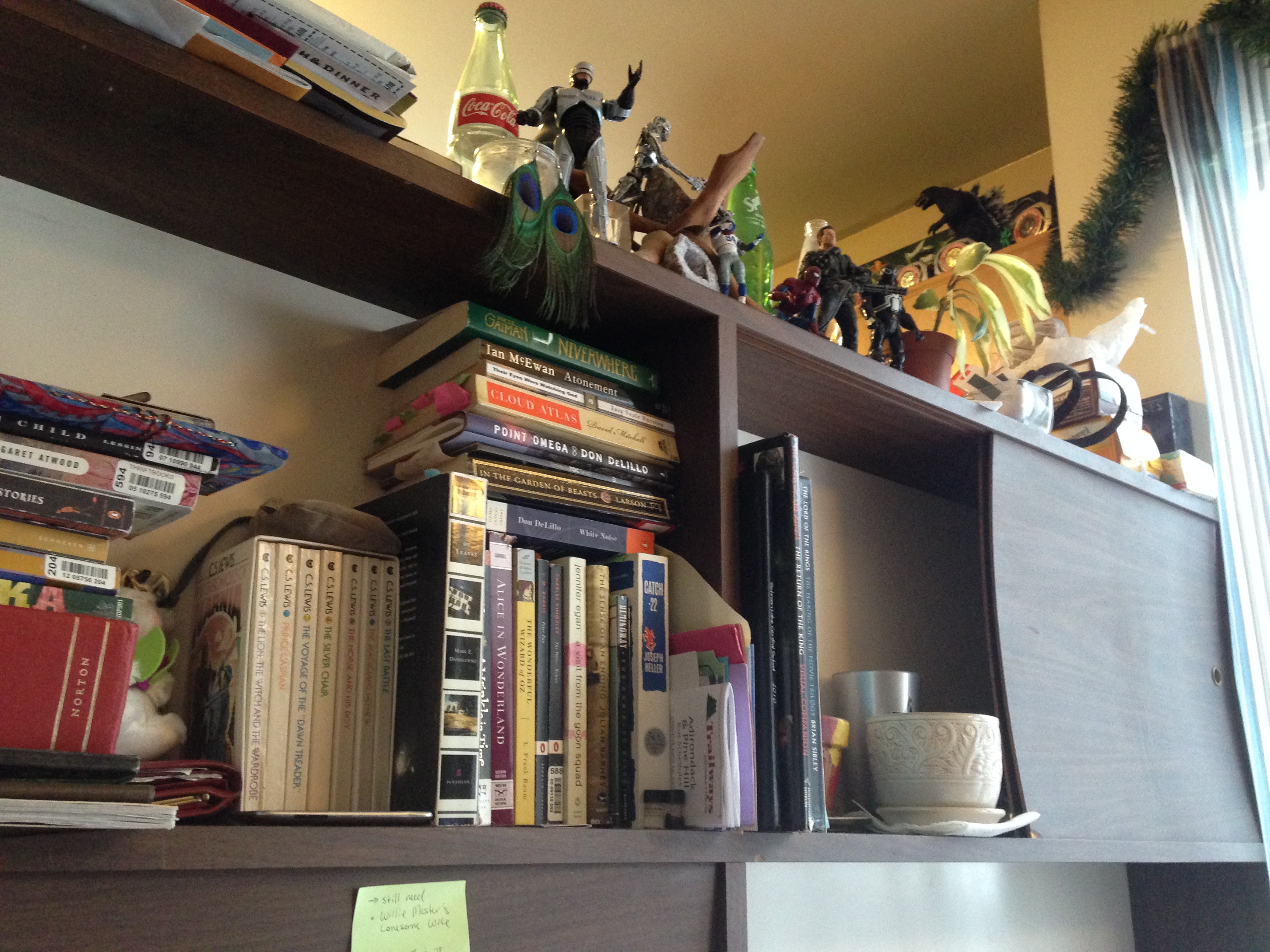
The bookcase serves as a miniature habitus, reflecting both my and my boyfriend’s identities. In this space, our individual collections have blended together in ways that indicate both our common interest and our differences. For instance, posing along the top of the book case are several plastic figures of various heights. A few of them are characters from our favorite action movies. Robocop stands as if trying to placate a suspect, his gun still contained (for now) within his metal leg. The stripped down Terminator crawls over a wooden stand, seemingly off to destroy his other self who stands a little ways down with a Gatling gun. However, overtime the collection has grown to reflect more of Matt’s other interest. Spiderman now crouches, ready to swing away, while his former nemesis Venom keeps watch next to my houseplant. A miniature Cowboy (of the Dallas football team variety) stands ready to receive the ball, unaware that he is going to be the skeleton Terminator’s first victim. On the kitchen side, a tiny red Power Ranger stands next to Godzilla the size of a finger. Godzilla, in turn, seems to be pointedly facing away from the similarly sized, but more brightly colored, Charizard Pokémon figure. Almost all of the figures are posed in a way that suggests a story (e.g. the crawling skeleton Terminator off to fight his fully skinned self). Viewing this collection, a stranger can fairly easily divine my boyfriend’s favorite football team, the television shows he watched as a child, and some of his favorite movie as well as his earnest appreciation for merchandise associated with his interests. However, they might also note his exuberance and creativity. Not unlike Charles Ephrussi and the netsuke, Matt wants the figurines to be shared and appreciated, not kept in boxes in the closet.They are a clear indicator of his presence in the apartment, mixing unselfconsciously with the decorative wooden stand, the geodes, and the houseplant.

Robo Cop (left), Skeleton Terminator (atop the rock), Cowboy (below)

Robo Cop (left), Skeleton Terminator (atop the rock), Cowboy (below), Spiderman (right)

Schwarzenegger Terminator (left) and Agent Venom (right). Between them stands Edna Mode from Pixar's The Incredibles. Matt got her for me so I because she's eminently sensible as well as rather short

Schwarzenegger Terminator (left) and Agent Venom (right). Between them stands Edna Mode from Pixar’s The Incredibles. Matt got her for me because she is eminently sensible as well as rather short

The bookcase is also the clearest indicator of my presence in the apartment.  The three cubbies on the right contain most my books (I have many and was forced to leave some at my parent’s house). It is a blend of past textbooks, childhood favorites, and current interests. The textbooks (almost all having to do with literature and language) are certain to give me away as an English student while the rest of my collection will reveal a penchant for science fiction and contemporary literature. I have not categorized them in any ostensible way (The Chronicles of Narnia sit next to the brain-teasing metafiction novel House of Leaves on the top shelf. David Mitchell’s Ghostwritten is not next to Cloud Atlas, but down next to my dictionary and anthology on literary criticism on the middle shelf), and if someone were to glance at them they would probably conclude that I am not very organized. While this is a little bit true, the books do, in fact, have a method behind their madness. The ones that I refer to the most often occupy the top and middle shelves while those that I refer to less often are located on the bottom. I call this organizational scheme the Arm Chair System as the texts I need the most are within easy reach from the armchair located, conveniently, right next to the shelves. The middle right shelf also hosts my various notebooks, sticky notes, and a pen holder that holds a plethora of ballpoint pens and wooden pencils as well as a couple of highlighters (yellow). It is difficult for me to guess what someone might think of me looking at my books. Likely, my love of language and narrative will be clear. Perhaps they might guess at my appreciation for the fantastic and the unexpected, and my desire to push on and find new forms and make new connections. Perhaps, they would get nothing of the sort. I am too close to see myself.

Everything you need at arms length...accept the fridge.

Everything you need at arms length…accept the fridge. The Chronicles of Narnia box set is right above the green sticky note. Next to it is House of Leaves. Cloud Atlas (orange and beige spine) is stacked horizontally.

Together, the various items on the bookcase represent Matthew and me both as individuals and as a couple in ways that are far more complicated than I can fully explain here. One can clearly see our mutual love of storytelling and our tendency to collect stories in tangible forms. Yet, one might notice that, spatially, the two collections are quite clearly separated. No figures descend to the shelves, and no book ascends to the top. This is partially a height problem. I cannot reach my books if they are sitting on top of the bookcase. However, it is also a product of the unspoken agreement that the right cubbies are my space. Due to the apartment’s small size, this boundary is relatively significant as it denotes one of the few areas either of us have allowed ourselves personal space. By the same token, I respect Matt’s wish that all of the figures be displayed, regardless of whether or not they match my aesthetic impulses (Full disclosure: Spiderman is not my favorite Marvel superhero). Our mutual acceptance of not only each other’s needs for space, but also our need to shape this space to reflect our likes regardless if they are our partner’s like, have made it possible for us to live in such a small space without turning Terminator. The fact that both the collection are present is the reason why the bookcase equals home.When the figurines are gone and the books packed away, you will know that Elise Bruce and Matthew Grey do not live here anymore.

IMG_0613.JPGseatshot

Post Script – The Man Who Would Not Take Off His Shoes

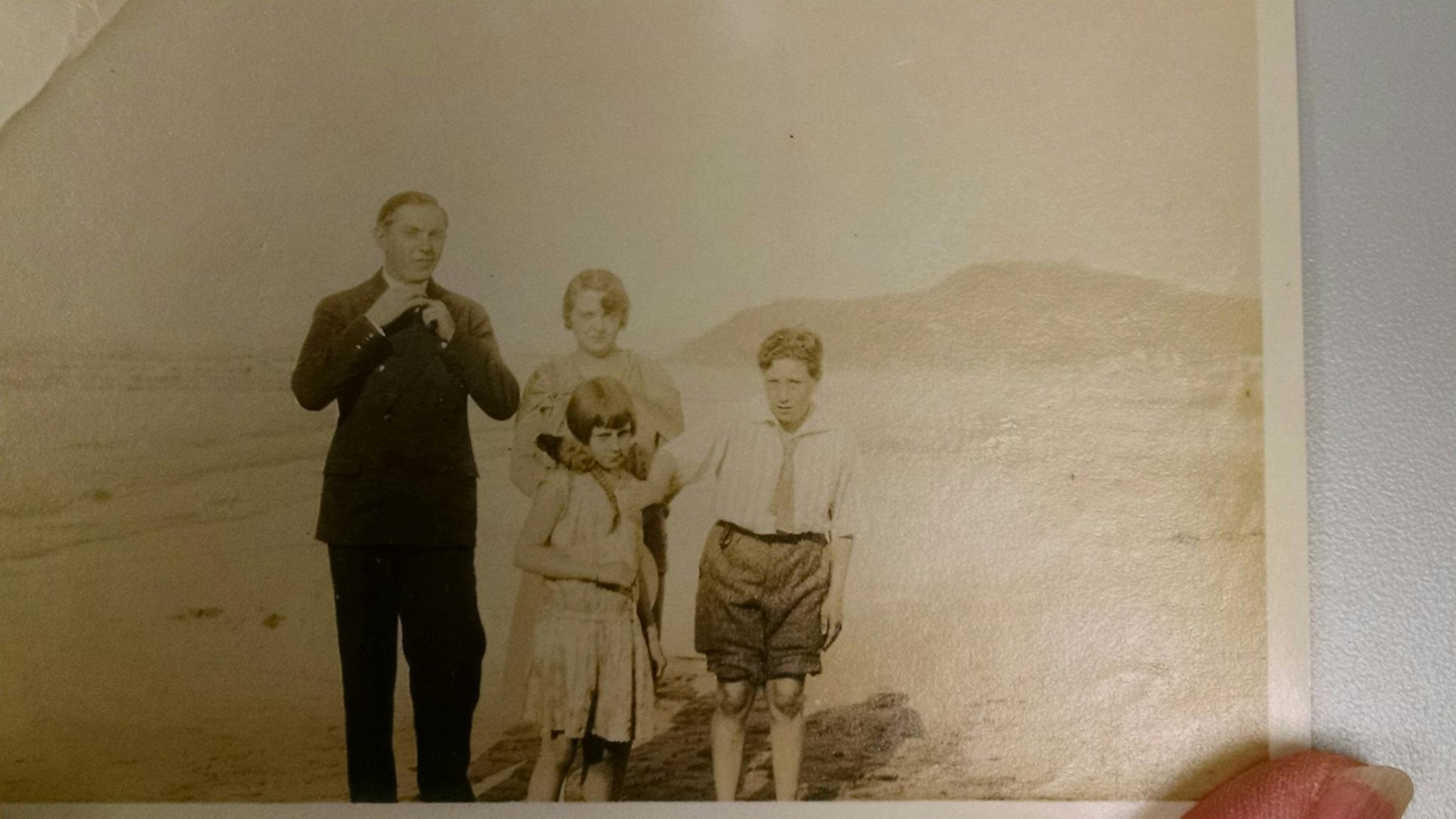
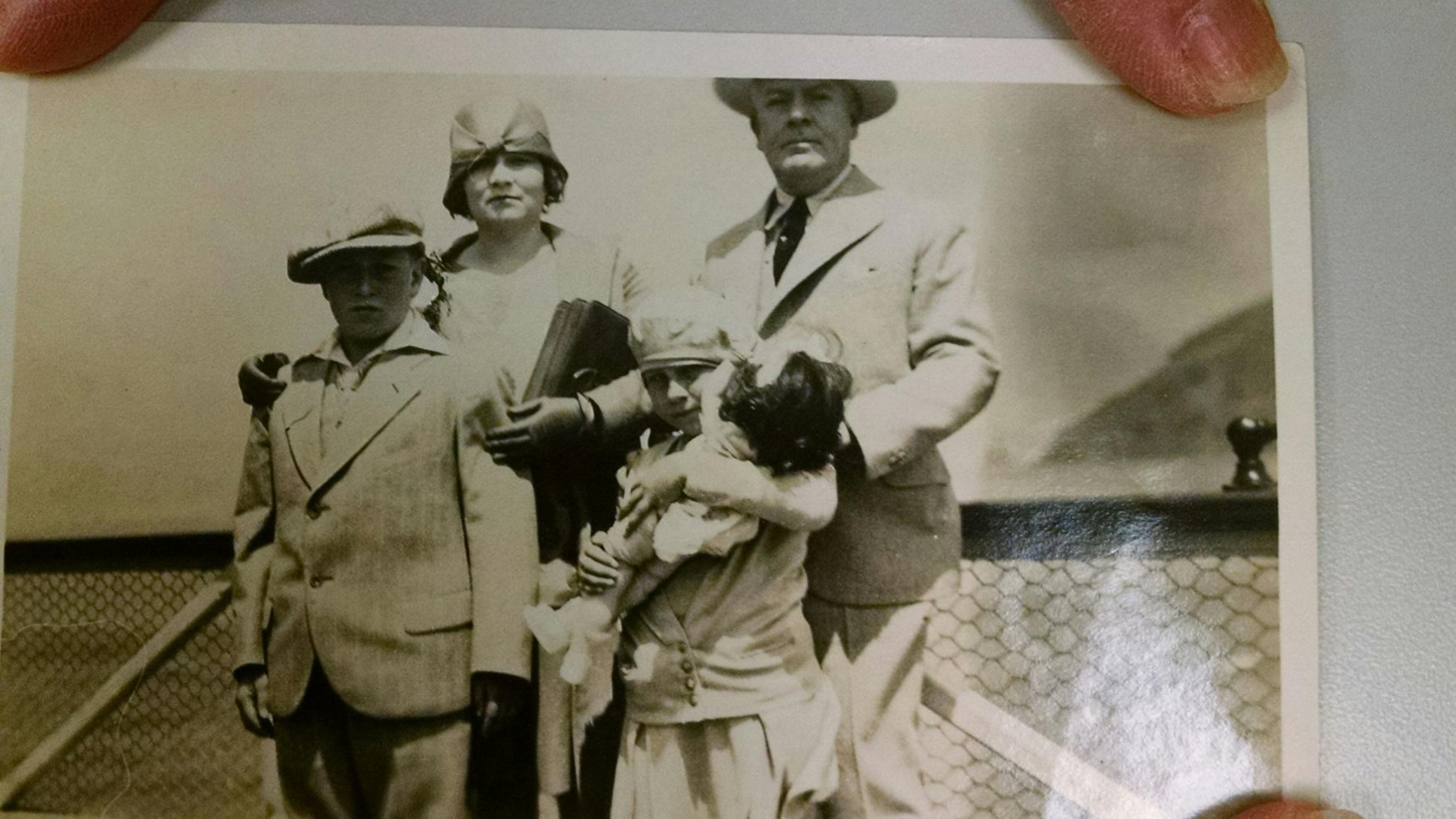
Emilio de Jauregui, left, and  Stella de Jauregui, back, and their children Emilio Ricardo , right, and little Stella, center. Thought to be a beach in San Sebastian

Emilio de Jauregui, left, and Stella de Jauregui, back, and their children Emilio Ricardo , right, and little Stella, center. Thought to be a beach in San Sebastian

Having traced a tenuous link between the brightly colored ticket stub and the little family photographed on the beach, I feel a sense of satisfaction. So, this is where you come from, I think to the ticket. These are the hands that accepted you from the ticket clerk, sliding you into a jacket pocket or, perhaps, into a small clutch-style handbag. I focus on the little girl in front, my great aunt, Auntie Stella, imagining her holding out her hand for the ticket, turning it over and over before resting it (with the epic struggle between bull and steed facing out) on the top of a bureau in their temporary San Sebastian residence. Yet, as I stare at the photograph, it occurs to me that these faces, despite being directly related to me, are as unfamiliar as strangers. Indeed, as I inspect the various photos my mother has sent me, I sometimes have trouble picking out who is who. With not a little chagrin, I reflect that while I can spot a random celebrity in a crowd photo, I cannot spot my own relatives. I stare harder at the beach photograph, hoping to imprint their features in my memory. I try to connect the scene with what I have been able to discover about their lives. Who are you? What are you like?

I focus particularly on my great grandfather, the elder Emilio. In the photo, he stands just apart from his family, his head turned to his left so that he can adjust his tie. There is something in his posture that strikes me as at once as being both debonair and uncomfortable. In his handsome double breasted suit, he looks like he is ready to sit down for a dinner party not a day at the beach. When I mention this detail to my mother, she passes on an anecdote she heard from Auntie Stella. While everybody changed into their bathing outfits to jump into the surf, Emilio would sit on the beach under an umbrella, fully clothed. Auntie Stella could not recall a time when her father even took off his shoes. Glancing again at his face, pulled into a slight grimace due to his effort with the tie, I wonder what his smile looks like and how often he uses it. I look through the other photos. Hmm, not even a ghost of a smile. Why so serious? Perhaps, it has something to do with his obligation to uphold the de Jauregui reputation. Or, perhaps it has something to do with being the second son. According to my Uncle Phil, the de Jaureguis are connected through marriage and relations to some of Latin America’s most influential families at the time, with ties that crisscross not only Central America but also the United States and Europe. Although this influence brings status and power, it also brings responsibility. As the youngest of four, Emilio is the baby of the family. His elder brother (technically, stepbrother), John, would mostly likely be expected to take point, taking over as head of the family affairs. However, Emilio cannot simply be the baby of the family for the rest of his life. He must do his part to preserve the family’s image of respectability. And, what is more respectable than a dental surgeon?

The de Jaureguis, circa 1930s,

The de Jaureguis, circa 1930s. Young Emilio and Stella (clutching a doll) standing with their parents on what appears to be the deck of ship.

Emilio graduates from the University of Pennsylvania in either 1900 or 1901 (my mom has graduation certificate, but could not be reached at the time I am writing this). In a recent email, my uncle mentioned that Emilio went on to practice in London during the early 1900s, helping to reconstruct the faces of soldiers coming home from the war front. I look back at Emilio’s face. Maybe I have gotten it wrong. Maybe he is serious because he realizes how fragile it all is. When he looks into the faces of those around him, does he see the wounded faces of the soldiers? Emilio retires from dentistry fairly early. By the time the photograph is taken (circa the 1930s), he is already several years into retirement. Yet, this is not a man who is not willing to let down his guard, to simply rest on his laurels. Rather, this is a man who keeps a tight grip on his image, even during a day on the beach.

A Passenger list for U.S.S Wyoming dated 1936, listing the de Jaureguis. Note their occupations.

A Passenger list for U.S.S Wyoming dated 1936, listing the de Jaureguis. Note their occupations.

A Day at the Bullfights: Connecting the Dots of Family History

IMG_0572

The OED defines the word “ticket” as a “short written notice or document.”  As I continue to research the ticket stub handed down by my matrilineal great grandparents, I realize just how apt this definition is. As I noted in the last post, a ticket offers proof of one’s presence in a particular place and a particular moment in time. It is a wonderfully specific little record. Unfortunately, not all records are so specific. While the ticket still stands like signpost, pointing me towards my family history, I find that the roads around the signpost have been obscured through disuse, forgetfulness, and, in some cases, calculated destruction. In my attempts to discover who exactly this ticket belonged to and what it was for, I find myself treading heavily into speculative territory. I hope that at some point, I can come back with a more definitive story. However, for now, I think I have just enough information to get a sense of what happened in San Sebastian on September 6, 1931.

Like most family histories, my mother’s family history is a murky mix of sometimes whimsical, often embellished stories and old photographs with the occasional date and name on the back. So, before attempting to answer the much more difficult question of who the ticket belonged to and why it was saved for so many years, I decided to figure out what the ticket was for. The eye-catching image of the man on horseback fending off a bull suggested that it was a ticket for a bullfight. Testing this hypothesis seemed like a good place to start. However, I soon found that despite the marked popularity of bullfighting in Spain, it is not easy to find information on the Playa de Torros in San Sebastian. This difficulty is due partially to my very limited ability to read Spanish which was, inevitably, the language of many of the web sites turned up by Google Search.

The scarcity also comes from a tendency to pass over San Sebastian’s bullring in order to praise Spain’s more widely venerated rings including those in Madrid and Pamplona. This tendency extends even into more academic writing on the topic. For example, San Sebastian is mentioned only a handful of times in Adrian Shubert’s rather helpful history of Spanish bullfighting, Death and Money in the Afternoon, and none of these reference the ring itself. However, he does note that San Sebastian was a popular summer destination for the Spanish as well as other Europeans, particularly people from France who arrived by trains “bursting at the seams” (Shubert 118).

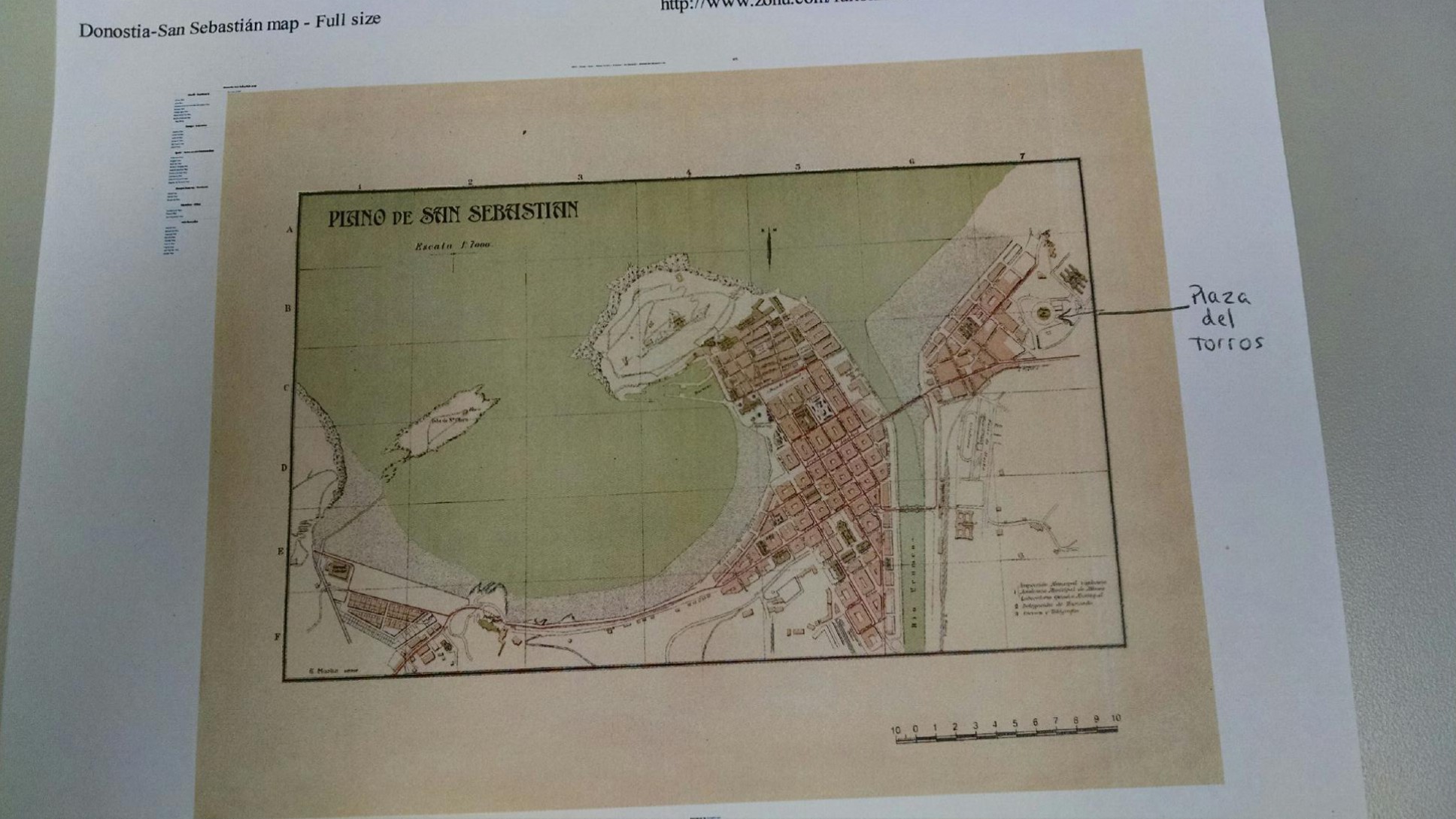
A map of San Sebastian. The Playa de Toros is located on the right.

A map of San Sebastian. The Playa de Toros is located on the right.

Located on Spain’s northern coast near the border with France, San Sebastian is graced with beautiful beaches ringed with mountains, making it a breathtaking vacation locale. However, Shubert argues that it was its bullring that really gave San Sebastian a competitive edge over other similar cities. He cites one source who remarks that cities like San Sebastian “understood that to attract the largest number of visitors it was necessary to include the bullfight among their attractions” (30). San Sebastian had it all, making it appealing to a wide range of people, including celebrities such as Charlie Chaplin.

Charlie Chaplin, at the Playa de Toros (aka El Chofre)  in San Sebastian on August 9, 1931. See citations for hyperlink to original article.

Charlie Chaplin, at the Playa de Toros (aka El Chofre) in San Sebastian on August 9, 1931. See citations for hyperlink to original article.

One newspaper article I found reports that Mr. Chaplin observed a bullfight for the first time at the San Sebastian arena  just a month before my great grandparents attended (ABC foto). Bullfighting seems to have functioned as one the city’s primary social focal points, offering a center that allowed the city’s visitors (including my great grandparents) to gather and mingle with the noteable and famous and the not so notable and famous. Yet, while Shubert’s depiction of San Sebastian offers some clues as to why Emilio and Stella would have chosen to vacation there, it does not offer much information about my ticket stub. After much searching on my part, it is my sister, Holly Bruce, who makes a breakthrough, turning up a poster advertising a “Gran Corrida de Beneficencia” in San Sebastian on September 6, 1931.

My sister's find: A poster adverting the bullfight attended by Emilio and Stella (and possibly their children). Found on a French auction site.    http://www.briscadieu-bordeaux.com/index.php?resultpage=14&action=fiche_vente&langue=fr&id=149

Lot 408 or My sister’s find: A poster advertising the bullfight attended by Emilio and Stella (and possibly their children). Found on a French auction site. See citations below for hyperlink to original page.

Setting aside my affronted sense of sibling rivalry, Holly’s find answers all of the questions I raised in the last post about the ticket.  Not only does the poster fill in the words missing from the front of the ticket, but it reveals what the ticket was for. The word corrida, which so prominently occupies the lower left half of the poster, translates to “bullfight.” Meanwhile, the phrase A favor de la Casa de Misericordia y Hospital de San Antonio Abad, written in thin black script underneath the date and the time, roughly translates to “In favor of the House of Mercy and the San Antonio Abad Hospital.”  The text in the bottom left indicates that there will be eight bulls (8 Hermosos Toros) at this event while the text in the right hand corner lists the names of the matadors in the order that they will appear. Now the only question is, who did the ticket belong to and why did they save it?

Emilio de Jauregui, left, and  Stella de Jauregui, back, and their children Emilio Ricardo , right, and little Stella, center. Thought to be a beach in San Sebastian

My Great Grandparents: Emilio de Jauregui (left) and Stella de Jauregui (back) with their children, Emilio Ricardo [my grandfather] (right) and little Stella (front). Thought to be a beach in San Sebastian

    Here is where we step into the speculative realm of family history, a place ripe with the potential for error. Indeed, I have already stumbled across one error in my last post. In a recent discussion with my mother, she mentioned that her father, Emilio Ricardo de Jauregui, was born in 1917. I did some math. That would make him fourteen in 1931, certainly old enough to attend the bullfight. Similarly, his little sister, Stella, (my great grandparents were perhaps not incredibly inventive when naming their children…) would have been eleven, perhaps just old enough to attend as well although the bullfights could be particularly gruesome making this seem a little unlikely. Still, it is possible than that this Sunday outing might have been a family affair.

It is also possible that my great grandparents attended the event on business rather than pleasure. According to my uncle, Philip de Jauregui, Emilio Senior served as diplomat for El Salvador during the family’s time in Paris (a space of about six years between 1928 and 1934) although the position might have been more ceremonial than political. If this is accurate, then it would certainly make sense if the Salvadoran diplomat attended a charity bullfight, a move that would certainly be noted and probably positively received by the French and Spanish alike. Yet, the stern man featured in the photo above does not seem like the type to save a ticket stub. Perhaps it was my great grandmother, the serious lady standing to his left. My mother has her own supposition. She believes that it was the little girl in front, my great aunt Stella. Even if she did not attend the event herself, it is possible that her mother, father, or, even her brother gave the stub to her to make up for what she had missed. Or, perhaps she was simply drawn to the ticket’s aesthetic qualities. It is certainly beautiful enough. While there is no real evidence to believe she was the one who preserved the ticket all this time, it was little Stella that kept most of the family lore, collecting photos, mementos, and documents and stashing it in her California apartment. With Stella’s death in 2004, my mom’s connection with her past was significantly weakened, leaving us all to connect the dots on our own.

Perhaps we have connected the dots wrong. However, this seems to trace a tentative path back to that ring, back to the crowds shouting, and the dust rising off the arena as the matador dodges another thrust of bull horns. It traces a path back to the frozen faces of that little family huddled together on a beach, squinting at the camera, waiting for the flash so they can move again.

Works Cited

ABC foto. “Charlot va a los toros.” ABC foto. DIARIO ABC, S.L. 22 July 2014. Web. 28 Jan. 2015.

http://www.abc.es/abcfoto/anverso-reverso/20140721/abci-chaplin-charlot-toros-charles-chaplin-chofre-201407181827.html

Gran Corrida Poster. Briscadieu Bordeaux. http://www.briscadieu-bordeaux.com/index.php?resultpage=14&action=fiche_vente&langue=fr&id=149 Web.

Martin, A. “Donostia-San Sebastian.” 1.700 “Zonu.com” http://www.zonu.com/fullsize-en/2011-02-08-12920/Donostia-San-Sebastian-map.html#.VM2zqgcpk10.email (30 January 2015).

Shubert, Adrian. Death and Money in the Afternoon: A History of the Spanish Bullfight. New York: Oxford UP, 1999. Print.

“ticket, n.1.” The OED Online. Oxford University Press, December 2014. Web. 1 February 2015.

Proof of Purchase and Presence: A Ticket Stub from San Sebastian’s Plaza de Toros

IMG_0570

Front side of the Ticket

IMG_0573

Reflecting on a Struggle

When I told my mother that I was enrolled in a class studying the role of objects in shaping both our personal lives and our cultural heritage, she immediately offered to dig up as many family mementos as possible. One of the several items that she excitedly passed along to me on a recent visit is a ticket stub, dated September 6, 1931, for an event at the Plaza de Toros in San Sebastian, Spain. It was likely purchased by my great grandparents (my mother’s father’s parents), Stella and Emilio de Jauregui-Blanco, while they were living in France.

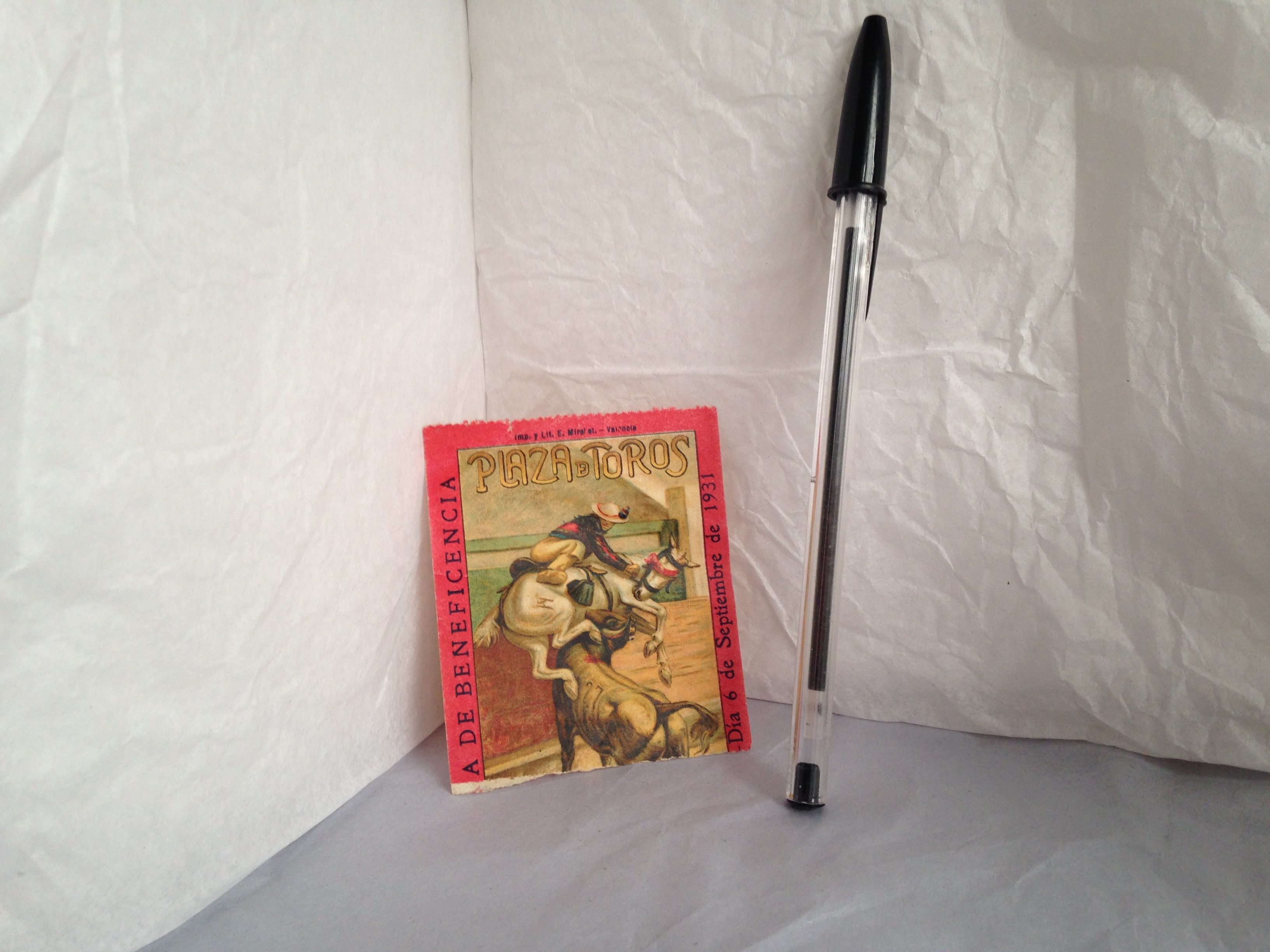
Just shy of three inches long and two and half wide (for those who prefer exact measurements, the dimensions are 2” by 2”), the ticket stub is no bigger than a gum wrapper and just as thin. It appears to be printed on paper. Yet, despite its thinness, this paper is surprising strong. When given a gentle tug, the ticket does not rip as one would expect, but springs back, not unlike a dollar bill.  It is possible, that, like dollar bills, the paper is combined with cotton or linen, making it more resilient to wear and tear as well as better able to absorb and retain ink during the printing process.

Indeed, it is the printing on the ticket that transforms it from a mere scrap of paper (a gum wrapper to be tossed away) into a cultural artifact signifying not only a purchase but also a presence. One side of the ticket features an incredibly detailed tri-color print of a man mounted on a white horse trying to evade the rush of a muscular grey bull. The horse’s eyes have been blindfolded with a red bandana and, if you look quite closely, the bull’s shoulder is shaded with a little bit of red, imbuing the scene with a palpable tension. At the top of the scene, a dramatic font proclaims in shades of yellow “Plaza de Toros.” I am tempted to imagine that the ticket is for a bullfight not unlike the one depicted, but nothing else on the ticket directly suggests this.  The only clue to the circumstances of the event appears in the red margins that border the scene. To the left of the bullfighter, and running perpendicular to the scene, are the words de beneficencia, “of charity,” suggesting that perhaps this was a charity event of some kind. However, the beginning of the phrase, which might have revealed the beneficiaries of this charity at least, has been ripped off, possibly by a ticket collector as my great grandparents made their way into the Plaza.

IMG_0571

Reverse Side of the Ticket

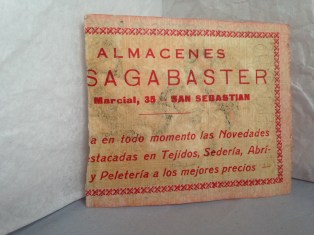
The reverse side of the ticket appears to be an advertisement for shops (almacenes) in the area. The red italic script in the lower half of the stub promise fabrics (tejidos), silk/screenprinting (sederia), and leather goods (peleteria) at the best prices (a los mejores precios ). It is interesting to imagine whether or not my great grandparents paid any attention to this advertisement, choosing perhaps to go to the address listed in bold red letters (the first half has been ripped off, leaving me lost, unable to trace it exactly) to buy trinkets for their son, my grandfather, who would still have been quite young at the time and not ready to attend a potentially dusty, crowded event at the Plaza.

Emilio de Jauregui-Blanco, a citizen of El Salvador, would eventually move his family back across the Atlantic, finally settling in Guatemala. Moving is a daunting process under any circumstances, and I can only imagine that a transatlantic move would be especially so, requiring the family to choose what they absolutely would not part with and what could stay behind in Europe. Somehow, this little ticket stub made the cut, successfully traversing both the ocean and three generations to make it into my hand. Certainly, it has little or no monetary value, nor will it ever grant me access to an event in the Plaza. However, what it does have to offer is far more meaningful. It offers me a physical link to my great grandparents. And, while I cannot say for sure what exactly they did on September 6, 1931, I can tell you it was significant. I have the ticket to prove it.

IMG_0579

Some Perspective