Letters, Journals, and a Good Friend

To preface my analog experience, a short history of my friendship with Molly Mueller (a friend from Cornell) is necessary. We met the summer before our freshman year but, we lived a few hours apart and had no means of communication. Over the years we ran into each other a few times, but we were never given the chance to connect and get to know one another. We somehow started writing letters as our main form of communication roughly two years ago. These letters were sporadic as we both lead busy lives, yet, through these letters, we connected and got to know each other. As our lives are busier than ever, we have not written in several months. We talk on the phone occasionally, but our previous means of communication have become something of the past.

           When deciding my analog experience, I immediately wanted to write a letter, but letter writing is something I do often which contradicted the prompt of the exercise. However, after thinking a little more I realized I hadn’t written a letter since the summer, and even longer since I had written Molly. I decided to write Molly a letter, not the typical kind where we have a topic that we critically argue about, but one that would replace the phone calls we have now about our lives. As of late, our phone conversations consist of relationship or life advice when our emotional peace is disrupted. I devoted an hour at my desk, with my AirPods in, my diffuser diffusing lavender, and a cup of tea in hand to write this letter. I wanted it to replicate the therapeutic phone calls we’d been having.

           While therapeutic writing is something I do often in a personal journal, writing in the vulnerable state I wanted to replicate from our phone calls to someone was a challenge. At times I felt I should hold thoughts and feelings back. This was confusing as I am beyond comfortable sharing on the phone or in-person with her. The act of putting it on paper and sending it was slightly nerve-racking. As I talked myself out of being uncomfortable with the form in which I was sharing the emotions I had been feeling the words began to flow. I became excited that she would be able to read and reread to fully understand my view on what was going on. The realization that she could absorb the information and write back excited me in that she could develop her ideas in a way that is not possible on a 45-minute phone call.

           After I wrote the letter, which came out to be roughly four pages, I reread it to check for grammatical errors and to make sure it made some sense. I usually am all over the place when it comes to emotions that are not completely clear to me. The rereading of my letter was the most profound part of this analog experience. Since I journal regularly, I am used to writing about my feelings and emotions, but I never read over what I write. When I finish a notebook with entries it goes straight to a bin, I keep random sentimental objects in. As I read through what I had written I saw my emotions in a different light. This led me to grab a journal I had filled a few weeks ago and go through some entries. This was something I had never done before, and I was amazed by how closely the letter I had written, and my journal entries resembled each other. I had originally struggled with the idea of writing my emotions for someone else to read. I was surprised by how similar the flow and rhetoric were. The unconscious writing style that I had developed in my journal came through in this letter.

           Writing the letter rather than having a phone conversation became much more than fulfilling my analog experience. I found my style of writing reflected my journal writing style. Until this experience hadn’t recognized my particular journal writing style.
Horses in New Paltz

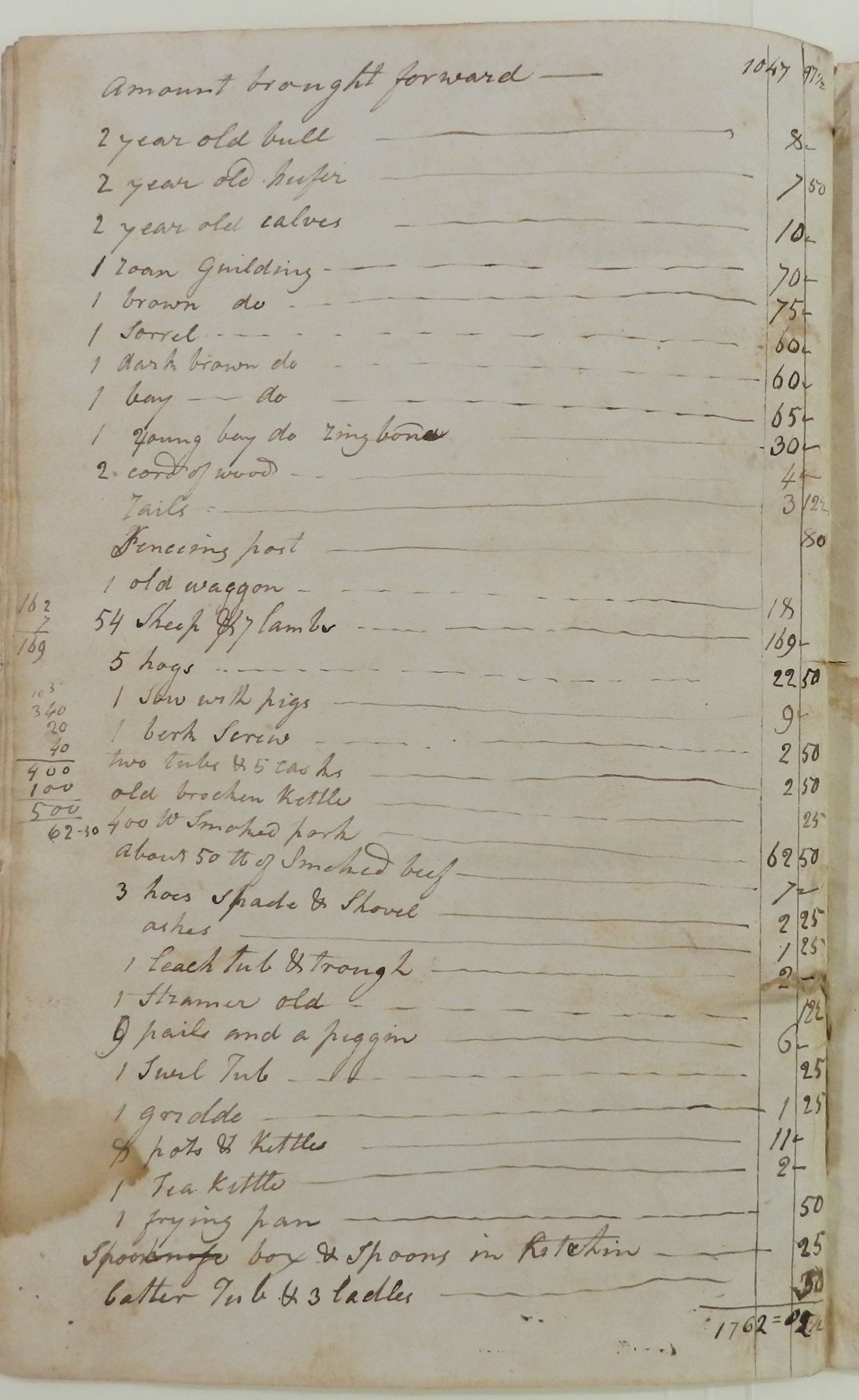
The Estate of Cornelius DuBois from 1816 details the belongings from his farm and farmhouse in New Paltz New York. A descendent of Cornelius DuBois, Jennetje, a granddaughter of Cornelius married Jacob Hasbrouck. The Hasbrouck family has ties to the original Huguenot settlers in New Paltz. Cornelius DuBois helped build the DuBois Stone House on 347 Main Street in Catskill New York which is now a historic house in the area. The DuBois family was also part of the early settlers in the area. During this time it was very common for farms to have slaves and the DuBois family was no exception. Part of the Estate details specific slaves that were considered property of Cornelius DuBois.

The itinerary of the estate includes a vast number of belongings from horses to broken tea kettles. The objects included in the estate give insight into the ins and outs of farm life in New Paltz during the 1800s. Agriculture has long been a prominent system in New Paltz and continues to provide many inhabitants with economic stability. Farms in the area were established early on which meant the designs were outdated in comparison to areas that were settled later. The structures on farms were geared toward drying wheat and then started to be remodeled in the mid-1800s to accommodate more hay that was demanded with the growth of many farms. The DuBois estate had some cattle but more horses at the time of Cornelius’ death. This fit into the period of New Paltz history when horses were needed for almost all day-to-day tasks that humans could not complete. With the invention of tractors and other machine-powered equipment horses became less prominent. 

In the document, horses are listed as a “do” which means horse. Several dos are seen throughout the estate with varying price tags. A “dark brown do” was priced at 60 dollars while a “brown do” was priced at 75 dollars. The health of the two animals likely played a role in their pricing. A sorrel is also listed which describes the coloring of the horse’s coat. These horses usually have a reddish color with little to no black coloring. The document provides no insight into what each horse was used for, but their prices are good indications of their age and health.

The structures on farms are dictated by the animals and crops being utilized on the property. Larger farms often included structures used for appliance maintenance and machinery storage. In the document, many of the items probably resided in the barns like the harnesses for horses that are listed. They are a pivotal part of making use of the animals in that they attach to plows and wagons used on the farm. The harnesses were priced at 6 dollars which shows the high quality of the equipment. These farms had shops and garages that required the construction of new structures. Stables continued to be needed in that horse-drawn carriages were still utilized by many families in their endeavors. The remodeling came a bit after the death of Cornelius DuBois, so they were not found on the particular estate.

Hay production on farms in New Paltz was a major source of income for many farms. In the estate, hay barns make up a fair sum of money. The “hay in the barracks” was listed for 27 dollars which probably accounted for a large amount of hay. While the “hay in small hay house” was listed at 3.50 dollars which likely is a small amount but it held some value so it was put in the estate. Structures on the property were also geared toward the storage of hay. As mentioned, there was a small hay house and a large hay house both of which contained the valuable commodity. The demand for hay in New York City grew as the city developed. Hay was used to feed horses and when railroads were getting laid in the area the demand for hay grew. Horses were a massive part of the community in that they dictated the crops grown and allowed daily operations to be run smoothly.

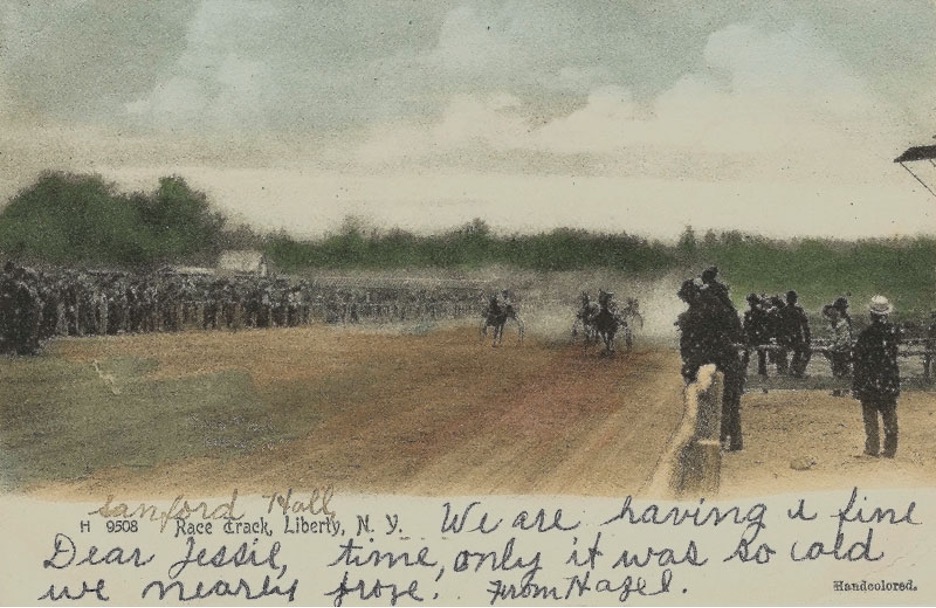
Horses were also involved in entertainment during this time in the form of a racetrack. The racetrack in Wallkill is thought to have begun on July 5, 1897, according to Historian Klinkenberg. It was a half-mile track that ran during the summer where thousands of people often congregated. The horses listed in the estate most likely did not race at the racetrack but instead were used on the farm.

Sources

“Dubois Family Association.” DuBois Family Association, Historic Huguenot Street, https://www.huguenotstreet.org/dubois.

Larson, Neil. “Village of New Paltz Reconnaissance-Level Historic …” Reconnaissance-Level Historic Resource Survey, Village Historic Preservation Commission New Paltz, New York, https://www.villageofnewpaltz.org/download/historic_preservation_commission/Historic_Preservation_Documents/I-Overview.pdf.

Wadlin, Vivian Yess. “Racing Hearts.” Abouttown, Abouttown Ulster, http://abouttown.us/articles/racing-hearts/.

The Letters That Make Frankenstein

Letters have been part of human society since ancient Egypt and India. Paper is a relatively new medium for letters. In a story from the Roman poet Ovid, there is a reference to a letter written on an apple. The prominence of paper has since removed apples as a medium for letters, but long-ago people wrote letters on whatever they could get their hands on. Early letters were generally used to communicate with people and to send information. The purpose of letter writing has changed very little over time, the modern letter can look like an email that holds the same purpose as a letter written on an apple.

The story of Frankenstein is passed on through a tale told by Victor Frankenstein in the form of several letters written by Robert Walton to his sister Margaret Saville.  The format of a novel like Mary Shelly’s Frankenstein told through letters is considered an epistolary novel. This tactic of writing allows the reader to feel as if the story is being told to them directly. The connection the audience feels with the story enhances the plot and emotional connection to the characters. The use of letters bridges the gap between private and public storytelling which Mary Shelley uses to her advantage. By having the reader see into private letters between Walton and Margaret, Shelley can portray the story as one told among acquaintances rather than one that is given to the public. The letters themselves are physical objects that build the story. The intangible entity that is a story is constructed through the tangible object of letters.

The novel contains more letters than those between Walton and his sister. Throughout the story, letters between Victor and Elizabeth pop up. These are different from the ones from Walton in that they help tell the story rather than frame the plot. These letters give the reader firsthand insight into how Elizabeth and The novel contains more letters than those between Walton and Victor are feeling. The use of these letters takes the account that Victor is giving Walton and allows the audience to understand how Elizabeth is thinking while Victor is not in Geneva. These letters make the story far more personal than if they were not included.

The story of Frankenstein begins and ends with several letters that could seem out of place when thinking of general information already known about Frankenstein. The letter at the beginning frames the story by giving some background to how the story is being told. The letters at the end bring the story full circle, making the ones at the beginning make complete sense. These several letters are objects that allow the story to be passed on. The letters bring the story into existence which makes it one of the most important objects in the story. These objects create the story that is an epistolary novel. This type of writing became popular in the 18th century because during this period letter writing was in its hay day. This period is considered the “great age of letter writing” and came with the increasing popularity of epistolary novels. Shelley likely wrote Frankenstein around this time and published it in 1818. The period she wrote the novel probably influenced the structure in the way of it being in the epistolary form.

Mignone Hall of Minerals and Gems

The American Museum of Natural History houses many wonderful exhibits one in which is the Mignone Hall of Minerals and Gems. This massive exhibit accounts for around 5,000 specimens. The space it occupies is 11,000 square feet but that accounts for meteorites displayed in the hall which are not part of the mineral and gems collection, so the square footage of the rest is a bit lower.

The collection has evolved over the years with many additions and the occasional loss of specimens when burglars find their way in as was the case with the Star of India (a special piece in the collection). It was quickly found but other stolen that night have never been found. The collection first opened in 1869 at the American Museum of Natural History. Originally it was displayed at the Old Arsenal Building in Manhattan where there were around 7,000 specimens.

The Allison and Roberto Halls of Gems and Minerals is in the American Museum of Natural History in Manhattan on the 1st floor of the museum. Upon entering the dark room, you are greeted by a huge amethyst geode measuring at 12 feet tall. Once you get past this very large focal point, you are then surrounded with many glass cases filled with minerals categorized by different mineral groups, rock specimens that have mineral inclusions, and large mineral specimens, such as the 12 ft tall amethyst and stibnite. One glass case in specific shows different types of quartz, including grape agate from Indonesia, while another includes minerals formed from magma, including quartz, topaz, and beryl. Off what could be considered the “main gallery” is a room that contains precious stones along with examples of raw gems and their cut & finished counterparts.   

    The Mignone Halls of Gems and Minerals is designed to tell its visitors how mineral species formed, how they are classified and studied, and how they are used as personal objects, tools, and even technology. In total, the galleries show more than 5000 specimens from around 98 countries. The Hall closed in 2017 to undergo a redesign worth around $32 million and reopened to the public recently last June.

    According to a June 2020 to 2019 financial statement from the museum, most funding comes from government grants, revenue, as well as from donor donations.

Sources

“Title of Section.” Title of Website, Publisher or Sponsoring Organization, Date of publication or last modified date, URL. Accessed Date Month (abbreviated) Year.

“Allison and Roberto Mignone Halls of Gems and Minerals Will Open Fall 2020.” American Museum of Natural History, https://www.amnh.org/about/press-center/mignone-gems-minerals-fall-2020. Accessed 04 Oct. 2021.

“Allison and Roberto Mignone Halls of Gems and Minerals.” American Museum of Natural History, https://www.amnh.org/exhibitions/permanent/gems-minerals. Accessed 01 Oct. 2021.

“American Museum of Natural History.” Crunchbase, https://www.crunchbase.com/organization/american-museum-of-natural-history. Accessed 04 Oct. 2021.

Castillo, Augusto. “Mignone Halls of Gems and Minerals.” GIA, https://www.gia.edu/gems-gemology/summer-2021-gemnews-mignone-halls-of-gems-and-minerals. Accessed 01 Oct. 2021.

“Consolidated Financial Statements Together with Report of Independent Auditors: The American Museum of Natural History.” American Museum of Natural History, https://www.amnh.org/content/download/325415/5011081/file/Consolidated%20Financial%20Statements%20for%20Fiscal%20Years%20Ended%20June%2030,%202020%20and%202019.pdf. Accessed 04 Oct. 2021.

Dukes, Tanya. “Some Famous Gems Get a New Setting.” The New York Times, 23 Oct. 2021, https://www.nytimes.com/2021/05/23/fashion/jewelry-gems-american-museum-of-natural-history.html. Accessed 01 Oct. 2021.

“George Frederick Kunz.” Wikipedia, https://en.wikipedia.org/wiki/George_Frederick_Kunz. Accessed 01 Oct 2021.

Hennings, Juli and Harry Lynch. “The Star of India.” EarthDate, Bureau of Economic Geology, https://www.earthdate.org/node/125. Accessed 01 Oct 2021.

Jordan, Sarah. “Famous Gemstones: The Star of India Sapphire.” The Gemmological Association of Great Britain, https://gem-a.com/gem-hub/gem-knowledge/famous-gemstones-star-india-sapphire. Accessed 01 Oct 2021.

“The Famous New York Subway Garnet.” Diamondoodles, January 27,  https://www.diamondoodles.com/blog/the-famous-new-york-subway-garnet. Accessed 01 Oct 2021.

Polymer EVA Sandals

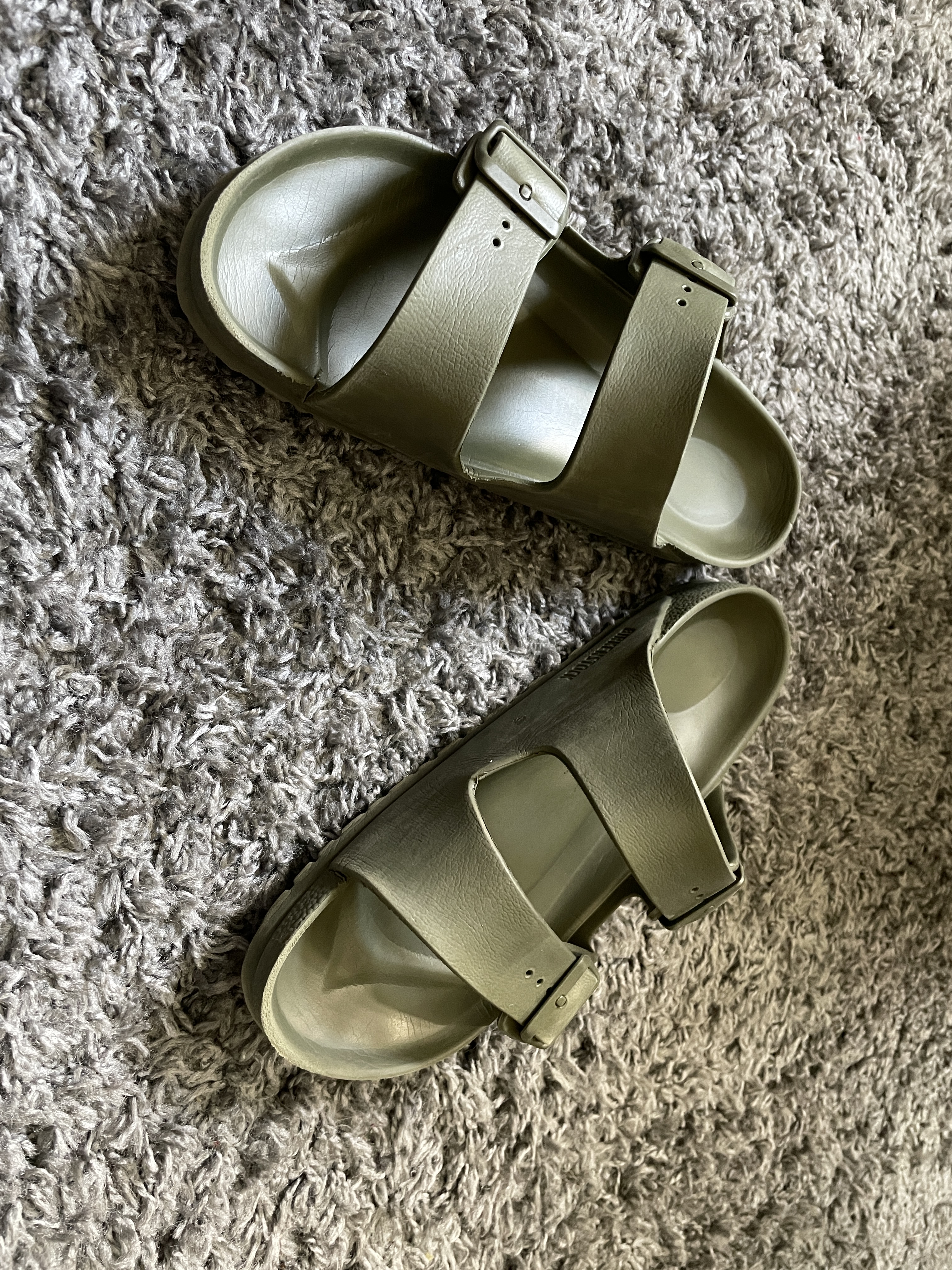
The summer of 2021 was one in which I wore the same pair of boots almost every day. They were functional, comfortable, and (if I say so myself) quite good-looking. This was not an issue until I started thinking about moving back to New Paltz where I would not want to wear the same, beaten and stained leather boots each day. So, I decided to purchase a pair of sandals that a friend of mine wears all the time. The forest green closed cell foam (basically a type of plastic that does not have bubbles between the material) Birkenstocks were on the top of my list for items I wanted for school. I did some online research that brought me to the Birkenstock website. My thrifty self found a solid student discount which solidified my choice to purchase the sandals.
Birkenstock plastic sandals are branded as polymer EVAs which holds little to no meaning for the common person. Ethylene-vinyl acetate (EVA) is a commonly used material that has desirable qualities for plastic sandals. It is lightweight, waterproof, and very elastic which makes it a versatile option when making plastic shoes. Crocs and various other plastic shoes utilize EVA to make quality footwear.

The specific manufacturer that supplies Birkenstock seems to be hidden in some hole in the abyss of the internet but based on Birkenstock’s vow to hold dealings in Germany, one can speculate the company Biesterfeld is the supplier. They are a family-owned company based out of Germany that provides over 30 countries with various plastics. They are known for EVA, so my best guess is they supply Birkenstock with the plastic used for the polymer EVAs.

The production of EVA happens through a process in which the compounds ethylene and vinyl acetate are mixed then compressed under significant pressure to create the material. It typically leaves the high-pressure reactor in long sheets that are then sent off to the companies that use the material. This allows companies like Birkenstock to work the closed cell foam in whatever way they need to.

The metal buckle that holds the straps across the sandal holds mystery when it comes to their origin. Birkenstock’s website delves into the quality of the metal but does not have any sourcing information. The nickel-free metal that is used has the company name etched on the side. The metal is enameled several times which prevents wear. The protective enamel allows the buckle to last longer while maintaining its original glory.

These sandals that typically go for $44.95 are made in Germany. The company prides itself on having their manufacturing happen in the country they are based in. From a quick Google search about where they are made one can gather the working conditions in the factories are ethically acceptable. They claim to have the best working conditions in their production factories which makes me (the consumer) feel better about purchasing new sandals. The steep price points of many products from Birkenstock reflect the fair wages paid to their employees.

Companies such as Birkenstock are fascinating in their ideas about keeping production close to home. They have created a company that consumers do not have to feel bad about purchasing from. Fair treatment of workers and sourcing locally each have their financial drawbacks that Birkenstock is willing to endure to run an ethical company.    

Alan Gartner: A Watch With A Story

My grandfather, Alan Gartner, was an amazing man and one of the most compassionate and caring people I have met. The details in my memories of him are vague and far between, but that does not take away from my admiration of him. His passing, after a lengthy battle with Parkinson’s disease, when I was fourteen, devastated my entire family. The impact he had on people can be seen in each of his three children, as they hold him in extremely high regard. My mother and her extended family share countless stories of the mitzvot (a loosely translated Hebrew word for good deeds) that illustrate his prowess in the endeavors he took on. I feel I should point out that my family does not feel this way about many people. In fact, the opposite is true when it comes to folks that we feel do not encapsulate qualities Alan held.  

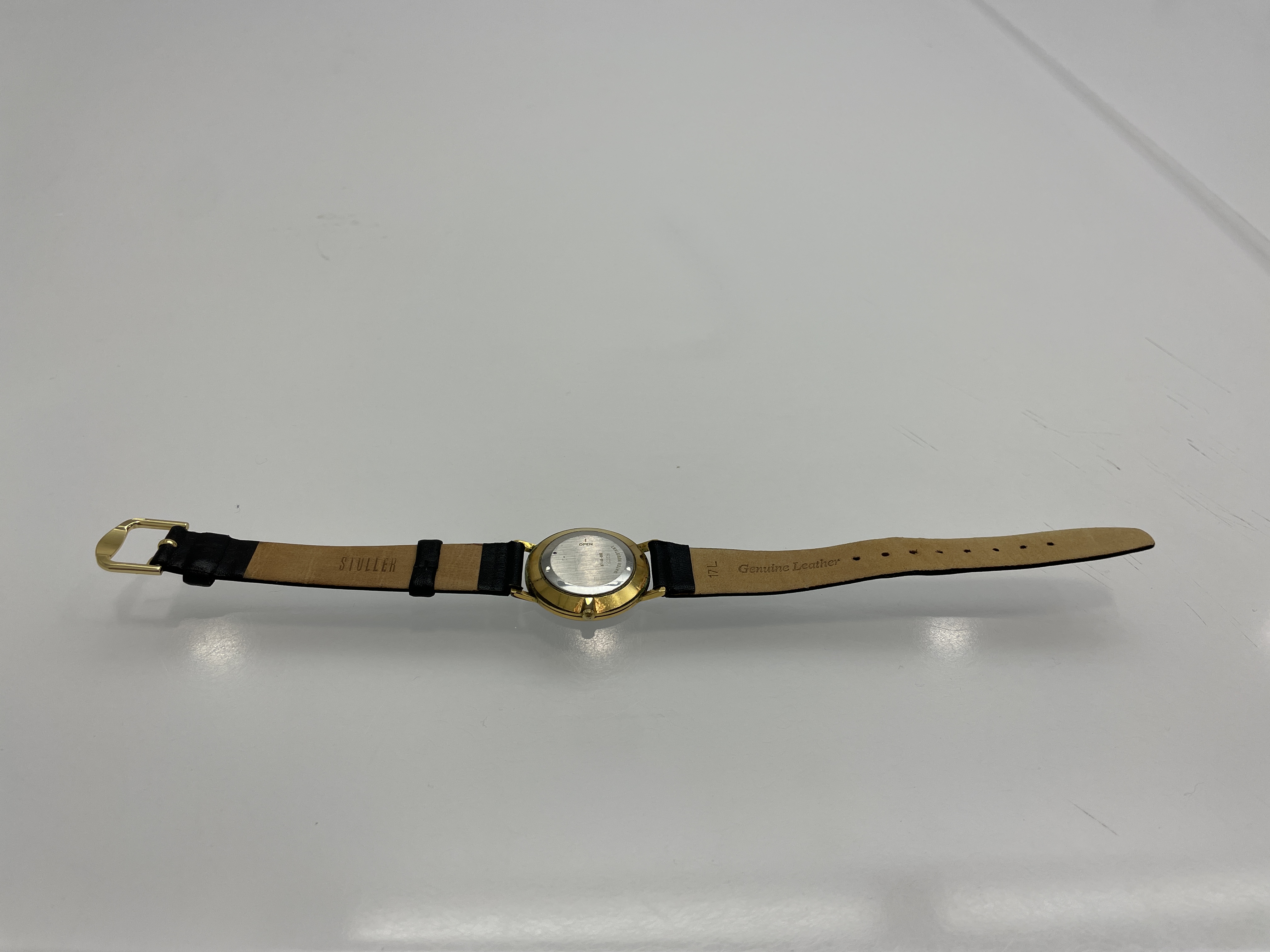
Alan and his second wife, Dorothy, gifted me the watch he wore throughout his adult life when I became a man in the eyes of the Jewish people. Many gifts are given to someone for his Bar mitzvah, most of which are checks and are forgotten about after the thank-you notes are written. The gorgeous, simple Movado watch was not one of the gifts that were quickly forgotten. I do not wear it often, but wherever I am living, the watch has come and will come, with me.  

All the information I have about the watch is known through oral history, as Alan is no longer alive, and my thirteen-year-old brain did not think to ask about the piece. Fortunately, this watch was prominent in my mother and Dorothy’s lives.  

The watch has a single gold dot where twelve o’clock typically is, an hour hand and a minute hand. The face has no markings other than the dot. The story goes that Alan could glance at his wristwatch and tell time to the minute every time, or so my mother says. Dorothy pointed out he may have been full of it as no one would question his reading, but I like to remember the story as my mother tells it.  

After talking to Dorothy, I was able to gather a bit of information about his relationship with the watch; but like my memories, hers are vague with some gaps. Dorothy recalls a story told to her by Alan in which he went about finding the watch. He loved museums and at the Museum of Modern art, he saw an exhibit where a watch designed by Nathan George Horwitt was displayed. The watch he saw was “The Museum Watch” which had a simple design (the same as the one I have) that he fell in love with. The design was stolen by Movado from Horwitt which was later settled in court. Alan saw the exhibit sometime after 1960; no one is quite sure when he actually bought the watch, but it must have been after 1960. After seeing the unique watch at MoMA, he decided to purchase the “Movado Museum Watch” as it is called. He later bought the exact same watch for Dorothy. She estimated he gifted it to her in the late 1990s but seemed fairly uncertain about the date. He loved the design so much that he wanted her to have the same one and be able to appreciate it as much as he did.   

Growing up, I have vivid memories of Alan wearing the watch. He wore it almost every day of his adult life. It went with him to his job as Director of Research, Office of the Mayor of the City of New York, where he worked closely with Michael Bloomberg. When he gifted it to me at my bar mitzvah, he took it straight off his wrist. The love he had for the watch made the gift far more valuable to me. I do not wear the watch often, but the object is safe for the amazing things it has been through with Alan. The stories I am aware of and the ones I am not aware of are held in the small face of the watch. Whether the hidden stories come to light is up in the air, but time will tell. In the meantime, I have the honor to have this watch that went everywhere with someone I admire immensely. 

Sources  

“Nathan George Horwitt.” Wikipedia, Wikimedia Foundation, 25 Jan. 2021, en.wikipedia.org/wiki/Nathan_George_Horwitt. 

Maple Spoon

As a young teen, I attended a wilderness camp where I found a passion for carving spoons out of wood. Over the years, I have fine-tuned my skills as a woodworker, especially in the wooden spoon arena. I have become skilled with the many tools used in the process to make a spoon and have developed much knowledge of wood in general. Most of my spoons are given as gifts to loved ones, who use them regularly. Their regular use changes the spoon in terms of its color and feel throughout its life. Wooden spoons are more than a simple eating utensil, they conjure stories and emotions when looked at and held by their users.

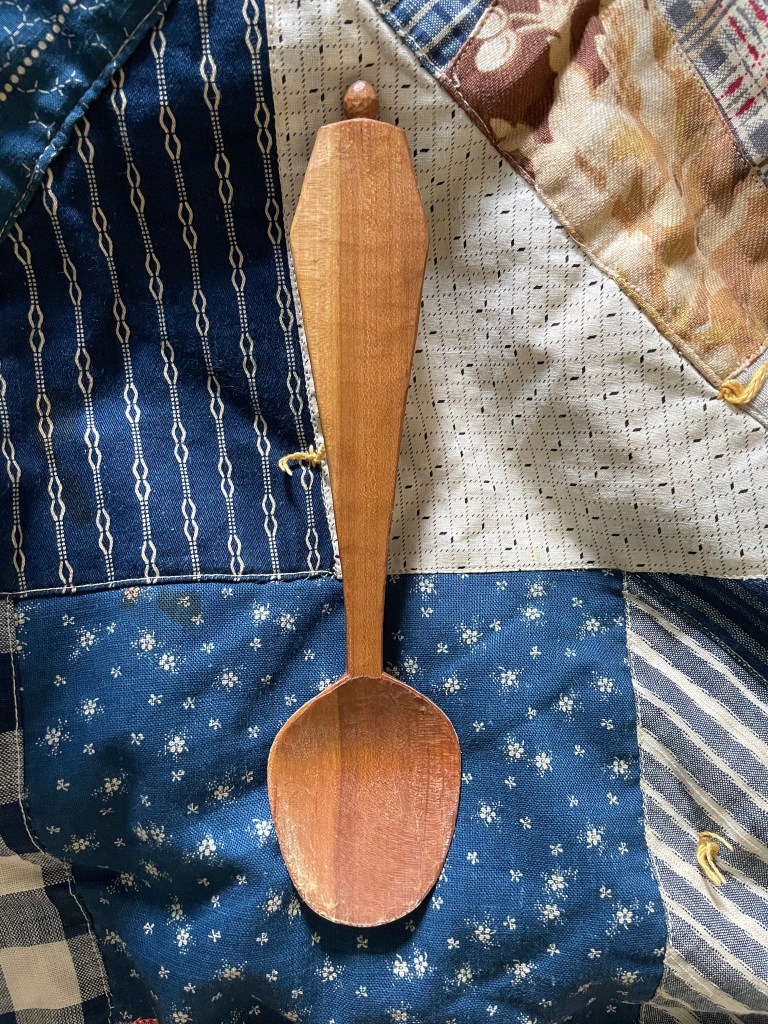
One object particularly close to my heart is a sugar maple eating spoon I made a few years ago. The eight-inch- spoon is ideal for eating cereal, whether it is hot oatmeal on a camping trip or cold Cheerios in my dorm room. Weighing just a little more than a feather, it may seem fragile, but time has proven its durability. This spoon is different from any other spoon I have made in that it is the first one I made that I use consistently.

When looking at the spoon from a bird’s eye view, there is a dividing line that runs vertically along the left side of the spoon that is slightly off-center. The line splits the appearance of the wood into a right and left side. The darker side (on the right) comes from the center of the original log and the smaller, lighter side is from the outer edge of the wood. Sunlight, weather, and age cause the wood to have a lighter tone. The contrast of the colors makes the spoon appear to have two separate sides. The lighter side is a light brown with a slight golden hue. The hue comes from the linseed oil used to put a protective coating on the wood. Over time the color of the spoon becomes richer with use. This is apparent when comparing the current color to photographs taken when the spoon was first made.

The tooled finish gives it a unique smoothness that stays consistent throughout its life. The back of the bowl reveals small knife marks that are smooth themselves but have some roughness when looking at them together. The curvature of the back of the bowl is fairly round which makes it difficult to have long cuts. When making the finishing cuts, the longer a cut is, the smoother the wood feels while short cuts leave a slightly less smooth feel. The curvature of the bowl is exacerbated by the crank of the spoon. The term crank is often used in the spoon carving community to describe the slight upward bend of the bowl. This allows the spoon to hold more food without being too deep. The crank of this particular spoon can be seen by the handle holding a constant plane until a quarter of the way into the bowl where it curves up about an inch. The profile of the spoon is defined by the crank. Looking at a regular metal spoon can illustrate the necessity for this feature. The bowl of the spoon could be described as a soft trapezoid. The end of the bowl is smaller while the part closer to the handle is larger. The edges are rounded as most spoons are for the comfortable feel in the mouth.

The back and front of the bowl are the only parts of the spoon that show tool marks other than the small ball on the top of the handle. The ball (purely for aesthetic) is the size of a small pea that sits on the top middle part of the handle. A decorative ball on the handle of a spoon is a common addition to improve aesthetic. The handle is tapered meaning near the bowl, it is narrower than at the top. This gives the spoon a comfortable feel in the hand. The widest part of the handle is close to an inch and a half. The widest part of the handle is about an inch from the top. It tapers around half an inch in at the top which leaves a half-inch surface for the ball to sit on. The back of the handle has a slight triangular ridge running vertically along the spoon. The area near the end is close to flat but as the handle connects to the bowl it becomes more pronounced and sharper. The ridge contributes to the comfortable feeling when holding the spoon.

This spoon holds a special place in my heart; wherever I am in life, the spoon is with me. Each time I use the ergonomic and solid spoon, it grows; the story develops, the character of the spoon evolves, and the overall look of the spoon changes. Whether the pigment becomes more enhanced from coffee grounds or a small ding on the handle appears after a camping trip, the spoon tells an evolving story and mirrors my busy life.