Not Your Typical Cupboard.


Caption: Kasten are very interesting objects, but not something you would find in many common households today. They were large, spacious objects that were typically owned by people classified to be wealthier. Part of the reason for this is that they were very difficult to transport because of how large they are in size. Typically, they held expensive linens and cloths as well. They were central to domestic life in colonial New York, serving a utilitarian function as the primary storage for linens and furnishing many American homes (Hudson Valley Kasten). Having these Kasten as furniture not only signified the owner’s heritage, but also demonstrated their wealth and social status. There is limited literature published on Kasten. There is even confusion over the terminology used to describe this piece of furniture. At the time of its origin, English was the mandated language of government decisions. Therefore in the most contemporary wills and inventory of objects from this historic time period, they were referred to as “cupboards.” However, cupboard is a very generic term for any generic wooden case piece with doors. The specific functions that people used these kasten for were made unclear in wills and inventories, so they’re uses range (American Kasten). Kasten are one of the many objects that the Dutch contributed to the American culture.The terms kas and kast, were used interchangeably in the seventeenth and eighteenth century. The term attempted to survive throughout the centuries, but regardless was reintroduced to the general public by the early historians of American furniture. Kasten have been recognized as a feature of colonial New York furniture since their first formal studies in the field. There was even later association made in 1900 by Singleton identifying kasten as possessions of New York Dutch families (American Kasten).
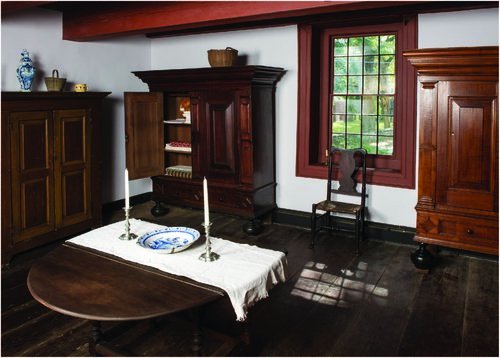
Figure 1: Other Kasten within the same collection of the one specifically analyzed.

Physical Description of the Object: The Kas in particular that I chose to work with is described as being, “early 18th century Red gum and pine” (Hudson Valley Kasten).  It is 75 ½ x 25 ⅝ inches.  Kasten, in general, are characterized to be mid-18th century Dutch style cupboards. Variations in design can exist, however, they usually are large, free standing cupboards. This one in particular has, “two-paneled doors surmounted by an over-scaled cornice” (Hudson Valley Kasten). They typically stand on ball shaped feet and a drawer. The drawer of this Kas is decorated with diamond shapes, which could have been attributed to symbolizing wealth.
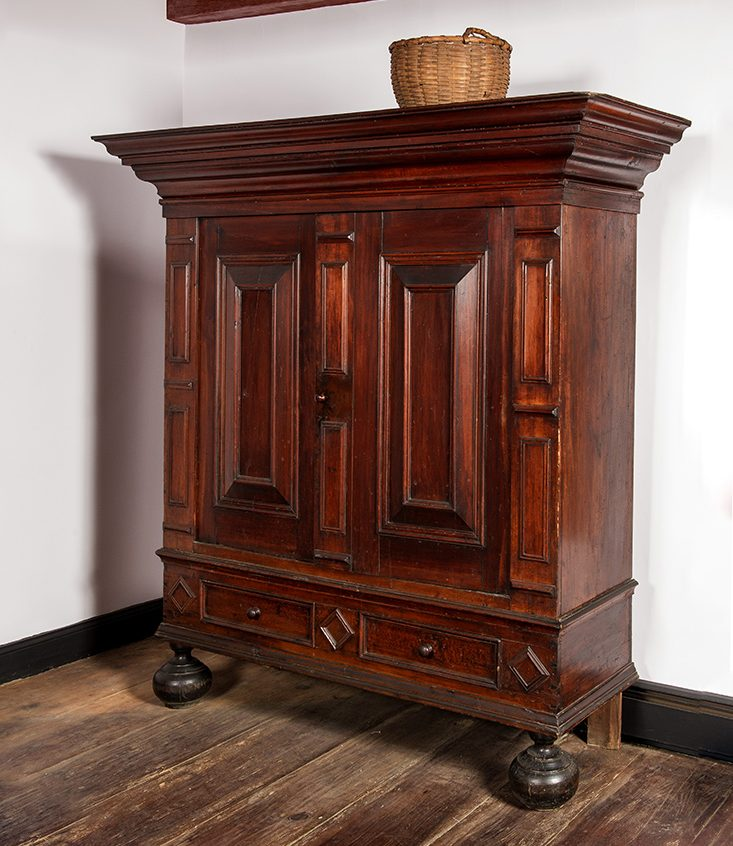
Figure 2: Actual image of specific Kasten analyzed.

Narrative: Nowadays girls dream about walk in closets. People’s wealth is sometimes determined by how many shoes line the walls of their walk in closet, or even how many different closets a person has for the different items they possess. However, as much as they need space to put their belongings, you need space for the closet as well. Often walk in closets make sense. A great storage place for all of your personal objects, yet doesn’t take up space within your bedroom. Who wouldn’t want one? Now picture a big, clunky, expensive cupboard taking up half your wall. They’re expensive, symbols of wealth, yet no longer sound as desirable, however, these furnished many Dutch-American homes during this time period. Closets are seen more for their function than for their appearance. Back then, it was more for their appearance than their function. These Dutch immigrants, “concerned themselves much more with domestic economy than with public government” (The ‘Kast’). This cupboard was one of the most important pieces of furniture for these Dutch settlers because it not only held all of their most tangible treasures, but, “Dutch notions of domestic life as well” (The ‘Kast’). These new homes they were establishing were trying to mimic the flourishes they had left behind. Nowadays it seems we are more focused on the quantity of our objects rather than the quality. We are never satisfied with what we have, but always want the latest and greatest, or to be able to say you have it all. In this time period their culture reflects a similar mindset, but a different means of execution. They didn’t have the space and housing we do today to have as many objects as we fill our houses with today. For them, it was about what they had to symbolize their wealth. Items like Kasten, to show their connections to their flourished heritage.

Provenance:

The Kas in particular that I chose to work with was from the Historic Huguenot Street Permanent Collection. It has been attributed to the Elting-Beekman Shops in Kingston, New York. Within these local areas surrounding Kingston, there were many people making Kasten at the time. There were were two families of craftsmen that are known of in Kingston, New York. These families were the Eltings and the Beekmans.This Kas in particular was one of the earliest examples attributed to many of the workshops in these areas, like the ones owned by the Elting and Beekmans. Along with its ties to these early craftsmen families, it is also reported to have connections to both the Hasbrouck and the Hardenberg families of Ulster County.

References:

“Historic Huguenot Street Permanent Collection, Gift of Innis Young.” Hudson Valley Kasten, 31 Oct. 2018, hudsonvalleykasten.org/portfolio-items/innis-young/.

“Hudson Valley Kasten.” Hudson Valley Kasten, hudsonvalleykasten.org/.

Metmuseum.org, www.metmuseum.org/art/metpublications/American_Kasten_The_Dutch_Style_Cupboards_of_New_York_and_New_Jersey_1650_1800
“The ‘Kast’.” AMERICAN HERITAGE, http://www.americanheritage.com/kast.

My Good Luck Charm

The item I decided to write my blog post on for this week is a necklace my grandma purchased for me as a souvenir from her trip to Ireland. As I have mentioned in previous posts, although I feel a stronger connection to my Ecuadorian side, I am also Irish on my moms side of the family. I don’t see this side of my family as often as the other because they are located in different states around the country, compared to my dad’s side which all live relatively close in Queens. However, especially around St. Patrick’s Day, I am still proud of this background and culture and am excited to learn more, hopefully while completing this post. Aside from the history of the object itself, I also thought it would be interesting to discuss some of my family’s history as well. My grandma is very into genealogy. A few years ago she began a very intricate search into my family’s origins. She especially thought it would be interesting to find more about my grandpa’s family history, especially since he was adopted. Through her research she has learned more about our irish roots, as well as english. She found many connections we have to various celebrities, and even found a connection to a woman who was on trial in Salem during the witch trials that I just so happen to be related to.

However, just like my grandma has discovered and researched our family history and origins, I too looked into the history of my necklace she gave me a couple of years ago. To begin, it is a tiny pendant on a gold chain. The front is covered in this gold plating with the outline of a shamrock revealing a stone, that makes up most of the rest of the necklace. The back of the necklace really reveals this stone, and the front shows a glimpse of it in the open spaces of the shamrock outline. Around the circle golden pendant are sort of ridges on the outside in a decorative fashion that adds a little extra flare to the necklace itself. When I first received this necklace from Ireland I never took it off. I wore it all throughout high school and to every performance I ever participated in as sort of my “good luck charm.” Today, I don’t wear it as often and have found new objects to give me these same feelings; however, I still have it in my jewelry box and pull it out on special occasions.

The necklace is from a region called Connemara in the county Galway. The word Connemara derives from the Gaelic meaning, “Inlets for the Sea.” Found in this area is Connemara Marble, it is a rare form of marble that is typically greenish in color. It dates back over 600 million years and due to its limited supply is considered one of the rarest forms of marble in the world. This rare marble is formed when limestone is heated under pressure. It is primarily green in color, but there are often shades of grey and brown seen throughout.

The stone in the necklace my grandma purchased for me is from a quarry in Clifden, Galway. It was opened by the Joyce family in 1822 and named it the Streamstown Marble quarry. The Joyce name has become pretty synonymous with Connemara Marble and they have been a supplier of this marble to many world-famous buildings. This includes Galway Cathedral in the city of Galway, in which the floor is made up of this beautiful marble. This floor is one of the largest examples of the marble in the world. I found this to be such an interesting assignment. I knew the necklace came from Ireland and I thought just that fact was special to my family and I. However, researching and finding out more about the background of the stone that is the centerpiece of this necklace, especially with how rare it turns out to be, really made me appreciate my long time “good luck charm,” that much more.

Unfortunately I am not home right now, so I am unable to attach an image of my necklace, but I will very soon. For now, enjoy this picture of my brother and I reppin’ our heritage in our golden days.


My Only Family Tradition

This blog post was very difficult for me. I don’t really have many objects that have been passed down throughout my family and have a “chain of ownership.” However, as I was reading back through last weeks blog posts I thought of the only object that I remember my mom telling me that has been passed down through the years. I responded a little bit in a comment, but these are little recipe cards that my family still makes around the holidays that they are associated with. It has become a tradition in my family. We always have my grandma’s quiche Christmas morning, my Nana’s sugar cookies and “butterscotchies,” also at Christmas, and my Nana’s ambrosia salad at Thanksgiving.

Unfortunately, I could not get a picture of these cards because my mom is currently visiting my grandparents and these index cards are at home. Also, these recipes are very secretive in my family and so when I called my grandma to get these recipes she did not want to send a picture of the recipe itself. The first one that I’m thinking of is my Nana’s (great-grandma)  Ambrosia salad recipe. Although, my grandma believed this recipe actually started with her 98-year old aunt. This recipe stuck out to me first because it is probably the most “secretive.” My mom used to tell me that my Nana never gave out this recipe until she got older. She would only make it for the family; however, would never give anyone in the family this recipe. Once she got older, she finally revealed her secret and passed it down to the rest of us. I’m glad she did because my Nana passed away before I was born and so this recipe is a piece of her that I will have for the rest of my life and be able to pass down to my own kids, when they’re old enough of course.

The next recipe cards are oriented around our Christmas traditions. These include my grandma’s quiche recipe and two of my Nana’s cookie recipes that we make every year. These traditions started on my mom’s side of the family with all of her relatives; however, even after my parents divorced my dad still makes quiche for my brother and I every Christmas and my mom always makes my dad a batch of the butterscotch cookies for us to bring over. Something that I like about these recipes though, is that even though they originated with my family as these special recipes they have changed over time within my family. When my aunt makes the butterscotch cookies she always adds peanuts to them (as the original recipe calls for), yet when my mom makes them she leaves out the nuts because she doesn’t like them as much. Also, the quiche recipes change slightly from year to year to. The base and basics always remain the same; however, sometimes we change what else goes in them. My mom’s new boyfriend hates onions and so now when she makes the quiche she leaves out onions in one of them, so we can all enjoy it.

Although, these index cards don’t seem like much, they mean a lot to me. I love cooking, if I wasn’t currently in college on a criminal justice/ law path, my second plan was to always go to culinary school. These cards are tiny and worn down and constantly changing, yet they’re one of the very few traditions my family treasures and still participates in every year. It’s not a crazy chain of ownership, but every member on my moms side of the family holds these recipes and continue to pass it down. There’s no real historical significance to these cards; however, to my family the history of these recipes is priceless.

Elephant Ring

The item I have decided to look further into is my elephant ring, mainly because I just found it today and i’ve been looking for it for weeks. This item is very important to me, almost like a “lucky charm,” every since I bought it over a year ago. I lost it a few weeks ago, and while usually I just end up forgetting about the item altogether when I lose things, this ring was different. I genuinely missed it and was upset that I did not have it to wear everyday like I usually do. I tried looking for it everywhere; in my apartment, my best friend’s house, my boyfriend’s house and even my car. It genuinely made me happy that I found it today and so I decided to think further into why this ring meant so much to me, as well as a little more history behind the object itself.

Rings can symbolize many different things. To some people it is a mere fashion statement, to others a symbol of marriage, or friendship, or promise. However, it is also used in sports to symbolize championships and to others as a symbol of power. To me, this ring just symbolizes my lucky charm. I’ve always loved elephants and even have a stuffed elephant on my bed that I sleep with every night (cheesy I know.) However, as I looked down at my own ring it was just crazy to think about the many different things rings symbolize to other people.

The function of a ring is primarily as a fashion accessory, or representation of some status (marriage, friendship, promise, power etc.). This accessory is typically meant to be worn on one of your fingers; however, some wear them around chains on their necks, or around their bracelets, or even “toe” rings. Rings are meant to represent circles which symbolize eternity. This is why I feel most people associate “rings” with love, more specifically engagement and wedding rings. Engagement rings symbolizing this concept of eternity and marriage dates back to the Egyptian times.

My ring, specifically, does not have as interesting of a background story. My ring came from my favorite store on the planet, Forever 21. It was mass produced and found in the jewelry section of the store. There were multiples just like it lining the rack in which I found it. On a wall full of different rings the elephant was the only thing that stood out to me. Something I’ve been looking for, for a while in stores and finally found. There was no real interesting chain for this ring, it started off at the manufacturers and then was shipped to retail stores. I don’t think the use of the ring changed much over time. Like I mentioned earlier, rings were symbolizing marriage back in Egyptian times. They still mean a similar thing in today’s society; however, there appearance and addition of diamonds and other gemstones have changed over time.

I definitely found this to be a fascinating assignment looking into the history and meaning behind rings. I didn’t realize how many different interpretations and symbols rings could represent and how far back into history their origins expand to. I’m so happy I found my lucky ring today and I don’t think it will be leaving my finger again any time soon.  

(besides to take this picture)

Family First

The object I have chosen to discuss is a little purse my abuelita (grandma) got for me a few years ago from Ecuador. This purse is one of a few other objects my family has gotten for me from their visits to Ecuador, a place I have still yet to visit; however, means a lot to my family and I. I am a first generation on my dad’s side. My father immigrated here when he was around 14 and I am very proud of my family’s cultural history and ecuadorian roots. A lot of people don’t realize I am hispanic based off my appearance. My mom is irish and so I have lighter skin color than my dad and other members of my family. However, I am proud to be hispanic and love spending time at my Titi’s (Aunts) or Abuelita’s houses; eating their amazing cooking, dancing along to spanish music and practicing my spanish.

The purse is approximately 5 inches tall and 5 inches wide, resembling a square. It is also about a ¼ inch thick, when the purse is empty. It looks as if it was hand stitched and some of the threading is even coming undone within the inside of the main pocket of the purse. It has two compartments. The main one is opened by a zipper on the top and the other is in the front of the purse and is much smaller, also opened by a zipper. Although the outside stitching of the purse is a repeating black and white lined pattern, the rest of its design is much more eccentric. There are lines of different colors striped down the front in different thicknesses. It’s primarily made up of “warmer” colors; like orange, yellow and red. However, it also contains some blue, black, green and white. The biggest block of color is a yellow rectangle shape with a blue and a red stripe going down it. This is consistent on both the front and the back. This is significant to me because it is the colors of Ecuador, also found on its flag.

The yellow symbolizes the fertility of the land, the blue represents the sea and the sky and lastly, the red represents the bloodshed during their fight for independence. The yellow stripe on the Ecuadorian flag is also twice as thick as the red and the blue. This is also consistent with my purse in that the yellow portion of this part of the purse is much larger than the blue and red stripes going through it.

Throughout completing this assignment, I began to think about more of the background on how I got this object. My grandma got it for me several years ago after she visited Ecuador. She gave it to my dad to give to me, and it has been in my possession ever since. All I know about this purse is that it came from Ecuador, but I’m more curious now into finding out more specific details. Where did my abuelita purchase this purse? Who made it? Where in Ecuador did she get it? Why did she pick this specific gift to bring back for me? As all these questions are now raised in my head I’m looking forward to seeing my abuelita soon and asking if she remembers getting it for me and more about where she got it from. Just like Daniel Miller wrote in, Stuff, we need to appreciate the role of objects by considering them as signs and symbols that represent us. These objects can be worthless without us giving them meaning and using them to represent ourselves to the rest of the world and I am proud that this object can represent me and my heritage.

Tidying Up

I chose to go through my dresser for this assignment. My parents have always been encouraging me to do a similar task of going through my clothes and picking out what I no longer want, so that we can give it away. However, their reasoning was not so much focused on the importance of material objects and their significance, but rather trying to clear up closet space in the room of an online shopaholic. I always knew I owned a lot more clothes than I probably should. I spend way too much of my free time browsing online for sales at my favourite stores and often when I’m stressed I tend to just “treat” myself to a new outfit or ten. However, like the reading proposes, you never really know how much you have until it is a pile right in front of you. While the clothes from my dresser wasn’t as big of a pile as I have suggested, given how frequently I’m shopping, it made me reflect on the clothes still in my closets at school, and both my mom and dad’s house at home. Yet, I never viewed my clothes as important material possessions, rather what just interested me while I was scrolling online, or out at the mall with friends.

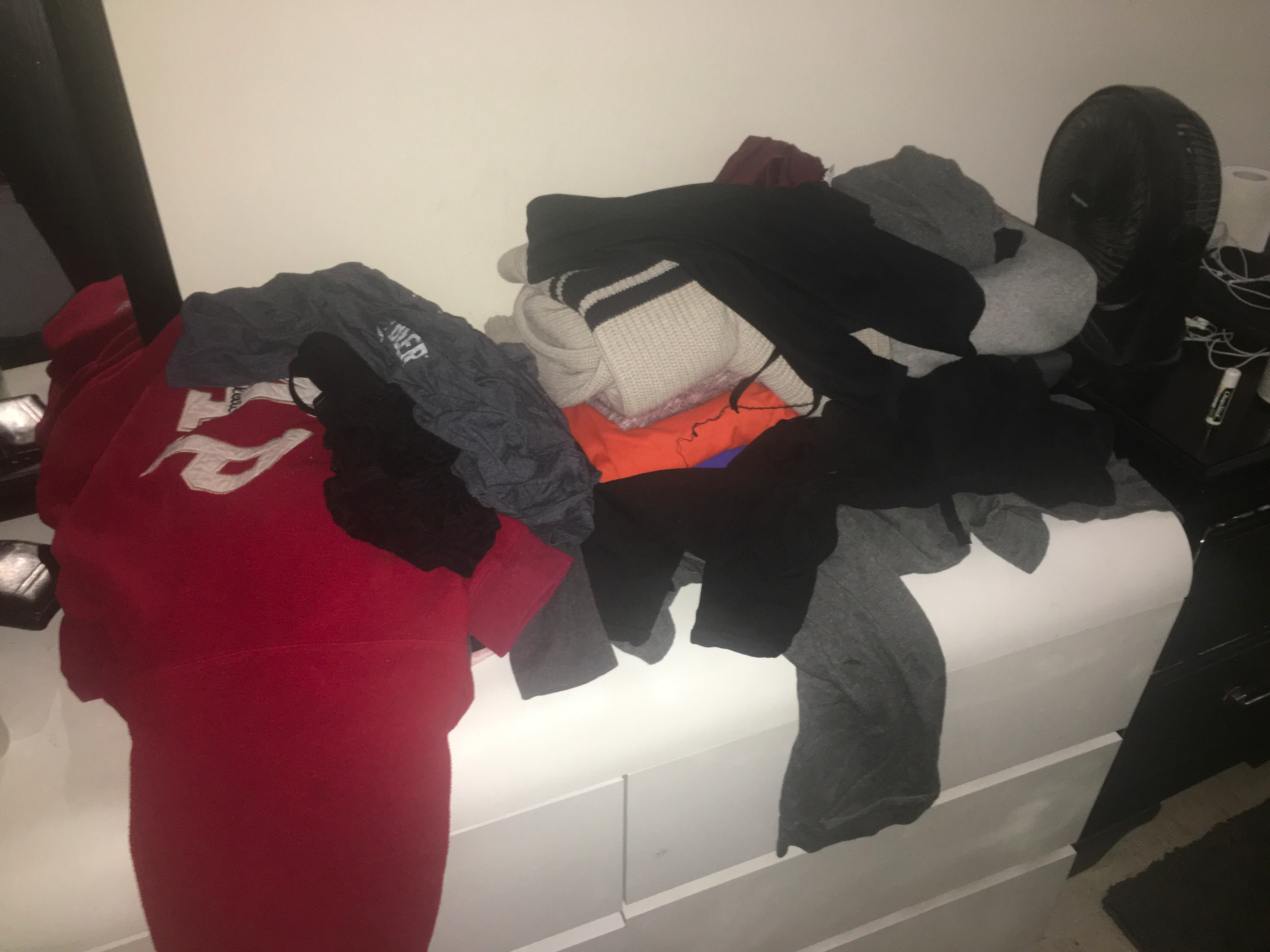
The clothes being initially taken out of my dresser.

As I was sorting through my clothes, I didn’t expect this assignment, after reading sections from the book, to really have that much of an effect on me. I owned so many random shirts, pants, even crazy socks that I haven’t thought twice about since purchasing. However, as I was completing this assignment I didn’t find that to be the case at all. It really opened my eyes to a new perspective on how I viewed these everyday objects. As I get changed everyday, I never put much thought into what I am dressing myself with, rather just if it all matched, and if it was warm enough to leave the house in with all of this crazy weather. Yet sitting down and being surrounded by all of these articles of clothing I actually had time to think about each and every piece I picked up.

The clothes I was going to get rid of/give away.

Organizing these piles I found a lot of clothes that I haven’t worn in forever and to be honest don’t really know why I have in the first place. I found shirts that I have some amazing memories in, as well as clothing that I wish getting rid of would also rid me of the traumas that happened while I was wearing them. Overall, tidying up my dresser helped me to realize that some of these clothes I thought were insignificant held a lot of meaning to me after all. I put on the top of my drawers those clothes that I want to continue wearing and feeling happy in and get rid of those that really don’t hold that much more importance in my life. This assignment helped me to tidy up my room a bit, find new meaning and significance in old items and hopefully put an end to my online shopping addiction.

Some of the items that stood out to me. My boyfriends grey sweatshirt, my plaid pants that all of my friends made fun of me for ordering and now all want to borrow. Lastly, my favourite pajama shorts that remind me of a funny story of when I got them with my friends.