19th Century Canton Ware: Serving Vegetables on Porcelain

What is your first thought upon laying eyes on a canton ware that dates back to the 19th century? Before lifting the pristinely decorated porcelain lid to unveil the awaiting scrumptious contents of the vegetable serving dish, would you attempt to piece together an understanding of the depicted environment in the painting? The cobalt blue illustrations spanning across the canton ware are cool to the touch and memorizing to admire. (Image: Louise McGoldrick, 2023)

Physical Description

This diamond-shaped canton ware set includes a plate and a lid that come together as a vegetable serving dish. Both underglaze pieces are first adorned with painted scenes of a Chinese coastal village in a monochromatic cobalt blue before being covered in transparent ceramic glaze. The 3” deep dish is painted with the “blue willow” pattern. A serene atmosphere features trees growing in harmony alongside the riverbank. In the foreground, a junk ship with raised sails is floating between a small pedestrian bridge and a Siheyuan-style courtyard with pavilion roofs. Towering mountains uniformly line the background behind French country-style houses. An oval knob-like handle protrudes half an inch from the center of the lid, which obscures part of the painting. The 8” long by 6” wide cover is outlined with large decorative “X” markings on top of a thick blue band. Meanwhile, the lip of the deep dish is traced with a royal blue ribbon that fades into thin lines and scalloped edges. The dish is larger than the cover, measuring to be 9.5” by 7.5”.  

Provenance

This porcelain vegetable serving dish and lid is part of Barbara Lumb Jeffers’s 38-piece donation to Historic Huguenot Street (HHS)’s permanent collection. Porcelain that was manufactured and exported from the Canton (Guangzhou) province of southern China is coined the term “canton ware.” This selection of canton ware is estimated to have been painted during the early nineteenth century (1800-1835), which is distinctly recognizable with the “blue willow” pattern. Her fourth great-grandfather, Jonathan Deyo, started collecting canton ware while living at New Paltz during the early 1800s. It would take another six generations—passing through the hands of Peter, Ira, Jacob, Florence, and Josephine—until Barbara inherited the 47-piece canton ware collection. 

Narrative

China is multifaceted. One object cannot represent the culture—arts, religion, language, and traditions—of its 56 ethnic groups. Yes, the country was prosperous, with prominent advancements in agriculture, medicine, and consumer goods. Even so, many Chinese citizens simultaneously faced a growing social class divide, political corruption, and civil wars. However, what if this vegetable serving dish was my only exposure to China? During the 19th century, idealized fantasies about a foreign country could have easily become mistaken for irrefutable truths.  

This particular canton ware holds a historical narrative of values from the porcelain’s first collectors. The creation of the dish dates to the early 19th century. Remarkably, the last seven generations of the Deyo family have excellently preserved this piece of canton ware without a single crack or chip. They treasured their canton ware collection.  

The Deyo family is one of the French Huguenots who settled in the town of New Paltz. The family lineage includes influential figures, such as politicians. The first collector of canton ware in the family was Jonathan Deyo, a 5th-generation Deyo.  

Marriage record between Jonathan Deyo and Mary (Maria) LeFevre. (Image: Family Search)

On February 16th, 1780, Jonathan married Mary (Maria) LeFevre at the Reformed Protestant Dutch Church. They had seven children, including four daughters and three sons. Throughout fatherhood, Jonathan instilled religious and educational values in his family. 

Receipt billed to Jonathan Deyo for the education of Abraham, Daniel, and Peter Deyo. 
(Image: Haviland-Heidgerd Historical Collection, Elting Memorial Library)

All three sons had private schooling. The Haviland-Heidgerd Historical Collection of the Elting Memorial Library published a digitalized tuition receipt billed to Jonathan on April 29th, 1804. The total expense for the schooling of Abraham, Daniel Lefever, and Peter was $23.30 ($596.01 today). Peter was the youngest Deyo. He was given the opportunity to learn at seven years old, unlike his sisters: Catherine, Elizabeth, Catrina, and Cornelia.  

I could imagine Mary and Jonathan taking out their precious collection of canton ware for the first time. The children are setting the table for a hearty homecooked lunch after the Sunday church service. Sunlight is streaming through the drawn curtains, casting its warmth throughout the dining room. The family of eight is seated around the dining room table. Soon, appetizing aromas and curls of steam waft upward from freshly baked potatoes that are inlaid on the uncovered vegetable serving dish. After the first serving, the second helping is kept warm under the covered dish lid. 

(Images: Louise McGoldrick, 2023)

The hand-painted porcelain distinguishes itself from other wooden or pewter plates, common dinnerware found in American households during the early 1800s. Jonathan begins his first educational lecture on the Deyo’s success. The canton ware displays their family’s great material wealth and social status. After all, they can afford exquisite dinnerware to entertain guests. Jonathan made his porcelain purchase from a local vendor who was actively bolstering the surrounding economy of New Paltz by participating in direct trade with Chinese merchants (University of Illinois).  

With a mouth full of potatoes, Peter asks, “Why are these plates, dishes, and teacups so special?” 

“Peter, the first President, George Washington, was fond of porcelain sets like these!” Jonathan proudly exclaims. He contrasts the affluence of the Deyo family with that of an American revolutionary leader. Meanwhile, many other American families still used pewterware, an affordable and versatile metal alloy composed of tin, antimony, and lead (Pewter Society). Jonathan takes note of Peter’s genuine intrigue.  

Next, Jonathan talks about kaolin, the specific clay used to create porcelain. The Deyos are amazed to hear that the serving dish needed to be fired at such high temperatures of 1200-1400 degrees Fahrenheit to create a smooth and durable finish suitable for serving dinner (Warwick 2012). 

The lunch conversation soon takes a nosedive into Orientalist concepts, with Jonathan leading the enlightening narrative used to define Chinese folk within the confines of the canton ware. To only receive education about a place, people, and culture through a singular story is dangerous. When only one understanding of China was academically praised and circulated through early American newspapers, US citizens were only exposed to an echo chamber of prejudices held against Chinese folk. The iconic “blue willow” pattern, a common motif of canton ware, perpetuates China as a “non-Western societ[y]” left “untainted by industry and capitalism” (MET). As Jonathan’s fingers trace the blue willow pattern on the dish’s scalloped lips, he invites his family to view, feel, and experience the Western world’s construction of Chinese culture. 

A brief glance alongside a thin narrative of the dish perpetuates the romanticized stereotype that China is an exotic and backward empire. They use old technology like junks (sailboats) instead of steam-powered vessels. Or worse, Chinese folk need “saving.” After all, there is a lack of visual representation of China’s citizens or technological innovations under the translucent glaze of the canton ware. Edward Said wrote about how “Orientalist ideologies actively shape the world they describe [because they] perpetuate people as inferior and subservient. [Orientalism] create[s] a worldview that justifies Western colonialism and imperialism” (Hibri). Later in 1839, when canton ware fell out of popularity, Britain invaded China to control merchant trade during the Opium War.  

Throughout Peter’s childhood, Jonathan sent him and his brothers to receive the best schooling. Yet was teaching an Orientalist perception of China sufficient to be called an education of substantial quality? 

Two months after Jonathan died on March 26th, 1833, Josiah Dubois and Daniel Dubois appraised the 90-acre estate. The total value of numerous kitchenware items—plates, silver utensils, tongs, and tables—was $94.70 ($3,593.29 today). The canton ware collection was passed down to Peter and his heirs. Today, the vegetable serving canton ware rests unused, waiting to reveal its truth. We know better than to place make-believe fantasies on a pedestal, which emits ignorance and omits cultural sensitivity. In a world already riddled with conflict, exposure to varying narratives helps us grow with greater empathy, reducing bias and judgment. 

Appraisal and inventory of the Deyo family’s estate. (Images: Haviland-Heidgerd Historical Collection, Elting Memorial Library)

Works Cited

“Canton Ware China.” Collections, 2022, www.pphmuseum.org/canton-ware-china.  

“Early American Trade with China.” China Trade, 2006, teachingresources.atlas.illinois.edu/chinatrade/introduction04.html.  

“Estate Inventory and Appraisal, Jonathan Deyo (2).” New York Heritage: Digital Collections, nyheritage.contentdm.oclc.org/digital/collection/p16694coll153/id/9621/rec/2. Accessed 9 May 2023.  

Hasbrouck, Kenneth E., et al. The Deyo (Deyoe) Family. Deyo Family Association, Huguenot Historical Society, 2003.

Hibri, Cyma. “Orientalism: Edward Said’s Groundbreaking Book Explained.” The Conversation, 29 Mar. 2023, theconversation.com/orientalism-edward-saids-groundbreaking-book-explained-197429.  

Historic Huguenot Street. “Porcelain Serving Dish.” Huguenotstreet, 13 Apr. 2023, www.instagram.com/p/CNm10bRjrnn/?utm_source=ig_web_copy_link.  

Inghram, Matthew C. “Chinese Porcelain.” George Washington’s , 2023, http://www.mountvernon.org/library/digitalhistory/digital-encyclopedia/article/chinese-porcelain/.

“Jonathan Deyo – Church Records.” Ancestors Family Search, 2021, ancestors.familysearch.org/en/KJCB-SDH/jonathan-deyo-1745-1833.  

“Key Points across East Asia-by Era 1750-1919.” Asia for Educators, 2023, afe.easia.columbia.edu/main_pop/kpct/kp_1750-1919.htm.  

McGoldrick, Louise. Research about Canton Ware, May 2023.  

Oshinsky, Sara J. “Exoticism in the Decorative Arts.” The Met’s Heilbrunn Timeline of Art History, Oct. 2004, www.metmuseum.org/toah/hd/exot/hd_exot.htm.  

“Receipt, Mr. Deyo by Edward O’Neil.” New York Heritage: Digital Collections, nyheritage.contentdm.oclc.org/digital/collection/p16694coll153/id/9341/rec/10. Accessed 9 May 2023.  

Warwick, Leslie, and Peter Warwick. “New Perspectives on Chinese Export Blue-and-White Canton Porcelain.” Chipstone, 2012, chipstone.org/article.php/519/Ceramics-in-America-2012/New-Perspectives-on-Chinese-Export-Blue-and-White-Canton-Porcelain.  

Webster, Ian. “Inflation Rate between 1833-2023: Inflation Calculator.” Value of 1833 Dollars Today | Inflation Calculator, www.officialdata.org/us/inflation/1833. Accessed 9 May 2023.  

“What Is Pewter?” About Pewter, www.pewtersociety.org/about-pewter. Accessed 9 May 2023. 

Collaborative History Project – Rough Draft

I will soon replace these images with higher resolution photos from Louise.

Physical Description

This diamond-shaped canton ware set includes a plate and a lid that come together as a vegetable serving dish. Both underglaze pieces are first adorned with painted scenes of a Chinese coastal village in a monochromatic cobalt blue before being covered in transparent ceramic glaze. Notably, there is a lack of people in the paintings. Instead, a calm and serene atmosphere features trees growing in harmony alongside the riverbank. In the foreground, a junk ship with raised sails is floating between a small pedestrian bridge and a Siheyuan-style courtyard with pavilion roofs. Towering mountains uniformly line the background behind French country-style houses. An oval knob-like handle protrudes from the center of the lid, which obscures part of the painting. The cover is outlined with large decorative “X” markings on top of a thick blue band. Meanwhile, the lip of the deep dish is traced with a royal blue ribbon that fades into thin lines and scalloped edges. 

Provenance

This porcelain vegetable serving dish and lid is part of Barbara Lumb Jeffers’s 38-piece donation to Historic Huguenot Street (HHS)’s permanent collection. Porcelain that was manufactured and exported from the Canton (Guangzhou) province of southern China is coined the term “canton ware.” This selection of canton ware is estimated to have been painted during the early nineteenth century (1800-1835), which is distinctly recognizable with the “blue willow” pattern. Her fourth great-grandfather, Jonathan Deyo, started collecting canton ware while living at New Paltz during the early 1800s. It would take another six generations—passing through the hands of Peter, Ira, Jacob, Florence, and Josephine—until Barbara inherited the 47-piece canton ware collection. 

Narrative

What is your first thought upon laying eyes on a canton ware that dates back to the 19th century? Before lifting the pristinely decorated porcelain lid to unveil the awaiting scrumptious contents of the vegetable serving dish, would you attempt to piece together an understanding of the depicted environment in the painting? The calm cobalt blue illustrations spanning across the canton ware are smooth to the touch and memorizing to admire. 

I have never traveled to China before. Yet, I understand that China is multi-faceted. Yes, the country was prosperous with prominent advancements in agriculture, medicine, and consumer goods. Even so, many Chinese citizens had simultaneously faced a growing social class divide, political corruption, and civil wars. However, what if this vegetable serving dish was my only one exposure to China? In thirteen colonies during the 19th century, idealized fantasies about a foreign country could have easily become mistaken for irrefutable truths. 

This particular canton ware holds a historical narrative of values from the porcelain’s first that has historically traveled back to its creation, during the 19th century. Remarkably, the last seven generations of the Deyo family have excellently preserved this piece of canton ware without a single crack or chip. They treasured their canton ware collection. 

The Deyo family is one of the French Huguenots who settled in the town of New Paltz. The family lineage is dated with influential figures including politicians. The first collector of canton ware was Jonathan Deyo, who was not a local celebrity. Yet, he upheld high religious and educational expectations for his family. 

On February 16th, 1780, Jonathan married Mary (Maria) LeFevre. They had seven children. (Unfinished draft)

Works Cited (soon to be updated in MLA format)

https://www.poughkeepsiejournal.com/obituaries/pjo066130

https://www.pphmuseum.org/canton-ware-china

Creation of the “Chandler”: Supply Chain of a Citizen Watch

What’s your reaction to the question, “what’s the time?” Do you glance down at your wrist or pull out your smartphone? In college, I notice that watches are less commonly worn. Many of us have traded interpreting analog watch faces for reading two sets of numbers separated by a colon.  

A rotation of my watch. Note the gleam of colors on the watch face resembles the mother-of-pearl.

Since 2017, I have owned an all-gray stainless-steel watch. The watch holds a lot of sentimental value as a Christmas gift from my parents. My 12-year-old self was delighted to make the quick discovery that the diamond-shaped hour and minute hands glow in the dark!  

One of the watch’s features is a tunable push-button that adjusts the time and date. The date is displayed in black font next to that dial in a deeply set box. On the face of the 26mm-wide watch face, “12” and 6” are the only numbers engraved on a design that resembles a protection stone, the mother-of-pearl (Citizen Watch Co., Ltd.). The foldable clasp of the bracelet is engraved with the inscription “CITIZEN STAINLESS STEEL BAND CHINA.” There are also markings on the backside of the watch face that I ignored as meaningless until I started researching my Citizen watch. These tiny serial numbers were the foundational puzzle piece in sifting through research to identify the product’s name and origins.  

Chandler—the watch’s name—historically refers to a wax candle or soap maker (Merriam-Webster). They supply people with necessary home products that serve the purpose of maintaining hygiene or lighting. Citizen markets the watch with a name of French origins to convey positive connotations associated with light, including the fulfillment of knowledge, happiness, or prosperity. Chandler eloquently rolls off the tongue, as opposed to its identification name, “ew1670-59d.” Unlike today’s smartphone devices that can tell time, the Chandler does not need an electronic charger to function. Instead, Citizen features my watch as part of the company’s conscious effort to be environmentally driven in its “Eco-Drive” movement. Solar power, in the form of fluorescent lighting or sunlight, fuels all watches in the Eco-Drive collection.  

Raw materials for watches, such as my Chandler, are sourced at undisclosed locations. However, Citizen declares its involvement in Corporate Social Responsibility (CSR), which is an initiative that is mindful of its environmental, social, and economic sustainability. Citizen claims that they refuse to incorporate “tantalum, tin, tungsten, and gold, which are conflict minerals connected to inhumane acts committed by local armed groups in the Democratic Republic of the Congo…” into their signature watch collections. Instead, 99% of the exterior of watches like my Chandler is made of stainless steel and sapphire glass. The inner movement of the watches is made of steel, metal alloys, copper, a solar cell, and a rechargeable battery. The movement of a watch refers to the beating mechanism, which maintains its ability to accurately tell time (Citizen Watch Co., Ltd.). The composition of the raw materials used in the manufacturing process is broken down to the nearest hundredth of a percent.  

Within this global watch corporation worth more than 1.6 billion USD, Citizen accesses their alignment with CSR in their relations with key suppliers through their sustainable procurement policies. Key suppliers are defined as businesses that provide indispensable raw materials for the creation of Citizen watches. Firstly, the supplier questionnaire (SAQ) is a survey sent to selective raw material providers. The SAQ determines the level of risk—with a numerical value out of 100—in doing business with the 657 companies that compose 50% of their key suppliers. Then, the scores lower than 50 decide that Citizen should take immediate action to address any ethical or environmental violations assessed by the SAQ. However, the business practices of all key suppliers are not accounted for when Citizen’s total number of key suppliers is approximately 3,700 groups (Citizen Watch Co., Ltd.). The overwhelming number of unaccounted business relationships that are not disclosed in fine detail prevents a consumer from making a holistic assessment when determining if minerals and natural resources used for Citizen watches are ethically sourced. 

Although there is a lack of complete transparency in the sourcing of materials for the inner movements and exterior of a Citizen watch, the corporation takes pride in the rest of its watch supply chain. Namely, all Citizen watches are made in Japan. Their global website organizes and lists every factory in Japan involved in the design, processing, manufacture, and assembly of watches like my Chandler. Processing a watch involves polishing and refining the metals that hold together Citizen’s iconic watch cases. The company engineered the SuperTitaniumTM to be five times more durable than stainless steel to withstand scratches. Meanwhile, watch parts are made throughout Japan. For instance, Yubari Factory produces gears, and Citizen Fine Device Factory specializes in making crystal oscillators. (More factories can be found in the image below.) 
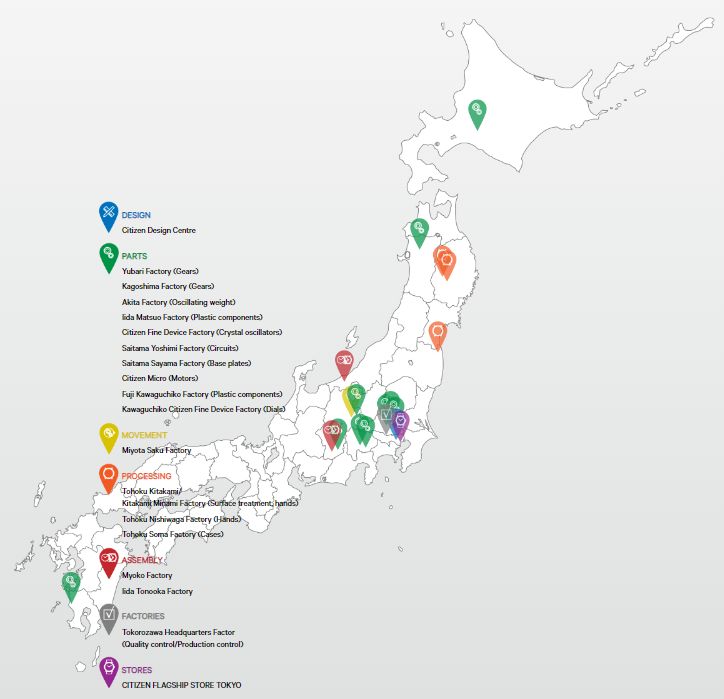
A map of Japan that is featured on Citizen’s website. They locate all of its factories involved in their watch supply chains.

Within the assembly factories (Myoko and Iida Tonooka Factory), the intricate parts are combined by hand through the skillful craftsmanship of watchmaking meisters. Depending on the watch, meisters either work in assembly lines or on the whole installation of a single product with tools like “tweezers, screwdrivers, probes, and watch hand retainers” (Citizen Watch Co., Ltd.).  

An example of Citizen watch box. Picture credits: jesnew-884.

In my phone interview with my father, he mentioned that my Chandler was the new and innovative watch displayed in one of many Macy’s department stores during the 2017 holiday shopping season. Over a video call, we discovered that an authentic Citizen watch arrives in a paper box branded with the Eco-Drive logo. The watch and bracelet rest on a gray, velvet-like cushion. They are stored within a hard, protective circular case that has the “CITIZEN” logo printed in gleaming silver and matte white font.
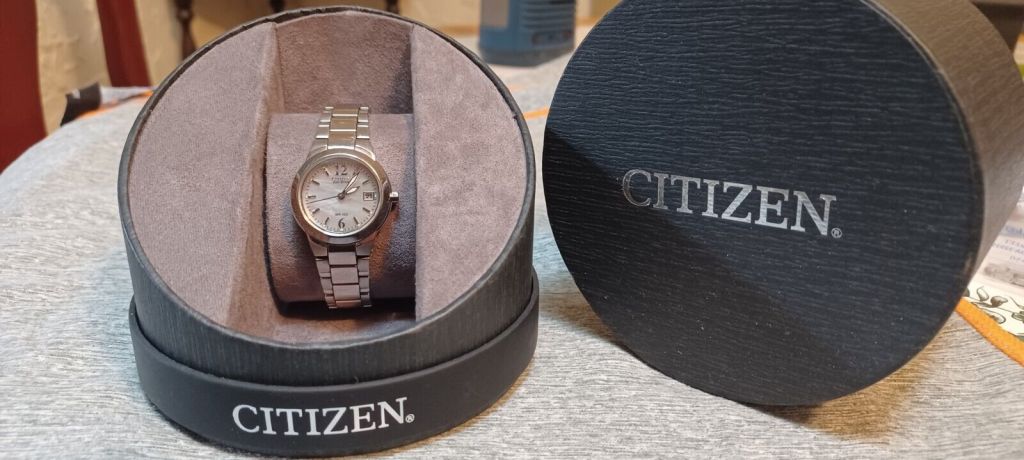
An example of how the Chandler Citizen watch looks inside its case. Picture credits: kimberlrobertso-4.

I tried tracing the supply chain between Macy’s and Citizen. Many questions and prompts, such as “How does a Citizen watch even up in Macy’s?” or “Supply chain of Macy’s watches,” remain unanswered. Rather, it was demoralizing to search for answers among pages of sponsored links that featured the command “Buy…!” next to Macy’s red star logo. The retailer persistently advertised “get FREE SHIPPING” on their dozens of men’s and women’s Citizen watches.  

I will take the relentless advertisements as a signal to stop my research for today. Yet my mind continues to churn with unanswered questions. What is a realistic and sizable impact that mindful consumers can make daily based on their conscious decisions? Do they have the time to tenaciously research the brand behind the article of clothing before clicking “Add to Cart?” Alternatively, how far does a consumer’s determination go to painstakingly follow the supply chain of a bunch of bananas before they walk to the grocery checkout line? 

Works Cited 

“Chandler Definition & Meaning.” Merriam-Webster, Merriam-Webster, 2023, https://www.merriam-webster.com/dictionary/chandler.  

Citizen Watch Co., Ltd. “Assembly.” CITIZEN Manufacture, Citizen Watch Co., Ltd., 2023, https://www.citizenwatch-global.com/manufacture/assembly.html

Citizen Watch Co., ltd. “Chandler.” CITIZEN, Citizen Watch Co., Ltd., 2023, https://www.citizenwatch.com/us/en/product/EW1670-59D.html.  

Citizen Watch Co., ltd. “CITIZEN GROUP’s CSR Procurement Guidelines.” Citizen Watch Co., Ltd., 1 Apr. 2020. https://www.citizenwatch-global.com/csrguideline/CSRProcurementGuideline.pdf 

Citizen Watch Co., ltd. Disclosure of Materials, Citizen Watch Co., Ltd., 2023, https://www.citizenwatch-global.com/citizen_l/special/modal/component.html.  

Citizen Watch Co., ltd. “Factories.” CITIZEN Manufacture, Citizen Watch Co., Ltd., 2023, https://www.citizenwatch-global.com/manufacture/factories.html

Citizen Watch Co., ltd. “Processing.” CITIZEN Manufacture, Citizen Watch Co., Ltd., 2023, https://www.citizenwatch-global.com/manufacture/processing.html. 

Citizen Watch Co., ltd. “Promoting Sustainable Procurement.” Social, Citizen Watch Co., Ltd., 2023, https://www.citizen.co.jp/global/sustainability/social/sourcing.html

Journaling about Browsing vs. Scrolling

My old journal stores fragments of my childhood dating back to my elementary school graduation. The entries are written by my past identities: a tennis player, a summer camp student, and a stressed-out high school senior. These stories were shelved away in the bottom of my desk drawer. After our class conversations that connected storytelling to an object’s value, I wanted to recreate a personal and intimate collection of my everyday experiences outside of digital photographs hastily snapped on my phone. The permanence of my blue-black tennis racket is stored through a narrative about my first tennis tournament within the thick, yellowing pages of my journal. 

During the past month, I picked up my 0.5 ballpoint pen to begin the practice of journaling. Now, there are only thirty-one blank sheets of paper left for future writing entries within the 1-inch-thick book. My thoughts, scribbled in thin navy-blue ink, will soon have to nestle in the pages of another journal.  

I began my first experiment with the Google search engine by punching in the key term “journals.” As if reading my mind, Google displayed the exact product I was looking for. There were 6,030,000,000 results that guided me to a vast selection of potential notepads, diaries, and journals in 1.14 seconds.  

I left Google and tried scrolling on Amazon. Soon, I felt overwhelmed by the lack of tactile touch. None of the items seemed to spark the needed joy for me to click “add to cart.” After all, how could I possibly narrow my selection of notebooks from 60,000 results when many of the products had five-star reviews? Would this professionally photoshopped image of an online journal have the same color contrast in my own hands? Do the journals on Amazon have the same level of quality as my own book? My current journal laces pages together with a fine white thread. There was not a single piece of paper that ripped or slipped out after jamming dried leaves, my first paycheck, and my New Paltz college acceptance letter into the book bind. These concerns clouded my judgment and dissuaded any further willingness to complete the online purchase order.  

Five-starred-reviewed journals on Amazon.

The ease and accessibility, yet the immemorable experience of scrolling that Guriel describes in his book, On Browsing, is accurate. Tomorrow, the small desk, the location of my current infinite scrolling will be repurposed as my workspace where I finish composing an email. If I did not record and reflect on my scrolling experiment, the experience of looking for a journal would have been forgotten. Only my browser cookies will fondly recall my digital shopping experience. However, Google’s reminder of my scrolling experiment will reappear as a pop-up advertisement that obscures my screen as I read a potential news article or shift through social media.  

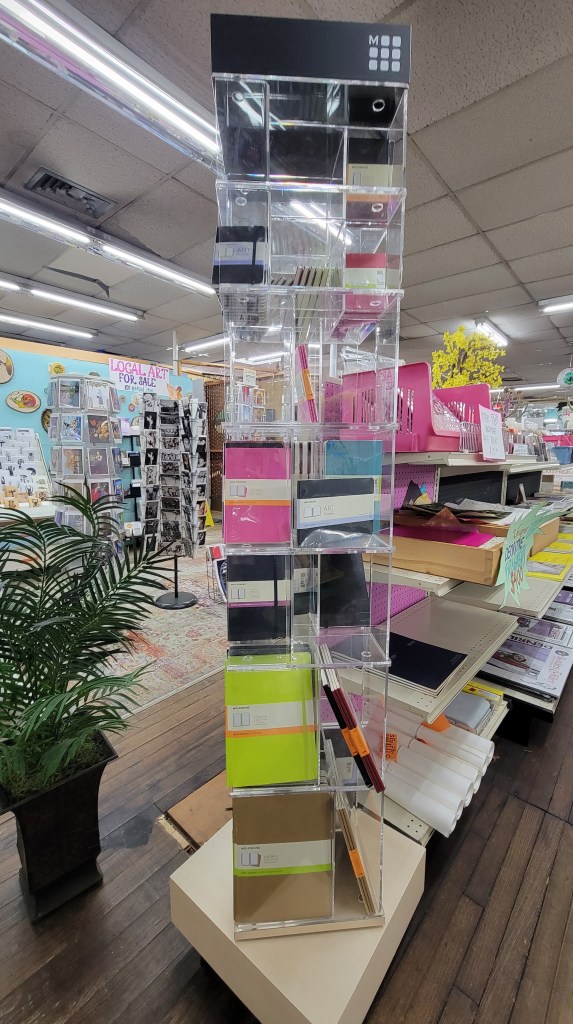
My second experiment began at Manny’s Art Supplies, a local arts and crafts shop on Main Street. I stepped into the crafts store with the assumption that only sketchbooks would be stocked on the shelves, as their website advertised.

Towards the back of the store, there was a plethora of sketchbooks and a limited selection of Moleskine journals. I felt an immediate pang of disappointment. When did the brand-name, dull, solid-colored journals that I saw on Amazon invade a store that supports creativity? Many of the journaling books were wrapped in a protective transparent plastic layer to preserve their leather-bound covers and pearly-white pages.  

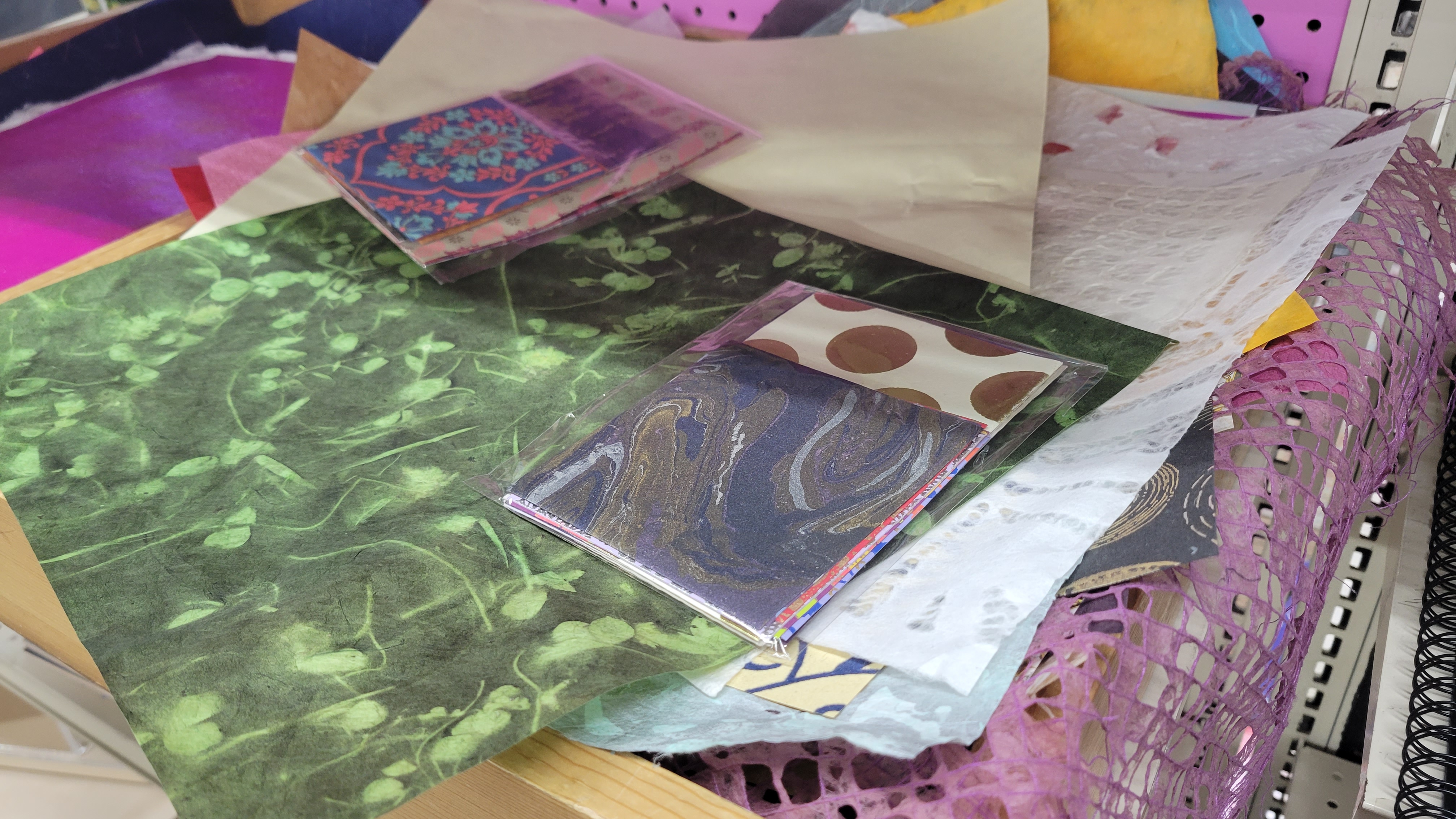
Usually, I do not linger in a store. However, staying true to the browsing experiment, I started wandering up and down the spacious aisles. The store was physically accessible, I noted. There were no stairs, and the slight ramp encouraged access for all individuals. My eyes roamed to admire peculiar greeting cards, while my fingers brushed against an assortment of decorative paper prints. Soon, I found myself swaying and humming to the pop music playing in the background. Between each lyrical tune, the loud creaks of the floorboards loudly creaked under every step.  

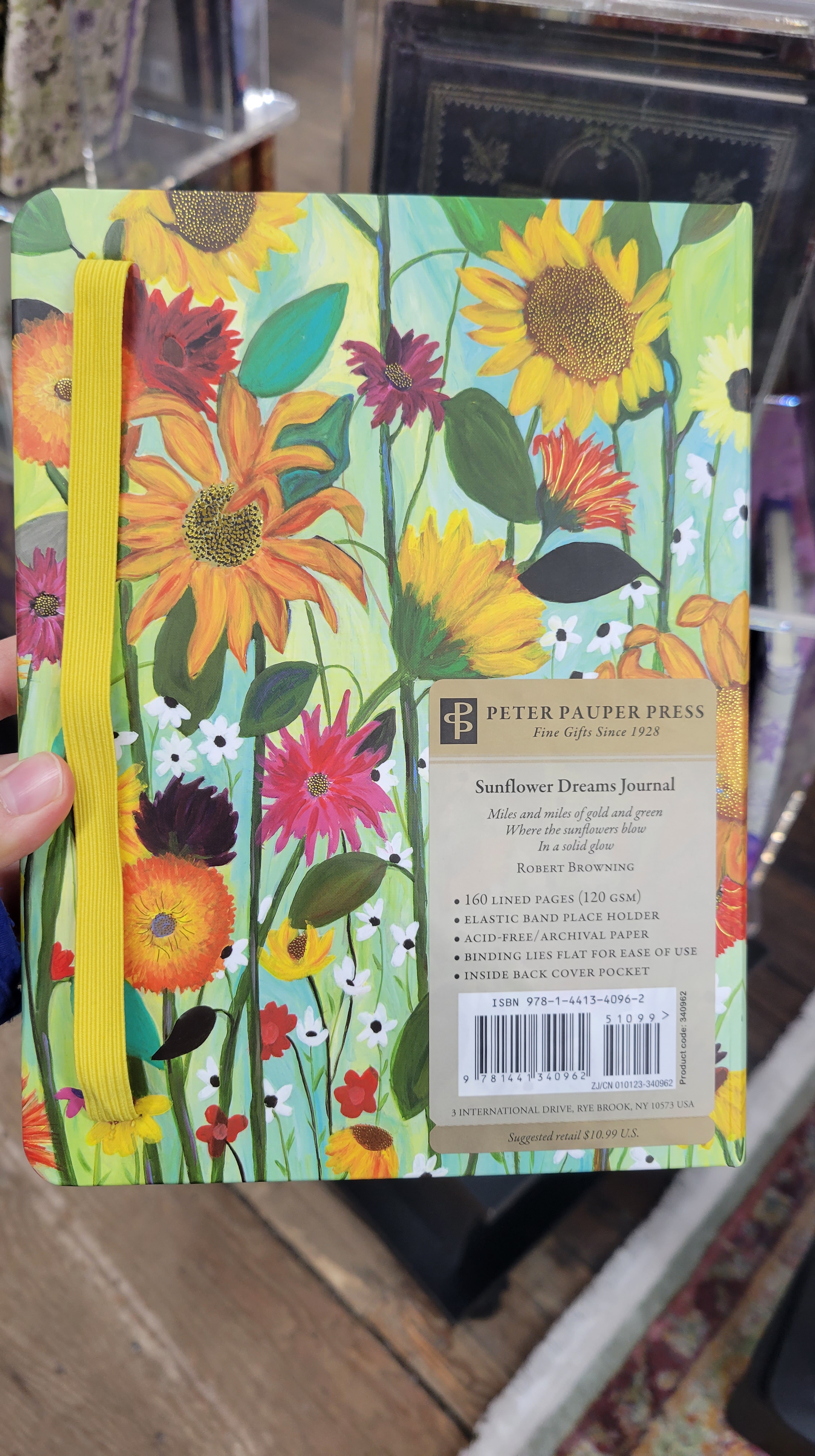
As I was about to gather my belongings and leave Manny’s, a book that depicted a field of sunflowers captured my attention. My brain immediately made the connection that my current journal also illustrated a sunflower!  

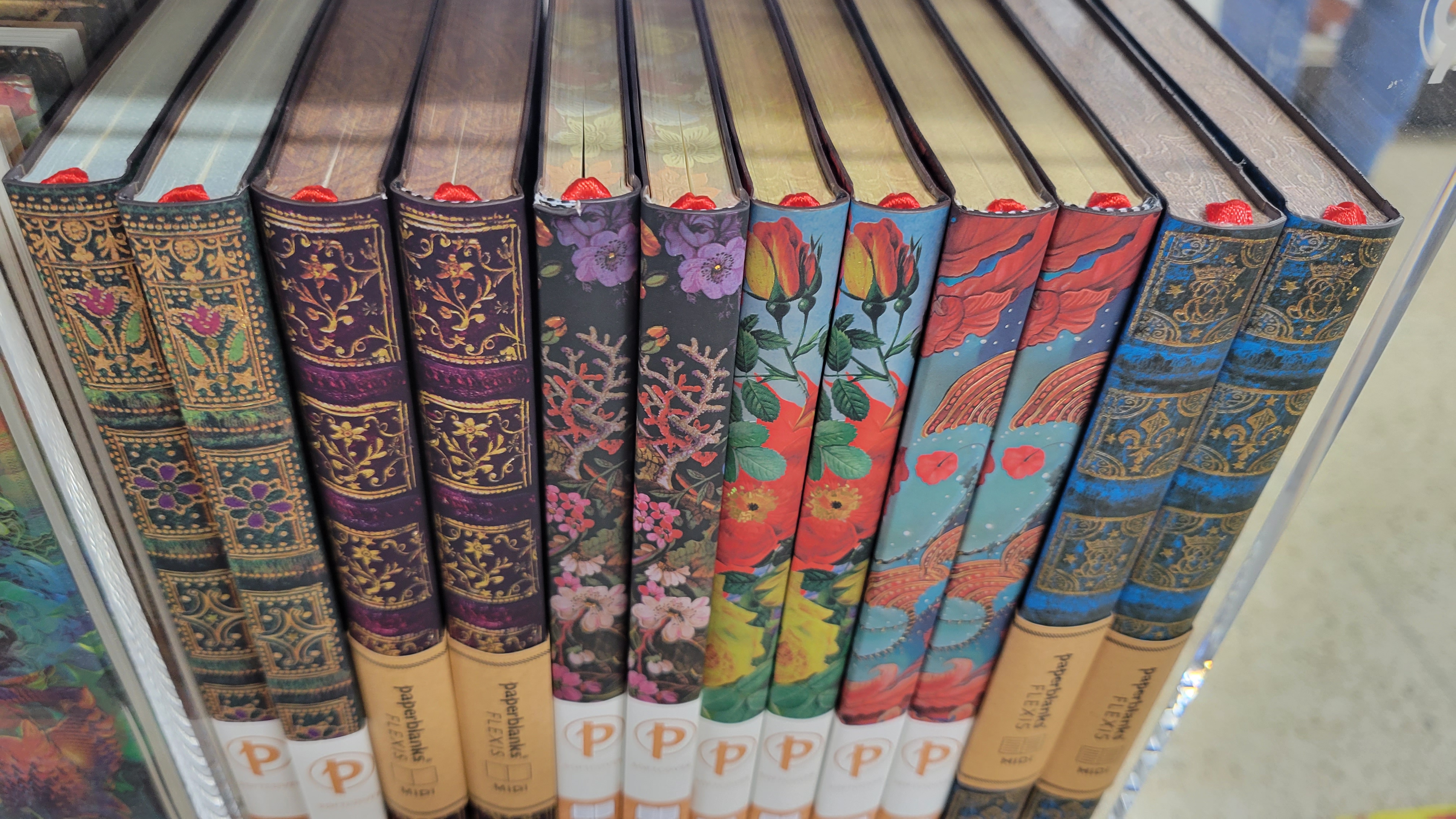
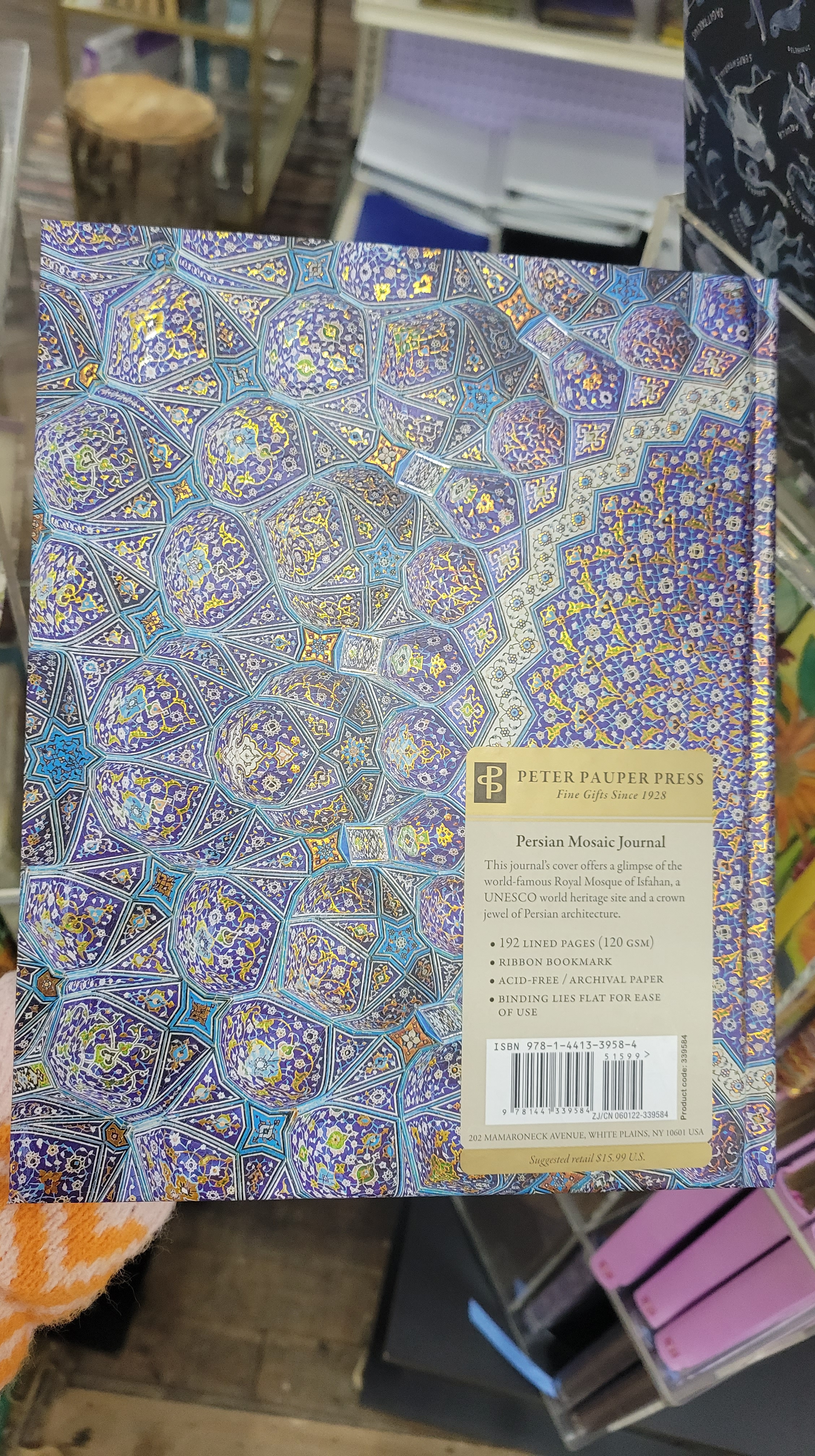
At closer inspection, I realized that I had stumbled upon brightly-hued journals that seemed to scream, pick me up! The whole shelf and the next two rotating columns were supplied with journals depicting famous mosaics and artworks. The back label of each journal briefly identified the printed design. I jotted down a few notes to remind myself to research Ohara Koson’s Tit on Paulownia and the ceiling of the Shah Mosque. 

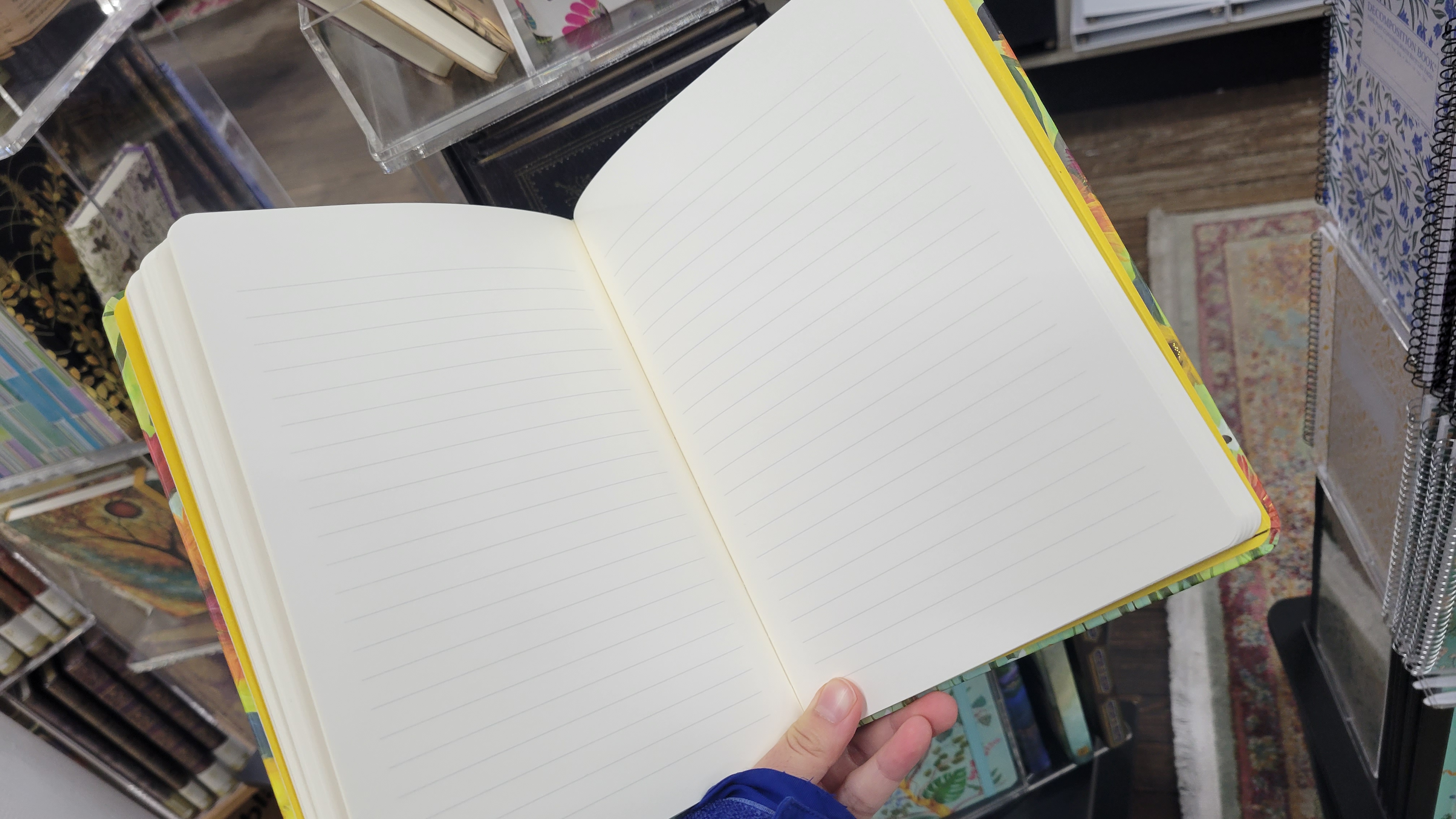
Each journal cover had a story during the design process. My sensory need for touch was appeased as my fingertips ran along the front and back covers. I felt the indented ridges and bumps that emphasized each petal and stem. After I opened the cover, the bookbinding was engineered to lay flat for writing to feel enjoyable. Meanwhile, my current journal needs one hand to stabilize and prevent the binding from closing, even while I am writing mid-sentence.  

Suddenly, my timer of forty-five minutes beeped. Today’s browsing experience was over if I wanted to get to class on time. I left satisfied with the discovery of a local crafts store where I could purchase a potential journal that I could fill with my future musings.  

After completing the two experiments, I understand Guriel’s perspective on scrolling. Scrolling felt mind-numbing and pointless in comparison to browsing. I was not compelled to complete a purchase order because the thousands of similar-looking journals lacked a touch of personal connection.  

The whole motion of browsing included my struggle against the February wind chill, but I treasured the surge of excitement after finding the vibrant collection of journals. I lack certainty about when journal advertisements may start popping up, but I intend to browse through more local shops on Main Street to create tangible and cherished experiences.

Red Garden Geraniums

The garden geranium perches undisturbed on my family’s home windowsill. Each day, a member of my family draws open four wooden blinds to flood our living room with the warmth of direct sunlight. Full sun exposure allowed the geraniums to flourish for almost two decades.  

After interviewing my mother (Lisa) over the phone about our geraniums, I recalled many of her oral stories about her childhood that were told over our dining room table. The blossoms of the vibrant red geraniums were my late grandmother’s favorite flower to admire. My brother and I called her “Popo,” which translates to maternal grandmother in Cantonese. She was a caring, hardworking, and sensible woman. Popo instilled values of education—including the importance of learning English—within her three children, Karen, Victor, and Lisa. By completing schoolwork or watching television, the children experienced the cultural values of America. 

I pieced together dates and timelines. In the winter of 1983, my mother was eight years old when she immigrated to the United States from the Guangdong Province of China. My mother shared one of her childhood American sitcoms with me on our phone call. Small Wonder, a series that comically features a human-like robot disguised as a family’s adopted daughter, aired from September 1985 to May 1989. 

Many of the details in my mother’s personal accounts about Popo’s long working hours at clothing and garment factories in New York City’s Chinatown parallel the muckraking in the New York Times Archives. Popo’s sweatshop experience of cutting, sewing, and stitching clothing is similar to the sweatshop conditions detailed in William Serrin’s “After Years of Decline, Sweatshops are Back.” I could imagine her hunched over large and dangerous sewing machines that threatened to pierce her nimble fingers. Garment workers were not given a sustainable hourly or yearly salary; instead, “wages in a Chinatown shop are 50 cents for a [completed] skirt and 50 cents for a [completed] jacket” (Serrin). Popo faced pressure to meet a high garment quota to earn a sufficient paycheck that covered the family’s necessities—rent, groceries, and clothing. The merger and hard-earned wages from the Chinatown sweatshops were not enough to support a family of five. Popo, Gunggung (my grandfather), Dai Ye (my aunt), Cow Fu (my uncle), and my mother resided in a small apartment. Purchasing a potted houseplant for indoor atmosphere and aesthetics was an unaffordable expense.  

Whenever I saw my grandmother as a child, before she passed away from cancer in 2011, she was long retired from working grueling hours at the clothing shops. During Popo’s retirement, she had the luxury of time to pursue a new passion. Under the open sky and comforting rays of sunshine, the whole motion of gardening for Popo was rejuvenating. My cousins and aunt savored the fruits of her labor at their dining room table. For five years, Popo resided in Dai Ye’s home to take care of my four cousins. As a grandmother, she tended a thriving vegetable garden of bell peppers, amaranth greens (“Yin Choy”), and bitter melon. Although the geraniums sitting indoors did not bear fruit, the flowers were special. Popo enjoyed tending to the plant because the geraniums were durable and required minimal maintenance. The presence of red flowers in Chinese culture symbolizes “longevity of life,” but Popo treasures the geraniums because the flowers represent her family’s persistence through hardship (Yelang). I could picture Popo’s proud and serene smile that lifted the corners of her eyes while watering the red geraniums. The red flowers outlived my grandmother’s lifetime and can be found throughout my family’s home. 

In 2004, my family moved into our house in Flushing, Queens. Without any houseplants or meaningful objects, our abode full of scattered cardboard boxes felt impersonal. Popo wished to help my parents begin the next chapter of their story, and she still lived at Dai Ye’s home—which was a quick five-minute drive away. From a geranium planted in my aunt’s outdoor garden, Popo snipped off a sturdy green branch that sprouted healthy and full leaves. She gave the branch as a housewarming gift to my parents. 

Fig. 1.3 – One branch of a geranium that can be cut from the plant to propagate. The cut should be located at thick brown-green branch, near the black marker. Healthy green leaves, that are circled by yellow markers, should be attached to the branch.

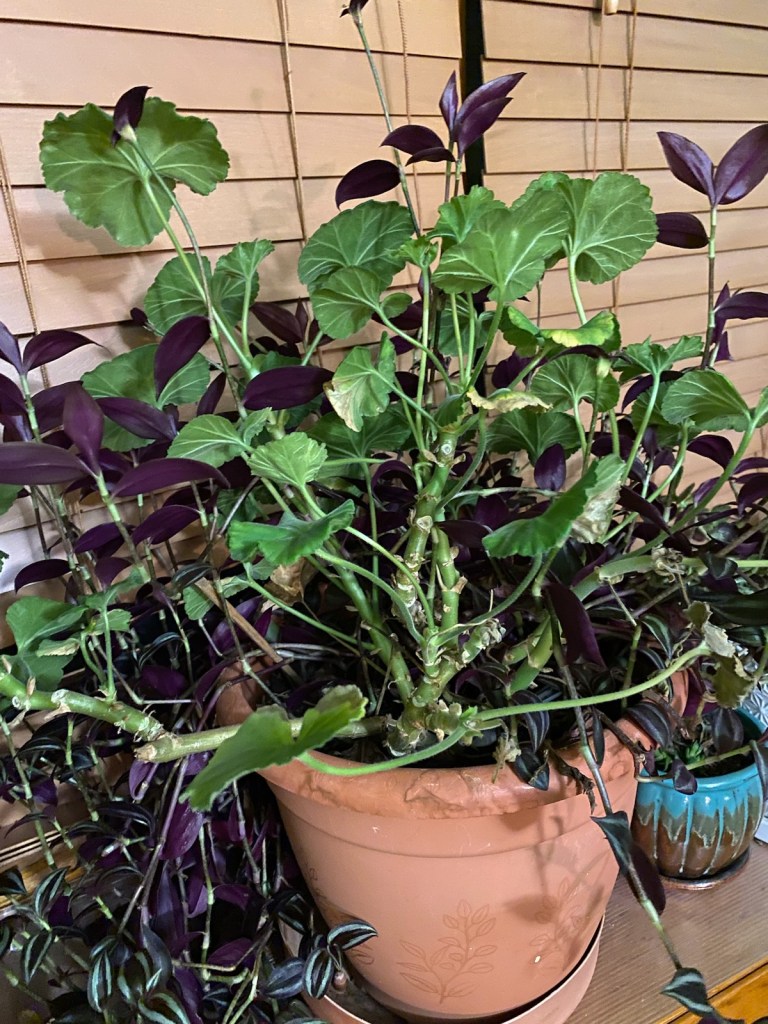
Geraniums can propagate after being cut from their stem. The single geranium branch has blossomed into several bundles of flowers. Today, they continue to thrive despite having an average lifespan of two years. Popo’s love for nature and her green thumb were passed down to my mother. There are many pots full of red geraniums scattered along the windowsill that now welcome house guests. Outside of our home, our front yard is a living and growing collection of peppers, strawberries, roses, sunflowers, and succulents.  

The medium-green leaves, knobby-thick trunk, and vermillion-red flowers all grew from Popo’s original geranium branch. Our red garden geranium is a cherished possession that holds a remnant of Popo and a continuing family narrative of tenacity and resilience.

Fig. 1.4 – Zoomed-in image of my family’s red garden geranium in full bloom.

Works Cited 

Liu, Lisa. Interview. 2023. 

Serrin, William. “After Years of Decline, Sweatshops Are Back.” The New York Times, The New York Times, 12 Oct. 1983, https://www.nytimes.com/1983/10/12/nyregion/after-years-of-decline-sweatshops-are-back.html

Yelang. “Meaning of Flowers in Chinese Culture(12 Types).” Son Of China, 12 Oct. 2022, https://sonofchina.com/meaning-of-flowers-in-chinese-culture/

Steamed Stuffed Tofu

The object I chose to describe is perishable within hours. The short shelf-life of my object, after it has been prepared and steamed, transcends my ancestor’s lifespan in which they created the recipe for 蒸釀豆腐. 蒸釀豆腐, pronounced zhēng niàng dòufu in pinyin, translates to steamed stuffed tofu. In my Chinese American household, the homemade Cantonese dish is a staple that combines the delicacies of tofu, shrimp, and fish.  

 
The small rectangular pieces of tofu each estimate to ¾ of an inch wide, ¾ of an inch high, and 1 ½ inches long. None of the pearly white pieces are identical in size, but each is cut from the same slab of soft tofu that originally totaled to a weight of 14 ounces. Each tofu is crowned with sprinkles of cornstarch with balled-up chunks of a pink, gray, and white mixture. These chunks are a dense mixture of shrimp and tilapia (fish) smashed over a painstaking twenty minutes. The fish and shrimp have been rinsed, peeled, dried, and finely chopped. A filling marinade of ¼ tsp of salt, ¼ tsp of sugar, 1 ½ tbsp of cornstarch, and 1 ½ tbsp water is the final component of softening the blend of seafood. The pre-steamed platter of tofu lies on a cold stainless steel metal plate, ideal for conducting heat. There is a slight excess liquid from the tofu packaging on the plate that pools underneath each nutrient-rich nugget. Excess cornstarch lightly powders the surface of the gray plate. While the stuffed tofu rests on the flat smooth surface of the plate, the raised rim is an integral property of a bowl that will contain and protect the dish from excess heat or potential spillage while steaming. 

Fig. 1.1 Pre-steamed stuffed tofu placed in a stainless steel plate.

After steaming the dish, the dipping sauce—containing ¼ tbsp of fish sauce, ¼ tbsp of oyster sauce, ¼ tsp of brown sugar, 4 tbsp of water, and ½ tsp of cornstarch—thickens over a low flame in a saucepan. The sweet fragrant smell of the savory sauce lingers throughout the kitchen air.  

Slightly tinted golden-yellow squares of tofu struggle to balance the weight of the homemade shrimp and fish paste. I needed several attempts to top each tofu, one by one, with the seafood paste. Still, despite the individualized attention while transferring the steamed stuffed tofu from the steaming plate to the serving platter, there are some minuscule triangular-sized fragments of tofu that broke off during the transition.  

 
After 8 minutes of steaming, perfectly well-done stuffed tofu now lies on a blue 10” flower-printed plate. Rich forest-green spring onions cut into ⅛ inch long pieces serve as a garnish. The tofu is drained of any excess liquid. Rough edges are smoothed into a succulent, rosy-pink latter of shrimp and tilapia.  

 
Chopsticks and a soup spoon carefully cradle the healthy delicacy, cupping the delicate slice of tofu topped with fish. Prior to eating, I lather the bottom of the stuffed tofu in a thick viscosity of the golden-brown dipping sauce. Raw sliced vivid-green scallions in the dipping sauce pack a tinge of spice with a rich earthy flavor. The luscious and tangy flavors of the oyster sauce melt harmoniously with the tofu in my mouth. The shrimp and tilapia bind together in a tender softness that has a uniquely elastic and chewy texture. My tastebuds welcome the fresh, clean, and mild hints of fish. Delectable ingredients that lack preservatives compose an easy-to-digest and scrumptious Cantonese cuisine. 

Fig. 1.2 Steamed stuffed tofu set on a decorative plate. The savory dish is ready for consumption.

 
Cooking a savory comfort meal with my mother ignited a new passion project of learning about Chinese cooking techniques like “wok hay.” I want to continue capturing my family’s traditional Cantonese delicacies through handwriting many more sweet and savory recipes.