The tombstones that commemorate the remains entered in the Huguenot Cemetery give off an undeniable first impression of eeriness and melancholy. The humble markers are cracked and crumbling, and one might fear that simply breathing on a stone would turn it to dust. Some of the stones are over 200 years old, and the passing of time as well as the elements brought with it have obviously taken their toll on the cemetery.
Lineages can be traced through the cemetery quite easily, as families were often buried in plots close to one another. The family that is the focus of this project is the Eltings, one of the families with the oldest stones and who have a plethora of archival documents detailing their family history. Yet, as one looks through the archives on Huguenot Street, it becomes clear that much has been muddled by time, for there are confusing gaps in generations within the cemetery that are not quite clear. Nonetheless, the presence of the Eltings in the cemetery began with the burial of Noah Elting, who was entered at the Huguenot Cemetery after his death in 1725. Providing a comprehensive family history through tombstones proved to be an interesting venture, and it provided a lot of insight into the burial practices of the Huguenots and how that exemplified their relationship with material culture.
Physical description:
Depending on the time of burial, the tombstones are constructed of either sandstone or marble. Sandstone headstones are what the older tombstones in the cemetery are made of and they are most identifiable by their simple engravings, usually only including a name and the deceased’s age and date of death. They vary in height, but most are either about two feet tall. Marble headstones are usually gray in pallor, and they are smooth to the touch–almost too smooth, for their ability to be preserved is minimal due to their lack of durability when it comes to their contact with rainwater. All of the Elting tombstones are plotted close to one another, lining the short stone wall that borders the sidewalk on Huguenot Street.

The tombstone of Noah Elting and his wife Jacomentje is made of sandstone, with a humble inscription that reads: “Noah Elting, Esq. Died Sept. 27, 1773, Aged 57. Jacomentje, His Spouse Died August 27 1790, Aged 75.” There is a tiny brass plaque with this inscription affixed to the withered tombstone due to the natural decay of the stone in order to ensure that visitors can distinguish who is buried where, for “In an effort to preserve the names of those buried, brass plates were fixed to the stones in the late 1960s by the Huguenot Historical Society” (Schenkman).
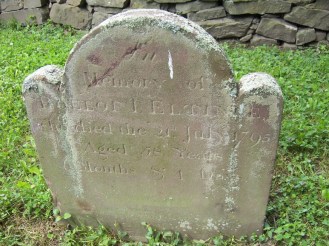
The following Elting to be buried in the cemetery was Roeloff Josiah Elting. His tombstone is made of sandstone and stands about two feet tall. The inscription on it reads: “In Memory of Roeloff I. Elting. He died the 21st July 1795. Aged 56 years, 6 months and 4 days.”
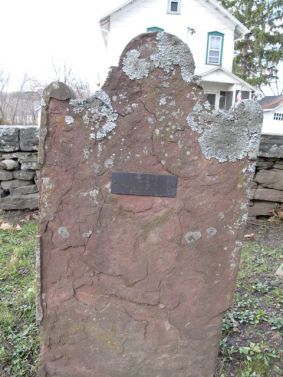
The tombstone of his wife, Mary Lowe Elting, is plotted right near his. It is also made of sandstone, topped with a bell curve design. The inscription, only legible via the brass plaque affixed to the stone, reads: “Wife of R.J. Elting. Died August 24, 1800. Aged 48 years, 7 days.” Mary’s tombstone is pleasantly tall and sleek compared to some of the others in the cemetery.

The next stone feels a bit out of place in the cemetery, that of Josiah Elting. It is a stout stone, made of marble and only about five inches thick. It is incredibly legible, reading: “Josiah Eltinge, 1760–1813. Rev. War.” I hypothesize that the distinguished craft work of this stone is indicative of a more Americanized burial practice associated with veterans at the time, which is interesting considering that the Huguenots are stereotyped as being as Calvinistic as they get, when in reality this stone is one of the least decorative of the Elting’s headstones.
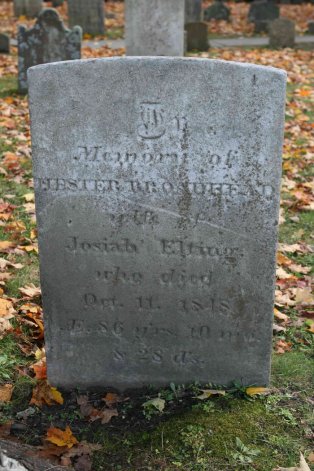
Josiah’s wife, Hester Broadhead Elting, has a lovely marble stone that stands about three feet tall. It is very plain but strikingly elegant, it’s simple geometric shape and faded inscription adds distinct Victorian panache. The stone reads: “In Loving Memory of Hester Broadhead. Wife of Josiah Elting Who Died on Oct. 11th 1848. Age 86 years, 10 months and 28 days.”
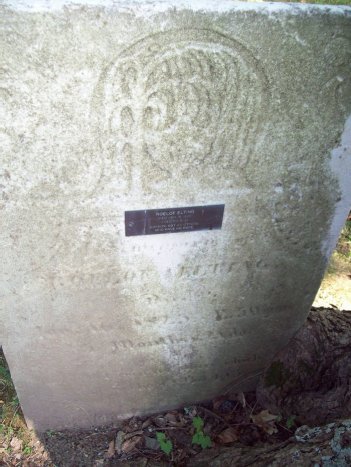 While I kept the stones of Josiah and Hester together, the rest of the headstones described were all erected decades before Hester’s death. The first of these stones was that of Roelof Elting, whose marble headstone stands about three feet tall and features some fascinating motifs. The face of the stone features a prominent carving of what could be a weeping willow tree. Below this decorative carving is the inscription: “Roelof Elting. Died Jan. 18 1825. Aged 50 years, 5 months and 21 days. Sorrow Not As Others Who Have No Hope.” This is the first and only time a quote appears on a Elting stone, making it an especially beautiful yet melancholy stone on display.

Roelof’s wife, Dinah Elting, however, is not entered in this cemetery. She “…died March 02, 1819 in Kingston (Ulster Co.), New York” (Elting). However, two of Roelof’s children were buried in this cemetery. The first was Ann Elting, whose simple marble stone stands about two feet tall. It reads: “Daughter of Roelof & Dina Elting. Died March 2nd, 1813. Aged 5 months, 15 days.”

Her brother’s tombstone is probably the most peculiar in the entire cemetery, for it is only about 10 inches tall and is partially grown into a tree. The size of the stone probably has much to do with his premature departure from this earth, for his tombstone reads: “Roelof Elting, Son of Dinah Elting. Died Feb. 2, 1825. Aged 11 days.” The metaphor is almost too easy to make; the necessity of death in order to create life, a kind of ouroboros that is implicit in the natural world.
Historical Narrative:
The persecution of the Huguenots in France and their subsequent migration to America had much to do with their heterodoxy in relation to their burial practices. Huguenots often shared cemeteries with Catholics, which actually made cemeteries a site of immense religious tension during these times. The sharing of cemeteries, then, was not born out of an attempt to unify but rather due to the fact that provincial towns could not afford the construction of more than one cemetery. Yet: “Shortages of funds, however, only partially account for shared cemeteries. The notion remained powerful that a parish cemetery was common ground used by all members of a community, who buried their dead in familial tombs or in graves near ancestors, even if they had been of the opposing faith…This sense of belonging, not religious affiliation, determined one’s place of burial” (Luria). This “sense of belonging” only lasted for so long, though, and that is how the Huguenots ended up in New Paltz in the first place. But it is crucial to understand the discrimination that the Huguenots faced in their burial practices in France in order to understand their significance in New Paltz.
The widely held idea surrounding the Huguenots is that they were the opposite of materialistic, often opting for the least ostentatious option available to them. Perhaps this is true in their Calvinistic ideological views, but there is definitely something to be said for the Huguenot’s desire to commemorate the dead in a way that often called for the sparing of no expense. But, a distinction needed to be made when it came to funerals held by Catholics versus funerals held by Huguenots, so there was actually a mandate by the state that called for them to tone down their funerals, for: “In France, Huguenots were more likely to be held to simple funerals by doctrine and the need to distinguish themselves from majority Catholics, but also, and perhaps more significantly, by the state’s restrictions” (Luria). The act of mourning itself was restricted, reducing the Huguenots to the stereotype that is still thought of them today–unpretentious, plain, and unembellished.
The reality is that social class was still a very tangible signifier in Huguenot culture, simply meaning that the more money and social standing that one had, the more likely their funeral was to at least parallel the pageantry of Catholic funerals: “The most frequent contraventions of Calvinist simplicity came from members of the Huguenot elite, who sought funeral pomp commensurate with their social status. When the great were buried, the Discipline’s rules were most likely to be frustrated, for instance on the issue of funerary monuments. Although cemetery walls did sometimes carry biblical inscriptions, the Discipline discouraged tombs and tombstones. But synods had to wrestle again with local custom and with the Huguenot elite’s assertion of their status.” This bit of research is so interesting when examining the Huguenot cemetery in New Paltz simply because it contains nothing but tombstones, something that was apparently condemned in French state restrictions of Huguenot burial practices at the time. Therefore, this could mean that the cemetery itself radical because it is a place of defiance of French doctrine that attempted to marginalize the Huguenots by way of regulating their burial practices. Especially in the case of the 12 Patenees, an aura of high social class (or perhaps status?) still surrounds them posthumously. This could mean that the tombstones that marked their final resting place were not only a symbol of their status at the time of their death, but also a hallmark of a new time for Huguenots, where everyone could have a tombstone and a dignified funeral without persecution.
The Elting family, then, served as an interesting study in Huguenot tombstones, but their specific stones say less about the implications of Huguenot burial practices in New Paltz than the existence of the cemetery itself. Furthermore, some interesting gaps in the family tree of the Eltings have much to do with the fact that with the birth of so many children from generation to generation, that many moved to neighboring towns (or further) for marriage, business, etc. For example, Roelif Josiah Elting “…had eleven children and seventy-seven grandchildren who lived to maturity” (Elting). Needless to say, the Elting family history is immense and almost daunting, but at least those entered in the Huguenot cemetery in New Paltz can find solace in their proximity to one another, lining the stone wall bordering Huguenot Street.
Works Cited
Luria, Keith P. “Separated by Death? Burials, Cemeteries, and Confessional Boundaries in Seventeenth-Century France.” French Historical Studies, vol. 24, no. 2, Spring2001, pp. 185-222. EBSCOhost.
Elting, James W. The Descendants of Jan Eltinge: The Genealogy of the Elting/Eltinge Family. Charlotte, NC: James W. Elting, 2002. Print.
Schenkman, A.J. “Old Huguenot Burying Ground.” Historic Huguenot Street. N.p., 2016. Print.




 The Materials of History, Thought, and Art