Philip Hasbrouck’s “Nice Cyphern Book”

This ciphering book belonged to young Philip Hasbrouck in approximately 1796. Beneath the battered, unassuming, faded cover bearing the words “Philip Hasbrouck, His Nice Cyphern Book” are 132 beautifully preserved pages containing his journey through arithmetic, his learning of the business practices of the time period, and his fascinating doodles.

A common thread that can be traced across years and years of history is the education of children. In the time of the Huguenots, they focused on “the three R’s”: reading, writing, and ‘rithmetic, and their educational system was heavily influenced by religion and matters of daily life. On a surface level, this ciphering book only contains Philip’s mathematical exercises and problems; however, diving deeper into the content of this book reveals a great deal about what was considered valuable to teach to children in the New Paltz community in the late-18th century.

Physical Description: The ciphering book is unexpectedly big, and certainly larger than most academic notepads or workbooks used by students today. It is about 12 inches long, 7 inches wide, and less than .5 inches thick, although it is likely the book has been compacted by time and years in storage. The stained and rumpled cover is rough to the touch and feels like a thin cardboard material. The edges of the cover are crinkled and furled, even a bit torn in places, with brown string running through the edges and through the center of the book to serve as binding. The inner pages of the ciphering book are stiff and yellowed with age, and some are stuck together. Despite some watermarks, fading, and ink bleedthrough between pages, the interior of the book is much more well-preserved than the cover and is nearly all clear and legible with Philip’s lovely sweeping script. The bottom right corners of the pages are the most crumpled, suggesting the repeated turning of these pages by Philip, his teacher or tutor, and the many researchers long after, leaving the corners bent and well-used.

Provenance: After its ownership by Philip Hasbrouck, it is difficult to trace this book’s journey. Who felt the need to keep a child’s math problems? Where was it kept? How did it get passed on? It is impossible to be certain of all the answers. We only know that after Philip Hasbrouck’s completion of his ciphering book, it somehow fell into the hands of brother and sister Robert Stokes and Mary Jensen Stokes years and years later, who donated it to Historic Huguenot Street in 2016 after finding it in storage in their family home. The brother and sister have also donated a couple of other artifacts to HHS.
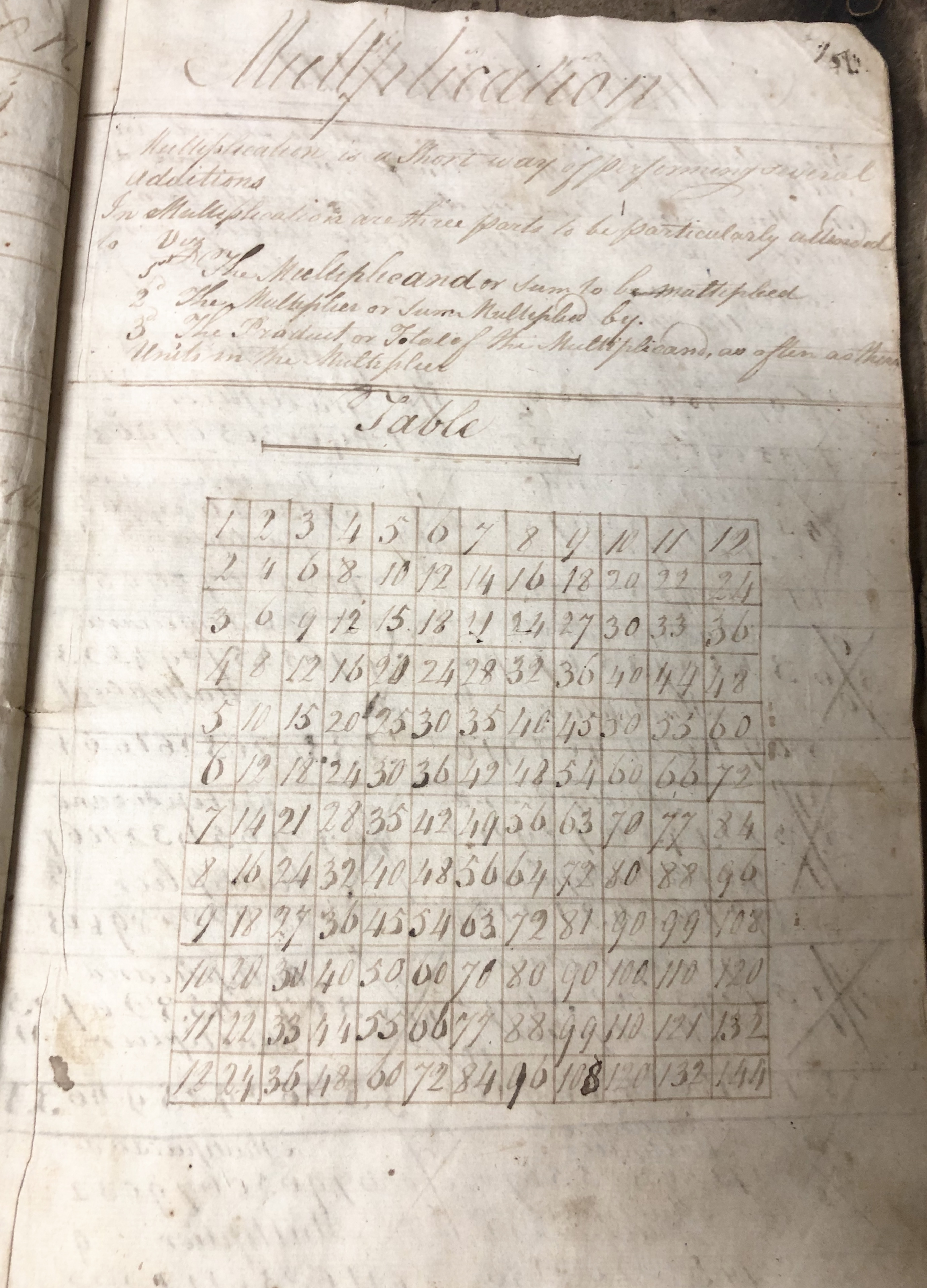
A page on Multiplication, with a table just like today’s multiplication charts

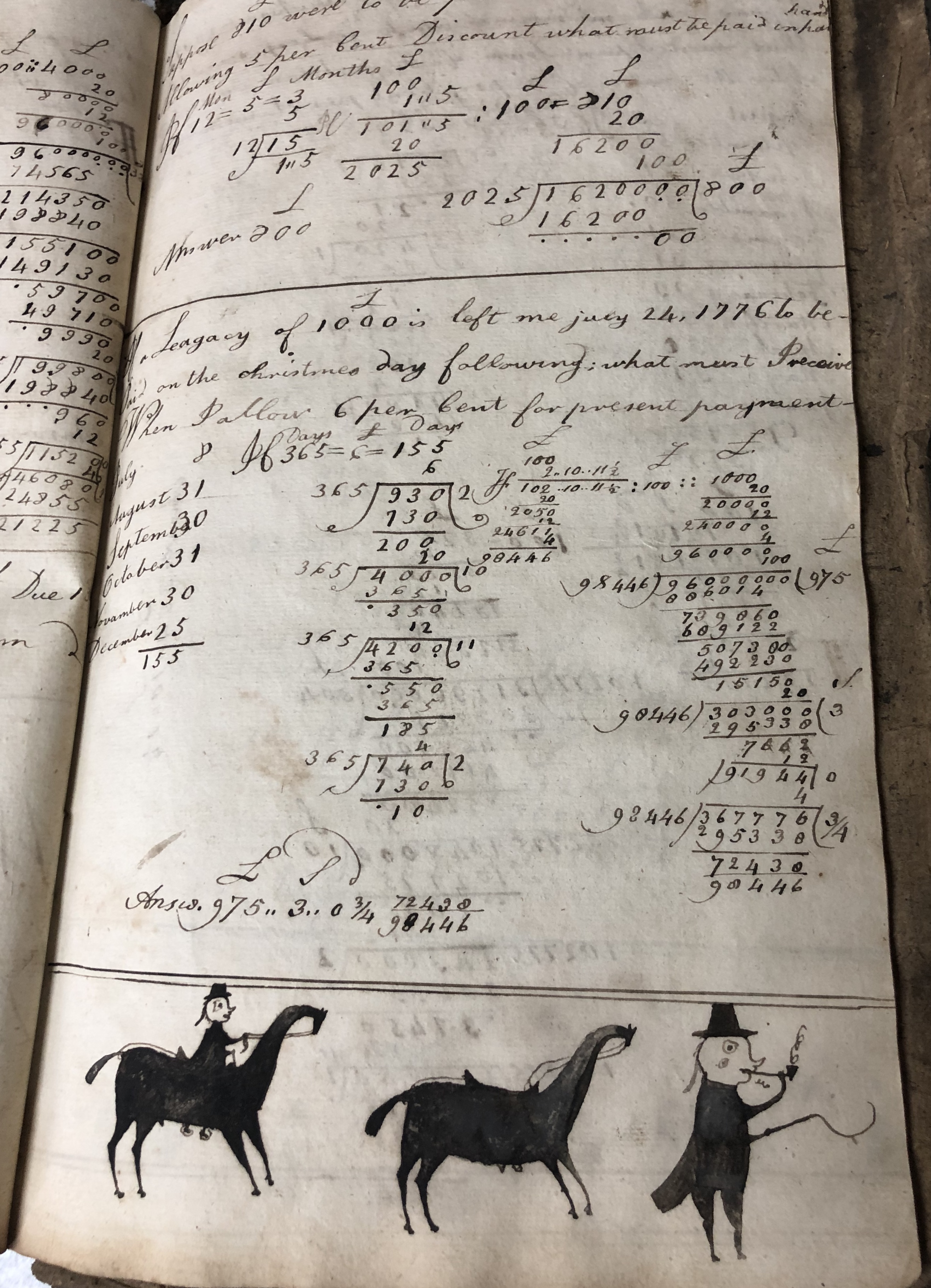
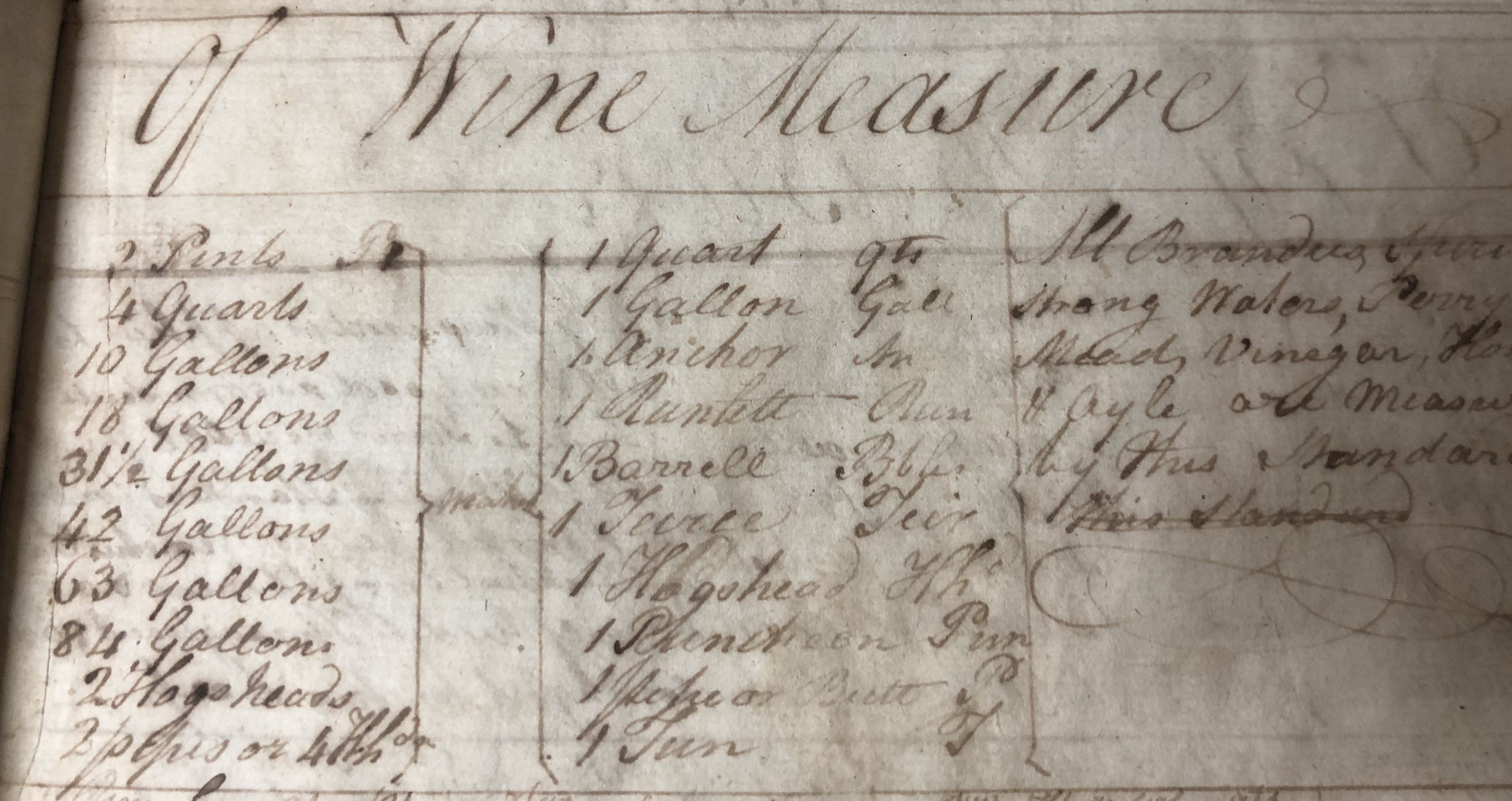
Narrative: Born in 1783 to Joseph Hasbrouck and Elizabeth Bevier, Philip was the great-great-grandson of Abraham Hasbrouck, one of the Patentees and original settlers of New Paltz. It is unclear when Philip first began writing in the book; there may be a date on the cover, but it is impossible to make out. However, one of the pages later on in the book is dated August 1st, 1796, when Philip would have been 13. It is possible that he owned his workbook for a couple of years as he progressed through his math studies. The ciphering book begins with the definitions and practice of the basics: addition, subtraction, multiplication, and division, all exactly the same as how these topics are taught now. There were also the same categories of math, with pages titled, “Of Dry Measure,” “Of Liquid Measure,” “Of Time,” and “Of Money” (though this unit of measure was concerning pounds and shillings), but there are some classifications that seem specific to the time period, such as, “Of Land Measure,” “Of Winchester Measure,” and interestingly, “Of Wine Measure.” Philip’s application examples are largely focused on land, business, and commerce, including problems about selling sheep, purchasing bushels of wheat, measuring the acreage of a ranch, or making sale deals with other merchants. As the book continues, Philip moves on to more complex lessons about types of interest, discounts, rebates, barter, and “brokage,” the definition of which includes a mention of selling goods to “Strangers or Natives.” This made me wonder if the New Paltz community in the late-18th century was still dealing in trade with the local Native Americans, or if they simply saw fit to include this in education. This ciphering book, along with records of the Hasbrouck family accounts, seem to demonstrate that “the economic goals of the settlers in New York’s mid-Hudson River valley and their descendants included meeting annual subsistence needs, increasing the comfort level of daily life, accumulating land, and passing on a legacy to heirs” (Hollister & Schultz 143). Philip’s concrete, realistic arithmetic exercises illustrate the importance of learning the ins and outs of engaging in business and being a merchant, perhaps especially so for a Hasbrouck, whose family store was still operating during Philip’s time.
“Of Brokage” definition, dated 1796; it reads, “What is Brokage. It is an Allowance made to Persons called Brokers at a certain rate per Cent. For finding Customers and selling to them Thee Goods of other men, whether Strangers or Natives.”
A problem relating to merchants: “1. My father sends me word that he has bought goods to the value of [money amounts] upon my account. I demand what his commission comes to at 3 1/2 per cent”

Religion makes only one appearance in Philip’s ciphering book, but the reference is concise and incredibly apparent. Tucked in a neat little box in the middle of a page full of numbers is the following passage: “Philip Hasbrouck is my name and guilt is my station / this earth to be my dwelling place and Christ to be my salvation. When I am dead and gone and all my Bones are rotten / when you see remember me that I am not Forgotten – Philip Hasbrouck.” The rather random placement of this religious excerpt in the midst of Philip’s math problems was incredibly interesting to me and brought up a lot of questions: Did the schoolteacher tell him to write it? Did the whim merely strike Philip? The rhyme is both catchy but foreboding, especially for a child, but it may have been inspired by the study of bible verses. During this time period, many families required their children to “learn to ‘read the Bible and write a legible hand’ by the time they reached adolescence. Reading and writing not only reinforced the child’s religious life, but they suggested a mastery of the fundamental skills needed to pursue further self-directed study” (Volo & Volo 97). Philip’s beautiful cursive suggests a great deal of writing practice. (Funnily enough, however, some of his entries contain misspellings, unnecessary words, lack of punctuation, or missing letters; the aforementioned example, if you look closely, is missing the “T” in Christ, so it reads, “Chris to be my salvation.”)

Philip’s religious entry
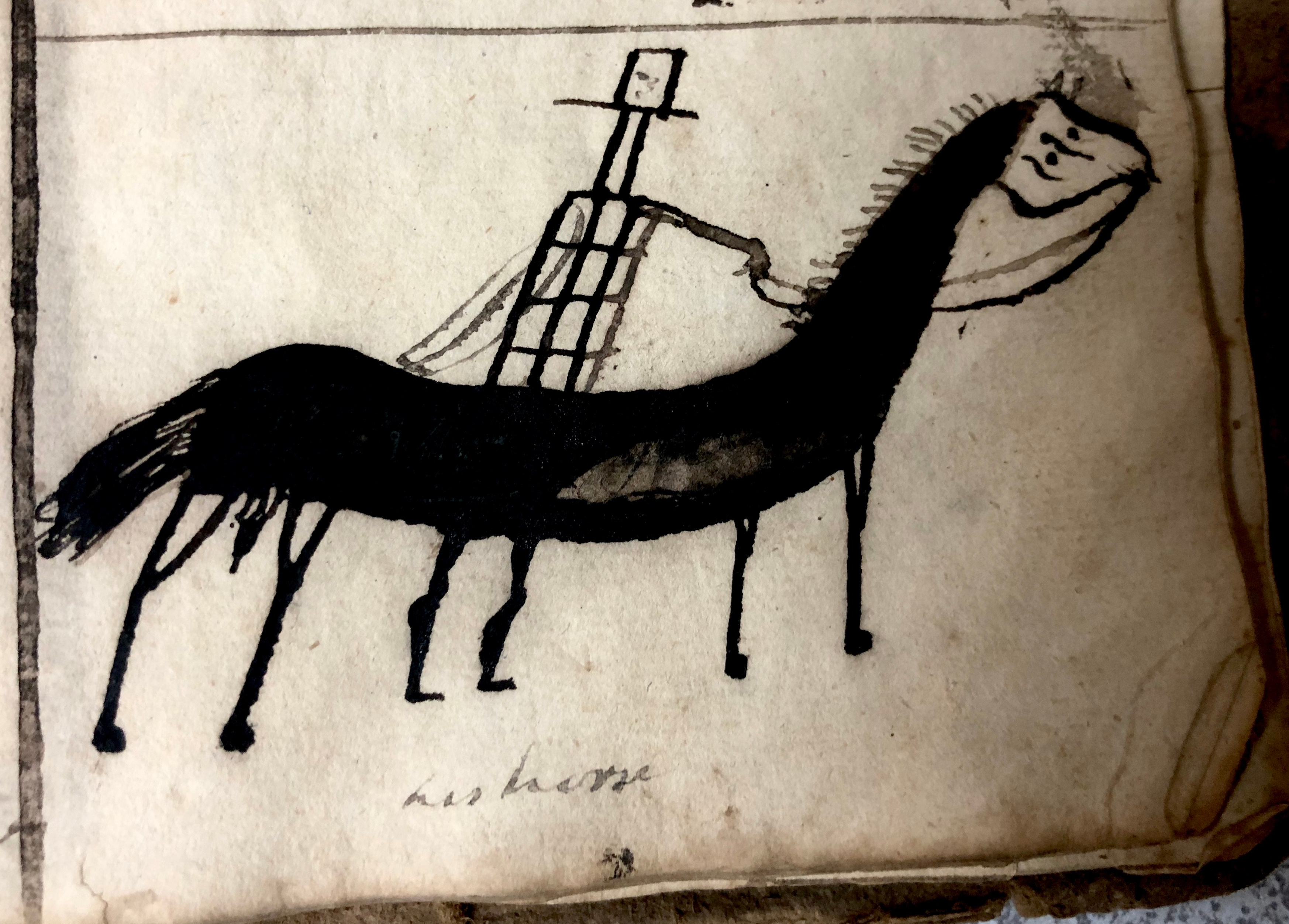
Helpfully labelled “his horse” by Philip

Although clearly a diligent student, the abundant doodles throughout the book are a testament to Philip’s occasionally wandering mind. For me, looking through this book was such a strange experience; its characteristics and content seemed so foreign to my conception of what education is like, and his doodles seemed to lend a bit more humanity and authenticity to the artifact. Seeing his small pictures that appeared more frequently the further I delved into the ciphering book, I was able to more fully reconcile with the fact that a child held this book in his hands, once, and wrote in it, did his math problems, likely became frustrated or tired at times, and turned to drawing in fits of boredom. It seemed that Philip’s favorite things to draw were horses and men, and they have various (sometimes silly) appearances. Some of the men smoke pipes or are holding whips in front of horses, and they are often well-dressed, with long hair and wearing tall hats. I wondered if his doodles spoke to his perception of the men around him, of their activities, and perhaps what it meant to “be a man” in his community in this time period.
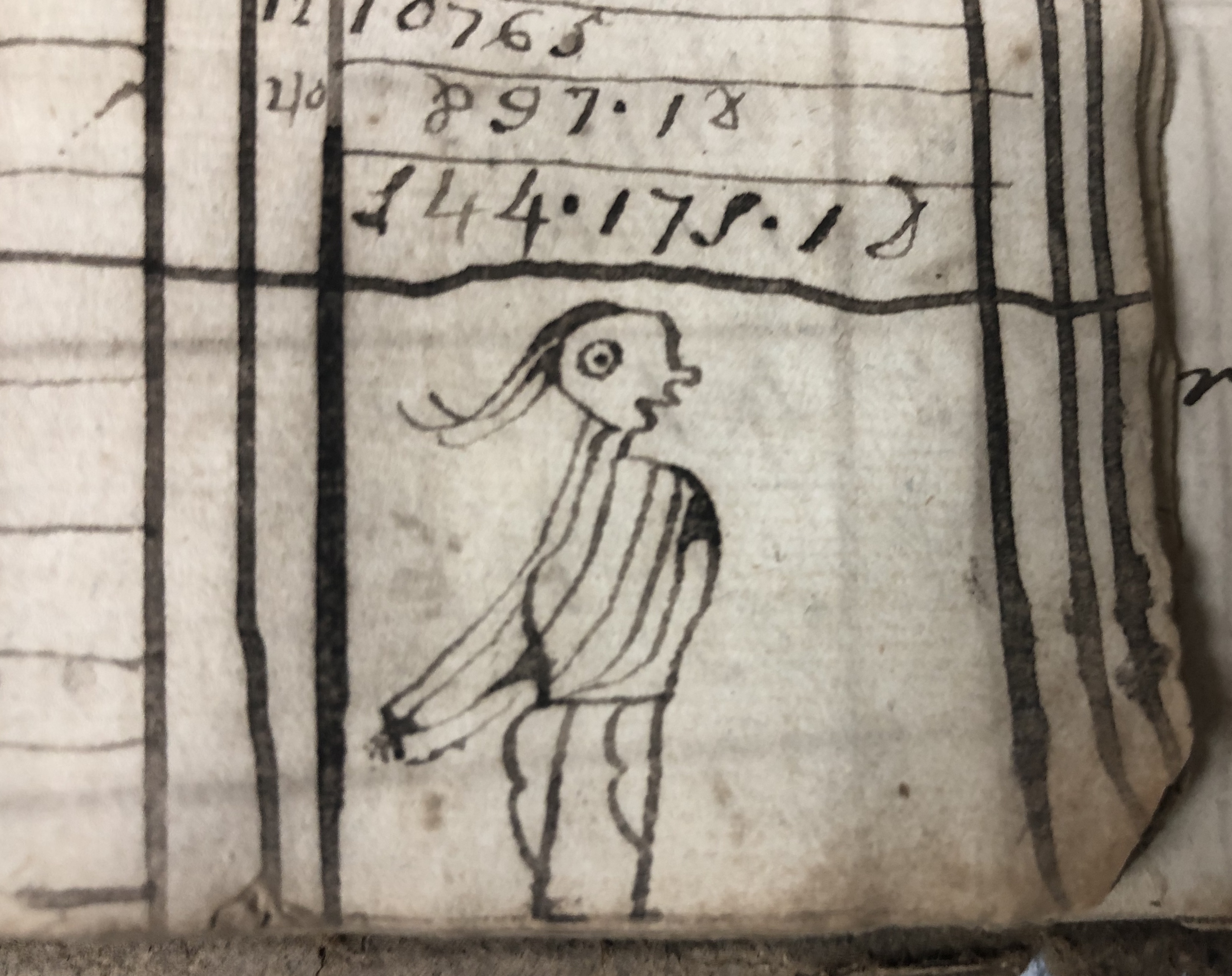
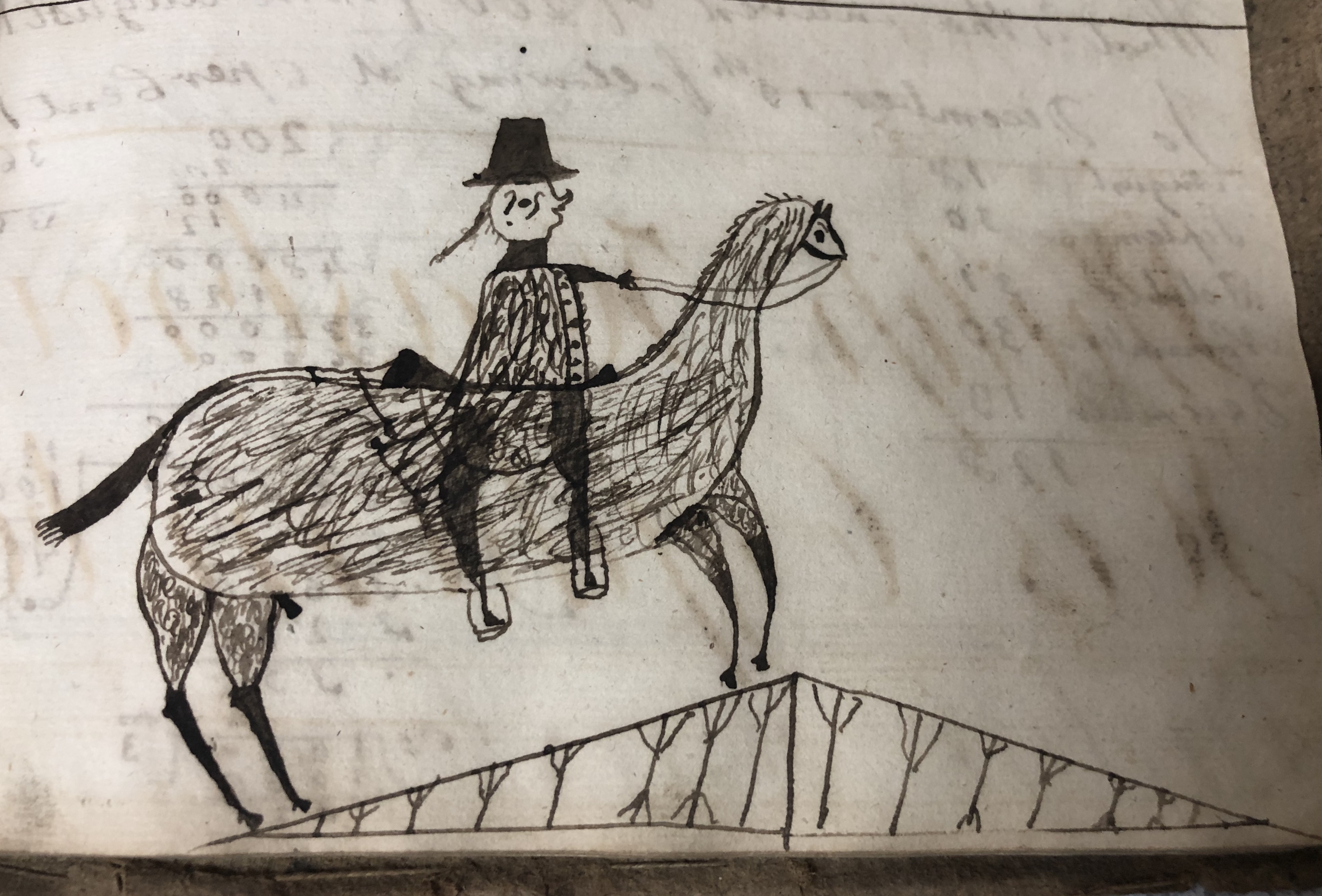
A series of men; two smoke pipes and the middle appears to be playing a violin
It looks like Philip tried to scribble out his writing next to this drawing; “Philip Hasbrouck” written down one column, and down the other: “There he Stands Sir he is a gentleman”

Reading through this book was a thought-provoking and surprising learning experience, with the curiosity that was evoked by all that is contained within the ciphering book’s pages. I was struck by the types of problems Philip completed; they were certainly more applicable to his world and his daily life than the kinds of problems we do in math classes today. I also was fascinated by the religious rhetoric demonstrated and how it compares to the separation of education and religion in public schools now; to see the religious passage merged right in with his arithmetic exercises suggested just how deeply intertwined the two were for New Paltz citizens in the late-18th century. As it turns out, his education served him well; young Philip Hasbrouck grew up to be a farmer and merchant, and in 1832, he was part of a group of New Paltz residents who received the deed to a property upon which they would build a Dutch Reformed Church. Exploring Philip’s doodles made me feel as if I could relate to him, a child of the 1790’s. It was comforting, in an odd way, to realize that although the education was incredibly different from the way it is now, the minds of children remain the same, transcending time. His drawings, however, also raised some questions: What would the doodles of a child who was not as well-off as Philip look like? What would a young girl be drawing? After investigating what I thought, quite frankly, might be a mundane representation of old-time education, I was thrilled by the information and insight that can be gleaned from a young boy’s writing in his school book from over 200 years ago.

References:

“Guilford Dutch Reformed Church Records (1832-1930).” Historic Huguenot Street, Huguenot Historical Society, www.huguenotstreet.org/guilford-dutch-reformed-church-records.

Hasbrouck, Philip. Ciphering Book, 1796.

Hollister, Joan, and Sally M. Schultz. “Single-Entry Accounting in Early America: The Accounts of the Hasbrouck Family.” Accounting Historians Journal, vol. 31, no. 1, June 2004, pp. 141–174. EBSCOhost, doi:10.2308/0148-4184.31.1.141.

Salton, Meredith. “A Child’s Ciphering Book.” Object of the Week, Historic Huguenot Street, 15 Aug. 2016, hhscollections.wordpress.com/2016/08/15/a-childs-ciphering-book/.

Schenkman, A.J. “Philip Hasbrouck’s Account Ledgers.” The Gardiner Gazette, The Gardiner Gazette, gardinergazette.com/article/philip-hasbroucks-account-ledgers/.

Volo, James M., and Dorothy Denneen Volo. Family Life in 17th- and 18th-Century America. Greenwood Press, 2006.

My Boots (and all the work that went into them)

This week, I have decided to examine something that I love: shoes. Last October, I finally purchased a pair of Timberland boots I had been eyeing for a few weeks. I actually ordered two pairs of the same shoe – one in a size 7 and one in a size 6.5, as I was not sure which would fit – and then eventually returned the size 6.5 boots by mailing it back (Timberland has free return shipping!). I’m a bit ashamed to say I spent $145.97 on these boots (per pair, but I was refunded for the pair I returned).

The boots
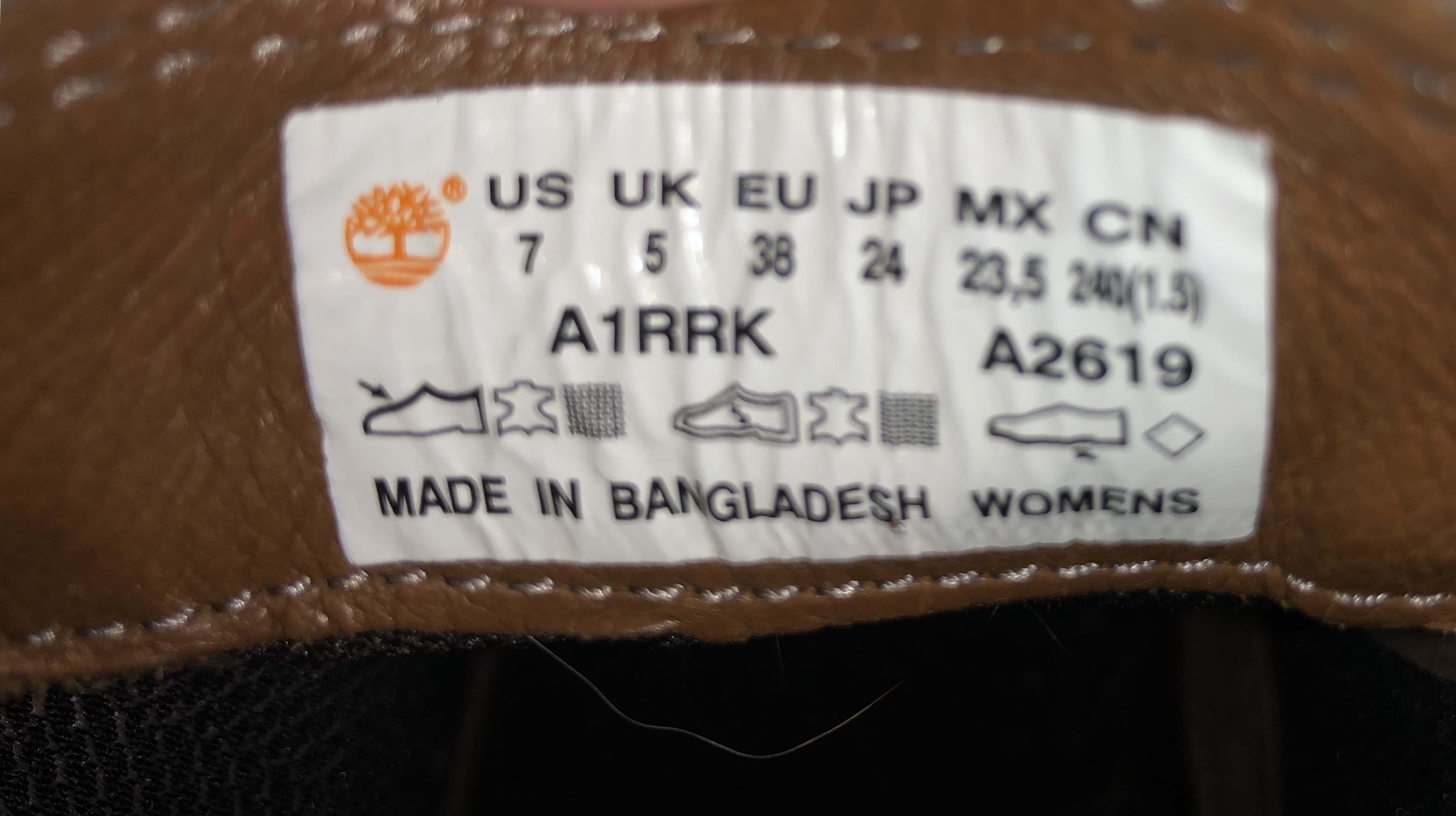
The inner label

The pair I bought are the Women’s Courmayeur Valley Chelsea Boots, size 7 in beige. One boot weighs a little less than a pound, surprisingly light for its thick rubber sole. They have stretchy side panels and wool and cotton lining. They are suede on the outside and contain Ortholite insoles, which supposedly are made to be sustainable out of recycled rubbers.

Timberland has a page dedicated to its Material Policy Statements, including areas such as Animal Welfare, Leather Processing, and a proclamation that they do not source their cotton from Uzbekistan due to the forced-labor system there that produces it. It is clear that the company wants its customers to be fully aware of the products that go into their shoes, and they seem proud of the fact that a majority of their shoes are made with sustainable, recyclable materials through ethically sound processes.

The inner label says that these boots were made in Bangladesh, and a quick Google search revealed that factory conditions in Bangladesh are not all that great. According to the Human Rights Watch website, little has been done to improve the conditions for garment workers in recent years despite a factory collapse in 2013 that killed 1,100 workers. Timberland, however, would have you believe a different story about the conditions of their workers: their website has a page listing their accomplishments with HERProject, an organization that seeks to improve the circumstances of low-income women working for global supply chains. While it is nice to see that Timberland may have had a hand in increasing health awareness for their female factory workers in Bangladesh, for some reason I always feel suspicious at how large companies advertise their charity work, especially when accompanied by photos like the one below of a smiling worker.

The (supposedly, & hopefully) happy Timberland factory worker

After examining the production of the boots, I then considered their journey. They were imported to one of three Timberland distribution centers in Canada, Kentucky, or Holland, the final center having received Europe’s BREEAM (Building Research Establishment Environmental Assessment Method) Certificate, a testament to its efficiency and eco-friendly nature. This facility gets 100% of its energy from wind power, which I thought was very cool. My boots, in particular, were shipped from the Kentucky center by way of UPS, finally arriving at my house just three days after I had ordered them. A friend of mine recently told me she is trying to do less online shopping because of its impact on the environment, what with the pollutive effects of fossil fuels released as goods travel to their destination, their home with the consumer who paid for them. This is not a topic I know much about, but I wonder if driving myself to the shoe store to buy a pair of boots would have been more or less energy efficient than ordering them, or if it perhaps is detrimental to the environment, either way. The fact that I shipped the pair did not fit back also likely had an environmental impact that I did not even contemplate.

According to the Timberland site, they “found out” that 67% of consumers take into consideration whether or not fashion is eco-conscious or not. Honestly, this is not something I considered at all; I bought my boots because I liked the way they looked and I wanted a new pair for the fall. However, after exploring this object’s production and how it finally got to me, I feel more aware of the massive, complex web of production and transport created by consumerism. It is hard to conceive of the human labor – and the human cost – that goes into the production of things that I take for granted. There are so many aspects that I did not even delve into, such as the packaging of Timberland products (supposedly recyclable) and the production of the individual components that went into my shoes (quite frankly, I do not think I wanted to know more about the tanning and leather process – I am not proud of my lack of environmental consciousness, but ignorance is bliss). After this project, though, I do think I will be more attentive to the grand scope of consumerism, especially when I inevitably buy another pair of shoes.

Sources:

https://www.timberland.com/shop/womens-ankle-boots/womens-courmayeur-valley-chelsea-boots-black-a1j66001#hero=0

https://www.timberland.com/responsibility/stories/improving-womens-health-in-bangladesh.html

https://www.timberland.com/responsibility/product/materials-policy-statements.html

https://www.timberland.com/responsibility/stories/improving-energy-efficiency-at-our-distribution-centers.html

https://www.hrw.org/news/2015/04/22/bangladesh-2-years-after-rana-plaza-workers-denied-rights

https://herproject.org/partners/companies

The Family Bible

For this week’s post, I decided not to continue discussion of my grandmother’s old recipe book; there is not a very substantial chain of ownership, and when I asked my mother, she was uncertain as to whether the recipes themselves had been passed down or if my grandma simply made them up on her own (or, possibly, just copied them out of a cookbook)!

Instead, I am going to focus on an object that I forgot even existed until this week (after a great deal of time spent bothering my mom, asking if we had any other heirlooms): the family bible. I do not currently have possession of the family bible, but it was the object I was able to discover the most history about, as it literally holds a record of the history of my mother’s side of the family back to the 1800’s (albeit a limited history of names, and the dates of births, marriages, and deaths). After my grandfather passed away, my Aunt Linda, my mother’s oldest sister, took possession of the family bible and provided me with some information and photos about it for the sake of this post. When I have the time, I would be curious to go to her house and see it in person (apparently I have seen it before, when I was very young, but I do not remember). Pardon the quality of some of the pictures – my Aunt Linda is technologically challenged and did her best.

The Family Bible (it reminds me, a bit, of something out of Harry Potter)
Inside front page of the family bible

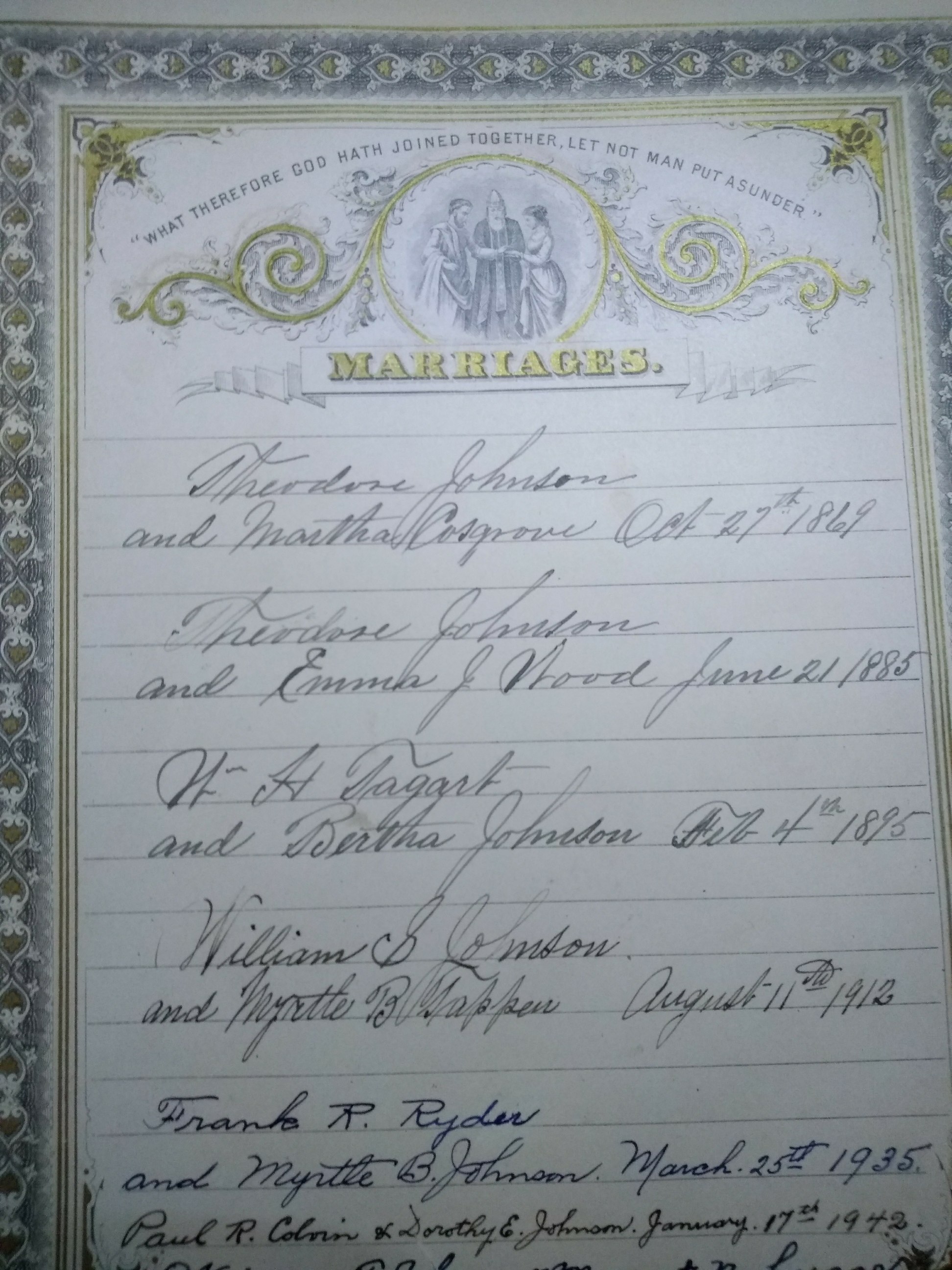
The duct tape is an unattractive necessity; it takes away from the overall fantastical and grandiose appearance of the family bible, but was put on by my grandfather when the book started to fall apart. The bible was bought and started by my grandfather’s parents – William and Myrtle Johnson, my great-grandparents – in 1912, the year they got married. They were able to document back as far as William’s great-grandfather, Theodore, and his marriage to a woman named Martha Cosgrove in 1869. In terms of births, my great-grandparents were able to trace the Johnson lineage as far back as Stephen Johnson, who was born in 1798.

Marriages in the Johnson family
Births in the Johnson family (my mother, Cindy, and her four older sisters listed in the bottom right corner)
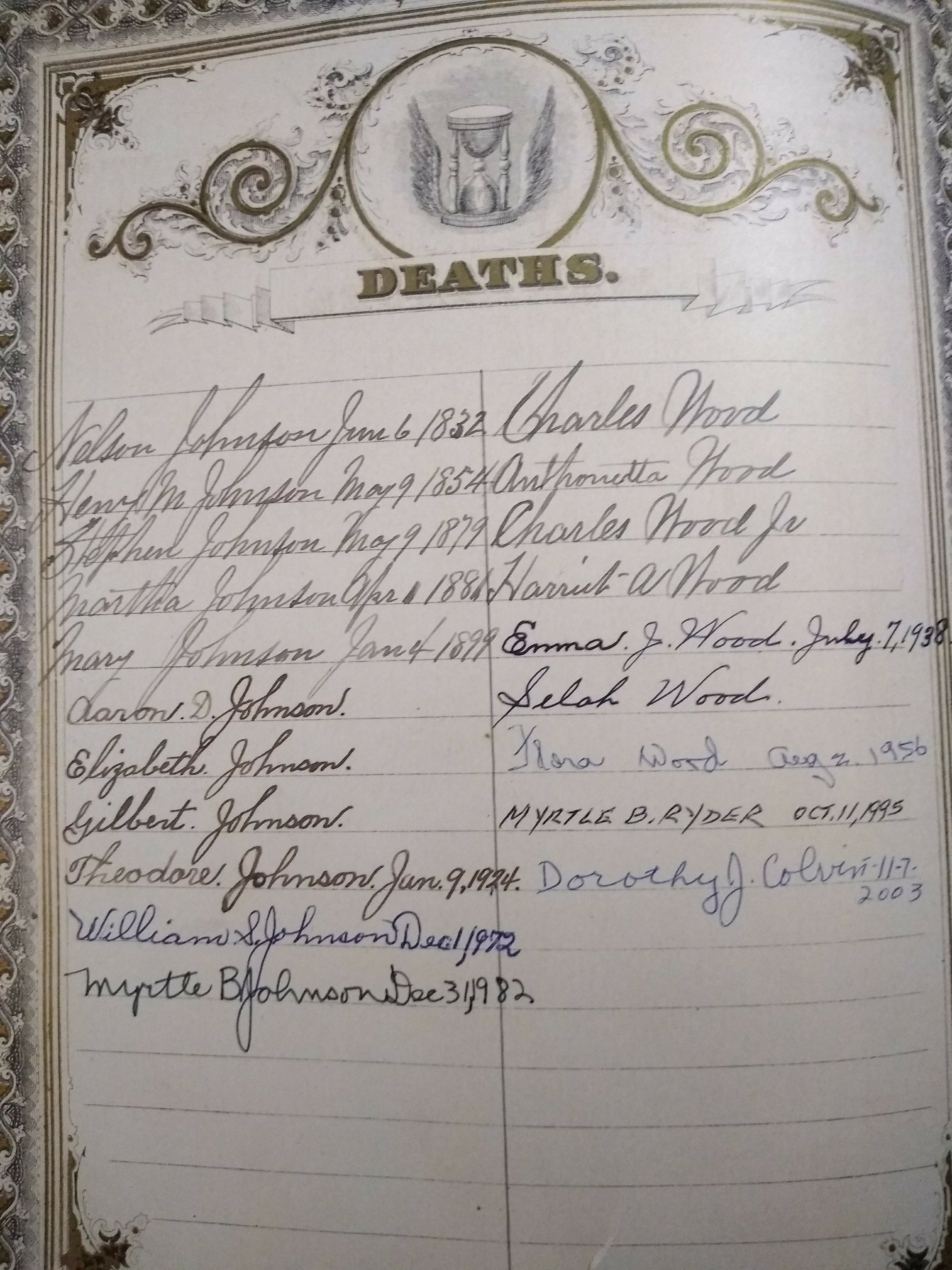
Deaths in the Johnson family

After my great-grandma passed away, the responsibility of the bible fell to my grandpa and grandma, and after their deaths it fell to my Aunt Linda. Interestingly enough, the deaths of my grandma and grandpa are not written on the Deaths page, even though they both passed away quite a few years ago; Aunt Linda told me she could not bring herself to do it. My mom said perhaps one day, when she is over, they can do it together. The more recent births and marriages within the large Johnson family could not fit on those pages and my Aunt Linda had to start writing on additional loose papers that she keeps with the family bible.

This item did not necessarily have a very extensive chain of ownership – only one generation more than the recipe book – but I felt that it unearthed so much. I am a Cavallucci, not a Johnson, and I have always identified more strongly with my father’s Greek and Italian side of the family, but I had never known very much about my mother’s side. It is both astonishing yet deeply bizarre to see your heritage written down, and the sheer number of people within the Johnson clan. The family bible actually inspired one of my older cousins to delve deeper into the Johnson lineage using Ancestry.com a number of years ago, revealing supposed connections to infamous horse thieves and even ancient Scottish royalty. I was young when he did this research and was disinterested at the time, but am certainly much more interested now to learn more about the people upon people that are my ancestors.

Although this book only contains names and dates, I loved learning about it as I gathered information from my aunt and my mother for this week’s post. I love seeing how the handwriting on the pages changes as the family bible was passed down – a testament to its continual inheritance. Heritage and family history are something that I have become quite fascinated with in recent years, and the family bible is something I think I hope to have one day, and to write and record the legacy of our family in, ugly duct tape and all. The object will continue to be weathered with time, but as my mother jokingly told me of the family bible: nothing can break the bonds of family.

The Recipe Book (…and the very few recipes inside)

This week, I have chosen to continue discussion of my grandmother’s recipe book, although I feel that its function and usage, as well as chain of ownership, are not exactly groundbreaking. Obviously, it is a recipe book, with “Recipes” clearly stamped across the cover. Unfortunately, there is practically no information on the book whatsoever about its original manufacture other than the words “Made in Hong Kong” in type font on the inside of the back cover, so I cannot be certain about what company may have produced it or the year that it was made. I would not even know how to begin an attempt to discover the manufacturer or its manufacture date with so little data to go on, especially if it was a recipe book that was mass produced during the time period in which my grandmother bought it.

I asked my mother when my grandma may have bought the recipe book and she was unsure, but she estimated that it was probably bought in the 1970’s “judging by the recipes in there.” This implied, to me, that my grandmother only began to write her recipes down after my mother, the youngest of five girls, was born in 1967. Perhaps she had never had time before then to put her recipes on paper, but had been making these desserts and cookies for years; maybe she had never truly explored baking until most of her children were grown and had moved out. I am not sure, and these are questions I will pose to my aunts when I next get an opportunity. My grandmother passed away in 2005, meaning that she likely had this recipe book for approximately 30 to 35 years before my mom took ownership of it.

What is so interesting (and a bit funny) to me is that if my grandmother really had this book for so long, she wrote down very few recipes in that time. My mother and I, of course, treasure the book (my mother more so than me, as it belonged to her mother), but it only contains a grand total of twelve recipes, two of which were written in by my mom, probably after my grandmother had already died. Objectively, this may not seem like an item that would have intrinsic value based on what its function should be: a recipe book with only twelve recipes in it? Yet I cannot explain the deep connection that my mother and I both feel to it, and the sorrow we would both feel if it were to fall apart or become lost.

I cannot say that the book’s use has changed all that much over time, except that perhaps we utilize it now only to make some of the recipes inside rather than continuously adding more recipes, so I suppose it has taken on a bit of a decorative quality. I enjoy baking and cooking, but am by no means an expert. My mother has not added any more recipes in years, and I had never even considered writing in the book despite the fact that a majority of it is empty, the blank yellow pages practically begging to be filled in. I still feel quite odd about the idea of adding anything new, as if it would decrease the sentimental value of the object or as if it would be, in some way, sacrilegious. Maybe one day when I feel ready and as if I have something worthwhile to contribute, I will write in the recipe book, but for now I am content with taking it out of its place on a shelf in the dining room a few times a year, baking my grandma’s gingerbread cookies for Christmastime or making her apple crisp on a whim.

My Grandmother’s Recipe Book

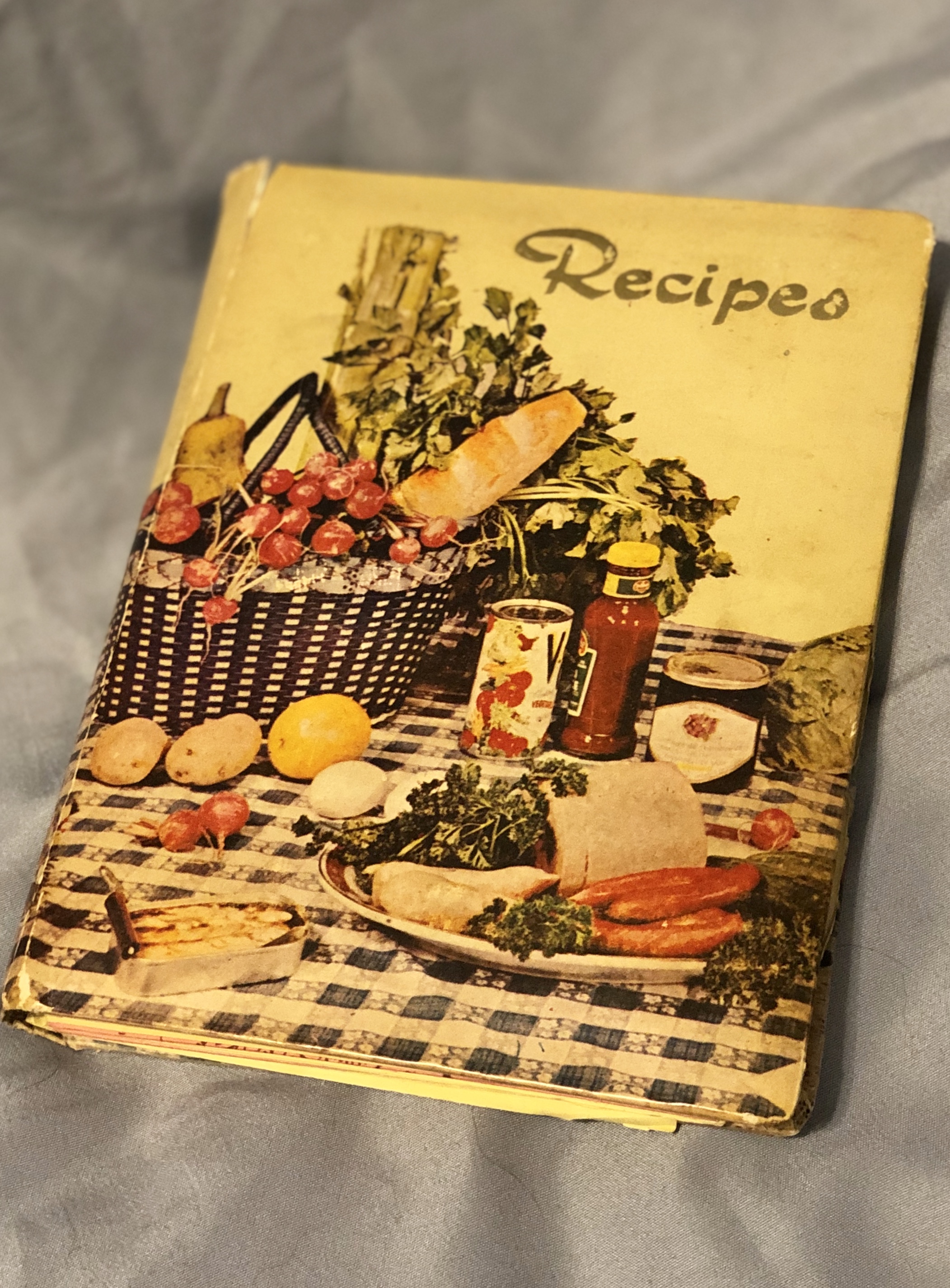
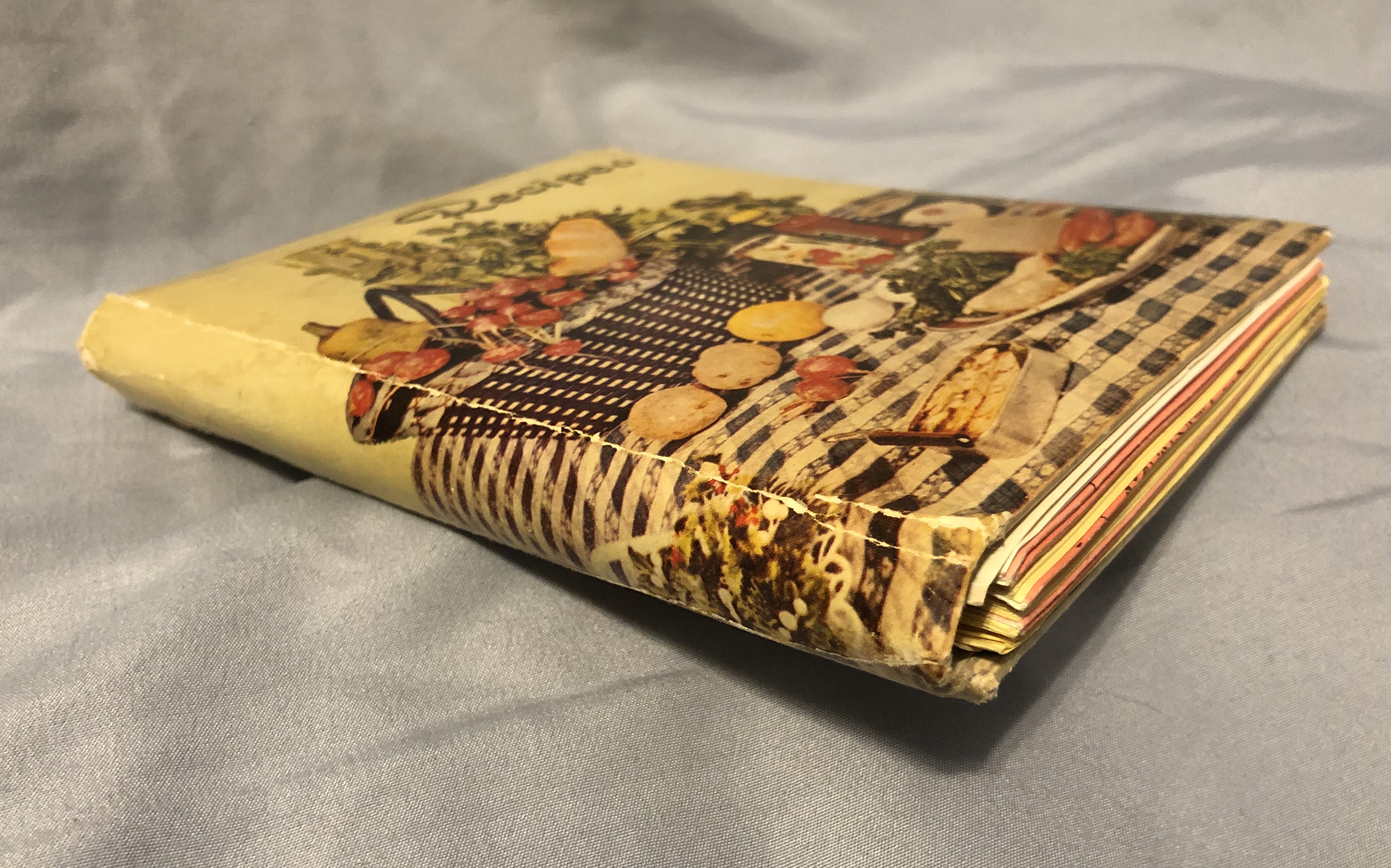
My grandmother’s recipe book

The object I have chosen to describe is the recipe book that belonged to my grandmother, who has passed away and so the book has fallen into the possession of my mother.

This recipe book is fairly small, measuring 6 ¾” tall, 5 ½” wide, and approximately ¾” thick. It is very light; I find it fascinating how an object I perceive as containing such a wealth of information manages to seem practically weightless. The cover of it is made of a thick cardboard material with a smooth, glossy look that has been dulled and yellowed over the years. On the cover, an image of a wide array of food set on a table is depicted, with the word “Recipes” in the top right corner. The spine is beginning to crease and crack in some places after being opened and closed many times by many different hands.

The inner pages separated from the cover (left inside cover reads “1 stick – 1/2 cup”)

The inside of the cover is peeling away a bit from the edges, and there are some yellowing stains, either from age or perhaps recipe ingredients. Handwritten by my grandmother on the inside cover is: “1 stick – ½ cup” (referring to butter measurements). The book is divided into sections with tabs made of slightly thicker paper that designate each category of food, such as “Soups and Sauces,” “Meat, Poultry and Fish,” and “Cakes and Pastries.” Each section consists of small, yellow lined notebook pages. The inner binder holding the pages together is made of thin white plastic; now, the pages are a bit hard to turn and some are beginning to fall out. Upon further inspection, I realized that the pages are actually fixed within the book with a cardboard insert on the back cover and can be removed.

What is notable about this recipe book is that the main food categories (soup, meat, fish, and so forth) are completely empty. There are only recipes written in the “Candy,” “Desserts,” and “Cookies” sections, clearly implying that my grandmother was a huge fan of baking and not as interested with cooking (the “Cookies” and “Desserts” tabs are actually more wrinkled and seem more physically aged than the other tabs because they have been handled so much more). As a result of my grandmother’s inclination toward baking, there actually are not many recipes at all in this book, but my mother and I still regularly make some of the cookies and breads that my grandmother scrawled in cursive across the small pages.

My grandma’s “Peanut butter swirl bars” recipe (for some reason, this recipe is written in the Candy section)

Although my mother and I have had and used this recipe book for years, I actually felt a deeper connection with it after taking the time to carefully depict this item in great detail. Measuring it, running my fingers over the cracks in the spine, and feeling the slight texture of my grandmother’s handwriting on the pages made me appreciate that this object has held together so well for so long. That is not to say that it’s perfectly preserved – there are a couple of faint stains on the pages, certainly from minor spills of vanilla extract or batter, now commingled with the other ingredient smudges left by my grandmother when she used this book and mixed together the components of her pumpkin bread or gingerbread cookies years ago. Baking is something I have always loved, and I hope to be able to pass this book on to my own children one day.

The Employment of the Joy Test

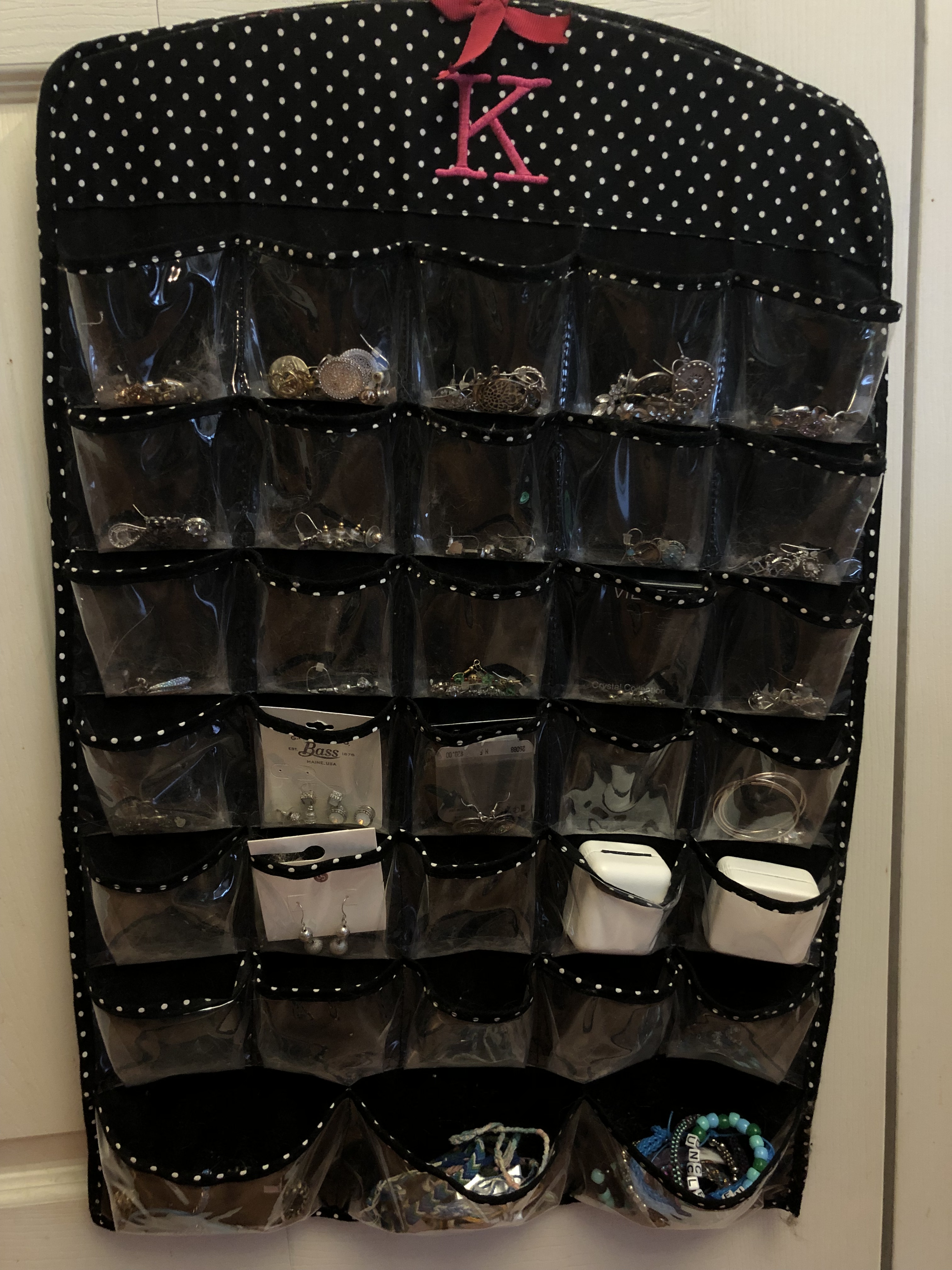
I feel that I should start this by confessing: I love stuff. While I do enjoy the occasional purge of my belongings when my room becomes too cluttered, I am more likely to go through my things simply to feel nostalgic and rarely have any real intentions of organizing my possessions. I decided to tidy up my collection of earrings, which I have been meaning to do since last summer. I began this assignment by asking myself one of Marie Kondo’s pertinent questions: “Why do I want to tidy?” Quite frankly, I think I want to tidy because I have this fear that my house might one day look like it is straight out of the Hoarders show; also, I got a new earring organizer for Christmas and figured it was finally time I use it. For approximately the past five years or so, I’ve been using the earring organizer pictured below. It’s not very practical and has been sitting there for so long that the pockets are filled with dust and dog hair.

My dusty old earring organizer

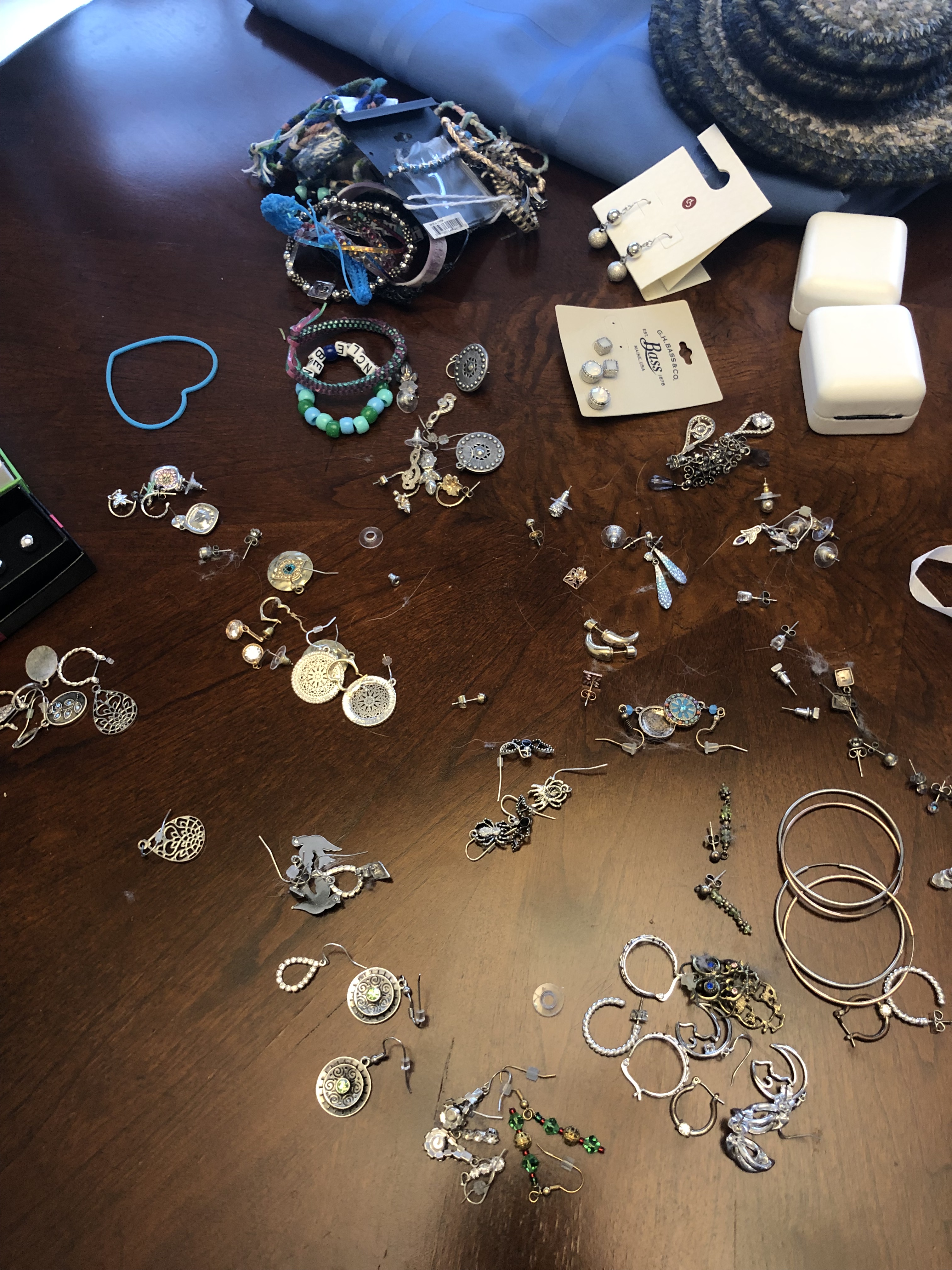
The process of removing all of my earrings and laying them out on a flat surface was both laborious and messy; the earrings kept getting caught in the pockets and I got clumps of dust all over my kitchen table. The below photos illustrate the process as I began to look over all of the earrings I had accumulated over the years (approximately 50 pairs, which was astounding to me) and decide what I wanted to keep and what I wanted to get rid of. Usually, when I take the time to purge my belongings, I focus only on what I don’t like anymore, what’s out of style, and what I haven’t worn or used in a long time. However, I tried to apply Kondo’s “joy test,” picking up each pair of earrings and trying to discern whether or not they sparked joy and if I felt a true attachment to them. In the beginning of The Life-Changing Magic of Tidying Up, Kondo states that her successful clients are ultimately “surrounded only by the things they love” (5). This sounds whimsical and wonderful in theory, but felt next to impossible for me, as my brain tried to convince me that I loved every single pair of earrings that I owned.

The initial stages…
Starting to organize (“get rid of” pile in top left)

I’m very sentimental, and I kept making excuses as to why I should keep the Mickey Mouse earrings from when I was little, the feather earrings I only ever wore once when I dressed up as a hippie for Halloween, or the various pairs of earrings that I had never once worn because I did not like them but kept because they were gifts from family or friends. In the end, I did feel that I made some progress and got rid of about 18 pairs of earrings (along with a bunch of old string and lanyard bracelets that I made at camp years ago, which had been living in the bottom of my old earring organizer for a long, long time).

While it was genuinely fun to have an assignment that forced me to neaten my perpetually haphazard earring collection, this task also reinforced, for me, just how terrible I am at letting go of my belongings. I have always had very strong connections to physical objects; I love how even the tiniest mementos can remind us of a specific place, a certain time in our lives, a dear friend or family member, or even of just a particular emotion. I sometimes find it hard to recall fond memories or events that have occurred in my life if I do not have a concrete, tangible reminder. Tidying up my earrings was not as magical of an experience as Marie Kondo seems to believe it should have been, and if I’m being blatantly honest with myself, I probably could have gotten rid of quite a few more pairs of earrings. However, I did feel accomplished at the end of this, and I did feel joy at seeing my organized earrings in their new and significantly more aesthetically pleasing container.

The finished product

(I should add that only a few minutes ago I remembered I have been keeping some of my mother’s and grandmother’s old earrings in a separate spot; I clearly did not do well at thinking in “categories,” as Kondo suggests, and ensuring that I had gathered all of the same items in one place before tidying up. I ultimately decided to leave these earrings where I found them, as I consider them to be heirlooms and do not wear them for fear that I will lose or damage them. Marie Kondo would likely not be pleased with this decision, but her organizational methods have not cured me of my cluttered and sentimental habits just yet.)

Old earrings (belonging to my mother and grandmother)