Using Simple Technologies for Complex Sequences

Our world is dominated by technology. That isn’t to say that we’ve become enslaved to it (although arguments have been made to say otherwise), but we do rely on technology now more than ever. This shift in cultures isn’t abnormal, it’s natural for humans to innovate to make difficult tasks easier. But we’ve gotten to a point where we are innovating to make easy tasks even easier. Technology was once humanity’s ability to match the capabilities of other species, now it is used to become godlike. We’ve gone from making tools to take lives, to creating medicine to save them, to creating new lives via cloning and now we’re trying to create artificial consciousness via computer programming. 

The point of this introduction isn’t to create existential dread, but rather to make apparent our issue with technology: our constant need to improve. Every new innovation and advancement is immediately followed by theories of how it can be improved. This culture of innovation can be suffocating at times, and it’s important to step back and understand other technologies we have that can perform the same tasks as our newer, more modern products.

For my project, I decided to choose an object that is slightly different from those listed as examples. These items included typewriters, film-based photographs and even newspapers, and they all have been replaced by new technologies that are more convenient. For my project I chose a video game controller, specifically a Nintendo GameCube controller. This controller was made back in 2001 by Nintendo alongside the GameCube. In terms of controllers for games today, that 20 year gap between then and now is a huge difference. Designs, button layout, quality of components and general versatility have been improved and innovated over this period of time. So using a GameCube controller seems like a waste of time, as there are many options that are more accessible and provide more advantages. 
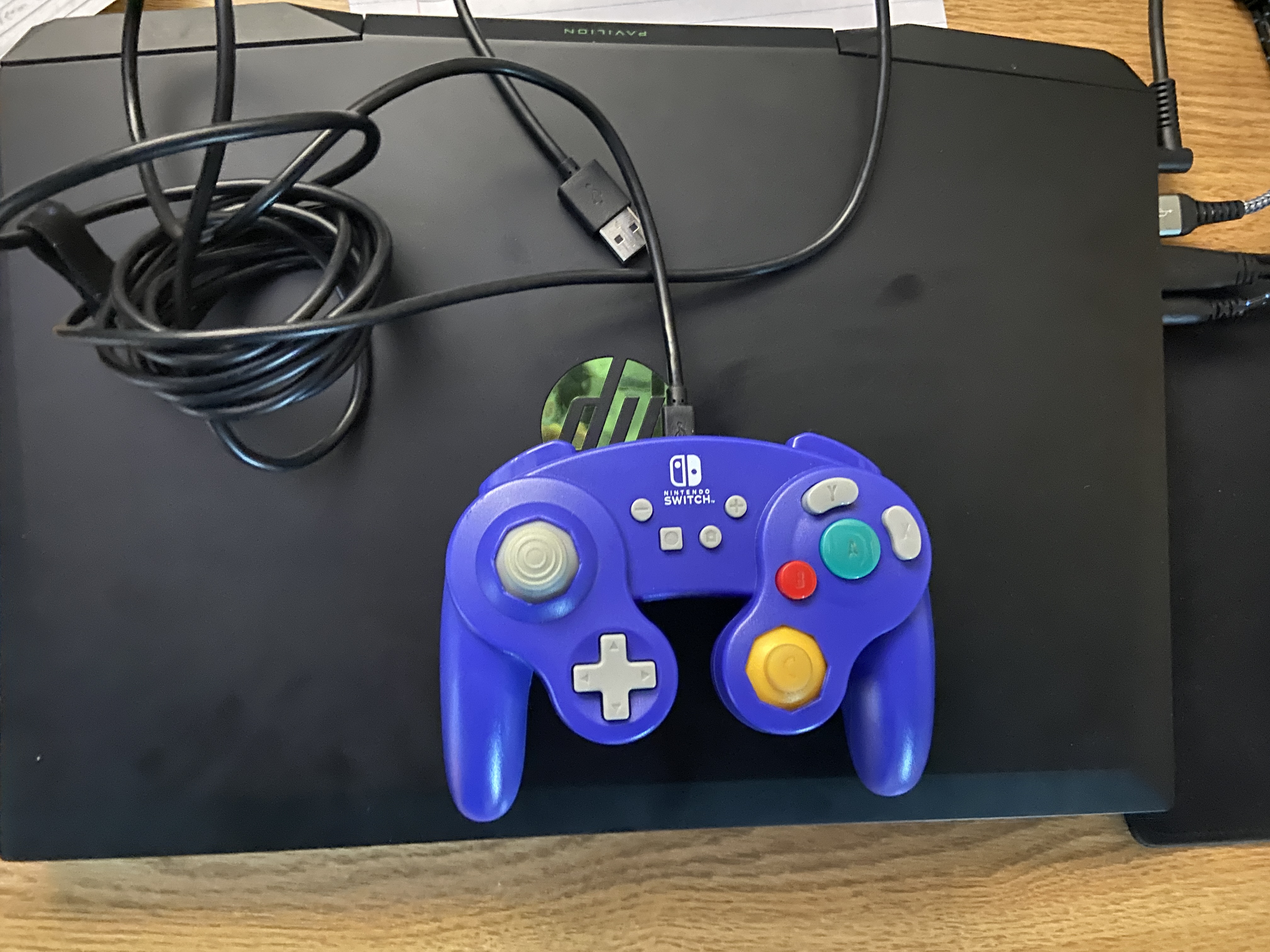
This was my thought process as I started playing some games with my friends using this controller. It should be noted that I’m used to playing most videogames on a keyboard and mouse, as that is always accessible as long as I’m playing games on my laptop and there are far more buttons to use and thus more options available to me. But while using the controller, playing against my friends in games like Smash Bros and Mario Kart, I began to grow fond of certain aspects of the controller. The first noticeable one was the distinct sound it made, both when moving either joystick and when pressing most buttons. The controller made a sound that could best be described as “clacking” when almost any action was performed with it, and this sound was specific to this controller. You would think that this sound would be annoying for the controller’s user, but oddly enough it was actually quite satisfying. It acted as an extra layer of feedback towards my action, as if the controller itself was assuring me of what action I had performed.

After playing a few rounds with the controller, I began to feel more comfortable with the layout of the buttons and joysticks. It took a while, as I had to translate the large arm movements of using a mouse into the fine motor skills of using a joystick with my thumb. But eventually I had mostly mastered using the controller. This shift was very pleasant, as I’m used to having a dedicated space where I could play games but at that moment I could play in whatever position was comfortable for me. This sense of freedom over my position allowed me to be more relaxed while playing, and created an environment that was less competitive and more casual between me and my friends. It was interesting how the dynamic shifted so easily due to a change in analog input.

After using the GameCube controller with my friends that night, I decided to keep using it from time to time. It has a USB connector, so I can use it as long as the device has a USB port on it. This newfound mobility became a great convenience to me, as all of a sudden I found myself playing games with people in close proximity with them, which was a nice change of pace from our usual conversations taking place over the internet. This sense of social freedom, along with the mobility granted by the controller, add together to create an experience that is focused less on the game itself and more on the social interaction between players. 

All in all, this experience was much less drastic than I was expecting. I thought using a GameCube controller would be a hindrance, and that it would be uncomfortable to use for quite a while. The truth is quite the opposite, after learning the muscle memory required to use the controller I found it to be a satisfying experience. On top of that, I find myself being more social with my friends while using this controller. I still use my computer to play games from time to time, but I’m glad I found an alternative method of gaming which is more social and, in some cases, enjoyable. In most cases the use of old technologies gets overshadowed by the convenience of the new, but sometimes there are qualities of the old that can’t quite be replicated.

Lightning Strikes and Tension Rises

Throughout Mary Shelley’s Frankenstein, several concepts and objects are used as symbols to greater themes Shelley is trying to convey. There is the use of fire and light, which represent intelligence and discovery (such as how the Monster is drawn to the light of the small cottage, in which he learned of how humans behave by observing the family inside), and there is the use of Adam and other biblical figures as symbolic descriptions for the Monster (who refers to themself as Adam but is called a Devil or “Daemon” by Victor). However, I want to focus on the symbolic use of lightning, as it is quite possibly the most misrepresented symbol in all of Frankenstein.

Many people who haven’t read Mary Shelley’s original Frankenstein likely connect the use of lightning to the creation of the monster, but the novel doesn’t inherently mention electricity in the monster’s creation. While this may be a mistaken interpretation of Shelley’s use of the phrase “I collected the instruments of life around me, that I might infuse a spark of being into the lifeless thing that lay at my feet.” (pg 83, Volume 1) However, use of lightning is more likely attributed to James Whale’s 1931 film adaptation to the novel, which established many of the tropes we associate with Frankenstein in the modern day. This isn’t to say that Shelley didn’t know the electrifying properties of lightning, as that information had become widespread by the point she had written her novel. But the use of lightning as a way of powering a machine, let alone a corpse, was beyond the thoughts of science fiction. 

The original symbolic meaning of lightning was to represent, and often foreshadow, death and destruction. This symbolic connection can be seen very early on in the novel, as Victor watches a bolt of lightning destroy a tree. This event sparks Victor’s interest in the philosophies of life and death but it also serves as a warning to the destructive and dangerous qualities of lightning. 

This destructive quality is used to describe the Monster as well, and lightning is used to foreshadow the arrival of the Monster with malicious intent. For example, after Victor returns to Geneva he sees the Monster silhouetted in the light created by a storm’s lightning. This event is preceded by the death of William, Victor’s brother, and alludes to the idea that the Monster killed William by using lightning to suggest the monster’s destructive capabilities. Lightning is also present at Victor’s wedding, specifically after it is revealed that the Monster killed Elizabeth. Both of these cases use lightning as a symbol of the Monster’s violent actions, but it’s also used to show the destruction caused by others. The most notable example of this is when Victor is attempting to create a partner for the Monster, he destroys his new creation in a thunderstorm. While destroying the body, Victor spots the Monster as he is illuminated by the light from the storm’s lightning. The use of lightning in this scene represents both the malicious intent by the Monster as well as the destructive actions of Victor Frankenstein. The use of lightning as a symbol in Frankenstein is often misunderstood. Most people see lightning as a symbol of life and creation when in actuality it is quite the opposite: a symbol of death and malicious destruction. It is important to understand the use of lightning in this book, as to understand the themes present and the author’s original intent.

Joy Test

For this assignment, I decided to try the “joy test” on the desk in my dorm. I have a bad habit of letting loose papers, trash and other things clutter my desk so having an excuse to clean it is always a good thing. I haven’t cleaned my desk since the beginning of the semester, when I moved all of my stuff into the desk. Over the course of half a semester, most of the desk’s space has been claimed by something or another. Whether that be the large laptop I use for my classwork, the textbooks that cluster into a pile in the corner or the many papers scattered around the desk, it can be difficult to find room to do work on the desk itself. 

My desk before cleaning

I’ve cleaned off my desk before, so I had a pretty good idea of where to start. I usually look through all of the objects on and inside the desk and see if I need to keep them and, if I do, is there another place I can put them to keep my workspace more orderly. This time around I tried taking a mental note about the emotions that arose as I cleaned off my desk, not just the usual thoughts of practicality I use when cleaning normally.

I started by looking through the loose papers on the desk, as those are usually the easiest to clean off (oftentimes they’re either on the desk for a reason or they’re just old trash). I went through many old assignments that could be thrown away, I found some old notes I had taken for a class and put them in my notebook, and I threw away some old candy wrappers that were still on the desk. I even found a copy of the syllabus for this very class, which was quite ironic. However there were some objects that surprised me, such as a card I received from my parents and some notes I had jotted down for a potential video game idea, that did spark joy when I found them. For the most part I had forgotten about these items, and seeing them again brought about a joyful feeling. I put the card back on my desk and I put the game notes into my drawer in case I ever wanted to act on my idea.

Not all of this trash was on my desk, but the crumpled paper near the top of the bag was most of it.

After reviewing the papers on my desk, I started looking towards the larger items on my desk. This is where I found the most objects that “sparked joy” for me. I found the bracelet that my girlfriend gave to me, a set of dice that I use when playing DnD with some friends, and a metal sign that I hadn’t hung up in my room at the start of the semester (which I then hung up in a moment of procrastination). There were some things that I threw away, such as an old 3D printed project that I no longer needed and some pencils that had been sharpened down to stubs, but most of these larger items sparked joy for me. The one object, or rather group of objects, that defies this rule for me is the pile of textbooks on my desk. I never really use textbooks for my classes, as if I have a question on the material I prefer to talk to the professor or a classmate about it rather than search through a textbook for a possible solution. Looking back on it, the action of renting the textbooks at all now feels like a waste of money, since I’ve never used them unless the class specifically required it. I put the textbooks in my desk drawer, that way I knew where they’d be when I needed to return them but they stopped taking up room on my desk. I now feel like there is much more space on the desk now that a quarter of it isn’t being taken up by books I wasn’t using. 

My desk after cleaning.

After cleaning off my desk, I feel like I have much more room to do my work. To be honest I don’t feel very different about how I see the objects on my desk, but that may be due to the fact that I tend to go object by object when cleaning off my desk normally. That being said, it was interesting to pay attention to the feelings that emanate while holding certain objects. I’ll be sure to listen to this feeling in the future, since it can help with deciding what objects to keep in the future.

A Plastic Water Bottle

I’ve decided to choose a plastic water bottle for this project. It’s an old Poland Spring bottle I drank a few days ago and forgot to throw out. While this item does not have any personal significance to me, I thought it fit this assignment as it’s something that many people have used and have never given much thought towards. I think that by learning where and how these small plastic bottles are made, we can better understand how to deal with the consequences of their mass production. 

First, it’s important to discuss the water itself. Poland Spring (and it’s parent company, Nestle) claim that it gets its water from natural springs, which is correct. What it fails to mention is that the company doesn’t harvest the water itself but rather buys it from the water suppliers for local towns. These towns are the ones who collect the spring water and refine it, but Poland Spring buys and bottles it. This has led to several controversies over the years, such as towns running low on drinking water for its citizens due to a larger than expected purchase from Poland Spring. What was interesting to me is how Poland Spring managed to twist the origin of where the water comes from to make it seem as though they are the providers of water itself, and despite this we still buy bottled water on our campus despite having access to reusable water bottles and several dozen water fountains spread out around campus. 

While the origin of the water has its own history, what I was really interested in was the origin of the bottle itself. About 60 million plastic bottles are thrown away every day, and most end up in landfills. This is devastating to the environment and shows that despite the societal movement to recycle, we as a society throw out far too much trash. 

But this issue is in part caused by an overabundance of trash to begin with, or rather a surplus of trash as a result of our general way of life. For example, the US is predicted to produce over 1.5 billion plastic bottles in the year 2021. Each of these bottles will be drunk from, and while some may be recycled, studies show that the majority will be thrown into landfills. This raises the question: where do all of these bottles come from? While there are several sources for these water bottles, their biggest exporter is China who is responsible for producing around 30% of the world’s plastic products. Other exporters of plastic products, including water bottles, include Germany, the United States, France and Italy. With all of these global superpowers producing such a high quantity of plastic products, it’s no wonder why plastic bottles contribute to so much of the planet’s waste.

While I couldn’t find much information about the location where my specific water bottle was made and sealed, there was still much I learned from researching the origins of the bottle’s core components. What fascinated me the most was how the plastic that made the water, as well as the water itself, likely came from a large first-world country. Going into this assignment I was under the impression that a lot of the water bottled by Poland Spring was taken from smaller springs from less developed countries but it was interesting to see how little the creation of these water bottles actually influenced smaller countries and their economies. 

Sources:

https://www.statista.com/statistics/723191/production-of-polyethylene-terephthalate-bottles-worldwide/

https://healthyhumanlife.com/blogs/news/plastic-water-bottle-pollution-plastic-bottles-end

Two Pins of Scrap Metal

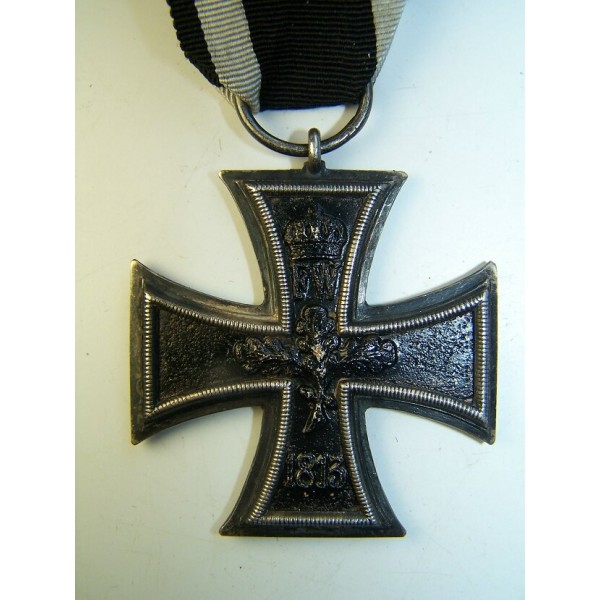
Going into this assignment I was unsure about how easy this was going to be. On the one hand, I knew from the very beginning what I would choose: my great grandfather’s World War 1 medals. My family doesn’t keep anything in our house unless it’s practical for present use but these medals are the one exception to this pattern. These medals are all I really know about my great grandfather, as I never met him while he was alive, and yet they have been kept in my family for generations. On the other hand, all I have connected to these objects are the stories passed down from my father, which he learned either from his father or from my great grandfather himself. The medals themselves aren’t very unique for a soldier of the time, so it’s difficult to create an image of what this distant relative was like back when my father was learning stories from him at a young age. But while I can’t draw on uniquities from the objects to create this image, the story of my great grandfather fills in the emotional gap that these medals lack.

My great grandfather was named Karl Bohnaker. He was born in Stuttgart Germany in 1898 to a woman who’s name has been lost to time. All I know is that she was a mistress to a wealthy German aristocrat, and Karl grew up a poor child with no connections to his father. Because of this he joined the army at the start of World War 1, hoping to escape his impoverished life. My father said he spoke little about the war, only that he served on the western front. Knowing the horrid living conditions and tactics of war used on the western front it makes sense as to why Karl wouldn’t speak much of his experiences at war, especially to a child. Rumor has it that he had to walk from the trenches back to Stuttgart on foot after the war was over. What I do know is that at the end of his service Karl received two medals from the German military: a “wound badge” given as the German equivalent to the American “purple heart” and an “iron cross” pin that was given to all soldiers regardless of rank. 

This is an example of a German Wound Badge from WW1, similar to the one Karl received from his service. They were often painted black, silver or gold based on the rank of the number of wounds the soldier earned. Karl’s was painted black.

What I find interesting about these medals is that they are made up of brass and zinc due to the German military using all other metals for the war effort, and thus these metals feel light and fragile to hold. I find it interesting that this is the detail that my dad would always point out when telling the story. I rarely hear about who my great grandfather was as a person, but my father never forgets to tell me what his medals were made of. Perhaps it was because of the irony behind a poor boy going to war to make some money and start a life, when in the end he is rewarded with the leftover metal that his country wasn’t using for the war that he just fought in. 

This is an example of an Iron Cross Badge from WW1, similar to Karl’s Iron Cross Badge.

This irony would continue after the end of Karl’s service for the German army. After returning home after the war had ended, he experienced the hyperinflation of the post war German economy. This hyperinflation made it nearly impossible for Karl to make any money for himself, and prompted drastic action to survive in this post war era. In the early 1920s Karl immigrated to the United States, taking what little money he had left and his two medals. He supposedly came to New York through Ellis Island, however I can not find any proof of this. His plan was to make some money in th US’s booming economy, wait for the German economy to settle down and then move back to Germany to continue his life. However, due to the economic crash of the American stock market in 1929 and the rise to power of the Nazi party in the 30s, Karl decided to stay in America. Throughout the 30s and early 40s, Karl started a tool and die manufacturing business in Brooklyn. From there he made enough money to settle down and start a family for himself.

And from there the story becomes much more vague. After settling down in Brooklyn my great grandfather’s story became less specific, so much so that I hardly hear about what his life was like after 1940. But what I find interesting about it is just how ironic the story is. Karl, who came from a childhood with little to no money, was constantly working to make a living for himself and was always being beaten down by political and economic conditions that were much larger than he was. And yet Karl never stopped working, even after the first world war and two economic catastrophes he still worked to make the life he always wanted. What I find most interesting is that he kept his two war medals with him the entire time. Maybe he kept these medals out of national pride, as a way of remembering where he came from. Or rather they were to remind him of his victories of the past, like surviving the hell that was World War 1. I may never know why Karl kept these two pins of scrap metal, but I believe he would be proud of the legacy that he’s left behind and the stories that are told of him to this day.

A Woven Leather Bracelet

I have decided to use a simple woven bracelet for this post. While the object doesn’t hold much historical value, neither from my family nor in history in general, it holds a lot of sentimental value to me personally. It was the first gift my girlfriend gave to me, and the first gift I received here in New Paltz.  

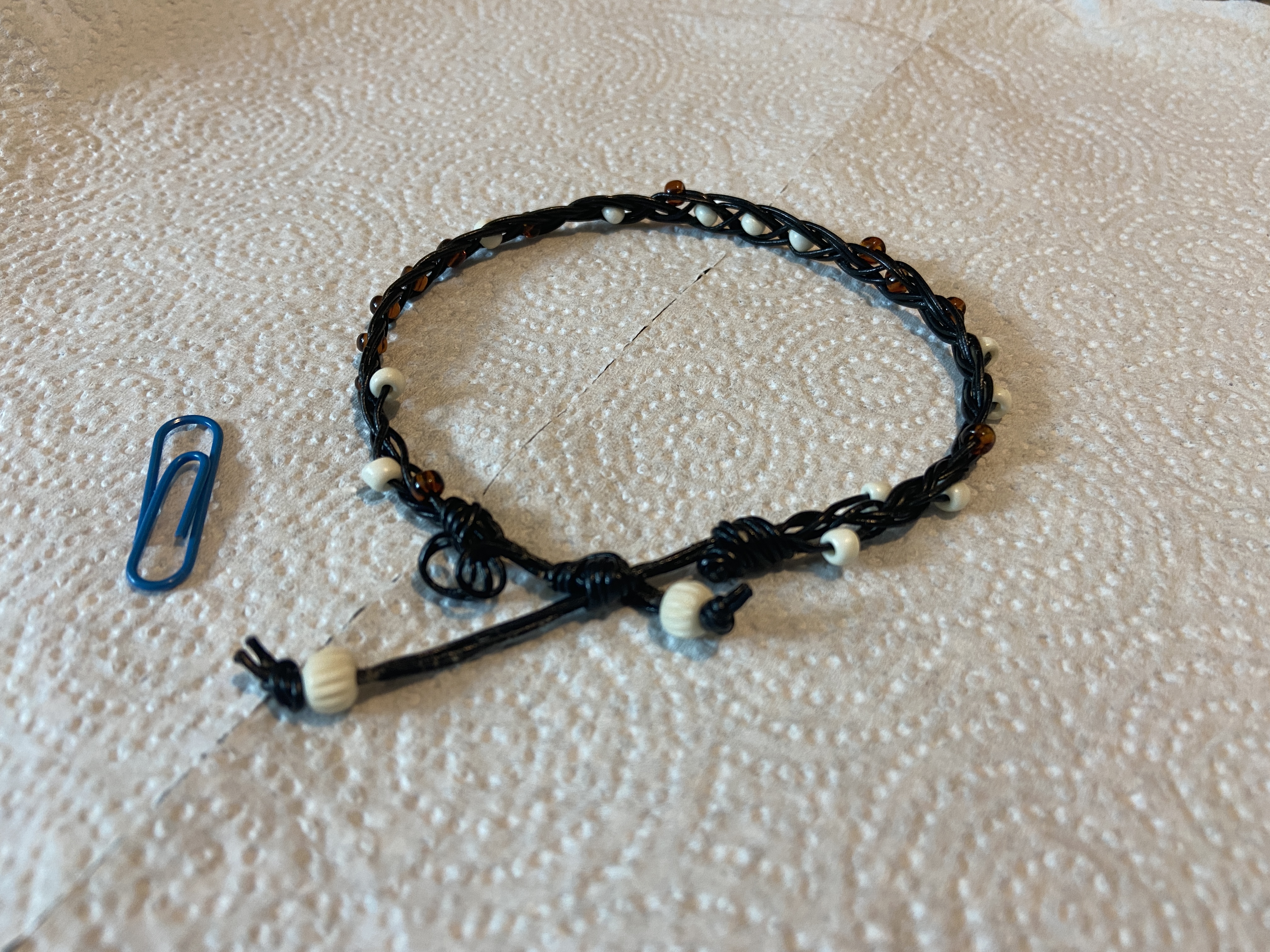
Bracelet and Paperclip for scale

The bracelet is three and a half inches across and is made from black leather and beads. The leather is carefully woven in what appears to be a double-braid, constantly alternating which pair of leather strips flow through the center channel. At equally spaced intervals on the bracelet, small white and amber beads are woven into an intricate pattern. The pattern once translated to “I love You” in morse code but the constant wearing of the bracelet caused the beads to shift and rearrange, leaving the original statement as nothing but a cheerful memory. The two ends of the bracelet are knotted off and tied together with a slip knot, allowing the bracelet to be tightened around the wrist, and two larger white beads are tied at the ends of the knot. 

When I first received the bracelet, it was almost shiny with the glint of new materials. However, after much wear and tear, the bracelet has lost much of its pristine glamore it once held. The slip knot is loosening, and the leather strands it runs over are showing cracking from the constant friction. The pattern of beads has become sloppy, much less uniform and more of a random assortment from rolling along the wrist. Still, despite the cracks and deformations, the bracelet holds much sentimental value to me. It was a gift from my girlfriend, whom I met on this very campus, and just the emotional value of the gesture outways the gift itself. The use of new materials, bought from a local crafts shop on main street we’ve walked through many times, shows how much she values me. The careful, hand-worked pattern shows the effort she has put into the gift. The fact that she gave me a gift at all is symbolic in a way, showing how much she enjoyed my company and our time together. 

When I first received the bracelet, I wore it every day. I don’t wear jewelry, but the sentimental value of the object along with it’s simple and minimalistic design are appealing to me. As of the time of writing this post, I do not wear the bracelet as I am afraid that doing so will lead to the knots untying and the pattern of beads being lost. But by this point the bracelet has subsided from being a decoration and has become a much more important symbol: that of our bond. I love the woman who gave me this bracelet, not because of the gifts she’s given me but because I enjoy her company and love spending time with her. I do not need a bracelet, nor any other physical object or quantifiable measurement, to prove this fact. We care for each other, we enjoy each other, and we love each other. Besides, if we ever want to make another bracelet we know where to go to make another.