The Rise and Decline of Wood’s Hibernia Halfpenny

IMG_1181

This weathered copper coin is a Hibernia halfpenny that was originally made in Ireland in 1723 for the purpose of currency. The excavation of the coin on Huguenot St in New Paltz, New York illustrates a migration of currency as well as people.

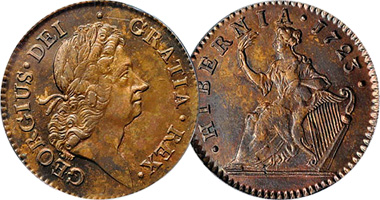
Description: The Hibernia halfpenny is about the size of a modern day quarter. On one side, the profile of King George I is pictured. The profile has long curly hair tied behind the ears. Around the circumference of the coin, it says Georgius Dei Gratia Rex. Translated from the Latin this means by the grace of King George. On the other side of the coin, it says Hibernia 1723 around the circumference. In the center, there is a woman pictured in a dress holding up a palm branch with her right hand and leaning against a harp with her left arm. Her face is also depicted in a profile. After almost 300 years of existence, the coin has been weathered and eroded. It is hard to make out these details because of the overt oxidation the coin has experienced over time creating the green substance on its surface.

Provenance: The original owner of the coin will forever be unknown for it was used as an object of exchange passing from person to person for different goods. In Ireland, the Hibernia coppers were made for use in small transactions at the local market or tavern such as for a loaf of bread that cost a penny (Danforth). The coin may have traveled from the pockets of middle class Irish citizens through the pockets of transatlantic seamen or through the pockets of Irish immigrants into the hands of The Huguenots in the Middle Colony of New York (Danforth). The coin now rests in its habitus amongst many other excavated, historical objects in Professor Diamond’s archives. It was discovered on July 20, 2012 at approximately N 50m / E 18m on Huguenot St in the ground that resides between the Bevier and Deyo houses across the street from the Dubois Fort. us_woods_hibernia_half_penny
Narrative: Although we may never know the coin’s owner, we do know its maker. William Wood owned copper and tin mines in Ireland. He purchased the royal patent that authorized him to produce up to 360 tons of halfpence and farthings for Ireland at 30 pence to the pound over a period of fourteen years for an annual fee of £800 paid to King George I (Hibernia). Wood believed this would be a profitable business and purchased the patent for £10,000 in 1722 from the king’s mistress, The Duchess of Kendal (Hibernia). At the time, Wood’s coinage was heavier than the coppers already in circulation in Ireland making his money more valuable (Hibernia). As a result of their weight and the cost of production, Wood’s Hibernia coppers were actually less profitable for him to mint (Hibernia). It is believed that he even would have lost money over those fourteen years from the deal (Hibernia).

Amongst numismatists, there seems to be a disagreement about the degree of reception the Wood’s Hibernia coppers received. According to Brian J. Danforth’s article in The Colonial Newsletter, “Wood’s Hibernia Coins Come to America”, the coins were first well received but lost popularity over time in Ireland. Danforth explains that the lower class of Ireland, who were largely illiterate and rarely made records, were the primary users of the copper coins. Since the primary users of the coins did not make records, numismatists do not accurately know the exact extent of usage that these coins received. However, Danforth believes the coins became very popular in Ireland because as he describes Ireland was a “coin starved” nation. Danforth also states that American colonies did not have a sufficient amount of coinage to satisfy their economic needs in the eighteenth century either. Furthermore, England did not even have enough coinage to satisfy its own needs resulting in this shortage of coinage in its distant lands (Danforth). It is in this apparent massive deficiency that Wood’s believed he had the potential for a successful business endeavor.

Because of Ireland’s desperate need for coins, the popularity of the coppers was almost inevitable. In the mid 1720’s some numismatists believe Wood’s coins were rejected, but Danforth believes the coins were used commonly in Ireland until 1737. Jonathan Swift led the campaign against Wood’s coppers that successfully leaves evidence of opposition to the coins for numismatists today (Danforth). According to Philip Nelson’s The Coinage of William Wood, 1722-1733, Swift and his allies opposed Wood’s coinage because the coins were not approved by the Irish Parliament, were minted under a private patent, and weighed more than the English royal issue (qtd. in Danforth). Wood’s original estimate on the amount of coppers to mint was also so large that the opposition believed they would hurt the Irish economy drastically (qtd. in Danforth). However, Danforth notes the rise in copper coins by 150 percent in 1728 illustrates the success of Wood’s coins with them actually becoming the dominant coinage in Ireland despite Swift’s oppositional forces. IMG_1225

The American Colonies similarly needed coinage for small transactions. In the Northern Colonies, this need was most prevalent because of the demands of urban centers, artisans, and commerce (Danforth). Danforth writes that Wood’s coppers came to America as a result of trade between the colonies and Ireland, immigrants from Ireland traveling to the colonies, and the eventual devaluation of the coins in Ireland. Before the American Revolution, Ireland traded more with the Middle Colonies than the rest of the colonies (Danforth). Wood’s money would have crossed the Atlantic in the pockets of seamen and would have been used in Irish seaports for everyday purchases (Danforth). The coins also became twice as valuable in the colonies as they were in Ireland allowing for some to take advantage of the exchange rate for profit (Danforth). In 1737, New York had what Danforth describes as a surplus of copper coins because of its growing economy and the devaluation of Hibernia Coppers in Ireland. New York also had the most favorable exchange rate of coppers amongst the other colonies (Danforth). Danforth describes how these factors contributed to New York becoming the foremost trade partner with Ireland.

During economically hard times, an increase in immigration to the colonies occurred bringing with them the cultures and customs of their homes (Danforth). An Irish famine in the late 1720’s spurred emigration from Ireland with people looking for employment in America (Danforth). Another massive surge of immigration in the mid 1730’s around the time of the monetary decline of Wood’s coins in Ireland also increased the export of the coins to America (Danforth). When leaving their homes, the Irish took as many coins as they could. Danforth notes they would have chosen to carry with them the coins with the highest amount of value that took up the least amount of space making coppers the best choice for poor immigrants. In 1729, the supply of copper coins in Ireland decreased. Although the attitude towards Irish immigrants in New England was often unwelcoming, Irish settlements and communities were still able to make roots in America (Danforth). Poor Irish immigrants were usually from rural areas and settled in the Middle Colonies with all their possessions from home including whatever money they could put in their pockets such as Wood’s coins (Danforth).

In 1736, it was announced that a new royal copper would be made in England and sent to Ireland securing the devaluation of Wood’s coins (Danforth). As a result, Wood’s coins were shipped “en masse” to the American colonies (Danforth). Irish leaders such as Swift and his advocates who had been against Wood’s coins from the beginning finally succeeded in receiving an official set of copper coins from the London mint (Danforth). Danforth also mentions regulations that were placed on the acceptance of Wood’s coins in Ireland limiting their use and decreasing their popularity significantly. The ideal shipping destination for the coins were the Middle Colonies because of their significant trade with Ireland, their Irish immigrant populations familiar with the coinage, and their growing economy in need of coins for daily exchanges (Danforth). As a result of all these factors, this Hibernia halfpenny landed in New Paltz amongst the Huguenots.

Bibliography

Danforth, Brian J. “Wood’s Hibernia Coins Come to America.” The Colonial Newsletter. Aug 2001. Web. 14 Apr 2015.

Diamond, Dr. Joseph. Personal Interview. 8 Apr 2015.

“Hibernia Coppers 1722- 1724: Introduction.” Coin and Currency Collections at the University of Notre Dame Department of Special Collections. 4 Jan 2001. Web. 14 Apr 2015

Rubino, Catherine. Image 1. 1 Apr 2015

“US Woods Hibernia Half Penny 1722 to 1724.” Coin Quest. Image 2. Web. 14 Apr 2015.

Rubino, Catherine. Image 3. 8 Apr 2015.

The Sun Also Rises

For this blog post, I have chosen to write about my copy of Ernest Hemingway’s The Sun Also Rises. I read this book last semester for my Intro to American Literature class with Professor Stoneback. For me, it was definitely a challenging and enlightening class. Looking at the book is like looking at a reminder of an accomplishment I made by completing the class. I bought it used off of Amazon in pretty good condition with barely any marks on it. However, I was not shy in marking this book during class. Within it I have highlighted important sections such as the value scene with Brett, Jake and the count and famed lines such as “Isn’t it pretty to think so.” All over the book I have scribbled questions to myself and made notes of Stoneback’s remarks like how important the value scene is.

Hemingwaysun1The size of the back is about 5 x 7 inches. It is a paperback edition published in New York by Scribner an imprint of Simon & Schuster in 2003. Scribner originally published the book on 22 October 1926. The book has remained in print since it’s original publication. Hemingway used his own experiences in Spain to inspire the novel. The photo to the left is a first edition cover of the book.

The book is based off of Hemingway’s manuscript of the story. According to an article I read online from The New Yorker, it seems that the manuscript went through an intensive editorial process. Ian Crouch’s article “Hemingway’s Hidden Metafictions” details several alternatives titles and lines that had been rewritten. The final line “Isn’t it pretty to think so” was originally written, as “It’s nice as hell to think so.” There has been a new edition of the novel published that reveals alternatives from Hemingway’s early manuscripts.

Maxwell Perkins was the Scribner editor on Hemingway’s work. Perkins also worked with F. Scott Fitzgerald who played a role in Hemingway’s editorial process in their correspondence as well. Fitzgerald reminded Hemingway that less is more and that the book didn’t really start until “Robert Cohn wasunnamed once middle weight boxing champion of Princeton.” Hemingway deleted the several pages of material he had written before this official opening line.
The book now sits amongst a stack of novels I am currently reading this semester and ones I read last semester. But, this book always brings me back to Stoneback’s class which was unlike any other. The front cover has Ernest Hemingway in big letters on the top and The Sun Also Rises on the bottom and in between is a blurry picture of a bull and a matador. When I look at the book, I see a text that bares the evidence of being carried from class to class. Ultimately, it looks like a student’s book to me. A student that was deeply motivated and interested in learning about the subject. However, I suppose my opinion could be a little biased on this matter.

Passatini Press

The passatini press currently lives in the kitchen cabinets of my mother’s home on Long Island. Other cooking tools surround it within her white cabinets. Now, it is used in her kitchen on Sundays to make soup for my grandfather who misses my grandmother’s cooking more than anyone. For years, a passatini press was used in my grandmother’s kitchen to make traditional Sammarinese meals. In San Marino, I realized how the passatini press had made its way through not only two generations of my own family but through generations of so many other Sammarinese homes.

While in San Marino, I went on a couple of hikes. On our last hike, our coordinator, Leopoldo, took us to see the old water mills that had run down and we ended our hike with a tour of the Museum of Agriculture. The museum was established in what is assumed the oldest house in San Marino dating back to 1770. The house had been restored to display the way of life from the past. The museum contains hundreds of ancient items that relate to agricultural life and work such as copper pots, flat irons, looms, and so much more.

The museum preserves these items that relate to the Sammarinese customs and traditions of rural life in the past. When walking through the museum, I remember seeing certain items in the historical kitchen that looked familiar. I saw an old cheese grater similar to the one in my grandmother’s cabinets. On the mantle of the museum, it was placed with others of varying sizes with wooden drawers to catch the cheese and a handle that turned the grater on the cheese. On the opposite wall of the mantle, I also saw an assortment of passatini presses hanging. They looked a little different from the one I have today because it was more of a flat iron sheet with holes and handles on the side. It was explained to us that all of these kitchen tools had been used in Sammarinese households for centuries to make the traditional Sammarinese meals.

I really enjoyed this museum because it showed us the way that our grandparents lived and generations before them. The press has lived in the homes of Sammarinese for centuries. In their kitchens, it waits amongst other cooking tools to bring the flavors and textures of a home cooked meal to a family just as mine does. Without certain kitchen tools, cooking these traditional Sammarinese meals would be impossible. While I know my press is only one of many,  the museum made me realize that the passatini press has been a staple in the kitchens of Sammarinese homes for generations and will keeping being in them through the efforts of the new generation.

The Passatini Press

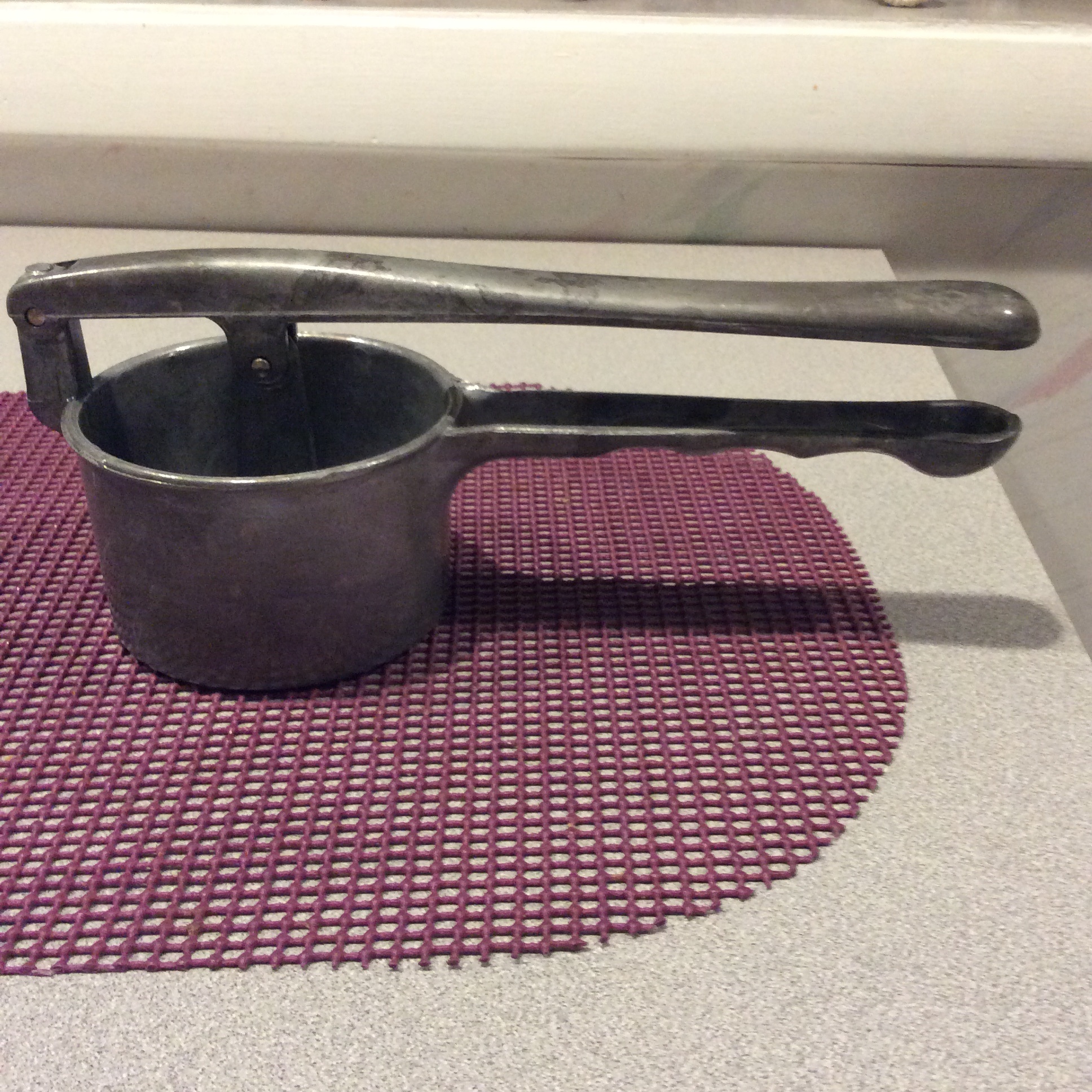
IMG_0296Again, I have chosen a new object for discussion. This time I asked my mother to send me pictures of it from home. My object is a Passatini Press.

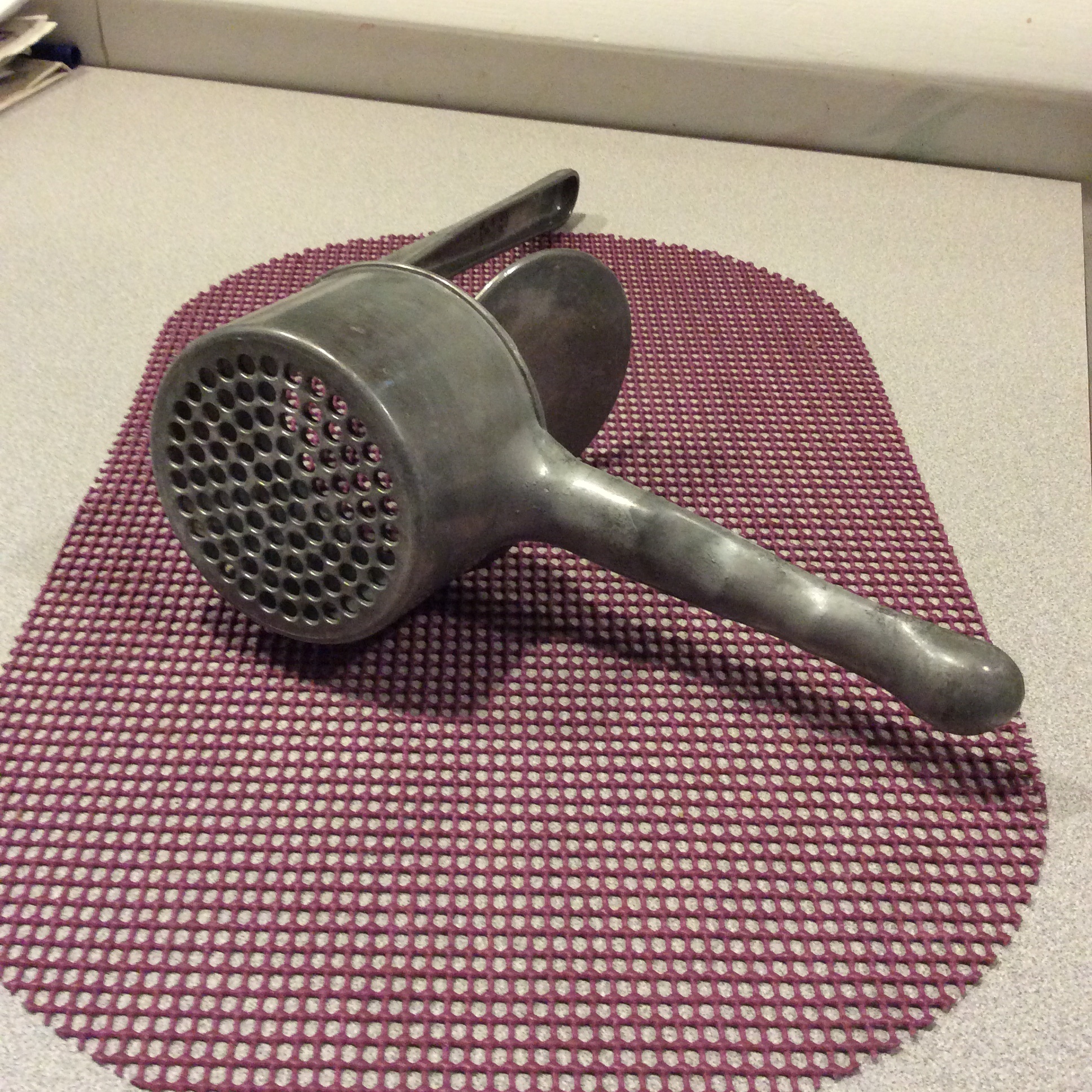
It is metal and hard but makes passatinis that bring me back to the warmth of my grandmother’s cooking. The tool has a cylindrical barrel with medium sized holes at the bottom where the noodle like passatini is pressed through. The bottom cylinder is attached to a long handle with finger grooves. The top long handle connects to the part of the tool that is flat and is meant to press the ingredients down into the medium holes.

I bought this Passatini Press myself while I was in Italy over the summer. My hunt for this obscure kitchen tool has always been with me. My grandmother is unable to cook anymore because she is too sick. Most of my memories with her have been in the kitchen as she cooks for me. My favorite meal of hers that she would cook for me was passatini. It is a sort of soup with chicken broth and breadcrumb noodles. It is the type of meal that I have never had anywhere else besides my grandmother’s kitchen. For years, I kept asking my mother where my grandmother’s own personal press was but it has never been found.

The hunt for the press was revived while I was living in San Marino. For the program I was in, everyone stayed at the Quercia Antica Hotel where we ate most of our meals. Claudio, the hotel owner, sat us all in their dining room downstairs right next to the kitchen. Everyone in the program took up about three long dining room tables. One night Eduardo, our waiter, brought out Passatini and I swear I almost cried. I had not had this soup in years and there it was right in front of me.

My friend, Stephanie, who spoke fluent Italian, began asking Claudio about the soup for me. He told her it was made in a chicken broth. It was also the meal that was cooked when there was not much else around besides the left over pieces of bread. Stephanie also asked Claudio’s wife where she could buy a good Passatini Press. Stephanie was told the mercato in Rimini would have them. The next Saturday I was in Rimini hunting down this press.

IMG_0293When I came back from San Marino with my Passatini Press, I began asking my grandfather and my mother about my grandmother’s recipe for the soup. Of course, my grandmother never wrote her recipes down but instead worked all from memory. From my grandfather, he told me to add lemon zest. From my mother, she told me to use a sharp knife tp cut the noodles from the bottom of the press. From my aunt, she told me to freeze the breadcrumb like dough before putting it through the press. From the Internet, I added nutmeg.

Over the past couple of months, I have been perfecting my own recipe taking bits and pieces from what everyone else could remember from watching my grandmother in the kitchen. For Christmas, my mother and I collaborated as she used her signature chicken broth and my passatinis. When my uncle Rob walked in to the kitchen and saw the passatini cooking in the broth, he actually screamed.

The Passatini Press is used to make soup but it is also able to bring back not only my own memories of my grandmother’s cooking but also my mother’s and my uncle’s. While the press has been used in Sammarinese house holds for years, it had finally made it into my own and it feels like a piece of my grandmother has come with it as well. Like the sari was an extension of the woman’s body, my grandmother’s cooking was an extension of her love. Her cooking brought her family together and still continues to do so today.

My Little Red Box

After my last blog post, I feel that I have exhausted the topic of my ring from San Marino. As a result, I have decided to choose a new object to discuss. My new object was given to me as a gift from my Uncle Rob and my new Aunt Kathy. I refer to her as new only because this is how I had first started to refer to her when my Uncle Rob married her. I was in the eight grade when they decided to get married and for most of my life I had known my Uncle Rob to be a bachelor. So his pending nuptials was a very big deal for my family.

In the eighth grade, my Uncle Rob and new Aunt Kathy asked me to be in her wedding party as a junior brides maid. I felt very honored to be included in the wedding party. With the wedding day being a very big day to the bride, I felt honored that Kathy made an effort to include me and all my other cousins with in her ceremony. I was a junior brides maid, my younger cousin Mellina was a flower girl, my brother and my cousin Evan read during the ceremony. When my Aunt Kathy asked me and my cousins to be a part of her wedding, it felt like she was making an effort not to have anyone left out of the big day or their new life together.

IMG_3136After their honeymoon in Mexico, my aunt and uncle presented me with this red box. It is a ceramic circular box with a lid that opens. When my new Aunt Kathy gave it to me, she said, “When I saw it, the box reminded me of you in every way.” Around the sides yellow swirls are hand painted and on the lid a multi colored flower is designed. I have kept this box in my room back home, in my dorm, and in my apartment off campus. It has followed me through the years holding miscellaneous objects and reminding me of my family. Currently, it holds my quarters for doing laundry.

I always had a great relationship with my Uncle Rob growing up. Whenever he went on trips to San Marino, he would always bring me back a little something. I received a Snow Globe of La Plaza Publico, costume jewelry from Venice, and a glass figurine of a gondola man. All of these objects are still in my room back home. I was very pleased when this tradition did not stop but instead included my aunt Kathy’s opinion as well. Now, they have two sons who are amazing and exhausting. My little red box is a symbol to me of their constant love and generosity.

The Sammarinese Ring

IMG_3107 (1)

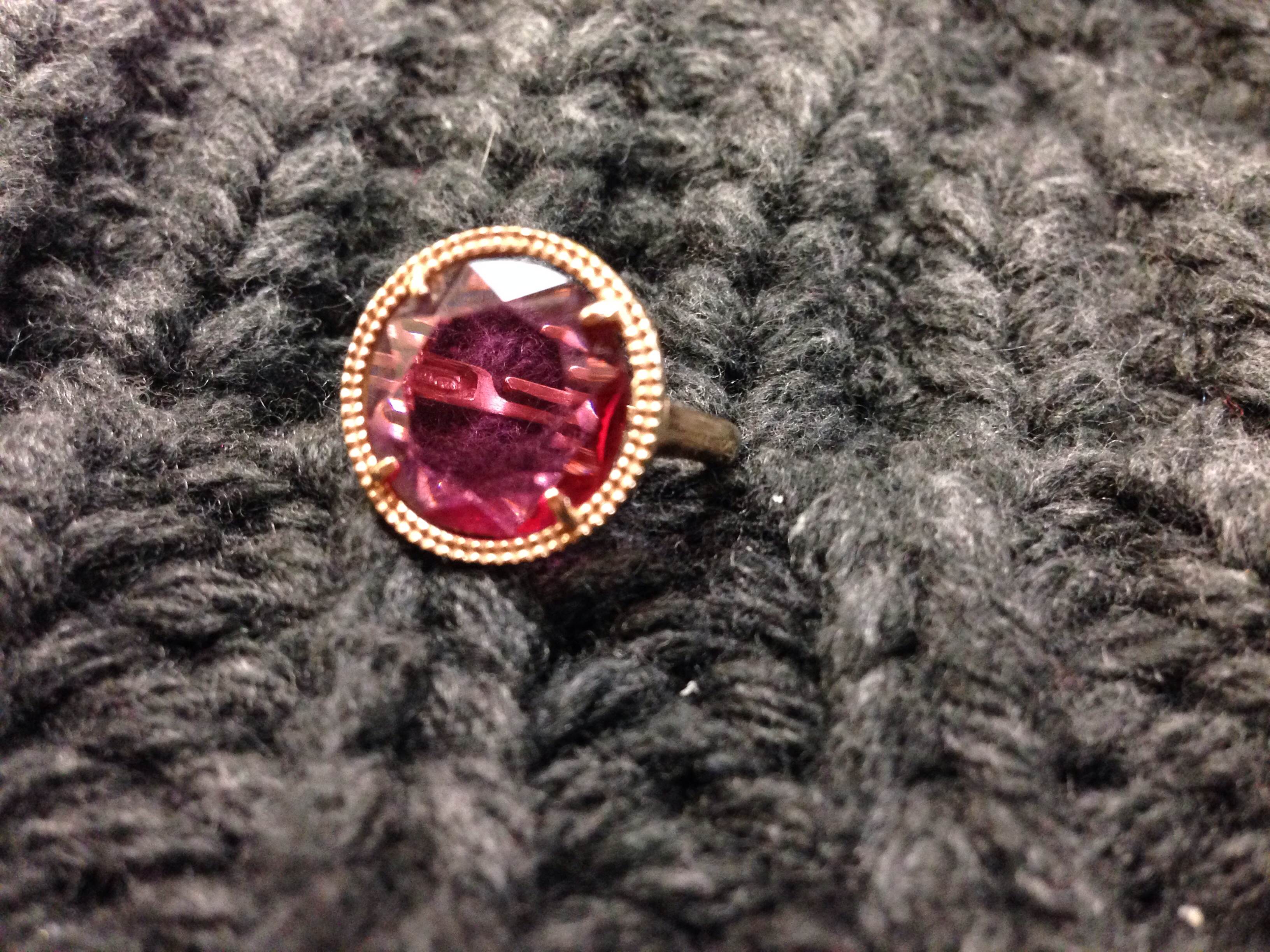
The object I chose that best represents my family history and me is a small ring. It is not an antique having been passed down to me through my family nor does it hold any real worth besides the forty euros I spent on it. But, the memories it holds for me are irreplaceable. I bought it over the summer in a jewelry store in San Marino. When I bought the gold ring with a magenta gem stoned colored focal piece, the adjustable band was sized to fit around my finger perfectly. The thin gold band connects to a gold circular perimeter that encompasses a magenta piece cut into a circle with triangular cuts on its surface. The gold circular perimeter is molded into two circles of tiny beads. The perimeter has four clasps that hold the circular focal piece keeping the ring in tact.

I bought the ring while on a trip last summer. It was a trip I had been waiting my whole life to make. My mother’s parents came to America in the 1950’s from San Marino. While members of my family have been able to make trips back to San Marino, I had never been fortunate enough to visit my grandparent’s homeland. Because I had never been to San Marino and experienced our culture for myself, I always felt this disconnect from my family and our culture.

However, San Marino has a sort of trip available to descendants who live abroad. The trip is sponsored by the government of San Marino making it free for me to make the trip I had been waiting for. So, in June I traveled to San Marino and spent four weeks soaking in the culture and beauty of my grandparent’s homeland. While in the main city center, I came across a few stores that carried Marlú jewelry. I felt as if this ring kept following me around San Marino and finally made the decision to purchase it my last week in San Marino. With the ring and my time in San Marino coming to an end, I could also feel the gap between my family and culture closing.

When I look at the ring, it brings me back to those four weeks. I think of the friends I made from Argentina and France who also participated in the trip. I think of Claudio trying to help me print my train tickets and his hotel where we stayed and ate most of our meals. I think of Sarah, Ava, and Arianna who I traveled to Florence and Venice with after getting no sleep and trying to navigate the European transit system. But, most importantly the ring makes me remember all of the beauty and happiness that San Marino provides in its people and architecture.