The Jean Hasbrouck House


Originally built in 1694 and later renovated around 1721, this massive stone house was an economic and social class distinction of its time. This house is distinctive because of its square form, central entrance, two room deep passage plan and flanking windows. Even with these unique features it still kept its dutch characteristics by keeping its interior exposed wood beams, jambless fireplaces and stone outer. Set currently upon one-acre of property, this 5 bedroom masterpiece also contains an attic and basement.

Creation

The Huguenots came to what we now know as New Paltz with nothing but hope and ambition to start their new lives. In 1677 they began developing New Paltz into what we know it as today (Home). The seven prominent families who are credited for developing New Paltz such as the Hasbrouck family purchased 40,000 acres from the Esopus Indians and began construction on their new life. At first they built simple wood houses but, due to the high status and wealth of these families, they quickly began construction on distinctive, more expensive Dutch style stone houses. Using more durable materials led to us being able to preserve their history and remind us that they created this town. Many of the structures and homes they created still stand today. “New Paltz is one of the most significant historic towns in New York State history and aspects of its early settlement history are of national significance” (Larson 1). Architecture and decorative arts are the two areas where Dutch culture can be seen surviving still today in the Hudson Valley.

Jean Hasbrouck intentionally created this double-wide Dutch house structure to show off his wealth in the new world. Although there is no permanent record of this due to not all historical houses being registered. It is believed that this is the only one of this kind still standing today in the United States. This house when created in 1694 set the tone for all other stone houses in this area. Although, none could compare to its size and magnificence. Later his son Jacob expanded this house. The house was used for more purposes than when it was created such as a store and also could house more family members. Today, it still stands on Huguenot street, reminding us of the significance of these brave families who came to develop the beloved town we call New Paltz today.

Physical Description

A Dutch style stone house was a tedious, time consuming process to construct. From building the basement foundation, adding the wood frames, plastering the interior, this process took months to begin to take shape. However, these houses were strong and sturdy, leaving the Hudson Valley containing some of the oldest architecture in the eastern United States. The typical seventeenth century stone house contained multiple entrances, a front façade and a steep gable roof. Although containing an attic and a basement, living was restricted to the main floor of usually no more than 3 rooms. However, Jacob expanded his home to five rooms. The houses were heated with jambless fireplaces. These fireplaces are a large hearth with no sides, venting into the chimney. (Larson 5). This is a distinctive feature of Dutch architecture. The Jean-Hasbrouck house is the only or one of the few with this structure still standing.

Dutch Stone House Significance

On top of being made of heavy materials and being a laborious process, stone houses were also costly and pretentious even those containing only one room. Stone became an emblem of wealth (Report 1.7). Stone houses were indicators of upper class status and the material gained value when this distinction of wealth and class became important in the community. Stone houses were only built wealthiest figures living in the area. The style of your house was said to show your social status. This material distinguished successful farmers and families from the everyday townspeople (Larson 4). The Jean Hasbrouck house stood above the traditional stone houses because of its size and amount of stone used to create its massive structure.

There are many similarities from the 17th century Dutch buildings discovered both in America and in Europe. Striving to make a presence in the New World community, the Dutch colonists built their iconic Dutch style houses here in America. The use of stone to build kept the Dutch homes distinct from the English and reminded the English that their Dutch culture was still prevalent even in the New World. These houses stood as a refusal to conform to English new world traditions. The Jean Hasbrouck House is one of the most impressive examples of Dutch Colonial stone architecture remaining in the United States.

Narrative

Jacob Hasbrouck renovated his father Jean’s house into a Dutch style house even more grand than the generic Dutch houses seen around the Hudson Valley. Generally plans for dutch houses were restricted to a three room maximum , one story house plans. Jacob’s house did not fall into these plans, it fell into the Large House category reserved for people generally of local importance. His five bedroom, one and a half floor home became an elite house in the neighborhood. This house stood at over twice the size than his neighbors. It is significant because the house was exceptionally large for its time and represented the Hasbrouck’s participation in the new world. While still keeping traditional Dutch culture, this design also showed his American presence. One feature that set this house apart from the other traditional houses was its roof structure and attic space. The roof frame was constructed with a complicated set of interlocking rafters, collars and braces neatly joined to create the structure and sizable attic space which was unusual for its time. Another reason the Jean-Hasbrouck house stood out amongst the other houses because of its symmetrical façades and center passage plan. It was one of the earliest accounts of this design of elite architecture in eastern America.

Provenance

Originally built in 1694 by Jean Hasbrouck as a small one-room living space, the building we see today was expanded around 1721 to serve as a store and a family house while also reminding the community of his status. While renovating Jacob still wished to keep some of the original characteristics of the 1694 design. You can still see the long oak beam in the southern part of the basement supporting the basement fireplace and a rafter on the west roof avoiding the chimney from the original 1694 house. Remainings of the original jambless fireplace and box bed can also be seen today.

The design we see today is that of his son Jacob Hasbrouck, Jean is said to have passed away before building plans were put in place. He expanded the house into its unusually large proportions. He was able to do this because his father passed all of his inheritance down to him making him unusually wealthy for his age (Larson 8). Jacob was an experienced farmer of only 34 years old. He increased the value of his father’s land through land allotments, his shop and various other ways of lending out his land. This large sum of money left to him led him to show this off through the design of this house.

Currently the sophisticated house that stands has seen no major construction since 1721. There has been work done to solely improve the conditions such as upgrading the windows and minor maintenance. In 1893 the vacant house was purchased by Historic Huguenot Street for $3,000 and the one acre of land it was set upon. 1952 interior work was done to keep it preserved. A light was added to display this historical house more. This home shows the Hasbrouck presence in society and Jacob’s large inheritance of wealth. Standing among the other buildings left, we can see its significance through its size and design even hundreds of years later.

Sources:

Crawford & Stearns. Historic Structure Report: The Jean Hasbrouck House. Architects and
Preservation Planners, 2004.

“Home.” Historic Huguenot Street, http://www.huguenotstreet.org/home.

Larson, Neil. “Building a Stone House in Ulster County, New York in 1751.” Vol. 2, 2014, pp. 1–16.

Larson, Niel. Furnishing Plan for the Jean [Jacob] Hasbrouck House. Neil Larson & Associates, 2004.


AirPods

It was summer, I just received my first paycheck of my new position as a summer teacher at a private preschool in Manhattan. Having a comma in my paycheck was not something I was used to so, my first instinct was to celebrate! I knew exactly what my first purchase would be, the second that paycheck landed in my exhausted hands from the 60 hour work weeks.  Although this object has become an internet meme, to me has been one of my most useful purchases. During the work week I saw countless numbers of wire free airpod users being able to effortlessly listen to music on their commutes. I wanted to join this unfashionable trend and be part of these users. This product was widely mocked for its slightly abnormal look of two q-tips stuck into your ears. But no, I did not buy q-tips to stick out of my ears but, a brand new pearly white pair of airpods fresh from the apple store right on 5th avenue walking home from another exhausting yet rewarding day.

AirPods and their convienent carrying/charger case

I think we all know that these apple products were not made right on 5th avenue. They are “designed in California” however are not made there. Generally their sleek “high class” are products are made all over various countries. Mongolia, China, Korea and Taiwan are their main producers. There are a lot of controversial debates about those who manufacture apple products not getting paid adequately. Apple does claim they are (shocker) and that they are providing thousands of jobs both here and internationally. These headphones were designed in california, then created abroad, shipped back here and sent out to be sold all over. They have probably traveled the world more than I have before hitting the shelves. After reading this information my brand new product feels less important and more mass produced. Apple has a way to advertise their products and make them extremely desirable no matter the cost. However, I believe this was worth the purchase for this palm sized technology filled pair of headphones.

The first time I nervously put these small and sleek objects in my ears I thought they would never last due to their size. Following their previous iconic Apple headphone look, they are smooth and pearly yet without the always tangled wires dangling from the earpieces.  This is a new form of technology and by far one of my favorites mainly because of their convenience. These tiny headphones and their palm sized plastic case have become a part of my everyday look. From their 24 hour battery life to the access to siri without even touching your phone, these are just some of the many surprising features of such a small yet technologically advanced product. Its slick features make it seem very futuristic. The pure white smoothness make me clean them with every drop of dirt. With a case designed to store them, it is difficult to lose and convenient to carry. The small  case rarely needs a charge making it a permanent object in my coat pocket. I never have to go without headphones

The Internet is not the biggest fan

Denounced for being over priced however, has been one of my best investments. I can definitely say in the few months I have owned them they have gotten more use than any other pair I have owned before. No more getting tangled up in so many of my daily activities. Lifting at the gym I can finally place my phone down and don’t have to detangle myself in wires and pocketless leggings to find a place to store my phone. Walking around and being able to not have wires getting caught in my jacket or pulled everytime I turn. Music is a very important part of my life and these headphones have given me access to this in any situation. Overall, they are great product even at the cost.

Nunley’s Carousel

After writing my blog post on the brass ring from the carousel I decided I wanted to get more into detail about where this carousel has been and how much it has traveled. While I was home this weekend I decided to go to Nunley’s Carousel and ask my boss about the details behind the ring machine and carousel which have always traveled together.

The ring machine, the rings and its accompanying carousel were created by the Artistic Carrousel Company in Brooklyn, New York under the ownership of Stein and Goldstein, German immigrants in 1912. The ring machine and carousel first saw operation in Golden City Park in Canarsie, Brooklyn.

Following a devastating fire in 1912 to the center of the park. The carousel building was built in the center of the park next to the roller coaster where the fire had destroyed the previous rides. This carousel was in continual operation until 1939. At that point Robert Moses devised an extensive plans of roads and parks, one of which, the belt parkway was designed to run right through Golden City Park. The park closed in 1939 for the construction of the Belt Parkway.

Nunley’s Carousel when located in Baldwin, NY

William Nunley brought his beloved carousel east to Long Island. He traveled down sunrise highway looking for a new home to start a small amusement park. He settled on a strip of land in Baldwin, opposite the Long Island Rail Road. There he opened a park, he erected a building he dismantled and took from golden city park that housed a different carousel. This carousel he brought to the 1939 World’s Fair in NYC. He placed the 1912 carousel in this building and opened it to the public. The carousel became the centerpiece of a new park called Nunley’s Amusements. The park eventually changed hands and was run by three brothers known as the Larcari brothers. The brothers ran Nunley’s Amusements including the carousel which became known astorages “Nunley’s Carousel. In 1995 the brothers retired and put the carousel and other amusement rides on the auction block. Public outcry over the thought of the carousel being sold in piecemeal caused nassau county to condemn the carousel for the “greater good of the people.” This was a landmark decision since an amusement drive has never been condemned for this purpose.

Rings still used today

The carousel was dismantled and stored in a hanger adjacent to the Cradle of Aviation Museum. It remained in storage in 2008 when Nassau County agreed to build a new building for the carousel and have it restored on Museum Row 100 feet from the storage facility. This restoration project was fueled by grassroots fundraising effort by a second grade student called “Pennies for Ponies.” In 2008 the dismantled carousel was loaded onto trucks for its journey to Mansfield, Ohio to Carousel Works, the only carousel restoration facility in America. Located directly behind the Mansfield State Penitentiary featured in the movie “Shawshank Redemption.”

Same Ring Machine since 1912

In 2009 the fully restored Carousel and ring machine returned to Long Island for its grand opening in May 2009. For the past 10 years rings such as mine have been loaded daily into the ring machine to the delight of tens of thousands of visitors. This 107 year old masterpiece continues to turn. Today, visitors still continue to grab the rings in hopes that they grab the coveted brass ring for a free carousel ride as visitors have done for the past century.

These Gloves Were Made for Boxing

I have always been interested in fitness and finding new ways to stay in shape. One of the more recent workout trends I have picked up in boxing. This has been by far my favorite one to be a part of. Although more difficult to pursue now that I am away at college, I still will shadow box or spar at any time I can. I have always been interested in watching movies and fights on boxing. From Muhammad Ali to Joe Frazier and George Foreman fighting till what looked like death in the ring. I was glued to the screen watching these gruesome yet legendary contests of endurance, persistence and character.

My first pair of gloves

These gloves have definitely seen their wear and tear, taking part in hundreds of workouts. They have helped me become stronger both physically and mentally. They serve as a protection for my hands while also adding some weight to supplement a workout. I have used them to help others become passionate about this sport while also feeling the benefits. This stress relieving, confidence boosting activity is something I could not do without my gloves.

My gloves have sat on my dresser since I have picked up this hobby. Their may purpose may be to fight however, I keep them out as a reminder. The ones I have out are my first pair and definitely not my last. I remember the first day I used these gloves and how powerful I felt after the workout. I remember breaking in the leather slowly till these gloves became made for my hands. Most gloves are made the same size and weight when used for workout purposes. So, when I broke them in to fit my hands it felt more personalized. They may all look similar but, it was important to me to have my own pair.  The ones made for sparring and fighting vary slightly.

I have always used Title boxing wraps and gloves since that is the gym I started at. However, I never knew the history behind this until now. The brand and gym locations itself were developed only in 2008 in Colorado and has spread to all over the world since. I don’t believe the brand has as much as a meaning as the history behind boxing and the purpose of using gloves.

Boxing gloves have always served the same purpose since they were created. These gloves main purpose are for hand protection for fighting. They have been dated back all the way to 650BC. However since the mid 1800s, the style has not changed much. Although my more modern ones contain velcro unlike the classic models you lace up. You still get the same satisfaction and leathery smell with every wear. The models have varied and developed based on practicality and rules and regulations of fighting. The purpose of protection and as a weapon has remained the same.

Earliest representation of boxing gloves

My 12 oz classic black and white Title boxing gloves are a great addition to my dresser. They serve as a reminder of my strength and reminder to keep fighting. What I have always noticed about the fighters I have looked up to in and out of the ring is that they always get back up and keep fighting. We all have fights in our own lives and we must keep punching through.

Grabbing the Brass Ring

The object I have chosen to focus on is a simple Brass Ring from the ring machine on Nunley’s Carousel.

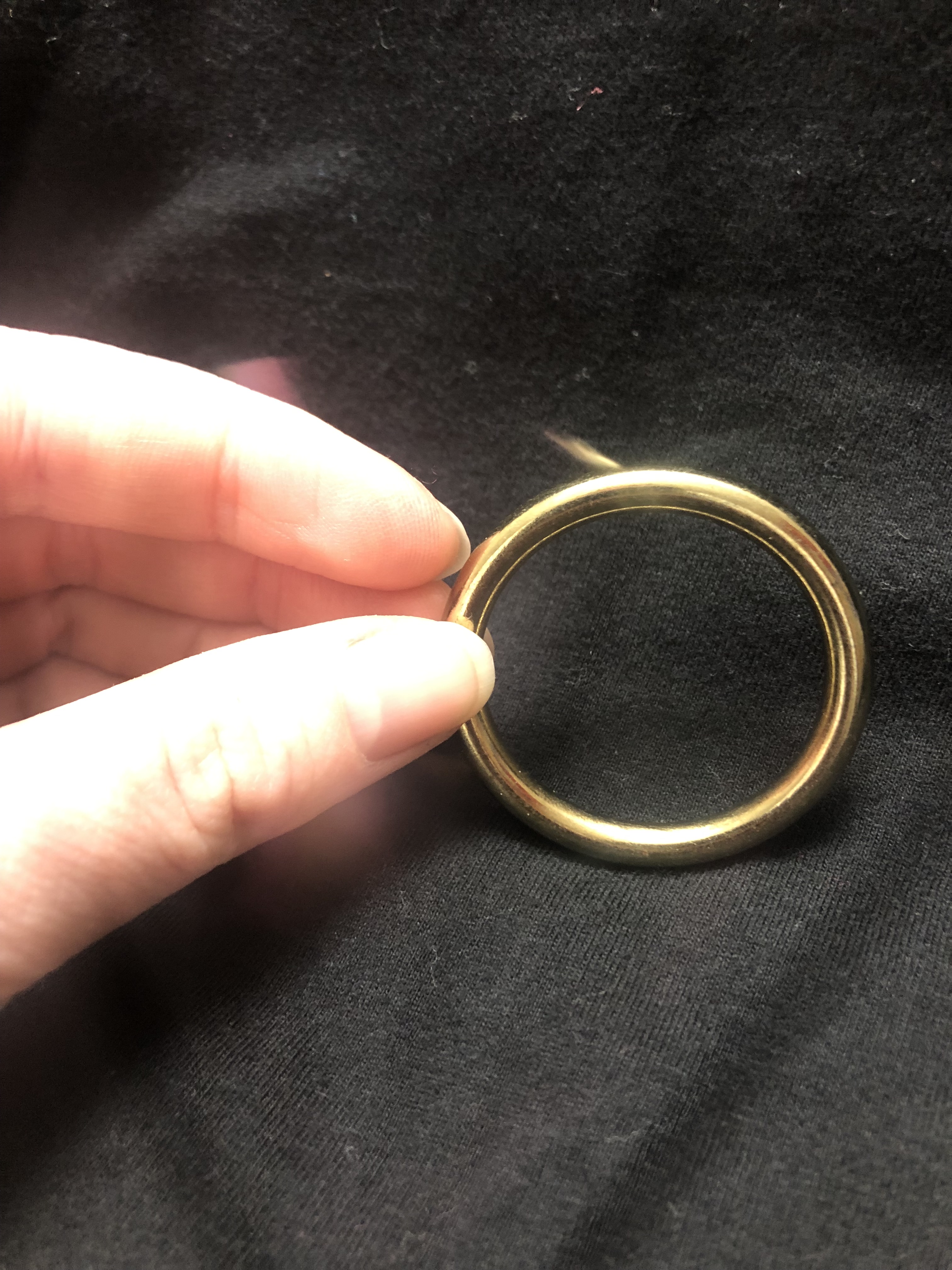
This is the ring. Approximately 1 in. in diameter

This is a simple object measuring one inch in diameter. It is about the same size as the circle your hand makes when giving an okay sign.  There is not much description I can give to this simple brass colored ring. It’s slightly heavier than it looks and is worth more than it seems for being so small in size. There’s a slight black line where this has been molded together to form a perfect circle. There are only 19 carousels left in the world who use ring machines, making this even more of a rarity to have in my possession.

Why did I choose an object so round and simple? It is because to me, it is the exact opposite. Every object has its own story to tell. The only thing that can stand out beyond the shimmering brass is the dirt and scuffs on it from being well used by those who have been lucky enough to “grab the brass ring.” These blemishes are hidden behind countless memories. There is only a 1 in 25 chance of grabbing this ring every ride making it a challenge to win the free ride that the brass ring comes with. Although made of brass, giving this object some value, it is generally returned in exchange for the satisfying free ride.

The phrase “grabbing the brass ring” usually refers to a success in life. When I have seen those lucky enough to grab one on the carousel to them, this moment is just that. I can guarantee every single person who has rode the carousel will remember the time they grabbed this brass ring. The shiny brass taken from the right angles by my simple iphone camera showed its beauty. With each click of the camera I remembered the hundreds of photos of smiling people holding this exact ring.   

I spent 5 years raising money to restore the historic Nunley’s Carousel. I raised $91,000 in second grade to bring back this carousel. Now, I have worked there for over 6 years and see the value this carousel holds generation after generation. I used to wear the ring around my neck during this project. I have always felt connected to this ring. This assignment has reminded me of how important this carousel is to me. Although it is nuisance to load the ring machine every ride, the happiness I realize it brings are absolutely worth it.

Every single person that rode the over 100 year old carousel has had a story to tell about the time they got the brass ring or at least attempted to. The circle ring represents the full circle the carousel made by being restored and brought back to life. When I hold the ring I picture all the events that led us to finally being restored and brought back close to its original location. Every single day grandparents bring their children and their children’s children to ride the same horses they have been riding for generations. I have watched countless number of kids finally grow up and are able to reach the brass ring.

Me wearing the brass ring as a necklace.

Here is more information on the Carousel https://en.wikipedia.org/wiki/Nunley%27sAlso on the history of ring machines and the importance of the brass ring: https://henssgenhardware.com/history-of-brass-rings/

The KonMari Method: Shirts

I started with T-shirts because Marie Kondo explained the best order was the clothes first then books, papers, komono and mementos. I felt this was my simplest form of clothing and the easiest to part with since the amount I know I have is excessive.

How many shirts stuffed in a small dresser drawer? 37

Before

First, I took all the shirts out. I was shocked about the 37 shirts that could fit in on dresser drawer. This felt like the commercial for Olive Garden’s never ending pasta. They just kept on coming.

Now that I had a mountain of only shirts on my bed I was not looking forward to refolding. This was discouraging because it was a mountain in front of me I was not ready to conquer. I decided that I would place the ones I was unsure of disposing and bring them back to my home before completely parting with them. I would keep the ones I saw valuable and toss those that served absolutely no purpose.

After taking them all out

The first one I picked up was one I wore once a week, this one was simple. It made me happy and was essential to my wardrobe. I’ll keep this one. Next, I don’t remember the last time i wore but, I really liked this Jimmy Buffet concert t-shirt I won 5 years ago yet have not worn since. I put this one to the side for later. This was an easy discard. I had no use for my ex-boyfriend from high school’s Berklee College shirt. That one was a satisfying toss in the trash. I unfortunately do not need 3 of the same exact black v necks. Some shirts had to stay because they serve a purpose such as work or for my fraternity. These can’t be thrown out because they’re necessary whether i like them or not.

After doing this process 35 more times I began to be able to more easily distinguish between what was worth keeping and what was not worth the space. I got rid of those with holes in the armpit that I told myself I would fix, that didn’t fit and those that shouldn’t have been ever allowed to be in fashion. Even knowing that they served no purpose being stored in the bottom of a drawer the thought of getting rid of them still made me feel like I would miss them.

I kept what has made me happy, what I feel confident wearing (and a few with sentimental value). Surprisingly this was easy to differentiate but, difficult to make the step of not putting it back in the drawer. Some brought back memories and I loved wearing. Others I use to workout with often. With every shirt I picked up, I kept reminding myself “if it doesn’t bring you joy, let it go.”

I completely agree when my house is in order, i definitely feel more efficient and organized. I never thought there was a “right order”, I always went by whatever looked “neat.”  This new process is one I would like to start on my own room to keep things consistently organized. 21 shirts is a lot more manageable, and somewhere to start from. Although a stressful process, I feel more at ease when everything is in order.

After Organizing